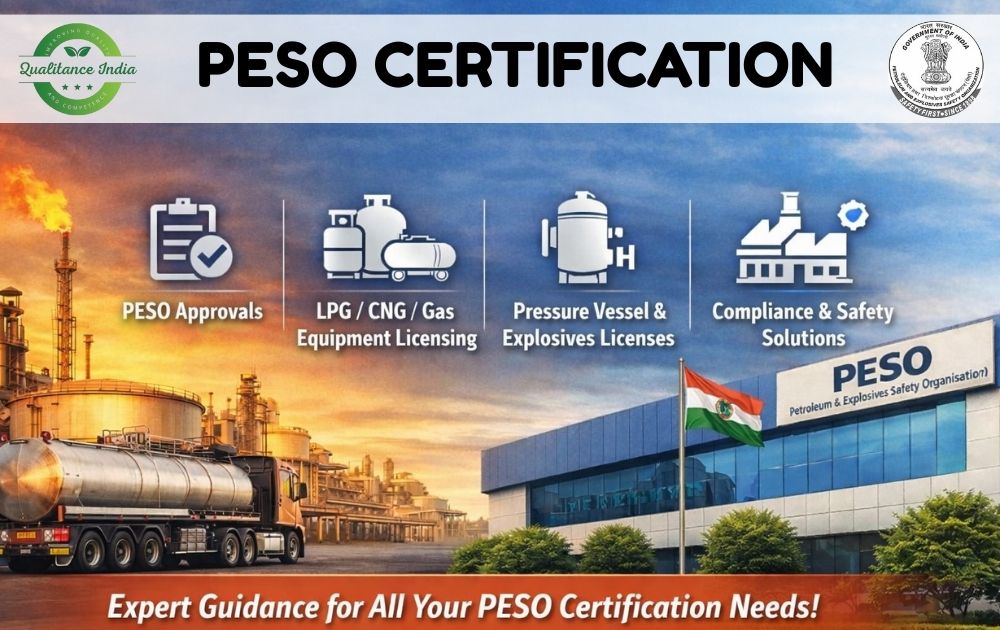
PESO Certification Consultant agency in India

PESO Certification in India (Petroleum & Explosives Safety Organisation)

Introduction

The Petroleum and Explosives Safety Organisation (PESO) has been safeguarding India against hazards associated with petroleum, explosives, and compressed gases since the era of British India. Established in the 1890s as the Department of Explosives, PESO’s primary objective has always been to regulate and enforce safety standards for hazardous substances.

Petroleum products and compressed gases are inherently dangerous—flammable, toxic, oxidizing, or corrosive in nature. Even a minor spark can trigger catastrophic accidents. Recognizing these risks, PESO has evolved into India’s premier authority for regulating the manufacture, storage, transportation, handling, import, and usage of hazardous materials.

With over a century of expertise, PESO has earned a reputation for excellence in safety regulation across industries dealing with:

  • Explosives
  • Petroleum & Petroleum Products
  • Compressed Gases
  • Pressure Vessels
  • Gas Cylinders
  • Cross-country Pipelines
  • LNG, CNG, Auto LPG, CBG
  • Ammonium Nitrate
  • Flameproof Electrical Equipment

What is PESO Certification?

PESO Certification is a mandatory regulatory approval issued by the Petroleum and Explosives Safety Organisation, also known as the Chief Controller of Explosives (CCOE).

PESO regulates and enforces safety requirements for:

  • Manufacturers
  • Importers
  • Exporters
  • Storage facilities
  • Transporters
  • Sellers and handlers

of explosives, flammable materials, petroleum products, pressure vessels, and compressed gases. PESO is also responsible for regulating petrol pumps and gas installations across India.

PESO operates as an independent regulatory body under the Department for Promotion of Industry and Internal Trade (DPIIT), Ministry of Commerce and Industry, Government of India.

Its headquarters is located in Nagpur, Maharashtra.

PESO certification is mandatory for products and installations used in hazardous and explosive environments, especially within the oil & gas, chemical, and energy sectors.

Mandatory Licensees / Stakeholders Under PESO

PESO certification or licensing is mandatory for entities engaged in:

  • Petroleum products & gas cylinders
  • SMPV (U) – Static and Mobile Pressure Vessels (Unfired)
  • Explosives & Ammonium Nitrate
  • Degassing & purging operations under SMPV (U)
  • Fabrication shops for pressure vessels
  • Gas cylinder testing stations
Static & Mobile Pressure Vessels (Unfired) Rules, 1981

Key provisions under the SMPV (U) Rules, 1981 include:

  • Approval of Design & Drawings:

    All designs, specifications, codes, and drawings must be approved by the Chief Controller of Explosives.

  • No Objection Certificate (NOC):

    Under Rule 47(7), the District Authority must issue or refuse an NOC (with reasons) within 2 months.

  • Manufacture, Filling & Import Restrictions:
    • No pressure vessel may be manufactured without prior approval of the Chief Controller
    • No vessel may be filled or transported unless manufactured as per approved standards
    • Import of vessels requires prior PESO approval
  • Delivery & Dispatch Restrictions:
    • Compressed gas can be delivered only to licensed storage holders
    • Quantity delivered must not exceed licensed storage limits
  • Safety Provisions:
    • Employment of persons below 18 years or intoxicated individuals is prohibited
    • Smoking, flames, and open lights are strictly prohibited near gas storage
    • Only trained and competent personnel may operate equipment
  • Modification & Inspection:

    Any modification to pressure vessels or machinery must be reported and inspected by PESO.

Recognition of Competent Persons Under SMPV (U) Rules

PESO grants recognition to Competent Persons under:

  • Rule 18: Testing of Safety Relief Valves
  • Rule 19: Periodic testing of pressure vessels
  • Rule 33: Issue of Safety Certificates for pressure vessel installations

Recognition Process

Stage A – Application (Appendix IIIA)
  • Qualification certificates
  • Passport-size photographs
  • Specimen signature
  • Scrutiny fee
Stage B – Evaluation (Appendix IIIB)
  • Degree in Chemical / Mechanical / Marine / Metallurgical Engineering (or equivalent experience)
  • Inspection of pressure vessels

Eligible candidates appear before the PESO Interview Board, which meets quarterly (January, April, July, October).

Final recognition is granted by the Chief Controller of Explosives based on the Board’s recommendations.

Process of PESO Certification

  1. Documentation Preparation
    • Technical documents, ATEX / IECEx certificates
    • Test reports (not older than 2 years)
  2. Application Submission
    • Submission to PESO along with commercial details (sales data, client list, etc.)
  3. Scrutiny by PESO
    • Verification of documents and compliance
  4. Factory Audit (if applicable)
    • Mandatory for certain products like pressure vessels
  5. Grant of PESO Certification
    • Certificate issued upon satisfactory compliance
  6. License to Authorized Indian Representative (AIR)
    • Mandatory for foreign manufacturers

Note: Products can be imported only after PESO approval. IECEx or ATEX reports are generally accepted. If unavailable, testing must be conducted in India.

Documents Required for PESO Certification

  • Application form and agreement with Authorized Indian Representative (AIR) (minimum 5 years)
  • Business licenses of manufacturer, plant, and AIR
  • Global organization chart
  • ATEX / IECEx certificates
  • Test reports, QAR / QAN
  • Manufacturer profile
  • List of production equipment & testing instruments
  • ISO certificates
  • Production facility video
  • Commercial data (last 3 years sales, Indian customers, installation details)

Timeline & Validity

  • Processing Timeline: 90–100 days
  • Validity of PESO License: 3 years
  • Renewal: Mandatory after expiry

How Qualitance India Can Help

Qualitance India provides complete end-to-end consultancy for PESO Certification, including:

  • Applicability analysis
  • Technical documentation & compliance mapping
  • Coordination with ATEX / IECEx testing agencies
  • PESO application filing & follow-ups
  • Factory audit preparation
  • AIR appointment support
  • Renewal & post-approval compliance

Conclusion

PESO Certification is mandatory for industries dealing with hazardous materials, pressure vessels, and explosive environments. Non-compliance can lead to severe penalties, operational shutdowns, and safety risks.

With Qualitance India as your compliance partner, you gain expert guidance, faster approvals, and complete regulatory assurance—allowing you to operate safely and confidently in India’s regulated industrial landscape.

Get Expert Assistance Today

Email: info@qualitanceindia.com

Serving PAN-India & Global Clients

    Get Your Free Consultation


    Talk to us?