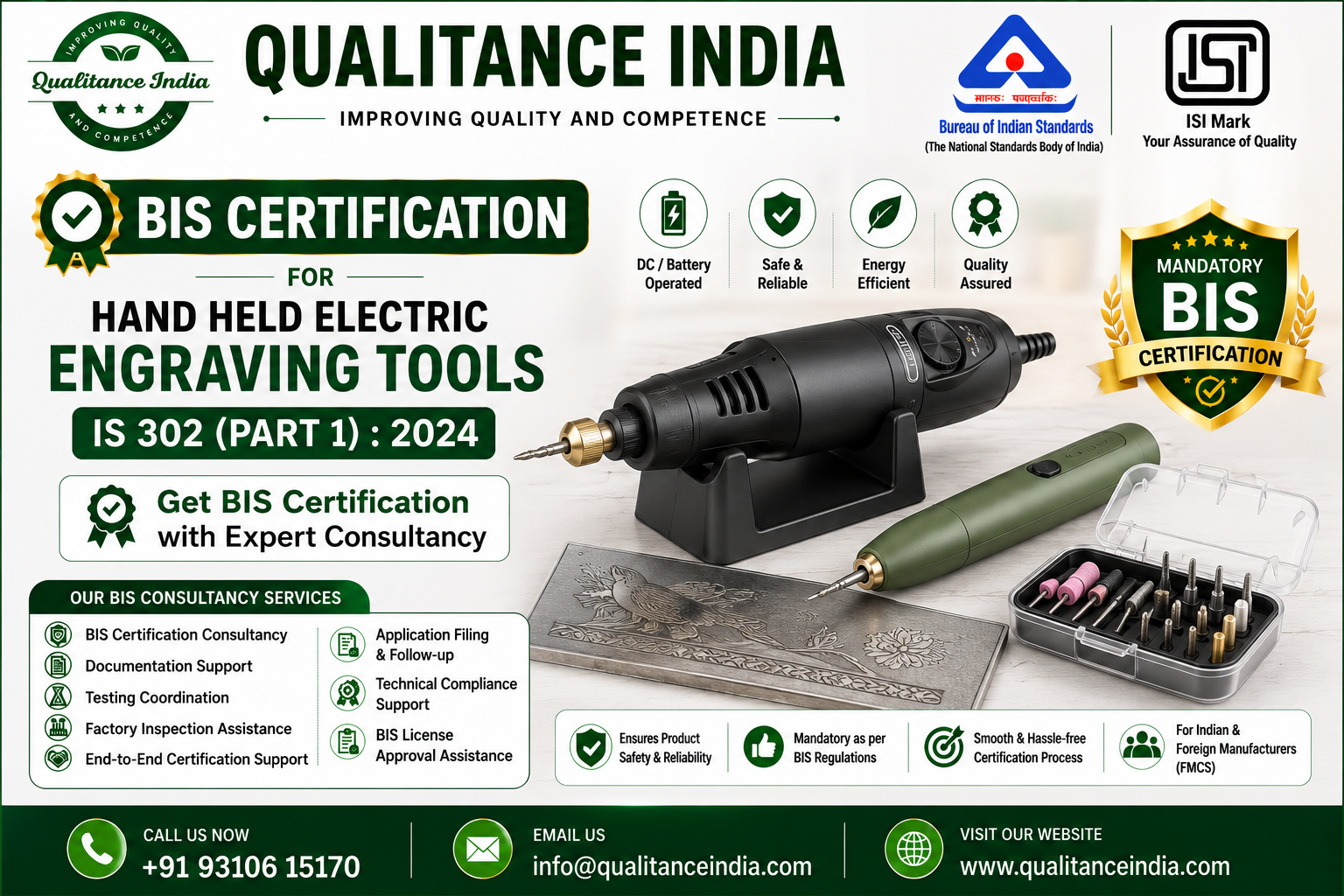
BIS Certification Consultancy for Hand Held Electric Engraving Tools | IS 302 (Part 1):2024 | Enforcement Date 01 October 2026
Introduction
The Indian market for Hand Held Electric Engraving Tools is expanding rapidly across industrial manufacturing, jewelry making, woodworking, metal fabrication, DIY projects, and precision marking applications. These electrically operated tools must meet stringent safety requirements before being placed on the Indian market where mandatory BIS compliance applies.
To enhance electrical safety and consumer protection, the Government of India has introduced mandatory compliance for specified household and similar electrical appliances under applicable Quality Control Orders (QCOs). Hand Held Electric Engraving Tools covered under these regulations must comply with IS 302 (Part 1):2024, which is harmonized with IEC 60335-1:2020. The enforcement date is 01 October 2026, making it essential for manufacturers and importers to complete the certification process in advance.
BIS Certification confirms that the product satisfies applicable safety requirements related to electrical protection, insulation, temperature rise, mechanical strength, construction, marking, and overall product reliability. Manufacturers who obtain the BIS licence are permitted to use the ISI Mark in accordance with BIS requirements, helping demonstrate compliance and build customer confidence.
Whether you are an Indian manufacturer, foreign manufacturer, OEM supplier, importer, or private-label brand, obtaining BIS Certification on time helps avoid regulatory delays and supports uninterrupted market access. Qualitance India provides end-to-end BIS Certification consultancy, including applicability assessment, technical documentation, product testing coordination, application filing, factory inspection assistance, and post-certification support.
About Hand Held Electric Engraving Tools
Hand Held Electric Engraving Tools are compact electrically powered devices used to engrave, carve, etch, mark, and personalize a wide variety of materials, including metal, wood, glass, plastic, ceramic, leather, and stone. They are widely used by artisans, manufacturers, jewelers, hobbyists, and industrial professionals for precision engraving and detailed surface marking.
Modern engraving tools may be corded, rechargeable, or battery-operated and are designed for accurate control, variable speed operation, and user safety. Because these products incorporate electrical components and are intended for regular use, compliance with recognized safety standards is important to minimize electrical hazards and ensure reliable performance.
What is BIS Certification?
BIS Certification is a conformity assessment system administered by the Bureau of Indian Standards (BIS) to verify that products meet the applicable Indian Standards for safety, quality, and performance.
For Hand Held Electric Engraving Tools, compliance with IS 302 (Part 1):2024 demonstrates that the product has been evaluated against prescribed electrical safety requirements. Where certification is mandatory under the applicable Quality Control Order, manufacturers and importers must obtain the BIS licence before marketing the product in India.
Scope of IS 302 (Part 1):2024 (IEC 60335-1:2020)
IS 302 (Part 1):2024 specifies the general safety requirements for household and similar electrical appliances. It addresses potential hazards arising during normal operation and foreseeable misuse, including protection against electric shock, overheating, fire, mechanical risks, and insulation failure.
The standard typically covers areas such as:
- Electrical Safety
- Mechanical Safety
- Temperature Rise
- Insulation Requirements
- Leakage Current
- Dielectric Strength
- Moisture Resistance
- Construction Requirements
- Stability
- Marking & Labelling
- User Instructions
- Durability and Endurance
Products Covered
Examples of products that may fall within this category (subject to the applicable scope and QCO) include:
- Hand Held Electric Engraving Tools
- Electric Engraving Pens
- Battery-Operated Engraving Tools
- Rechargeable Engraving Pens
- Cordless Engraving Machines
- Mini Electric Engravers
- Portable Engraving Devices
- Rotary Engraving Tools
- Electric Etching Tools
- Precision Engraving Machines
- Personalization Engraving Tools
- DIY Electric Engraving Kits
Enforcement Date
According to the applicable Quality Control Order, the Enforcement Date is 01 October 2026.
Manufacturers, importers, brand owners, and foreign manufacturers should initiate the BIS Certification process well in advance to allow sufficient time for documentation, testing, application review, and any required factory assessment.
Applicable Quality Control Order (QCO)
If Hand Held Electric Engraving Tools are covered under the notified QCO, compliance with IS 302 (Part 1):2024 / IEC 60335-1:2020 and the applicable BIS Certification scheme is mandatory before manufacture, import, or sale in India.
Manufacturers should always verify the latest BIS notifications and QCO amendments to confirm the current regulatory status of their products.
Who Needs BIS Certification?
BIS Certification is required for manufacturers and businesses involved in producing, importing, or selling Hand Held Electric Engraving Tools in India when the product falls under the applicable Quality Control Order (QCO) and relevant Indian Standard.
The following entities generally require BIS Certification:
- Indian Manufacturers
- Foreign Manufacturers (FMCS)
- Importers
- Brand Owners
- OEM Manufacturers
- Private Label Manufacturers
- Contract Manufacturers
- Export-Oriented Manufacturers Supplying India
- E-commerce Sellers (where applicable)
Obtaining BIS Certification before the enforcement date helps ensure uninterrupted market access and regulatory compliance.
Eligibility Criteria
To apply for BIS Certification, applicants should generally meet the following requirements:
Indian Manufacturers
- Valid manufacturing facility
- Quality Control System
- Manufacturing Equipment
- Product Testing Facility (where applicable)
- Qualified Technical Personnel
- Complete Product Documentation
Foreign Manufacturers
Foreign manufacturers can obtain BIS Certification under the Foreign Manufacturers Certification Scheme (FMCS).
Requirements generally include:
- Manufacturing Facility Outside India
- Authorized Indian Representative (AIR)
- Factory Quality Management System
- Product Testing
- BIS Factory Inspection
- Complete Technical Documentation
Complete BIS Certification Process
Obtaining BIS Certification for Hand Held Electric Engraving Tools involves multiple regulatory and technical stages.
Step 1 – Product Applicability Assessment
Experts evaluate whether the product falls under the applicable Quality Control Order (QCO), identify the relevant Indian Standard, and determine the appropriate BIS certification scheme.
Step 2 – Documentation Preparation
Prepare all required technical and legal documents, including manufacturing details, quality control records, product specifications, and supporting declarations.
Step 3 – Product Testing
Representative product samples are tested at a BIS-recognized laboratory to verify compliance with IS 302 (Part 1):2024 and applicable safety requirements.
Step 4 – BIS Application Submission
The completed application, along with all required documents and test reports, is submitted to the Bureau of Indian Standards through the applicable certification process.
Step 5 – Factory Inspection (Where Applicable)
BIS officials may inspect the manufacturing facility to verify:
- Production Process
- Manufacturing Infrastructure
- Quality Control Procedures
- Testing Equipment
- Calibration Records
- Product Traceability
- Inspection Procedures
- Compliance with BIS Requirements
Step 6 – Technical Evaluation
BIS reviews:
- Test Reports
- Factory Inspection Findings
- Product Specifications
- Quality Control System
- Technical Documents
- Compliance with Applicable Indian Standards
Step 7 – Grant of BIS Licence
After successful evaluation and compliance verification, BIS grants the licence, allowing the manufacturer to use the ISI Mark on compliant products in accordance with BIS guidelines.
Required Documents
Although documentation requirements may vary, the following are commonly required:
Company Documents
- Certificate of Incorporation
- GST Registration
- PAN Card
- Factory Licence
- MSME Certificate (if applicable)
- Import Export Code (IEC), where applicable
Technical Documents
- Product Specifications
- Product Catalogue
- User Manual
- Product Drawings
- Circuit Diagram
- Bill of Materials (BOM)
- Component Details
- Product Labels
- Marking Details
Manufacturing Documents
- Manufacturing Process Flow Chart
- List of Machinery
- Production Capacity
- Quality Control Plan
- Calibration Certificates
- Internal Test Reports
- Inspection Records
Quality Documents
- Quality Manual
- Standard Operating Procedures (SOPs)
- Incoming Material Inspection Records
- Final Product Inspection Reports
- Batch Traceability Records
- Corrective Action Procedures
Additional Documents
- Authorization Letter
- Trademark Authorization (if applicable)
- Brand Owner Agreement
- Authorized Indian Representative (AIR) documents for foreign manufacturers
Product Testing Requirements
Testing plays a critical role in the BIS Certification process. Samples are evaluated at BIS-recognized laboratories to ensure compliance with IS 302 (Part 1):2024.
Typical evaluations may include:
- Protection Against Electric Shock
- Leakage Current Test
- Dielectric Strength Test
- Temperature Rise Test
- Mechanical Strength Test
- Stability Test
- Moisture Resistance Test
- Insulation Resistance Test
- Endurance Test
- Abnormal Operation Test
- Component Safety Verification
- Construction Examination
- Marking and Label Verification
Additional tests may apply depending on the product’s design and intended use.
Factory Inspection Process
For certification schemes requiring factory assessment, BIS officers evaluate the manufacturing facility to confirm that consistent product quality can be maintained.
The inspection typically includes:
- Manufacturing Infrastructure Review
- Production Line Verification
- Raw Material Inspection
- In-Process Quality Control
- Finished Product Inspection
- Testing Equipment Verification
- Calibration Status
- Laboratory Facilities
- Employee Competency
- Product Identification & Traceability
- Record Maintenance
- Corrective and Preventive Action System (CAPA)
Any non-conformities identified during the inspection may need to be resolved before certification can proceed.
Common Reasons for Application Rejection
Many applications are delayed or rejected due to avoidable issues such as:
- Incomplete Documentation
- Incorrect Indian Standard Selection
- Product Test Failure
- Improper Product Marking
- Inconsistent Manufacturing Process
- Missing Calibration Records
- Poor Quality Control System
- Incorrect Application Details
- Non-Compliant Factory Infrastructure
- Failure to Address BIS Queries
- Inadequate Technical Documentation
- Product Design Non-Compliance
Working with experienced BIS consultants can significantly reduce these risks.
Cost Factors
The total cost of BIS Certification depends on several factors, including:
- Product Category
- Applicable Certification Scheme
- Laboratory Testing Charges
- Number of Product Variants
- Factory Inspection Requirements
- Documentation Complexity
- Consultant Fees
- Government Fees
- Travel Expenses (if applicable)
- Foreign Manufacturer Requirements
For an accurate estimate, a product-specific assessment is recommended.
Estimated Timeline
The certification timeline may vary based on documentation readiness, testing schedules, factory inspection requirements, and BIS processing.
A typical project may include:
- Documentation Preparation
- Product Testing
- BIS Application Review
- Factory Inspection (if applicable)
- Query Resolution
- Licence Approval
Starting the process well before the 01 October 2026 enforcement date helps minimize delays and supports timely compliance.
Benefits of BIS Certification
Obtaining BIS Certification offers several advantages:
- Compliance with Indian Regulations
- Enhanced Product Safety
- Authorization to Use the ISI Mark
- Increased Customer Confidence
- Improved Brand Reputation
- Easier Market Access Across India
- Reduced Risk of Regulatory Action
- Competitive Business Advantage
- Better Acceptance in Government and Institutional Procurement
- Demonstrated Commitment to Quality and Safety
Why Choose Qualitance India?
Qualitance India provides comprehensive BIS Certification consultancy services for manufacturers, importers, and foreign businesses.
Our Services Include
- Product Applicability Assessment
- BIS Documentation Support
- Technical Compliance Guidance
- Product Testing Coordination
- BIS Application Filing
- Factory Inspection Assistance
- Query Resolution Support
- BIS Licence Approval Assistance
- Post-Certification Compliance Support
- FMCS Support for Foreign Manufacturers
Why Clients Trust Us
- Experienced BIS Compliance Professionals
- End-to-End Project Management
- Transparent Process
- Timely Updates
- PAN India Support
- Dedicated Client Assistance
- Support for Indian and International Manufacturers
- Focus on Efficient and Compliant Certification
Step-by-Step BIS Certification Flow Chart (Text Format)
Start
   │
   ▼
Check Product Applicability under QCO
   │
   ▼
Identify Applicable Indian Standard
(IS 302 (Part 1):2024)
   │
   ▼
Prepare Technical Documentation
   │
   ▼
Product Testing at BIS Recognized Laboratory
   │
   ▼
Submit BIS Application
   │
   ▼
Document Verification
   │
   ▼
Factory Inspection (Where Applicable)
   │
   ▼
BIS Technical Evaluation
   │
   ▼
Resolve Queries (If Any)
   │
   ▼
Grant of BIS Licence
   │
   ▼
Apply ISI Mark on Product
   │
   ▼
Maintain Ongoing Compliance
30 SEO FAQs
1. What is BIS Certification for Hand Held Electric Engraving Tools?
BIS Certification verifies that Hand Held Electric Engraving Tools comply with the applicable Indian safety standard IS 302 (Part 1):2024 before being manufactured, imported, or sold in India where mandatory requirements apply.
2. Is BIS Certification mandatory for Hand Held Electric Engraving Tools?
If the product falls under the applicable Quality Control Order (QCO), BIS Certification becomes mandatory before sale or import in India.
3. Which Indian Standard applies?
The applicable standard is:
IS 302 (Part 1):2024
(Aligned with IEC 60335-1:2020)
4. What is the enforcement date?
The enforcement date is:
01 October 2026
5. Who needs BIS Certification?
- Indian Manufacturers
- Foreign Manufacturers
- Importers
- Brand Owners
- OEM Manufacturers
6. Can foreign manufacturers apply?
Yes. Foreign manufacturers can apply under the Foreign Manufacturers Certification Scheme (FMCS) through an Authorized Indian Representative (AIR).
7. Is factory inspection required?
Yes, depending on the applicable BIS certification scheme and product category.
8. Which laboratory performs testing?
Testing is conducted at BIS-recognized laboratories.
9. What documents are required?
Typical documents include:
- Company Registration
- Product Specifications
- Factory Details
- Quality Documents
- Test Reports
- Manufacturing Process
- Product Labels
10. What tests are conducted?
Typical tests include:
- Leakage Current
- Dielectric Strength
- Temperature Rise
- Mechanical Strength
- Insulation Resistance
- Moisture Resistance
- Stability
- Marking Verification
11. How long does BIS Certification take?
The timeline depends on documentation, laboratory testing, factory inspection, and BIS review.
12. What is the validity of the BIS licence?
The validity is governed by applicable BIS regulations and may be renewed subject to continued compliance.
13. Can importers apply directly?
Importers generally work with the manufacturer, as the BIS licence is typically issued to the manufacturing entity.
14. Can OEM products obtain BIS Certification?
Yes, provided all applicable BIS requirements are fulfilled.
15. Is product testing mandatory?
Yes. Product testing at a BIS-recognized laboratory is a key part of the certification process.
16. Can one licence cover multiple models?
This depends on BIS guidelines, product similarity, and applicable certification requirements.
17. What happens if the product fails testing?
The manufacturer must address the identified non-conformities and may need to undergo re-testing.
18. What happens if certification is not obtained before the enforcement date?
Products covered by mandatory requirements generally cannot be legally manufactured, imported, or sold in India without the required BIS certification.
19. Can startups apply?
Yes. Eligible startups and MSMEs can also apply, provided they meet the applicable requirements.
20. Why choose Qualitance India?
Qualitance India provides end-to-end BIS Certification consultancy, including documentation support, testing coordination, application filing, factory inspection assistance, and post-certification guidance.
21. What is an ISI Mark?
The ISI Mark indicates that a product conforms to the applicable Indian Standard under a valid BIS licence.
22. Does BIS Certification improve customer trust?
Yes. Certification demonstrates compliance with recognized safety and quality requirements, helping enhance customer confidence.
23. Is BIS Certification required for imported products?
Yes, where the imported product falls under a mandatory BIS certification requirement.
24. What is FMCS?
FMCS stands for the Foreign Manufacturers Certification Scheme, enabling eligible overseas manufacturers to obtain BIS certification.
25. Can BIS Certification help in government procurement?
Many government and institutional buyers prefer or require compliant products where BIS certification is applicable.
26. Does BIS Certification support market access?
Yes. Compliance helps facilitate lawful market access and demonstrates adherence to applicable standards.
27. Are rechargeable engraving tools also covered?
Coverage depends on the applicable standard and Quality Control Order. Manufacturers should confirm product applicability before applying.
28. What is the role of product testing?
Testing verifies that the product meets the prescribed safety and performance requirements of the applicable Indian Standard.
29. How can application delays be reduced?
Maintaining complete documentation, ensuring product readiness, and addressing BIS queries promptly can help streamline the process.
30. How can Qualitance India assist?
Qualitance India offers comprehensive consultancy, from applicability assessment through certification and ongoing compliance support.
FAQ Schema (JSON-LD)
<script type="application/ld+json">
{
 "@context":"https://schema.org",
 "@type":"FAQPage",
 "mainEntity":[
 {
 "@type":"Question",
 "name":"Is BIS Certification mandatory for Hand Held Electric Engraving Tools?",
 "acceptedAnswer":{
 "@type":"Answer",
 "text":"If the product falls under the applicable Quality Control Order (QCO), BIS Certification is mandatory before manufacture, import or sale in India."
 }
 },
 {
 "@type":"Question",
 "name":"Which Indian Standard applies?",
 "acceptedAnswer":{
 "@type":"Answer",
 "text":"Hand Held Electric Engraving Tools are covered under IS 302 (Part 1):2024, where applicable."
 }
 },
 {
 "@type":"Question",
 "name":"What is the enforcement date?",
 "acceptedAnswer":{
 "@type":"Answer",
 "text":"The enforcement date is 01 October 2026."
 }
 }
 ]
}
</script>
Service Schema Suggestion
- @type: Service
- Service Name: BIS Certification Consultancy for Hand Held Electric Engraving Tools
- Provider: Qualitance India
- Area Served: India
- Service Type: BIS Certification Consultancy
- Audience: Manufacturers, Importers, Foreign Manufacturers, OEMs
Organization Schema Suggestion
Organization Name:
Qualitance India

Type:
Organization

Industry:
Regulatory Compliance Consultancy

Services:
BIS Certification
FMCS
ISI Certification
Product Testing Coordination
Technical Documentation

Telephone:
+91 93106 15170

Email:
info@qualitanceindia.com

Website:
https://qualitanceindia.com
Breadcrumb Schema
Home
↓
BIS Certification
↓
Household Electrical Appliances
↓
Hand Held Electric Engraving Tools
Article Schema
- Article Type
- Technical Compliance Guide
- Author: Qualitance India
- Publisher: Qualitance India
- Primary Topic: BIS Certification Consultancy for Hand Held Electric Engraving Tools
- Standard: IS 302 (Part 1):2024
- Enforcement Date: 01 October 2026
Image ALT Tags (15)
- BIS Certification for Hand Held Electric Engraving Tools
- IS 302 Part 1 2024 Electric Engraving Tool
- BIS Consultancy for Electric Engraving Machine
- ISI Mark for Hand Held Engraving Tool
- Electric Engraving Tool BIS Compliance
- BIS Licence for Portable Engraving Machine
- Hand Held Electric Engraving Tool Certification
- BIS Product Testing for Engraving Tools
- Electric Engraving Pen BIS Approval
- BIS Factory Inspection for Engraving Tools
- Rechargeable Engraving Tool BIS Certification
- Rotary Engraving Tool ISI Certification
- BIS Documentation for Electric Tools
- BIS Consultant India for Engraving Equipment
- Qualitance India BIS Certification Services
People Also Ask (PAA)
- Is BIS Certification mandatory for electric engraving tools?
- Which IS standard applies to hand held electric engraving tools?
- How do I obtain BIS Certification for engraving tools?
- What is the cost of BIS Certification?
- What documents are required for BIS approval?
- What tests are conducted under IS 302 (Part 1):2024?
- Can foreign manufacturers apply for BIS Certification?
- How long does the BIS Certification process take?
- What is the enforcement date for this product?
- Who can help with BIS Certification consultancy?
Featured Snippet Optimized Answers
What is BIS Certification for Hand Held Electric Engraving Tools?
BIS Certification confirms that Hand Held Electric Engraving Tools comply with the applicable Indian Standard IS 302 (Part 1):2024. Where required under the relevant Quality Control Order, manufacturers and importers must obtain BIS certification before marketing these products in India.
What is the enforcement date?
The enforcement date for the applicable requirement is 01 October 2026. Businesses should begin the certification process early to allow adequate time for testing, documentation, and regulatory review.
Who provides BIS Certification consultancy?
Qualitance India offers end-to-end BIS Certification consultancy, including applicability assessment, documentation support, testing coordination, application filing, and assistance throughout the certification process.
Internal Linking Strategy
Strengthen your website’s topical authority by linking this page to related BIS certification services.
Related BIS Certification Pages
- BIS Certification for DC Supplied / Battery-Operated Vacuum Cleaners
- BIS Certification for DC Supplied / Battery-Operated Blenders & Juicers
- BIS Certification for DC Supplied / Battery-Operated Air Purifiers
- BIS Certification for Electric Toothbrush & Oral Hygiene Appliances
- BIS Certification for Foot Warmers & Heating Mats
- BIS Certification for Electric Drills
- BIS Certification for Electric Grinders
- BIS Certification for Rotary Tools
- BIS Certification for Electric Screwdrivers
- BIS Certification for Portable Power Tools
- BIS Certification for Household Electrical Appliances
- BIS ISI Mark Certification Consultancy
Related BIS Compliance Services
Create internal links to:
- BIS Certification Consultancy
- ISI Mark Certification
- BIS CRS Registration
- FMCS Certification
- WPC ETA Approval
- TEC Certification
- EPR Registration
- LMPC Registration
- Product Testing Services
- Factory Inspection Assistance
- Technical Documentation Support
- Import Compliance Consultancy
Related SEO Blog Suggestions
Publishing supporting blogs helps improve Google rankings and AI visibility.
Recommended topics:
- Complete Guide to BIS Certification for Hand Held Electric Engraving Tools
- IS 302 (Part 1):2024 Explained
- IEC 60335-1:2020 Safety Requirements
- How to Obtain BIS Certification for Electric Power Tools
- BIS Certification Process Step-by-Step
- BIS Certification Cost in India
- Common Mistakes During BIS Certification
- BIS Factory Inspection Checklist
- Product Testing for Electrical Appliances
- Latest BIS QCO Updates
- ISI Mark vs BIS Certification
- BIS Certification for Imported Electrical Products
- FMCS for Foreign Manufacturers
- Electrical Product Compliance in India
- Preparing for BIS Certification Before 01 October 2026
External Authority References
Reference trusted and official sources:
- Bureau of Indian Standards (BIS)
- Ministry of Commerce & Industry
- Department for Promotion of Industry and Internal Trade (DPIIT)
- Applicable Quality Control Orders (QCO)
- IS 302 (Part 1):2024
- IEC 60335-1:2020
Related BIS Services
Cross-link with:
- BIS Certification Consultancy
- BIS ISI Mark Certification
- FMCS Certification
- Product Testing Coordination
- Factory Inspection Support
- Technical Documentation Services
- Regulatory Compliance Consultancy
- BIS Licence Renewal
- Import Compliance Services
- Product Registration Consultancy
Why Choose Qualitance India?
India’s Trusted BIS Certification Consultancy
Qualitance India provides complete regulatory compliance solutions for manufacturers, importers, OEMs, exporters, startups, and foreign manufacturers seeking BIS Certification in India.
Our Expertise
- BIS Certification Consultancy
- Product Applicability Assessment
- Indian Standard Identification
- Documentation Preparation
- Product Testing Coordination
- BIS Application Filing
- Factory Inspection Assistance
- Technical Compliance Support
- BIS Licence Approval
- Post-Certification Compliance
Why Clients Choose Qualitance India
- Experienced BIS Consultants
- Fast Documentation Support
- End-to-End Project Management
- Dedicated Compliance Experts
- Transparent Process
- PAN India Support
- FMCS Support for Foreign Manufacturers
- Timely Project Updates
- High Success Rate
- Customer-Focused Service
Strong Lead Generation CTA
Get BIS Certification for Hand Held Electric Engraving Tools
If you manufacture, import, assemble, or sell Hand Held Electric Engraving Tools, Electric Engraving Pens, Rechargeable Engraving Tools, Battery-Operated Engraving Devices, or Rotary Engraving Machines, ensure compliance with IS 302 (Part 1):2024 / IEC 60335-1:2020 before the 01 October 2026 enforcement date.
Qualitance India Provides
- Free Product Applicability Assessment
- BIS Documentation Support
- Product Testing Coordination
- BIS Application Filing
- Factory Inspection Assistance
- Technical Compliance Guidance
- FMCS Support
- Complete BIS Certification Consultancy
Contact Our Experts
📞 Phone: +91 93106 15170
📧 Email: info@qualitanceindia.com
🌐 Website: https://qualitanceindia.com
Get in touch with our BIS experts today and simplify your certification process with end-to-end professional support.
SEO-Optimized Conclusion
As India’s regulatory framework continues to prioritize electrical safety and product quality, manufacturers and importers of Hand Held Electric Engraving Tools should proactively prepare for compliance with IS 302 (Part 1):2024, harmonized with IEC 60335-1:2020. With the enforcement date of 01 October 2026, early planning for documentation, testing, and certification is essential to avoid delays in market access.
Whether you are an Indian manufacturer, foreign manufacturer under FMCS, importer, OEM, or private-label brand, obtaining BIS Certification demonstrates commitment to safety, quality, and regulatory compliance.
Qualitance India offers complete BIS Certification Consultancy—from applicability assessment and documentation to testing coordination, application filing, factory inspection assistance, and licence approval—helping businesses achieve compliance efficiently.
Need help with BIS certification for this product?
Get a free consultation from our compliance experts — we handle testing, documentation and the complete BIS process for you.