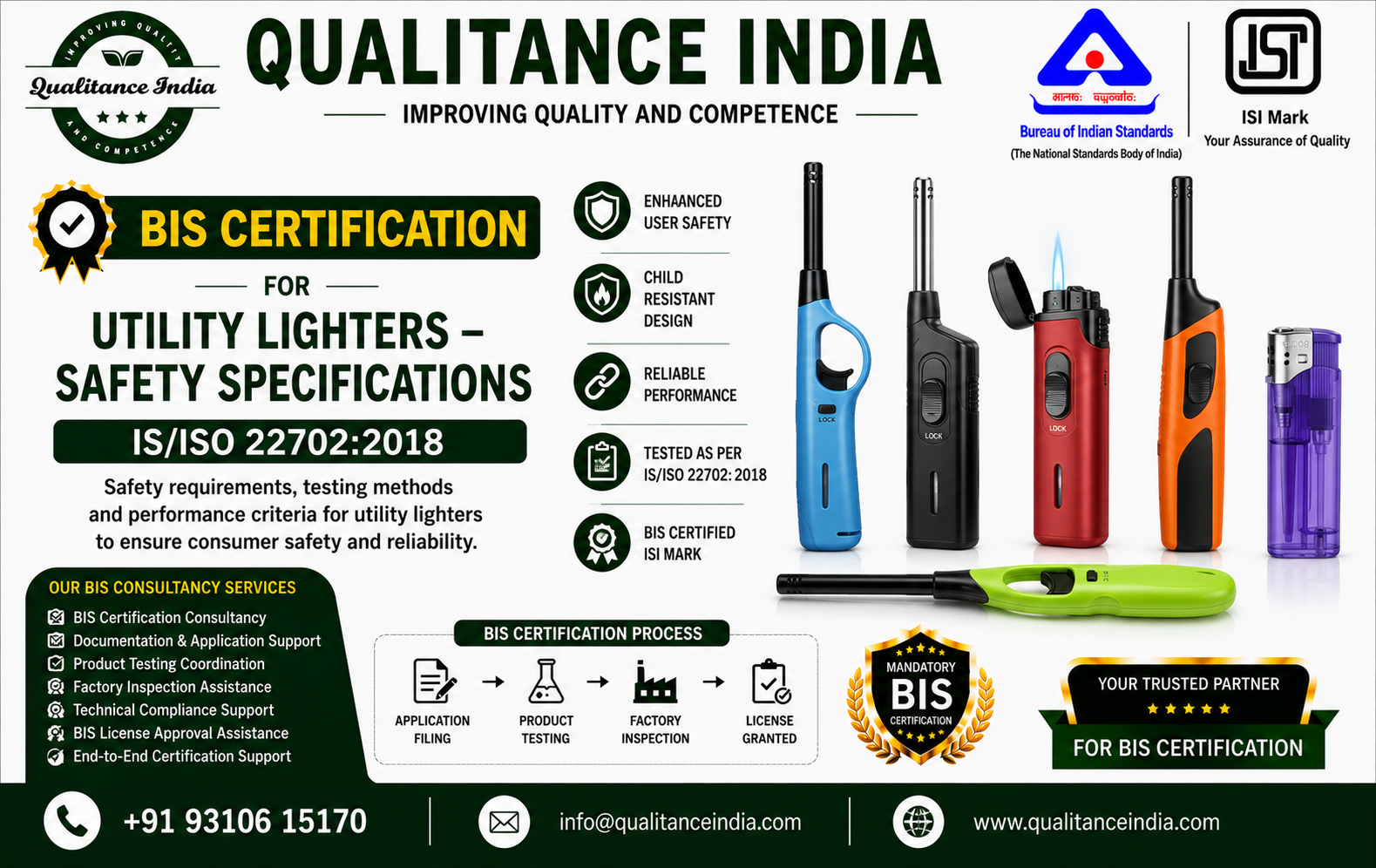
BIS Certification Consultancy for Utility Lighters – Safety Specifications | IS/ISO 22702:2018
BIS Certification for Utility Lighters in India
Utility lighters are flame-producing products designed for applications such as lighting candles, fireplaces, grills, pilot lights, gas appliances, camping equipment, lanterns and other ignition sources. Since these products contain fuel and generate an open flame, safety performance is a critical factor in their design, manufacturing and use.
In India, IS/ISO 22702:2018 – Utility Lighters – Safety Specifications is the applicable Indian Standard for utility lighters covered under the compulsory certification framework for Flame-Producing Lighters. The standard focuses on important safety characteristics including flame generation, flame height, flame stability, flame extinction, resistance to dropping, elevated temperature, burning performance, fuel compatibility, internal pressure and refilling requirements.
The Flame-Producing Lighters (Quality Control) Order, 2023 includes IS/ISO 22702:2018 for utility lighters. Covered products are required to conform to the applicable Indian Standard and bear the BIS Standard Mark under a BIS licence, subject to applicable statutory exemptions. BIS continues to list IS/ISO 22702:2018 under the compulsory Scheme-I certification framework. (bis.gov.in)
Qualitance India provides end-to-end BIS Certification Consultancy for Utility Lighters, including applicability assessment, product grouping, documentation, laboratory testing coordination, BIS application filing, factory inspection assistance, technical compliance and BIS licence support.
What is IS/ISO 22702:2018?
IS/ISO 22702:2018 – Utility Lighters – Safety Specifications is the Indian Standard covering the safety requirements applicable to utility lighters.
The standard is designed to establish safety requirements for utility lighters during normal use and reasonably foreseeable misuse. It addresses both functional performance and structural safety of the product.
The current BIS Product Manual identifies the product as:
Utility Lighters – General Consumer – Safety Requirements according to IS/ISO 22702:2018
The Product Manual operates under Scheme-I of the BIS Conformity Assessment Regulations, 2018. It specifies a sample size of 10 lighters for certification testing and currently lists no amendments against the Product Manual. (bis.gov.in)
What are Utility Lighters?
Utility lighters are hand-held flame-producing devices intended for extended-reach or specialized ignition applications.
Common examples include:
- Grill lighters
- Fireplace lighters
- Candle lighters
- Long-reach gas lighters
- BBQ lighters
- Camping lighters
- Pilot-light lighters
- Long-handle utility lighters
- Refillable utility lighters
- Disposable utility lighters
- Dual-flame utility lighters
- Multiple-flame utility lighters
These products are commonly used for candles, fireplaces, grills, camp stoves, lanterns, pilot lights and fuel-fired appliances.
IS/ISO 22702:2018 specifically addresses utility lighters and does not cover cigarette or cigar lighters. (services.bis.gov.in)
Is BIS Certification Mandatory for Utility Lighters in India?
Utility lighters covered by the Flame-Producing Lighters (Quality Control) Order, 2023 are subject to compulsory conformity requirements.
The QCO specifically includes:
- IS/ISO 9994:2018 – Lighters – Safety Specifications
- IS/ISO 22702:2018 – Utility Lighters – Safety Specifications
For products covered by the QCO, conformity with the applicable Indian Standard and use of the BIS Standard Mark under a BIS licence are required, subject to the exemptions provided in the applicable legal provisions. (bis.gov.in)
Therefore, manufacturers should determine BIS applicability before starting commercial production or placing covered utility lighters in the Indian market.
Latest Regulatory Updates for Utility Lighters
Manufacturers should consider the latest amendments to the Flame-Producing Lighters QCO rather than relying only on the original 2023 notification.
2024 Amendment
An amendment issued in 2024 introduced provisions concerning existing stock manufactured or imported before the amendment came into force, subject to the conditions specified in the notification. The amendment included provisions relating to declaration and sale/display of qualifying existing stock for the prescribed period. (bis.gov.in)
2026 Amendment
A further amendment was issued through S.O. 777(E) dated 12 February 2026, which revised the relevant exemption provision for specified Udyam-registered manufacturing enterprises.
The amended provision refers to enterprises where:
- Investment in plant and machinery or equipment at original cost does not exceed ₹1 crore; and
- Turnover during the previous financial year does not exceed ₹5 crore;
- Along with the prescribed Chartered Accountant certification requirement.
This provision should be evaluated against the manufacturer’s actual Udyam registration, financial status and the complete wording of the current notification before relying on the exemption. (bis.gov.in)
Scope of IS/ISO 22702:2018
The standard establishes safety requirements for utility lighters and addresses several important product characteristics.
Flame Generation
The lighter must require deliberate manual action for flame generation so that accidental ignition is minimized.
The standard recognizes mechanisms involving positive user action, multiple independent actions or an actuating force requirement. A force criterion of at least 15 N is referenced for one of the accepted mechanisms. (services.bis.gov.in)
Flame Height
Flame height is an important safety parameter and must comply with the applicable requirements specified by the standard.
Flame-Height Adjustment
For adjustable utility lighters, the adjustment mechanism and the resulting flame performance are assessed.
Spitting, Sputtering and Flaring
The flame should operate in a controlled and safe manner without unacceptable spitting, sputtering or flaring under the specified test conditions.
Flame Extinction
The lighter must safely extinguish the flame according to the requirements of the standard.
Fuel-Related Performance
The product must maintain safe performance with the fuel specified by the manufacturer.
Resistance to Dropping
The product must withstand the prescribed drop testing without developing dangerous conditions such as unsafe ignition, excessive leakage or structural failure.
Resistance to Elevated Temperature
The standard includes resistance to elevated-temperature exposure as part of its safety evaluation.
Burning Behaviour
Utility lighters are evaluated for safe operation under specified flame orientations and burning conditions.
Continuous Burning
The product is evaluated under prolonged burning conditions to verify safe performance.
Cyclic Burning
Repeated ignition and burning cycles are used to evaluate the product’s ability to withstand repeated operation.
Internal Pressure
The fuel-containing system must withstand the specified internal pressure requirements.
Refilling
Refillable utility lighters must comply with applicable refilling requirements, including safety information and the refilling mechanism.
Instructions and Warnings
The manufacturer must provide suitable instructions and warnings for safe handling and operation, including relevant refilling information for refillable products. (standards.iteh.ai)
Types of Utility Lighters Covered Under BIS Certification
The BIS Product Manual identifies several classifications for utility lighters.
These include:
Burner Type
- Postmixing burner lighter
- Premixing burner lighter
Flame Adjustment
- Adjustable lighter
- Non-adjustable lighter
Flame Extinction
- Self-extinguishing lighter
- Non-self-extinguishing lighter
Fuel / Refill Configuration
- Refillable lighter
- Disposable lighter
Flame Configuration
- Dual-flame type utility lighter
- Multiple-flame type utility lighter
These classifications are important when deciding product grouping and the scope of the BIS licence. (bis.gov.in)
BIS Product Grouping for Utility Lighters
Product grouping is one of the most important parts of the BIS certification process.
The current Product Manual states that for Grant of Licence or Change/Extension of Scope, each type of lighter of any reservoir capacity is required to be tested for all applicable requirements so that lighters of all reservoir capacities of that particular type can be covered.
The manufacturer is required to declare the varieties intended to be included in the licence.
BIS may restrict the approved scope according to:
- Manufacturing capability
- Testing capability
- Product varieties
- Available quality-control facilities
- Technical compliance arrangements
During licence operation, samples from different varieties may be drawn by rotation as far as practicable. (bis.gov.in)
Proper product grouping can therefore help avoid unnecessary testing and scope-related problems.
BIS Sample Size for Utility Lighters
The current BIS Product Manual specifies:
Sample Size: 10 Lighters
The correct samples must represent the product configuration and the variety for which certification is being sought. (bis.gov.in)
Manufacturers should ensure that the tested samples are identical to the commercial product in terms of design, materials, burner configuration, ignition mechanism, fuel arrangement and other relevant characteristics.
Main BIS Tests for Utility Lighters
Utility lighters are subject to multiple safety tests under IS/ISO 22702:2018.
Important tests include:
| Test | Purpose |
|---|---|
| Flame Generation | Verification of safe deliberate ignition |
| Flame Height | Control of flame height |
| Flame-Height Adjustment | Verification of adjustment mechanism |
| Spitting / Sputtering / Flaring | Flame stability |
| Flame Extinction | Safe flame shut-off |
| Volumetric Displacement | Fuel-related performance |
| External Finish | Prevention of hazardous edges/points |
| Fuel Compatibility | Compatibility of materials with fuel |
| Resistance to Fuel Loss | Fuel containment performance |
| Resistance to Dropping | Mechanical safety |
| Elevated Temperature | Thermal safety |
| Burning Behaviour | Safe operation under burning conditions |
| Continuous Burning | Prolonged-use performance |
| Cyclic Burning | Repeated-use performance |
| Internal Pressure | Pressure resistance |
| Refilling | Refill mechanism and safety |
These tests are based on the requirements specified in the BIS Product Manual and the applicable standard. (bis.gov.in)
Detailed Testing Requirements
Flame Generation Test
The ignition system is evaluated to ensure that flame generation requires deliberate user action.
The objective is to reduce the possibility of accidental activation and unintended flame generation.
Flame Height Test
The flame height is measured under prescribed conditions to determine compliance with the specified requirements.
Flame-Height Adjustment Test
Adjustable models are evaluated to confirm that the adjustment mechanism works correctly and produces an acceptable flame.
Flame Stability Test
The lighter is checked for abnormal spitting, sputtering or flaring that could create unsafe flame behaviour.
Flame Extinction Test
The flame must extinguish safely when the applicable operating action is released or completed.
Drop Test
Resistance to accidental dropping is evaluated according to the specified test procedure.
Technical material relating to IS/ISO 22702 describes three separate drops from approximately 1.5 m, followed by evaluation for specified safety conditions. (standards.iteh.ai)
Elevated Temperature Test
Utility lighters are evaluated for resistance to elevated temperature. Technical material for the standard specifies an exposure condition of approximately 65°C for 4 hours under the prescribed test procedure. (standards.iteh.ai)
Burning Behaviour Test
Burning behaviour is evaluated using specified operating positions and conditions.
Continuous Burning Test
The lighter is operated continuously under the specified conditions to verify that it remains safe.
Cyclic Burning Test
Repeated operating cycles are used to assess reliability and safety during repeated use.
Fuel Compatibility Test
Materials used in the lighter must remain compatible with the specified fuel and should not deteriorate in a way that compromises safety.
Internal Pressure Test
The fuel reservoir and associated components are assessed for resistance to the specified internal pressure.
Refilling Test
For refillable utility lighters, the refilling mechanism and associated safety requirements are evaluated.
BIS Test Equipment for Utility Lighters
The BIS Product Manual provides an indicative list of major testing equipment, which includes:
- Rotary actuator
- Push-button actuator
- Flame-height measurement apparatus
- Draught-free chamber
- Digital thermometer
- Stopwatch
- Measuring scale
- Weighing balance
- Drilling machine
- Drill bit
- Syringe
- Concrete surface
- Freezer
- Hot-air oven
- Height gauge
- Pressure-generating equipment
- Pressure gauge
- Pressure-regulating equipment
- Containers for fuel compatibility tests
- Enclosures
The Product Manual clarifies that the equipment list is indicative and not exhaustive. (bis.gov.in)
In-House Testing Facility Requirements
A proper testing and quality-control system is important for obtaining and maintaining BIS certification.
The BIS Product Manual requires suitable in-house facilities and trained personnel for applicable routine testing and control activities. (bis.gov.in)
Where a particular test is permitted to be subcontracted, the testing may be carried out through:
- BIS-recognized or empanelled laboratory; or
- Eligible NABL-accredited laboratory as per applicable requirements.
MSME Manufacturers
For MSME manufacturers, routine tests classified as “R” may be supported through common cluster facilities, shared testing facilities or eligible external laboratories as allowed under the applicable BIS provisions. (bis.gov.in)
Large Manufacturers
Large manufacturers are expected to maintain appropriate in-house laboratory arrangements for routine testing together with suitable calibration controls. (bis.gov.in)
Quality Assurance Plan for Utility Lighters
Maintaining consistent product quality is a major part of BIS certification.
A Quality Assurance Plan should clearly establish:
- Definition of control unit
- Routine testing
- Sampling quantity
- Test frequency
- In-process inspection
- Final inspection
- Calibration
- Test records
- Handling of non-conforming products
The BIS Product Manual recommends a control unit consisting of utility lighters of the same type manufactured during one day. (bis.gov.in)
Manufacturers should maintain proper records of routine testing and make the required records available during BIS inspections.
Routine Testing and Quality Control
The Product Manual includes routine control requirements for different characteristics.
Examples include:
Flame Generation
10 lighters – Each control unit
Flame Height
5 lighters – Once every month
Resistance to Dropping
5 lighters – Once every month
Continuous Burning
5 lighters – Once every month
Fuel Compatibility
5 lighters – Once every three months
Internal Pressure
5 lighters – Once every month
The prescribed testing rotation should ensure that different types produced during the relevant period are adequately covered. (bis.gov.in)
BIS Factory Inspection for Utility Lighter Manufacturers
Factory inspection is an important stage in the BIS certification process.
BIS may review the manufacturer’s:
Manufacturing Facilities
- Raw material handling
- Component manufacturing
- Burner assembly
- Ignition mechanism
- Fuel filling
- Valve assembly
- Leak-control arrangements
- Final assembly
- Product inspection
- Packaging
Testing Facilities
- Routine testing equipment
- Measuring instruments
- Calibration certificates
- Testing procedures
- Test records
- Sampling arrangements
Quality Control System
- Incoming inspection
- In-process controls
- Final inspection
- Non-conforming product control
- Batch identification
- Product traceability
- Complaint handling
Technical Documentation
- Quality Assurance Plan
- Test records
- Calibration records
- Manufacturing process
- Inspection procedures
- Laboratory reports
Proper preparation before factory inspection can significantly reduce avoidable observations and delays.
BIS Marking Requirements for Utility Lighters
After obtaining a BIS licence, conforming utility lighters must be marked according to the applicable BIS marking requirements.
The current Product Manual specifies that the BIS Standard Mark shall be marked on each lighter, provided the product conforms to all applicable requirements.
The licence number in the form:
CM/L-__________
and the prescribed BIS website statement:
“For details of BIS certification please visit www.bis.gov.in”
must also be provided at the appropriate place as specified. (bis.gov.in)
Only products covered by the approved licence scope and complying with applicable requirements should carry the Standard Mark.
Safety Instructions and Warnings for Utility Lighters
Utility lighters require clear safety instructions because they combine fuel and an open flame.
The manufacturer should review the following information against the applicable standard and product configuration:
- Instructions for use
- Safety warnings
- Fuel information
- Refilling instructions
- Handling precautions
- Storage instructions
- Packaging information
- User safety precautions
- Relevant warning statements
For refillable utility lighters, safe refilling instructions are particularly important. (standards.iteh.ai)
Documents Required for BIS Certification
The exact document requirement depends on the manufacturer, product configuration and factory setup, but the following documents are commonly required.
Company Documents
- Certificate of Incorporation / Registration
- GST Registration Certificate
- PAN
- Factory address proof
- Udyam Registration, where applicable
- Authorized signatory documents
Product Documents
- Product specifications
- Technical drawings
- Product photographs
- Model and variant list
- Product catalogue
- Fuel specification
- Construction details
- User instructions
- Warning information
- Packaging/label artwork
Factory Documents
- Manufacturing process flow chart
- Plant layout
- Machinery list
- Laboratory equipment list
- Calibration records
- Quality-control procedure
- Raw material details
- Testing facility details
BIS Application Documents
- BIS application information
- Product scope
- Product grouping details
- Test reports
- Quality Assurance Plan
- Undertakings and declarations, where applicable
- Authorized signatory details
BIS Certification Process for Utility Lighters
Step 1 – Product Applicability Assessment
The first step is to determine whether the product falls within the utility lighter scope covered by IS/ISO 22702:2018.
Step 2 – Product Classification
The lighter is evaluated for:
- Burner type
- Flame adjustment
- Flame extinction
- Refillability
- Flame configuration
- Fuel system
Step 3 – Product Grouping
Models and variants are technically grouped for the proposed BIS scope.
Step 4 – Technical Documentation
Drawings, specifications, manufacturing information and quality-control documents are prepared.
Step 5 – Sample Preparation
Representative samples are prepared according to the applicable Product Manual requirements.
Step 6 – Laboratory Testing
The required tests are conducted through the appropriate laboratory.
Step 7 – Test Report Review
Test reports are technically reviewed to ensure that the product meets all relevant requirements.
Step 8 – BIS Application
The application is prepared and submitted under the applicable BIS Scheme-I process.
Step 9 – Factory Inspection
BIS assesses the manufacturing facility, testing arrangements and quality-control system.
Step 10 – Compliance
Technical observations or documentation queries, if any, are addressed.
Step 11 – BIS Licence Grant
After successful completion of the applicable requirements, the BIS licence is granted.
Step 12 – Standard Marking
The manufacturer can use the BIS Standard Mark on conforming products within the approved scope and according to the licence conditions.
Common Reasons for BIS Certification Delays
Utility lighter certification can be delayed due to:
- Incorrect standard selection
- Wrong product classification
- Incorrect product grouping
- Testing of the wrong model
- Difference between tested and commercial product
- Incomplete technical drawings
- Missing test reports
- Testing equipment not ready
- Calibration problems
- Incomplete quality records
- Incorrect product labels
- Inadequate safety instructions
- Factory inspection observations
- Testing failure
- Product scope exceeding manufacturing capability
A proper technical review before submitting the BIS application can help reduce these issues.
What Happens if a Utility Lighter Fails BIS Testing?
Testing failure should be investigated technically rather than simply sending a new sample.
For example:
Flame Height Failure
The manufacturer may need to review:
- Burner design
- Nozzle
- Gas flow
- Flame adjustment mechanism
- Fuel pressure
Fuel Leakage Failure
The manufacturer may need to review:
- Valve
- Seals
- Reservoir
- Joints
- Assembly process
- Material compatibility
Drop Test Failure
The manufacturer may need to review:
- Outer housing
- Burner protection
- Reservoir design
- Joint strength
- Structural support
Pressure Test Failure
The manufacturer may need to review:
- Reservoir construction
- Valve connection
- Sealing
- Material strength
- Assembly
Corrective action should be completed before arranging repeat testing.
BIS Certification Cost for Utility Lighters
There is no single fixed BIS certification cost for every utility lighter manufacturer.
The total cost may depend on:
- Laboratory testing
- Number of models
- Product grouping
- Number of samples
- Testing equipment
- Calibration
- Factory inspection
- Documentation
- BIS-related charges
- Consultancy
- Travel and logistics
- Additional testing after a failure
Current BIS LIMS data shows a listed testing charge of ₹21,000 excluding taxes for IS/ISO 22702:2018 under one listed laboratory scope. The same listing includes several applicable test components such as flame generation, flame height, dropping, elevated temperature, burning behaviour, fuel compatibility, internal pressure and refilling. Actual charges may vary depending on the laboratory and applicable product scope. (lims.bis.gov.in)
A final project quotation should therefore be prepared after reviewing the exact product configuration and proposed licence scope.
BIS Certification Timeline for Utility Lighters
The certification timeline depends on:
- Product readiness
- Correct product grouping
- Sample availability
- Laboratory schedule
- Testing results
- Documentation accuracy
- Factory readiness
- Inspection scheduling
- Technical observations
- Corrective action
- Product changes
A product that passes testing on the first attempt and has complete documentation can normally progress more smoothly than a project involving multiple failures or scope changes.
Benefits of BIS Certification for Utility Lighters
Regulatory Compliance
Helps manufacturers comply with applicable compulsory certification requirements.
Product Safety
The certification process evaluates critical flame, fuel, pressure, mechanical and thermal safety characteristics.
Consumer Confidence
BIS certification can strengthen customer confidence in product quality and safety.
Better Quality Control
Routine testing and Quality Assurance requirements encourage consistent manufacturing quality.
Market Access
BIS compliance supports market access where compulsory certification requirements apply.
Brand Credibility
Demonstrating compliance with an Indian Standard can strengthen the credibility of manufacturers and brands.
BIS Certification for Refillable Utility Lighters
Refillable utility lighters have additional considerations related to the refilling mechanism.
Manufacturers should pay particular attention to:
- Refilling valve
- Seal integrity
- Fuel compatibility
- Refill instructions
- Safety warnings
- Fuel retention
- Post-refilling performance
The BIS Product Manual includes specific refilling requirements and routine controls for refillable utility lighters. (bis.gov.in)
BIS Certification for Disposable Utility Lighters
Disposable utility lighters are also recognized as a separate product type under the BIS grouping framework.
Manufacturers should evaluate:
- Fuel containment
- Flame generation
- Flame extinction
- Drop resistance
- Elevated-temperature performance
- Internal pressure
- Fuel loss
- Continuous burning
- Cyclic burning
The final licence scope depends on the declared product variety and applicable testing requirements. (bis.gov.in)
BIS Certification for Dual-Flame Utility Lighters
Dual-flame utility lighters are specifically recognized under the BIS Product Manual.
Because the flame configuration directly affects product construction and performance, the manufacturer should clearly declare the dual-flame configuration during the product grouping and certification process. (bis.gov.in)
BIS Certification for Multiple-Flame Utility Lighters
Multiple-flame utility lighters are also included as a separate product type in the BIS grouping requirements.
Before applying for certification, manufacturers should ensure that the product design, flame arrangement, ignition system and intended scope are clearly documented and technically assessed. (bis.gov.in)
BIS Certification for Grill, Fireplace and Long-Reach Lighters
Utility lighters used for grills, fireplaces, candles and similar ignition applications can fall within IS/ISO 22702:2018 where their product characteristics meet the applicable scope.
Common products may include:
- BBQ lighters
- Grill lighters
- Fireplace lighters
- Candle lighters
- Long-reach lighters
- Gas ignition lighters
The actual applicability should always be checked against the product’s technical construction, operating principle and intended use.
BIS Certification for Imported Utility Lighters
Importers should check BIS applicability before importing utility lighters into India.
Where the product is covered by the compulsory QCO, the appropriate BIS compliance route should be established before commercial import and sale.
An overseas manufacturer’s certificate or general quality certificate does not automatically substitute for the BIS requirements applicable in India.
Foreign manufacturers may also be subject to additional BIS procedures depending on their location and the applicable certification route.
BIS Certification for MSME Utility Lighter Manufacturers
The 2026 amendment is particularly relevant for eligible small manufacturing enterprises.
The revised exemption provision refers to Udyam-registered enterprises meeting the specified investment and turnover limits, including:
Plant and machinery/equipment investment: up to ₹1 crore
Previous financial year turnover: up to ₹5 crore
The prescribed Chartered Accountant certification condition also applies. Manufacturers should verify their individual eligibility from the latest notification before relying on the exemption. (bis.gov.in)
Why Choose Qualitance India for BIS Certification?
Qualitance India provides complete BIS Certification Consultancy support for utility lighter manufacturers.
Our support includes:
Product Applicability Assessment
Evaluation of product design, scope and applicable BIS requirements.
Product Grouping Assistance
Technical review of models and variants to help establish an appropriate certification scope.
Documentation Support
Assistance with drawings, specifications, manufacturing documents and quality-control documentation.
Product Testing Coordination
Coordination with suitable laboratories for applicable testing.
BIS Application Filing Support
Assistance in preparing and submitting the BIS application.
Factory Inspection Assistance
Preparation of manufacturing facilities, testing arrangements and records before BIS inspection.
Quality Assurance Plan Support
Assistance with routine testing and quality-control documentation.
Technical Compliance Support
Support in resolving testing observations and technical queries.
BIS Licence Approval Assistance
End-to-end coordination up to BIS licence grant.
Utility Lighter BIS Certification Process
Product Assessment
↓
IS/ISO 22702:2018 Applicability Check
↓
Product Classification & Grouping
↓
Technical Documentation
↓
Sample Preparation
↓
Laboratory Testing
↓
BIS Application Filing
↓
Factory Inspection
↓
Compliance / Clarification
↓
BIS Licence Grant
↓
BIS Standard Marking
↓
Routine Quality Control
Frequently Asked Questions About BIS Certification for Utility Lighters
What is the BIS standard for utility lighters?
The applicable Indian Standard is IS/ISO 22702:2018 – Utility Lighters – Safety Specifications. (bis.gov.in)
Is BIS certification mandatory for utility lighters?
Utility lighters covered by the Flame-Producing Lighters QCO are subject to compulsory conformity requirements, including the applicable BIS licence and Standard Mark requirements, subject to statutory exemptions. (bis.gov.in)
Does IS/ISO 22702:2018 cover cigarette lighters?
No. IS/ISO 22702:2018 is for utility lighters and does not cover cigarette or cigar lighters. (services.bis.gov.in)
How many samples are required for BIS utility lighter testing?
The current BIS Product Manual specifies 10 lighters as the sample size. (bis.gov.in)
What are the main tests for utility lighters?
Major tests include flame generation, flame height, flame adjustment, flame stability, flame extinction, dropping, elevated temperature, burning behaviour, continuous burning, cyclic burning, fuel compatibility, internal pressure and refilling. (bis.gov.in)
Is drop testing required?
Yes. Resistance to dropping is an important safety requirement under the standard.
Is there an elevated-temperature test?
Yes. The standard includes elevated-temperature resistance as part of the safety evaluation. Technical material references a 65°C, 4-hour exposure condition under the specified procedure. (standards.iteh.ai)
Is fuel compatibility tested?
Yes. Compatibility with fuel is an applicable safety requirement. (bis.gov.in)
Are refillable utility lighters covered?
Yes. Refillable utility lighters are specifically included in the BIS product classification. (bis.gov.in)
Are disposable utility lighters covered?
Yes. Disposable utility lighters are also recognized under the BIS grouping framework. (bis.gov.in)
Are dual-flame utility lighters covered?
Yes. Dual-flame utility lighters are specifically identified as a product type. (bis.gov.in)
Are multiple-flame utility lighters covered?
Yes. Multiple-flame utility lighters are also identified as a separate product type. (bis.gov.in)
Is factory inspection required?
Yes. Factory inspection is a significant stage of BIS certification under Scheme-I.
Is an in-house laboratory required?
Manufacturers need appropriate testing and quality-control arrangements. MSMEs have certain flexibility for routine “R” tests through eligible shared or external facilities, while large manufacturers are expected to maintain appropriate in-house routine testing arrangements. (bis.gov.in)
Can utility lighter testing be outsourced?
Where subcontracting is permitted, tests may be conducted through eligible BIS-recognized/empanelled or NABL-accredited laboratories in accordance with the Product Manual. (bis.gov.in)
What is the current BIS testing cost?
A current BIS LIMS listing shows ₹21,000 excluding taxes for an IS/ISO 22702:2018 laboratory scope. Actual cost may vary according to the laboratory and certification requirements. (lims.bis.gov.in)
Can all utility lighter models be included in one BIS licence?
Not automatically. Product type, grouping, applicable testing and manufacturing/testing capability determine the approved scope. (bis.gov.in)
What is the BIS Standard Mark?
The BIS Standard Mark is the conformity mark used on certified products under the applicable BIS licence and certification requirements.
What does CM/L mean?
CM/L is the BIS certification licence number associated with the manufacturer and approved product scope.
Is BIS certification required for imported utility lighters?
The importer should verify applicability under the Flame-Producing Lighters QCO before importing or selling the product in India.
Can eligible MSMEs claim exemption?
Certain eligible Udyam-registered manufacturing enterprises may qualify under the revised exemption provision introduced through the 2026 amendment, subject to the notified conditions. (bis.gov.in)
Who can help with BIS certification for utility lighters?
Qualitance India provides consultancy support for product assessment, grouping, documentation, testing coordination, factory inspection preparation and BIS licence assistance.
Contact Qualitance India for Utility Lighter BIS Certification
If you are manufacturing or planning to manufacture utility lighters for the Indian market, it is important to assess BIS applicability and product scope before starting testing or commercial production.
Qualitance India provides professional consultancy for:
BIS Applicability Assessment
IS/ISO 22702:2018 Product Testing
Product Grouping
Technical Documentation
BIS Application Filing
Factory Inspection Assistance
Quality Assurance Plan
Technical Compliance Support
BIS Licence Approval Assistance
Qualitance India
Phone: +91 93106 15170
Email: info@qualitanceindia.com
Website: qualitanceindia.com
For a technical assessment, manufacturers can provide the product model details, photographs, technical specifications and manufacturing location.
Conclusion
BIS Certification for Utility Lighters as per IS/ISO 22702:2018 is an important regulatory and product-safety requirement for utility lighters covered by the applicable Flame-Producing Lighters QCO.
The certification process involves much more than laboratory testing. Manufacturers need to correctly assess product applicability, classify the lighter, establish product grouping, prepare technical documents, arrange testing, maintain suitable quality-control facilities, prepare for factory inspection and comply with BIS marking requirements.
IS/ISO 22702:2018 addresses major utility lighter safety characteristics including flame generation, flame height, flame adjustment, flame stability, flame extinction, dropping, elevated temperature, burning behaviour, fuel compatibility, internal pressure and refilling. (bis.gov.in)
The regulatory framework has also been amended after the original 2023 QCO, including the 2024 amendment and the significant 2026 amendment concerning certain Udyam-registered manufacturing enterprises. Manufacturers should therefore verify the latest applicable legal requirements before relying on an exemption or finalizing their certification strategy. (bis.gov.in)
A properly planned BIS certification process can help reduce testing errors, scope-related problems, documentation issues and factory inspection delays.
Qualitance India provides end-to-end BIS Certification Consultancy for Utility Lighters under IS/ISO 22702:2018, helping manufacturers move from product assessment and testing to factory inspection and BIS licence support.
Phone: +91 93106 15170
Email: info@qualitanceindia.com
Website: qualitanceindia.com
Need help with BIS certification for this product?
Get a free consultation from our compliance experts — we handle testing, documentation and the complete BIS process for you.