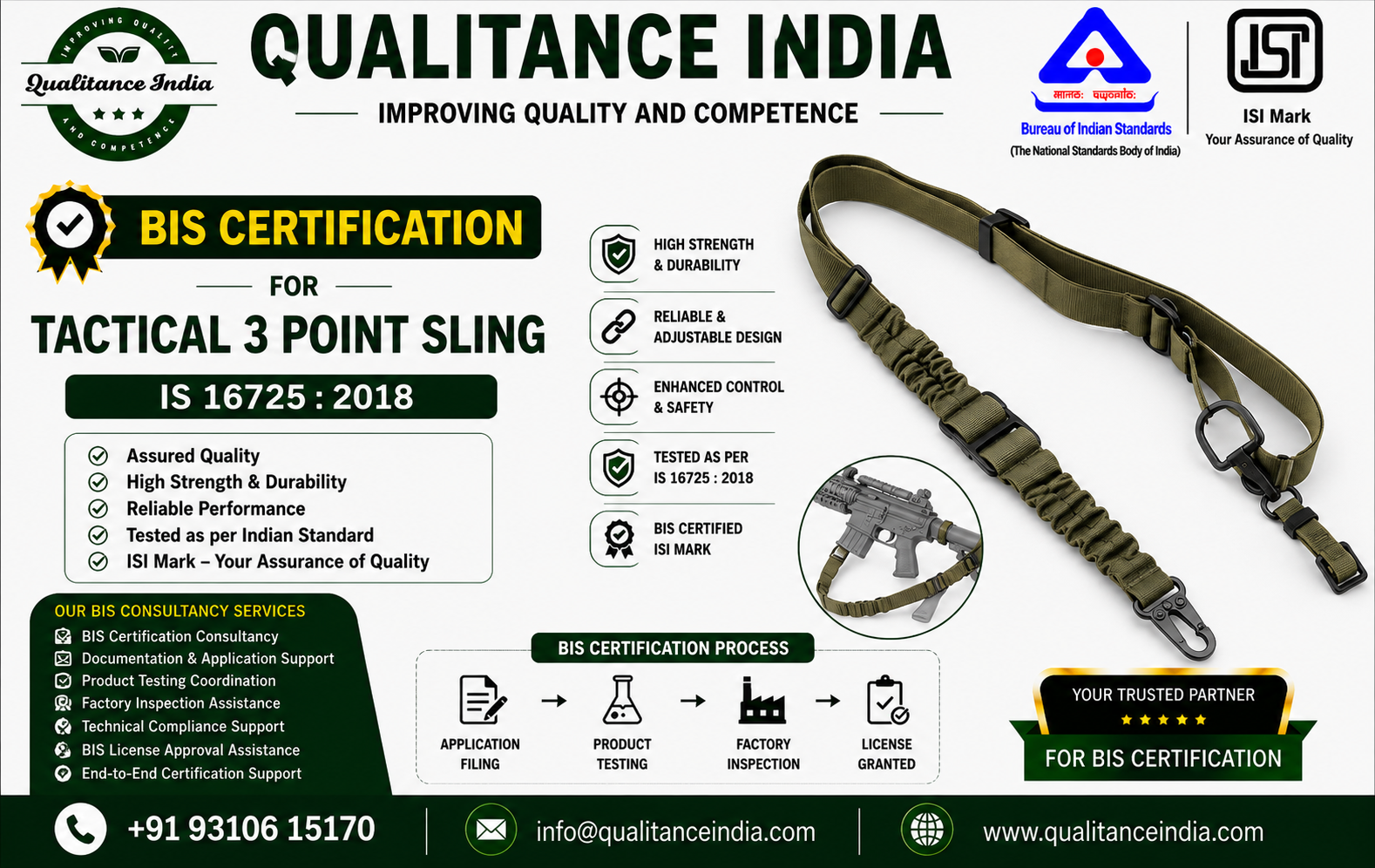
BIS Certification Consultancy for Tactical 3 Point Sling | IS 16725:2018 | BIS & ISI Mark Certification
Introduction
A Tactical 3 Point Sling is a specialized textile product manufactured as a three-point support sling with textile, elastic, metallic and fastening components. Because the product needs consistent dimensional construction, suitable material properties, adequate strength and reliable workmanship, its raw materials and finished construction are important from a quality and conformity perspective.
In India, IS 16725:2018 – Textiles – Tactical 3 Points Sling Universal – Specification establishes the requirements for this product. The current BIS Product Manual PM/16725/1 dated February 2023 states that certification is operated under Scheme-I of the BIS Conformity Assessment Regulations, 2018 and identifies no amendments, no specific grouping guidelines, and a sample size of 10 slings made into one unit pack (bundle).
IS 16725:2018 is included in the BIS compulsory certification framework under the Protective Textiles (Quality Control) Order, 2022. The Government order requires specified goods to conform to the relevant Indian Standard and bear the Standard Mark under a BIS licence according to Scheme-I. The original order also states that it does not apply to goods or articles meant for export.
BIS’s current Scheme-I listing continues to identify IS 16725:2018 – Tactical 3 point sling under the Protective Textiles category along with the applicable QCO framework and subsequent amendments.
The certification requirements are not limited to the finished sling. The BIS Product Manual specifies important requirements for the tape, shoulder pad, loops, metallic parts, sewing thread, stitching, dimensions, workmanship and finish. It also provides a detailed inspection and testing framework for ongoing production.
Qualitance India provides end-to-end BIS Certification Consultancy for Tactical 3 Point Sling as per IS 16725:2018, including product assessment, technical requirement review, documentation, raw-material conformity guidance, sample preparation, laboratory testing coordination, BIS application assistance, factory inspection preparation and quality-control documentation.
What is IS 16725:2018?
IS 16725:2018 is titled:
“Textiles – Tactical 3 Points Sling Universal – Specification.”
The standard is a product specification under the textiles sector. BIS’s Product Manual confirms that the certification operation is under Scheme-I, making the standard relevant to manufacturers seeking a BIS certification licence for the specified product.
The standard addresses important characteristics of the complete sling and its components, including:
- Shape and design
- Dimensions
- Tape construction
- Yarn characteristics
- Breaking strength
- Colour fastness
- Dimensional change
- pH
- Shoulder-pad construction
- Elastic tape used in loops
- Metallic parts
- Stitching
- Sewing thread
- Workmanship
- Finish
- Marking
- Packing
The current Product Manual identifies NIL amendments and states that product grouping guidelines are Not Applicable.
What is a Tactical 3 Point Sling?
A Tactical 3 Point Sling is a textile sling assembly consisting of multiple connected sections designed around a three-point configuration.
For certification purposes, the important consideration is not simply the appearance of the finished product but whether its materials, components, construction and finished workmanship comply with the requirements of IS 16725:2018.
The BIS Product Manual identifies several components, including:
- Component A – Tape
- Component B – Shoulder pad
- Component D – Woven elastic tape used in loops
- Metallic parts
- Sewing thread
Each component has specific material or performance requirements under the certification framework.
Scope of IS 16725:2018
The BIS Product Manual identifies the product scope as:
Textiles – Tactical 3 points sling universal
and provides the Standard Mark licence scope against IS 16725:2018.
The certification scope should be aligned with the actual manufactured product.
Before testing, manufacturers should verify:
- Overall sling construction
- Tape material
- Tape width
- Tape linear mass
- Shoulder-pad construction
- Loop material
- Metallic parts
- Sewing thread
- Stitching arrangement
- Product dimensions
- Workmanship
- Finish
- Packing and marking
Because the Product Manual states Grouping Guidelines: Not applicable, manufacturers should not assume that unrelated constructions or substantially different configurations can automatically be included under the same tested scope.
Is BIS Certification Mandatory for Tactical 3 Point Sling?
Yes, for covered products supplied in the Indian market under the applicable QCO framework.
The Protective Textiles (Quality Control) Order, 2022 specifically lists:
Tactical 3 point sling – IS 16725:2018
The Order requires the specified goods to conform to the relevant Indian Standard and bear the Standard Mark under a BIS licence in accordance with Scheme-I. It also identifies BIS as the certifying and enforcing authority. Goods meant for export are outside the scope of the Order.
BIS’s current Scheme-I listing continues to show IS 16725:2018 under the Protective Textiles category.
Manufacturers should therefore assess BIS applicability before manufacturing or supplying covered Tactical 3 Point Slings in India.
Protective Textiles Quality Control Order
The Protective Textiles (Quality Control) Order, 2022, issued by the Ministry of Textiles, covers specified protective textile products.
The Schedule includes:
| Product | Indian Standard |
|---|---|
| Protective clothing for firefighters | IS 16890:2018 |
| Protective gloves for firefighters | IS 16874:2018 |
| Protective clothing for industrial workers exposed to heat | IS 15748:2022 |
| High visibility warning clothes | IS 15809:2017 |
| Protective clothing for welding | IS 16655:2017 |
| Tactical 3 point sling | IS 16725:2018 |
| Pouch for ammunition and grenades | IS 16726:2018 |
| Bullet resistant jackets | IS 17051:2018 |
| Water-proof multipurpose rain poncho | IS 17286:2019 |
The current BIS Scheme-I page continues to associate IS 16725:2018 with the Protective Textiles QCO framework.
BIS Certification for Tactical 3 Point Sling
BIS Certification is the conformity assessment process through which a manufacturer demonstrates that the Tactical 3 Point Sling complies with the applicable requirements of IS 16725:2018.
The Product Manual states that the certification is operated under Scheme-I of the BIS Conformity Assessment Regulations, 2018.
After successful conformity assessment and grant of a BIS licence, the manufacturer can use the applicable BIS Standard Mark / ISI Mark on products covered by the approved licence and subject to the conditions of that licence.
Who Needs BIS Certification for Tactical 3 Point Sling?
The requirement is primarily relevant to manufacturers producing Tactical 3 Point Sling conforming to IS 16725:2018.
Potentially affected businesses include:
- Tactical Sling Manufacturers
- Textile Product Manufacturers
- Protective Textile Manufacturers
- Military Textile Equipment Manufacturers
- Institutional Textile Suppliers
- Outdoor Equipment Manufacturers
- Defence Supply Manufacturers
- Contract Manufacturers
- OEM Manufacturers
- Government Procurement Suppliers
Importers, traders and sellers should independently verify the applicable regulatory position because BIS product certification under Scheme-I is granted to manufacturers within the prescribed conformity-assessment framework.
BIS Certification Eligibility Requirements
A manufacturer seeking BIS certification should maintain suitable manufacturing, inspection and quality-control facilities.
Depending on the production model, these may include:
- Textile webbing production facilities
- Needle loom or suitable tape manufacturing arrangement
- Shoulder-pad production facility
- Sewing machines
- Cutting equipment
- Assembly area
- Component inspection facilities
- Dimensional measuring equipment
- Tensile testing equipment
- Conditioning chamber
- Colour-fastness testing facilities or permitted external arrangements
- pH testing facility
- Quality-control personnel
- Calibration arrangements
- Production records
- Raw-material records
- Test records
- Packing and marking arrangements
The exact laboratory and testing arrangements should be established from the current BIS Product Manual and proposed product scope.
BIS Certification Process for Tactical 3 Point Sling
Step 1 – Product Applicability Assessment
The first step is to assess whether the product falls within IS 16725:2018.
The review should cover:
- Product design
- Three-point construction
- Components
- Materials
- Dimensions
- Stitching
- Workmanship
- Finish
Step 2 – Technical Requirement Review
The product is checked against the applicable material and construction requirements of the standard.
Step 3 – Product Scope Finalisation
The exact product configuration to be included in the BIS licence is finalised.
The Product Manual identifies grouping as Not Applicable, so scope should be clearly established before testing.
Step 4 – Raw Material Assessment
The manufacturer identifies and documents the required materials and components.
Step 5 – Documentation Preparation
Administrative, technical and quality-control documents are prepared.
Step 6 – Sample Preparation
The current Product Manual specifies:
Ten Tactical 3 Point Slings made into one unit pack (bundle).
Step 7 – Laboratory Testing
Representative samples are tested against the applicable requirements.
Step 8 – BIS Application
The manufacturer submits the application with the required documents and test information.
Step 9 – Factory Assessment
BIS evaluates the manufacturing, testing and quality-control arrangements.
Step 10 – Observation Closure
Any observations identified during the assessment are addressed through corrective action.
Step 11 – BIS Licence Grant
After successful conformity assessment, BIS grants the licence for the approved product scope.
Step 12 – Standard Marking
Conforming products covered by the licence can be marked according to the applicable BIS requirements.
BIS Sample Requirement for Tactical 3 Point Sling
The current Product Manual specifies:
Sample Size: Ten “Sling” made into one unit pack (bundle).
This sample requirement applies to the certification process as specified in the Product Manual.
Manufacturers should prepare the required sample quantity and ensure that the samples fully represent the construction intended for certification.
Raw Materials Used in Tactical 3 Point Sling
The BIS Product Manual gives detailed requirements for the raw materials and components.
Component A – Tape
The tape is required to be manufactured using:
Continuous filament yarn of Nylon 6 6
and produced on a needle loom according to the specified weave particulars.
Component B – Shoulder Pad
The shoulder pad contains:
- Top layer of Nylon 6 6 fabric
- Plain weave construction
- Bottom layer of Nylon 6 6 tape
- Middle layer of white rubber sheet
The Product Manual specifies the middle rubber layer as:
40 mm wide × 230 mm length × 3 mm thickness.
Component D – Loops
The woven elastic tape used in the loops must meet the requirements of IS 9686, and its colour should match Component A.
Metallic Parts
The Product Manual identifies metallic components such as:
- Sling locking buckle
- D-rings
- Goods holding hook
- Buckle
These are required to conform to IS 2062, except for shape and dimensions.
Sewing Thread
The Product Manual specifies Nylon sewing thread of green shade, matching Component A, conforming to Variety No. H1 of IS 4229.
Raw Material Conformity
The Product Manual permits conformity of raw materials to be established through:
- Supplier test certificate
- Third-party laboratory report
- Accredited laboratory report
- In-house testing
- A combination of these methods
This provision applies to the specified raw-material requirements under the Product Manual.
This makes proper supplier documentation and incoming-material control particularly important.
Testing Requirements for IS 16725:2018
The testing programme covers both the complete product and its components.
Important characteristics include:
- Nature of filament
- Yarn denier
- Tenacity of single-ply yarn
- Dimensions
- Ends and picks
- Mass per linear metre
- Breaking strength
- Colour fastness to light
- Colour fastness to rubbing
- Colour fastness to washing
- Dimensional change due to relaxation
- pH value
- Shoulder-pad characteristics
- Elastic tape requirements
- Metallic components
- Stitching
- Workmanship
- Finish
- Marking
- Packing
The current BIS laboratory database also shows detailed clause-wise testing entries for IS 16725:2018.
Nature of Filament
The nature of the filament used in the applicable textile components is verified through the relevant test methods.
The Product Manual references IS 667 and identifies microscopic, dissolution, staining or melting-temperature approaches depending on the applicable method.
Yarn Denier
The denier of yarn is one of the specified characteristics under the tape construction requirements.
The Product Manual identifies equipment such as:
- Special balance
- Wrap reel
- Yarn tensioning device
- Skein gauge
for the applicable determination.
Tenacity of Single-Ply Yarn
Tenacity is an important yarn characteristic because it contributes to the strength of the textile components.
The Product Manual identifies a tensile testing machine with suitable clamps and pretensioning arrangements for the applicable test.
Number of Ends and Picks
The tape and applicable woven components are evaluated for the number of ends and picks.
The Product Manual identifies a thread counter equipped with a microscope and graduated base for this purpose.
Width of Tape
Tape width is a specified characteristic under the requirements for Component A.
The manufacturer needs appropriate dimensional control and inspection during production.
Mass per Linear Metre
Mass per linear metre of tape is another important requirement.
The Product Manual identifies a conditioning chamber, tensile-testing machine and weighing balance for the test. The chamber condition specified is:
65 ± 2 percent relative humidity and 27 ± 2°C.
Breaking Strength
Breaking strength is tested for the relevant tape and component materials.
The current BIS Product Manual identifies the applicable tensile testing machine for breaking-strength determination.
Colour Fastness to Light
Colour fastness to light is evaluated according to the applicable textile test method.
The Product Manual references IS/ISO 105-B02:2014 for artificial-light testing and identifies equipment such as a xenon arc light source, humidity chamber, black-standard thermometer and assessment cabinet.
Colour Fastness to Rubbing
Both:
- Dry rubbing
- Wet rubbing
are covered.
The Product Manual refers to IS/ISO 105-X12 and identifies suitable rubbing-test equipment and grey scales.
Colour Fastness to Washing
Colour fastness to washing includes:
- Change in colour
- Staining on adjacent fabric
The Product Manual refers to IS/ISO 105-C10 and specifies relevant washing-test equipment.
Dimensional Change Due to Relaxation
Dimensional change due to relaxation is evaluated in both directions as applicable.
The Product Manual references IS 10099:1982 for the applicable apparatus arrangement.
pH Value of Aqueous Extract
The pH value of the aqueous extract is tested by the cold method.
The Product Manual references IS 1390 and identifies:
- pH meter
- Glass electrode
- Balance
- Volumetric flasks
- Mechanical shaker
- Appropriate reagents
for the testing arrangement.
Shoulder Pad Requirements
The shoulder pad is an important component and has separate construction and material requirements.
The Product Manual identifies a top layer made from Nylon 6 6 fabric and a bottom layer based on Nylon tape.
The applicable checks include:
- Nature of filament yarn
- Ends
- Picks
- Width
- Mass
- Colour fastness to washing
- Colour fastness to rubbing
- Colour fastness to light
Shoulder Pad Top Layer
The top layer is identified as disruptive printed Nylon 6 6 fabric with specified weave construction.
Applicable characteristics include:
- Nature of filament yarn
- Ends per decimetre
- Picks per decimetre
- Width
- Mass
- Colour fastness to washing
- Colour fastness to rubbing
- Colour fastness to light
Shoulder Pad Bottom Layer
The bottom layer is identified as:
Nylon tape – 50 mm wide
and is subject to requirements including:
- Nature of filament yarn
- Width
- Mass per linear metre
- Colour fastness to washing
- Colour fastness to rubbing
- Colour fastness to light
Elastic Tape Used in Loops
The woven elastic tape used in the loops is treated as Component D.
The Product Manual requires the material to comply with IS 9686 and states that the colour of the elastic tape should match Component A.
Metallic Parts
The metallic parts of the sling include the listed buckles, D-rings and hook.
The Product Manual requires these metallic parts to conform to IS 2062, except for their shape and dimensions.
Conformity can be established through the permissible material-control arrangements.
Stitching Requirements
Stitching is a specific requirement under Clause 4.1.
The Product Manual requires routine control of stitching and states that the manufacturer should maintain adequate inspection and in-process controls to ensure conformity.
Proper stitching control is important for maintaining consistent workmanship and assembly quality.
Sewing Thread
The sewing thread must conform to the applicable requirement of IS 4229.
The Product Manual identifies the specified H1 variety and allows conformity through supplier certificates, third-party reports, accredited laboratory reports or permitted in-house testing.
Workmanship and Finish
Workmanship and finish are important parts of final product conformity.
The BIS Product Manual requires manufacturers to maintain appropriate inspection and in-process controls to ensure that the product meets the applicable requirements.
Final products should therefore be checked for:
- Proper assembly
- Correct dimensions
- Proper stitching
- Clean finishing
- Component conformity
- Consistent appearance
- Freedom from manufacturing defects
Testing Equipment for IS 16725:2018
The current Product Manual provides an indicative list of major test equipment.
Depending on the testing scope, facilities may include:
- Compound microscope
- Fibre-testing equipment
- Vernier caliper
- Measuring tape
- Thickness gauge
- Special balance
- Wrap reel
- Yarn tensioning device
- Skein gauge
- Tensile testing machine
- Thread counter
- Conditioning chamber
- Weighing balance
- Xenon arc light source
- Humidity chamber
- Colour assessment cabinet
- Rubbing tester
- Mechanical laundering device
- Hot plate
- pH meter
- Volumetric flasks
- Relevant textile-testing accessories
The Product Manual clearly states that the equipment list is indicative and should not be treated as exhaustive.
Testing in Factory Laboratory
The Product Manual requires a laboratory to be maintained that is suitably equipped and staffed for applicable tests. It also requires the manufacturer to prepare and implement a calibration plan for testing equipment and maintain test records.
This means manufacturers should have a systematic system for:
- Equipment identification
- Calibration
- Test procedures
- Test records
- Sample identification
- Acceptance decisions
- Control of non-conforming products
Scheme of Inspection and Testing
The BIS Product Manual provides a detailed inspection and testing scheme.
The manufacturer is required to maintain a suitable laboratory, implement calibration, maintain test records and control production covered by the licence.
The Product Manual identifies test equipment as either:
R – Required
or
S – Subcontracting permitted
for the applicable test requirements.
Subcontracting, where permitted, may be carried out through a laboratory recognized by BIS or an applicable Government laboratory empanelled by BIS under the provisions stated in the Product Manual.
Control Unit for Tactical 3 Point Sling
The Product Manual defines the control unit as:
The entire quantity of slings manufactured from the same raw materials under similar conditions in a day.
This definition is important for production control and routine testing.
Manufacturers should maintain clear batch or daily production records linking:
- Raw-material lot
- Production date
- Product quantity
- Inspection results
- Test results
- Final product release
Routine Control of Tape
The Product Manual specifies regular controls for the tape used as Component A.
Examples include:
Nature of Filament
One sample from each consignment.
Width
One sample from each control unit.
Mass per Linear Metre
One sample from each control unit.
Breaking Strength
One sample from each control unit.
Colour Fastness to Light
Once a year, and also when the supplier or colour changes.
Colour Fastness to Rubbing
Once a week.
Colour Fastness to Washing
Once a week.
Dimensional Change
Once a week.
pH
Once a week.
Routine Control of Shoulder Pad
For the shoulder-pad top layer, the Product Manual specifies controls for:
- Nature of filament yarn
- Ends
- Picks
- Width
- Mass
- Colour fastness to washing
- Colour fastness to rubbing
- Colour fastness to light
Several of the characteristics are controlled each consignment or each control unit, while colour fastness to light is listed once annually and when the supplier or colour changes.
Routine Control of Bottom Shoulder-Pad Layer
For the 50 mm-wide Nylon tape forming the bottom layer, the Product Manual identifies:
- Nature of filament yarn
- Width
- Mass per linear metre
- Colour fastness to washing
- Colour fastness to rubbing
- Colour fastness to light
Dimensions and Construction
The Product Manual places responsibility on the manufacturer to maintain appropriate inspection and in-process controls for the dimensions and construction of the sling and its components.
Dimensional inspection can involve:
- Tape width
- Tape thickness
- Component dimensions
- Shoulder-pad dimensions
- Metallic component dimensions
- Assembly dimensions
- Overall sling construction
Suitable measuring instruments should be maintained under calibration control.
Raw Material Procurement
Manufacturers should establish a controlled procurement system.
Important records include:
- Supplier name
- Material specification
- Material grade
- Purchase order
- Delivery details
- Batch or consignment number
- Supplier test certificate
- Incoming inspection report
- Material approval status
This is especially important because the Product Manual allows certain raw-material conformity to be established through supplier certificates or other permitted evidence.
Manufacturing Process for Tactical 3 Point Sling
A typical manufacturing process may include:
- Procurement of Nylon 6 6 yarn and other materials
- Raw-material inspection
- Tape manufacturing
- Tape weaving
- Shoulder-pad material preparation
- Printing or dyeing, where applicable
- Cutting of components
- Loop preparation
- Metallic-component inspection
- Sewing-thread verification
- Component assembly
- Stitching
- Buckle and D-ring assembly
- Shoulder-pad assembly
- Final dimensional inspection
- Workmanship inspection
- Testing
- Final product release
- Packing
- BIS marking
The actual production process may differ according to the manufacturer’s technology and production setup.
Dyeing and Printing Requirements
The Product Manual identifies IS 15570 for dyes used for dyeing and printing. The specified control requires dyes to meet the applicable requirement relating to banned amines.
Manufacturers should therefore maintain appropriate supplier and material records for dyed and printed materials.
Product Grouping
For IS 16725:2018, the current Product Manual states:
Grouping Guidelines: Not Applicable.
This means manufacturers should clearly define the product configuration they intend to include in the BIS licence and should not rely on assumed grouping arrangements.
Where multiple configurations exist, a technical review should be conducted before selecting samples.
Factory Inspection for BIS Certification
Factory assessment is an important stage of BIS certification.
During the assessment, BIS may review:
Raw Material Area
Identification, storage and traceability of textile and component materials.
Tape Manufacturing
Production of the required tape and its construction.
Shoulder Pad Manufacturing
Control over the layers and specified material construction.
Cutting and Sewing
Accuracy of cutting and quality of stitching.
Component Assembly
Proper assembly of buckles, D-rings, hooks and other components.
Testing Laboratory
Availability of required testing facilities or permitted testing arrangements.
Calibration
Calibration records for testing and measuring equipment.
Quality Control
Incoming, in-process and final inspection systems.
Production Records
Daily production and control-unit records.
Test Records
Records demonstrating conformity.
Packing and Marking
Correct Standard Mark and packing arrangements.
Documents Required for BIS Certification
A manufacturer should generally prepare documents such as:
- Company registration documents
- Factory address proof
- Factory layout
- Manufacturing process flow chart
- Machinery list
- Product specification
- Product drawings
- Product construction details
- Tape specification
- Shoulder-pad specification
- Loop details
- Metallic component details
- Sewing thread specification
- Raw-material supplier details
- Supplier test certificates
- Material test reports
- Laboratory equipment list
- Calibration certificates
- Quality-control plan
- Inspection procedures
- Production records
- Test records
- Sample details
- Laboratory reports
- Product photographs
- Packing details
- Marking details
- Authorised signatory documents
- Trademark documents, where applicable
The exact documentation depends on the manufacturing arrangement and proposed licence scope.
Packing and Marking Requirements
The Product Manual provides specific requirements for Standard Marking.
It states that the Standard Mark from the licence schedule must be incorporated legibly and indelibly on each sling, provided that the marked material conforms to every requirement of the specification.
Each bundle and bale containing slings must also be marked with:
- BIS Licence Number
- “For BIS certification details please visit www.bis.gov.in”
All production covered by the BIS licence and conforming to IS 16725:2018 must bear the Standard Mark.
Quality Control After BIS Licence
Obtaining the BIS licence is not the end of the compliance process.
The manufacturer must continue controlling:
- Raw materials
- Tape quality
- Component quality
- Dimensions
- Breaking strength
- Colour fastness
- Stitching
- Workmanship
- Finish
- Test records
- Calibration
- Product marking
- Non-conforming products
The Product Manual requires test records and continuing production controls for products covered by the licence.
Common Reasons for BIS Certification Delays
Manufacturers may experience delays because of:
- Incorrect product classification
- Incorrect interpretation of IS 16725:2018
- Incomplete product specifications
- Incorrect Nylon 6 6 material
- Non-conforming tape
- Incorrect tape width
- Incorrect tape mass
- Low breaking strength
- Incorrect yarn denier
- Wrong number of ends or picks
- Colour-fastness failure
- Excessive dimensional change
- Incorrect pH
- Shoulder-pad construction problems
- Incorrect elastic tape
- Metallic component non-conformity
- Improper stitching
- Poor workmanship
- Incomplete supplier certificates
- Inadequate testing equipment
- Missing calibration records
- Incorrect sample quantity
- Poor production traceability
- Incorrect marking
- Incomplete packing information
- Factory not ready for assessment
A technical review before laboratory testing can help identify many of these issues.
BIS Certification Cost for Tactical 3 Point Sling
There is no single fixed total cost applicable to every manufacturer.
The overall certification expense can depend on:
- BIS application fees
- Laboratory testing
- Number and type of tests
- Testing laboratory
- Factory assessment
- Testing equipment
- Calibration
- Documentation
- Product modifications
- Retesting
- Consultancy charges
Current BIS LIMS records demonstrate significant variation between laboratories.
Examples of current listed testing charges include:
- ₹9,100 at one BIS laboratory entry
- ₹22,900 at another listing
- ₹45,300 at another current listing
- ₹60,500 at the Northern India Textile Research Association listing
These are laboratory-specific testing charges excluding applicable taxes and should not be treated as the complete BIS certification cost.
The current NITRA listing specifically identifies IS 16725:2018 and shows a testing charge of ₹60,500 excluding taxes for its listed scope.
Laboratory charges can change, so manufacturers should confirm the latest quotation and testing scope before sending samples.
BIS Certification Timeline
The certification timeline can vary depending on:
- Product readiness
- Documentation
- Sample preparation
- Laboratory availability
- Testing duration
- Test results
- Application scrutiny
- Factory readiness
- BIS inspection
- Observation closure
The Product Manual indicates that some tests such as dimensions, linear density, mass, ends and picks, breaking strength/tenacity and pH can potentially be completed in a day on pre-conditioned samples.
Other textile tests, particularly colour-fastness testing, may require additional laboratory time depending on the selected test method and facility.
Benefits of BIS Certification for Tactical 3 Point Sling
Regulatory Compliance
Helps manufacturers meet the applicable BIS and Protective Textiles QCO requirements.
ISI Mark
Eligible manufacturers can use the BIS Standard Mark on products covered by the approved licence.
Consistent Product Quality
Regular testing helps maintain consistency in materials, construction and workmanship.
Improved Manufacturing Control
The inspection and testing system creates a structured approach to raw-material and production quality control.
Customer Confidence
BIS certification can provide confidence to institutional and industrial buyers regarding product conformity.
Better Traceability
Control-unit records and test documentation support traceability.
Market Acceptance
Certification supports legal supply where BIS certification is required under the applicable QCO.
Business Credibility
A valid BIS licence can strengthen the manufacturer’s position in the protective textile and institutional supply market.
Why Choose Qualitance India?
Qualitance India provides professional BIS Certification Consultancy for manufacturers seeking BIS and ISI Mark certification.
For Tactical 3 Point Sling as per IS 16725:2018, our consultancy support can include:
- Product applicability assessment
- IS 16725:2018 requirement review
- Product construction review
- Raw-material assessment
- Nylon 6 6 material review
- Tape requirement review
- Shoulder-pad requirement review
- Metallic component assessment
- Sample selection guidance
- Sample preparation guidance
- Laboratory testing coordination
- Documentation preparation
- BIS application assistance
- Factory inspection preparation
- Testing equipment guidance
- Calibration documentation guidance
- Quality-control documentation
- Quality Assurance Plan support
- Observation closure support
- BIS licence assistance
Our objective is to help manufacturers manage the certification process from initial technical assessment through sample testing, BIS application, factory assessment and licence approval.
Contact Qualitance India
Phone: +91 93106 15170
Email: info@qualitanceindia.com
Website: qualitanceindia.com
BIS Certification Process – Quick Flow
Product Identification
↓
IS 16725:2018 Requirement Review
↓
Product Construction Assessment
↓
Raw Material & Component Verification
↓
Tape & Shoulder Pad Assessment
↓
Product Scope Finalisation
↓
Documentation Preparation
↓
Sample Preparation – 10 Slings
↓
Laboratory Testing
↓
Test Report Review
↓
BIS Application
↓
Application Scrutiny
↓
Factory Assessment
↓
Observation Closure
↓
BIS Licence Grant
↓
Standard Mark on Approved Products
Frequently Asked Questions
1. What is IS 16725:2018?
IS 16725:2018 is the Indian Standard titled Textiles – Tactical 3 Points Sling Universal – Specification.
2. Is BIS certification mandatory for Tactical 3 Point Sling?
Tactical 3 Point Sling is specifically included under the Protective Textiles (Quality Control) Order, 2022, which requires the specified goods to conform to the applicable Indian Standard and bear the Standard Mark under a BIS licence, subject to the Order’s provisions.
3. Which BIS scheme applies to IS 16725:2018?
The Product Manual states that certification is operated under Scheme-I of the BIS Conformity Assessment Regulations, 2018.
4. What is the BIS sample size?
The current Product Manual specifies 10 slings made into one unit pack (bundle).
5. What are the main raw materials?
Important materials include Nylon 6 6 continuous filament yarn, Nylon 6 6 fabric, Nylon 6 6 tape, white rubber sheet, woven elastic tape, specified metallic components and Nylon sewing thread.
6. What is required for the tape?
The tape is made using continuous filament Nylon 6 6 yarn on a needle loom, with weave particulars specified in the standard.
7. What is required for the shoulder pad?
The shoulder pad has a Nylon 6 6 fabric top layer, Nylon 6 6 tape bottom layer and a specified white rubber middle layer.
8. What standard applies to the elastic tape in the loops?
The woven elastic tape used in the loops is required to meet IS 9686.
9. Which standard applies to the metallic parts?
The Product Manual specifies IS 2062, except for the shape and dimensions of the metallic parts.
10. Which standard applies to the sewing thread?
The specified Nylon sewing thread must conform to Variety No. H1 of IS 4229.
11. Is product grouping available?
The current Product Manual states Grouping Guidelines: Not applicable.
12. What tests are performed on the tape?
Testing can include filament identification, width, mass per linear metre, breaking strength, colour fastness to light, rubbing and washing, dimensional change and pH.
13. Is yarn tenacity tested?
Yes. The Product Manual identifies tenacity of single-ply yarn among the requirements for the applicable tape construction.
14. Is colour fastness tested?
Yes. Colour fastness to light, rubbing and washing is included within the testing framework.
15. Is pH tested?
Yes. The Product Manual identifies pH value of aqueous extract using the cold method, with reference to IS 1390.
16. Is stitching tested?
Yes. Stitching is specifically covered under Clause 4.1 and is subject to routine control.
17. What is the control unit?
The control unit is the entire quantity of slings manufactured from the same raw materials under similar conditions in a day.
18. Are raw-material supplier certificates acceptable?
Yes. The Product Manual allows supplier test certificates, third-party or accredited laboratory reports, in-house testing or combinations of these methods for specified raw-material conformity.
19. Is an in-house laboratory required?
The Product Manual requires a suitably equipped laboratory and identifies certain tests as required or permitted for subcontracting. The exact arrangement should be assessed according to the applicable test and BIS requirements.
20. Is calibration required?
Yes. The manufacturer is required to prepare and implement a calibration plan for test equipment.
21. What must be marked on each sling?
The Standard Mark must be incorporated legibly and indelibly on each conforming sling covered by the licence.
22. What information is required on bundles and bales?
Each bundle and bale containing slings must carry the BIS licence number and the specified BIS certification-details statement.
23. What is the current testing cost?
Current BIS LIMS listings show different laboratory-specific charges, including examples around ₹9,100, ₹22,900, ₹45,300 and ₹60,500, excluding taxes, depending on laboratory and scope.
24. Is the laboratory testing charge the complete BIS certification cost?
No. Application fees, factory assessment, testing equipment, calibration, documentation, retesting and consultancy expenses may be additional.
25. How long does BIS certification take?
The timeline depends on product readiness, documentation, sample availability, laboratory testing, application processing, factory assessment and closure of observations.
26. Can Qualitance India help with IS 16725:2018 certification?
Yes. Qualitance India provides product assessment, raw-material review, documentation, sample preparation, testing coordination, BIS application support and factory inspection preparation.
People Also Ask
What is BIS certification for Tactical 3 Point Sling?
BIS certification for Tactical 3 Point Sling is the conformity-assessment process for demonstrating compliance with IS 16725:2018 under the BIS Scheme-I framework.
Is IS 16725:2018 under a Quality Control Order?
Yes. IS 16725:2018 is listed under the Protective Textiles (Quality Control) Order, 2022.
What is the BIS standard for Tactical 3 Point Sling?
The applicable standard is IS 16725:2018 – Textiles – Tactical 3 Points Sling Universal – Specification.
What is the sample requirement for IS 16725:2018?
The current Product Manual specifies 10 slings made into one unit pack.
Which materials are used for Tactical 3 Point Sling?
The Product Manual specifies Nylon 6 6 yarn and fabrics, Nylon tapes, a specified rubber sheet, woven elastic tape, metallic components and Nylon sewing thread.
What tests are required for Tactical 3 Point Sling?
Testing includes dimensions, yarn properties, breaking strength, colour fastness, dimensional change, pH, shoulder-pad characteristics, metallic components, stitching, workmanship and finish.
Is product grouping applicable to Tactical 3 Point Sling?
The current BIS Product Manual states that grouping guidelines are Not Applicable.
Is factory inspection required?
Manufacturers applying for BIS certification should be prepared for assessment of manufacturing, quality-control and testing arrangements under the applicable Scheme-I process.
What documents are needed for Tactical 3 Point Sling BIS certification?
Typical documents include factory details, product specifications, raw-material information, machinery details, testing facilities, calibration records, test reports, quality-control records, packing and marking details.
What is the BIS testing cost for Tactical 3 Point Sling?
Testing charges vary by laboratory and scope. Current BIS LIMS entries show different charges, including examples of ₹9,100, ₹22,900, ₹45,300 and ₹60,500 excluding taxes.
How do I get an ISI Mark for Tactical 3 Point Sling?
A manufacturer needs to complete the applicable BIS certification process for IS 16725:2018, meet testing and factory requirements, obtain the BIS licence and then apply the Standard Mark according to the licence conditions.
Frequently Searched Topics
- BIS Certification for Tactical 3 Point Sling
- Tactical 3 Point Sling BIS Certification
- IS 16725:2018 Certification
- BIS Licence for Tactical Sling
- ISI Mark for Tactical Sling
- Tactical Sling Testing
- Tactical 3 Point Sling Testing in India
- Protective Textiles BIS Certification
- IS 16725 Testing
- Tactical Sling QCO
- Protective Textiles QCO
- BIS Certification for Textile Products
- BIS Consultant for Tactical Sling
- BIS Certification Consultancy
- BIS Testing Coordination
- BIS Factory Inspection Assistance
Related BIS Certification Services
- BIS Certification for Water-Proof Multipurpose Rain Poncho – IS 17286:2019
- BIS Certification for Pouch for Ammunition and Grenades – IS 16726:2018
- BIS Certification for Bullet Resistant Jackets – IS 17051:2018
- BIS Certification for High Visibility Warning Clothes – IS 15809:2017
- BIS Certification for Protective Clothing for Welding – IS 16655:2017
- BIS Certification for Protective Gloves for Firefighters – IS 16874:2018
- BIS Certification for Protective Clothing for Firefighters – IS 16890:2018
- BIS Certification for Technical Textiles
- BIS & ISI Mark Certification
- BIS Laboratory Testing Coordination
- BIS Factory Inspection Assistance
- BIS Documentation Support
Suggested Website Navigation
Manufacturers visiting this page may also be interested in:
BIS Certification Consultancy
BIS Product Testing Coordination
BIS Application Support
BIS Factory Inspection Assistance
BIS Documentation Services
BIS Quality-Control Documentation
BIS Licence Renewal Support
BIS Scope Extension Assistance
These pages can be connected from this article where relevant to help visitors reach the appropriate BIS service.
Share-Ready Post
BIS Certification for Tactical 3 Point Sling – IS 16725:2018
Manufacturing Tactical 3 Point Sling in India?
The product is covered under IS 16725:2018 – Textiles – Tactical 3 Points Sling Universal – Specification and is included in the Protective Textiles BIS certification framework.
The current BIS Product Manual specifies:
✔ Scheme-I certification
✔ 10 slings as the product sample
✔ Nylon 6 6 tape and textile requirements
✔ Shoulder-pad requirements
✔ Metallic component requirements
✔ Breaking-strength testing
✔ Colour-fastness testing
✔ Dimensional and pH testing
✔ Stitching and workmanship controls
✔ BIS Standard Marking requirements
Qualitance India provides complete consultancy support for BIS Certification, including documentation, sample preparation, laboratory testing coordination, BIS application assistance and factory inspection preparation.
Contact Qualitance India
📞 +91 93106 15170
📧 info@qualitanceindia.com
🌐 qualitanceindia.com
Conclusion
Tactical 3 Point Sling is a specialized textile product covered by IS 16725:2018 – Textiles – Tactical 3 Points Sling Universal – Specification. The current BIS Product Manual operates certification under Scheme-I and provides detailed requirements for the product’s materials, components, construction, dimensions, strength, colour fastness, stitching, workmanship and finish.
The Product Manual specifies 10 Tactical 3 Point Slings made into one unit pack as the sample requirement and states that product grouping guidelines are Not Applicable.
Material control is a major part of certification. The Product Manual specifies Nylon 6 6 continuous filament yarn for the tape, Nylon 6 6 fabric and tape for the shoulder pad, a specified rubber middle layer, woven elastic tape complying with IS 9686, metallic components conforming to IS 2062 except for shape and dimensions, and Nylon sewing thread conforming to Variety H1 of IS 4229.
The testing programme covers a wide range of characteristics, including filament identification, yarn denier, tenacity, dimensions, ends and picks, mass per linear metre, breaking strength, colour fastness to light, rubbing and washing, dimensional change, pH, shoulder-pad properties, metallic components, stitching, workmanship and finish.
For ongoing conformity, the Product Manual defines the control unit as the entire quantity of slings manufactured from the same raw materials under similar conditions in a day. It also requires a suitable laboratory arrangement, calibration planning and maintenance of test records.
Marking is also specifically addressed. The Standard Mark must be applied legibly and indelibly to conforming slings covered by the BIS licence, while bundles and bales must carry the BIS licence number and the specified BIS certification information.
IS 16725:2018 is listed by BIS under the Protective Textiles category and is associated with the Protective Textiles (Quality Control) Order, 2022. The QCO requires covered products to conform to the relevant Indian Standard and bear the Standard Mark under a BIS licence according to Scheme-I, while goods meant for export are outside the scope of the Order.
Current BIS LIMS data shows that laboratory testing charges vary substantially by laboratory and testing scope, with current examples including ₹9,100, ₹22,900, ₹45,300 and ₹60,500 excluding taxes. The ₹60,500 figure is the current listed charge at the referenced NITRA laboratory entry. These amounts are laboratory charges only and should not be considered the complete BIS certification cost.
For manufacturers, successful BIS certification requires careful preparation of the product construction, Nylon 6 6 materials, shoulder pad, loops, metallic parts, sewing thread, stitching process, testing arrangements, calibration records, production controls, documentation and marking system.
Qualitance India provides end-to-end BIS Certification Consultancy for Tactical 3 Point Sling as per IS 16725:2018, including product assessment, technical requirement review, raw-material conformity guidance, documentation, sample preparation, laboratory testing coordination, BIS application support, factory inspection preparation and quality-control documentation.
For BIS Certification and ISI Mark Consultancy for Tactical 3 Point Sling, contact Qualitance India today.
Phone: +91 93106 15170
Email: info@qualitanceindia.com
Website: qualitanceindia.com
Need help with BIS certification for this product?
Get a free consultation from our compliance experts — we handle testing, documentation and the complete BIS process for you.