BIS Certification Consultancy for Harvest Nets for Agriculture & Horticulture | IS 17357:2020
Introduction
Harvest nets are agro-textile products used in agriculture and horticulture to protect harvested fruits and crops from damage caused by contact with soil or ground surfaces. These nets are particularly useful in applications where crops are harvested, collected or handled in a manner requiring a protective layer between the produce and the ground.
For manufacturers producing Harvest Nets for Agriculture and Horticulture Purposes, the applicable Indian Standard is IS 17357:2020.
The BIS Product Manual for this product is PM/17357/1 dated April 2023, and certification is operated under Scheme-I. The manual specifies the raw material requirements, sampling, testing equipment, Scheme of Inspection and Testing, control-unit requirements and marking provisions. (bis.gov.in)
IS 17357:2020 is also currently listed by BIS under Agro Textiles within the Scheme-I certification framework. (bis.gov.in)
Qualitance India provides complete BIS Certification consultancy for Harvest Nets, covering product identification, standard applicability, documentation, testing coordination, factory preparation, application support, BIS inspection assistance, licence processing and post-licence compliance.
What is IS 17357:2020?
IS 17357:2020 is the Indian Standard titled:
“Agro Textiles — Harvest Nets for Agriculture and Horticulture Purposes”
The standard specifies constructional and performance requirements for harvest nets manufactured from monofilament yarns, intended to protect fruits and crops from damage caused by contact with soil or ground during harvesting and related agricultural applications. BIS technical literature describes the standard as covering constructional and performance requirements for such harvest nets. (services.bis.gov.in)
Current BIS Certification Status
The current BIS Product Manual identifies:
- Indian Standard: IS 17357:2020
- Product: Agro Textiles — Harvest Nets for Agriculture and Horticulture Purposes
- Product Manual: PM/17357/1, April 2023
- Certification Scheme: Scheme-I
- Amendments: Nil
- Grouping Guidelines: None
- Sample Size: 10 metres length (bis.gov.in)
The BIS standards database currently shows IS 17357:2020 reviewed in 2025, while the Scheme-I page continues to list the standard under Agro Textiles. (standards.bis.gov.in)
Is BIS Certification Mandatory for Harvest Nets?
Harvest Nets for Agriculture and Horticulture Purposes are included under the Agro Textiles (Quality Control) Order, 2023.
The current BIS Scheme-I listing identifies IS 17357:2020 under the Agro Textiles QCO framework and records the applicable 2023 order and its 2024 amendment. (bis.gov.in)
The 2023 QCO makes the Standard Mark under a BIS licence according to Scheme-I compulsory for the specified goods. The order excludes goods or articles meant for export. (bis.gov.in)
For implementation-date details, manufacturers should verify the latest QCO notification and amendments applicable to their particular product and enterprise category before manufacturing or selling the regulated product.
What are Harvest Nets?
Harvest nets are protective agro-textile nets designed to reduce crop or fruit damage by keeping harvested produce away from direct contact with soil or ground.
They can be used in:
- Fruit harvesting
- Horticultural operations
- Agricultural harvesting
- Crop collection
- Ground-protection applications
- Post-harvest handling areas
- Orchard operations
The actual construction and dimensions depend on the product manufactured by the applicant and the requirements of IS 17357:2020.
Raw Material Requirements for Harvest Nets
The BIS Product Manual specifies:
HDPE Monofilament as the principal raw material, and the monofilament used shall conform to Clauses 4.1 and 4.1.1 of IS 17357:2020. (bis.gov.in)
Raw-material control is therefore an important part of the certification process.
The manufacturer should maintain appropriate records relating to:
- HDPE monofilament procurement
- Supplier details
- Material specification
- Incoming inspection
- Density/other applicable characteristics
- Production traceability
- Test certificates where applicable
BIS Grouping for Harvest Nets
The current Product Manual states:
Grouping Guidelines: None. (bis.gov.in)
This means the manufacturer cannot rely on a general grouping mechanism to automatically extend a tested sample to multiple product categories.
The product scope for the BIS licence should therefore be properly defined based on the actual manufacturing and product specifications.
BIS Sample Size for Harvest Nets
The Product Manual specifies:
Sample Size: 10 metres length. (bis.gov.in)
Correct sample preparation is essential because the sample is used for the prescribed tests to demonstrate conformity.
A manufacturer should therefore ensure that the sample is representative of regular production and is properly identified before dispatch to the laboratory.
BIS Testing Requirements for Harvest Nets
The Product Manual identifies several important tests.
1. Length
The length of the harvest net must comply with the applicable requirements.
The Product Manual specifies length testing according to IS 1954. (bis.gov.in)
2. Width
Width is also checked according to the applicable requirements using IS 1954 methods. (bis.gov.in)
3. Mass
Mass per unit area is an important product characteristic.
The BIS testing arrangement identifies mass testing according to IS 1964, with one sample checked from every control unit. (bis.gov.in)
4. Breaking Strength
The average breaking strength of the harvest-net fabric is tested in:
- Warpway
- Weftway
The Product Manual refers to IS 1969 (Part 1) for the test method. One sample is required from every control unit under the listed Scheme of Inspection and Testing. (bis.gov.in)
5. Retention of Breaking Strength After UV Exposure
UV resistance is an important performance property because harvest nets can be exposed to sunlight during agricultural use.
The standard requires testing retention of breaking strength after 144 hours of UV exposure.
The Product Manual permits this test to be subcontracted and specifies a frequency of once per month. (bis.gov.in)
6. Colour Fastness to Artificial Light
Colour fastness is tested to determine resistance to colour change under artificial light.
The Product Manual refers to ISO 105-B02 and permits subcontracting of the test at a frequency of once per month. (bis.gov.in)
7. Bursting Pressure
Bursting pressure is another specified performance characteristic.
The Product Manual refers to IS 1966 (Part 1) or IS 1966 (Part 2) and specifies testing of one sample from every control unit. (bis.gov.in)
8. Air Permeability
Air permeability is measured at a 50 Pa water-head pressure.
The test method referenced is IS 11056, and one sample is required from each control unit. (bis.gov.in)
Tests That Can Be Completed in One Day
The Product Manual identifies the following as possible tests in one day:
- Length
- Width
- Mass
- Average breaking strength of harvest-net fabric in warpway and weftway
- Colour fastness to artificial light
- Bursting pressure
- Air permeability (bis.gov.in)
UV exposure testing is separately scheduled as a periodic test and therefore should be planned accordingly.
BIS Testing Equipment for Harvest Nets
The Product Manual provides an indicative list of major equipment required for testing.
For Length and Width
- Calibrated steel rule of at least 2 metres
- Smooth flat table
- Conditioning chamber
The conditioning chamber is specified for maintaining:
Temperature: 27 ± 2°C
Relative Humidity: 65 ± 2% (bis.gov.in)
For Mass
- Horizontal smooth flat table
- Graduated steel scale
- Balance capable of weighing to an accuracy of 0.005 g
- Conditioning chamber (bis.gov.in)
For Breaking Strength
- Tensile testing machine
- Test-specimen cutting equipment (bis.gov.in)
For UV Exposure
- Fluorescent UV-B lamp, 313 nm or equivalent
- Arrangement for maintaining the prescribed temperature conditions (bis.gov.in)
For Colour Fastness
- Blue wool reference materials
- Humidity chamber
- Appropriate light source
- Black-standard or black-panel thermometer
- Assessment cabinet
- Grey scale
- Colour-matching equipment (bis.gov.in)
For Bursting Pressure
- Bursting tester (bis.gov.in)
For Air Permeability
- Circular specimen holder
- Clamping device
- Guard-ring device
- Pressure gauge or manometer
- Steady-air-flow arrangement
- Flow meter
- Volumetric counter or measuring aperture (bis.gov.in)
The Product Manual notes that the equipment list is indicative for guidance and should not be treated as exhaustive. (bis.gov.in)
Laboratory Requirements
A suitably equipped and staffed laboratory must be maintained for the applicable tests.
The manufacturer is also required to:
- Prepare a calibration plan
- Calibrate relevant test equipment
- Maintain test records
- Establish appropriate inspection procedures
- Maintain evidence of conformity (bis.gov.in)
Where subcontracting is permitted, the Product Manual allows testing through laboratories recognized by BIS or Government laboratories empanelled by BIS, subject to the applicable conditions. (bis.gov.in)
Scheme of Inspection and Testing
The Product Manual provides a specific Scheme of Inspection and Testing for Harvest Nets.
The manufacturer must implement suitable controls for:
- Fabric
- Colour
- Eyelets
- Length
- Width
- Mass
- Breaking strength
- UV retention
- Colour fastness
- Bursting pressure
- Air permeability (bis.gov.in)
In-Process Control
Fabric, colour and eyelets are subject to in-process controls and inspection.
The manufacturer is expected to establish adequate controls to ensure conformity. (bis.gov.in)
Control Unit for Harvest Nets
The Product Manual defines the control unit as:
All harvest-net rolls or bundles of the same construction dispatched to a buyer against one dispatch note. (bis.gov.in)
This is an important requirement for production control and testing records.
The manufacturer should maintain traceability between:
- Production
- Control unit
- Dispatch
- Test results
- Raw materials
- Product identification
Testing Frequency
The Product Manual specifies important testing frequencies.
Every Control Unit
The following are required for every control unit:
- Mass
- Average breaking strength
- Bursting pressure
- Air permeability (bis.gov.in)
Once a Month
The following tests are permitted on a monthly basis:
- Retention of breaking strength after 144-hour UV exposure
- Colour fastness to artificial light (bis.gov.in)
The manufacturer must maintain appropriate records for all applicable tests.
Marking Requirements
The Product Manual requires:
- Standard Mark
- BIS licence number in the prescribed CM/L format
- Marking according to the provisions of IS 17357:2020
The Standard Mark and licence number must be incorporated on the product, provided the product conforms to all applicable requirements. (bis.gov.in)
Only production covered by the BIS licence and conforming to the Indian Standard should carry the Standard Mark.
Rejection and Non-Conforming Products
Non-conforming products must be controlled and disposed of in a manner that does not violate the provisions of the BIS Act, 2016.
Manufacturers should therefore establish proper procedures for:
- Identification of rejected material
- Segregation
- Re-testing where applicable
- Corrective action
- Disposal
- Prevention of inadvertent BIS marking (bis.gov.in)
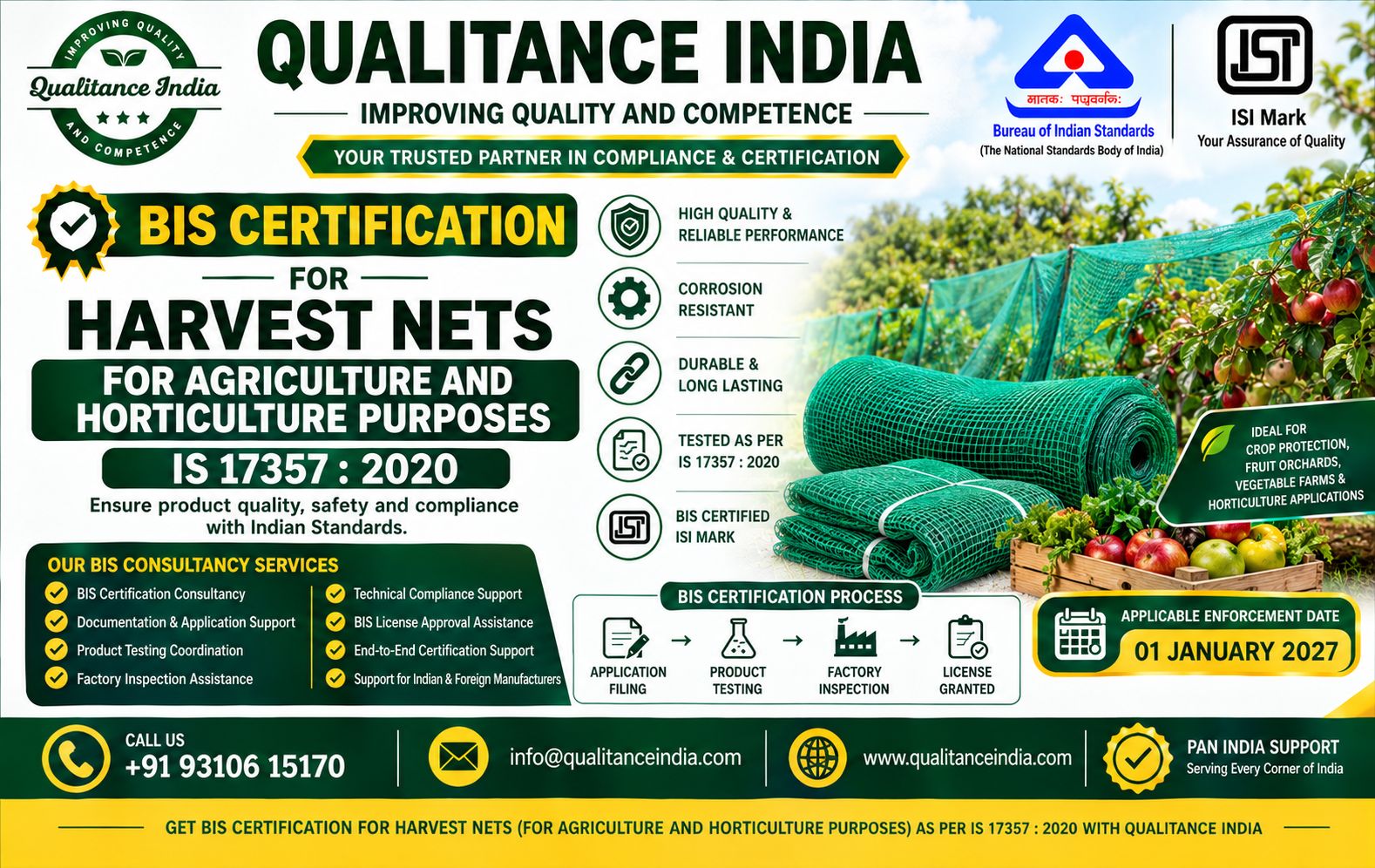
BIS Certification Process for Harvest Nets
The typical certification process is:
Product Identification → IS 17357:2020 Applicability → Factory Assessment → Raw Material Review → Product Scope → Sample Preparation → Testing → Documentation → BIS Application → Factory Inspection/Assessment → Compliance → BIS Licence → Standard Marking → Post-Licence Compliance
The exact procedure can vary according to the manufacturing unit and the requirements applicable at the time of application.
Documents Required for BIS Certification
Common documents may include:
- Company registration documents
- Factory address proof
- Factory ownership/lease documents
- Authorized signatory details
- Manufacturing process flow chart
- Factory layout
- Machinery details
- Testing equipment details
- Calibration certificates
- Product specifications
- Product construction details
- Raw-material details
- HDPE monofilament details
- Test reports
- Quality-control documents
- Production records
- Test records
- Applicable declarations and undertakings
- Brand/trademark documents where required
The final checklist should be prepared according to the current BIS application and product-specific requirements.
Factory Inspection for Harvest Net Manufacturers
A manufacturer applying for BIS certification should be prepared to demonstrate the ability to consistently manufacture conforming harvest nets.
Factory readiness may include:
- HDPE monofilament storage
- Net manufacturing machinery
- Fabric formation equipment
- Eyelet fixing arrangements, where applicable
- Cutting and finishing facilities
- Measurement equipment
- Testing arrangements
- Laboratory facility
- Calibration records
- Raw-material records
- Production records
- Quality-control documents
- Marking and packing system
Qualitance India assists manufacturers in reviewing these areas before BIS assessment.
BIS Testing Charges for Harvest Nets
Current BIS LIMS shows a testing scope for IS 17357 (2020).
One current LIMS listing displays a total testing charge of ₹22,410 excluding taxes for the listed scope. The same listing provides individual charges for several components, including HDPE monofilament density, heat shrinkage, fabric width, dimensions, mass, breaking strength, UV retention, colour fastness, bursting pressure, air permeability and related inspection requirements. (lims.bis.gov.in)
The exact cost may vary depending on:
- Laboratory
- Scope
- Exclusions
- Testing facility
- Sample requirements
- Additional tests
- Applicable taxes
The latest BIS LIMS entry should be checked before sample submission.
Cost of BIS Certification for Harvest Nets
The overall BIS certification cost is not limited to laboratory testing.
It may include:
- BIS application fees
- Licence-related charges
- Product testing
- Sample preparation
- Factory preparation
- Calibration
- Laboratory equipment
- Documentation
- Inspection-related expenses
- Consultancy charges
- Post-licence compliance
The actual cost depends on the manufacturer’s factory condition, testing arrangement and applicable certification scope.
How Long Does BIS Certification Take?
The certification timeline depends on:
- Factory readiness
- Testing schedule
- Sample conformity
- Documentation
- Laboratory availability
- Inspection scheduling
- BIS queries
- Corrective actions, if required
Manufacturers can reduce avoidable delays by preparing their factory, testing facilities, product information and documentation before filing the application.
Common Reasons for BIS Certification Delays
Incorrect Raw Material
The HDPE monofilament must meet the applicable requirements of IS 17357:2020.
Inadequate Testing Facility
Missing testing equipment or unsuitable laboratory arrangements can create delays.
Calibration Problems
Expired or unavailable calibration certificates can cause compliance issues.
Breaking Strength Failure
Failure in warpway or weftway breaking-strength requirements may require corrective action.
Poor UV Performance
Insufficient retention of breaking strength after UV exposure can lead to non-conformity.
Bursting Pressure Failure
The product must meet the applicable bursting-pressure requirements.
Poor Air Permeability
Air permeability results outside the required limits can affect conformity.
Inadequate Eyelet/Construction Control
Fabric, colour and eyelet-related in-process controls must be properly maintained.
Incorrect BIS Marking
The Standard Mark and licence number must be implemented according to applicable requirements.
Who Needs BIS Certification for Harvest Nets?
The certification requirement is particularly relevant to manufacturers producing Harvest Nets covered under the applicable Agro Textiles regulatory framework.
This may include manufacturers supplying products for:
- Agriculture
- Horticulture
- Orchards
- Fruit harvesting
- Crop harvesting
- Government agricultural projects
- Institutional procurement
- Agricultural equipment suppliers
Businesses involved only in trading or importing should separately verify the legal responsibility and applicable exemptions under the relevant QCO.
Benefits of BIS Certification for Harvest Nets
Regulatory Compliance
Certification supports compliance with the applicable Quality Control Order.
Quality Assurance
The product is manufactured under defined quality and performance requirements.
Buyer Confidence
Certified agro-textiles can provide additional confidence to institutional and professional buyers.
Government Procurement
BIS certification can support procurement opportunities where conformity is mandatory or specified.
Product Consistency
Inspection and testing requirements help maintain consistency in manufacturing.
Better Market Acceptance
A properly certified product can be more readily accepted in regulated markets.
BIS Certification Consultancy for Harvest Nets
Qualitance India provides complete support for manufacturers seeking BIS certification for Harvest Nets for Agriculture and Horticulture Purposes as per IS 17357:2020.
Product & Standard Identification
We assess the product and confirm the applicable Indian Standard.
BIS Applicability Assessment
We review the current certification and regulatory requirements applicable to the product.
Sample Planning
We assist in preparing the required 10-metre sample and coordinating the appropriate testing. (bis.gov.in)
Testing Coordination
We coordinate testing through the appropriate laboratory and help manage the required test reports.
Documentation Support
We assist in preparing the required BIS documents and application information.
Factory Inspection Preparation
We review production, testing, calibration and quality-control facilities before assessment.
BIS Application Filing
We assist with preparing and submitting the certification application.
Query & Compliance Support
We help coordinate responses to BIS observations and certification-related queries.
BIS Licence Processing
We provide support through the licence processing stage.
Post-Licence Compliance
We also provide support for ongoing compliance and applicable licence-related requirements.
Quick BIS Certification Checklist
Before applying for BIS certification for Harvest Nets:
☑ IS 17357:2020 applicability confirmed
☑ HDPE monofilament specifications checked
☑ Product construction finalized
☑ 10-metre representative sample prepared
☑ Manufacturing machinery available
☑ Testing equipment available
☑ Calibration records available
☑ Laboratory arrangement established
☑ Raw-material records maintained
☑ Quality-control system established
☑ Product testing completed
☑ Test reports reviewed
☑ BIS documentation prepared
☑ Factory ready for inspection
☑ Standard Mark arrangements prepared
☑ Control-unit records established
Frequently Asked Questions
1. What is IS 17357:2020?
IS 17357:2020 is the Indian Standard for Agro Textiles — Harvest Nets for Agriculture and Horticulture Purposes.
2. What are harvest nets used for?
Harvest nets are used in agriculture and horticulture to help protect harvested fruits or crops from damage caused by contact with soil or the ground.
3. Is BIS certification required for harvest nets?
IS 17357:2020 is included under the applicable Agro Textiles Quality Control Order framework and BIS Scheme-I. (bis.gov.in)
4. Which BIS scheme applies to harvest nets?
Certification is under Scheme-I according to the current Product Manual. (bis.gov.in)
5. What is the sample size for IS 17357:2020?
The Product Manual specifies 10 metres length as the sample size. (bis.gov.in)
6. What is the main raw material?
The Product Manual specifies HDPE monofilament conforming to Clauses 4.1 and 4.1.1 of IS 17357:2020. (bis.gov.in)
7. Are there BIS grouping guidelines?
No. The current Product Manual states that grouping guidelines are none. (bis.gov.in)
8. What are the main tests?
Important tests include length, width, mass, breaking strength, UV retention, colour fastness, bursting pressure and air permeability.
9. Is breaking strength tested?
Yes. Average breaking strength is checked in both warpway and weftway.
10. Which standard is used for breaking strength?
The Product Manual references IS 1969 (Part 1) for breaking-strength testing. (bis.gov.in)
11. Is UV resistance tested?
Yes. Retention of breaking strength after 144 hours of UV exposure is specified. (bis.gov.in)
12. How often is the UV test required?
The Product Manual specifies a frequency of once a month for the UV-retention test under its Scheme of Inspection and Testing. (bis.gov.in)
13. Is colour fastness tested?
Yes. Colour fastness to artificial light is included, using ISO 105-B02 as the referenced method. (bis.gov.in)
14. Is bursting pressure tested?
Yes. Bursting pressure is an applicable product requirement.
15. Is air permeability tested?
Yes. Air permeability is tested at 50 Pa water-head pressure using the referenced method. (bis.gov.in)
16. What is the control unit?
All harvest-net rolls or bundles of the same construction dispatched to a buyer against one dispatch note constitute one control unit. (bis.gov.in)
17. Which tests are performed for every control unit?
Mass, average breaking strength, bursting pressure and air permeability are specified at every-control-unit frequency. (bis.gov.in)
18. Is an in-house laboratory required?
A suitably equipped and staffed laboratory must be maintained for the applicable testing requirements. (bis.gov.in)
19. Can some tests be outsourced?
Yes. The Product Manual permits subcontracting for specified tests to BIS-recognized or Government laboratories empanelled by BIS, subject to the prescribed provisions. (bis.gov.in)
20. Are calibration records required?
Yes. The manufacturer must prepare and implement a calibration plan for test equipment and maintain test records. (bis.gov.in)
21. Is factory inspection required?
The manufacturer needs to demonstrate appropriate production, testing and quality-control capability as part of the BIS certification process.
22. What testing equipment is required?
Major equipment includes a calibrated steel rule, conditioning chamber, precision balance, tensile testing machine, UV-B lamp arrangement, bursting tester and air-permeability equipment. (bis.gov.in)
23. Is a conditioning chamber required?
Yes. The Product Manual identifies a conditioning chamber capable of maintaining 27 ± 2°C and 65 ± 2% relative humidity for relevant measurements. (bis.gov.in)
24. Is Standard Marking mandatory?
Conforming production covered under the BIS licence should carry the Standard Mark and licence number as prescribed. (bis.gov.in)
25. Can non-conforming products be BIS marked?
No. Only conforming production covered under the licence should carry the Standard Mark.
26. What is the current testing cost?
One current BIS LIMS listing shows ₹22,410 excluding taxes for the listed IS 17357:2020 testing scope. (lims.bis.gov.in)
27. Does the testing price remain fixed?
No. Laboratory scope, exclusions, testing facility and applicable charges can change. The current BIS LIMS entry should be checked before testing.
28. Can an MSME apply for BIS certification?
Eligible MSME manufacturers can apply subject to the applicable BIS certification and regulatory requirements.
29. Can a trader obtain the manufacturer’s BIS licence?
BIS product licensing is linked to the manufacturing and conformity-assessment requirements applicable to the product. Traders should verify their specific role and sourcing arrangement.
30. How can I obtain BIS Certification for Harvest Nets?
Start by identifying the manufacturer, product construction, raw material and intended scope. Qualitance India can assist with standard applicability, documentation, testing, factory preparation, application filing and BIS licence processing.
Related BIS Certification Services
Qualitance India also provides consultancy for:
- BIS Certification
- ISI Mark Certification
- Agro Textile Certification
- Protective Textile Certification
- BIS Scheme-I Certification
- BIS Licence Renewal
- BIS Scope Extension
- Product Testing Coordination
- BIS Documentation
- Factory Inspection Assistance
- Quality Control Order Applicability
- Product Grouping Guidance
- Technical Compliance Support
Related Agro Textile Standards
Manufacturers of agro-textile products may also need to evaluate other applicable standards, including:
- IS 17355:2020 – Propylene Spun Bonded Non-Woven Mulch Mat
- IS 17356:2020 – Windshield Nets
- IS 17358 (Part 1):2020 – Fencing Nets made from Extruded Polymer Mesh
- IS 17358 (Part 2):2020 – Fencing Nets made from Monofilament Yarns and Combination of Tape and Monofilament Yarns
- IS 17513:2020 – Plant Support Nets
- IS 17730 (Part 1):2021 – Warp Knitted Hail Protection Nets
- IS 17730 (Part 2):2021 – Woven Hail Protection Nets
- IS 17731:2021 – Laminated Woven Orchard Protection Covers
These standards are currently listed by BIS under Agro Textiles. (bis.gov.in)
Why Choose Qualitance India?
Qualitance India provides practical end-to-end support for manufacturers seeking BIS certification for agro-textile products.
Product Assessment
We review the product and identify the relevant Indian Standard.
Regulatory Guidance
We help understand the applicable BIS certification and QCO requirements.
Testing Coordination
We assist with sample preparation and laboratory testing.
Documentation
We help prepare and organize the required BIS documents.
Factory Preparation
We review manufacturing and testing arrangements before inspection.
BIS Application
We assist with application filing and follow-up.
Inspection Assistance
We help prepare the factory for applicable BIS assessment.
Licence Processing
We support the certification process through the licence stage.
Post-Licence Compliance
We provide ongoing support for applicable BIS compliance requirements.
Contact Qualitance India
Qualitance India – Your Certification & Compliance Partner
Phone: +91 93106 15170
Email: info@qualitanceindia.com
Website: https://qualitanceindia.com/
For BIS Certification of Harvest Nets for Agriculture & Horticulture as per IS 17357:2020, Qualitance India provides complete consultancy covering product assessment, sample planning, testing coordination, documentation, factory inspection preparation, BIS application and licence support.
Conclusion
Harvest Nets are important agro-textile products used in agriculture and horticulture for protecting harvested produce from damage associated with contact with the ground. IS 17357:2020 establishes requirements for their construction and performance, while the BIS Product Manual provides the certification framework under Scheme-I. (bis.gov.in)
The certification process involves careful attention to HDPE monofilament raw material, product construction, a 10-metre sample, dimensional requirements, mass, breaking strength, UV resistance, colour fastness, bursting pressure, air permeability, testing facilities, calibration, control units, records and Standard Marking.
For manufacturers covered by the applicable Agro Textiles Quality Control Order, obtaining the appropriate BIS certification is an important compliance requirement.
With Qualitance India, manufacturers can receive end-to-end support from product identification and sample preparation through testing, documentation, factory inspection preparation, BIS application, licence processing and post-licence compliance.
Need BIS Certification for Harvest Nets as per IS 17357:2020? Contact Qualitance India for complete BIS licence and compliance support.
Need help with BIS certification for this product?
Get a free consultation from our compliance experts — we handle testing, documentation and the complete BIS process for you.