
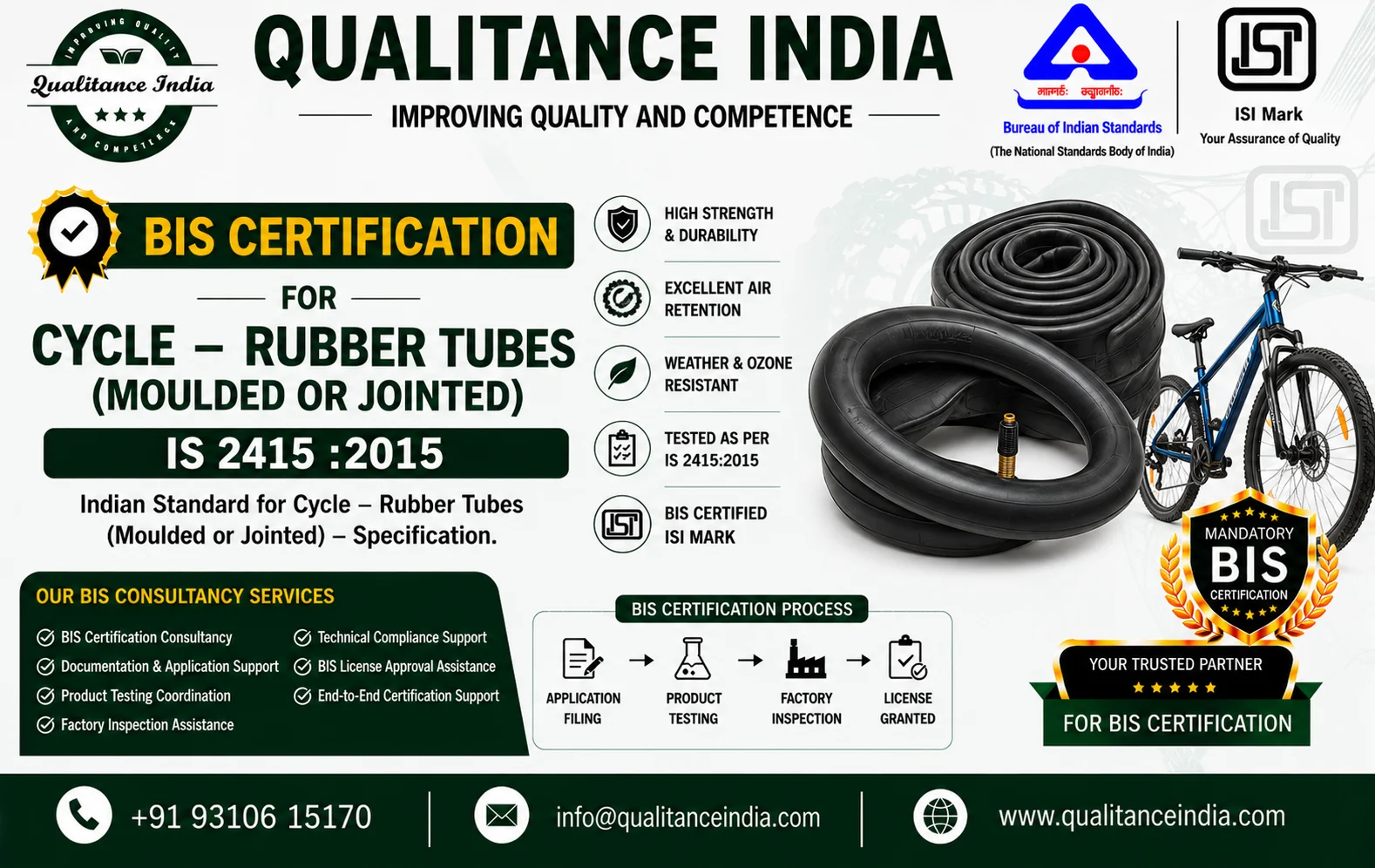
BIS Certification for Cycle Rubber Tubes | IS 2415:2015 | BIS Consultancy
Introduction
Cycle rubber tubes are essential components of pneumatic bicycle tyres. They hold compressed air inside the tyre and directly influence inflation, riding comfort, air retention, compatibility with the tyre and overall wheel performance.
Because a cycle tube must withstand inflation pressure and repeated use without leakage or premature failure, important properties such as dimensions, thickness, tensile strength, elongation, ageing resistance, tension set and joint strength need to be controlled.
The applicable Indian Standard is IS 2415:2015 – Cycle — Rubber Tubes (Moulded/Jointed) — Specification (Fourth Revision). BIS’s Product Manual PM/IS 2415/1/September 2018 provides the certification framework under Scheme-I. It covers four classes of cycle rubber tubes—Class A, Class B, Class C and Class D—and specifies product grouping, a sample of two tubes along with valves, testing requirements and quality-control provisions.
The product is covered by the Cycle and Rickshaw Tyres and Tubes (Quality Control) Order, 2023, which requires the specified cycle rubber tubes to conform to the applicable Indian Standard and bear the Standard Mark under a BIS licence as per Scheme-I.
Qualitance India provides complete BIS Certification consultancy for Cycle Rubber Tubes, including standard applicability, product classification, grouping, sample planning, testing coordination, documentation, BIS application, factory inspection preparation, licence processing and continuing compliance.
What is IS 2415:2015?
IS 2415:2015 is titled:
“Cycle — Rubber Tubes (Moulded/Jointed) — Specification”
The standard is the Fourth Revision and covers moulded and jointed rubber tubes intended for use with cycle tyres covered by IS 2414. BIS technical material states that the tubes are intended for cycle tyres and addresses requirements relating to material composition, dimensions, mechanical properties, ageing, joint adhesion, leakage and valves.
The standard covers both:
- Moulded rubber tubes
- Jointed rubber tubes
What is a Moulded Tube?
A moulded tube is a tube vulcanized in a heated mould or by another suitable process and having a butt joint.
What is a Jointed Tube?
A jointed tube is a tube vulcanized in an autoclave or cured by another suitable process and having an overlap joint.
Current BIS Certification Status
The BIS Product Manual available for this product is:
PM/IS 2415/1/September 2018
It identifies:
- Product: Cycle Rubber Tubes (Moulded/Jointed)
- Standard: IS 2415:2015
- Certification Scheme: Scheme-I
- Amendments in Product Manual: Nil
- Grouping: Annex A
- Sample: 2 cycle rubber tubes along with valve
- Test Equipment: Annex B
- Scheme of Inspection and Testing: Annex C.
The current BIS Scheme-I listing also includes IS 2415:2015 – Cycle – Rubber Tubes (Moulded or Jointed) under the Cycle and Rickshaw Tyres and Tubes product category.
Is BIS Certification Mandatory for Cycle Rubber Tubes?
Yes.
The Cycle and Rickshaw Tyres and Tubes (Quality Control) Order, 2023 specifically includes:
IS 2415:2015 – Cycle – Rubber Tubes (Moulded or Jointed)
The QCO requires the covered product to conform to the corresponding Indian Standard and bear the Standard Mark under a BIS licence according to Scheme-I. The order does not apply to goods or articles manufactured domestically for export.
Implementation Timeline
The QCO was notified on 11 December 2023 and provides:
- General manufacturers: after six months from publication
- Small enterprises: after nine months
- Micro enterprises: after twelve months.
That corresponds to approximately:
- 11 June 2024 – general implementation
- 11 September 2024 – small enterprises
- 11 December 2024 – micro enterprises
Manufacturers should verify the latest applicable notification and any subsequent amendment before relying on a specific exemption or transition provision.
Who Needs BIS Certification for Cycle Rubber Tubes?
The BIS requirements are particularly relevant to manufacturers producing cycle rubber tubes for the Indian market.
This may include:
- Bicycle tube manufacturers
- Cycle component manufacturers
- Rubber tube manufacturers
- Bicycle OEM suppliers
- Cycle spare-part manufacturers
- Private-label cycle component suppliers
- Government and institutional suppliers
- Businesses supplying cycle tyres and tubes
Importers, traders and distributors should separately verify their responsibilities under the applicable QCO.
Product Classes Under IS 2415:2015
Cycle rubber tubes are classified according to the rubber material used in compounding.
Class A
Butyl rubber and equivalent rubber
Class B
Synthetic rubbers other than butyl rubber
Class C
Natural rubber blended with compatible synthetic rubber
Class D
Natural rubber and equivalent rubber.
The Product Manual uses these four classes as the principal licence-scope classification.
Tube Designation
The cycle rubber tube is designated according to the designation of the corresponding cycle tyre.
This means the tube must be appropriately matched to the tyre size designation used for the corresponding cycle tyre.
Correct product designation is therefore important for:
- Product marking
- Scope
- Compatibility
- Quality control
- Customer identification.
Dimensions of Cycle Rubber Tubes
The standard contains dimensional requirements for cycle rubber tubes.
The main dimensional characteristics include:
- Flat length
- Flat width
- Thickness
- Uniformity of thickness
Flat Length
The flat length is approximately half of the total circumferential length of the completely deflated tube when measured flat. It is also referred to as double-fold length.
Flat Width
Flat width is measured with the deflated tube laid flat according to the method specified in Annex A.
Thickness
The standard specifies a minimum average tube thickness of:
0.8 mm minimum
subject to the special provision for certain large ETRTO/British designations where thickness may be agreed between purchaser and supplier.
Uniformity of Thickness
Except near the lap or splice region, the thickness variation along the tube should not exceed ±15% of the arithmetic mean at any point under the specified measurement procedure.
Main BIS Tests for Cycle Rubber Tubes
The Product Manual identifies important tests under IS 2415:2015.
1. Dimensions
Dimensional conformity is checked for:
- Flat length
- Flat width
- Thickness
- Uniformity of thickness.
2. Tensile Strength
Tensile strength is one of the principal mechanical properties.
The standard specifies minimum tensile strength according to the rubber class.
The corresponding test method is IS 3400 (Part 1).
3. Elongation at Break
Elongation at break indicates the ability of the rubber to stretch before failure.
The applicable test is performed with the tensile test according to IS 3400 (Part 1).
4. Tension Set
Tension set measures the permanent deformation of the rubber after extension.
The test is performed according to IS 3400 (Part 13) at the specified stretch.
The standard states that this test applies to Class B, Class C and Class D tubes.
5. Ageing Test
Ageing resistance is important because rubber properties can change due to heat and environmental exposure.
The standard specifies accelerated ageing using the air-oven method under IS 3400 (Part 4).
The specified ageing conditions are:
- 70 ± 1°C for 168 hours for Class B, C and D
- 125 ± 1°C for 72 hours for Class A.
After ageing, the variation in tensile strength and elongation at break must remain within the specified limits.
6. Joint Adhesion Strength
For jointed tubes, joint adhesion is a critical requirement.
The minimum joint adhesion strength specified is:
3.05 kgf/cm (3 000 N/m).
7. Strength of Splice on Moulded Tube
For moulded tubes, splice strength is evaluated relative to body strength.
The average splice strength must be at least:
- 45% for Class D
- 40% for Class A, B and C.
8. Leak Test
The tube is inflated until its cross-sectional circumference increases by 20% maximum from its initial circumference and is then immersed in water for 1 minute.
The tube must not show any sign of leakage.
9. Valve Test / Valve Requirement
A suitable valve conforming to IS 532 must be provided in each tube.
The valve is therefore an important part of the finished cycle-tube assembly.
Mechanical Property Requirements by Class
The standard specifies the following minimum tensile requirements:
| Class | Minimum Tensile Strength | Minimum Elongation at Break |
|---|---|---|
| Class A | 8 MPa | 450% |
| Class B | 6 MPa | 350% |
| Class C | 6 MPa | 350% |
| Class D | 10 MPa | 430% |
These values are given in Table 3 of IS 2415:2015.
BIS Grouping Guidelines for Cycle Rubber Tubes
The BIS Product Manual provides grouping under Annex A.
The primary grouping parameter is:
Class of Tube
- Class A
- Class B
- Class C
- Class D
The manufacturer must declare the classes intended to be covered in the licence.
Grouping of Different Sizes
The Product Manual states that:
Different sizes of tubes can be considered as one group provided the class remains the same.
Any one size from each class can be tested to cover all sizes of tubes in that particular class group.
This can significantly simplify certification scope planning.
Scope Restriction
The licence scope may be restricted according to:
- Manufacturing capability
- Testing capability.
During operation of the licence, BIS may ensure that different types and sizes included in the licence are tested in rotation to the extent possible.
BIS Sample Size for Cycle Rubber Tubes
The Product Manual specifies:
Two pieces of cycle rubber tube along with valve.
The manufacturer should make sure the submitted sample is:
- Representative of regular production
- Correctly identified
- From the intended class
- Of the intended size
- Complete with the valve.
Sampling Under IS 2415:2015
The underlying standard provides a detailed sampling framework.
For guidance, a consignment consists of cycle tubes of the same nominal size manufactured by the same firm under relatively similar manufacturing conditions.
The standard divides the consignment into groups of 5,000 tubes or less, with each group constituting a lot.
Non-Destructive Testing
Selected tubes from each lot are checked for:
- Dimensions
- Leak test.
Destructive Testing
For each lot that passes the non-destructive checks, one tube is selected and test pieces are prepared for:
- Tensile strength
- Elongation at break
- Tension set
- Ageing
- Joint adhesion strength.
If a characteristic fails, the standard specifies additional sampling and testing before the lot can be accepted.
Manufacturing Process for Cycle Rubber Tubes
A typical manufacturing process may include:
Raw Material Receipt → Rubber Compounding → Mixing → Extrusion/Tube Formation → Curing/Vulcanization → Cutting → Jointing/Splicing or Moulding → Valve Installation → Finishing → Dimensional Inspection → Leak Testing → Mechanical Testing → Final Inspection → Marking → Packing
The exact manufacturing route depends on whether the tube is:
- Moulded
- Jointed
- Butyl
- Synthetic-rubber based
- Natural-rubber based
- Blended.
Important Manufacturing Controls
Rubber Compound
The manufacturer should control:
- Polymer type
- Filler/additive dosage
- Plasticizers
- Vulcanizing system
- Batch identification
- Mixing conditions.
Extrusion
Important parameters can include:
- Tube wall thickness
- Diameter
- Uniformity
- Extrusion speed
- Compound temperature.
Vulcanization
Curing conditions have a direct effect on:
- Tensile strength
- Elongation
- Tension set
- Ageing
- Durability.
Jointing
Jointed tubes require proper overlap, bonding and curing of the joint.
Valve Installation
The valve must be properly mounted so that inflation and air retention are maintained.
BIS Laboratory Testing Equipment
The BIS Product Manual refers to Annex B for the applicable equipment.
Important testing facilities can include:
Dimensional Measurement
- Steel scale
- Measuring tape
- Flat measurement table
- Thickness measuring device
- Suitable micrometer/gauge.
Tensile and Elongation Testing
- Tensile testing machine
- Dumb-bell die
- Suitable grips
- Thickness measurement facility.
Tension Set
- Extension arrangement
- Dumb-bell test pieces
- Oven
- Measuring equipment.
Ageing
- Air oven capable of maintaining the required temperature
- Suitable test fixtures.
Joint Adhesion / Splice Strength
- Tensile testing machine
- Specimen cutting tools
- Suitable fixtures.
Leak Test
- Inflation arrangement
- Water tank
- Pressure measurement equipment.
The final equipment requirement should be established using Annex B and the manufacturer’s exact testing scope.
BIS Laboratory Requirements
The manufacturer should maintain suitable laboratory facilities for the applicable certification tests.
Important requirements include:
- Suitable testing equipment
- Trained personnel
- Calibration system
- Test procedures
- Test records
- Sample identification
- Traceability.
For tests that are not available in-house, the applicable BIS provisions should be followed for permitted external testing.
Scheme of Inspection and Testing
The BIS Product Manual identifies a Scheme of Inspection and Testing under Annex C.
Important quality-control areas include:
- Product classification
- Dimensions
- Tensile strength
- Elongation
- Tension set
- Ageing
- Joint adhesion
- Leak test
- Valve
- Manufacturing and workmanship
- Marking
- Packing.
A manufacturer should maintain systematic quality-control records for production and final inspection.
Marking Requirements
The tube must carry the applicable identification and marking requirements.
The standard requires the nominal size designation of the tube to be marked, corresponding to the size designation of the tyre with which it is intended to be used.
The BIS certification framework additionally requires licensed conforming production to bear the applicable BIS Standard Mark according to the certification licence.
The manufacturer’s product marking should be finalized against the current IS 2415 requirements and BIS licence conditions.
Product Quality and Workmanship
The standard requires the tube to:
- Be clean
- Be free from blemishes
- Retain a uniform cross-section when inflated under the prescribed condition.
Poor surface quality, uneven wall thickness, weak joints or improper valve installation can lead to product failure.
Control Unit and Quality Records
The manufacturer should maintain traceability between:
- Rubber compound batch
- Production batch
- Tube class
- Nominal size
- Manufacturing date
- Joint/splice details
- Valve batch
- Test result
- Final dispatch.
This traceability is important for maintaining consistent quality and responding effectively to non-conformities.
Factory Inspection for Cycle Rubber Tube Manufacturers
Before BIS assessment, the manufacturer should ensure that the factory has:
Manufacturing Facilities
- Rubber mixing
- Compounding
- Tube formation
- Vulcanization
- Jointing/moulding
- Valve fitting
- Finishing.
Testing Facilities
- Dimensional testing
- Tensile testing
- Elongation
- Tension set
- Ageing
- Joint strength
- Leak testing.
Quality-Control Facilities
- Incoming material inspection
- Process controls
- Finished product inspection
- Calibration
- Test records
- Rejection control.
Qualitance India assists manufacturers in reviewing their factory readiness before the applicable BIS assessment.
Documents Required for BIS Certification
Common documents may include:
- Company registration documents
- Factory address proof
- Factory ownership/lease documents
- Authorized signatory details
- Manufacturing process flow chart
- Factory layout
- Rubber mixing/compounding machinery details
- Tube manufacturing machinery
- Vulcanization equipment
- Jointing/moulding equipment
- Valve-fitting equipment
- Testing equipment list
- Calibration certificates
- Product specifications
- Tube class details
- Size/designation details
- Rubber-compound details
- Valve details
- Test reports
- Quality-control documents
- Production records
- Internal test records
- Marking details
- Packaging information
- Applicable declarations and undertakings
- Trademark documents, where applicable.
Current BIS Testing Charges for IS 2415:2015
Current BIS LIMS listings show multiple laboratories with active testing scope for IS 2415:2015 – Cycle Rubber Tubes (Moulded/Jointed).
Examples currently displayed include:
₹8,700 excluding taxes at the Research & Development Centre for Bicycle and Sewing Machine, Ludhiana.
Another current BIS LIMS listing at BIS Central Laboratory displays:
₹14,270 excluding taxes.
The BIS Western Regional Laboratory currently displays:
₹14,270 excluding taxes for the listed scope.
These are laboratory-specific displayed charges and are not a universal fixed certification price.
The final amount can vary according to:
- Laboratory
- Test scope
- Product class
- Scope of testing
- Sample requirements
- Exclusions
- Applicable taxes.
The latest BIS LIMS entry should therefore be confirmed before testing.
Cost of BIS Certification for Cycle Rubber Tubes
The total certification cost may include:
- BIS application fees
- Laboratory testing
- Sample preparation
- Factory assessment
- Calibration
- Testing equipment
- Documentation
- Inspection-related expenses
- Consultancy charges
- Licence-related costs
- Continuing compliance expenses.
The final cost depends on the proposed product scope and the manufacturer’s existing facilities.
How Long Does BIS Certification Take?
The certification timeline depends on:
- Product class
- Tube size
- Sample availability
- Laboratory schedule
- Factory preparedness
- Documentation
- Application processing
- Inspection
- Resolution of observations.
Routine laboratory testing can be completed relatively quickly once samples and facilities are ready, but the overall BIS licensing process includes application and factory-assessment activities beyond laboratory testing.
Common Reasons for BIS Certification Delays
Wrong Class
The manufacturer may incorrectly identify the rubber classification.
Poor Compound Control
Variation in the rubber formulation can affect tensile and ageing properties.
Thickness Variation
Uneven wall thickness can lead to dimensional and performance failures.
Tensile Strength Failure
Poor compounding or curing can reduce tensile strength.
Elongation Failure
Incorrect material formulation or vulcanization can affect elongation.
Tension Set Failure
Permanent deformation may exceed the applicable requirement.
Ageing Failure
Improper compound selection can cause excessive property change after ageing.
Joint Failure
Weak lap or butt joints can lead to adhesion or splice-strength failure.
Leakage
Valve, seam or tube-body defects can result in air leakage.
Incorrect Valve
The valve must comply with the applicable valve standard and be properly fitted.
Calibration Problems
Laboratory equipment should have valid calibration.
Incorrect Sample
The sample must represent the class and size being proposed for certification.
Incomplete Documents
Missing process, test, machinery or factory records can delay the application.
Benefits of BIS Certification for Cycle Rubber Tubes
Regulatory Compliance
Certification addresses the mandatory requirements under the applicable QCO.
Better Product Quality
Testing ensures that critical mechanical and dimensional properties are controlled.
Consumer Confidence
BIS-certified tubes provide greater confidence in product conformity.
Product Compatibility
Correct size designation supports proper matching with corresponding cycle tyres.
Government & Institutional Supply
Certification supports procurement where compliance is required.
Consistent Production
Regular inspection and testing help maintain manufacturing consistency.
BIS Certification Consultancy by Qualitance India
Qualitance India provides complete BIS Certification consultancy for Cycle Rubber Tubes as per IS 2415:2015.
Product & Standard Identification
We review the product and confirm the applicable standard and certification route.
Class Assessment
We help determine whether the tube falls under:
- Class A
- Class B
- Class C
- Class D.
Scope & Grouping
We help determine the desired size range and representative sample according to BIS grouping provisions.
Sample Planning
We assist with the required two cycle rubber tubes along with valves.
Testing Coordination
We coordinate testing for:
- Dimensions
- Tensile strength
- Elongation
- Tension set
- Ageing
- Joint adhesion
- Leak test
- Other applicable requirements.
Documentation Support
We assist with BIS application documents and technical information.
Factory Inspection Preparation
We review machinery, testing equipment, calibration and quality-control procedures.
BIS Application Filing
We assist with preparation and submission of the BIS certification application.
Factory Inspection Assistance
We help prepare the unit for BIS assessment.
Query & Compliance Support
We assist in resolving technical and documentation-related observations.
Licence Processing
We support the certification process through licence grant.
Post-Licence Compliance
We assist with renewal, scope-related changes and continuing BIS compliance.
Quick BIS Certification Checklist
Before applying for BIS certification for cycle rubber tubes:
☑ IS 2415:2015 applicability confirmed
☑ Moulded or jointed construction identified
☑ Rubber class identified
☑ Class A/B/C/D finalized
☑ Tube size/designation finalized
☑ Valve specification checked
☑ Grouping reviewed
☑ Rubber compound controlled
☑ Manufacturing machinery available
☑ Vulcanization facility available
☑ Jointing/moulding facility available
☑ Testing equipment available
☑ Calibration certificates available
☑ Leak-test facility available
☑ Representative samples prepared
☑ Test reports completed
☑ Quality-control system established
☑ BIS documentation prepared
☑ Factory ready for inspection
☑ Product marking prepared
Frequently Asked Questions
1. What is IS 2415:2015?
IS 2415:2015 is the Indian Standard for Cycle – Rubber Tubes (Moulded/Jointed) – Specification, Fourth Revision.
2. Is BIS certification mandatory for cycle rubber tubes?
Yes. Cycle rubber tubes under IS 2415:2015 are included in the Cycle and Rickshaw Tyres and Tubes (Quality Control) Order, 2023, which requires the Standard Mark under a BIS licence according to Scheme-I.
3. Which BIS scheme applies?
Certification is under Scheme-I.
4. What is the current BIS Product Manual?
The Product Manual is PM/IS 2415/1/September 2018.
5. What types of cycle tubes are covered?
Both moulded and jointed cycle rubber tubes are covered.
6. What are the four classes of cycle rubber tubes?
The classes are:
- Class A – Butyl rubber and equivalent
- Class B – Synthetic rubber other than butyl
- Class C – Natural rubber blended with compatible synthetic rubber
- Class D – Natural rubber and equivalent.
7. What is the sample size for BIS certification?
The Product Manual specifies two pieces of cycle rubber tube along with valve.
8. Is grouping available?
Yes. Grouping is provided according to the class of tube.
9. Can different sizes be included in one group?
Yes. Different tube sizes can be considered as one group when the class remains the same.
10. How many sizes need to be tested for grouping?
The Product Manual states that any one size from each class can be tested for covering all sizes in that group, subject to the applicable conditions.
11. Does tube size have to match tyre size?
Yes. The tube is designated according to the corresponding tyre designation and should be suitable for the same tyre size designation.
12. What is the minimum tube thickness?
The specified minimum is 0.8 mm, subject to the special provisions for certain larger tube designations.
13. What is the thickness uniformity requirement?
Except near the joint/lap region, thickness should not vary from the arithmetic mean by more than ±15% at any point under the specified method.
14. What is the minimum tensile strength for Class A?
Class A requires a minimum tensile strength of 8 MPa and minimum elongation of 450%.
15. What is the minimum tensile strength for Class B?
Class B requires a minimum tensile strength of 6 MPa and minimum elongation of 350%.
16. What is the minimum tensile strength for Class C?
Class C requires a minimum tensile strength of 6 MPa and minimum elongation of 350%.
17. What is the minimum tensile strength for Class D?
Class D requires a minimum tensile strength of 10 MPa and minimum elongation of 430%.
18. Which test method is used for tensile strength?
Tensile strength and elongation at break are tested according to IS 3400 (Part 1).
19. Is tension-set testing required?
Yes, for Class B, Class C and Class D tubes under the standard’s applicable requirements.
20. What is the maximum tension set?
The standard specifies a maximum tension set of 20% under the stated test conditions.
21. Is ageing testing required?
Yes. Ageing is performed according to IS 3400 (Part 4).
22. What are the ageing conditions for Class B, C and D?
The ageing test is conducted at 70 ± 1°C for 168 hours.
23. What are the ageing conditions for Class A?
Class A tubes are aged at 125 ± 1°C for 72 hours.
24. Is joint adhesion testing required?
Yes, jointed tubes are subject to joint adhesion-strength requirements.
25. What is the minimum joint adhesion strength?
The minimum specified joint adhesion strength is 3.05 kgf/cm (3 000 N/m).
26. Is splice strength tested for moulded tubes?
Yes. The average splice strength relative to body strength is specified at 45% minimum for Class D and 40% minimum for Class A, B and C.
27. Is leak testing required?
Yes. The tube must not show leakage when inflated to the specified circumference increase and immersed in water for one minute.
28. What valve must be fitted to the tube?
A suitable valve conforming to IS 532 must be provided in each tube.
29. What is the lot size under the standard?
For guidance, tubes of the same nominal size made under relatively similar conditions are grouped into lots of 5,000 tubes or less.
30. What tests are part of non-destructive sampling?
Dimensions and leak testing are used for the non-destructive conformity assessment of the lot.
31. What tests are destructive tests?
Tensile strength, elongation, tension set, ageing and joint adhesion are among the destructive characteristics tested from samples selected from conforming lots.
32. What happens when a sample fails a destructive test?
The standard provides for two additional tubes to be tested for the failed characteristic; the lot is accepted only when the prescribed additional results are satisfactory.
33. What are the main BIS tests?
The main certification requirements include dimensions, tensile strength, elongation at break, tension set, ageing, joint adhesion strength and leak testing.
34. Is workmanship checked?
Yes. The standard requires tubes to be clean, free from blemishes and able to retain a uniform cross-section under the specified inflation condition.
35. Is an in-house laboratory required?
The manufacturer must maintain suitable testing arrangements as prescribed under the BIS certification framework and Product Manual.
36. Is calibration required?
Testing equipment should be appropriately calibrated and calibration records maintained as part of the quality-control system.
37. Can testing be outsourced?
Where permitted by the Product Manual and applicable BIS provisions, specified testing can be carried out through approved external laboratory facilities.
38. Is factory inspection required?
The manufacturer must demonstrate suitable manufacturing, testing and quality-control capabilities during the BIS certification process.
39. Does BIS certification cover every size automatically?
The grouping provisions allow different sizes within the same class to be covered based on representative testing, subject to manufacturing and testing capability and the approved licence scope.
40. Can one licence cover Class A and Class D?
The manufacturer can propose multiple classes, but each class is a separate grouping parameter and representative testing must be carried out according to the Product Manual.
41. Can a manufacturer include all four classes?
Yes, subject to the required testing, manufacturing capability and BIS approval.
42. What are current BIS testing charges?
Current BIS LIMS examples show ₹8,700, ₹14,270 and ₹14,270 excluding taxes at different laboratories for listed IS 2415 scopes.
43. Are these charges fixed?
No. Laboratory charges vary according to the laboratory, scope, test inclusions/exclusions and applicable taxes.
44. Does the QCO apply to exports?
The 2023 QCO states that it does not apply to goods or articles manufactured domestically for export.
45. When was the Cycle and Rickshaw Tyres and Tubes QCO issued?
The QCO was issued on 11 December 2023.
46. What is the general implementation period under the QCO?
The order provides six months from publication for general implementation, nine months for small enterprises and twelve months for micro enterprises.
47. Can a private-label cycle tube seller use another manufacturer’s BIS licence?
This should not be assumed automatically. The manufacturer, product scope, branding and BIS licence conditions should be checked for the exact arrangement.
48. Can an OEM manufacturer apply for BIS certification?
Yes, an eligible manufacturing unit can apply subject to the applicable BIS requirements.
49. What documents are important for BIS certification?
Important documents include factory information, manufacturing process, machinery details, test equipment, calibration, product specifications, raw-material information, test reports, quality records and marking information.
50. Can Qualitance India help with complete BIS certification for Cycle Rubber Tubes?
Yes. Qualitance India provides end-to-end consultancy covering standard applicability, class selection, grouping, sample planning, testing coordination, documentation, BIS application, factory inspection preparation, licence processing and post-licence compliance.
Related BIS Certification Services
Qualitance India also provides consultancy for:
- BIS Certification
- ISI Mark Certification
- Cycle Rubber Tube Certification
- Bicycle Tyre Certification
- Cycle and Rickshaw Tyre Certification
- Bicycle Components Certification
- Rubber Product Certification
- BIS Scheme-I Certification
- BIS Licence Renewal
- BIS Scope Extension
- Product Testing Coordination
- Factory Inspection Assistance
- BIS Documentation
- Quality Control Order Applicability
- Product Grouping Guidance
- Technical Compliance Support
Related Bicycle & Cycle Standards
Manufacturers in the bicycle sector may also need BIS certification consultancy for products such as:
- IS 2414 – Cycle and Rickshaw Pneumatic Tyres
- IS 532 – Bicycle Tube Valves and Valve Tubing
- IS 623 – Bicycle Frames
- IS 624 – Bicycle Rims
- IS 625 – Bicycle Handle Bars
- IS 628 – Bicycle Pedal Assembly
- IS 629 – Bicycle Hub Assembly
- IS 1281 – Bicycle Cranks and Chain Wheels
- Other regulated bicycle components.
The applicable standard should always be verified against the exact product and current BIS/QCO position.
Why Choose Qualitance India?
Qualitance India provides complete BIS Certification consultancy for cycle and rubber products.
Product Assessment
We identify the correct standard and certification route.
Class Selection
We help determine the correct rubber class.
Grouping Guidance
We assist in planning representative sizes and product scope.
Sample Planning
We help arrange the required tubes and valves.
Testing Coordination
We coordinate dimensional, mechanical, ageing, joint and leakage testing.
Documentation Support
We assist with BIS application and technical documentation.
Factory Preparation
We review rubber-processing machinery, tube-manufacturing facilities, testing equipment and calibration.
BIS Application Filing
We assist with preparing and submitting the BIS application.
Factory Inspection Assistance
We help prepare the manufacturing unit for BIS assessment.
Query & Compliance Support
We assist with technical and documentary observations.
Licence Processing
We support the certification process through the licence stage.
Post-Licence Compliance
We provide support for renewal, scope changes and continuing certification requirements.
Contact Qualitance India
Qualitance India – Your Certification & Compliance Partner
Phone: +91 93106 15170
Email: info@qualitanceindia.com
Website: https://qualitanceindia.com/
For BIS Certification of Cycle Rubber Tubes as per IS 2415:2015, Qualitance India provides complete consultancy covering product classification, grouping, sample preparation, testing, documentation, factory inspection preparation, BIS application, licence processing and post-licence compliance.
Conclusion
IS 2415:2015 – Cycle Rubber Tubes (Moulded/Jointed) is an important standard for manufacturers of bicycle inner tubes. The standard covers both moulded and jointed tubes and classifies them into Class A, Class B, Class C and Class D according to the rubber used in compounding.
The BIS Product Manual PM/IS 2415/1/September 2018 operates under Scheme-I and specifies a sample of two cycle rubber tubes along with valves. It also provides grouping provisions under which different sizes can be covered together when the rubber class remains the same, subject to the applicable testing and manufacturing capability.
Important conformity requirements include flat length, flat width, thickness, uniformity of thickness, tensile strength, elongation at break, tension set, accelerated ageing, joint adhesion strength, splice strength, leak testing and valve compliance. The standard also specifies important class-wise mechanical requirements and ageing conditions.
The product is included under the Cycle and Rickshaw Tyres and Tubes (Quality Control) Order, 2023, which requires the specified cycle rubber tubes to conform to the Indian Standard and bear the Standard Mark under a BIS licence according to Scheme-I.
For manufacturers, successful BIS certification requires more than laboratory testing. Correct classification, grouping, representative sample selection, rubber-compounding control, vulcanization, joint quality, valve fitting, dimensional control, leakage testing, calibration, quality records and factory preparedness all play an important role.
Qualitance India provides end-to-end BIS Certification consultancy for Cycle Rubber Tubes, helping manufacturers manage the complete process from standard identification and sample planning to testing, documentation, factory inspection, licence processing and post-licence compliance.
Need BIS Certification for Cycle Rubber Tubes as per IS 2415:2015? Contact Qualitance India for complete BIS licence and compliance support.