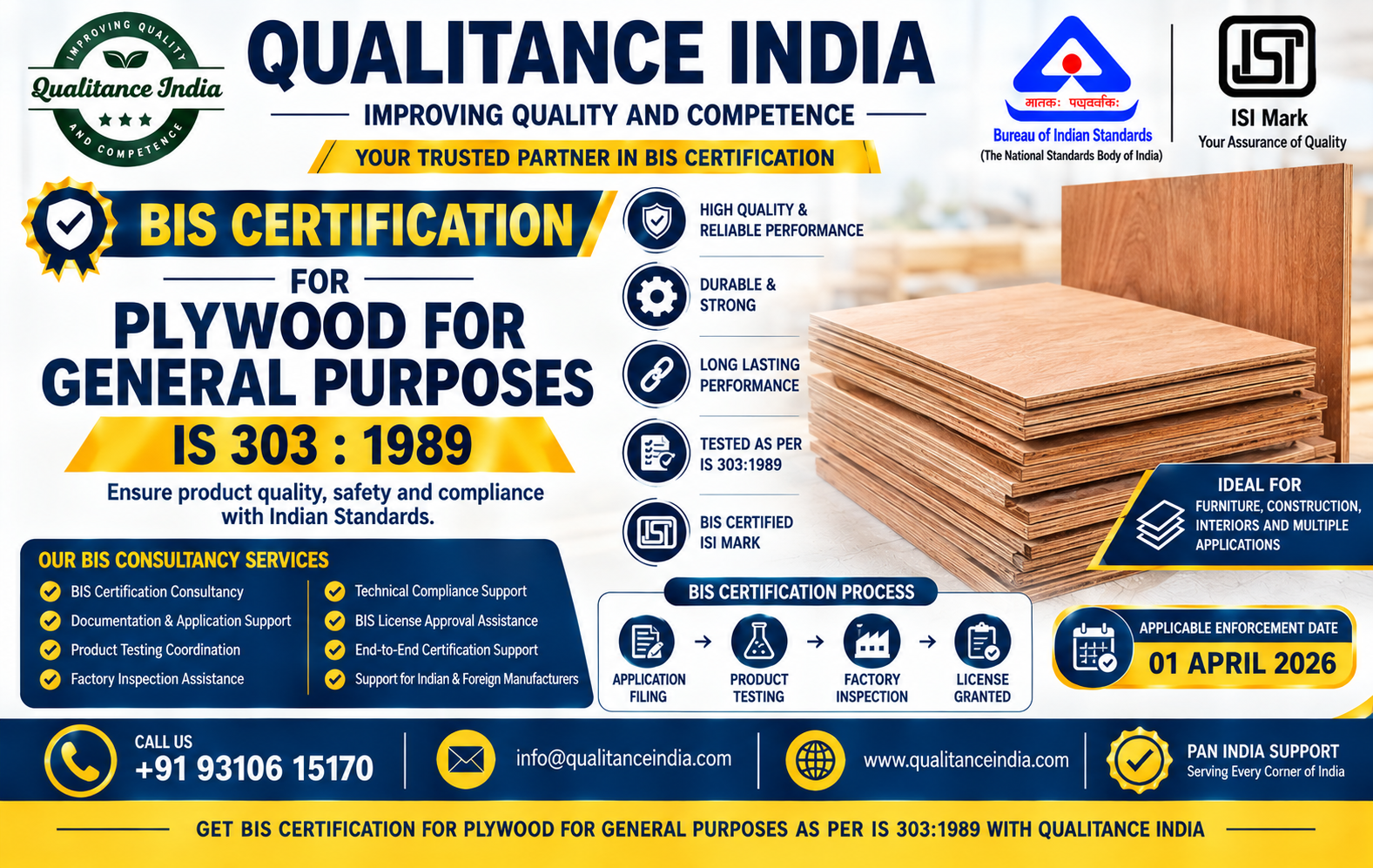
BIS Certification Consultancy for Plywood for General Purposes | IS 303:1989
Introduction
Plywood for general purposes is one of the most widely used wood-based panel products in construction, furniture, interior work, doors, partitions, cabinetry and other applications. Consistent bonding, strength, dimensions, moisture performance, surface quality and formaldehyde control are important for ensuring reliable plywood performance.
For many years, manufacturers referred to IS 303:1989 – Plywood for General Purposes for BIS certification. However, the standard has subsequently been revised. BIS published IS 303:2024 – Plywood for General Purposes – Specification (Fourth Revision), and its implementation guidelines stated that IS 303:1989 would stand withdrawn after 14 February 2025.
The current BIS Product Manual is PM/IS 303/4/May 2025, based on IS 303:2024 with Amendment No. 1. Therefore, manufacturers starting a new certification process today should generally assess their product against the current IS 303:2024 requirements rather than relying only on the old 1989 requirements.
The product continues to be covered under the Plywood and Wooden Flush Door Shutters (Quality Control) Order framework. The 2024 QCO requires covered products to conform to the applicable Indian Standard and bear the Standard Mark under a BIS licence as per Scheme-I, subject to specified exemptions.
Qualitance India provides complete BIS Certification consultancy for plywood manufacturers, including standard applicability assessment, documentation, product testing coordination, grouping guidance, factory inspection preparation, BIS application support, licence processing and post-licence compliance.
What is BIS Certification for Plywood?
BIS Certification is a conformity assessment mechanism under which a manufacturer demonstrates that its product complies with the applicable Indian Standard and related BIS requirements.
For plywood covered by the applicable compulsory certification framework, the manufacturer must follow the relevant standard, testing requirements, quality-control arrangements and certification procedure before using the BIS Standard Mark on licensed production.
The current BIS Scheme-I listing identifies IS 303:1989 – Plywood for General Purposes in the historical listing alongside the applicable Plywood and Wooden Flush Door Shutters Quality Control Orders.
Because the standard has since been revised, the current certification route must be assessed against IS 303:2024 and its applicable amendment.
Important Update: IS 303:1989 Revised to IS 303:2024
This is an important point for plywood manufacturers.
BIS published IS 303:2024 – Plywood for General Purposes – Specification (Fourth Revision). BIS implementation guidelines issued in July 2024 stated:
- IS 303:1989 was revised as IS 303:2024.
- The last date for implementation of the revised standard was 14 February 2025.
- After the implementation date, the old standard was to stand withdrawn.
BIS subsequently published Amendment No. 1 to IS 303:2024. The implementation guideline dated 26 May 2025 stated that the amendment had to be implemented by 17 September 2025.
The latest BIS Product Manual located for this product is PM/IS 303/4/May 2025, covering IS 303:2024 with Amendment No. 1.
Therefore, businesses searching for “BIS Certification for Plywood as per IS 303:1989” should understand that the current certification requirements have moved to the revised standard.
Current Product Standard
Current Standard: IS 303:2024
Product: Plywood for General Purpose
Revision: Fourth Revision
Current Product Manual: PM/IS 303/4/May 2025
Certification Scheme: Scheme-I
Latest amendment reflected in Product Manual: Amendment No. 1
Is BIS Certification Mandatory for Plywood?
Yes, specified plywood products are covered by the Plywood and Wooden Flush Door Shutters (Quality Control) Order, 2024.
The QCO states that the specified goods must conform to the corresponding Indian Standard and bear the Standard Mark under a BIS licence according to Scheme-I, subject to the exemptions provided in the order. The 2024 order came into force generally on 28 February 2025, with later implementation dates for small and micro enterprises.
The QCO specifies:
- General implementation date: 28 February 2025
- Small enterprise: 28 May 2025
- Micro enterprise: 28 August 2025
- Domestic goods manufactured for export are excluded from the scope of the order.
Manufacturers should always verify the latest QCO notifications and applicable exemptions before relying on an exemption.
What is Plywood for General Purposes?
Plywood is an engineered wood panel produced by bonding layers of wood veneer together, normally with adjacent veneer grains arranged in different directions.
For general-purpose plywood, product performance depends on:
- Veneer quality
- Veneer thickness
- Grain direction
- Adhesive quality
- Bonding
- Core construction
- Surface quality
- Moisture content
- Water resistance
- Mechanical strength
- Dimensional accuracy
- Formaldehyde performance
The current IS 303:2024 framework expands the classification structure compared with the older standard.
Product Classification Under Current IS 303:2024
The current BIS Product Manual classifies plywood using several parameters.
Grade
The current standard covers:
- MR – Moisture Resistant
- BWR – Boiling Water Resistant
- BWP – Boiling Water Proof
Bending Class
The revised standard, including Amendment No. 1, uses five bending classes:
- F10
- F20
- F30
- F40
- F50
Type Based on Appearance
The current Product Manual identifies:
- AA
- AB
- AC
- BB
- BC
- CC
Thickness
Specified thicknesses include:
3, 4, 5, 6, 9, 12, 15, 19, 22 and 25 mm
Other thicknesses may be agreed between manufacturer and purchaser, subject to the applicable standard provisions. The manufacturer is required to declare the thickness range intended to be covered.
Formaldehyde Class
The current framework identifies:
- E1
- E2
Steady-State Formaldehyde Emission
The Product Manual treats the steady-state formaldehyde emission test as an optional test, and the scope can indicate whether the certification includes this test.
BIS Grouping Guidelines for Plywood
Grouping is one of the most important parts of the BIS application because plywood manufacturers often produce many combinations of grades, thicknesses, appearance types and bending classes.
The current Product Manual provides grouping based on:
- Grade
- Bending Class
- Appearance type
- Thickness
- Formaldehyde class
- Optional steady-state formaldehyde emission test
Grouping by Bending Class
Plywood of each bending class must be tested to cover that particular bending class in the licence scope.
The manufacturer should ensure that samples cover the grades and formaldehyde classes intended for inclusion in the licence.
Grouping by Thickness
The Product Manual allows plywood of any thickness to represent the declared thickness range, provided the manufacturer has the necessary manufacturing and testing infrastructure and the required range is appropriately demonstrated through sampling.
Grouping by Appearance
The highest appearance type tested can cover lower appearance types.
For example, testing AA can cover lower types such as:
- AB
- AC
- BB
- BC
- CC
Similarly, testing BB can cover:
- BC
- CC
Formaldehyde Emission Grouping
One sample is required for the optional steady-state formaldehyde emission test to include that test in the licence scope.
The manufacturer must declare the varieties intended to be covered, and the final licence scope can be restricted according to manufacturing and testing capabilities.
BIS Sample Size for Plywood
The current Product Manual specifies:
Sample Quantity: 1 sheet of plywood.
Correct sample selection is essential because one sheet may be used to establish a significant portion of the proposed licence scope under the applicable grouping provisions.
Raw Material Requirements
The current May 2025 Product Manual does not specify a separate raw-material sample quantity in its sampling table and notes that this section addresses raw-material requirements where specified in the Indian Standard.
The older IS 303:1989 product manual identified:
- Adhesive – IS 848
- Extenders – IS 1508
For current certification, the manufacturer should follow the material requirements of IS 303:2024 and its amendment, rather than relying solely on the historical 1989 material provisions.
Manufacturing Process for Plywood
A typical plywood manufacturing process may include:
Log Selection → Timber Conversion → Veneer Peeling/Slicing → Veneer Clipping → Drying → Grading → Glue Preparation → Glue Application → Lay-Up → Pre-Pressing → Hot Pressing → Trimming → Sanding → Surface Inspection → Dimensional Inspection → Testing → Marking → Packing
The exact process can vary according to the manufacturer’s equipment, timber species, veneer construction, adhesive system and product specification.
Important Manufacturing Controls
A plywood manufacturer should maintain control over:
- Timber quality
- Veneer thickness
- Veneer moisture
- Grain direction
- Core construction
- Glue mixing
- Glue spread
- Pressing conditions
- Temperature and pressure
- Pressing time
- Panel thickness
- Edge quality
- Surface quality
- Final conditioning
- Product testing
Proper production controls help maintain consistent plywood quality.
Main BIS Tests for Plywood
The testing requirements depend on the applicable grade, type, bending class, formaldehyde class and other declared characteristics.
Important testing areas under the current framework include the following.
1. Classification by Appearance
Surface appearance is assessed according to the permitted categories and defects.
The current LIMS test scopes identify appearance classification and defect categories including:
- Blisters
- Checks
- Discolouration
- Dote
- Insect holes
- Joints
- Dead knots
- Dead pin knots
- Live pin knots
- Tight knots
- Patches
- Splits
- Swirl
2. Veneer Thickness
Veneer thickness is checked against the requirements of the applicable standard.
3. Grain Direction
Grain direction is controlled to ensure the correct construction and orientation of veneers.
4. Gaps in Cores and Cross-Bands
The panel is checked for gaps in internal veneer construction.
5. Splits and Overlaps
Construction defects such as splits and overlaps are controlled according to the standard.
6. Dimensions
Important dimensional checks include:
- Length
- Width
- Thickness
- Squareness
- Edge straightness
7. Moisture Content
Moisture content is an important property affecting panel performance and dimensional stability.
8. Glue Adhesion / Water Resistance
Glue adhesion and water resistance are key requirements, particularly for MR, BWR and BWP products.
Current BIS LIMS scopes identify water resistance testing and glue shear-strength testing.
9. Mycological Test
Applicable plywood grades may require mycological testing related to glue adhesion and biological resistance.
The current LIMS entries identify mycological testing as part of the test scope.
10. Static Bending Strength
The revised IS 303 framework places significant importance on mechanical strength.
Bending strength is linked to the five bending classes:
- F10
- F20
- F30
- F40
- F50
The amendment modified the MOE and MOR requirements based on these bending classes.
Tests can include:
- Modulus of Elasticity
- Modulus of Rupture
- Along face grain
- Across face grain
- Average values
- Minimum individual values
11. Formaldehyde Content
Formaldehyde content testing is included in the current testing framework for the declared formaldehyde classes.
12. Steady-State Formaldehyde Emission
This is an optional test under the current Product Manual.
A manufacturer may include it in the licence scope by completing the applicable test and meeting the corresponding requirements.
BIS Testing Equipment for Plywood
The exact equipment requirement depends on the tests being conducted.
Typical facilities may include:
- Vernier caliper
- Micrometer
- Steel scale
- Measuring tape
- Squareness measurement arrangement
- Moisture meter
- Universal testing machine
- Bending test arrangement
- Glue adhesion test setup
- Conditioning equipment
- Water-resistance testing equipment
- Formaldehyde testing facilities
- Laboratory weighing balance
- Oven
- Measuring instruments and gauges
The manufacturer’s laboratory must be capable of performing the tests applicable to its proposed licence scope.
In-House Laboratory Requirements
A suitable testing and inspection facility is important for BIS certification.
The manufacturer should establish appropriate facilities for relevant tests and maintain:
- Testing equipment
- Calibration records
- Test procedures
- Qualified personnel
- Test registers
- Production inspection records
- Corrective-action records
- Material records
The exact requirements depend on the current Product Manual and applicable Scheme of Inspection and Testing.
Scheme of Inspection and Testing
The manufacturer should establish an effective inspection and testing system to ensure that production continuously conforms to the applicable standard.
Quality-control activities may include:
Incoming Material Inspection → Process Control → Veneer Inspection → Glue/Adhesive Control → Lay-Up Control → Pressing Control → Panel Inspection → Dimensional Testing → Physical Testing → Mechanical Testing → Formaldehyde Testing → Final Release
Test records should be retained as required under the applicable certification framework.
Factory Inspection for BIS Certification
Factory assessment is an important part of the BIS certification process.
During assessment, the manufacturer should be prepared to demonstrate:
- Manufacturing capacity
- Timber and veneer handling
- Drying facilities
- Glue preparation
- Lay-up arrangement
- Hot press
- Trimming and sanding
- Measuring equipment
- Testing equipment
- Laboratory arrangements
- Calibration status
- Quality-control procedures
- Production records
- Test records
- Marking arrangements
- Packing system
Qualitance India helps manufacturers prepare their factory and documentation before the applicable BIS assessment.
BIS Certification Process for Plywood
The typical process is:
Product Identification → Current Standard Confirmation → Product Scope → Grade/Type/Bending Class Selection → Thickness & Formaldehyde Class Selection → Grouping Review → Factory Assessment → Documentation → Sample Preparation → Laboratory Testing → BIS Application → Factory Inspection → Compliance → BIS Licence → Standard Marking → Post-Licence Compliance
The actual procedure may vary according to the certification status, factory setup and applicable BIS requirements.
Documents Required for BIS Certification
Common documentation may include:
- Company registration documents
- Factory address proof
- Factory ownership or lease documents
- Authorized signatory details
- Manufacturing process flow chart
- Factory layout
- Machinery list
- Testing equipment list
- Calibration certificates
- Product specifications
- Product drawings, where applicable
- Timber/raw-material details
- Adhesive details
- Quality-control plan
- Test reports
- Internal testing records
- Production records
- Applicable declarations and undertakings
- Trademark/brand documents where applicable
The final document checklist should always be prepared against the current Product Manual and BIS application requirements.
Current BIS Testing Charges for Plywood
BIS LIMS currently shows active testing facilities for IS 303:2024.
Examples visible in current LIMS records include:
- ₹15,000 excluding taxes for an entry covering MR, BWR and BWP with E1/E2 formaldehyde classes.
- ₹14,900 excluding taxes for an all-scope entry in another laboratory.
- ₹13,000 excluding taxes for a laboratory scope covering MR/BWR/BWP, formaldehyde classes and specified product varieties.
- Another current laboratory listing shows ₹7,500 excluding taxes for MR/BWR/BWP, specified appearance types, E1/E2, bending classes F10–F50 and all sizes, subject to the displayed laboratory scope.
The actual testing cost depends on the selected laboratory, grade, testing scope, product varieties and exclusions. The latest BIS LIMS entry should therefore be checked before sample submission.
Cost of BIS Certification for Plywood
The total certification cost is usually made up of several components.
These may include:
- BIS application fees
- BIS processing/licence-related charges
- Product testing charges
- Sample preparation
- Factory inspection-related expenses
- Calibration
- Laboratory setup
- Testing equipment
- Documentation
- Consultancy charges
- Ongoing compliance costs
The actual cost depends on the manufacturer and proposed licence scope.
How Long Does BIS Certification Take?
The certification timeline depends on:
- Product scope
- Grade
- Bending class
- Number of thicknesses
- Formaldehyde class
- Testing schedule
- Factory preparedness
- Laboratory availability
- Documentation readiness
- Factory inspection schedule
- Response to BIS observations
Manufacturers can reduce unnecessary delays by finalizing the product scope before application.
Common Reasons for BIS Certification Delays
Using the Old 1989 Requirements
One of the biggest risks is preparing a new application only around IS 303:1989 without assessing the current revised requirements.
Incorrect Scope
A manufacturer may attempt to include too many grades, thicknesses, appearance types or bending classes without adequate testing and facilities.
Incorrect Sample Selection
Improper representative samples can affect the proposed licence scope.
Bending-Class Non-Conformity
The revised standard introduced five bending classes, making mechanical performance an important scope consideration.
Adhesion Failure
Poor adhesive formulation, veneer moisture or incorrect pressing conditions can result in glue-line failures.
Moisture Problems
Incorrect veneer or panel moisture can affect product performance.
Formaldehyde Non-Conformity
The manufacturer must ensure that its declared formaldehyde class is supported by appropriate testing.
Dimensional Problems
Variation in length, width, thickness, squareness or edge straightness may result in non-conformity.
Incomplete Factory Facilities
Missing testing equipment, calibration records or quality-control arrangements can delay assessment.
Who Needs BIS Certification for Plywood?
The certification requirement is particularly relevant to manufacturers producing plywood covered by the applicable Quality Control Order and Indian Standard.
This includes manufacturers of general-purpose plywood supplied for:
- Construction
- Furniture
- Interior applications
- Partitions
- Doors
- Cabinets
- Commercial fit-outs
- Institutional projects
- Government supply
- Infrastructure projects
Importers, traders and sellers should separately verify the applicable legal and procurement requirements for their specific products.
BIS Certification for Plywood Manufacturers
A manufacturer seeking BIS certification should evaluate the following before applying:
Product
What type of plywood are you manufacturing?
Grade
MR, BWR or BWP?
Bending Class
F10, F20, F30, F40 or F50?
Appearance
AA, AB, AC, BB, BC or CC?
Thickness
What thickness range do you manufacture?
Formaldehyde
E1 or E2?
Testing
Which tests can be performed in-house and which require an external facility?
Factory
Does the manufacturing facility meet the applicable requirements?
Correctly answering these questions before application can prevent repeated testing and unnecessary delays.
Benefits of BIS Certification for Plywood
Regulatory Compliance
Certification supports compliance where BIS is mandatory under the applicable QCO.
Quality Assurance
The certification process establishes documented product and quality-control requirements.
Buyer Confidence
BIS-certified plywood can provide confidence to institutional and commercial buyers.
Government Procurement
Where BIS compliance is specified, certification can support participation in eligible procurement opportunities.
Product Standardization
Testing and production controls help maintain more consistent quality.
Better Market Acceptance
Certified products can have stronger acceptance where buyers specifically require conformity to the Indian Standard.
BIS Consultancy Services by Qualitance India
Qualitance India provides complete consultancy for plywood manufacturers.
Product & Standard Identification
We identify the applicable plywood standard and determine whether your existing documentation is based on the old or revised standard.
Scope Assessment
We help determine the appropriate:
- Grade
- Bending class
- Appearance type
- Thickness range
- Formaldehyde class
- Optional test scope
Grouping Guidance
We review representative samples and proposed scope according to the current BIS grouping provisions.
Documentation Support
We assist in preparing the application and technical documentation.
Testing Coordination
We coordinate sample preparation and testing requirements.
Factory Inspection Preparation
We review your factory, machinery, laboratory and documentation before assessment.
BIS Application Support
We assist with application preparation, submission and follow-up.
Query & Compliance Support
We help coordinate responses to BIS observations and technical/documentary queries.
Licence Processing
We provide support throughout the certification process until the applicable licence stage.
Post-Licence Compliance
We support applicable renewal, scope extension and ongoing compliance matters.
Quick BIS Certification Checklist for Plywood
Before starting your application:
☑ Current IS 303:2024 requirements reviewed
☑ Amendment No. 1 requirements reviewed
☑ Grade selected
☑ Bending class selected
☑ Appearance type selected
☑ Thickness range finalized
☑ Formaldehyde class selected
☑ Optional steady-state emission test considered
☑ Product grouping reviewed
☑ Manufacturing machinery available
☑ Testing equipment available
☑ Calibration records available
☑ Quality-control system established
☑ Representative sample prepared
☑ Testing completed
☑ Documents prepared
☑ Factory ready for assessment
☑ Marking and packing arrangements ready
Frequently Asked Questions
1. What is IS 303:1989?
IS 303:1989 was the earlier Indian Standard for Plywood for General Purposes.
2. Is IS 303:1989 still the current standard?
No. BIS revised the standard as IS 303:2024. BIS implementation guidelines stated that IS 303:1989 would stand withdrawn after 14 February 2025.
3. What is the current standard for plywood for general purposes?
The current standard is IS 303:2024 – Plywood for General Purposes – Specification (Fourth Revision).
4. What is the current BIS Product Manual?
The current Product Manual identified is PM/IS 303/4/May 2025.
5. Is BIS certification mandatory for plywood?
Specified plywood products are covered under the Plywood and Wooden Flush Door Shutters Quality Control Order, 2024, which requires conformity and the Standard Mark under a BIS licence, subject to specified exemptions.
6. Which BIS scheme applies to plywood?
The applicable QCO requires the Standard Mark under Scheme-I.
7. What are the current plywood grades?
The current framework covers MR, BWR and BWP grades.
8. What are the current bending classes?
The five bending classes are F10, F20, F30, F40 and F50.
9. What are the plywood appearance types?
The current grouping guidelines identify AA, AB, AC, BB, BC and CC.
10. What thicknesses are specified?
The current Product Manual identifies 3, 4, 5, 6, 9, 12, 15, 19, 22 and 25 mm, with other thicknesses possible by agreement subject to the standard.
11. What formaldehyde classes are covered?
The current Product Manual identifies E1 and E2 formaldehyde classes.
12. Is steady-state formaldehyde emission mandatory?
The current Product Manual identifies it as an optional test.
13. What is the sample quantity?
The current Product Manual specifies one sheet of plywood.
14. Is product grouping available?
Yes. Grouping is provided for bending class, thickness, appearance type, grade and formaldehyde class.
15. Can one appearance type cover lower types?
Yes. The highest appearance type tested can cover lower appearance types according to the grouping guidelines.
16. Can one thickness cover multiple thicknesses?
The current grouping provisions allow a tested thickness to cover the declared range subject to manufacturing/testing capability and appropriate sampling.
17. What are the major plywood tests?
Major tests can include appearance classification, veneer construction, dimensions, moisture content, water resistance/glue adhesion, mycological testing, static bending strength and formaldehyde testing, depending on the applicable scope.
18. Is bending strength important under the new standard?
Yes. Amendment No. 1 introduced five bending classes with corresponding MOE and MOR requirements.
19. Is formaldehyde testing required?
The current framework includes formaldehyde classes E1/E2, with formaldehyde content testing included in current laboratory scopes.
20. Is factory inspection required?
The manufacturer must demonstrate appropriate manufacturing, testing and quality-control capability under the applicable BIS certification process.
21. Is an in-house laboratory required?
The manufacturer must maintain suitable testing arrangements for the applicable requirements. The exact arrangements depend on the current Product Manual, testing scope and applicable provisions for external testing.
22. Can testing be outsourced?
Permitted external testing arrangements depend on the applicable BIS provisions and selected laboratory.
23. Can an MSME obtain BIS certification?
Yes, eligible MSME manufacturers can obtain BIS certification, subject to the product-specific requirements and applicable QCO provisions.
24. Can one BIS licence cover different plywood grades?
The licence scope depends on the approved grouping, testing and manufacturing capability.
25. Can a manufacturer include several bending classes?
Yes, subject to the required testing and scope provisions. Each bending class intended for coverage must be appropriately established.
26. What happens to an old IS 303:1989 BIS licence?
Existing licences needed to transition to the revised standard within the implementation framework notified by BIS. The amendment implementation requirements also had to be completed for IS 303:2024 licences by 17 September 2025.
27. What is the current amendment status?
The current May 2025 Product Manual incorporates Amendment No. 1 to IS 303:2024.
28. What is the current plywood testing cost?
Current BIS LIMS listings show different laboratory prices, including displayed values around ₹7,500, ₹13,000, ₹14,900 and ₹15,000 excluding taxes depending on scope.
29. How long does BIS certification take?
The timeline depends on product scope, testing, factory readiness, documentation, inspection scheduling and compliance with any observations.
30. Can Qualitance India help with BIS certification for plywood?
Yes. Qualitance India provides complete support for standard identification, scope assessment, grouping, documentation, testing coordination, factory inspection preparation, BIS application, licence processing and post-licence compliance.
Related BIS Certification Services
Qualitance India also provides consultancy for:
- BIS Certification
- ISI Mark Certification
- BIS Scheme-I Certification
- Plywood BIS Certification
- Marine Plywood Certification
- Fire Retardant Plywood Certification
- Structural Plywood Certification
- Decorative Plywood Certification
- Concrete Shuttering Plywood Certification
- BIS Licence Renewal
- BIS Scope Extension
- Product Testing Coordination
- Factory Inspection Assistance
- BIS Documentation
- Quality Control Order Applicability
- Product Grouping Guidance
Related Plywood Standards
Manufacturers may also need to evaluate other plywood standards depending on the product:
- IS 710 – Marine Plywood
- IS 5509 – Fire Retardant Plywood
- IS 1328 – Veneered Decorative Plywood
- IS 4990 – Plywood for Concrete Shuttering Works
- IS 10701 – Structural Plywood
These standards are also included in the Plywood and Wooden Flush Door Shutters Quality Control framework.
Why Choose Qualitance India?
Qualitance India helps plywood manufacturers manage BIS certification without having to handle each technical and procedural stage separately.
Our support covers:
Product Identification
Understanding the plywood product and applicable standard.
Current Standard Assessment
Checking whether the manufacturer is working under the current IS 303:2024 requirements.
Scope & Grouping
Planning grades, bending classes, appearance types, thicknesses and formaldehyde classes.
Testing Coordination
Managing samples and laboratory testing requirements.
Documentation
Preparing and organizing required certification documents.
Factory Preparation
Reviewing manufacturing and testing infrastructure.
Application Support
Assisting with BIS application and follow-up.
Inspection Support
Preparing the unit for BIS assessment.
Licence Support
Assisting through the licence processing stage.
Post-Licence Compliance
Supporting applicable renewal, scope and compliance requirements.
Contact Qualitance India
Qualitance India – Your Certification & Compliance Partner
Phone: +91 93106 15170
Email: info@qualitanceindia.com
Website: https://qualitanceindia.com/
For BIS Certification for Plywood for General Purposes, Qualitance India provides end-to-end consultancy covering product assessment, current IS 303 requirements, testing, documentation, factory inspection preparation, BIS application and licence support.
Conclusion
IS 303:1989 – Plywood for General Purposes remains an important reference for manufacturers searching for historical BIS certification requirements, but the standard has been revised to IS 303:2024. BIS implementation guidelines established the transition from the 1989 standard, and the current Product Manual is based on IS 303:2024 with Amendment No. 1.
The current framework introduces a more detailed classification structure covering MR, BWR and BWP grades; F10 to F50 bending classes; AA to CC appearance types; thickness ranges; E1/E2 formaldehyde classes; and optional steady-state formaldehyde emission testing.
For manufacturers, successful certification depends on selecting the correct product scope, understanding grouping, preparing suitable samples, completing the required testing, maintaining manufacturing and quality-control facilities, and complying with the applicable BIS certification procedure.
Qualitance India provides complete BIS Certification consultancy for plywood manufacturers, from product and standard identification to testing, documentation, factory inspection preparation, BIS application, licence processing and ongoing compliance.
Need BIS Certification for Plywood? Contact Qualitance India for complete BIS licence and compliance support.
Need help with BIS certification for this product?
Get a free consultation from our compliance experts — we handle testing, documentation and the complete BIS process for you.