
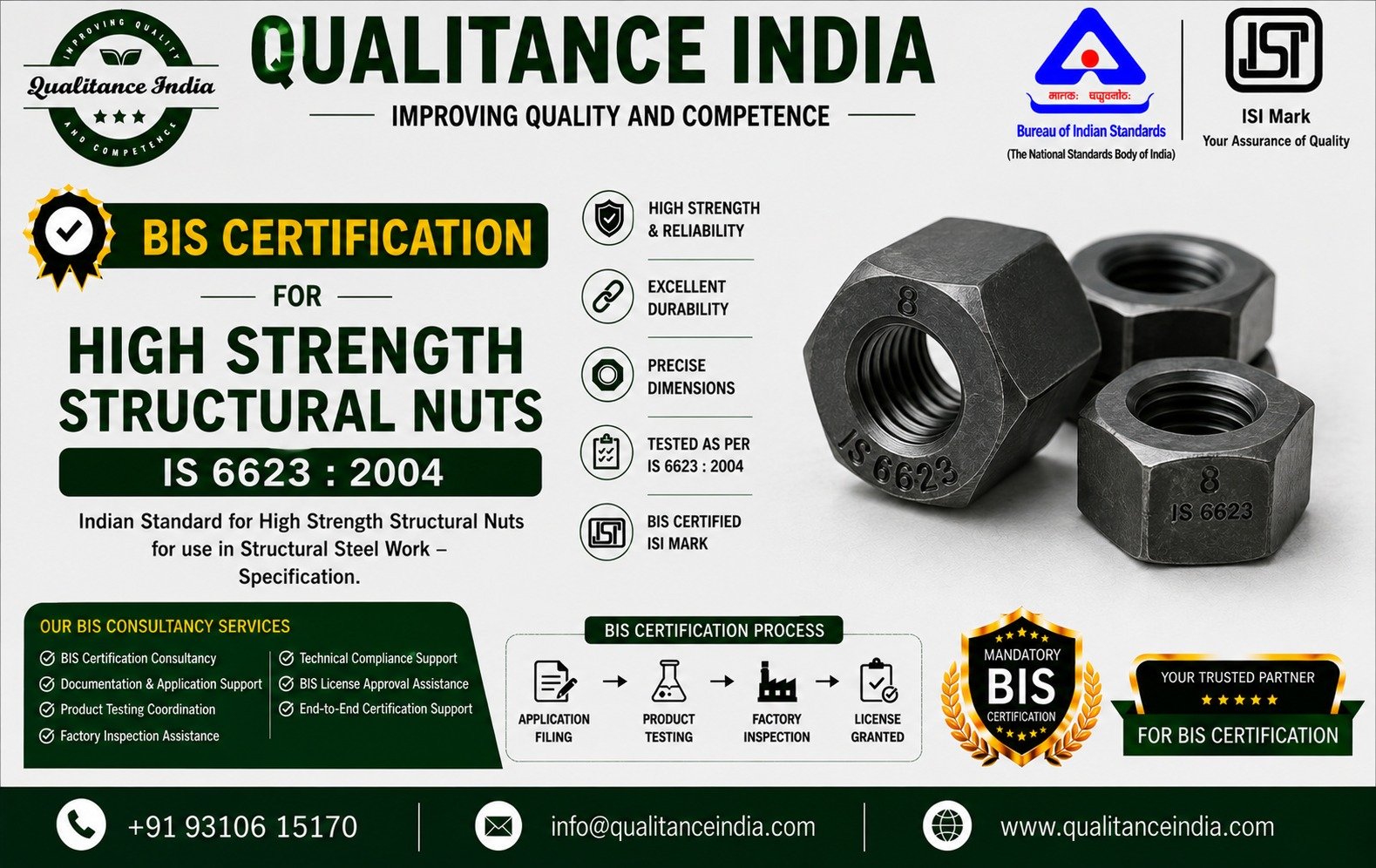
BIS Certification Consultancy for High Strength Structural Nuts | IS 6623:2004
Introduction
High Strength Structural Nuts are important fastening components used together with high strength structural bolts in steel structures where secure, reliable and high-load structural connections are required. Their dimensional accuracy, thread compatibility, hardness, proof load and anti-seizing performance are important for the safety and reliability of structural joints.
In India, High Strength Structural Nuts are covered by IS 6623:2004 – High Strength Structural Nuts – Specification. The BIS Product Manual identifies the product under Scheme-I of the BIS Conformity Assessment Regulations, 2018. The current BIS Product Manual provides requirements for product scope, sampling, grouping, test equipment and the Scheme of Inspection and Testing.
The product is also included in the mandatory Bolts, Nuts and Fasteners (Quality Control) Order framework. BIS’s current Scheme-I listing identifies IS 6623:2004 – High Strength Structural Nuts under the applicable QCO.
Qualitance India provides end-to-end BIS Certification consultancy for High Strength Structural Nut manufacturers, including product scope assessment, BIS application, documentation, laboratory testing coordination, factory inspection preparation, technical compliance and BIS licence support.
What Are High Strength Structural Nuts?
High Strength Structural Nuts are specially manufactured structural steel nuts designed to be used with appropriate high-strength structural bolts.
IS 6623 covers large-series hexagon high strength structural steel nuts intended for both:
- Friction-type structural steel connections
- Bearing-type structural steel connections
The standard covers property classes 8S and 10S and sizes from M12 to M36.
These nuts are designed to provide a high level of assurance against thread stripping when correctly matched with the appropriate structural bolts.
Applications of High Strength Structural Nuts
High Strength Structural Nuts are commonly used in:
- Structural steel buildings
- Bridges
- Industrial steel structures
- Power projects
- Infrastructure projects
- Steel towers
- Heavy engineering
- Structural fabrication
- Industrial plants
- Transmission structures
- Large steel assemblies
- Construction and infrastructure applications
The correct matching of structural nuts and bolts is essential for reliable structural connections.
BIS Standard for High Strength Structural Nuts
The applicable Indian Standard is:
IS 6623:2004 – High Strength Structural Nuts – Specification
It is the Second Revision of the standard. BIS technical material states that the standard covers large-series hexagon high strength structural steel nuts of property classes 8S and 10S in sizes M12, M16, M20, M22, M24, M27, M30 and M36.
The current BIS Product Manual is:
PM/IS 6623/2/July 2021
The Product Manual records one amendment to IS 6623:2004.
Manufacturers must comply with the standard together with applicable amendments and current BIS certification requirements.
Is BIS Certification Mandatory for High Strength Structural Nuts?
Yes.
IS 6623:2004 – High Strength Structural Nuts is included in the current BIS Scheme-I compulsory certification listing under the Bolts, Nuts and Fasteners product category.
The QCO framework requires applicable covered fasteners to conform to their corresponding Indian Standards and use the Standard Mark under a BIS licence, subject to the provisions and exemptions of the applicable Order.
BIS issued a 2024 implementation circular for products notified under the Bolts, Nuts and Fasteners QCO and specifically included IS 6623:2004.
For manufacturers supplying covered High Strength Structural Nuts to the Indian market, obtaining the applicable BIS licence is therefore an important regulatory requirement.
BIS Product Manual for IS 6623:2004
The Product Manual contains the practical certification requirements used by BIS offices, licensees and applicants.
Important details include:
| Particular | Requirement |
|---|---|
| Product | High Strength Structural Nuts |
| Standard | IS 6623:2004 |
| Certification Scheme | Scheme-I |
| Amendments | 1 |
| Sample Size | 6 nos. |
| Grouping | Annex A |
| Test Equipment | Annex B |
| Scheme of Inspection & Testing | Annex C |
| Possible Tests in a Day | Annex D / as specified |
| Licence Scope | Property Class, Size and Finish |
These details are specified in the current BIS Product Manual.
Scope of BIS Licence for High Strength Structural Nuts
The BIS Product Manual defines the licence scope using the following important parameters:
Property Class
- 8S
- 10S
Size
The listed sizes include:
- M12
- M16
- M20
- M22
- M24
- M27
- M30
- M36
Finish
The Product Manual identifies:
- Plain (Dull Black)
- Galvanized
For property class 10S, the current BIS technical material identifies plain finish, hot-dip galvanized finish, and combinations as applicable to the standard.
The final licence scope should be finalized carefully because property class, size and finish can directly affect the applicable testing and certification scope.
Material Requirements for High Strength Structural Nuts
The Product Manual specifies raw-material requirements with reference to:
Clause 5.1 of IS 6623:2004 read in conjunction with Clause 6 of IS 1367 (Part 6):2018.
The nuts are manufactured from steel suitable for the required mechanical properties.
Important raw-material controls can include:
- Steel grade verification
- Chemical composition
- Heat-number traceability
- Mechanical properties
- Supplier test certificates
- Incoming material inspection
- Heat-treatment records
Manufacturers should maintain proper traceability from raw-material heat to finished nut production.
Heat Treatment Requirements
High Strength Structural Nuts require controlled heat treatment to achieve the specified mechanical characteristics.
BIS technical information for IS 6623 states that the nuts are made from steel and are hardened and tempered at a temperature of at least 425°C, with mechanical properties linked to IS 1367 (Part 6).
Therefore, manufacturers should maintain suitable records for:
- Furnace identification
- Batch/heat number
- Loading details
- Heating temperature
- Holding time
- Quenching conditions
- Tempering temperature
- Hardness
- Batch traceability
Poor heat-treatment control can lead to failures in proof load or hardness testing.
Manufacturing Process of High Strength Structural Nuts
A typical manufacturing process can include:
1. Raw Material Inspection
Steel input is checked for grade, heat number and conformity.
2. Cutting
Bars, wire or suitable forging stock are cut to the required blank length.
3. Nut Forming
The nut blank is formed through suitable forging or heading operations.
4. Punching
The internal hole is formed in the nut blank.
5. Threading
Internal threads are produced to the specified dimensions and tolerance.
6. Heat Treatment
The nuts undergo controlled hardening and tempering.
7. Cleaning and Finishing
The nuts are cleaned and finished according to the approved product specification.
8. Galvanizing
Where galvanized nuts are included in the scope, the required hot-dip galvanizing process is carried out.
9. Inspection and Testing
Dimensional, mechanical, surface and coating tests are performed as applicable.
10. Marking and Packing
Conforming nuts are marked and packed according to the applicable BIS requirements.
BIS Sample Size
The current BIS Product Manual specifies:
6 nos.
as the sample size for High Strength Structural Nuts.
An important additional provision applies when Hot-Dip Galvanized Nuts are sampled:
2 nuts should be available before galvanizing for dimensional tests.
Manufacturers should therefore prepare samples according to the exact testing and finish requirements of the proposed scope.
BIS Grouping Guidelines
The Product Manual refers manufacturers to Annex A for grouping.
The product scope is based on:
- Property Class
- Size
- Finish
Because the Product Manual states that there is no separate product sampling guideline and refers applicants to the grouping annex, scope planning should be completed before sample submission.
A well-planned grouping approach can help the manufacturer obtain the desired scope without unnecessary testing while remaining within BIS requirements.
Major Tests for High Strength Structural Nuts
Current BIS LIMS records show laboratory scopes for IS 6623:2004 covering dimensional, mechanical, surface and marking requirements.
The important testing areas include the following.
Dimensional Tests
Dimensions of the nuts are checked against the applicable requirements.
Current BIS laboratory scopes specifically identify parameters such as:
- d
- p
- da
- dw
- e
- m
- s
- Other applicable dimensional characteristics
These dimensions ensure proper compatibility with the corresponding bolt and structural connection.
Thread Dimensions
Internal thread dimensions and related tolerances are checked to ensure correct mating with the appropriate bolt.
Proof Load Test
Proof load testing is an important mechanical test for High Strength Structural Nuts.
The test verifies the ability of the nut to withstand the specified load without unacceptable failure.
Hardness Test
Hardness testing is carried out according to the applicable requirements.
The standard includes requirements relating to:
- Rockwell Hardness
- Vickers Hardness
for the covered property classes and sizes.
Surface Condition
The surface condition is checked for conformity with the applicable requirements.
Surface Integrity
The nut surface is examined for relevant discontinuities or defects that could adversely affect performance.
Current BIS LIMS entries specifically include surface condition and surface integrity requirements for IS 6623:2004.
Galvanized Coating Tests
Where galvanized nuts are included in the licence scope, applicable tests can include:
- Zinc coating thickness/mass
- Coating uniformity
- Passivation
- Adhesion
- Other applicable galvanizing requirements
The exact coating tests depend on the applicable standard provisions and laboratory scope.
Anti-Seizing Test
Anti-seizing performance is particularly important for hot-dip galvanized nuts.
BIS technical information identifies an anti-seizing requirement for hot-dip galvanized nuts.
Mechanical Properties of High Strength Structural Nuts
IS 6623 covers proof-load and hardness requirements for property classes 8S and 10S.
The standard is intended for structural connections where high-strength bolt-and-nut assemblies must resist excessive tightening and provide reliable thread engagement.
Proper control of:
- Material
- Heat treatment
- Thread geometry
- Hardness
- Proof load
- Surface condition
is therefore essential.
Testing Equipment for BIS Certification
The current BIS Product Manual directs manufacturers to Annex B for the test-equipment requirements.
Depending on the product scope, testing and inspection equipment may include:
- Vernier calipers
- Micrometers
- Thread gauges
- Plug gauges
- Ring gauges
- Measuring instruments
- Weighing balance
- Hardness testing machine
- Proof-load testing arrangement
- Surface inspection equipment
- Coating-thickness equipment
- Galvanizing test equipment
- Chemical testing facilities, where applicable
- Dimensional inspection gauges
The actual equipment requirement should be established from the applicable Product Manual and the selected product scope.
In-House Laboratory Requirements
Manufacturers applying for BIS certification should maintain appropriate testing and inspection facilities for the tests required under the applicable Scheme of Inspection and Testing.
The laboratory should have:
- Suitable testing equipment
- Competent testing personnel
- Calibration records
- Documented test methods
- Reference standards
- Traceable measurements
- Proper test records
Where a specific test is permitted to be subcontracted, the manufacturer may use the permitted external laboratory route in accordance with BIS requirements.
Quality Assurance Plan for Structural Nuts
A strong Quality Assurance Plan should cover:
- Incoming steel inspection
- Heat-number traceability
- Blank preparation
- Nut forming
- Threading
- Heat treatment
- Hardness control
- Dimensional inspection
- Galvanizing control
- Final inspection
- Routine testing
- Rejection procedure
- Calibration
- Marking
- Traceability
- Record retention
The Quality Assurance Plan should be aligned with the applicable Scheme of Inspection and Testing.
Control of Heat Treatment and Hardness
Heat treatment is one of the most important production controls for High Strength Structural Nuts.
The manufacturer should establish controls for:
- Material identification
- Furnace temperature
- Holding time
- Quenching
- Tempering
- Hardness
- Production batch identification
Every heat-treated batch should remain traceable to the original material heat and production records.
Factory Inspection for BIS Certification
During a BIS factory inspection, the manufacturing unit may be evaluated for:
Raw Material Control
Steel material, certificates and traceability records may be checked.
Manufacturing Machinery
Forging/forming, punching, threading, heat-treatment and finishing facilities should match the proposed scope.
Testing Facilities
Relevant measuring and testing equipment should be available and properly calibrated.
Quality Records
The manufacturer should maintain records of:
- Incoming inspection
- Production
- Heat treatment
- Hardness
- Proof load
- Dimensional inspection
- Galvanizing
- Rejection
- Corrective actions
- Dispatch
Product Identification
Production should be identifiable and traceable.
Marking
The marking arrangement should comply with the applicable BIS licence requirements.
BIS Marking Requirements
Only products manufactured under the approved BIS licence scope and conforming to the applicable Indian Standard should bear the BIS Standard Mark.
The manufacturer must ensure:
- Correct Standard Mark usage
- Legible and durable marking
- Correct licence identification
- Product traceability
- Proper product identification
- No misleading representation of non-conforming or outside-scope products as BIS-certified
The exact marking format should be finalized according to the current BIS licence and applicable certification documents.
BIS Testing Charges for High Strength Structural Nuts
Current BIS LIMS records show different testing charges depending on the laboratory and the testing scope.
Examples currently listed for IS 6623:2004 include:
- Approximately ₹18,000 excluding taxes for an extensive scope at one listed laboratory.
- Approximately ₹15,000 excluding taxes for another listed scope.
- Approximately ₹14,500 for another active scope.
- Another current listing shows approximately ₹22,500 for M12/M16/M20/M22/M24/M27/M30/M36 scope.
These figures are laboratory testing charges only and may vary by laboratory, test scope, sample, taxes and applicable discounts.
Total BIS Certification Cost for High Strength Structural Nuts
The total cost of BIS certification can include:
- BIS application and certification-related charges
- Laboratory testing
- Sample preparation
- Factory inspection-related expenses
- Testing equipment
- Calibration
- Documentation
- Consultancy
- Re-testing, if required
- Corrective-action activities
The exact cost should be calculated after reviewing:
Property Class + Size + Finish + Testing Scope + Factory Capability
Documents Required for BIS Certification
Typical documents may include:
- Company registration documents
- Factory address proof
- Factory layout
- Manufacturing process flow chart
- Machinery list
- Raw-material details
- Steel mill test certificates
- Heat-number records
- Product drawings
- Nut specifications
- Property-class details
- Size range
- Finish details
- Heat-treatment process details
- Testing equipment list
- Calibration certificates
- Laboratory test reports
- In-house test reports
- Quality Assurance Plan
- Technical personnel details
- GST/business documents
- Trademark/brand information
- Authorization documents
- BIS declarations and undertakings
- Proposed product marking details
The final documentation depends on the manufacturer’s business structure and proposed licence scope.
BIS Certification Process for High Strength Structural Nuts
The typical process is:
Factory Assessment → Product Scope Finalization → Documentation → BIS Application → Sample Preparation → Laboratory Testing → Factory Inspection → Compliance Closure → BIS Licence Grant → Standard Marking
Proper scope planning before sample testing is essential because the BIS Product Manual defines licence scope using property class, size and finish.
Common Reasons for BIS Certification Delay
Manufacturers may face delays due to:
- Incorrect product scope
- Incomplete grouping assessment
- Incorrect property-class selection
- Insufficient size coverage
- Thread-dimension problems
- Hardness failure
- Proof-load failure
- Heat-treatment inconsistency
- Raw-material traceability issues
- Galvanizing non-conformity
- Anti-seizing failure
- Surface-discontinuity issues
- Calibration problems
- Incomplete test records
- Factory inspection observations
- Incorrect marking
A detailed technical assessment before application can reduce avoidable delays.
Who Needs BIS Certification for High Strength Structural Nuts?
Manufacturers supplying covered High Strength Structural Nuts to the Indian market generally require the applicable BIS licence under the mandatory Bolts, Nuts and Fasteners regulatory framework.
This can include manufacturers supplying structural nuts for:
- Steel construction
- Infrastructure
- Bridges
- Power plants
- Industrial structures
- Transmission projects
- Structural fabrication
- Heavy engineering
- Government and institutional projects
The applicability of any specific exemption should be checked against the current QCO provisions.
Benefits of BIS Certification
BIS certification provides manufacturers with an established conformity framework and authorization to use the Standard Mark within the approved scope.
Benefits can include:
- Regulatory compliance
- Better customer confidence
- Improved production control
- Better product consistency
- Stronger acceptance in infrastructure and structural projects
- Improved traceability
- Better documentation
- Increased market credibility
- Greater confidence among structural engineering buyers
Why High Strength Structural Nuts Must Be Matched With Suitable Bolts
A structural nut does not operate independently. It forms part of a complete bolted joint.
IS 6623 specifically describes nuts intended for use with appropriate high strength bolts and is designed to reduce the risk of thread stripping during over-tightening.
Therefore, manufacturers and purchasers should consider compatibility between:
- Nut property class
- Bolt property class
- Thread dimensions
- Size
- Surface finish
- Galvanizing
- Assembly requirements
BIS Certification for High Strength Structural Nuts – Quick Process
Manufacturer Assessment → Product Scope → Documentation → BIS Application → Testing → Factory Inspection → Compliance → BIS Licence → Standard Mark
Why Choose Qualitance India?
Qualitance India provides BIS Certification consultancy for High Strength Structural Nut manufacturers.
Our support can include:
- BIS application preparation
- Product scope assessment
- IS 6623 compliance guidance
- Property-class and size planning
- Finish-related scope guidance
- Grouping support
- Documentation preparation
- Sample planning
- Laboratory coordination
- Product testing coordination
- Testing-equipment guidance
- Quality Assurance Plan support
- Factory inspection preparation
- Non-conformity response assistance
- BIS licence follow-up
- Post-certification compliance guidance
We help manufacturers organize the technical and documentation requirements needed for BIS certification.
Frequently Asked Questions
1. What is BIS Certification for High Strength Structural Nuts?
It is the BIS conformity assessment process through which a manufacturer demonstrates that High Strength Structural Nuts comply with IS 6623:2004 and obtains authorization to use the BIS Standard Mark within the approved scope.
2. Which standard applies to High Strength Structural Nuts?
The applicable standard is IS 6623:2004 – High Strength Structural Nuts – Specification.
3. Is BIS certification mandatory for High Strength Structural Nuts?
Yes. IS 6623:2004 is included in the compulsory BIS Scheme-I listing under the Bolts, Nuts and Fasteners regulatory framework.
4. What property classes are covered?
The standard covers 8S and 10S property classes.
5. What sizes are covered?
The Product Manual lists:
M12, M16, M20, M22, M24, M27, M30 and M36.
6. What finishes are covered?
The Product Manual identifies Plain (Dull Black) and Galvanized finishes for the product scope.
7. What is the BIS sample size?
The Product Manual specifies 6 nos. as the sample size.
8. Are additional samples needed for galvanized nuts?
Yes. Where Hot-Dip Galvanized Nuts are sampled, 2 samples should be available before galvanizing for dimensional tests.
9. What are the main tests for IS 6623?
Major tests include dimensions, thread-related requirements, proof load, hardness, surface condition, surface integrity and applicable galvanized-nut tests.
10. Is proof-load testing required?
Yes. Proof load is one of the key mechanical requirements for High Strength Structural Nuts.
11. Is hardness testing required?
Yes. IS 6623 specifies applicable Rockwell and Vickers hardness requirements for the covered property classes and sizes.
12. Is anti-seizing testing required?
For hot-dip galvanized nuts, IS 6623 includes an anti-seizing requirement.
13. What raw material is used for structural nuts?
The product uses suitable steel meeting the applicable material and mechanical-property requirements referenced by IS 6623 and IS 1367 (Part 6).
14. Is heat treatment required?
Yes. BIS technical material states that the nuts are hardened and tempered at a temperature of at least 425°C.
15. What is included in the BIS licence scope?
The Product Manual identifies property class, size and finish as key scope parameters.
16. Can one BIS licence cover all sizes?
The final scope depends on the grouping provisions and tested varieties. The manufacturer should finalize the size range before sample testing.
17. Can one tested property class cover another class?
This should not be assumed automatically. The scope should be evaluated using the current BIS grouping provisions and the manufacturer’s proposed varieties.
18. Can galvanized and plain nuts be included in the same licence?
They may be included where the applicable grouping and testing provisions allow it, but finish is an identified licence-scope parameter and should be planned accordingly.
19. Is an in-house laboratory required?
Applicable testing arrangements should be established according to the current Product Manual and Scheme of Inspection and Testing. Tests for which subcontracting is permitted may be conducted through the permitted external laboratory arrangement.
20. Can external laboratories be used?
Where subcontracting is allowed, manufacturers can use the permitted laboratory route under BIS requirements.
21. What is the BIS laboratory testing cost?
Current BIS LIMS listings show example charges of approximately ₹14,500 to ₹22,500, with some listed scopes around ₹15,000 or ₹18,000 excluding taxes. Actual charges vary by laboratory and scope.
22. Does laboratory testing cost include BIS certification fees?
No. Testing charges are separate from BIS certification and other project-related costs.
23. What documents are needed for BIS certification?
Typical documents include factory details, machinery information, production process, product drawings, steel certificates, heat-treatment details, testing-equipment records, calibration certificates, quality documents and legal/company documents.
24. What happens if a nut fails proof-load or hardness testing?
The manufacturer must investigate the cause, implement corrective action and follow the applicable BIS retesting and compliance procedure.
25. Is factory inspection required?
Factory inspection is an important part of the BIS licensing process, during which manufacturing and testing capabilities are assessed.
26. What should be maintained for heat-treatment traceability?
Manufacturers should maintain heat number, batch identification, furnace records, temperature, holding time, quenching/tempering details and final inspection records.
27. Can Qualitance India help with laboratory testing?
Yes. Qualitance India provides product-testing coordination and laboratory support for BIS certification.
28. Can Qualitance India help with BIS factory inspection?
Yes. Factory-readiness assessment, technical documentation review, testing-equipment guidance and inspection preparation can be provided.
29. Can Qualitance India help with BIS licence scope extension?
Yes. Consultancy support can be provided for applicable scope-extension and certification-related activities.
30. Can Qualitance India help with ongoing BIS compliance?
Yes. Support can include testing planning, documentation, technical compliance, inspection preparation and other BIS-related activities.
Frequently Searched Topics
- BIS Certification for High Strength Structural Nuts
- IS 6623:2004 BIS Certification
- BIS Licence for High Strength Structural Nuts
- High Strength Structural Nut Testing
- IS 6623 Testing
- Structural Nut BIS Mark
- High Strength Nut BIS Licence
- BIS Certification for Structural Fasteners
- High Strength Nut Testing Laboratory
- BIS Testing Charges for IS 6623
- Property Class 8S Nuts BIS Certification
- Property Class 10S Nuts BIS Certification
- Galvanized Structural Nut BIS Certification
- Structural Nut Quality Certification
- BIS Consultant for Nut Manufacturer
- IS 6623 Product Certification
- High Strength Structural Nuts Certification in India
Related BIS Certification Services
Qualitance India also provides BIS consultancy for manufacturers of various regulated products covered under Indian Standards and mandatory Quality Control Orders.
Our services include:
BIS Certification Consultancy | BIS Licence | ISI Mark Certification | Product Testing | Documentation Support | Factory Inspection Assistance | Quality Plan Preparation | Technical Compliance Support | Scope Extension | Licence Renewal | End-to-End BIS Support
Contact Qualitance India
Qualitance India
BIS Certification Consultancy for Manufacturers
Phone: +91 93106 15170
Email: info@qualitanceindia.com
Website: https://qualitanceindia.com/
Manufacturers of High Strength Structural Nuts can contact Qualitance India for assistance with IS 6623:2004 certification, product testing, documentation, grouping, factory inspection preparation and BIS licence support.
Conclusion
High Strength Structural Nuts are critical components of high-strength structural bolted connections. Their dimensional accuracy, thread compatibility, proof-load performance, hardness, surface integrity and, where applicable, galvanized coating and anti-seizing characteristics are important for dependable structural joints.
IS 6623:2004 – High Strength Structural Nuts covers large-series hexagon structural nuts of property classes 8S and 10S in sizes from M12 to M36. The current BIS Product Manual specifies a 6-nut sample, identifies property class, size and finish as key licence-scope parameters, and provides the applicable grouping, testing equipment and inspection requirements.
Current BIS information confirms that IS 6623:2004 remains included in the compulsory BIS Scheme-I framework under the Bolts, Nuts and Fasteners category.
For manufacturers, proper scope planning, raw-material traceability, controlled heat treatment, suitable testing facilities and factory preparedness are essential for successful BIS certification.
With professional support from Qualitance India, manufacturers can receive end-to-end assistance for documentation, laboratory testing, technical compliance, factory inspection preparation and BIS licence processing for High Strength Structural Nuts.
Need help with BIS certification for this product?
Get a free consultation from our compliance experts — we handle testing, documentation and the complete BIS process for you.