BIS Certification Consultancy for Domestic Gas Stoves for Use with PNG | IS 17153:2019
Introduction
Domestic gas stoves designed for use with Piped Natural Gas (PNG) are commonly used in residential kitchens and are required to meet important requirements relating to safety, gas consumption, combustion, thermal efficiency, flame stability and other performance characteristics.
IS 17153:2019 specifies requirements for Domestic Gas Stoves for Use with Piped Natural Gas (PNG). BIS has a product-specific manual for this standard, and certification is operated under Scheme-I of the BIS Conformity Assessment Regulations, 2018.
The Domestic Gas Stoves for Use with PNG (Quality Control) Order, 2023 requires the covered products to conform to the relevant Indian Standard and bear the BIS Standard Mark under a BIS licence. The QCO was notified on 9 August 2023.
Important current update: IS 17153:2019 has since been revised and published as IS 17153:2025 – Domestic Gas Stove and Built-in Hob for Use with PNG. BIS issued implementation guidelines stating 10 May 2026 as the last date for implementation of the revised standard. Therefore, manufacturers starting a new application now should verify the applicable current standard and transition requirements with BIS rather than relying only on the 2019 version.
About Domestic Gas Stoves for PNG
Domestic PNG gas stoves are cooking appliances designed to operate using Piped Natural Gas supplied through a pipeline network.
These stoves may be available in different configurations, such as:
- Single burner
- Double burner
- Three burner
- Four burner
- Five burner
- Stainless-steel body
- Glass-top models
- Different burner ratings
- Different gas-consumption capacities
BIS's published first-licence information for IS 17153:2019 demonstrates that the standard was used for multiple burner configurations and both stainless-steel and toughened-glass-top designs.
What is IS 17153:2019?
IS 17153:2019 is the Indian Standard for:
Domestic Gas Stoves for Use with Piped Natural Gas (PNG)
The standard provides technical requirements intended to ensure safe and satisfactory performance of domestic PNG gas stoves.
The BIS Product Manual identifies IS 17153:2019 as a product covered under Scheme-I and provides requirements for raw materials, product grouping, sample size, testing equipment, Scheme of Inspection and Testing and licence scope.
Current Standard Update: IS 17153:2025
Manufacturers should pay particular attention to the recent revision.
BIS issued implementation guidelines on 24 February 2026 stating that:
IS 17153:2019 has been revised and published as IS 17153:2025.
The revised standard is titled:
Domestic Gas Stove and Built-in Hob for Use with PNG
BIS specified 10 May 2026 as the last date for implementation of the revised standard. The revision also enlarged the scope to cover certain designs involving a metallic or plastic frame with a glass top.
Therefore, if you are preparing a new BIS application today, the applicable version should be confirmed based on the latest BIS implementation requirements.
Scope of IS 17153
Under the 2019 standard, the product category covers domestic gas stoves designed for use with Piped Natural Gas (PNG).
The certification scope can vary depending on:
- Number of burners
- Burner type
- Burner ratings
- Body construction
- Glass-top construction
- Gas consumption
- Injector configuration
- Product design
The BIS Product Manual states that each type of domestic gas stove for use with PNG shall be tested for GOL/CSoL under the applicable grouping guidance.
Products Covered
Depending on the applicable standard and approved licence scope, products can include:
Single Burner PNG Gas Stove
Domestic stove with one burner designed for PNG.
Double Burner PNG Gas Stove
Two-burner domestic PNG stove.
Three Burner PNG Gas Stove
Three-burner configuration for domestic cooking.
Four Burner PNG Gas Stove
Four-burner domestic PNG cooking appliance.
Five Burner PNG Gas Stove
Five-burner configuration.
Stainless Steel Body Gas Stove
Gas stoves manufactured using stainless-steel body construction.
Glass Top Gas Stove
Gas stoves incorporating a glass cooking surface, subject to the applicable requirements.
Main Safety and Performance Requirements
BIS laboratory information for IS 17153:2019 identifies several important tests and characteristics, including gas connections, flame visibility, gas taps, flame-failure devices, accidental overheating, gas soundness, water soundness, thermal efficiency, combustion-related parameters, gas consumption, ignition and flame travel, flame stability, noise, flash-back and fire hazards.
Gas Soundness
The gas-carrying system must be suitably checked to ensure that the appliance does not have unacceptable gas leakage.
Water Soundness
The relevant components and construction are assessed for water soundness as specified by the standard.
Thermal Efficiency
Thermal efficiency is an important performance characteristic for domestic gas stoves.
Gas Consumption
Gas consumption is measured to verify that the appliance operates within the applicable requirements.
Flame Stability
The flame should remain stable during the specified operating conditions.
Flame Failure Device
Where applicable, the flame-failure arrangement is evaluated as part of the safety requirements.
Ignition and Flame Travel
The ignition system and flame travel are assessed under the relevant test conditions.
Flash-Back
The appliance is evaluated against flash-back conditions.
Carbon Monoxide and Carbon Dioxide
Combustion performance includes assessment of carbon monoxide/carbon dioxide parameters under the applicable test conditions.
Fire Hazards and Limiting Temperatures
The appliance is evaluated for fire hazards and temperature-related safety requirements.
Noise
Noise generated during operation is also addressed by the test programme.
Raw Material and Components
The BIS Product Manual states that materials and components are to comply with the requirements specified under Clause 5 of IS 17153:2019.
Depending on the construction, manufacturers may use components such as:
- Stainless-steel body
- Glass top
- Brass burners
- Burner caps
- Gas taps
- Injectors
- Gas inlet connections
- Pan supports
- Knobs
- Flame-failure components
- Gas-carrying components
- Sealing components
- Other specified parts
The exact requirements should be checked against the applicable current standard.
Manufacturing Process
A typical manufacturing process for a domestic PNG gas stove may include:
1. Raw Material Procurement
Materials and components are sourced according to approved specifications.
2. Incoming Inspection
Raw materials and purchased components are checked.
3. Body Manufacturing
The stove body is fabricated, formed or assembled.
4. Glass Top Processing
Where applicable, the glass top is prepared according to the product design.
5. Burner Assembly
Burners and associated components are assembled.
6. Gas Train Assembly
Gas taps, injectors, connections and other gas-carrying components are installed.
7. Ignition System
The ignition mechanism is installed where provided.
8. Flame-Failure System
Where applicable, the flame-failure device is installed.
9. Final Assembly
All components are assembled into the completed stove.
10. Inspection
The finished stove is inspected for appearance, construction and functionality.
11. Performance Testing
Representative products undergo the required tests.
12. Packing
The finished products are packed and labelled according to applicable requirements.
Testing Requirements
Testing is one of the most important stages of BIS certification.
The BIS laboratory scope for IS 17153:2019 includes tests such as:
- Gas inlet connections
- Flame visibility
- Gas taps
- Flame-failure device
- Protection against accidental overheating
- Gas soundness
- Water soundness
- Thermal efficiency
- Carbon monoxide/carbon dioxide
- Gas consumption
- Ignition and flame travel
- Flame stability
- Noise control
- Flash-back
- Fire hazards and limiting temperatures
- Temperature rise
- Other applicable requirements
The exact testing programme should be confirmed against the applicable standard version and product configuration.
Laboratory Testing Cost
BIS LIMS currently lists IS 17153:2019 laboratory testing scopes.
One BIS laboratory listing shows a total listed charge of ₹28,000 excluding taxes for the specified scope, with individual test charges shown separately. Another BIS laboratory listing provides different charges based on stove configuration.
For example, one listed laboratory gives configuration-specific charges for the burner test, with different amounts for:
- Single burner
- Double burner
- Three burner
- Four burner
- Five burner
- Stainless-steel body
- Glass-top construction
These figures should not be treated as a fixed certification cost because laboratory charges, applicable standards and test scopes can change.
Product Grouping
Product grouping is particularly important for PNG gas stoves.
The BIS Product Manual for IS 17153:2019 states that:
Each type of Domestic Gas Stove for use with PNG shall be tested for GOL/CSoL.
Manufacturers should therefore carefully identify their:
- Burner configuration
- Burner ratings
- Body construction
- Glass-top construction
- Gas consumption
- Injector details
- Product design
before finalising the BIS licence scope.
Sample Requirement
The BIS Product Manual specifies:
Sample Size: One Gas Stove with additional components.
It also specifies no separate product sampling guideline in the manual.
The actual sample submitted should represent the product configuration for which certification is being sought.
Testing Equipment
The BIS Product Manual directs applicants to Annex A for the list of testing equipment applicable to IS 17153:2019.
Depending on the applicable testing requirements, suitable arrangements may be required for checking:
- Gas leakage
- Gas consumption
- Thermal efficiency
- Temperature
- Combustion
- Flame behaviour
- Pressure
- Other safety characteristics
Testing and measuring equipment should be appropriately maintained and calibrated.
Factory Inspection
During BIS factory assessment, the manufacturing unit may be reviewed for:
Raw Material Control
Verification of incoming material and component quality.
Manufacturing Machinery
Inspection of relevant fabrication, assembly and finishing machinery.
Production Process
Review of the complete manufacturing process.
Gas Components
Verification of gas taps, burners, injectors and gas-carrying components.
Testing Facilities
Assessment of required in-house testing arrangements.
Calibration
Checking applicable calibration records.
Quality Control
Review of incoming, in-process and finished-product inspection.
Production Records
Verification of production and batch records.
Packing and Marking
Checking product labels, packaging and applicable BIS marking arrangements.
Documents Required
Common documents may include:
- Company registration documents
- Factory address proof
- Factory layout
- Manufacturing process flow
- Machinery list
- Product specification
- Product drawings
- Burner details
- Gas consumption details
- Burner rating
- Gas inlet details
- Injector specifications
- Raw-material specifications
- Component supplier documents
- Internal test reports
- Laboratory test reports
- Testing equipment list
- Calibration certificates
- Quality-control plan
- Production records
- Inspection records
- Product photographs
- Packing details
- Marking details
- Authorized signatory documents
- Trademark documents, where applicable
The exact documents depend on the product and current BIS application requirements.
QCO Requirement
The Domestic Gas Stoves for Use with Piped Natural Gas (PNG) Quality Control Order, 2023 covers:
Domestic Gas Stoves for use with Piped Natural Gas (PNG)
against:
IS 17153:2019
The QCO requires covered goods to conform to the relevant Indian Standard and bear the Standard Mark under a BIS licence. It also states that the latest version of the Indian Standard, including amendments notified by BIS, applies from the relevant date of notification.
BIS's current compulsory-certification listing also includes this product category under IS 17153:2019 and references the 2023 QCO.
Because BIS has subsequently revised IS 17153 to IS 17153:2025, manufacturers should verify the current transition requirements before applying. BIS's February 2026 implementation guideline specified 10 May 2026 as the last date for implementation of the revised standard.
Who Needs BIS Certification?
BIS certification requirements can apply to manufacturers producing domestic PNG gas stoves covered under the applicable standard and QCO.
This may include:
- PNG gas stove manufacturers
- Domestic gas stove manufacturers
- Kitchen appliance manufacturers
- Stainless-steel gas stove manufacturers
- Glass-top gas stove manufacturers
- Burner manufacturers producing complete stoves
- Gas appliance manufacturers
- OEM manufacturers
- Contract manufacturers
- Manufacturers supplying PNG gas appliances
Importers and overseas manufacturers should separately verify the applicable BIS requirements for their products.
Eligibility Requirements
A manufacturer should generally have:
- Suitable manufacturing premises
- Appropriate manufacturing machinery
- Approved raw-material sources
- Component control system
- Product drawings
- Product specifications
- Testing facilities
- Quality-control procedures
- Calibration arrangements
- Production records
- Inspection records
- Trained technical personnel
- Suitable storage and packing arrangements
Common Reasons for Certification Delays
Some common issues include:
- Incorrect product classification
- Wrong standard selection
- Incorrect product grouping
- Burner configuration mismatch
- Gas consumption not meeting requirements
- Thermal-efficiency failure
- Gas leakage
- Combustion failure
- Carbon monoxide-related non-conformity
- Flame instability
- Flash-back
- Ignition failure
- Flame-failure device problems
- Excessive temperature rise
- Inadequate testing facilities
- Missing calibration records
- Incorrect sample
- Incomplete documents
- Factory not ready for assessment
- Incorrect product marking
BIS Standard Mark
After successful grant of the BIS licence, the manufacturer can use the applicable BIS Standard Mark and licence number (CM/L) according to the certification conditions.
The mark should only be used on products covered under the approved licence scope and in the manner specified by BIS.
BIS has published All India First Licence information for domestic PNG gas stoves under IS 17153:2019, demonstrating implementation of the certification scheme for this product.
Cost of BIS Certification
The total cost depends on several factors:
- BIS application fees
- Laboratory testing
- Product configuration
- Number of burners
- Product variants
- Testing equipment
- Factory assessment
- Calibration
- Retesting, if required
- Documentation
- Consultancy charges
Laboratory testing costs can vary substantially depending on the stove configuration and testing scope. Current BIS LIMS listings show different charges for different burner and body/glass-top configurations.
Therefore, a manufacturer should obtain the current test quotation after finalising the product configuration.
Certification Timeline
The certification timeline depends on:
- Product readiness
- Technical documentation
- Sample availability
- Laboratory testing
- Test results
- BIS application processing
- Factory readiness
- Factory assessment
- Closure of observations
- Applicable transition from IS 17153:2019 to IS 17153:2025
For new applications, checking the current standard version before testing is particularly important because BIS has already issued implementation guidelines for IS 17153:2025.
Benefits of BIS Certification
Safety
Testing helps verify important gas-appliance safety characteristics.
Regulatory Compliance
Helps manufacturers meet applicable BIS and QCO requirements.
Customer Confidence
BIS certification can increase confidence among distributors and customers.
Market Acceptance
Certification supports supply where BIS certification is mandatory.
Product Reliability
Testing evaluates important performance characteristics such as gas consumption, thermal efficiency and flame stability.
Better Manufacturing Control
Quality-control requirements help maintain consistency between production batches.
Business Credibility
A BIS-certified product can strengthen the manufacturer's credibility in the Indian market.
Why Choose Qualitance India?
Qualitance India provides BIS certification consultancy for gas appliances and products covered under Indian Standards.
For Domestic Gas Stoves for Use with PNG, assistance can include:
- Product applicability assessment
- Standard identification
- Current standard-version review
- Product grouping guidance
- Technical-document preparation
- Testing requirement review
- Laboratory coordination
- Sample preparation guidance
- BIS application support
- Factory inspection preparation
- Quality-control documentation
- Test report coordination
- Observation closure
- BIS licence assistance
Qualitance India
Phone: +91-9310-615-170
Email: info@qualitanceindia.com
Website: https://qualitanceindia.com/
BIS Certification Process
Product Identification
↓
Applicable IS Standard Review
↓
IS 17153 Product Requirement Assessment
↓
Product Configuration & Grouping Review
↓
Raw Material & Component Assessment
↓
Testing Requirement Review
↓
Sample Preparation
↓
Laboratory Testing
↓
Technical Documentation
↓
BIS Application
↓
BIS Scrutiny
↓
Factory Assessment
↓
Test Report Evaluation
↓
Observation Closure
↓
BIS Licence Grant
↓
BIS Standard Mark
Frequently Asked Questions
1. What is IS 17153:2019?
IS 17153:2019 is the Indian Standard for Domestic Gas Stoves for Use with Piped Natural Gas (PNG).
2. Is BIS certification required for PNG gas stoves?
Domestic Gas Stoves for Use with PNG are covered by the 2023 QCO requiring conformity to the applicable Indian Standard and BIS licensing.
3. What is the BIS standard for PNG gas stoves?
The original standard is IS 17153:2019. BIS subsequently revised it to IS 17153:2025.
4. What is the latest standard for PNG gas stoves?
BIS published IS 17153:2025 – Domestic Gas Stove and Built-in Hob for Use with PNG as the revised standard.
5. What was the implementation date for IS 17153:2025?
BIS's implementation guideline specified 10 May 2026 as the last date for implementation of the revised standard.
6. What tests are conducted for PNG gas stoves?
Testing can include gas soundness, water soundness, thermal efficiency, gas consumption, combustion, flame stability, flash-back, ignition, temperature rise and other applicable safety tests.
7. Is thermal efficiency tested?
Yes. Thermal efficiency is specifically included in the BIS laboratory scope for IS 17153:2019.
8. Is gas leakage tested?
Yes. Gas soundness is one of the listed test requirements.
9. Is gas consumption tested?
Yes. Gas consumption is included among the applicable performance tests.
10. Is flame stability tested?
Yes. Flame stability is included in the laboratory test scope.
11. Is carbon monoxide tested?
Combustion-related carbon monoxide/carbon dioxide requirements are included in the BIS laboratory scope.
12. Are glass-top PNG gas stoves covered?
Glass-top configurations have been included in BIS certification examples, and the 2025 revision further enlarged the scope concerning metallic or plastic frames with glass tops.
13. Can single-burner gas stoves be certified?
Yes, BIS's published licence information includes single-burner PNG gas stove configurations.
14. Can five-burner gas stoves be certified?
Yes, five-burner configurations are included in the applicable laboratory information for IS 17153:2019.
15. What is the sample size?
The Product Manual for IS 17153:2019 specifies one gas stove with additional components.
16. Is product grouping applicable?
Yes. The Product Manual provides specific grouping requirements and states that each type is to be tested for GOL/CSoL.
17. What documents are needed?
Documents generally include factory details, product specifications, drawings, manufacturing process, machinery details, raw-material information, testing documents, calibration records and quality-control records.
18. How much does laboratory testing cost?
BIS LIMS currently lists different charges depending on the applicable test scope and stove configuration. One listed scope shows ₹28,000 excluding taxes, while another laboratory provides configuration-specific charges.
19. Is factory inspection required?
Factory assessment is part of the applicable BIS certification process under Scheme-I.
20. Can Qualitance India help with BIS certification for PNG gas stoves?
Yes. Qualitance India can assist manufacturers with standard assessment, documentation, laboratory coordination, BIS application and factory inspection preparation.
People Also Ask
What is BIS certification for PNG gas stoves?
It is the BIS conformity assessment process for domestic gas stoves designed for use with Piped Natural Gas.
What is the BIS code for PNG gas stove?
The original standard is IS 17153:2019, which has subsequently been revised to IS 17153:2025.
Is IS 17153 mandatory?
Domestic Gas Stoves for Use with PNG are covered by the Domestic Gas Stoves for Use with PNG QCO, 2023.
What are the tests for PNG gas stoves?
Tests include gas soundness, thermal efficiency, gas consumption, combustion, flame stability, ignition, flash-back, temperature-related safety and other applicable requirements.
Can a glass-top PNG stove get BIS certification?
Yes, glass-top configurations have been included in BIS certification, subject to the applicable requirements and current standard.
How long does BIS certification for PNG gas stoves take?
The timeline depends on testing, documentation, BIS processing, factory readiness and assessment. The transition to the revised IS 17153:2025 should also be considered.
How can a manufacturer apply for a BIS licence for PNG gas stoves?
The manufacturer generally needs to identify the applicable standard, prepare the product and factory, complete testing, submit the BIS application and undergo the applicable conformity-assessment process.
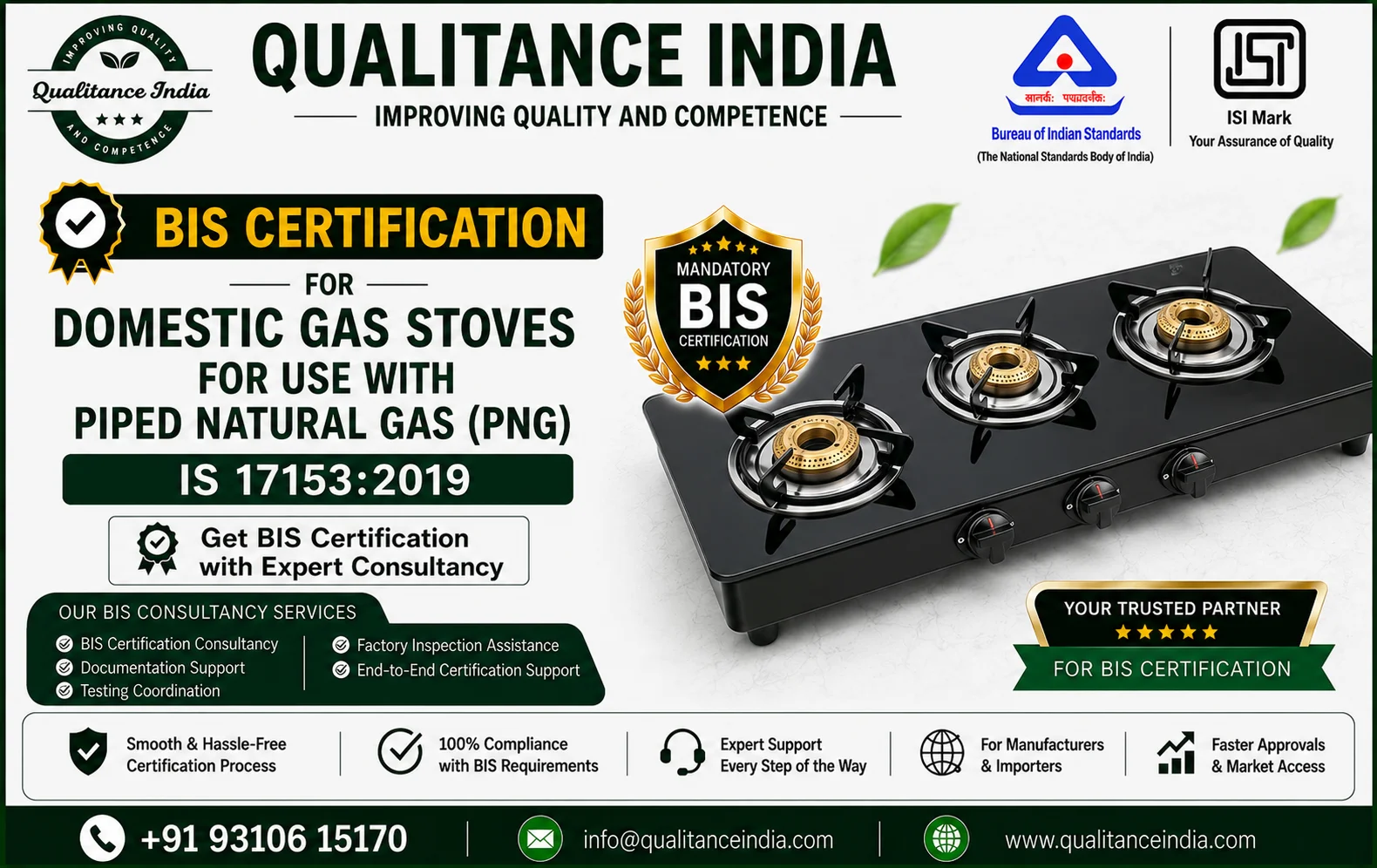
Website Image Text
DOMESTIC GAS STOVES FOR PNG
IS 17153:2019
BIS CERTIFICATION CONSULTANCY
PIPED NATURAL GAS (PNG)
Qualitance India
+91-9310-615-170
info@qualitanceindia.com
qualitanceindia.com
Image Text Suggestions
- BIS Certification for PNG Gas Stove
- BIS Licence for Domestic Gas Stove
- IS 17153:2019 Certification
- PNG Gas Stove BIS Certification
- Domestic Gas Stove Testing
- BIS Certification Consultancy for Gas Stove
- PNG Gas Stove Testing
- IS 17153 Testing
- Gas Stove Factory Inspection
- BIS Licence for PNG Gas Stove
- Domestic Gas Stove Certification
- PNG Gas Appliance Certification
- BIS Testing for Gas Stoves
- Gas Stove Quality Testing
- Qualitance India BIS Consultancy
Related Services
- BIS Certification for Domestic Gas Stoves
- BIS Certification for PNG Gas Appliances
- BIS Certification for LPG Appliances
- BIS Certification for Gas Burners
- BIS Product Testing
- BIS Factory Inspection
- BIS Licence Consultancy
- ISI Mark Certification
- QCO Compliance Consultancy
- Product Testing Consultancy
Related Topics for Your Website
- BIS Certification for PNG Gas Stoves
- IS 17153:2025 Certification
- Difference Between IS 17153:2019 and IS 17153:2025
- PNG Gas Stove Testing Requirements
- BIS Certification Process for Gas Stoves
- PNG Gas Stove QCO Requirements
- Gas Stove Thermal Efficiency Testing
- Gas Stove Gas Soundness Testing
- BIS Certification for Glass Top PNG Gas Stoves
- BIS Certification for Single and Multi-Burner PNG Gas Stoves
Need BIS Certification for Domestic PNG Gas Stoves?
If you manufacture Domestic Gas Stoves for Use with Piped Natural Gas, it is important to verify the applicable BIS standard, product configuration, testing requirements and current transition requirements.
Since IS 17153:2019 has been revised to IS 17153:2025, manufacturers should ensure that their application and testing strategy is based on the currently applicable BIS requirements.
Qualitance India can assist with:
- Product applicability assessment
- Standard identification
- Product grouping
- Documentation
- Laboratory coordination
- Sample preparation
- BIS application
- Factory inspection preparation
- Quality-control documentation
- Observation closure
Qualitance India
Phone: +91-9310-615-170
Email: info@qualitanceindia.com
Website: https://qualitanceindia.com/
Conclusion
Domestic Gas Stoves for Use with Piped Natural Gas (PNG) are subject to important safety and performance requirements under the applicable BIS framework. IS 17153:2019 provided the original specification for these products, while BIS has subsequently published IS 17153:2025 – Domestic Gas Stove and Built-in Hob for Use with PNG.
The certification process involves assessment of the product design, gas components, manufacturing process, testing facilities, product performance and quality-control arrangements. Important testing areas include gas soundness, thermal efficiency, gas consumption, combustion, flame stability, ignition, flash-back and temperature-related safety.
The Domestic Gas Stoves for Use with PNG QCO, 2023 provides the regulatory framework for BIS certification of covered products, while the latest standard version and BIS transition instructions need to be considered for current applications.
For manufacturers, proper preparation of technical documents, representative samples, testing arrangements, product grouping and factory facilities can make the certification process more efficient.
Qualitance India provides BIS certification consultancy for domestic PNG gas stoves, including product assessment, documentation, testing coordination, application support and factory inspection preparation.