
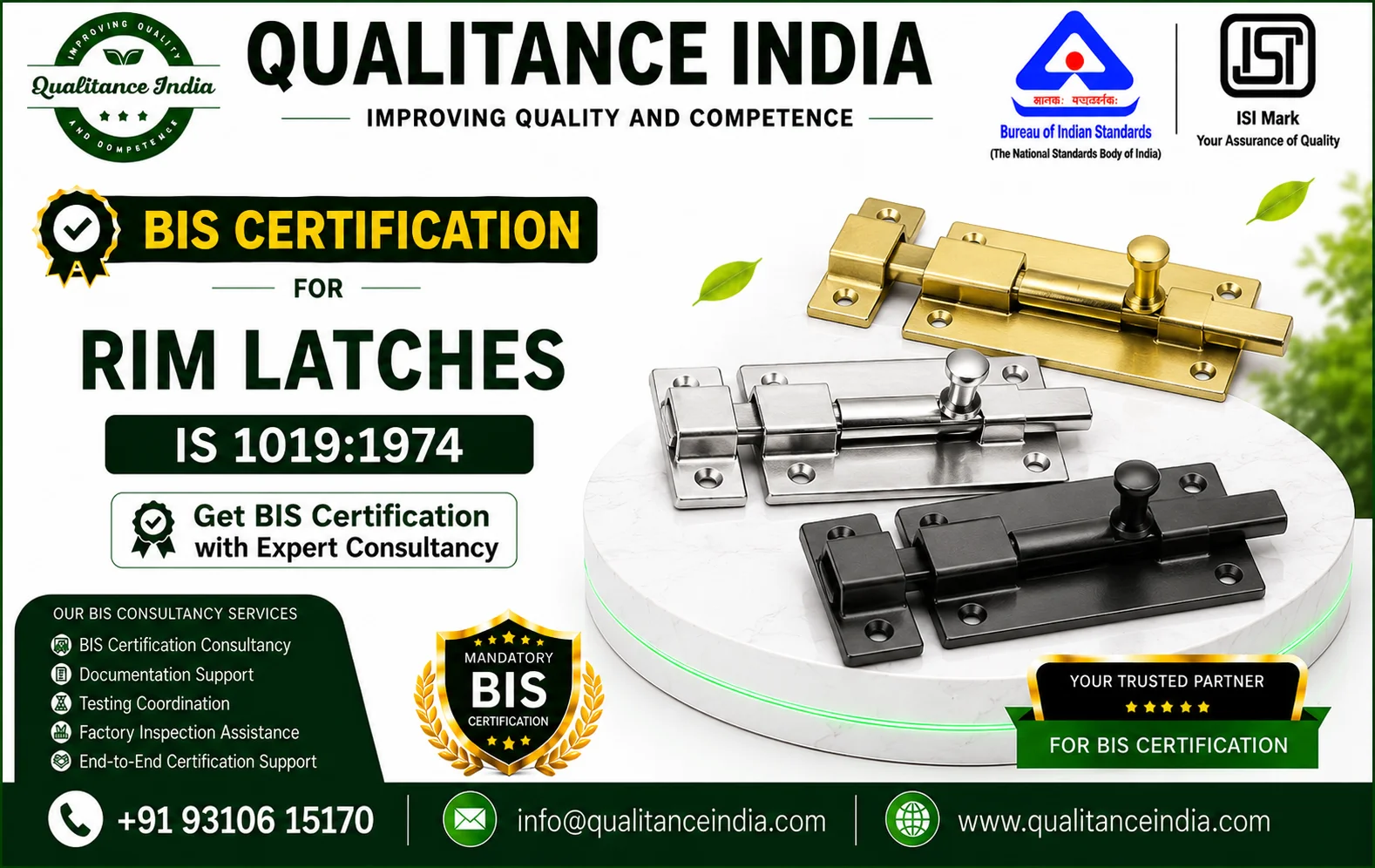
BIS Certification Consultancy for Rim Latches | IS 1019:1974 | BIS & ISI Mark Certification
Introduction
Rim latches are commonly used as surface-mounted door hardware for residential, commercial and other general-purpose applications. Their construction, dimensions, material, manufacturing quality and finish directly affect their durability and proper operation.
For maintaining consistent quality in the Indian market, IS 1019:1974 – Specification for Rim Latches lays down requirements relating to the material, dimensions, manufacture and finish of rim latches for general use.
Rim latches are also included under the Door Fittings (Quality Control) Order, 2023, and IS 1019:1974 appears in BIS's current compulsory certification listing under the Door Fittings category.
Manufacturers supplying rim latches in India therefore need to understand the applicable BIS certification requirements and ensure that their products conform to the relevant Indian Standard.
About Rim Latches
A rim latch is a type of door latch installed on the surface of a door rather than being fitted completely inside the door. It generally consists of components such as a body, back plate, latch bolt, follower and associated hardware.
Rim latches can be manufactured in different configurations and materials depending on the approved product scope.
The BIS Product Manual for IS 1019:1974 identifies the body materials as:
- Mild Steel
- Aluminium Alloy
- Brass
- Zinc Alloy
The licence scope also identifies Type 1 – Left Hand/Right Hand and Type 2, with the applicable size range specified in the licence.
What is IS 1019:1974?
IS 1019:1974 is titled:
Specification for Rim Latches (Second Revision)
The standard specifies requirements for rim latches intended for general use. It covers important aspects such as:
- Material
- Dimensions
- Manufacture
- Finish
- Product type
- Workmanship
- Relevant performance requirements
The standard was originally published for rim latches and was subsequently revised; the second revision also permitted zinc-base alloy pressure die casting for manufacture of rim latches.
Scope of IS 1019:1974
IS 1019:1974 applies to rim latches for general use.
The standard addresses the requirements necessary to ensure that the product is properly manufactured and meets the specified dimensional, material and finish requirements.
The BIS Product Manual confirms that the certification scope can cover rim latches based on:
Material of Body:
Mild Steel / Aluminium Alloy / Brass / Zinc Alloy
Type:
Type 1 – Left Hand / Right Hand
Type 2
Size:
As applicable to the approved licence scope.
Types of Rim Latches
Type 1 Rim Latches
Type 1 rim latches are identified according to the handing of the door.
They may be:
- Left Hand
- Right Hand
The appropriate configuration is selected depending on the door installation.
Type 2 Rim Latches
Type 2 rim latches are another configuration covered by IS 1019:1974. The BIS Product Manual specifically identifies Type 2 within the licence scope.
Materials Used for Rim Latches
Depending on the product configuration, rim latch bodies may be manufactured using:
Mild Steel
Mild steel is commonly used for strong and economical hardware components.
Aluminium Alloy
Aluminium alloy can be used where lightweight construction and suitable corrosion resistance are required.
Brass
Brass provides a combination of durability, machinability and appearance.
Zinc Alloy
Zinc alloy pressure die casting is also permitted for rim latch manufacture under the standard.
The applicable raw materials must meet the requirements specified in the standard and the relevant BIS certification conditions.
BIS Certification for Rim Latches
BIS Certification demonstrates that the manufacturer's rim latches have been evaluated against the applicable requirements of IS 1019:1974.
For products covered by the applicable regulatory requirements, certification is provided under the BIS Product Certification Scheme-I / ISI Mark Scheme.
BIS's current Scheme-I listing places IS 1019:1974 – Rim Latches under the Door Fittings (Quality Control) Order, 2023.
After obtaining the licence, the manufacturer can use the BIS Standard Mark on products covered by the approved licence scope, subject to BIS marking requirements.
Door Fittings Quality Control Order
The Door Fittings (Quality Control) Order, 2023 covers several door-fitting products, including rim latches conforming to IS 1019:1974.
BIS's current compulsory certification listing identifies:
IS 1019:1974 – Rim Latches
under the Door Fittings (Quality Control) Order, 2023, S.O. 4646(E), dated 23 October 2023.
The QCO requires covered products to conform to the applicable Indian Standard and carry the Standard Mark under a BIS licence, subject to the order's provisions.
Implementation of the QCO
The Door Fittings QCO was notified on 23 October 2023.
The commonly applicable implementation schedule provided for:
- Medium and Large Enterprises – six months from publication
- Small Enterprises – nine months from publication
- Micro Enterprises – twelve months from publication
For rim latches, the implementation dates have consequently been reported as 23 April 2024 for medium/large enterprises, 23 July 2024 for small enterprises and 23 October 2024 for micro enterprises.
Manufacturers and other stakeholders should always verify the latest government notification and any amendments applicable to their particular business category.
Who Needs BIS Certification for Rim Latches?
BIS certification is relevant to businesses involved in manufacturing covered rim latches, including:
- Rim latch manufacturers
- Door hardware manufacturers
- Builder hardware manufacturers
- Lock and latch manufacturers
- Metal hardware manufacturers
- Aluminium hardware manufacturers
- Brass hardware manufacturers
- Zinc alloy hardware manufacturers
- OEM manufacturers
- Contract manufacturers
Importers and sellers should also verify their responsibilities under the applicable QCO and BIS requirements.
BIS Certification Eligibility
A manufacturer applying for BIS certification should generally have:
- Manufacturing premises
- Suitable manufacturing machinery
- Product drawings
- Raw-material control
- Quality-control arrangements
- Testing and measuring facilities
- Calibrated equipment
- Trained personnel
- Inspection procedures
- Production records
- Testing records
- Suitable storage facilities
- Proper product identification and marking arrangements
The exact requirements depend on the product configuration and proposed licence scope.
BIS Certification Process for Rim Latches
Step 1 – Product Assessment
The product is first reviewed against IS 1019:1974.
The applicable:
- Type
- Material
- Size
- Construction
- Product configuration
are identified.
Step 2 – Product Scope
The proposed BIS licence scope is determined according to the applicable BIS grouping requirements.
Step 3 – Documentation
The required technical and factory documents are prepared.
Step 4 – Sample Preparation
Representative rim latch samples are prepared according to the applicable testing requirements.
The BIS Product Manual specifies a sample size of 2 nos. for IS 1019:1974.
Step 5 – Laboratory Testing
Samples are tested against the applicable requirements of IS 1019:1974.
Step 6 – BIS Application
The manufacturer submits the BIS application with the required documents and test information.
Step 7 – Factory Assessment
BIS assesses the manufacturing facility and quality-control arrangements.
Step 8 – Closure of Observations
If any observations are raised, the manufacturer takes corrective action and submits the required evidence.
Step 9 – Licence Grant
After successful conformity assessment, BIS grants the licence for the approved product scope.
Step 10 – ISI Mark
The manufacturer can mark compliant products according to the applicable BIS licence conditions.
Testing Requirements
Testing is an important part of the BIS certification process for rim latches.
The BIS laboratory information for IS 1019:1974 includes testing related to various requirements of the standard, including:
- Material-related requirements
- Dimensions
- Workmanship
- Finish
- Applicable component requirements
- Performance-related requirements
BIS LIMS currently lists IS 1019:1974 testing facilities and charges for different clauses and material-related requirements.
The exact test programme should be determined from the latest applicable standard, amendment, Product Manual and BIS requirements.
Raw Material Requirements
Raw-material quality is an important part of rim latch certification.
The BIS Product Manual states that materials are to conform to the requirements given in Table 1 of IS 1019:1974. It also notes that certain materials covered by IS 1079, IS 280 and IS 4454 (Part 2) are under mandatory BIS certification, and the manufacturer is required to ensure that applicable ISI-marked material is used and received with a test certificate.
Manufacturers should therefore maintain proper records for:
- Material purchase
- Material grade
- Supplier details
- Material test certificates
- Incoming inspection
- Batch identification
- Traceability
Product Dimensions
Dimensions are an important requirement for rim latches.
The manufacturer should maintain appropriate dimensional control during production.
Important areas can include:
- Body dimensions
- Back plate dimensions
- Latch bolt dimensions
- Component dimensions
- Hole positions
- Thickness
- Overall size
- Assembly dimensions
The actual dimensional requirements must be checked against the applicable tables and figures in IS 1019:1974.
Manufacturing Requirements
The manufacturing process should be controlled to ensure consistent product quality.
Depending on the material and manufacturing method, processes may include:
- Raw material receiving
- Cutting
- Pressing/forming
- Casting, where applicable
- Machining
- Drilling
- Component preparation
- Surface treatment
- Assembly
- Functional checking
- Final inspection
- Packing
Manufacturing controls should be documented and maintained.
Finish Requirements
Surface finish is another important aspect of rim latch quality.
The finished product should be properly processed and free from unacceptable defects that can affect appearance, operation or durability.
Where coating or surface treatment is applicable, appropriate controls and testing should be maintained.
The BIS Product Manual notes that finish testing is associated with IS 1868, while coating thickness and coating quality can be tested as applicable.
Factory Inspection
During BIS factory assessment, the manufacturing facility may be examined for:
Manufacturing Machinery
BIS may review machinery relevant to the manufacturing process.
Raw Material Storage
Material identification and storage arrangements may be checked.
Production Process
The manufacturing process should be properly controlled.
Testing Facilities
Required testing and measuring equipment should be available as applicable.
Calibration
Measuring instruments should have valid calibration records.
Quality Control
Incoming, in-process and final inspection procedures should be maintained.
Records
Production and quality records may be reviewed.
Product Identification
Product types, sizes and materials should be properly identified.
Documents Required
Typical documents for BIS certification may include:
- Company registration certificate
- Factory address proof
- Factory layout
- Manufacturing process flow
- Machinery list
- Product drawings
- Product specifications
- Product catalogue
- Raw-material details
- Material test certificates
- Supplier details
- Testing equipment list
- Calibration certificates
- Quality-control plan
- Internal inspection records
- Production records
- Test reports
- Product photographs
- Packing details
- Marking details
- Authorized signatory documents
- Trademark documents, where applicable
The exact document list can vary according to the applicant and licence scope.
Product Grouping
Product grouping is important when a manufacturer produces rim latches in multiple:
- Materials
- Types
- Sizes
- Configurations
The BIS Product Manual contains specific grouping guidance in its annexure and provides for licence scope based on material, type and size.
A manufacturer should therefore determine the proposed product scope before arranging samples and laboratory testing.
Common Reasons for BIS Certification Delays
Some common issues include:
- Incorrect standard selection
- Incorrect product classification
- Incomplete product drawings
- Wrong material declaration
- Inadequate raw-material records
- Incorrect product grouping
- Dimensional non-conformity
- Manufacturing defects
- Poor finish
- Inadequate testing facilities
- Missing calibration certificates
- Incorrect samples
- Incomplete documentation
- Factory not ready for assessment
- Incorrect marking or labelling
Proper preparation can help reduce unnecessary delays.
BIS Certification Cost
The overall cost depends on several factors, such as:
- BIS application fees
- Laboratory testing charges
- Number of product types
- Number of materials
- Number of sizes
- Product grouping
- Factory assessment
- Testing equipment
- Calibration
- Documentation
- Retesting, where required
- Consultancy charges
BIS LIMS currently lists testing charges for IS 1019:1974, but the final project cost depends on the actual scope and testing requirements.
Certification Timeline
The certification timeline can vary depending on:
- Document readiness
- Product scope
- Sample availability
- Laboratory testing
- Test results
- Application scrutiny
- Factory readiness
- Factory assessment
- Closure of observations
Manufacturers can often avoid delays by finalising their product scope and technical documentation before beginning the application process.
Benefits of BIS Certification
Regulatory Compliance
Helps manufacturers meet applicable BIS and QCO requirements.
Consistent Product Quality
Testing and production controls help maintain uniform product quality.
Customer Confidence
The ISI Mark provides assurance that the product has been certified under the applicable BIS framework.
Market Acceptance
BIS certification supports legal market access where certification is mandatory.
Better Quality Control
The certification process encourages systematic inspection and testing.
Business Credibility
Certified products can strengthen the manufacturer's position in the door hardware and builder hardware market.
Why Choose Qualitance India?
Qualitance India provides consultancy support for BIS certification and ISI Mark certification for various products covered under Indian Standards.
For Rim Latches as per IS 1019:1974, our support can include:
- Product applicability assessment
- Standard requirement review
- Product scope guidance
- Type and material assessment
- Product grouping guidance
- Documentation preparation
- Testing coordination
- Sample preparation guidance
- BIS application assistance
- Factory inspection preparation
- Quality-control documentation
- Observation closure support
- BIS licence assistance
Contact Qualitance India
Phone: +91 93106 15170
Email: info@qualitanceindia.com
Website: qualitanceindia.com
Rim Latch BIS Certification Process
Product Identification
↓
IS 1019:1974 Requirement Review
↓
Material & Type Identification
↓
Size and Scope Finalisation
↓
Documentation Preparation
↓
Sample Preparation
↓
Laboratory Testing
↓
BIS Application
↓
Application Scrutiny
↓
Factory Assessment
↓
Observation Closure
↓
BIS Licence Grant
↓
ISI Mark on Approved Products
Frequently Asked Questions
1. What is the BIS standard for rim latches?
The applicable standard is IS 1019:1974 – Specification for Rim Latches.
2. Is BIS certification mandatory for rim latches?
Rim latches are included in the BIS compulsory certification framework under the Door Fittings (Quality Control) Order, 2023.
3. What is the ISI Mark for rim latches?
The applicable Standard Mark is the BIS Standard Mark used under the BIS licence for products conforming to IS 1019:1974.
4. Which materials are covered under IS 1019?
The BIS Product Manual identifies mild steel, aluminium alloy, brass and zinc alloy as body materials within the licence scope.
5. What types of rim latches are covered?
The BIS Product Manual identifies Type 1 and Type 2 rim latches, with Type 1 being left-hand or right-hand.
6. What is the sample requirement?
The BIS Product Manual specifies 2 nos. as the sample size.
7. Is factory inspection required?
Yes, factory assessment forms part of the BIS Product Certification process under Scheme-I.
8. What tests are required for rim latches?
Testing covers applicable requirements of IS 1019:1974, including material, dimensions, workmanship, finish and other specified requirements.
9. Are raw materials required to be BIS certified?
For the applicable materials identified by the Product Manual, manufacturers must ensure the required conformity and documentation, including applicable ISI-marked material and test certificates.
10. Can different rim latch sizes be covered under one licence?
The licence scope can cover a specified size range, subject to BIS grouping and conformity requirements.
11. Is BIS certification required for imported rim latches?
Importers should verify the applicable QCO and BIS requirements before importing covered rim latches into India.
12. Is the Door Fittings QCO applicable to rim latches?
Yes. IS 1019:1974 – Rim Latches is specifically listed under the Door Fittings QCO.
13. When did the QCO requirements become applicable?
The implementation schedule depends on the enterprise category, with the commonly applicable dates being 23 April 2024 for medium/large enterprises, 23 July 2024 for small enterprises and 23 October 2024 for micro enterprises.
14. What documents are needed for BIS certification?
Documents generally include factory details, drawings, manufacturing process, machinery details, raw-material information, testing arrangements and quality-control records.
15. How long does BIS certification take?
The timeline depends on testing, documentation, application scrutiny, factory assessment and closure of observations.
16. Can Qualitance India help with BIS certification?
Yes. Qualitance India can assist with product assessment, documentation, testing coordination, BIS application and factory inspection preparation.
17. What is the difference between BIS certification and the ISI Mark?
BIS certification is the conformity assessment approval, while the ISI Mark is the Standard Mark applied to products under the relevant BIS licence and conditions.
18. Can a manufacturer apply for BIS certification without testing?
The applicable product testing and conformity assessment requirements must be completed as part of the BIS certification process.
19. What happens if a rim latch fails testing?
The manufacturer may need to investigate the non-conformity, make necessary corrections and undertake testing again as permitted under the applicable BIS procedure.
20. Can a manufacturer get BIS certification for multiple rim latch materials?
Potentially yes, but the proposed licence scope must be assessed according to the applicable material, type, size and grouping requirements.
People Also Ask
What is IS 1019:1974?
IS 1019:1974 is the Indian Standard specifying requirements for rim latches for general use.
Is IS 1019:1974 under a QCO?
Yes. Rim Latches under IS 1019:1974 are included under the Door Fittings (Quality Control) Order, 2023.
What materials are used in rim latches?
Mild steel, aluminium alloy, brass and zinc alloy are identified within the BIS Product Manual's licence scope.
What is the BIS certification process for rim latches?
It generally involves product assessment, documentation, sample testing, BIS application, factory assessment and grant of the licence.
Is ISI Mark mandatory for rim latches?
For rim latches covered by the applicable QCO, conformity and Standard Mark requirements apply under the BIS certification framework.
Frequently Searched Questions
BIS certification for rim latches
BIS licence for rim latches
ISI Mark for rim latches
IS 1019:1974 certification
Rim latch testing in India
Rim latch QCO
Door fittings BIS certification
BIS certification for door hardware
BIS consultant for rim latches
Rim latch manufacturer BIS licence
Related BIS Certification Services
- BIS Certification for Door Handles – IS 208:2020
- BIS Certification for Door Closers – IS 6343:1982
- BIS Certification for Hydraulically Regulated Door Closers – IS 3564:1995
- BIS Certification for Floor Springs – IS 6315:1992
- BIS Certification for Tower Bolts
- BIS Certification for Sliding Door Bolts
- BIS Certification for Cabinet Hinges
- BIS Certification for Butt Hinges
- BIS Certification for Builder Hardware
- BIS Certification for Fasteners
- ISI Mark Certification
- BIS Factory Inspection Assistance
Related Topics for Website
- BIS Certification for Door Handles as per IS 208:2020
- BIS Certification for Door Closers as per IS 6343:1982
- BIS Certification for Floor Springs as per IS 6315:1992
- BIS Certification for Tower Bolts – IS 204
- BIS Certification for Sliding Door Bolts
- BIS Certification for Cabinet Hinges
- BIS Certification for Stainless Steel Butt Hinges
- Door Fittings QCO 2023 – Complete Guide
- BIS Certification Process for Builder Hardware
- ISI Mark Certification for Door Hardware
Image Text for Website / Post
BIS CERTIFICATION
FOR
RIM LATCHES
IS 1019:1974
BIS & ISI MARK CERTIFICATION
Get BIS Certification with Expert Consultancy
BIS Certification Consultancy
Documentation Support
Testing Coordination
Factory Inspection Assistance
End-to-End Certification Support
Qualitance India
+91 93106 15170
info@qualitanceindia.com
www.qualitanceindia.com
Suggested Page Structure
BIS Certification for Rim Latches – IS 1019:1974
Introduction
About Rim Latches
What is IS 1019:1974?
Scope of IS 1019:1974
Types of Rim Latches
Materials Covered
BIS Certification Requirement
Door Fittings Quality Control Order, 2023
Implementation Requirements
Who Needs BIS Certification?
Eligibility Requirements
BIS Certification Process
Testing Requirements
Raw Material Requirements
Product Dimensions
Manufacturing Requirements
Finish Requirements
Factory Inspection
Documents Required
Product Grouping
Common Certification Issues
Certification Cost
Certification Timeline
Benefits of BIS Certification
Why Choose Qualitance India?
Frequently Asked Questions
People Also Ask
Related BIS Services
Contact Qualitance India
BIS Certification for Rim Latches – Contact Qualitance India
If you manufacture Rim Latches as per IS 1019:1974, getting the applicable BIS certification and maintaining the required quality-control system is important for supplying covered products in the Indian market.
Qualitance India can assist you with the complete process, from product applicability and scope assessment to testing, documentation, BIS application and factory inspection preparation.
Qualitance India – BIS & ISI Mark Certification Consultancy
Call: +91 93106 15170
Email: info@qualitanceindia.com
Website: qualitanceindia.com
The BIS Product Manual confirms that IS 1019:1974 certification is operated under Scheme-I and provides specific guidance on raw materials, product grouping, sample requirements, testing equipment and the licence scope.
Final Note
Rim latches are an important category of door hardware, and IS 1019:1974 establishes requirements for their material, dimensions, manufacture and finish. Because rim latches are included under the Door Fittings (Quality Control) Order, 2023, manufacturers should ensure that their products, manufacturing facilities, testing arrangements and documentation are ready for the applicable BIS conformity assessment requirements.
For BIS Certification and ISI Mark assistance for Rim Latches, contact Qualitance India.