
BIS Certification Consultancy for Tower Bolts – Non-Ferrous Metals | IS 204 (Part 2):1992
Introduction
Tower bolts are commonly used as fastening hardware for doors, windows, cabinets, furniture and other applications where a simple sliding locking arrangement is required. When these products are manufactured from non-ferrous metals such as brass, aluminium alloy or zinc alloy, their material quality, dimensions, finish and construction become important factors in determining their performance and durability.
IS 204 (Part 2):1992 – Tower Bolts – Specification: Part 2 Non-Ferrous Metals specifies requirements for tower bolts made from non-ferrous metals. BIS includes this product under its certification framework, and the current BIS Product Manual provides guidance on raw materials, product grouping, sample requirements, testing equipment and inspection and testing arrangements.
The standard covers both barrel tower bolts and skeleton tower bolts, with different types based on material and construction. BIS's current compulsory-certification listing includes IS 204 (Part 2):1992 – Tower Bolts – Non-ferrous metal under Scheme-I.
About Tower Bolts – Non-Ferrous Metals
A tower bolt is a sliding fastening device generally fitted to a door, window or similar movable panel. The bolt slides into a corresponding keeper or socket to secure the door or panel.
Non-ferrous tower bolts are manufactured using metals that do not have iron as their principal constituent. Common materials covered by the standard include:
- Brass
- Aluminium alloy
- Zinc alloy
These materials can provide suitable corrosion resistance, appearance and service performance when manufactured according to the applicable requirements.
IS 204 (Part 2):1992 covers barrel tower bolts and skeleton tower bolts.
What is IS 204 (Part 2):1992?
IS 204 (Part 2):1992 is titled:
Tower Bolts – Specification: Part 2 Non-Ferrous Metals
The standard lays down requirements for tower bolts made of non-ferrous metals.
It addresses important characteristics including:
- Material
- Dimensions
- Tolerances
- Manufacture
- Finish
- Product types
- Applicable material requirements
The standard is currently listed by BIS under its compulsory certification framework.
Scope of IS 204 (Part 2):1992
The standard covers tower bolts manufactured from non-ferrous metals.
The products are broadly classified into:
Barrel Tower Bolts
These tower bolts have a barrel arrangement through which the bolt slides.
Skeleton Tower Bolts
These have an open or skeleton-type plate and associated bolt arrangement.
The current BIS Product Manual identifies Types 1 to 5 for barrel tower bolts and Types 6 to 9 for skeleton tower bolts.
Types of Tower Bolts Covered
According to the current BIS grouping guidance:
| Tower Bolt Type | Material | Size Range |
|---|---|---|
| Barrel Type 1, 2, 3 | Brass | 75–300 mm |
| Barrel Type 4 | Aluminium Alloy | 75–300 mm |
| Barrel Type 5 | Zinc Alloy | 75–300 mm |
| Skeleton Type 6, 7 | Brass | 375–900 mm |
| Skeleton Type 8 | Aluminium Alloy | 375–900 mm |
| Skeleton Type 9 | Zinc Alloy | 375–900 mm |
The BIS Product Manual gives the detailed grouping basis and identifies the relevant sizes for each type.
Materials Used in Tower Bolts
The standard specifies requirements for materials used in tower bolts.
Depending on the type, tower bolts may be manufactured using:
Brass
Used for various barrel and skeleton tower bolt configurations.
Aluminium Alloy
Used for aluminium alloy tower bolts.
Zinc Alloy
Used for zinc-alloy tower bolts, including die-cast constructions.
The current BIS Product Manual requires raw material to conform to the applicable requirements of Clause 4 and Table 3 of IS 204 (Part 2):1992.
Important Requirements
Material
The material used for manufacturing tower bolts should meet the requirements specified by the standard.
Dimensions
The dimensions of the tower bolt must conform to the applicable tables and requirements.
Tolerances
Dimensional tolerances must remain within the limits specified by the standard.
Manufacture
Tower bolts should be properly manufactured and free from defects that can affect their performance.
Smooth Operation
The bolt should operate smoothly and correctly.
Finish
The finished product should have a suitable surface finish and should not have unacceptable sharp edges or other defects.
Anodizing
For applicable aluminium alloy tower bolts, anodizing requirements may apply.
Manufacturing Process
A typical manufacturing process for non-ferrous tower bolts may involve the following stages:
1. Raw Material Selection
Suitable brass, aluminium alloy or zinc alloy material is selected.
2. Incoming Material Inspection
Material composition, dimensions and supplier documentation are checked.
3. Component Manufacturing
Components such as:
- Barrel
- Bolt
- Plate
- Staple
- Knob
- Keeper
are manufactured according to the applicable product design.
4. Casting / Extrusion / Forming
Depending on the material and product type, components may be produced through casting, extrusion, rolling, drawing or other suitable processes.
5. Machining
Necessary machining operations are carried out to achieve required dimensions.
6. Drilling
Screw holes and other required holes are produced.
7. Assembly
Individual components are assembled.
8. Surface Finishing
Applicable finishing, polishing, plating or anodizing is carried out.
9. Inspection
The finished tower bolt is checked for:
- Dimensions
- Tolerances
- Finish
- Operation
- Workmanship
- Surface defects
10. Packing
Finished products are packed and identified according to applicable requirements.
Testing Requirements
Testing is an important part of BIS certification.
The applicable testing can include:
- Material requirements
- Dimensions
- Dimensional tolerances
- Manufacture
- Finish
- Visual examination
- Anodizing, where applicable
BIS laboratory information for IS 204 (Part 2):1992 lists testing under the applicable specification and currently shows laboratory testing availability for the product.
The exact testing programme should always be checked against the latest BIS Product Manual and applicable amendments.
Product Grouping
Product grouping is particularly important for manufacturers producing multiple tower bolt sizes and materials.
The July 2025 BIS Product Manual provides specific grouping guidelines. It states that the product is classified according to:
- Description
- Type
- Material
- Size
For each applicable type and size range, samples representing the smallest and highest size are to be tested to cover the intervening sizes within that range.
This grouping approach can help manufacturers include multiple sizes within the licence scope while following BIS requirements.
Sample Requirement
The earlier BIS Product Manual specifies a sample size of:
5 nos. of Tower Bolts.
However, the current Product Manual should be referred to when preparing a new application because BIS may update product manuals, grouping requirements or testing arrangements.
Testing Equipment
Manufacturers applying for BIS certification should maintain suitable testing and measuring facilities according to the applicable Product Manual.
The BIS Product Manual provides the list of testing equipment through its relevant annexure.
Depending on the applicable requirements, manufacturers may need arrangements for checking:
- Dimensions
- Tolerances
- Material characteristics
- Finish
- Anodizing, where applicable
- Other specified product characteristics
Measuring equipment should be appropriately maintained and calibrated.
Factory Inspection
During BIS factory assessment, the manufacturing facility may be evaluated for:
Raw Material Control
Verification of brass, aluminium alloy, zinc alloy and other materials.
Manufacturing Machinery
Assessment of casting, extrusion, machining, drilling, forming and finishing machinery, as applicable.
Production Process
Review of the complete manufacturing process.
Quality Control
Inspection of incoming, in-process and finished products.
Testing Facilities
Verification of testing and measuring equipment.
Calibration
Review of calibration records.
Product Identification
Checking product types, sizes and material identification.
Packing
Review of product packaging and identification.
Records
Production, inspection and testing records may be reviewed during assessment.
Documents Required
Common documents required for BIS certification may include:
- Company registration documents
- Factory address proof
- Factory layout
- Manufacturing process flow
- Machinery list
- Product drawings
- Product specifications
- Product catalogue
- Raw-material specifications
- Material test certificates
- Supplier documents
- Internal test reports
- Laboratory test reports
- Testing equipment list
- Calibration certificates
- Quality-control plan
- Inspection records
- Production records
- Product photographs
- Packing details
- Marking details
- Authorized signatory documents
- Trademark documents, where applicable
The exact documentation depends on the applicant and proposed licence scope.
BIS Marking Requirements
After obtaining the BIS licence, the manufacturer can use the applicable BIS Standard Mark and licence number (CM/L) according to BIS certification conditions.
The Standard Mark should only be applied to products covered by the approved licence scope.
The marking and labelling requirements should be checked against the latest applicable standard, Product Manual and BIS licence conditions.
QCO Requirement
Tower Bolts – Non-Ferrous Metals are included in the BIS compulsory certification framework under:
IS 204 (Part 2):1992
BIS's current Scheme-I listing specifically includes IS 204 (Part 2):1992 – Tower Bolts – Non-ferrous metal.
The BIS technical publication also states that the applicable Quality Control Order requires covered tower bolts manufactured, sold or imported in India to comply with IS 204 (Part 2) and display the BIS Standard Mark.
Manufacturers, importers and sellers should therefore verify the latest QCO and implementation requirements applicable to their products before placing them on the Indian market.
Who Needs BIS Certification?
BIS certification can be relevant to manufacturers producing covered non-ferrous tower bolts, including:
- Tower bolt manufacturers
- Builder hardware manufacturers
- Brass tower bolt manufacturers
- Aluminium tower bolt manufacturers
- Zinc alloy tower bolt manufacturers
- Door hardware manufacturers
- Window hardware manufacturers
- Hardware OEM manufacturers
- Contract manufacturers
- Export-oriented manufacturers supplying the Indian market
Importers should separately review the requirements applicable to imported products.
Eligibility Requirements
A manufacturer should generally have:
- Suitable manufacturing premises
- Appropriate machinery
- Raw-material control
- Product drawings
- Product specifications
- Quality-control procedures
- Testing arrangements
- Calibrated measuring equipment
- Production records
- Inspection records
- Suitable technical personnel
- Proper storage arrangements
- Packing and marking arrangements
Common Reasons for Certification Delays
Manufacturers may face delays because of:
- Incorrect standard selection
- Incorrect product classification
- Wrong material declaration
- Incorrect product grouping
- Inadequate product drawings
- Dimensional non-conformity
- Tolerance failure
- Poor surface finish
- Sharp edges
- Improper bolt operation
- Material-related non-conformity
- Anodizing-related issues
- Missing calibration records
- Inadequate testing arrangements
- Incorrect samples
- Incomplete documents
- Factory not ready for assessment
- Incorrect marking
Proper preparation before submitting the BIS application can reduce avoidable issues.
Cost of BIS Certification
The total certification cost depends on:
- BIS application charges
- Laboratory testing
- Number of product types
- Number of materials
- Product grouping
- Number of sizes
- Testing equipment
- Factory assessment
- Calibration
- Retesting, if required
- Documentation
- Consultancy charges
BIS LIMS currently shows a listed testing charge for IS 204 Part 2, although the final cost depends on the actual scope and laboratory selected.
Certification Timeline
The time required for certification depends on:
- Product readiness
- Documentation
- Sample availability
- Laboratory testing
- Test results
- BIS application processing
- Factory readiness
- Factory assessment
- Closure of observations
Manufacturers with multiple materials and sizes should finalise their product grouping before testing.
Benefits of BIS Certification
Product Quality
Testing helps verify important product characteristics.
Regulatory Compliance
Helps manufacturers comply with applicable BIS requirements.
Customer Confidence
BIS certification can increase buyer confidence.
Market Acceptance
Certification supports market access where BIS certification is compulsory.
Better Manufacturing Control
Quality-control arrangements help maintain consistent production.
Product Reliability
Proper dimensions, material and workmanship contribute to reliable tower bolt operation.
Business Credibility
BIS certification can strengthen the manufacturer's position in the builder hardware market.
Why Choose Qualitance India?
Qualitance India provides BIS certification consultancy for builder hardware, fasteners and various products covered under Indian Standards.
For Tower Bolts – Non-Ferrous Metals as per IS 204 (Part 2):1992, assistance can include:
- Product applicability assessment
- Standard requirement review
- Product grouping guidance
- Material assessment
- Size and type assessment
- Documentation support
- Testing requirement review
- Laboratory coordination
- Sample preparation guidance
- BIS application assistance
- Factory inspection preparation
- Quality-control documentation
- Test report coordination
- Observation closure assistance
- BIS licence support
Contact Qualitance India
Phone: +91-9310-615-170
Email: info@qualitanceindia.com
Website: https://qualitanceindia.com/
BIS Certification Process
Product Identification
↓
IS 204 (Part 2):1992 Requirement Review
↓
Material & Product Type Assessment
↓
Size and Product Grouping
↓
Raw Material Verification
↓
Documentation Preparation
↓
Sample Selection
↓
Laboratory Testing
↓
BIS Application
↓
BIS Scrutiny
↓
Factory Assessment
↓
Test Report Evaluation
↓
Observation Closure
↓
BIS Licence Grant
↓
BIS Standard Mark
Frequently Asked Questions
1. What is IS 204 (Part 2):1992?
IS 204 (Part 2):1992 is the Indian Standard for Tower Bolts – Specification: Part 2 Non-Ferrous Metals.
2. What are non-ferrous tower bolts?
They are tower bolts manufactured from non-ferrous materials such as brass, aluminium alloy and zinc alloy.
3. Which products are covered under IS 204 Part 2?
The standard covers non-ferrous metal tower bolts, including barrel and skeleton types.
4. Which materials are covered?
The BIS grouping guidance identifies brass, aluminium alloy and zinc alloy for the specified tower bolt types.
5. What is the size range for barrel tower bolts?
The current grouping guidance identifies sizes from 75 mm to 300 mm for the listed barrel tower bolt types.
6. What is the size range for skeleton tower bolts?
The current grouping guidance identifies sizes from 375 mm to 900 mm for the listed skeleton tower bolt types.
7. Is BIS certification required for non-ferrous tower bolts?
IS 204 (Part 2):1992 is included in BIS's current compulsory certification listing under Scheme-I.
8. Is product grouping applicable?
Yes. BIS provides specific grouping guidance based on type, material and size.
9. Which samples are tested for product grouping?
The current grouping guidance specifies testing one sample each of the smallest and highest size from each applicable type and size range.
10. What tests are performed?
Testing can include material, dimensions, tolerances, manufacture, finish and other applicable requirements.
11. Is material testing required?
Material must comply with the applicable requirements of Clause 4 and Table 3 of IS 204 (Part 2):1992.
12. Is anodizing tested?
Anodizing can be an applicable requirement for aluminium alloy tower bolts.
13. Is factory inspection required?
Factory assessment is part of the applicable BIS certification process under Scheme-I.
14. What documents are required?
Typical documents include factory details, product drawings, raw-material information, manufacturing process, machinery list, testing arrangements, calibration records and quality-control records.
15. Can a manufacturer include different sizes in one licence?
Potentially yes, subject to the applicable BIS grouping rules and the manufacturer's testing and production capabilities.
16. Can brass and aluminium tower bolts be included in the same licence?
The licence scope and grouping need to be determined according to the applicable type, material and BIS grouping requirements.
17. What is the BIS certification process?
It generally involves product assessment, grouping, documentation, testing, BIS application, factory assessment and conformity evaluation.
18. Can Qualitance India help with tower bolt certification?
Yes. Qualitance India can assist manufacturers with product assessment, grouping, documentation, testing coordination, BIS application and factory inspection preparation.
People Also Ask
What is the BIS standard for non-ferrous tower bolts?
The applicable standard is IS 204 (Part 2):1992.
Is IS 204 Part 2 mandatory?
It is included in BIS's compulsory certification listing under Scheme-I.
What metals are used for non-ferrous tower bolts?
Common materials covered include brass, aluminium alloy and zinc alloy.
What are barrel tower bolts?
Barrel tower bolts have a tubular/barrel arrangement through which the sliding bolt operates.
What are skeleton tower bolts?
Skeleton tower bolts use an open or skeleton-type plate and associated sliding bolt arrangement.
What sizes are covered under IS 204 Part 2?
The current BIS grouping guidance identifies barrel tower bolt sizes from 75 to 300 mm and skeleton tower bolt sizes from 375 to 900 mm for the specified types.
How can I obtain BIS certification for tower bolts?
A manufacturer needs to identify the applicable product type and material, prepare representative samples and documents, complete the required testing and undergo the BIS certification process.
Website Image Text
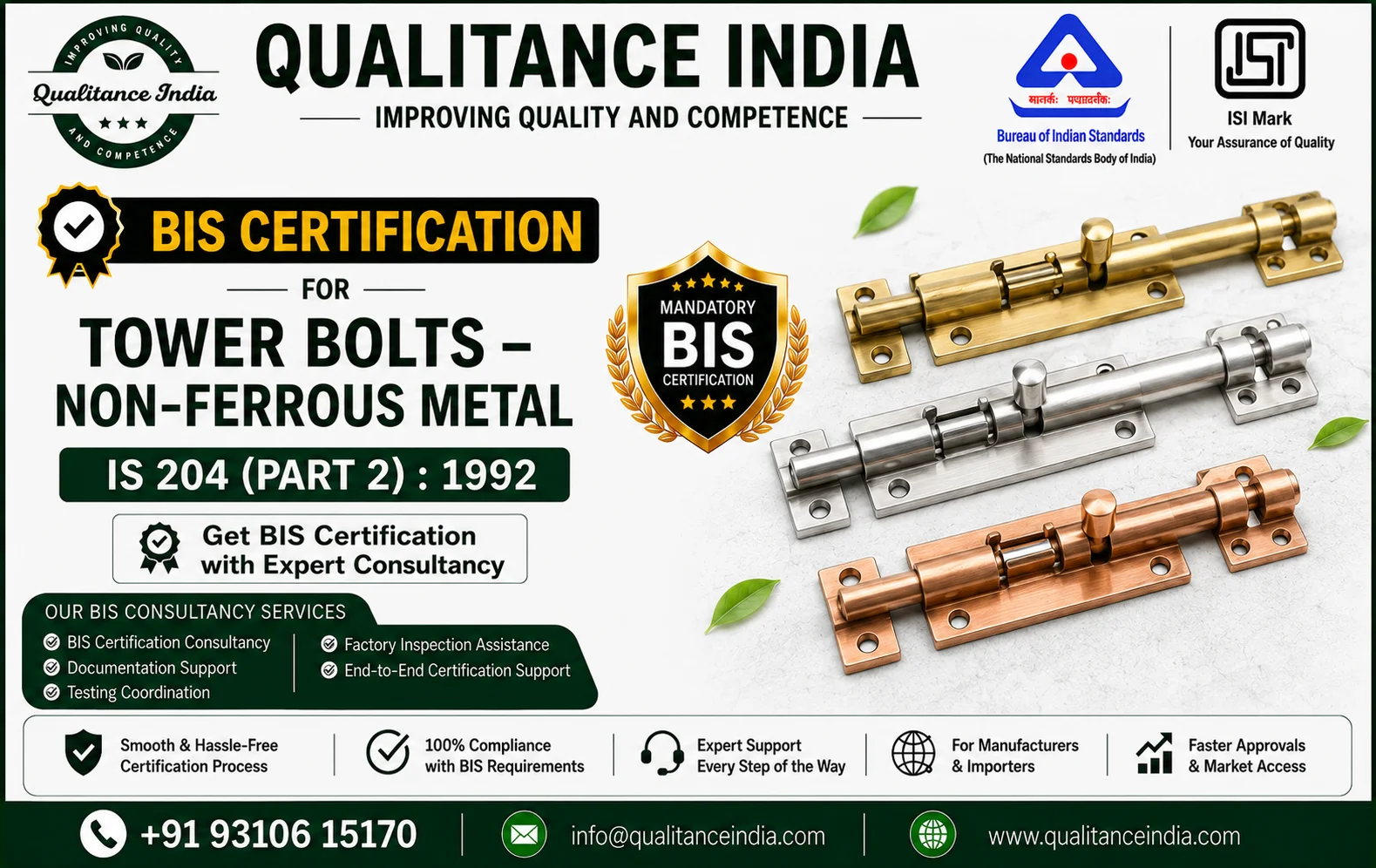
TOWER BOLTS – NON-FERROUS METALS
IS 204 (PART 2):1992
BIS CERTIFICATION CONSULTANCY
BRASS | ALUMINIUM ALLOY | ZINC ALLOY
Qualitance India
+91-9310-615-170
info@qualitanceindia.com
qualitanceindia.com
Image Text Suggestions
- BIS Certification for Tower Bolts
- IS 204 Part 2:1992
- Non-Ferrous Tower Bolts BIS Certification
- BIS Licence for Tower Bolts
- Brass Tower Bolt Certification
- Aluminium Tower Bolt Certification
- Zinc Alloy Tower Bolt Certification
- Tower Bolt Testing
- Tower Bolt Factory Inspection
- IS 204 Part 2 Testing
- BIS Certification for Builder Hardware
- Non-Ferrous Metal Tower Bolts
- Tower Bolt Quality Testing
- BIS Licence Consultancy for Tower Bolts
- Qualitance India BIS Consultancy
Related Services
- BIS Certification for Ferrous Tower Bolts – IS 204 (Part 1)
- BIS Certification for Stainless Steel Tower Bolts – IS 15833
- BIS Certification for Sliding Door Bolts
- BIS Certification for Fasteners
- BIS Certification for Step Bolts
- BIS Certification for Transmission Tower Bolts
- BIS Certification for Structural Bolts
- BIS Product Testing
- BIS Factory Inspection
- ISI Mark Certification
- QCO Compliance Consultancy
Related Blog Topics
- BIS Certification for Ferrous Tower Bolts – IS 204 Part 1
- BIS Certification for Stainless Steel Tower Bolts – IS 15833
- BIS Certification for Brass Tower Bolts
- BIS Certification for Aluminium Tower Bolts
- BIS Certification for Zinc Alloy Tower Bolts
- IS 204 Part 2 Testing Requirements
- Tower Bolt Product Grouping Under BIS
- BIS Certification Process for Builder Hardware
- QCO Requirements for Tower Bolts
- BIS Certification for Door and Window Hardware
Need BIS Certification for Tower Bolts?
If you manufacture non-ferrous metal tower bolts made from brass, aluminium alloy or zinc alloy, compliance with the applicable BIS requirements is important before supplying the product in the Indian market.
The current BIS Product Manual provides detailed guidance regarding product grouping, materials, sizes, samples, testing equipment and inspection and testing arrangements for IS 204 (Part 2):1992.
Qualitance India can assist manufacturers with:
- Product applicability
- Type and material identification
- Product grouping
- Sample planning
- Laboratory coordination
- Documentation
- BIS application
- Factory inspection preparation
- Quality-control documentation
- Test report coordination
Qualitance India
Phone: +91-9310-615-170
Email: info@qualitanceindia.com
Website: https://qualitanceindia.com/
Conclusion
IS 204 (Part 2):1992 – Tower Bolts – Non-Ferrous Metals provides requirements for tower bolts manufactured from non-ferrous materials such as brass, aluminium alloy and zinc alloy. The standard covers both barrel and skeleton tower bolts and addresses important characteristics including material, dimensions, tolerances, manufacture and finish.
BIS currently includes IS 204 (Part 2):1992 in its Scheme-I compulsory certification listing.
For manufacturers with multiple sizes and materials, correctly understanding the BIS product grouping requirements is especially important. The current Product Manual specifies grouping based on product type, material and size, with representative smallest and highest sizes tested for the relevant ranges.
Proper preparation of product specifications, raw-material documents, samples, testing facilities and factory records can make the certification process more systematic.
Qualitance India provides BIS certification consultancy for Tower Bolts – Non-Ferrous Metals as per IS 204 (Part 2):1992, assisting manufacturers from product assessment and testing coordination through BIS application and factory inspection preparation