
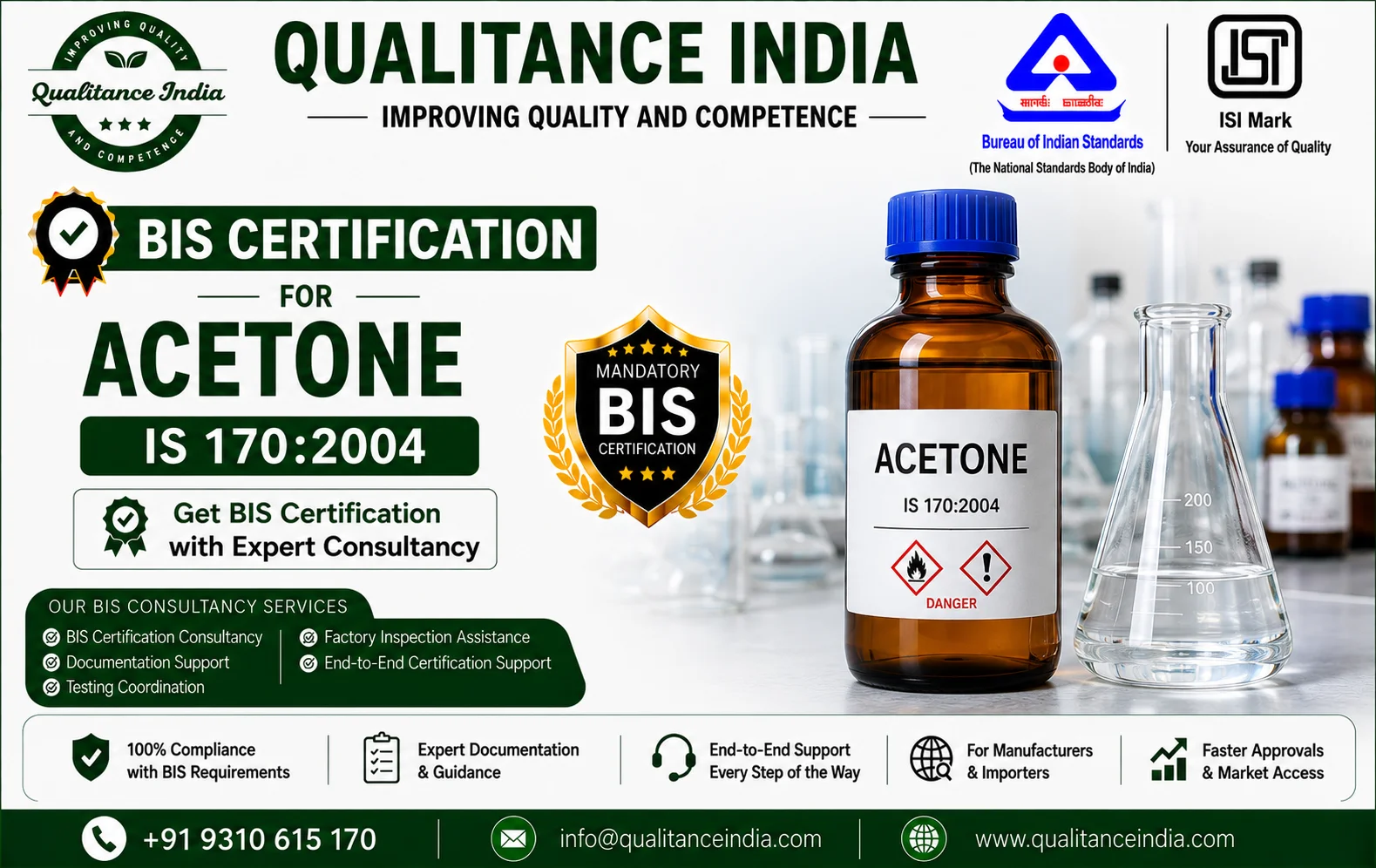
BIS Certification for Acetone | IS 170:2004 | Acetone Specification
Introduction
Acetone BIS Certification is an important regulatory compliance requirement for manufacturers and suppliers dealing with Acetone covered under the applicable Indian Standard and Quality Control Order.
IS 170:2004 specifies requirements for Acetone. BIS's Product Manual for IS 170:2004 was prepared for certification under Scheme-I of the BIS Conformity Assessment Regulations, 2018. The manual specifies a minimum sample size of 500 ml, and states that all tests prescribed in IS 170:2004 may be conducted in a day, subject to the applicable testing arrangements.
BIS's compulsory certification listing identifies IS 170:2004 – Acetone under the Acetone (Quality Control) Order, 2020.
Important: BIS currently also publishes a Product Manual for IS 170:2020 – Acetone – Specification. Therefore, manufacturers should verify the latest applicable standard and regulatory requirements before submitting a new certification application.
About Acetone
Acetone is a widely used organic solvent and chemical raw material.
It is commonly used in:
- Paint and coating industries
- Adhesive manufacturing
- Pharmaceutical industries
- Chemical processing
- Printing industries
- Plastic and polymer processing
- Laboratory applications
- Cleaning and degreasing applications
- Cosmetic and personal-care formulations
- Industrial solvent applications
Because Acetone is used across multiple industrial sectors, maintaining consistent chemical quality and purity is important for manufacturers and industrial users.
For products falling under compulsory BIS requirements, conformity with the applicable Indian Standard and QCO requirements becomes an important part of market compliance.
What is BIS Certification?
BIS Certification is a product conformity assessment system administered by the Bureau of Indian Standards (BIS).
Under applicable certification schemes, manufacturers demonstrate that their products comply with the relevant Indian Standard.
For products covered under compulsory certification, the manufacturer must obtain the required BIS licence before using the BIS Standard Mark and supplying the regulated product in accordance with the applicable legal requirements.
BIS lists Acetone under its Scheme-I compulsory certification framework through the applicable Quality Control Order.
What is IS 170:2004?
IS 170:2004 is the Indian Standard relating to:
Acetone – Specification
The BIS Product Manual identifies:
- Product: Acetone
- Indian Standard: IS 170:2004
- Certification Scheme: Scheme-I
- Sample size: Minimum 500 ml
- Grouping: Not applicable because no varieties are specified in the standard
- Testing: Tests prescribed in IS 170:2004
The Product Manual also states that the 2004 standard had three amendments at the time of that manual.
Scope of IS 170:2004
The standard establishes specification requirements for Acetone.
The purpose of the specification is to provide defined quality requirements so that Acetone supplied for industrial and other applicable uses maintains consistent characteristics.
The relevant conformity assessment can involve evaluation of chemical and physical characteristics prescribed by the applicable standard.
Manufacturers should always use the current applicable edition, amendments and BIS certification requirements rather than relying only on an old copy of the standard.
Acetone Products Covered
The exact licence scope should be determined according to the applicable BIS standard and certification requirements.
The product category generally relates to:
Industrial Acetone
Acetone manufactured for industrial applications.
Chemical-Grade Acetone
Acetone produced according to specified chemical quality requirements.
Solvent Applications
Acetone used as an industrial solvent.
Manufacturing Raw Material
Acetone used as a raw material or process chemical in other industries.
Note: The final BIS licence scope should be based on the applicable standard and the product actually manufactured at the applicant's premises.
Acetone Quality Control Order – Important
This is a very important section for your website.
The BIS Scheme-I page lists:
IS 170:2004 – Acetone
under:
Acetone (Quality Control) Order, 2020
The listed QCO is S.O. 1896(E), dated 16 June 2020. BIS's Scheme-I page also provides links to subsequent amendments to the Acetone QCO.
The original QCO documentation identifies Acetone against IS 170:2004, reaffirmed 2015, under the relevant chemical-products regulatory framework.
Why is QCO Important?
A Quality Control Order can make compliance with a specified Indian Standard compulsory for the covered goods.
Therefore, manufacturers should verify:
- Current QCO
- Applicable standard
- Effective date
- Amendments
- Product scope
- Manufacturer applicability
- BIS certification route
before manufacturing or supplying regulated Acetone.
Current Standard Revision – Important Update
For a professional website, do not leave this point out.
BIS's current product-manual records include:
IS 170:2020 – Acetone
BIS has published a Product Manual titled “Acetone – Specification According to IS 170:2020.”
BIS's product-manual listings also show IS 170:2020 – Acetone.
Therefore, if your target keyword is:
“BIS Certification for Acetone – IS 170:2004”
you can keep the page focused on IS 170:2004 but add a prominent section explaining that IS 170:2020 is the subsequent/currently listed standard, and manufacturers should verify which version applies to their certification or regulatory requirement.
This will make your page more trustworthy and reduce outdated information.
Who Needs BIS Certification for Acetone?
Depending on the applicable QCO and product scope, relevant businesses may include:
- Acetone manufacturers
- Chemical manufacturers
- Solvent manufacturers
- Petrochemical manufacturers
- Chemical processing companies
- Industrial chemical suppliers
- Chemical exporters/importers where applicable
- Manufacturers supplying Acetone to regulated industries
- Chemical companies subject to applicable BIS requirements
The exact obligation should be checked against the current QCO and product scope.
Eligibility Criteria
A manufacturer applying for BIS certification should generally have:
- Manufacturing facility
- Suitable chemical processing equipment
- Quality-control system
- Laboratory/testing arrangements
- Qualified technical personnel
- Calibrated testing instruments
- Raw-material control
- Production process control
- Finished-product inspection
- Storage arrangements
- Batch identification system
- Test records
- Quality records
The actual requirements depend on the applicable BIS standard, Product Manual and certification scheme.
Complete BIS Certification Process for Acetone
Step 1 – Product Applicability Assessment
Determine whether the Acetone product falls under the applicable BIS/QCO requirements.
Step 2 – Standard Verification
Verify whether IS 170:2004 or the applicable current revision applies to the product.
Step 3 – Factory Assessment
Review the manufacturer's:
- Manufacturing process
- Machinery
- Laboratory
- Testing equipment
- Quality-control system
Step 4 – Documentation
Prepare all required BIS documents.
Step 5 – Sample Preparation
Prepare representative Acetone samples according to BIS requirements.
The IS 170:2004 Product Manual specifies a minimum sample size of 500 ml.
Step 6 – Laboratory Testing
Test the product against the applicable requirements.
Step 7 – BIS Application
Submit the BIS application through the applicable certification process.
Step 8 – Application Scrutiny
BIS reviews the submitted documents and technical details.
Step 9 – Factory Inspection
BIS may assess the manufacturing facility and quality-control arrangements.
Step 10 – Test Report Verification
Test results are reviewed against applicable requirements.
Step 11 – Observation Closure
Any non-conformity or observation must be appropriately addressed.
Step 12 – Licence Grant
After satisfactory completion of applicable requirements, BIS may grant the licence.
Step 13 – Standard Mark Compliance
The manufacturer uses the BIS Standard Mark according to the licence conditions.
Step 14 – Continued Compliance
The manufacturer maintains ongoing quality, testing and inspection requirements.
Required Documents
Typical documentation may include:
- Company registration certificate
- Factory registration documents
- Factory address proof
- Manufacturing process flow chart
- Factory layout
- Machinery list
- Testing equipment list
- Calibration certificates
- Raw-material details
- Raw-material specifications
- Product specification
- Product test reports
- Quality-control plan
- Batch records
- Internal testing records
- Laboratory details
- Packaging details
- Product labels
- Marking details
- Trademark documents
- Authorized signatory documents
- BIS application documents
- Declarations and undertakings
The final checklist should be prepared according to the current BIS certification requirements.
Testing Requirements for Acetone
Testing is one of the most important parts of BIS certification.
The Product Manual for IS 170:2004 states that all tests prescribed in the standard are applicable.
Depending on the applicable edition and testing requirements, important quality characteristics may include chemical and physical properties such as:
- Appearance
- Purity
- Distillation characteristics
- Acidity
- Water/moisture
- Residue
- Specific gravity
- Other prescribed chemical characteristics
Important: The exact test parameters, methods and acceptance limits should be taken directly from the applicable edition of IS 170 and current BIS certification documentation.
Sampling Requirements
For IS 170:2004, the BIS Product Manual specifies:
Minimum Sample Size: 500 ml
The manual also states:
Grouping Guidelines: Not Applicable
This is because no varieties are specified in IS 170:2004.
Laboratory Testing
Acetone testing should be performed through the appropriate laboratory/testing arrangement recognized for the applicable BIS certification requirements.
Before selecting a laboratory, manufacturers should verify:
- Current BIS recognition/scope
- Applicable standard version
- Test parameters
- Laboratory scope
- Sample requirements
- Testing charges
- Current validity
BIS's Know Your Standard portal allows users to access information such as standards, amendments, testing laboratories and certification-related details.
Factory Inspection Process
During factory assessment, the following areas may be reviewed:
Manufacturing Facility
Chemical processing and production facilities.
Raw Materials
Incoming raw-material identification and quality control.
Production Process
Process control and batch manufacturing procedures.
Testing Laboratory
Availability of required testing facilities.
Calibration
Calibration status of measuring/testing equipment.
Finished Product
Finished Acetone quality verification.
Batch Traceability
Ability to identify and trace individual production batches.
Quality Records
Inspection and testing records.
Storage
Safe and controlled storage arrangements.
Packaging and Marking
Correct product identification, packaging and applicable BIS marking requirements.
Common Reasons for BIS Application Rejection or Delay
- Wrong standard selected
- Outdated standard information
- QCO applicability not properly assessed
- Incomplete documents
- Insufficient testing facilities
- Failed laboratory test
- Improper sampling
- Inadequate calibration
- Missing batch records
- Poor raw-material control
- Incorrect product specifications
- Incomplete quality-control plan
- Factory not ready for inspection
- Incorrect marking/label information
- Failure to close BIS observations
BIS Certification Cost for Acetone
There is no single fixed BIS certification cost applicable to every Acetone manufacturer.
The overall cost can depend on:
- BIS application fees
- Laboratory testing charges
- Number of tests
- Sample requirements
- Factory inspection
- Testing equipment
- Documentation
- Number of manufacturing locations
- Retesting, if required
- Consultancy charges
Cost Formula
Total BIS Cost = Application + Testing + Inspection + Documentation + Other Applicable Charges
For an accurate quotation, the manufacturer's product, factory location and current BIS requirements should first be assessed.
BIS Certification Timeline
The timeline depends on:
- Document readiness
- Factory readiness
- Laboratory availability
- Testing duration
- Test results
- BIS application scrutiny
- Inspection scheduling
- Observation closure
Therefore, a manufacturer should not rely on a fixed number of days without first completing a product and factory assessment.
Benefits of BIS Certification for Acetone
1. Regulatory Compliance
Helps manufacturers meet applicable BIS/QCO requirements.
2. Product Quality
Encourages consistent quality-control practices.
3. Customer Confidence
Provides greater confidence to industrial customers.
4. Market Acceptance
Supports supply to markets where BIS compliance is applicable.
5. Brand Credibility
A valid BIS licence can strengthen credibility.
6. Quality Control
Encourages systematic testing and documentation.
7. Business Opportunities
Can help manufacturers participate in procurement opportunities where applicable compliance is required.
Why Choose Qualitance India?
Qualitance India provides professional BIS Certification Consultancy for chemical and industrial products.
For Acetone manufacturers, our consultancy support can include:
✓ Product Applicability Assessment
✓ IS Standard Verification
✓ QCO Applicability Assessment
✓ Current Revision Verification
✓ Documentation Support
✓ Laboratory Coordination
✓ Sample Preparation Guidance
✓ BIS Application Assistance
✓ Factory Inspection Preparation
✓ Quality-Control Documentation
✓ Test Report Coordination
✓ Observation Closure Support
✓ BIS Licence Guidance
✓ ISI Mark Compliance Guidance
Contact Qualitance India
Phone: +91-9310-615-170
Email: info@qualitanceindia.com
Website: qualitanceindia.com
QUALITANCE INDIA – IMPROVING QUALITY AND COMPETENCE
Step-by-Step Flow Chart – Text Format
Acetone Product Identification
↓
BIS/QCO Applicability Check
↓
Applicable IS Standard Verification
↓
Factory & Laboratory Assessment
↓
Documentation Preparation
↓
Sample Preparation – Minimum 500 ml*
↓
Laboratory Testing
↓
BIS Application Submission
↓
Application Scrutiny
↓
Factory Inspection
↓
Test Report Verification
↓
Observation Closure
↓
BIS Licence Grant
↓
ISI Mark Compliance
↓
Ongoing Compliance
*As specified in the IS 170:2004 Product Manual.
25 SEO FAQs
1. What is IS 170:2004?
IS 170:2004 is the Indian Standard for Acetone – Specification. BIS published a Product Manual for certification under this standard.
2. What is BIS Certification for Acetone?
It is the BIS conformity assessment process for Acetone covered by the applicable Indian Standard and regulatory requirements.
3. Is BIS Certification mandatory for Acetone?
Acetone is listed under the Acetone (Quality Control) Order, 2020 in BIS's compulsory certification/Scheme-I listing. Manufacturers should verify the current QCO and applicability to their product.
4. What is the Acetone QCO?
The Acetone Quality Control Order is the regulatory framework specifying applicable conformity requirements for Acetone covered by the order.
5. What is the sample size for IS 170:2004?
The BIS Product Manual specifies a minimum sample size of 500 ml.
6. Is grouping applicable under IS 170:2004?
The Product Manual states that grouping is not applicable because no varieties are specified in the standard.
7. What tests are required for Acetone?
The applicable tests are those prescribed in the relevant edition of IS 170. The 2004 Product Manual states that all tests prescribed in IS 170:2004 are applicable.
8. Is IS 170:2004 the latest standard?
BIS currently publishes a Product Manual for IS 170:2020 – Acetone – Specification, so manufacturers should verify the current applicable standard before applying.
9. What is IS 170:2020?
It is the later BIS standard/product-manual version relating to Acetone specification.
10. What documents are required for Acetone BIS Certification?
Documents generally include factory details, manufacturing process, machinery, laboratory/testing details, product specifications, calibration records and quality-control documents.
11. Is factory inspection required?
Factory assessment may form part of the applicable BIS certification process.
12. How much does Acetone BIS Certification cost?
The cost depends on testing, application, inspection, documentation and other applicable charges.
13. How long does BIS Certification take?
The timeline varies depending on documentation, laboratory testing, inspection and BIS processing.
14. Can a chemical manufacturer apply for BIS Certification?
Yes, provided the product and manufacturer meet the applicable BIS/QCO requirements.
15. What is the BIS Standard Mark?
It is the applicable BIS conformity mark used by an authorized licensee according to the licence conditions.
16. Is Acetone testing mandatory?
Where BIS certification is applicable, the product must meet the applicable testing and conformity requirements.
17. Can Qualitance India help with Acetone BIS Certification?
Yes. Qualitance India can assist with applicability assessment, documentation, laboratory coordination, application support and factory inspection preparation.
18. What is Acetone used for?
Acetone is widely used as a solvent and chemical raw material across several industrial sectors.
19. What industries use Acetone?
Industries include paints and coatings, adhesives, pharmaceuticals, chemicals, plastics, printing and laboratories.
20. What is Scheme-I?
Scheme-I is the BIS certification scheme under which eligible products can be certified and marked according to applicable BIS requirements.
21. What is a Quality Control Order?
A QCO is a government regulatory order that can make conformity with specified Indian Standards compulsory for covered products.
22. Where can I verify Acetone BIS requirements?
BIS's official Know Your Standard platform provides access to standard-related information, amendments, laboratories and certification details.
23. What is Acetone specification?
Acetone specification refers to the quality requirements prescribed by the applicable Indian Standard.
24. Can foreign manufacturers obtain BIS Certification?
Eligible foreign manufacturers may apply through the applicable BIS certification route for foreign manufacturers.
25. Why should Acetone manufacturers verify the current standard?
Because BIS currently lists IS 170:2020 as a later Acetone standard, while IS 170:2004 remains referenced in the compulsory-certification/QCO framework. The applicable current regulatory position should therefore be confirmed before a new application.
FAQ Schema Content
Website FAQ section mein ye questions use karein:
- What is IS 170:2004?
- What is BIS Certification for Acetone?
- Is BIS Certification mandatory for Acetone?
- What is the Acetone Quality Control Order?
- What is the sample size for IS 170:2004?
- What tests are required for Acetone?
- Is IS 170:2004 the latest standard?
- What is IS 170:2020?
- What documents are required?
- Is factory inspection required?
- What is the BIS Certification cost?
- How long does Acetone BIS Certification take?
- Can chemical manufacturers apply?
- What is Scheme-I?
- What is a Quality Control Order?
- Where can Acetone BIS requirements be verified?
- Can foreign manufacturers obtain BIS Certification?
- Why is Acetone testing important?
- What industries use Acetone?
- Can Qualitance India help with Acetone BIS Certification?
Service Schema Suggestion
Service Name: BIS Certification Consultancy for Acetone
Service Type: BIS Certification Consultancy
Product: Acetone
Applicable Standard: IS 170:2004 / applicable current revision
Certification Scheme: Scheme-I, where applicable
Provider: Qualitance India
Area Served: India
Description: Professional BIS Certification Consultancy for Acetone including BIS/QCO applicability assessment, documentation, testing coordination, application support and factory inspection preparation.
Organization Schema Suggestion
Organization Name: Qualitance India
Tagline: Improving Quality and Competence
Phone: +91-9310-615-170
Email: info@qualitanceindia.com
Website: qualitanceindia.com
Breadcrumb Schema Suggestion
Home → BIS Certification → Chemical Products → Acetone → IS 170:2004
Article Schema Suggestion
Article Type: Article / BlogPosting
Headline: BIS Certification for Acetone – IS 170:2004
Author: Qualitance India
Publisher: Qualitance India
Article Section: BIS Certification / Chemical Product Certification
Keywords: BIS Certification for Acetone, IS 170:2004, Acetone BIS Licence, Acetone QCO, IS 170 Testing
Image ALT Tags
- BIS Certification for Acetone
- IS 170:2004 BIS Certification
- Acetone BIS Licence
- Acetone ISI Mark Certification
- BIS Certification for Chemical Products
- IS 170 Acetone Testing
- Acetone Quality Control Order
- Acetone BIS Testing Laboratory
- Acetone Manufacturer BIS Licence
- Acetone Quality Testing
- BIS Certification for Acetone Manufacturer
- IS 170:2004 Acetone Specification
- Acetone Chemical Testing
- Acetone BIS Certification Process
- Qualitance India BIS Certification Consultancy
Internal Linking Strategy
Is page ko website ke following pages se link karein:
- BIS Certification Consultancy
- BIS Certification Process
- BIS Certification Cost
- BIS Certification Documents
- BIS Product Testing
- BIS Factory Inspection
- ISI Mark Certification
- Chemical Product Certification
- QCO Compliance Consultancy
- Foreign Manufacturer BIS Certification
- Chemical Testing Services
- BIS Licence Consultancy
Recommended Anchor Text
- BIS Certification Process
- BIS Certification Cost
- BIS Testing Services
- BIS Factory Inspection
- ISI Mark Certification
- QCO Compliance Consultancy
- Chemical Product BIS Certification
- BIS Licence for Manufacturers
External Authority References
Official BIS Product Manual – IS 170:2004
BIS Product Manual for Acetone – IS 170:2004
Official BIS Product Manual – IS 170:2020
BIS Product Manual for Acetone – IS 170:2020
BIS Scheme-I / Compulsory Certification
BIS Know Your Standard
Related BIS Services
- BIS Certification for Acetone
- BIS Certification for Caustic Soda
- BIS Certification for Sodium Sulphide
- BIS Certification for Chemical Products
- BIS Certification for Industrial Chemicals
- BIS Certification for Solvents
- BIS Product Testing
- BIS Factory Inspection
- QCO Compliance Consultancy
- ISI Mark Certification
- Chemical Testing Consultancy
- Foreign Manufacturer BIS Certification
Related Blog Suggestions
- BIS Certification for Acetone – Complete Guide
- IS 170:2004 – Acetone Specification Explained
- IS 170:2004 vs IS 170:2020 – Difference Explained
- Acetone Quality Control Order 2020 – Complete Guide
- Acetone BIS Testing Requirements
- Documents Required for Acetone BIS Certification
- BIS Certification Cost for Acetone
- Acetone BIS Licence Process in India
- BIS Testing Laboratory for Acetone
- How to Get BIS Licence for Chemical Products
- BIS Certification for Caustic Soda – IS 252:2013
- BIS Certification for Sodium Sulphide – IS 297:2001
- Chemical Products Covered Under BIS QCO
- Complete Guide to BIS Quality Control Orders
- BIS Certification for Chemical Manufacturers
Strong Lead Generation CTA
Need BIS Certification for Acetone?
Are you an Acetone Manufacturer, Chemical Manufacturer, Solvent Manufacturer or Industrial Chemical Supplier looking for BIS Certification?
Qualitance India can help you understand the applicable BIS standard, QCO requirements, testing procedure and certification process.
Our Support Includes:
✓ BIS/QCO Applicability Assessment
✓ IS 170 Standard Verification
✓ Current Revision Assessment
✓ Documentation Preparation
✓ Laboratory Testing Coordination
✓ Sample Preparation Guidance
✓ BIS Application Assistance
✓ Factory Inspection Preparation
✓ Quality-Control Documentation
✓ Test Report Coordination
✓ Observation Closure Support
✓ BIS Licence Guidance
Contact Qualitance India
📞 +91-9310-615-170
📧 info@qualitanceindia.com
🌐 qualitanceindia.com
QUALITANCE INDIA – IMPROVING QUALITY AND COMPETENCE
SEO-Optimized Conclusion
BIS Certification for Acetone is an important compliance consideration for manufacturers whose products fall within the applicable BIS and Quality Control Order requirements.
IS 170:2004 provides the Acetone specification referenced in the earlier BIS certification framework, and the BIS Product Manual specifies important certification elements including sample requirements, testing and Scheme-I certification.
The Acetone (Quality Control) Order, 2020 is listed by BIS in connection with IS 170:2004, making QCO applicability an important part of the manufacturer's compliance assessment.
At the same time, BIS currently publishes a Product Manual for IS 170:2020 – Acetone – Specification. Manufacturers should therefore verify the latest applicable standard, QCO, amendments and certification requirements before filing a new application.
For professional assistance with Acetone BIS Certification, IS 170 applicability, QCO compliance, laboratory testing, documentation, BIS application and factory inspection preparation, Qualitance India provides end-to-end BIS consultancy support.