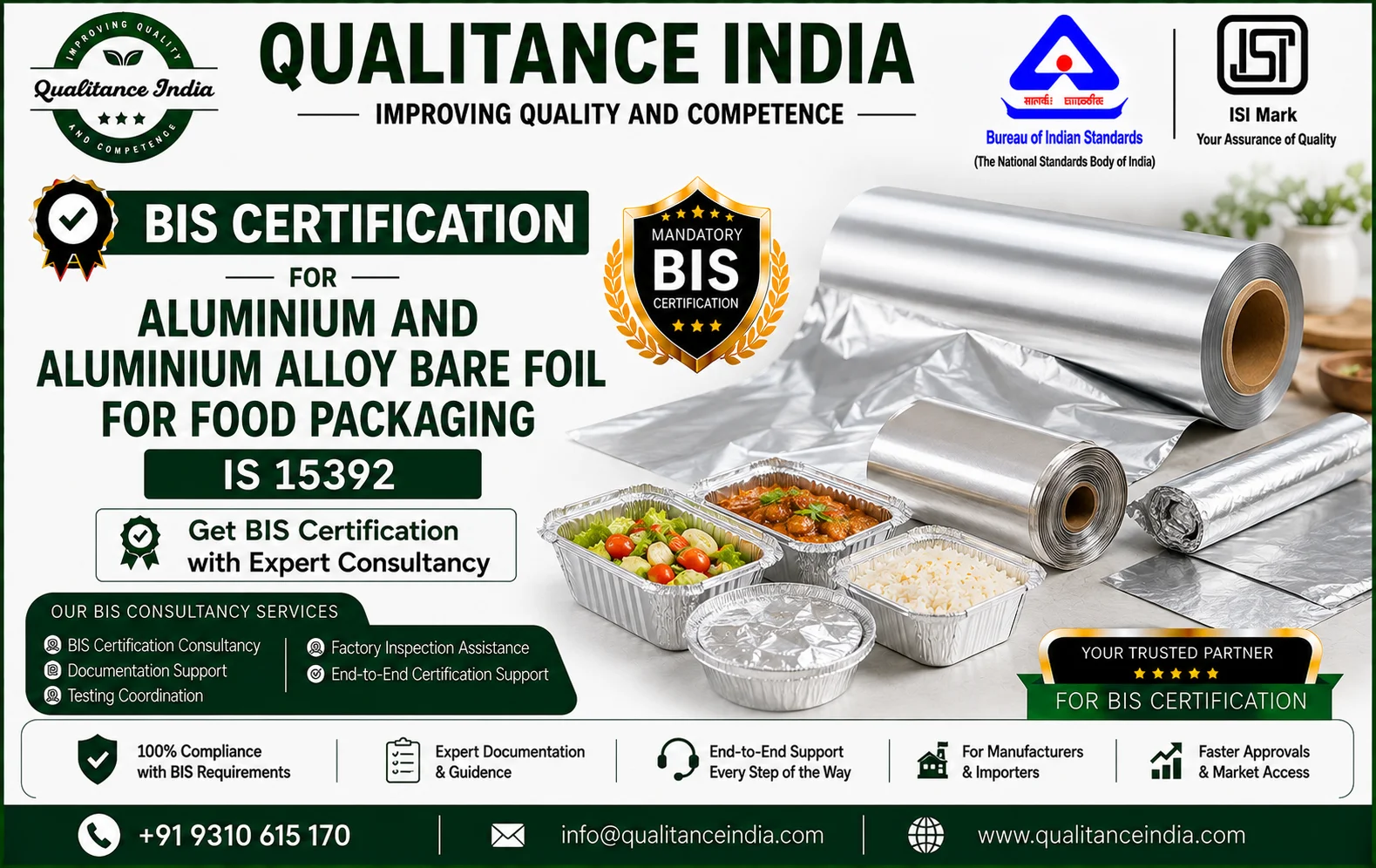
BIS Certification for Aluminium and Aluminium Alloy Bare Foil for Food Packaging | IS 15392:2003
Introduction
BIS Certification for Aluminium and Aluminium Alloy Bare Foil for Food Packaging is a mandatory product-certification requirement for covered aluminium foil products under the applicable Indian regulatory framework. The relevant Indian Standard is IS 15392:2003 – Aluminium and Aluminium Alloy Bare Foil for Food Packaging – Specification. BIS's current compulsory-certification listing identifies IS 15392 under the Aluminium Foil (Quality Control) Order, 2020.
The BIS Product Manual for IS 15392:2003 provides guidance on product scope, raw material, sampling, grouping, testing equipment, Scheme of Inspection and Testing, and licensing scope.
Manufacturers of aluminium foil intended for food packaging should therefore assess their product against the applicable requirements of IS 15392, prepare the required technical documentation, complete testing through the appropriate laboratory and obtain the applicable BIS licence before using the Standard Mark.
About the Product
Aluminium and Aluminium Alloy Bare Foil for Food Packaging is aluminium foil manufactured for applications involving food packaging.
The product can be supplied in different forms and surface conditions according to the applicable specification.
The BIS Product Manual identifies the licence scope in terms of parameters such as:
- Nominal thickness
- Width
- Form of product
- Coil/Sheet
- Surface condition
- Dry annealed condition
- Slick annealed condition
Aluminium foil is widely used because of its lightweight nature, formability and suitability for various packaging applications.
What is BIS Certification?
BIS Certification is a conformity assessment mechanism administered by the Bureau of Indian Standards (BIS).
For products covered under compulsory certification, manufacturers must demonstrate that their products conform to the applicable Indian Standard and satisfy the relevant certification requirements.
For aluminium foil covered by IS 15392, BIS currently lists the product under Scheme-I / ISI Mark Scheme and identifies the applicable Aluminium Foil (Quality Control) Order, 2020.
What is IS 15392:2003?
IS 15392:2003 is titled:
“Aluminium and Aluminium Alloy Bare Foil for Food Packaging – Specification.”
The BIS Product Manual confirms IS 15392:2003 as the applicable product standard and provides certification guidance for prospective applicants and existing licensees.
The standard covers requirements relating to the characteristics and quality of aluminium and aluminium alloy bare foil intended for food packaging.
Scope of IS 15392
The standard covers aluminium and aluminium alloy bare foil intended for food packaging.
The BIS Product Manual identifies certification scope using parameters such as:
- Nominal thickness
- Width
- Product form
- Coil
- Sheet
- Surface condition
- Dry annealed condition
- Slick annealed condition
The applicable scope should be finalized according to the manufacturer's actual product range and the current BIS requirements.
Amendment to IS 15392
An important point for manufacturers is that Amendment No. 1 to IS 15392:2003 was issued in April 2022.
The amendment changed certain thickness-related provisions, including replacing 0.075 mm (75 µm) with 0.100 mm (100 µm) in specified clauses and adding preferred thicknesses of 80 µm, 90 µm and 100 µm in the relevant table. It also added corresponding tensile-breaking-load values.
Therefore, manufacturers should ensure that their technical documents and product specifications reflect the applicable amended requirements.
Products Covered
Depending on the applicable scope, the product category can include:
- Aluminium Bare Foil for Food Packaging
- Aluminium Alloy Bare Foil for Food Packaging
- Aluminium Foil Coils
- Aluminium Foil Sheets
- Dry Annealed Aluminium Foil
- Slick Annealed Aluminium Foil
- Different nominal thicknesses
- Different widths
- Applicable aluminium alloy grades
The exact certification scope should be determined according to the product specifications and BIS grouping requirements.
Raw Material Requirements
The BIS Product Manual specifies that the raw material should conform to the chemical composition of the relevant grades:
- G 19000
- G 19500
- G 19600
- G 31000
- G 40800
of IS 737.
It also states that the material shall be supplied in fully annealed “O” temper.
This makes raw-material control an important part of BIS compliance.
Mandatory BIS Certification
Yes. IS 15392 is included in BIS's compulsory certification framework.
BIS's current Scheme-I listing shows:
IS 15392 – Aluminium and Aluminium Alloy Bare Foil for Food Packaging
under:
Aluminium Foil (Quality Control) Order, 2020 – S.O. 687(E), dated 13 February 2020.
Therefore, manufacturers covered by the applicable QCO should obtain the required BIS certification before supplying the regulated product in the Indian market.
Applicable QCO Details
The applicable regulatory order is:
Aluminium Foil (Quality Control) Order, 2020
Notification: S.O. 687(E)
Date: 13 February 2020
BIS's current compulsory-certification page identifies this QCO against IS 15392.
Manufacturers should verify the latest applicable regulatory notification and any subsequent amendments/exemptions before relying on the compliance position for a particular product.
Who Needs BIS Certification?
BIS certification may be required for manufacturers producing covered aluminium and aluminium alloy bare foil for food packaging, including:
- Indian manufacturers
- Aluminium foil manufacturers
- Aluminium foil processing units
- OEM manufacturers
- Contract manufacturers
- Private-label manufacturers
- Eligible foreign manufacturers
- Manufacturers supplying food-packaging foil to Indian customers
The exact applicability depends on the product and the latest QCO provisions.
Eligibility Criteria
A manufacturer should generally have:
- Suitable manufacturing facilities
- Aluminium foil production/processing equipment
- Quality-control system
- Raw-material control
- Testing facilities or suitable testing arrangements
- Calibrated measuring instruments
- Technical personnel
- Production records
- Inspection records
- Finished-product control
- Proper storage facilities
- Product identification and traceability
The manufacturing facility should be capable of consistently producing foil conforming to IS 15392.
Complete BIS Certification Process
Step 1 – Product Identification
Identify the exact aluminium foil product manufactured for food packaging.
Step 2 – Standard Assessment
Confirm applicability of:
IS 15392:2003
including applicable amendments.
Step 3 – Product Scope Assessment
Identify:
- Alloy grade
- Thickness
- Width
- Form
- Surface condition
- Coil/sheet
- Annealing condition
Step 4 – Grouping Assessment
Determine the appropriate BIS product grouping.
The BIS Product Manual specifically provides grouping guidance in its annex.
Step 5 – Factory Assessment
Review manufacturing machinery, quality-control systems, testing arrangements and production facilities.
Step 6 – Documentation
Prepare all technical, legal and quality documents.
Step 7 – Sample Preparation
Prepare samples according to the applicable BIS sampling requirements.
Step 8 – Laboratory Testing
Submit samples to the appropriate BIS-recognized/approved testing facility as applicable.
Step 9 – BIS Application
Submit the certification application along with the required documents and test information.
Step 10 – Application Scrutiny
BIS reviews the submitted application and documentation.
Step 11 – Factory Inspection
The factory may be assessed for manufacturing and quality-control capabilities.
Step 12 – Observation Closure
Address any technical or documentation observations raised during the certification process.
Step 13 – Licence Grant
After successful completion of the requirements, BIS may grant the licence.
Step 14 – Standard Mark
The licensee may use the BIS Standard Mark according to the applicable licence conditions.
Step 15 – Continued Compliance
Maintain ongoing production, inspection and testing compliance.
Required Documents
Commonly required documents may include:
- Company registration documents
- Factory licence/registration
- Factory address proof
- Factory layout
- Manufacturing process flow chart
- Machinery list
- Product specifications
- Product drawings
- Raw-material details
- Aluminium alloy grade details
- Quality-control plan
- Testing equipment list
- Calibration certificates
- Internal test reports
- Product photographs
- Packaging/label details
- Trademark documents
- Authorized signatory documents
- BIS application documents
- Declarations and undertakings
The exact documents depend on the applicant and product scope.
Testing Requirements
Testing is a critical part of IS 15392 BIS certification.
BIS LIMS currently lists testing facilities for IS 15392:2003 and identifies tests relating to various clauses of the standard.
Testing may include:
Pinhole Count
The foil is evaluated for pinholes according to the applicable requirement.
Freedom from Defects
The product is checked for specified defects.
Chemical Composition
Relevant aluminium alloy/material composition requirements are evaluated.
Thickness
Average thickness is assessed.
Dimensions
Relevant dimensional requirements such as width and length are evaluated.
Tensile Properties
Tensile properties may be tested according to the applicable requirements.
Surface Condition
The foil surface is assessed according to the relevant requirements.
Lubricants
Applicable lubricant requirements are evaluated where relevant.
BIS LIMS listings show individual test activities for IS 15392, including pinhole count, freedom from defects, material, average thickness, dimensions, surface condition and tensile properties.
BIS Testing Laboratory
BIS LIMS currently shows laboratories with testing scope for IS 15392:2003.
For example, BIS's Central Laboratory lists IS 15392:2003 within its scope, while the BIS Eastern Regional Laboratory also lists testing for the standard.
Testing charges can vary depending on:
- Laboratory
- Test package
- Product grade
- Number of tests
- Testing scope
- Additional tests
BIS LIMS currently shows different test charges/packages for IS 15392, so manufacturers should obtain the latest applicable quotation rather than relying on an old fixed cost.
BIS Product Sampling
The BIS Product Manual contains specific sampling guidance.
For the product manual, the sampling information includes:
Sample Size: 20 metre coils – 3 Nos.
The manual also provides grouping guidance and test-equipment requirements in its annexes.
The exact sampling requirement should always be checked against the applicable current BIS certification documentation.
Product Grouping
Product grouping is important where a manufacturer has multiple:
- Alloy grades
- Thicknesses
- Widths
- Forms
- Surface conditions
The BIS Product Manual provides grouping guidelines under Annex A.
Proper grouping can help manufacturers avoid unnecessary testing and delays.
Factory Inspection Process
During factory assessment, the following areas may be reviewed:
Raw Material Control
The manufacturer should demonstrate control over aluminium/alloy raw materials.
Manufacturing Process
The complete foil manufacturing process should be properly controlled.
Rolling/Processing
Relevant production processes should be maintained consistently.
Annealing
Applicable annealing conditions should be controlled.
Quality Control
Incoming, in-process and final-product inspections should be documented.
Testing Facilities
Required testing arrangements should be available.
Calibration
Measuring and testing equipment should have valid calibration records.
Records
Production and testing records should be properly maintained.
Scheme of Inspection and Testing
The BIS Product Manual includes a Scheme of Inspection and Testing (SIT) for IS 15392 under its relevant annex.
The manufacturer/licensee needs to maintain appropriate inspection and testing controls to demonstrate continued conformity.
The SIT framework may address:
- Test parameters
- Test frequency
- Sample selection
- Acceptance criteria
- Records
- Routine testing
- Corrective action
Common Reasons for BIS Application Rejection or Delay
Some common problems include:
- Wrong standard selected
- Incorrect product scope
- Incorrect alloy grade
- Incomplete technical documentation
- Missing test reports
- Product failing laboratory testing
- Incorrect product grouping
- Missing calibration certificates
- Inadequate testing arrangements
- Improper raw-material records
- Incomplete factory documentation
- Incorrect product marking
- Failure to close BIS observations
- Incomplete quality-control records
BIS Certification Cost
There is no single fixed BIS certification cost for every aluminium foil manufacturer.
The overall cost can depend on:
- BIS application fees
- Product testing charges
- Number of product variants
- Number of alloy grades
- Product grouping
- Laboratory charges
- Inspection expenses
- Retesting
- Documentation requirements
- Consultancy charges
BIS LIMS currently shows separate testing charges for different IS 15392 test parameters, demonstrating why the laboratory-testing portion can vary according to scope.
BIS Certification Timeline
The certification timeline depends on:
- Documentation readiness
- Product grouping
- Sample availability
- Laboratory availability
- Testing duration
- Test results
- Factory readiness
- BIS application scrutiny
- Inspection scheduling
- Observation closure
Therefore, manufacturers should avoid claiming a guaranteed fixed certification timeline.
Benefits of BIS Certification
Regulatory Compliance
Helps manufacturers comply with applicable mandatory BIS requirements.
Product Quality
Promotes consistent product quality and conformity.
Customer Confidence
Provides confidence to food-packaging companies and buyers.
Market Acceptance
Supports compliant supply of covered aluminium foil products.
Brand Credibility
The BIS certification adds credibility to the manufacturer's product.
Better Quality Control
Encourages systematic raw-material, production and finished-product controls.
Why Choose Qualitance India?
Qualitance India provides professional BIS Certification Consultancy for aluminium foil and other regulated products.
Our support can include:
✓ BIS Applicability Assessment
✓ IS 15392 Scope Assessment
✓ Product Grouping Guidance
✓ Documentation Support
✓ Testing Laboratory Coordination
✓ Sample Preparation Guidance
✓ BIS Application Assistance
✓ Factory Inspection Preparation
✓ Quality-Control Documentation
✓ Technical Observation Support
✓ Product Marking Guidance
✓ End-to-End BIS Certification Support
Contact Qualitance India
Phone: +91-9310-615-170
Email: info@qualitanceindia.com
Website: qualitanceindia.com
QUALITANCE INDIA – IMPROVING QUALITY AND COMPETENCE
Step-by-Step Flow Chart
Product Identification
↓
IS 15392 Applicability Assessment
↓
Product Scope & Grade Identification
↓
Grouping Assessment
↓
Factory Readiness Assessment
↓
Documentation Preparation
↓
Sample Preparation
↓
Laboratory Testing
↓
BIS Application Submission
↓
Application Scrutiny
↓
Factory Inspection
↓
Observation Closure
↓
BIS Licence Grant
↓
ISI Mark Compliance
↓
Ongoing Compliance
25 SEO FAQs
1. What is BIS Certification for Aluminium Foil?
BIS Certification for Aluminium Foil is the conformity assessment process for aluminium foil products covered by the applicable BIS standard and Quality Control Order.
2. What is IS 15392:2003?
IS 15392:2003 is the Indian Standard for Aluminium and Aluminium Alloy Bare Foil for Food Packaging – Specification.
3. Is BIS Certification mandatory for Aluminium Foil?
Yes, IS 15392 is listed under BIS compulsory certification and the Aluminium Foil (Quality Control) Order, 2020.
4. What is the applicable QCO for Aluminium Foil?
The applicable order is the Aluminium Foil (Quality Control) Order, 2020, notified through S.O. 687(E) dated 13 February 2020.
5. What products are covered under IS 15392?
The standard covers aluminium and aluminium alloy bare foil intended for food packaging.
6. What raw materials are specified under IS 15392?
The BIS Product Manual references grades G 19000, G 19500, G 19600, G 31000 and G 40800 of IS 737.
7. What is the sample size for IS 15392?
The BIS Product Manual specifies 20 metre coils – 3 Nos. under its sampling guidance.
8. What tests are required for Aluminium Foil BIS Certification?
Testing can include pinhole count, freedom from defects, material/chemical composition, thickness, dimensions, tensile properties, surface condition and other applicable requirements.
9. Is chemical composition tested?
Yes. Material/chemical-composition requirements form part of the testing framework.
10. Is thickness tested?
Yes. Average thickness and applicable thickness requirements are evaluated.
11. Is pinhole testing required?
Pinhole count is one of the testing parameters identified in the BIS LIMS scope for IS 15392.
12. What is product grouping?
Product grouping determines how different product variants can be covered within a BIS certification scope.
13. Is factory inspection required?
Factory assessment is part of the applicable BIS certification process.
14. What documents are required?
Documents generally include factory details, manufacturing process, product specifications, raw-material details, machinery information, testing arrangements and quality-control documents.
15. How much does BIS Certification for Aluminium Foil cost?
The cost varies according to testing scope, product variants, laboratory charges, inspection and other certification expenses.
16. How long does BIS certification take?
The timeline depends on documentation, testing, factory readiness, BIS scrutiny, inspection and observation closure.
17. Can an aluminium foil manufacturer apply for BIS Certification?
Yes, an eligible manufacturer producing products covered by the applicable QCO can apply for BIS certification.
18. Can foreign manufacturers obtain BIS Certification?
Eligible foreign manufacturers may apply under the applicable BIS foreign manufacturer certification framework.
19. What is the BIS Standard Mark?
The BIS Standard Mark is used by a licensed manufacturer according to the conditions of the BIS licence.
20. What amendment was made to IS 15392?
Amendment No. 1 issued in April 2022 modified certain thickness provisions and added specified preferred thicknesses including 80 µm, 90 µm and 100 µm.
21. Does IS 15392 cover food packaging foil?
Yes. The standard specifically covers aluminium and aluminium alloy bare foil for food packaging.
22. Is BIS testing available for IS 15392?
Yes. BIS LIMS currently lists laboratories and testing scope for IS 15392:2003.
23. What forms of foil can be covered?
The BIS Product Manual identifies coil/sheet among the licence-scope parameters.
24. Can Qualitance India help with IS 15392 certification?
Yes. Qualitance India can assist with product assessment, documentation, testing coordination, BIS application and factory inspection preparation.
25. How can I start Aluminium Foil BIS Certification?
You can start by assessing the aluminium grade, thickness, width, product form, surface condition and manufacturing location against the applicable IS 15392 requirements.
FAQ Schema Content
Use these questions in the visible FAQ section and FAQ structured data where eligible:
- What is BIS Certification for Aluminium Foil?
- Is BIS Certification mandatory for Aluminium Foil?
- What is IS 15392:2003?
- What is the Aluminium Foil QCO?
- What products are covered under IS 15392?
- What tests are required for Aluminium Foil?
- What is the BIS certification cost?
- What documents are required?
- What is the sample size?
- Is factory inspection required?
- What is product grouping?
- Can foreign manufacturers obtain BIS Certification?
Service Schema Suggestion
Service Name: BIS Certification Consultancy for Aluminium and Aluminium Alloy Bare Foil
Service Type: BIS Certification Consultancy
Applicable Standard: IS 15392:2003
Product: Aluminium and Aluminium Alloy Bare Foil for Food Packaging
Provider: Qualitance India
Area Served: India
Description: Professional BIS Certification Consultancy for Aluminium and Aluminium Alloy Bare Foil for Food Packaging under IS 15392, including documentation, testing coordination, BIS application and factory inspection support.
Organization Schema Suggestion
Organization Name: Qualitance India
Tagline: Improving Quality and Competence
Phone: +91-9310-615-170
Email: info@qualitanceindia.com
Website: qualitanceindia.com
Breadcrumb Schema Suggestion
Home → BIS Certification → Metal Products → Aluminium Foil BIS Certification → IS 15392
Article Schema Suggestion
Article Type: Article / BlogPosting
Headline: BIS Certification for Aluminium and Aluminium Alloy Bare Foil for Food Packaging – IS 15392:2003
Author: Qualitance India
Publisher: Qualitance India
Article Section: BIS Certification
Keywords: BIS Certification for Aluminium Foil, IS 15392, Aluminium Food Packaging Foil, Aluminium Foil BIS Licence
- BIS Certification for Aluminium Foil
- IS 15392 BIS Certification
- Aluminium and Aluminium Alloy Bare Foil for Food Packaging
- Aluminium Foil BIS Licence
- IS 15392:2003 Certification
- Aluminium Food Packaging Foil
- Aluminium Foil BIS Testing
- Aluminium Foil ISI Mark
- Aluminium Foil Quality Control Order
- BIS Certification for Aluminium Foil Manufacturer
- Aluminium Foil Testing Laboratory
- IS 15392 Product Testing
- Aluminium Alloy Foil BIS Certification
- BIS Factory Inspection for Aluminium Foil
- Qualitance India Aluminium Foil BIS Certification
Internal Linking Strategy
Is page ko website ke related pages se internally link karein:
- BIS Certification Consultancy
- BIS Certification Process
- BIS Certification Cost
- BIS Certification Documents
- BIS Product Testing
- BIS Factory Inspection
- ISI Mark Certification
- Metal Products BIS Certification
- Aluminium Products BIS Certification
- QCO Compliance Consultancy
- Foreign Manufacturer BIS Certification
Recommended Anchor Text
- BIS Certification Process
- BIS Certification Cost
- BIS Testing Services
- BIS Factory Inspection
- ISI Mark Certification
- QCO Compliance Consultancy
- BIS Certification for Aluminium Products
- BIS Product Testing
External Authority References
Website par external references ke liye official BIS sources ko priority dein:
BIS Scheme-I Compulsory Certification: IS 15392 is listed under Aluminium Foil (Quality Control) Order, 2020.
BIS Product Manual: IS 15392:2003 product manual provides sampling, grouping, testing and licensing guidance.
BIS Amendment: Amendment No. 1, April 2022.
BIS LIMS: Current laboratory/test-scope information for IS 15392.
Related BIS Services
- BIS Certification for Aluminium Foil
- BIS Certification for Aluminium and Aluminium Alloy Products
- BIS Certification for Pharmaceutical Packaging Foil
- BIS Certification for Aluminium Products
- BIS Product Testing
- BIS Factory Inspection Assistance
- BIS Documentation Support
- BIS Application Assistance
- ISI Mark Certification
- QCO Compliance Consultancy
- Foreign Manufacturer BIS Certification
- Aluminium Product Testing
- Food Packaging Material Certification
Related Blog Suggestions
- BIS Certification for Aluminium Foil – Complete Guide
- IS 15392:2003 – Complete BIS Certification Process
- Aluminium Foil Quality Control Order 2020 – Complete Guide
- Documents Required for Aluminium Foil BIS Certification
- BIS Testing Requirements for Aluminium Food Packaging Foil
- BIS Certification Cost for Aluminium Foil
- BIS Certification Process for Aluminium Foil Manufacturers
- IS 15392 Amendment 2022 – Important Changes
- Aluminium Foil BIS Testing Laboratory in India
- BIS Factory Inspection for Aluminium Foil Manufacturers
- BIS Certification for Pharmaceutical Packaging Aluminium Foil
- Difference Between Food Packaging Foil and Pharmaceutical Packaging Foil
- How to Get BIS Licence for Aluminium Foil
- ISI Mark Certification for Aluminium Foil
- QCO Compliance for Aluminium Foil Manufacturers
Need BIS Certification for Aluminium Food Packaging Foil?
Are you an Aluminium Foil Manufacturer, Aluminium Alloy Foil Manufacturer, Food Packaging Material Manufacturer, OEM or Supplier looking for BIS Certification?
Qualitance India Can Help You With:
✓ IS 15392 Applicability Assessment
✓ Product Scope Assessment
✓ Product Grouping
✓ Documentation Support
✓ Sample Preparation
✓ Laboratory Testing Coordination
✓ BIS Application Assistance
✓ Factory Inspection Preparation
✓ Quality-Control Documentation
✓ Technical Observation Support
✓ ISI Mark Guidance
✓ End-to-End BIS Certification Consultancy
Contact Qualitance India
📞 Phone: +91-9310-615-170
📧 Email: info@qualitanceindia.com
🌐 Website: qualitanceindia.com
QUALITANCE INDIA – IMPROVING QUALITY AND COMPETENCE
Conclusion
BIS Certification for Aluminium and Aluminium Alloy Bare Foil for Food Packaging is an important compliance requirement for manufacturers covered under the applicable Aluminium Foil (Quality Control) Order, 2020. BIS currently lists IS 15392 under its compulsory certification framework.
The applicable product standard is IS 15392:2003, which specifies requirements for aluminium and aluminium alloy bare foil intended for food packaging. BIS's Product Manual provides important guidance on raw materials, product grouping, sampling, testing equipment, inspection and testing requirements and licensing scope.
Manufacturers should also consider Amendment No. 1 issued in April 2022, particularly for the revised thickness-related provisions and additional preferred thicknesses.
A successful certification process requires proper product classification, grouping, documentation, laboratory testing, factory readiness and BIS application compliance.
If you are an aluminium foil manufacturer looking for IS 15392 BIS Certification, testing coordination, documentation support or factory inspection assistance, Qualitance India can provide end-to-end BIS consultancy support.