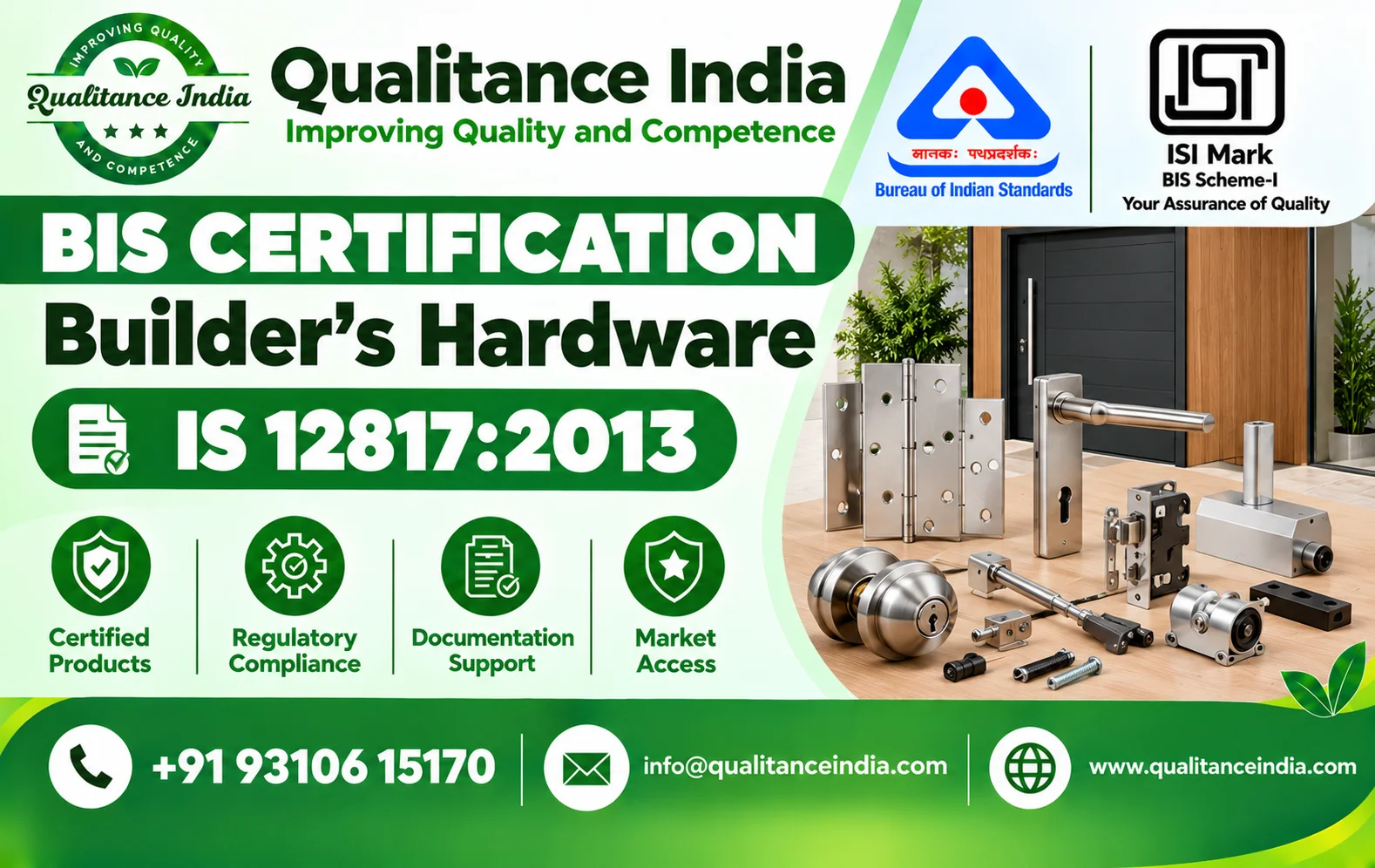
BIS Certification for Builder’s Hardware | IS 12817:2013 | ISI Mark Consultancy
Introduction
Builder's hardware plays an important role in the construction, furniture, architectural and interior industries. Hinges, locks, bolts, handles and other hardware components are essential for the proper functioning, durability and safety of doors, windows, cabinets and other building elements.
Among these products, Stainless Steel Butt Hinges are widely used because of their strength, durability and resistance to corrosion.
IS 12817:2013 is the Indian Standard for Stainless Steel Butt Hinges – Specification (Second Revision). BIS published a product manual for certification against this standard under Scheme-I of the BIS Conformity Assessment Regulations, 2018.
However, manufacturers should note that IS 12817:2013 has subsequently been revised to IS 12817:2020, and the current BIS certification framework refers to IS 12817:2020. BIS's current product manual identifies the product as Stainless Steel Butt Hinges according to IS 12817:2020.
The Hinges (Quality Control) Order, 2025 specifies IS 12817:2020 for Stainless Steel Butt Hinges and requires the Standard Mark under a BIS licence. The order specifies 1 July 2025 as the implementation date.
Therefore, manufacturers searching for BIS Certification for Builder's Hardware under IS 12817:2013 should verify the latest applicable standard and certification requirements before starting a new application.
Qualitance India provides professional BIS Certification and ISI Mark Consultancy for Stainless Steel Butt Hinges, including documentation, testing coordination, BIS application support and factory inspection preparation.
What is IS 12817?
IS 12817 is the Indian Standard covering Stainless Steel Butt Hinges.
The 2013 edition was the second revision of the standard. BIS's product manual for IS 12817:2013 identifies the product as Stainless Steel Butt Hinges and provides requirements for certification under Scheme-I.
The standard is relevant to manufacturers producing stainless steel butt hinges for applications such as:
- Doors
- Windows
- Cabinets
- Furniture
- Building hardware
- Architectural hardware
- Commercial buildings
- Residential construction
- Industrial applications
Important Update: IS 12817:2020
Manufacturers should be aware that the 2013 edition is not the latest edition.
BIS's product manual for the revised standard identifies IS 12817:2020 – Stainless Steel Butt Hinges and provides the applicable product sampling, testing, grouping and licence-scope requirements.
The BIS product manual also states that certification is operated under Scheme-I of the BIS Conformity Assessment Regulations, 2018.
For a new certification application, manufacturers should therefore assess their product against the latest applicable version rather than relying only on the 2013 edition.
BIS Certification for Stainless Steel Butt Hinges
BIS certification demonstrates that the manufacturer's stainless steel butt hinges have been assessed against the applicable Indian Standard and meet the specified conformity requirements.
Under the current regulatory framework, the Hinges (Quality Control) Order, 2025 requires stainless steel butt hinges covered by IS 12817:2020 to conform to the applicable Indian Standard and bear the Standard Mark under a BIS licence.
This makes BIS compliance particularly important for manufacturers and suppliers dealing with stainless steel butt hinges in the Indian market.
What are Stainless Steel Butt Hinges?
A butt hinge is a mechanical hardware component used to connect a door, window, cabinet or similar element to its frame while allowing rotational movement.
Stainless steel butt hinges are manufactured using stainless steel components such as the hinge flaps and hinge pin.
Their performance depends on factors such as:
- Material quality
- Dimensions
- Hinge construction
- Pin design
- Number of knuckles
- Screw-hole arrangement
- Finish
- Manufacturing accuracy
- Corrosion resistance
- Load-bearing performance
Consistent manufacturing and appropriate quality control are therefore important for reliable performance.
Product Scope Under IS 12817
The BIS product manual for IS 12817 provides product grouping and licence-scope provisions.
For the 2013 edition, BIS specified:
Product: Stainless Steel Butt Hinges
Sample size: 12 hinges
The licence scope could identify the product name, product type and product sizes.
The current 2020 product manual also specifies 12 hinges as the sample size and provides product grouping guidelines for determining the certification scope.
Manufacturers producing multiple types or sizes should therefore assess their product range carefully before testing.
Types and Sizes of Stainless Steel Butt Hinges
The product range may include different hinge types and sizes depending on the manufacturer's catalogue and applicable standard requirements.
The 2013 revision introduced additional provisions, including:
- Medium-weight narrow hinges
- Light-weight unequal-flap hinges
- Heavy-weight unequal-flap hinges
- Additional sizes of light-weight narrow hinges
BIS's 2014 implementation communication specifically highlighted these changes when IS 12817:2013 replaced the earlier 1997 edition.
The exact products that can be included in a BIS licence should be determined according to the applicable current product manual and grouping guidelines.
Why BIS Certification is Important for Builder's Hardware
Quality builder's hardware contributes to the durability and proper functioning of doors, windows, furniture and other installations.
BIS certification can help manufacturers to:
- Demonstrate conformity with Indian Standards
- Build customer confidence
- Meet applicable regulatory requirements
- Support procurement for construction projects
- Improve product acceptance
- Establish consistent manufacturing quality
- Strengthen brand credibility
- Supply to institutional and commercial buyers
- Support compliance with applicable Quality Control Orders
For stainless steel butt hinges, the current QCO makes the Standard Mark requirement especially important for covered products.
BIS Certification Process for Stainless Steel Butt Hinges
Step 1: Product and Standard Assessment
The first step is to determine the correct standard applicable to the product.
For stainless steel butt hinges, manufacturers should assess whether the product falls under IS 12817:2020, which is the current revised standard.
If a manufacturer has older documentation or certification under IS 12817:2013, the status and transition requirements should be reviewed before continuing production or applying for modification.
Step 2: Product Scope and Grouping
Manufacturers should identify:
- Hinge type
- Hinge size
- Material
- Product design
- Product range
- Manufacturing process
- Proposed BIS scope
Correct grouping can help determine which products and sizes need to be tested.
Step 3: Documentation Preparation
The manufacturer should prepare the required technical and legal documents.
These may include:
- Company registration documents
- Factory address proof
- Factory layout
- Manufacturing process flow
- Machinery list
- Raw material details
- Product drawings
- Product catalogue
- Technical specifications
- Quality-control plan
- Testing equipment details
- Calibration certificates
- Test reports
- Competent testing personnel details
- Manufacturing records
- Proposed licence scope
Step 4: Product Testing
Testing is an important part of BIS certification.
The BIS product manual for IS 12817:2020 specifies relevant testing and quality-control arrangements. The product manual identifies testing requirements related to dimensions, manufacture and other applicable characteristics.
BIS laboratory listings for IS 12817 also show testing related to:
- Dimensions
- Number of knuckles
- Screw holes
- Hinge pin
- Flap
- Chemical composition
- Material characteristics
- Manufacturing requirements
Current BIS laboratory listings continue to show testing facilities for IS 12817:2013, while the current certification framework refers to IS 12817:2020.
Step 5: Factory Testing Facilities
Manufacturers should maintain appropriate testing and inspection facilities for the applicable requirements.
Testing instruments should be maintained in proper working condition and calibration records should be available wherever applicable.
A proper internal quality-control system helps ensure consistent production.
Step 6: BIS Application
After completing the product assessment, documentation and testing arrangements, the BIS application can be prepared.
The information in the application should match the actual manufacturing facility and proposed product scope.
This includes:
- Manufacturer name
- Factory address
- Product name
- Product type
- Product sizes
- Raw materials
- Manufacturing process
- Testing facilities
- Proposed licence scope
Step 7: Factory Inspection
BIS may inspect the manufacturing premises to verify the manufacturer's production and quality-control arrangements.
The inspection may cover:
- Raw materials
- Production machinery
- Manufacturing process
- Product identification
- Testing equipment
- Calibration records
- Quality-control procedures
- Internal test records
- Finished products
- Technical documents
Proper factory preparation is important for successful certification.
Step 8: Grant of BIS Licence and ISI Mark
After successful completion of applicable testing, inspection and compliance requirements, BIS can grant the licence for the approved product scope.
The manufacturer can then use the BIS Standard Mark/ISI Mark in accordance with the applicable BIS licence conditions.
For products covered by the Hinges Quality Control Order, the Standard Mark must be used as prescribed under the BIS certification framework.
Testing Requirements for Stainless Steel Butt Hinges
The applicable testing requirements depend on the edition of the standard and the product scope.
Important characteristics may include:
Dimensions and Tolerances
The dimensions of the hinge components must conform to the applicable requirements.
Important dimensions can include:
- Length
- Breadth
- Flap thickness
- Hinge pin diameter
- Number of knuckles
- Screw-hole dimensions
- Screw-hole positioning
The BIS product manual specifically identifies dimensions and tolerances as possible tests.
Material Requirements
The stainless steel used for manufacturing the hinge must meet the applicable material requirements.
BIS laboratory listings for IS 12817 include chemical testing for elements such as:
- Carbon
- Silicon
- Phosphorus
- Sulphur
- Manganese
- Chromium
- Nickel
- Molybdenum
- Nitrogen
- Copper
- Titanium
- Vanadium
- Niobium
- Other applicable elements
The exact chemical testing depends on the applicable material requirements and testing scope.
Manufacturing Requirements
The hinge construction and manufacturing quality should comply with the applicable requirements.
The BIS product manual identifies manufacture among the applicable tests/requirements.
Finish
The finish of the stainless steel butt hinge is also an important product characteristic under the applicable standard requirements.
Documents Required for BIS Certification
Manufacturers may need to arrange the following documents:
- Company incorporation/registration documents
- Factory address proof
- Factory layout
- Manufacturing process flow chart
- Machinery details
- Raw material specifications
- Product drawings
- Product catalogue
- Technical specifications
- Quality-control plan
- Testing equipment list
- Calibration certificates
- Test reports
- Internal inspection records
- Competent testing personnel details
- Manufacturing records
- Proposed BIS licence scope
The exact document requirements should be confirmed according to the latest applicable BIS certification procedure.
Common Reasons for BIS Certification Delays
Manufacturers may face delays when:
- The old standard is used without checking the current revision
- Product grouping is not correctly determined
- Multiple sizes are not properly identified
- Product drawings are incomplete
- Raw material specifications are unclear
- Testing facilities are inadequate
- Calibration records are unavailable
- Product samples fail testing
- Factory records are incomplete
- Application information does not match the actual factory
- The manufacturer is not prepared for BIS inspection
Professional ISI Mark consultancy can help manufacturers identify and address these issues before the application and inspection stages.
BIS Certification for Indian Manufacturers
Indian manufacturers producing stainless steel butt hinges for construction, furniture, architectural and building hardware applications should evaluate the applicable BIS requirements.
BIS certification can be particularly relevant for manufacturers supplying:
- Door hardware companies
- Furniture manufacturers
- Builders
- Contractors
- Architectural hardware suppliers
- Interior companies
- Construction projects
- Institutional buyers
- Commercial projects
- Government procurement
Manufacturers should ensure that the product complies with the applicable current Indian Standard and regulatory requirements.
BIS Certification for Foreign Manufacturers
Foreign manufacturers exporting stainless steel butt hinges to India should also assess the applicable BIS requirements.
International manufacturers may need assistance with:
- Indian Standard applicability
- Product classification
- Technical documentation
- Product testing
- BIS application
- Factory inspection
- Quality-control requirements
- Product scope
- Regulatory compliance
Qualitance India provides BIS and ISI Mark consultancy support to manufacturers outside India who need assistance with Indian product certification requirements.
BIS Certification Cost for Stainless Steel Butt Hinges
The total cost of BIS certification depends on the manufacturer's specific product range and certification requirements.
Cost factors can include:
- Number of hinge types
- Number of sizes
- Product grouping
- Testing requirements
- Laboratory charges
- Sample requirements
- Factory inspection
- Documentation
- Calibration
- BIS certification fees
- Consultancy requirements
The BIS laboratory database shows that testing charges can vary according to the applicable laboratory and testing scope.
Therefore, manufacturers should obtain a product-specific cost assessment rather than relying on a fixed generic amount.
How Long Does BIS Certification Take?
The certification timeline depends on:
- Documentation readiness
- Product sample availability
- Testing schedule
- Test results
- Factory readiness
- BIS application processing
- Inspection scheduling
- Closure of observations
Manufacturers with complete documents, suitable testing facilities and compliant products can generally avoid unnecessary delays.
Why Choose Qualitance India for ISI Mark Consultancy?
Qualitance India provides professional BIS Certification and ISI Mark Consultancy for manufacturers of stainless steel butt hinges and other builder's hardware products.
Our support can include:
- Product applicability assessment
- Standard revision verification
- Product scope and grouping guidance
- BIS documentation
- Testing coordination
- Test report review
- Factory readiness support
- BIS application assistance
- Factory inspection preparation
- Technical compliance support
- Assistance with BIS observations
- Certification process coordination
We support both Indian manufacturers and foreign manufacturers seeking BIS certification and ISI Mark compliance for the Indian market.
Frequently Asked Questions
What is IS 12817:2013?
IS 12817:2013 is the Indian Standard for Stainless Steel Butt Hinges – Specification (Second Revision). BIS published a product manual for certification under this standard.
Is IS 12817:2013 still the current standard?
No. BIS has revised the standard to IS 12817:2020. The current BIS product manual identifies IS 12817:2020 as the applicable standard for Stainless Steel Butt Hinges.
Is BIS Certification compulsory for Stainless Steel Butt Hinges?
Yes, stainless steel butt hinges are covered by the Hinges (Quality Control) Order, 2025, which specifies IS 12817:2020 and requires the Standard Mark under a BIS licence. The implementation date specified for this product is 1 July 2025.
What is the sample size for BIS testing?
The BIS product manual for both the 2013 and 2020 versions specifies a sample size of 12 hinges for the product certification process.
What tests are performed on Stainless Steel Butt Hinges?
Depending on the applicable requirements, testing can cover dimensions and tolerances, manufacturing requirements, material/chemical composition and other specified characteristics. BIS laboratory listings include testing of hinge dimensions, screw holes, knuckles, pin and chemical composition.
Can different hinge sizes be covered under one BIS Licence?
Product grouping guidelines determine how different sizes and types may be covered. The manufacturer should assess the complete product range before testing so that the required scope can be planned correctly.
Can a foreign manufacturer obtain BIS Certification for Stainless Steel Butt Hinges?
Yes, foreign manufacturers should assess the applicable BIS certification requirements before supplying covered products in India. Documentation, testing, factory assessment and other applicable compliance requirements need to be addressed.
How can I start BIS Certification for Stainless Steel Butt Hinges?
Start by reviewing your hinge types, sizes, stainless steel grades, manufacturing process, product drawings and existing testing facilities. The applicable current BIS standard and product certification scope can then be determined.
Conclusion
BIS Certification for Builder's Hardware and Stainless Steel Butt Hinges is an important compliance requirement for manufacturers supplying covered products in the Indian market.
While IS 12817:2013 remains a commonly searched standard reference, manufacturers should be aware that it has been revised to IS 12817:2020. BIS's current product manual and the Hinges (Quality Control) Order, 2025 refer to IS 12817:2020 for Stainless Steel Butt Hinges.
The certification process involves determining the applicable standard, identifying the correct product scope, preparing technical documentation, arranging product testing, maintaining appropriate quality-control facilities and successfully completing the applicable BIS assessment process.
Whether you are an Indian stainless steel hinge manufacturer, builder's hardware manufacturer, architectural hardware supplier, furniture hardware manufacturer or foreign manufacturer planning to supply products in India, professional ISI Mark consultancy can help simplify the certification process.
Qualitance India provides BIS Certification and ISI Mark Consultancy for Stainless Steel Butt Hinges under IS 12817, including product assessment, documentation, testing coordination, BIS application support and factory inspection preparation.
Qualitance India Website: https://qualitanceindia.com/ Phone: +91-9310-615-170 Email: info@qualitanceindia.com