BIS Certification for Electric Berry Juice Extractors in India: Complete Guide (IS 302 Part 1:2024)
BIS Certification for Electric Berry Juice Extractors in India: Complete Guide (IS 302 Part 1:2024)
If you manufacture, import, or sell electric berry juice extractors in India, there's a compliance deadline you can't afford to ignore. Under the government's new Quality Control Order for household and commercial electrical appliances, electric berry juice extractors sold in the country will need to carry the BIS ISI Mark starting 1st October 2026. This guide breaks down exactly what that means for your business, what the standard covers, and how to get certified without last-minute panic.
Why This Matters Now
The Ministry of Commerce and Industry notified the Safety of Household, Commercial and Similar Electrical Appliances (Quality Control) Order, 2026 on 6th April 2026. It replaces the earlier 2025 order and brings over 90 categories of electrical appliances under mandatory BIS certification — including juicers and extractors used in kitchens, alongside food processors, mixers, cooking ranges, and dozens of other household products.
The rollout is phased by business size:
- Large enterprises: compliance required from 1st October 2026
- Small enterprises: compliance required from 1st January 2027
- Micro enterprises: compliance required from 1st April 2027
Once your deadline hits, manufacturing, importing, or selling an electric berry juice extractor without a valid BIS license and ISI Mark is illegal — and enforcement isn't just theoretical. Non-compliant products can be seized, businesses can face fines and legal action under the BIS Act, 2016, and major e-commerce platforms are already tightening requirements around BIS proof before allowing listings.
Note: Confirm the exact appliance sub-category and applicable Part 2 standard for your specific extractor model with Qualitance India before filing — classification can vary depending on whether the unit uses a centrifugal, masticating, or steam-based extraction mechanism.
What Standard Applies
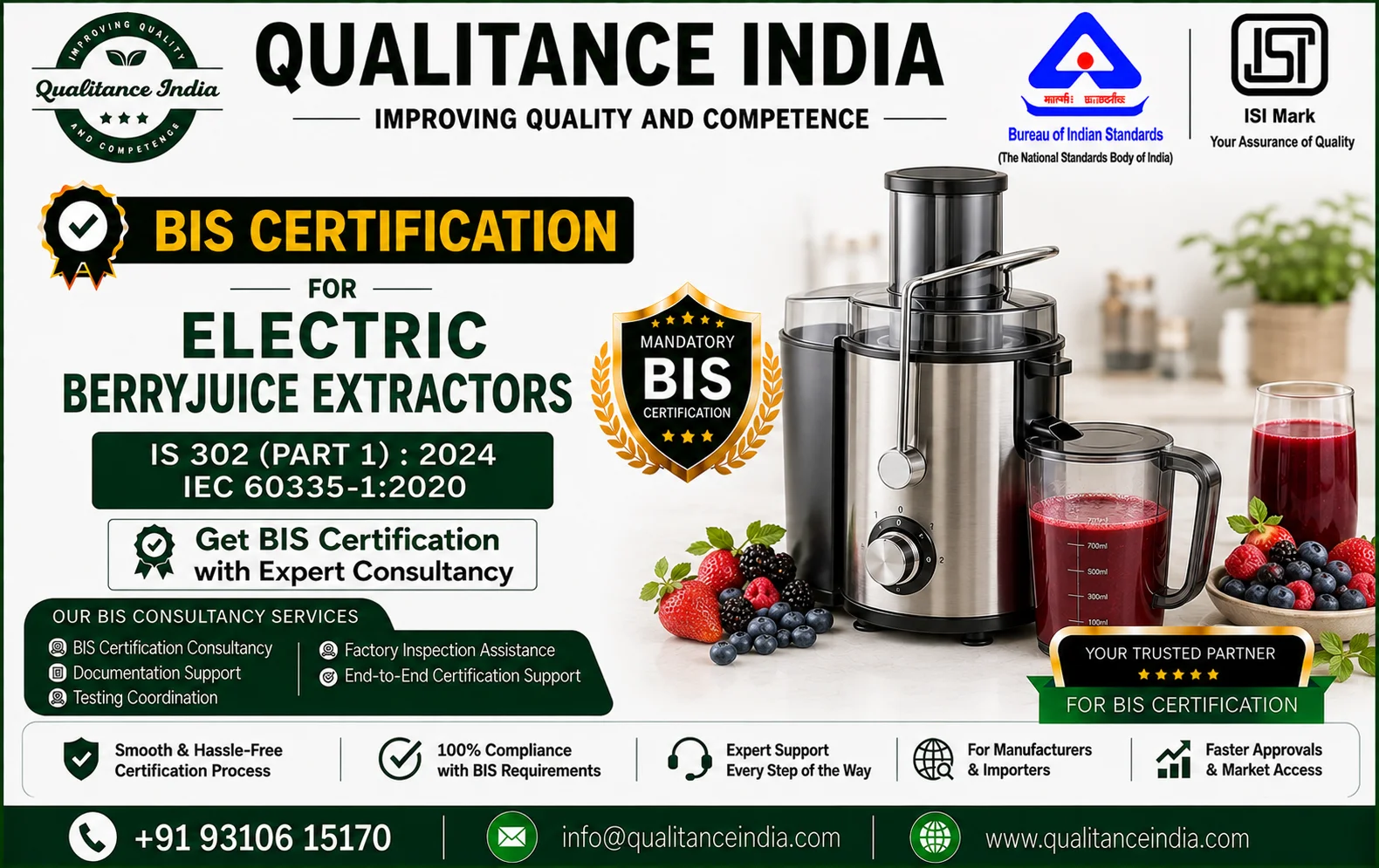
Electric berry juice extractors are certified against IS 302 (Part 1):2024, which is India's version of the international safety standard IEC 60335-1:2020 for household and similar electrical appliances. This is the "general safety" standard — it covers things like protection against electric shock, safe temperature limits, internal wiring, mechanical stability, insulation, and fire resistance.
On top of this general standard, every appliance also needs to meet a product-specific "Part 2" standard. For juice extractors, this adds requirements around lid and feed-chute interlocks (so the motor can't run with the lid open), rotating strainer/blade guarding, motor overload cut-off, and pulp-ejection mechanism safety — since these appliances combine high-speed rotating parts with a feed opening the user interacts with directly.
Who Needs to Get Certified
- Indian manufacturers producing electric berry juice extractors under their own brand or as a contract manufacturer
- Foreign manufacturers exporting juice extractors into India (via the Foreign Manufacturers Certification Scheme, with a locally appointed representative)
- Private-label sellers and brands selling through Amazon, Flipkart, Meesho, or other marketplaces
- Small appliance workshops supplying to kitchenware retailers and juice bar equipment suppliers
- Anyone repackaging or rebranding imported units for the Indian market
If your product reaches an Indian kitchen or juice/food business, this applies to you — regardless of whether you make it locally or import it.
The Certification Process, Step by Step
1. Gap Assessment Before spending money on lab testing, your product design, wiring, motor rating, and lid/feed-chute interlock design are checked against the standard to catch problems early — things like a missing lid interlock or inadequate strainer guard.
2. Lab Testing Sample units go to a BIS-recognized laboratory for testing: electric shock protection, leakage current, temperature rise during continuous operation, mechanical strength, lid interlock and strainer guard reliability, and moisture resistance, among other parameters.
3. Application Filing Once test reports are in hand, the application goes in through the BIS portal, along with your factory details, technical documentation, and the lab reports.
4. Factory Audit A BIS inspector visits your factory to confirm that what's actually being produced matches the tested sample — checking your quality control systems, test equipment (or a valid outsourcing arrangement), and traceability of components.
5. License Grant Once everything checks out, BIS issues the license and you're authorized to put the ISI Mark on your product.
6. Ongoing Compliance Certification isn't a one-time event — expect periodic surveillance audits, re-testing, and license renewal to keep your certification active.
Documents You'll Need
- GST registration and Udyam/MSME certificate
- Factory registration and layout plan
- Technical drawings and wiring diagrams
- Bill of materials with supplier/component details (including motor and strainer specifications)
- Details of in-house test equipment, or an agreement with an accredited outside lab
- Authorized signatory details
- Trademark/brand documentation, if applicable
- For foreign manufacturers: appointment letter for your Authorised Indian Representative
Why Applications Get Rejected
Most rejections and delays come down to avoidable issues:
- Applying under Part 1 alone and missing the correct Part 2 standard for the specific extractor type
- Test samples that don't actually match the units in production
- Missing or poorly designed lid interlocks that let the motor run with the lid open
- Motor overheating during extended extraction cycles not addressed in the design
- Incomplete or mismatched documentation
- Not having adequate in-house testing capability or a valid outsourcing arrangement
- Factory audit findings that show inconsistent production quality
Getting these right the first time is the difference between an 8-week process and a 4-6 month one.
How Long It Takes and What It Costs
For a domestic manufacturer with documentation ready and a design that clears testing on the first try, the whole process usually takes 8 to 16 weeks. More complex cases — foreign manufacturer applications, or products that need redesign after failing a test — can stretch to 4-6 months. Costs depend on your product, the testing lab, and how many test cycles are needed, so it's worth getting a clear, itemized quote before you commit to anything.
Given the phased deadlines are already public and enforcement dates are fixed, starting early isn't just advisable — it's the only way to avoid a scramble later.
The Upside of Getting Certified
Beyond just staying on the right side of the law, BIS certification opens doors: it's now a prerequisite for listing on most major e-commerce platforms, it builds trust with retailers and consumers who recognize the ISI Mark, and it reduces your liability if something ever goes wrong with a unit in the field. Manufacturers who get ahead of the deadline also avoid the bottleneck that's likely to hit testing labs and BIS offices as the October 2026 date gets closer and everyone rushes at once.
How Qualitance India Helps
Getting through this process smoothly comes down to documentation accuracy, picking the right lab, and being fully prepared before the factory audit — this is exactly where Qualitance India steps in.
We handle:
- Full gap assessment before you spend on testing
- Coordination with BIS-recognized labs
- Complete application filing and follow-up
- Factory audit preparation, including mock walkthroughs
- Post-certification support for renewals and surveillance audits
Based in Noida, Uttar Pradesh, we work with manufacturers across India — whether you're just starting your BIS journey or renewing an existing license.
Frequently Asked Questions
Is BIS certification really mandatory for electric berry juice extractors? Yes. As a household electrical appliance covered under the 2026 QCO, electric juice extractors need a valid ISI Mark before they can be manufactured, imported, or sold in India.
Does it matter whether my extractor is centrifugal or masticating type? Yes — the extraction mechanism affects which product-specific Part 2 standard and test parameters apply. Confirm the exact scope for your model with a consultant.
What standard is used for certification? IS 302 (Part 1):2024, aligned with IEC 60335-1:2020, along with the applicable product-specific Part 2 standard.
When exactly does this become mandatory? 1st October 2026 for large enterprises, 1st January 2027 for small enterprises, and 1st April 2027 for micro enterprises.
Can I keep selling my existing stock after the deadline? There are provisions for pre-implementation stock with proper declaration to BIS, but the rules can be specific — it's worth confirming your exact situation with a consultant rather than assuming.
Do imported juice extractors need this certification too? Yes — foreign manufacturers apply through the Foreign Manufacturers Certification Scheme, which requires a locally appointed representative in India.
How long does the whole process take? Usually 8 to 16 weeks for a straightforward domestic application, longer if redesign or re-testing is needed.
What happens if I sell without certification after the deadline? You risk product seizure, fines, and legal action under the BIS Act, 2016 — and you'll likely be locked out of major e-commerce platforms.
Is the factory audit really necessary? Yes, it's a mandatory part of the process — lab testing alone isn't enough; BIS also needs to confirm your factory can consistently produce what was tested, including the lid interlock and strainer guard design.
Do different capacity or model variants need separate testing? Generally, each distinct model or significant design variant needs its own testing coverage — it's best to confirm the exact scope with your consultant before filing.
Ready to Get Started?
The deadline is fixed, and certification isn't something you can rush through at the last minute. Get in touch with Qualitance India for a free assessment of what your electric berry juice extractor needs before you can legally carry the ISI Mark.
Qualitance India — BIS/ISI Mark Certification Consultancy, Noida, Uttar Pradesh