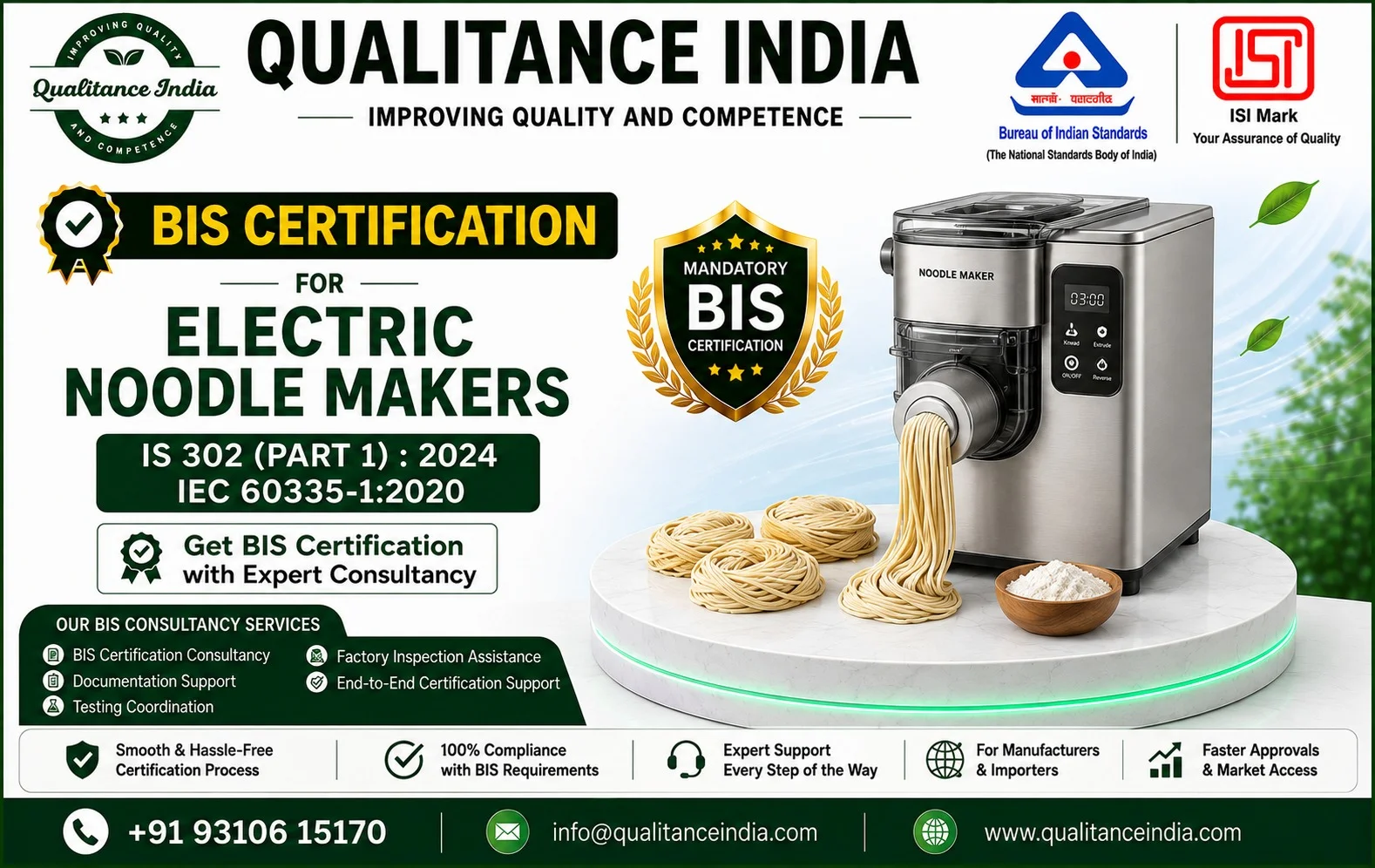
BIS Certification for Electric Noodle Makers | IS 302 (Part 1):2024 | IEC 60335-1:2020
Introduction
BIS Certification for Electric Noodle Makers is an important compliance consideration for manufacturers, importers and businesses supplying electrically operated noodle-making or noodle-preparation appliances in India. Where an Electric Noodle Maker falls within the scope of a mandatory Quality Control Order (QCO), the manufacturer is required to comply with the applicable Indian Standard and BIS certification requirements before the product is marketed in India.
IS 302 (Part 1):2024, identical under dual numbering to IEC 60335-1:2020, specifies general safety requirements for covered household and similar electrical appliances. Depending on the product's design, operating mechanism, rated voltage, intended application and specific construction, additional product-specific requirements may also need to be evaluated. BIS's product manual also notes that where a separate Product Manual has been issued for a specific electrical appliance, that manual should be followed.
Qualitance India provides professional BIS Certification Consultancy for Electric Noodle Makers, including product applicability assessment, technical documentation support, testing coordination, BIS application assistance and factory inspection preparation.
11. About the Product
An Electric Noodle Maker is an electrically operated appliance or machine designed to assist in preparing, processing, shaping or producing noodles and similar food products.
Depending on the product design, an Electric Noodle Maker may include:
- Electric motor
- Heating elements
- Dough mixing mechanism
- Extrusion mechanism
- Cutting mechanism
- Rollers
- Blades or shaping components
- Control switches
- Digital controls
- Power supply
- Internal wiring
- Protective housing
- Electrical insulation
- Safety components
These products may be designed for:
- Household kitchens
- Restaurants
- Hotels
- Catering businesses
- Commercial kitchens
- Food preparation facilities
- Small food-processing businesses
Since the product uses electrical power and may contain motor-operated, heating or mechanical components, its safety requirements should be evaluated according to the applicable BIS standard and certification framework.
12. What is BIS Certification?
BIS Certification is a conformity assessment mechanism administered by the Bureau of Indian Standards (BIS) to verify that products comply with applicable Indian Standards.
Where an electrical appliance falls within the scope of a mandatory QCO, the manufacturer may be required to obtain a BIS licence before manufacturing, importing, selling or distributing the covered product in India.
Depending on the applicable product and certification scheme, the process may involve:
- Product classification
- Applicable Indian Standard identification
- QCO applicability assessment
- Product testing
- Technical documentation
- BIS application
- Factory inspection
- Compliance verification
- Grant of BIS licence
- Authorized use of the Standard Mark/ISI Mark, where applicable
The exact certification route should be determined based on the product's technical characteristics and the latest applicable regulatory requirements.
13. Scope of IS 302 (Part 1):2024
IS 302 (Part 1):2024 / IEC 60335-1:2020 is titled Household and Similar Electrical Appliances – Safety – Part 1: General Requirements.
The standard provides general safety requirements for covered electrical appliances and addresses areas such as:
- Protection against electric shock
- Electrical insulation
- Leakage current
- Electric strength
- Temperature rise
- Abnormal operation
- Mechanical safety
- Construction requirements
- Internal wiring
- Components
- Earthing
- Power input
- Marking and instructions
- Resistance to heat and fire
- Other applicable safety requirements
The BIS standard details indicate that the revised standard also covers applicable DC-supplied and battery-operated appliances.
For an Electric Noodle Maker, the precise applicability of IS 302 (Part 1):2024 should be assessed based on its construction, voltage, intended use and whether a specific Part 2 standard or another QCO applies.
14. Products Covered
Depending on the product's exact scope and applicable certification requirements, this category may include:
- Electric Noodle Makers
- Electric Noodle Making Appliances
- Motor-Operated Noodle Makers
- Household Electric Noodle Makers
- Commercial Electric Noodle Preparation Appliances
- Electric Pasta and Noodle Preparation Appliances, where applicable
- Similar electrically operated food preparation appliances, where covered
Important: The exact classification should be confirmed based on the technical design and intended use of the product.
If a separate product-specific Part 2 standard or Product Manual applies to the particular appliance, the applicable requirements should be evaluated along with the general requirements of Part 1.
15. Enforcement Date
The enforcement date depends on the applicable Quality Control Order (QCO) and the specific product category.
The Safety of Household, Commercial and Similar Electrical Appliances (Quality Control) Order, 2024 covers specified electrical appliances within its defined scope and requires applicable manufacturers to obtain BIS certification. However, products already covered by another QCO are excluded from that QCO's scope.
Therefore, before publishing or applying for certification, the manufacturer should verify whether the specific Electric Noodle Maker is covered under the applicable QCO and whether any separate product-specific regulation applies.
16. Applicable QCO Details
The applicable QCO should be determined based on:
- Product category
- Intended use
- Rated voltage
- Product construction
- Applicable Indian Standard
- Whether another QCO already covers the product
- Applicable BIS conformity assessment scheme
The 2024 QCO implementation framework requires BIS certification for electrical appliances within its scope that are intended for household, commercial or similar applications and are not covered under another QCO. BIS's December 2024 circular also addressed implementation of IS 302 (Part 1):2024 and the transition from the earlier 2008 edition.
For the Electric Noodle Maker specifically, the latest QCO and product applicability should be verified before making a mandatory-certification claim.
17. Who Needs BIS Certification?
Depending on the applicable QCO and BIS certification framework, the following businesses may need certification:
- Indian manufacturers
- Foreign manufacturers
- Exporters supplying India
- OEM manufacturers
- Contract manufacturers
- Private-label manufacturers
- Brand owners
- Manufacturers of covered food preparation appliances
- Importers dealing with covered products
For eligible foreign manufacturers, the Foreign Manufacturers Certification Scheme (FMCS) may be applicable.
18. Eligibility Criteria
Generally, an applicant may need:
- Legally established manufacturing facility
- Defined manufacturing process
- Adequate production infrastructure
- Quality control arrangements
- Required testing facilities or testing arrangements
- Competent technical personnel
- Product technical specifications
- Product drawings
- Circuit diagrams
- Manufacturing process documentation
- Raw material information
- Component details
- Applicable test reports
The exact eligibility criteria depend on the applicable BIS certification scheme and product requirements.
19. Complete BIS Certification Process
Step 1: Product Applicability Assessment
The Electric Noodle Maker is evaluated to identify:
- Applicable Indian Standard
- Product category
- Product scope
- QCO applicability
- Relevant certification scheme
- Any applicable Part 2 standard
Step 2: Technical Documentation
Required technical, manufacturing and legal documents are prepared.
Step 3: Product Testing
Product samples are tested according to applicable requirements through the appropriate laboratory/testing route.
Step 4: BIS Application
The applicable BIS application is prepared and submitted.
Step 5: Application Scrutiny
BIS reviews the submitted application and supporting documents.
Step 6: Factory Inspection
Where applicable, BIS assesses the manufacturing facility and quality control arrangements.
Step 7: Sample Verification and Testing
Samples may be evaluated according to the relevant certification procedure.
Step 8: Observation Closure
Any technical observations or non-conformities must be addressed.
Step 9: BIS Licence Grant
After successful completion of applicable requirements, the BIS licence may be granted.
Step 10: Post-Licence Compliance
The manufacturer must maintain ongoing compliance with applicable BIS requirements, testing, marking and surveillance provisions.
20. Required Documents
Common documents may include:
- Company registration documents
- Factory address proof
- Manufacturing unit details
- Factory layout
- Manufacturing process flow chart
- Production machinery list
- Testing equipment list
- Calibration certificates
- Quality control plan
- Product technical specifications
- Product drawings
- Electrical circuit diagrams
- User manual
- Product labels
- Trademark authorization
- Raw material details
- Component details
- Test reports
- Authorized signatory documents
- Brand ownership documents
- Undertakings and declarations
- Other BIS-required documents
The final document list depends on the applicable certification scheme.
21. Testing Requirements
Electric Noodle Makers may require testing according to the applicable Indian Standard and certification requirements.
Depending on product construction, testing may evaluate:
- Electrical safety
- Protection against electric shock
- Leakage current
- Electric strength
- Insulation resistance
- Temperature rise
- Power input
- Current input
- Abnormal operation
- Motor operation
- Mechanical strength
- Earthing
- Internal wiring
- Resistance to heat and fire
- Marking and instructions
Where the appliance contains heating and motor-operated functions, the applicable tests may depend on its specific construction and classification.
BIS's laboratory listings for IS 302 (Part 1):2024 include testing areas such as classification, marking, construction, protection against electric shock, motor-operated appliance tests, heating appliance tests, temperature rise, leakage current/electric strength, mechanical strength and other applicable clauses.
22. Factory Inspection Process
During a BIS factory inspection, the manufacturing facility may be evaluated for:
- Production capability
- Manufacturing process
- Quality control arrangements
- Testing facilities
- Testing equipment
- Calibration records
- Raw material control
- In-process inspection
- Finished product inspection
- Product identification
- Record maintenance
- Complaint handling
- Marking controls
A well-prepared factory can help reduce avoidable compliance issues during the certification process.
23. Common Reasons for Application Rejection
Common issues may include:
- Incorrect standard selection
- Incorrect product classification
- Incomplete application
- Missing technical documents
- Incorrect product specifications
- Product outside declared scope
- Failed laboratory testing
- Inadequate testing arrangements
- Missing calibration certificates
- Factory inspection non-conformities
- Incorrect product marking
- Mismatch in manufacturer details
- Unresolved BIS observations
- Failure to meet applicable requirements
Professional consultancy can help identify potential issues before application submission.
24. Cost Factors
The total BIS Certification cost may depend on:
- BIS application fees
- Government charges
- Laboratory testing charges
- Factory inspection expenses
- Sample transportation
- Testing equipment requirements
- Documentation
- Consultancy charges
- Travel expenses
- Product complexity
- Number of models
- Product variants
- Additional testing requirements
Therefore, the exact cost should be assessed based on the specific Electric Noodle Maker and applicable certification route.
25. Timeline
The BIS Certification timeline may vary depending on:
- Product complexity
- Applicable testing requirements
- Laboratory availability
- Documentation readiness
- Application scrutiny
- Factory inspection
- Testing results
- Resolution of observations
Complete and accurate documentation can help minimize avoidable delays.
26. Benefits of BIS Certification
BIS Certification can help manufacturers and businesses to:
- Meet applicable regulatory requirements
- Demonstrate product conformity
- Improve customer confidence
- Support legal market access
- Improve product quality
- Reduce compliance risks
- Strengthen brand credibility
- Expand market opportunities
- Improve business reputation
27. Why Choose Qualitance India?
Qualitance India provides professional BIS Certification Consultancy services to manufacturers, importers and businesses seeking product compliance support.
Our services may include:
✓ Product Applicability Assessment
✓ Applicable Standard Identification
✓ BIS Certification Guidance
✓ Documentation Support
✓ Laboratory Testing Coordination
✓ BIS Application Assistance
✓ Factory Inspection Preparation
✓ Technical Compliance Support
✓ BIS Query Assistance
✓ End-to-End Certification Coordination
Qualitance India – Improving Quality and Competence
28. Step-by-Step Flow Chart
Product Identification
↓
Product Applicability Assessment
↓
Applicable IS Standard & QCO Verification
↓
Part 2 Standard Check, Where Applicable
↓
Technical Documentation Preparation
↓
Product Testing
↓
BIS Application Submission
↓
Application Scrutiny
↓
Factory Inspection (Where Applicable)
↓
Sample Testing / Verification
↓
Non-Conformity Closure
↓
BIS Licence Grant
↓
Post-Licence Compliance & Surveillance
29. 25 SEO FAQs
1. Is BIS Certification mandatory for Electric Noodle Makers?
It depends on whether the specific product is covered under a mandatory QCO and applicable BIS certification requirements. Product applicability should be verified before marketing the product in India.
2. Which standard applies to Electric Noodle Makers?
The applicable standard depends on the product's design, intended use and classification. IS 302 (Part 1):2024 provides general safety requirements for covered household and similar electrical appliances.
3. What is IS 302 (Part 1):2024?
IS 302 (Part 1):2024 is the Indian Standard for general safety requirements applicable to covered household and similar electrical appliances.
4. Is IEC 60335-1:2020 related to IS 302 Part 1:2024?
Yes. BIS identifies IS 302 (Part 1):2024 as identical under dual numbering to IEC 60335-1:2020.
5. How can I get BIS Certification for an Electric Noodle Maker?
The process generally involves product applicability assessment, standard identification, documentation, testing, BIS application, factory inspection where applicable and fulfilment of certification requirements.
6. What documents are required?
Documents may include company information, factory details, technical specifications, drawings, circuit diagrams, test reports and quality control documents.
7. Is product testing required?
Testing requirements depend on the applicable certification scheme and standard. Required testing must be completed through the appropriate testing route.
8. Is factory inspection mandatory?
Factory inspection requirements depend on the applicable BIS conformity assessment scheme.
9. Can an importer apply for BIS Certification?
Eligibility depends on the applicable BIS scheme and the status of the applicant under the relevant certification framework.
10. Can foreign manufacturers obtain BIS Certification?
Yes. Eligible foreign manufacturers may obtain BIS certification under the applicable certification scheme, including FMCS where relevant.
11. How much does BIS Certification cost?
The cost depends on testing, government fees, inspection, documentation and product-specific requirements.
12. How long does BIS Certification take?
The timeline varies depending on product testing, documentation, application scrutiny and inspection requirements.
13. What happens if the product fails testing?
The manufacturer may need to identify the cause of failure, implement corrective action and complete applicable re-testing.
14. Can one BIS licence cover multiple Electric Noodle Maker models?
This depends on product similarity, applicable grouping guidelines and BIS licensing requirements.
15. Is BIS Certification required for imported Electric Noodle Makers?
If the specific product is covered by a mandatory QCO, applicable foreign manufacturers and importers must comply with the relevant requirements.
16. Can Qualitance India help with BIS documentation?
Yes. Qualitance India provides documentation and BIS certification consultancy support.
17. Can Qualitance India help with product testing?
Yes. Testing coordination support can be provided based on the applicable certification requirements.
18. What is the BIS Standard Mark?
The Standard Mark indicates conformity with applicable Indian Standard requirements under the relevant BIS certification framework where its use is authorized.
19. Can BIS Certification be obtained without testing?
Where testing is prescribed under the applicable certification scheme, the required testing requirements must be fulfilled.
20. What is BIS factory inspection?
BIS factory inspection is an assessment of the manufacturing facility, production capability and quality control arrangements as required by the applicable certification procedure.
21. What causes BIS Certification delays?
Incomplete documentation, testing delays, technical discrepancies and unresolved observations may cause delays.
22. Do all Electric Noodle Makers require BIS Certification?
Not necessarily. Mandatory certification depends on the exact product category, applicable Indian Standard and government notification/QCO.
23. What is the difference between BIS Certification and BIS Registration?
BIS Certification and BIS Registration under schemes such as CRS are different conformity assessment routes. The applicable route depends on the product category and regulatory requirements.
24. Does BIS Certification improve product credibility?
Yes. Where applicable, BIS certification demonstrates conformity with relevant standards and may improve customer confidence.
25. How can I start BIS Certification for my Electric Noodle Maker?
Start with a product applicability assessment to identify the applicable Indian Standard, QCO and certification scheme, followed by testing and the appropriate BIS certification process.
30. FAQ Schema Content
Recommended Schema Type: FAQPage
आप ऊपर दिए गए 25 FAQs को FAQ structured data में implement कर सकते हैं।
Important: Schema में वही questions और answers रखें जो webpage पर visible content के रूप में भी मौजूद हों।
31. Service Schema Suggestion
Schema Type: Service
Service Name: BIS Certification Consultancy for Electric Noodle Makers
Service Type: BIS Certification Consultancy
Provider: Qualitance India
Area Served: India
Description: Professional BIS Certification consultancy support for applicable Electric Noodle Makers, including product applicability assessment, documentation, testing coordination, BIS application support and factory inspection assistance.
32. Organization Schema Suggestion
Schema Type: Organization
Organization Name: Qualitance India
Tagline: Improving Quality and Competence
Website: Qualitance India Official Website
Phone: +91-9310-615-170
Email: info@qualitanceindia.com
33. Breadcrumb Schema Suggestion
Home
→ BIS Certification
→ Electrical Appliances
→ Electric Noodle Makers BIS Certification
34. Article Schema Suggestion
Schema Type: Article / BlogPosting
Headline: BIS Certification Consultancy for Electric Noodle Makers | IS 302 (Part 1):2024
Author: Qualitance India
Publisher: Qualitance India
Main Entity: BIS Certification for Electric Noodle Makers
35. Image ALT Tags
- BIS Certification for Electric Noodle Makers
- Electric Noodle Maker BIS Certification
- IS 302 Part 1 2024 Certification
- BIS Certification Consultancy for Electric Noodle Makers
- BIS Licence for Electric Noodle Makers
- Electric Noodle Maker BIS Testing
- BIS Product Certification Process
- BIS Factory Inspection for Electric Noodle Makers
- BIS Certification Documents for Electric Noodle Makers
- Electric Noodle Maker ISI Mark Certification
- BIS Testing Requirements for Food Preparation Appliances
- BIS Certification Consultant India
- IS 302 Part 1 2024 BIS Certification
- IEC 60335-1 2020 Electrical Appliance Certification
- Qualitance India BIS Certification Consultancy
36. Internal Linking Strategy
इस blog से निम्न pages को internally link करें:
- BIS Certification Consultancy
- BIS Certification Process
- BIS Certification Documents
- BIS Certification Cost
- BIS Certification for Electrical Appliances
- BIS FMCS Certification
- BIS Product Testing Services
- BIS Factory Inspection Support
- BIS Certification for Household Appliances
- ISI Mark Certification
- BIS Certification FAQs
37. External Authority References
External references के लिए trusted official sources को प्राथमिकता दें:
- Bureau of Indian Standards (BIS)
- BIS Indian Standards
- BIS Product Certification
- BIS Quality Control Orders
- Department for Promotion of Industry and Internal Trade (DPIIT)
- Ministry of Consumer Affairs, Food and Public Distribution
BIS के official Product Manual में स्पष्ट किया गया है कि यदि किसी specific electrical appliance के लिए अलग Product Manual जारी किया गया है, तो उस Product Manual को follow किया जाना चाहिए।
38. Related BIS Services
- BIS Certification Consultancy
- BIS ISI Mark Certification
- BIS FMCS Certification
- BIS Product Testing Coordination
- BIS Factory Inspection Assistance
- BIS Documentation Support
- BIS Licence Renewal Support
- BIS Compliance Consultancy
- Electrical Product Certification Consultancy
- Household Electrical Appliance Certification
- Commercial Electrical Appliance Certification
39. Related Blog Suggestions
- What is BIS Certification? Complete Guide for Manufacturers
- Complete BIS Certification Process in India
- BIS Certification Cost, Documents and Timeline
- BIS Certification vs BIS Registration
- Complete BIS Factory Inspection Guide
- How to Get BIS Certification for Electrical Appliances
- BIS Certification for Foreign Manufacturers
- Common Reasons for BIS Certification Rejection
- BIS QCO Complete Guide
- IS 302 Part 1:2024 Complete Certification Guide
- IEC 60335-1:2020 Electrical Appliance Safety Guide
- BIS Certification for Household Electrical Appliances
- BIS Certification for Commercial Electrical Appliances
- BIS Certification for Food Preparation Appliances
40. Strong Lead Generation CTA
Need BIS Certification for Electric Noodle Makers?
Are you a manufacturer, importer or brand owner dealing with Electric Noodle Makers for the Indian market?
Don't let documentation problems, testing delays or compliance issues affect your business.
Qualitance India can assist you with:
✓ Product Applicability Assessment
✓ Applicable Standard Identification
✓ BIS Documentation Support
✓ Testing Coordination
✓ BIS Application Assistance
✓ Factory Inspection Preparation
✓ End-to-End BIS Certification Consultancy
Contact Qualitance India today for professional BIS Certification consultancy support.
Call / WhatsApp: +91-9310-615-170
Email: info@qualitanceindia.com
Conclusion
BIS Certification for Electric Noodle Makers is an important compliance consideration for manufacturers, importers and businesses involved in supplying electrically operated food preparation appliances in India. The exact certification requirement depends on the product's classification, intended application, technical construction, applicable Indian Standard and relevant QCO.
The certification process may involve product applicability assessment, technical documentation, laboratory testing, BIS application, factory inspection and compliance verification. Therefore, manufacturers should verify the latest applicable BIS requirements and QCO before beginning the certification process.
Qualitance India provides professional BIS Certification Consultancy, documentation assistance, testing coordination and factory inspection support to help manufacturers and businesses navigate the certification process.