
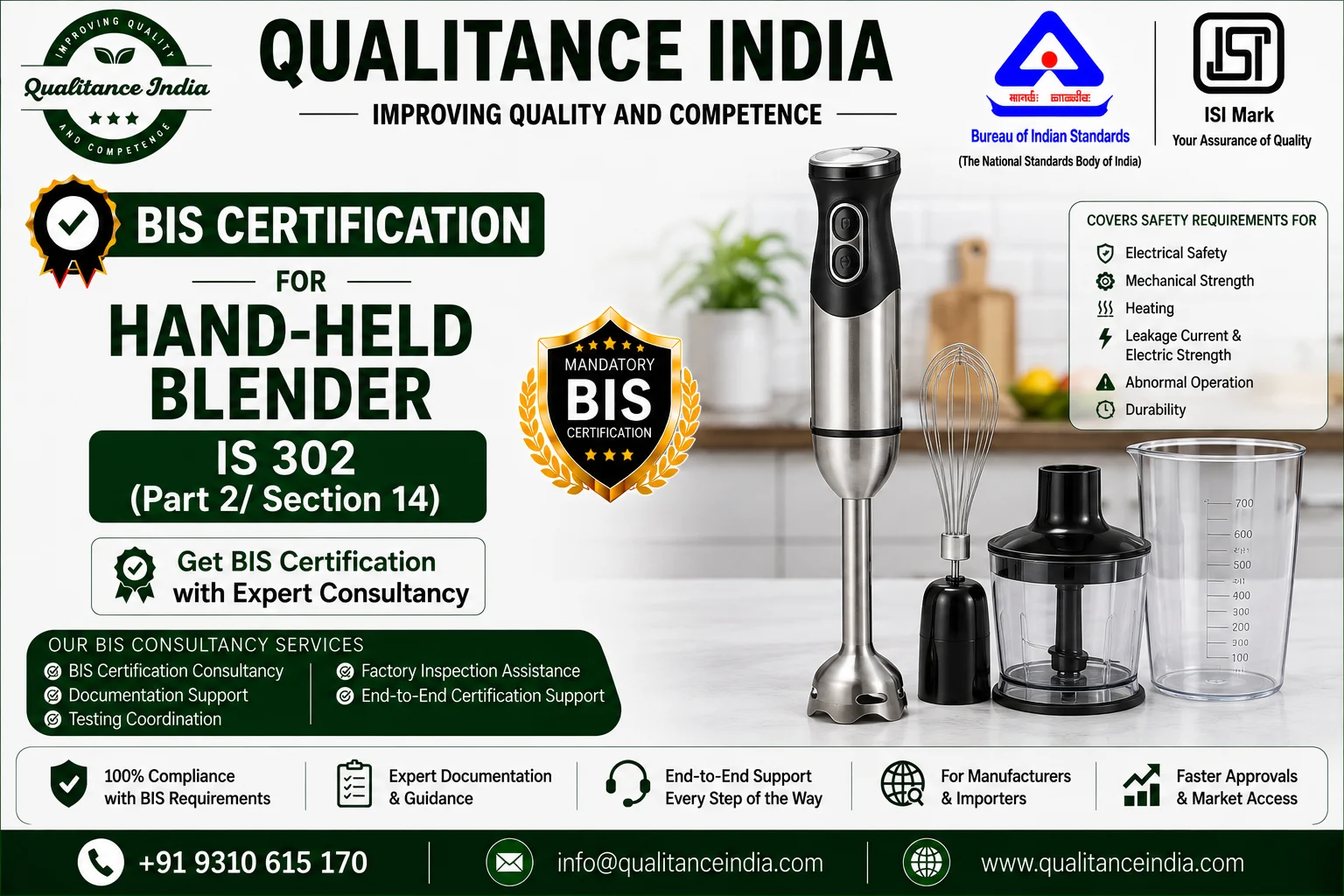
BIS Certification for Hand-held Blender | IS 302 (Part 2/Section 14) | Complete Guide
Introduction
A Hand-held Blender BIS Certification is an important compliance requirement for manufacturers of hand-held electric kitchen appliances covered under the applicable BIS requirements.
The relevant standard is IS 302 (Part 2/Section 14), titled Safety of Household and Similar Electrical Appliances – Part 2: Particular Requirements – Section 14: Electric Kitchen Machines. BIS's Product Manual specifically identifies Hand-held Blender as one of the product types covered under this standard.
The Government of India notified Hand-held Blender under the Bureau of Indian Standards Kitchen Appliances (Quality Control) Order, 2018, with the applicable Indian Standard identified as IS 302: Part 2: Section 14.
For manufacturers, obtaining the applicable BIS licence involves product testing, documentation, quality-control arrangements and compliance with BIS certification requirements.
About Hand-held Blender
A Hand-held Blender, commonly known as a stick blender or immersion blender, is an electrically operated kitchen appliance used for blending, mixing, pureeing and processing food or liquid ingredients.
Typical applications include:
- Blending soups
- Preparing sauces
- Making purees
- Mixing beverages
- Preparing baby food
- Processing vegetables
- Preparing smoothies
- Mixing liquid food products
- Kitchen food preparation
Hand-held blenders may be supplied with different accessories depending on their design, such as:
- Blending shaft
- Blending blade
- Whisk attachment
- Chopper attachment
- Measuring container
- Beaker
- Mixing accessories
The exact product scope and certification requirements should be determined based on the construction, functionality and applicable BIS requirements.
What is BIS Certification?
BIS Certification is a conformity assessment system operated by the Bureau of Indian Standards (BIS).
For products covered under compulsory certification requirements, manufacturers must demonstrate compliance with the applicable Indian Standard before manufacturing, importing or selling the regulated product in accordance with the applicable legal requirements.
For Hand-held Blenders, BIS identifies IS 302 (Part 2/Section 14) in its compulsory certification information under the kitchen-appliances framework.
What is IS 302 (Part 2/Section 14)?
IS 302 (Part 2/Section 14) relates to:
Safety of Household and Similar Electrical Appliances – Part 2: Particular Requirements – Section 14: Electric Kitchen Machines
The BIS Product Manual available for this standard is titled:
Safety of Household and Similar Electrical Appliances – Part 2 Particular Requirements – Section 14 Electric Kitchen Machines according to IS 302-2-14:2009.
The standard addresses safety requirements for relevant electric kitchen machines, including products such as:
- Food processors
- Hand-held blenders
- Centrifugal juicers
- Egg beaters
- Other applicable electric kitchen machines
The Product Manual specifically provides Hand-held Blender as an example under product type/functionality.
Scope of IS 302 (Part 2/Section 14)
The standard establishes particular safety requirements for applicable electric kitchen machines.
The certification scope can involve assessment of aspects such as:
- Electrical safety
- Protection against electric shock
- Construction
- Marking
- Insulation
- Creepage and clearance
- Temperature-related safety
- Mechanical safety
- Wiring
- Terminals
- Protection against abnormal operation
- Other applicable safety requirements
The exact tests depend on the applicable standard clauses and product construction.
Products Covered
The standard can cover different electric kitchen machine functionalities.
Examples include:
Hand-held Blender
Used for blending and processing food or liquids.
Food Processor
Used for various food-processing operations.
Egg Beater
Used for mixing and beating food ingredients.
Centrifugal Juicer
Used for extracting juice from fruits and vegetables.
Other Electric Kitchen Machines
Other products falling within the applicable scope of the standard may also be considered.
The exact licence scope should be determined based on the product's name, functionality, rated input power, rated voltage, appliance class and construction.
BIS Certification for Hand-held Blender – Important Regulatory Requirement
BIS's official compulsory-certification listing identifies:
IS 302 (Part 2/Section 14) – Hand-held Blender
under the:
Bureau of Indian Standards Kitchen Appliances (Quality Control) Order, 2018
The associated order is:
S.O. 5243(E), dated 10 October 2018.
Therefore, manufacturers dealing with Hand-held Blenders should assess the applicable BIS/QCO requirements before placing regulated products on the Indian market.
Who Needs BIS Certification for Hand-held Blender?
BIS certification may be relevant for:
- Hand-held Blender manufacturers
- Electric kitchen appliance manufacturers
- Hand blender manufacturers
- Food-processing appliance manufacturers
- OEM manufacturers
- Private-label manufacturers
- Indian manufacturers
- Eligible foreign manufacturers
- Businesses importing regulated products, subject to applicable regulations
The certification obligation should always be verified based on the current regulatory framework and the specific product.
Eligibility Criteria
A manufacturer generally needs:
- Manufacturing facility
- Suitable production machinery
- Product assembly facility
- Quality-control system
- Testing facilities or appropriate testing arrangements
- Qualified technical personnel
- Calibrated testing equipment
- Product specifications
- Manufacturing process documentation
- Quality records
- Raw-material control
- Finished-product inspection system
- Appropriate product marking arrangements
Complete BIS Certification Process for Hand-held Blender
Step 1 – Product Assessment
First identify the exact Hand-held Blender model and its:
- Rated voltage
- Rated frequency
- Rated input power
- Appliance class
- Construction
- Functions
- Accessories
Step 2 – Applicable Standard Verification
Confirm applicability of IS 302 (Part 2/Section 14).
Step 3 – Factory Assessment
Review:
- Manufacturing machinery
- Assembly process
- Testing facilities
- Quality-control system
- Production capacity
Step 4 – Documentation
Prepare the required BIS technical and company documents.
Step 5 – Product Testing
Representative samples are tested against applicable requirements.
Step 6 – BIS Application
Submit the application through the applicable BIS certification process.
Step 7 – Application Scrutiny
BIS reviews the application and supporting documents.
Step 8 – Factory Inspection
The manufacturing facility may be assessed by BIS.
Step 9 – Sample/Test Report Review
Product test results and compliance are evaluated.
Step 10 – Observation Closure
Any observations/non-conformities need to be addressed.
Step 11 – Licence Grant
After satisfactory compliance, the BIS licence may be granted.
Step 12 – ISI Mark Compliance
The manufacturer uses the Standard Mark according to applicable licence conditions.
Required Documents
Typical documents may include:
- Company registration documents
- Factory licence
- Factory address proof
- Manufacturing process flow chart
- Factory layout
- Machinery list
- Testing equipment list
- Calibration certificates
- Product technical specifications
- Product drawings
- Circuit diagrams
- Bill of materials
- Component details
- Critical component details
- Product photographs
- User manual
- Product label/marking artwork
- Trademark documents
- Quality-control plan
- Test reports
- Raw-material details
- Authorized signatory documents
- BIS application documents
The final document checklist should be prepared according to the applicable BIS certification requirements.
Testing Requirements
Testing is a major part of Hand-held Blender BIS Certification.
The BIS Product Manual for IS 302-2-14:2009 identifies testing equipment, product grouping and testing-related requirements for certification. It specifies a sample size of two pieces in its product sampling guidelines.
Depending on the applicable clauses, safety assessment can include areas such as:
1. Marking
Verification of required product markings.
2. Construction
Assessment of the appliance construction.
3. Protection Against Electric Shock
Verification of protection against accidental electric shock.
4. Creepage and Clearance
Assessment of required electrical distances.
5. Earthing
Where applicable, verification of earthing provisions.
6. Internal and External Wiring
Assessment of wiring arrangements.
7. Insulation
Electrical insulation performance.
8. Temperature/Heating Tests
Assessment of heating and temperature-related safety.
9. Abnormal Operation
Assessment under specified abnormal conditions.
10. Mechanical Safety
Assessment of mechanical hazards associated with the appliance.
Important: The exact testing programme must be determined from the applicable edition, clauses and product construction.
Product Sample Requirement
The BIS Product Manual for IS 302-2-14 identifies:
Sample Size: 2 Pieces
The manual also provides product-grouping guidelines in its annexure.
For an actual application, sample requirements should be confirmed with the applicable BIS process and testing laboratory.
Factory Inspection Process
During factory assessment, important areas may include:
Manufacturing Process
BIS may assess how the Hand-held Blender is manufactured and assembled.
Component Control
Critical components should be appropriately controlled.
Testing Facility
Required testing arrangements should be available.
Calibration
Testing and measuring instruments should have appropriate calibration.
Quality Control
Incoming, in-process and final product controls should be maintained.
Product Identification
Models and batches should be traceable.
Documentation
Quality and testing records should be maintained.
Marking
Product marking should comply with applicable requirements.
Common Reasons for BIS Application Rejection or Delay
- Wrong standard selected
- Incorrect product classification
- Incomplete documents
- Incorrect product specifications
- Missing circuit diagram
- Incomplete BOM
- Testing failure
- Insufficient laboratory arrangements
- Calibration issues
- Incorrect product marking
- Factory not ready for inspection
- Incomplete quality-control records
- Non-compliant components
- Failure to close observations
- Incorrect scope of licence
BIS Certification Cost for Hand-held Blender
There is no single fixed cost for every Hand-held Blender manufacturer.
The overall cost can depend on:
- BIS application charges
- Product testing charges
- Number of models
- Number of variants
- Testing laboratory
- Factory inspection
- Documentation requirements
- Component testing
- Retesting, if necessary
- Consultancy charges
Total Cost
BIS Certification Cost = Application + Testing + Inspection + Documentation + Other Applicable Charges
For an accurate quotation, the manufacturer should provide the product model, technical specifications and factory details.
BIS Certification Timeline
The certification timeline can depend on:
- Documentation readiness
- Product readiness
- Laboratory availability
- Testing results
- BIS application scrutiny
- Factory inspection scheduling
- Observation closure
Therefore, the actual timeline can vary from one application to another.
Benefits of BIS Certification
1. Regulatory Compliance
Helps manufacturers meet applicable BIS/QCO requirements.
2. Product Safety
Encourages compliance with electrical safety requirements.
3. Customer Confidence
A BIS-certified product can provide greater confidence to customers.
4. Market Acceptance
Supports compliant supply in the Indian market.
5. Brand Credibility
Improves confidence in the manufacturer's quality systems.
6. Quality Control
Encourages systematic product testing and quality management.
7. Business Opportunities
Helps manufacturers meet BIS-related requirements for customers and procurement opportunities where applicable.
Why Choose Qualitance India?
Qualitance India provides professional BIS Certification Consultancy for electrical and kitchen appliances.
For Hand-held Blender manufacturers, our support can include:
✓ Product Applicability Assessment
✓ IS Standard Verification
✓ BIS/QCO Requirement Assessment
✓ Technical Documentation Support
✓ BOM & Specification Review
✓ Laboratory Coordination
✓ Sample Testing Guidance
✓ BIS Application Assistance
✓ Factory Inspection Preparation
✓ Quality-Control Documentation
✓ Test Report Coordination
✓ Observation Closure Support
✓ BIS Licence Guidance
✓ ISI Mark Compliance Support
Contact Qualitance India
Phone: +91-9310-615-170
Email: info@qualitanceindia.com
Website: qualitanceindia.com
QUALITANCE INDIA – IMPROVING QUALITY AND COMPETENCE
Step-by-Step Flow Chart – Text Format
Hand-held Blender Product Identification
↓
Applicable BIS Standard Verification
↓
IS 302 (Part 2/Section 14) Assessment
↓
Technical Specification Review
↓
Factory Assessment
↓
Document Preparation
↓
Sample Preparation
↓
Laboratory Testing
↓
BIS Application Submission
↓
Application Scrutiny
↓
Factory Inspection
↓
Test Report Verification
↓
Observation Closure
↓
BIS Licence Grant
↓
ISI Mark Compliance
↓
Ongoing Product Compliance
25 SEO FAQs
1. What is BIS Certification for Hand-held Blender?
BIS Certification for Hand-held Blender is the conformity assessment process for Hand-held Blenders covered by applicable BIS requirements under IS 302 (Part 2/Section 14).
2. Which standard applies to Hand-held Blender?
The applicable particular requirement is IS 302 (Part 2/Section 14) for Electric Kitchen Machines.
3. Is BIS Certification mandatory for Hand-held Blender?
Hand-held Blender is listed by BIS under the applicable compulsory certification framework and the Kitchen Appliances QCO, 2018.
4. What is IS 302 Part 2 Section 14?
It is the Indian Standard covering particular safety requirements for Electric Kitchen Machines.
5. Does IS 302 Part 2 Section 14 cover Hand-held Blenders?
Yes. The BIS Product Manual specifically gives Hand-held Blender as an example of product type/functionality under the standard.
6. What is the sample requirement?
The Product Manual specifies two pieces under its product sampling guidelines.
7. What tests are required?
Testing can cover electrical and mechanical safety aspects including construction, marking, insulation, protection against electric shock, wiring, creepage/clearance and applicable heating or abnormal-operation tests.
8. What documents are required?
Documents generally include factory information, product specifications, drawings, BOM, circuit diagrams, machinery details, testing equipment details and quality-control documents.
9. Is factory inspection required?
Factory assessment can form part of the BIS certification process.
10. How much does Hand-held Blender BIS Certification cost?
The cost depends on testing, application, inspection, number of models and other applicable factors.
11. How long does BIS Certification take?
The timeline depends on documentation, laboratory testing, BIS processing, inspection and observation closure.
12. Can an OEM manufacturer obtain BIS Certification?
Yes, eligible manufacturers can apply subject to applicable BIS requirements.
13. Can foreign manufacturers obtain BIS Certification?
Eligible foreign manufacturers may apply through the applicable BIS certification route.
14. What is an ISI Mark?
The ISI Mark is the BIS Standard Mark used by authorized licensees according to applicable certification conditions.
15. What is a Hand Blender?
A Hand Blender is a compact electric kitchen appliance generally used for blending, mixing and pureeing food or liquids.
16. Is a Stick Blender the same as a Hand-held Blender?
In common commercial usage, a stick blender or immersion blender is generally a type of hand-held blender. Final BIS classification should be based on product construction and functionality.
17. Can Hand-held Blender accessories affect certification?
Yes. Accessories and product configuration can affect the applicable technical assessment and licence scope.
18. What is the rated input power?
Rated input power is the electrical power rating specified by the manufacturer for the appliance.
19. Why is laboratory testing important?
Laboratory testing demonstrates whether the product meets the applicable safety requirements.
20. Can Qualitance India help with BIS Certification?
Yes. Qualitance India provides consultancy support for BIS applicability, documentation, testing coordination, application and factory inspection preparation.
21. What is the Kitchen Appliances QCO?
It is the regulatory framework under which specified kitchen appliances are subject to applicable BIS requirements. Hand-held Blender was included in the 2018 order.
22. What is the difference between general and particular requirements?
General requirements address common safety principles, while particular requirements address safety issues specific to a particular type of appliance.
23. What happens if a Hand-held Blender fails testing?
The manufacturer generally needs to identify and correct the non-conformity and follow the applicable retesting/certification procedure.
24. Can multiple Hand Blender models be covered under one BIS licence?
Possible grouping depends on the applicable BIS grouping guidelines and technical similarities between the models.
25. Where can I verify BIS requirements?
Manufacturers should verify the applicable standard, product manual, QCO and current BIS certification information through official BIS resources.
FAQ Schema Content
Website FAQ section ke liye:
- What is BIS Certification for Hand-held Blender?
- Which standard applies to Hand-held Blender?
- Is BIS Certification mandatory for Hand-held Blender?
- What is IS 302 Part 2 Section 14?
- Does IS 302 Part 2 Section 14 cover Hand-held Blenders?
- What is the sample requirement?
- What tests are required?
- What documents are required?
- Is factory inspection required?
- How much does BIS Certification cost?
- How long does BIS Certification take?
- Can OEM manufacturers apply?
- Can foreign manufacturers obtain BIS Certification?
- What is an ISI Mark?
- What is a Hand Blender?
- Can accessories affect certification?
- What is rated input power?
- Why is laboratory testing important?
- What is Kitchen Appliances QCO?
- Can Qualitance India help with BIS Certification?
Service Schema Suggestion
Service Name: BIS Certification Consultancy for Hand-held Blender
Service Type: BIS Certification Consultancy
Product: Hand-held Blender
Applicable Standard: IS 302 (Part 2/Section 14)
Product Category: Electric Kitchen Machines
Certification: BIS / ISI Mark Certification
Provider: Qualitance India
Area Served: India
Description: Professional BIS Certification consultancy for Hand-held Blenders including standard verification, documentation, laboratory testing coordination, BIS application and factory inspection preparation.
Organization Schema Suggestion
Organization Name: Qualitance India
Tagline: Improving Quality and Competence
Phone: +91-9310-615-170
Email: info@qualitanceindia.com
Website: qualitanceindia.com
Breadcrumb Schema Suggestion
Home → BIS Certification → Electrical Appliances → Kitchen Appliances → Hand-held Blender → IS 302 Part 2 Section 14
Article Schema Suggestion
Article Type: Article / BlogPosting
Headline: BIS Certification for Hand-held Blender | IS 302 (Part 2/Section 14)
Author: Qualitance India
Publisher: Qualitance India
Article Section: BIS Certification / Electrical Appliances
Keywords: BIS Certification for Hand-held Blender, IS 302 Part 2 Section 14, Hand Blender BIS Licence, Hand Blender Testing, Kitchen Appliance BIS Certification
Image ALT Tags
- BIS Certification for Hand-held Blender
- IS 302 Part 2 Section 14 Hand Blender
- Hand-held Blender BIS Certification
- Hand Blender ISI Mark
- BIS Licence for Hand-held Blender
- Hand Blender BIS Testing
- Electric Kitchen Machines BIS Certification
- BIS Certification for Kitchen Appliances
- Hand Blender Testing Laboratory
- Hand-held Blender BIS Licence
- IS 302-2-14 Testing
- Hand Blender Electrical Safety Testing
- BIS Certification Process for Hand Blender
- Hand-held Blender Quality Testing
- Qualitance India BIS Certification Consultancy
Internal Linking Strategy
Is page ko aap website ke following pages se internally link kar sakte hain:
- BIS Certification Consultancy
- BIS Certification Process
- BIS Certification Cost
- BIS Testing Services
- BIS Factory Inspection
- ISI Mark Certification
- Electrical Appliance BIS Certification
- Kitchen Appliance BIS Certification
- Product Testing Services
- QCO Compliance Consultancy
- Foreign Manufacturer BIS Certification
Recommended Anchor Text
- BIS Certification Process
- BIS Certification Cost
- BIS Testing Services
- BIS Factory Inspection
- ISI Mark Certification
- Kitchen Appliance BIS Certification
- Electrical Appliance BIS Certification
External Authority References
BIS Compulsory Certification – Scheme-I
BIS Scheme-I / Compulsory Certification List
BIS Product Manual – IS 302-2-14
BIS Product Manual for IS 302-2-14:2009
Kitchen Appliances QCO, 2018
BIS Kitchen Appliances Quality Control Order 2018
Related BIS Services
- BIS Certification for Hand-held Blender
- BIS Certification for Electric Knife Sharpeners
- BIS Certification for Electric Knives
- BIS Certification for Electric Noodle Makers
- BIS Certification for Electric Potato Peelers
- BIS Certification for Electric Citrus Fruit Squeezers
- BIS Certification for Electric Coffee Mills
- BIS Certification for Electric Churns
- BIS Certification for Centrifugal Juicers
- BIS Certification for Electric Can Openers
- BIS Certification for Electric Cream Whippers
- BIS Certification for Electric Bean Slicers
- BIS Certification for Commercial Kitchen Appliances
Related Blog Suggestions
High-Search Blog Topics
- BIS Certification for Hand Blender in India – Complete Guide
- IS 302 Part 2 Section 14 – Electric Kitchen Machines Explained
- BIS Certification for Electric Kitchen Appliances
- Hand Blender BIS Testing Requirements
- Hand Blender ISI Mark – Complete Certification Process
- BIS Certification Cost for Hand Blender
- Documents Required for Hand Blender BIS Licence
- BIS Factory Inspection for Kitchen Appliances
- BIS Certification for Electric Knife Sharpeners
- BIS Certification for Electric Knives
- BIS Certification for Electric Noodle Makers
- BIS Certification for Electric Potato Peelers
- BIS Certification for Electric Coffee Mills
- BIS Certification for Electric Citrus Fruit Squeezers
- Complete List of Kitchen Appliances Covered Under BIS
Strong Lead Generation CTA
Need BIS Certification for Hand-held Blender?
Are you a Hand Blender Manufacturer, Kitchen Appliance Manufacturer, OEM or Importer looking for BIS Certification?
Qualitance India can help you with the complete BIS certification journey.
Our Consultancy Support Includes:
✓ Product Applicability Assessment
✓ IS 302 Part 2 Section 14 Verification
✓ Technical Documentation
✓ BOM & Product Specification Review
✓ Laboratory Testing Coordination
✓ Sample Preparation Guidance
✓ BIS Application Assistance
✓ Factory Inspection Preparation
✓ Quality-Control Documentation
✓ Test Report Coordination
✓ Observation Closure
✓ BIS Licence Guidance
✓ ISI Mark Compliance Support
Contact Us Today
📞 +91-9310-615-170
📧 info@qualitanceindia.com
🌐 qualitanceindia.com
Get your Hand-held Blender BIS Certification with professional consultancy support from Qualitance India.
SEO-Optimized Conclusion
BIS Certification for Hand-held Blender under IS 302 (Part 2/Section 14) is an important compliance requirement for manufacturers of applicable electric kitchen machines.
The relevant standard covers particular safety requirements for Electric Kitchen Machines, and the BIS Product Manual specifically includes Hand-held Blender among the product types/functions considered under the standard.
The Government of India notified Hand-held Blender under the Bureau of Indian Standards Kitchen Appliances (Quality Control) Order, 2018, making BIS compliance an important consideration for manufacturers supplying the regulated product.
Manufacturers should ensure that their product, technical documentation, testing arrangements, manufacturing facility and quality-control system comply with the applicable BIS requirements before applying for the licence.
Qualitance India provides end-to-end consultancy support for Hand-held Blender BIS Certification, IS 302 Part 2 Section 14 testing, documentation, BIS application and factory inspection preparation.