BIS Certification for Insect Nets for Agriculture & Horticulture | IS 16513:2016
Introduction
Insect nets are important agro-textile products used in agriculture and horticulture to protect crops from insects while allowing suitable air and light movement. They are commonly used in protected cultivation, nurseries, greenhouses and other crop-protection applications.
IS 16513:2016 – Agro Textiles – Insect Nets for Agriculture and Horticulture Purposes – Specification specifies the constructional and performance requirements for insect nets used for crop protection. BIS's current Product Manual identifies certification under Scheme-I of the BIS Conformity Assessment Regulations, 2018.
The standard is particularly relevant for manufacturers producing insect nets from HDPE monofilament yarn. BIS's Product Manual provides requirements related to raw materials, netting fabric, colour, mesh type, dimensions, mass and other applicable characteristics.
For manufacturers planning to supply insect nets in the Indian market, understanding the requirements of IS 16513:2016 is important for maintaining consistent product quality and completing the BIS certification process properly.
About Insect Nets
Insect nets are specially manufactured mesh fabrics designed to create a physical barrier against insects and other pests while allowing ventilation and sunlight to reach crops.
They can be used for:
- Agricultural crops
- Horticultural crops
- Nurseries
- Greenhouses
- Polyhouses
- Protected cultivation
- Vegetable cultivation
- Fruit cultivation
- Flower cultivation
- Seedling protection
The BIS compendium states that IS 16513:2016 prescribes constructional and performance requirements for insect nets used to protect crops from insects such as aphids, whitefly, carrotfly and caterpillars.
What is IS 16513:2016?
IS 16513:2016 is titled:
Agro Textiles – Insect Nets for Agriculture and Horticulture Purposes – Specification
The standard establishes requirements for insect nets intended for agricultural and horticultural applications.
BIS's current Product Manual lists three amendments to IS 16513:2016.
The standard is part of India's broader agro-textile standards covering products used for crop protection and agricultural applications.
Scope of IS 16513:2016
The standard covers insect nets designed for use in agriculture and horticulture.
The BIS compendium explains that the classification of insect nets is based on mesh, expressed as the number of openings per inch in the longitudinal direction.
The Product Manual identifies three types:
- Type I – Mesh 30
- Type II – Mesh 40
- Type III – Mesh 50
These different mesh types provide manufacturers and users with options depending on the intended crop-protection application.
Types of Insect Nets
Type I – Mesh 30
Type I insect nets have a mesh count of 30 in the specified direction.
Type II – Mesh 40
Type II insect nets have a mesh count of 40.
Type III – Mesh 50
Type III insect nets have a mesh count of 50.
The applicable product type should be correctly identified before BIS testing and application.
Raw Material Requirements
The BIS Product Manual identifies HDPE monofilament yarn as the raw material for insect nets.
It also specifies that the:
- HDPE monofilament yarn
- Netting fabric
- Colour of the fabric
should conform to the respective requirements of IS 16513:2016.
Manufacturers should therefore maintain proper records for:
- HDPE monofilament yarn
- Raw-material suppliers
- Purchase records
- Raw-material specifications
- Batch details
- Incoming inspection
- Material test certificates
- Traceability
Manufacturing Process of Insect Nets
A typical manufacturing process can include the following stages:
1. HDPE Monofilament Yarn
Suitable HDPE monofilament yarn is selected according to the product requirements.
2. Yarn Inspection
The incoming yarn is checked for applicable characteristics.
3. Netting
The monofilament yarn is processed using suitable net-making machinery.
4. Mesh Formation
The required mesh is produced according to the selected Type I, Type II or Type III product.
5. Colour Processing
Where applicable, the required colour is incorporated according to the product specification.
6. Fabric Inspection
The manufactured netting fabric is inspected for:
- Mesh
- Dimensions
- Appearance
- Mass
- Uniformity
7. Cutting
The fabric is cut into the required lengths and widths.
8. Finishing
Edges and other finishing operations are carried out as applicable.
9. Testing
Finished insect nets are tested against the requirements of IS 16513:2016.
10. Packing
The finished product is packed with suitable identification and product information.
Important Product Requirements
Mesh
Mesh is one of the important characteristics of insect nets.
The three types identified by the Product Manual are:
| Type | Mesh |
|---|---|
| Type I | 30 |
| Type II | 40 |
| Type III | 50 |
Dimensions
The length and width of the finished net must conform to the applicable requirements.
Mass
The mass per square metre is an important characteristic for the finished net.
Netting Fabric
The netting fabric must meet the applicable requirements of IS 16513:2016.
Colour
The colour of the fabric is also covered under the product requirements.
Testing Requirements
Testing is an important part of BIS certification for insect nets.
The BIS LIMS listing for IS 16513:2016 identifies testing for characteristics including:
- Length
- Width
- Mass in g/m²
- Netting fabric
- HDPE monofilament yarn
- Mesh
- Colour
The exact testing programme should be determined according to the latest applicable standard, Product Manual and the manufacturer's proposed licence scope.
Sample Requirements
The BIS Product Manual specifies a sample size of 1 metre × 6 metres for insect nets.
The Product Manual also states that for grouping purposes, one sample of insect nets of each type of any dimensions (length × width) is to be tested.
This makes correct identification of the product type particularly important before submitting samples for testing.
Product Grouping
Product grouping is an important part of BIS certification planning.
For IS 16513:2016, the BIS Product Manual provides grouping guidance based on the type of insect net.
Manufacturers producing multiple types should consider the applicable grouping requirements before finalising their certification scope.
For example, a manufacturer producing Type I, Type II and Type III insect nets should assess the testing and scope requirements for each type before submitting the BIS application.
Testing Facilities
Manufacturers should have access to suitable facilities for the applicable quality-control and testing requirements.
Testing arrangements may include facilities for checking:
- Dimensions
- Mass
- Mesh
- Fabric characteristics
- Raw-material characteristics
- Colour
BIS's Product Manual provides a dedicated list of testing equipment under its annexure.
Measuring and testing equipment should be properly maintained and calibrated wherever applicable.
BIS Laboratory Testing
BIS LIMS currently lists laboratories with testing facilities for IS 16513:2016 – Agro Textiles – Insect Nets for Agriculture and Horticulture Purposes – Specification.
One current BIS LIMS listing shows testing charges of ₹20,873 excluding taxes for the listed scope, while other laboratory listings show different charges depending on the available testing facilities and scope.
Laboratory charges can change, so manufacturers should confirm the latest applicable charges and scope with the selected BIS-recognized laboratory before submitting samples.
Factory Inspection
During the BIS factory assessment, the manufacturing unit may be evaluated for:
Raw Materials
Verification of HDPE monofilament yarn and associated records.
Manufacturing Machinery
Inspection of machinery used for producing insect nets.
Production Process
Review of netting, mesh formation, finishing and packing processes.
Testing Facilities
Verification of testing and measuring equipment.
Calibration
Review of calibration records where applicable.
Quality Control
Inspection of incoming, in-process and finished-product testing.
Product Identification
Verification of type, dimensions, mesh and other applicable characteristics.
Traceability
Review of production and batch records.
Quality Control
A manufacturer should establish proper quality controls for:
- Incoming HDPE monofilament yarn
- Yarn identification
- Netting process
- Mesh
- Length
- Width
- Mass per square metre
- Fabric quality
- Colour
- Finished-product inspection
- Packing
- Batch identification
Consistent quality control helps ensure that every production batch meets the applicable requirements.
Documents Required for BIS Certification
Common documents can include:
- Company registration documents
- Factory address proof
- Factory layout
- Manufacturing process flow
- Machinery list
- Product specifications
- Product drawings/details
- HDPE monofilament yarn specifications
- Raw-material test certificates
- Supplier details
- Internal test reports
- Testing equipment list
- Calibration certificates
- Quality-control plan
- Production records
- Inspection records
- Product photographs
- Packing details
- Product marking details
- Authorized signatory documents
- Trademark documents, where applicable
The exact documents depend on the manufacturer's factory setup and proposed product scope.
Who Needs BIS Certification?
BIS certification requirements can apply to manufacturers producing insect nets covered under IS 16513:2016.
This can include:
- Insect net manufacturers
- Agro-textile manufacturers
- HDPE insect net manufacturers
- Agricultural net manufacturers
- Horticultural net manufacturers
- Greenhouse net manufacturers
- Polyhouse net manufacturers
- Crop-protection net manufacturers
- Protected cultivation product manufacturers
Importers and traders should separately verify the regulatory requirements applicable to their specific business activity.
Eligibility Requirements
A manufacturer planning BIS certification should generally have:
- Suitable manufacturing premises
- HDPE monofilament yarn sourcing arrangements
- Net-making machinery
- Suitable inspection facilities
- Testing and measuring equipment
- Quality-control procedures
- Product identification system
- Calibration arrangements
- Production records
- Batch traceability
- Competent technical personnel
Common Reasons for Certification Delays
Some common issues include:
- Incorrect product type
- Incorrect mesh classification
- Non-conforming HDPE monofilament yarn
- Mesh outside the required specification
- Incorrect dimensions
- Incorrect mass per square metre
- Poor fabric quality
- Colour non-conformity
- Inadequate testing facilities
- Missing calibration records
- Incomplete raw-material records
- Poor batch traceability
- Incomplete documentation
- Incorrect sample preparation
- Factory not ready for assessment
- Incorrect product marking
Proper preparation before the BIS application can help avoid many unnecessary delays.
BIS Marking
After successful grant of the BIS licence, the manufacturer can use the applicable BIS Standard Mark and licence number (CM/L) in accordance with the certification requirements.
The Standard Mark should only be used for products covered under the approved licence scope and according to BIS marking conditions.
Cost of BIS Certification
The overall cost can depend on:
- BIS application charges
- Laboratory testing
- Number of insect-net types
- Sample preparation
- Factory inspection
- Testing equipment
- Calibration
- Documentation
- Retesting, if required
- Consultancy charges
Laboratory charges can differ depending on the laboratory and testing scope. Current BIS LIMS listings demonstrate this variation.
Certification Timeline
The actual timeline depends on:
- Product type
- Documentation readiness
- Factory readiness
- Sample preparation
- Laboratory availability
- Testing results
- BIS application processing
- Factory assessment
- Closure of observations
Manufacturers producing several insect-net types should plan the testing and certification scope in advance.
Benefits of BIS Certification
Better Product Quality
Testing helps verify important characteristics of the insect net.
Regulatory Compliance
Helps manufacturers meet applicable BIS certification requirements.
Customer Confidence
Certification gives customers greater confidence in product conformity.
Market Acceptance
BIS certification can support market access where certification requirements apply.
Consistent Production
Quality-control requirements encourage consistent manufacturing.
Better Product Identification
Controlled product specifications make it easier to maintain consistency between different types and batches.
Business Credibility
BIS certification can strengthen the credibility of agro-textile manufacturers.
Why Choose Qualitance India?
Qualitance India provides BIS certification consultancy for manufacturers across different product categories and Indian Standards.
For Insect Nets as per IS 16513:2016, assistance can include:
- Product applicability assessment
- Type and mesh identification
- Product grouping guidance
- Documentation support
- Testing requirement assessment
- Laboratory coordination
- Sample preparation guidance
- BIS application assistance
- Factory inspection preparation
- Quality-control documentation
- Test report coordination
- Observation closure assistance
- BIS licence support
Qualitance India
Phone: +91-9310-615-170
Email: info@qualitanceindia.com
Website: https://qualitanceindia.com/
BIS Certification Process
Product Identification
↓
IS 16513:2016 Requirement Review
↓
Insect Net Type Identification
↓
Mesh & Dimension Assessment
↓
Raw Material Review
↓
Factory & Testing Facility Assessment
↓
Documentation Preparation
↓
Sample Preparation
↓
Laboratory Testing
↓
BIS Application
↓
BIS Scrutiny
↓
Factory Assessment
↓
Test Report Evaluation
↓
Observation Closure
↓
BIS Licence Grant
↓
BIS Standard Mark
Frequently Asked Questions
1. What is IS 16513:2016?
IS 16513:2016 is the Indian Standard for Agro Textiles – Insect Nets for Agriculture and Horticulture Purposes – Specification.
2. What are insect nets used for?
They are used to protect agricultural and horticultural crops from insects and pests while allowing suitable ventilation and light.
3. Which insects can insect nets help protect crops from?
The BIS agro-textile compendium mentions insects such as aphids, whitefly, carrotfly and caterpillars.
4. What material is used for insect nets?
The BIS Product Manual identifies HDPE monofilament yarn as the relevant raw material.
5. How many types of insect nets are covered?
The Product Manual identifies three types based on mesh: Type I, Type II and Type III.
6. What is the mesh for Type I insect net?
Type I has a mesh of 30.
7. What is the mesh for Type II insect net?
Type II has a mesh of 40.
8. What is the mesh for Type III insect net?
Type III has a mesh of 50.
9. What sample size is required?
The Product Manual specifies a sample size of 1 m × 6 m.
10. Is product grouping applicable?
Yes. The Product Manual contains grouping guidance based on the product type.
11. What tests are required?
Testing can cover dimensions, mass, netting fabric, HDPE monofilament yarn, mesh and colour, depending on the applicable requirements.
12. Is factory inspection required?
Factory assessment forms part of the applicable BIS certification process under Scheme-I.
13. Is testing equipment required?
Suitable testing and measuring facilities are required according to the applicable certification requirements.
14. Can a manufacturer produce different insect-net types?
Yes, manufacturers can produce different types, but the applicable testing and licence-scope requirements should be assessed for each type.
15. Can different dimensions be covered?
The Product Manual provides grouping guidance stating that one sample of each type of any dimensions is to be tested for the respective grouping.
16. What is the BIS laboratory testing cost?
Current BIS LIMS listings show different charges depending on the laboratory and scope; one listing currently shows ₹20,873 excluding taxes for its listed scope.
17. Is HDPE monofilament yarn testing required?
The Product Manual identifies requirements for the HDPE monofilament yarn used in manufacturing the insect nets.
18. What documents are required for BIS certification?
Documents generally include factory details, manufacturing information, raw-material details, product specifications, testing information, calibration records and quality-control documents.
19. Can Qualitance India help with IS 16513 certification?
Yes. Qualitance India can assist with product assessment, documentation, testing coordination, BIS application and factory inspection preparation.
20. How can I start BIS certification for insect nets?
You can start by sharing your insect-net type, mesh, dimensions, raw-material details, manufacturing process and existing testing facilities.
People Also Ask
What is BIS certification for insect nets?
It is the BIS certification process for insect nets manufactured according to the applicable requirements of IS 16513:2016.
Is IS 16513 mandatory for insect nets?
The applicability of BIS certification should be checked against the current regulatory requirements and the manufacturer's product category.
What is the difference between Type I, Type II and Type III insect nets?
The types are differentiated by mesh, with Type I having 30, Type II having 40 and Type III having 50 mesh according to the BIS Product Manual.
What is an HDPE insect net?
It is an insect net manufactured using high-density polyethylene monofilament yarn.
Where are insect nets used?
They are commonly used in agriculture, horticulture, nurseries, greenhouses, polyhouses and protected cultivation.
What tests are performed on insect nets?
Testing can include dimensions, mass, mesh, fabric characteristics, raw-material characteristics and colour.
How do I obtain a BIS licence for insect nets?
The process generally involves product assessment, documentation, sample testing, BIS application, factory assessment and evaluation before grant of the licence.
Website Image Text
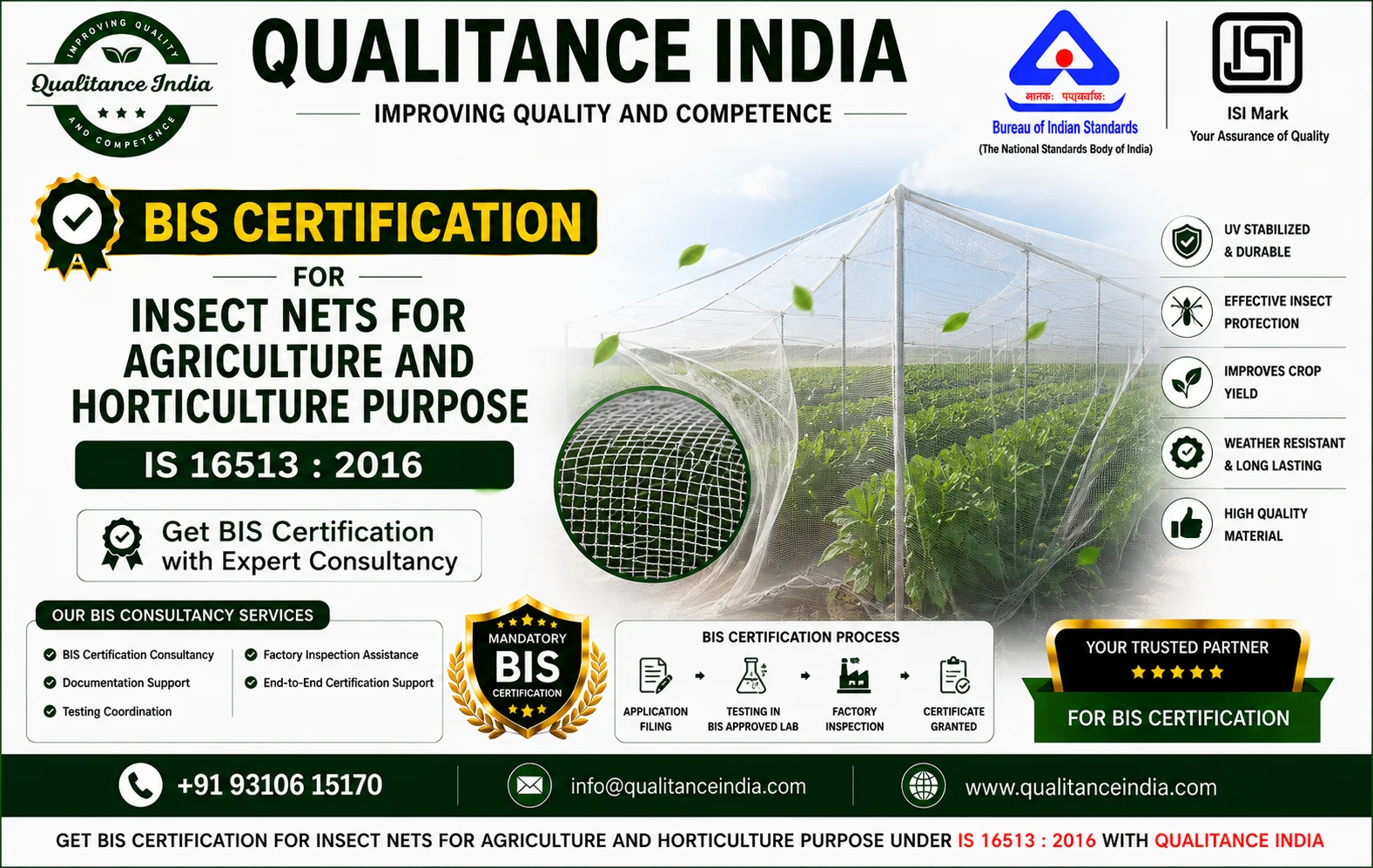
INSECT NETS FOR AGRICULTURE & HORTICULTURE
IS 16513:2016
BIS CERTIFICATION CONSULTANCY
Qualitance India
+91-9310-615-170
info@qualitanceindia.com
qualitanceindia.com
Image Text Suggestions
- BIS Certification for Insect Nets
- Insect Nets IS 16513:2016
- BIS Licence for Insect Nets
- Agriculture Insect Net Certification
- Horticulture Insect Net Certification
- HDPE Insect Net BIS Certification
- Agro Textile BIS Certification
- Type I Insect Net – Mesh 30
- Type II Insect Net – Mesh 40
- Type III Insect Net – Mesh 50
- Insect Net Testing
- Insect Net Factory Inspection
- BIS Certification for Agro Textiles
- Insect Net Quality Testing
- Qualitance India BIS Certification Consultancy
Related Services
- BIS Certification Consultancy
- BIS Certification for Agro Textiles
- BIS Certification for Agriculture Products
- BIS Product Testing
- BIS Factory Inspection
- ISI Mark Certification
- HDPE Product Certification
- Textile Product Certification
- Agro Textile Testing
- Agricultural Net Testing
Related Topics for Your Website
- BIS Certification for Agro Textiles
- BIS Certification for Shade Nets
- BIS Certification for Agricultural Nets
- BIS Certification for Horticultural Nets
- Insect Net Testing Requirements
- HDPE Insect Net Certification
- Type I, Type II and Type III Insect Nets
- BIS Certification Process for Agro Textile Manufacturers
- Agricultural Net Quality Testing
- BIS Certification for Crop Protection Products
Need BIS Certification for Insect Nets?
If you manufacture Insect Nets for Agriculture and Horticulture Purposes as per IS 16513:2016, proper assessment of your product type, mesh, HDPE monofilament yarn, manufacturing process, testing facilities and documentation is important.
Qualitance India can assist manufacturers with product assessment, product grouping, documentation, laboratory coordination, BIS application and factory inspection preparation.
Qualitance India
Phone: +91-9310-615-170
Email: info@qualitanceindia.com
Website: https://qualitanceindia.com/
Contact Qualitance India for assistance with BIS Certification for Insect Nets as per IS 16513:2016.
Conclusion
Insect nets are important agro-textile products used to protect agricultural and horticultural crops from insects and pests. IS 16513:2016 establishes constructional and performance requirements for these nets and classifies them into different types based on mesh.
The BIS Product Manual identifies HDPE monofilament yarn as the relevant raw material and provides requirements relating to netting fabric, colour, mesh, dimensions and mass. It also provides sampling and product-grouping guidance for manufacturers applying for certification.
Manufacturers should carefully assess their product type, mesh, dimensions, raw materials, manufacturing process, testing facilities and proposed licence scope before beginning the certification process.
For manufacturers requiring assistance, Qualitance India can support the BIS certification process for Insect Nets as per IS 16513:2016, from initial product assessment through testing, documentation and factory inspection preparation.