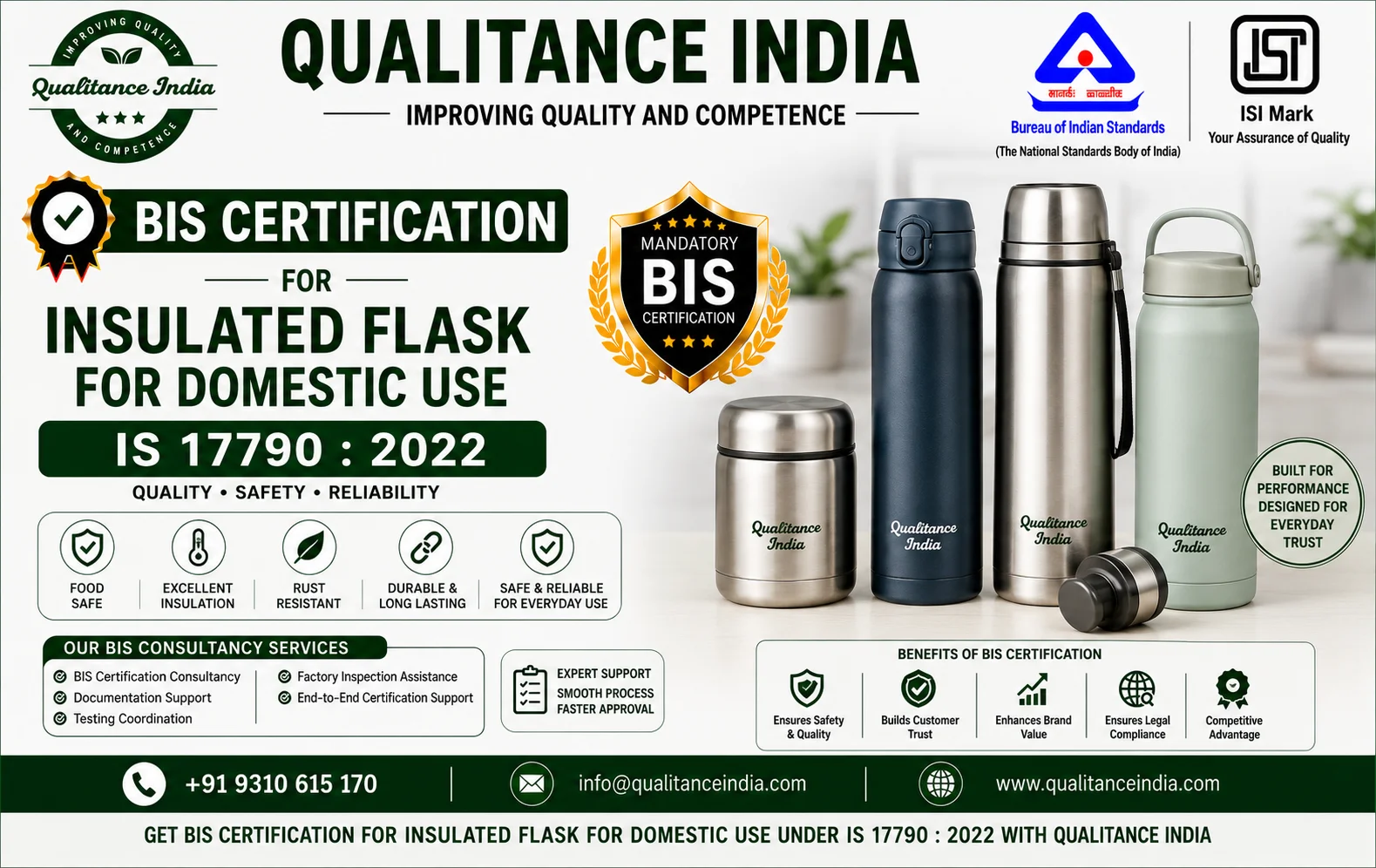
BIS Certification for Insulated Flask for Domestic Use | IS 17790:2022 | BIS Licence
Introduction
BIS Certification for Insulated Flask for Domestic Use is required under the applicable Indian Standard and Quality Control Order framework for products covered by IS 17790:2022.
IS 17790:2022 is titled “Insulated Flask for Domestic Use — Specification.” BIS describes the standard as covering minimum requirements for domestic insulated stainless-steel flasks used for storing and maintaining the temperature of hot and cold liquids intended for drinking.
The product is included under the Insulated Flask, Bottles and Containers for Domestic Use (Quality Control) Order, 2023, and BIS currently lists IS 17790:2022 under the ISI Mark Scheme / Scheme-I.
Manufacturers need to demonstrate conformity with the applicable requirements through the prescribed BIS certification process, including product testing, documentation, manufacturing controls and other applicable assessment requirements.
About Insulated Flask for Domestic Use
An insulated flask is a reusable container designed to maintain the temperature of liquids for an extended period.
It can be used for:
- Drinking water
- Hot beverages
- Cold beverages
- Tea
- Coffee
- Other suitable drinking liquids
IS 17790:2022 specifically addresses domestic insulated stainless-steel flasks used for maintaining the temperature of hot and cold liquids for drinking purposes.
The standard focuses not only on thermal performance but also on construction, material, safety, leakage, impact resistance, stability, workmanship and other relevant characteristics.
What is BIS Certification?
BIS Certification is a conformity assessment mechanism administered by the Bureau of Indian Standards (BIS).
For products covered under compulsory certification requirements, manufacturers need to demonstrate conformity with the applicable Indian Standard and comply with the relevant Quality Control Order and BIS certification requirements.
For insulated flasks, BIS currently lists IS 17790:2022 under the product category “Insulated Flask, Bottles and Containers for Domestic Use.”
A manufacturer meeting the applicable requirements can obtain the relevant BIS licence and use the Standard Mark in accordance with BIS conditions.
What is IS 17790:2022?
IS 17790:2022 is the Indian Standard titled:
Insulated Flask for Domestic Use — Specification
BIS's product manual listing includes IS 17790:2022 – Insulated Flask For Domestic Use, and the standard is currently included in the BIS product certification framework.
The standard establishes requirements intended to ensure that domestic insulated flasks provide appropriate performance, safety and quality.
Scope of IS 17790:2022
The standard covers minimum requirements for domestic insulated stainless-steel flasks used to store and maintain the temperature of hot and cold liquids intended for drinking.
The requirements can address areas such as:
- Manufacturing and workmanship
- Materials
- Inner container
- Outer container
- Material thickness
- Coating
- Capacity
- Heat retention
- Cold retention
- Impact resistance
- Handle strength
- Strap strength
- Leakage
- Joint leakage
- Staining
- Seepage
- Stability
- Pouring performance
- Stopper
- O-ring and washer
- Thermal insulation
- Marking
- Packaging
BIS laboratory information currently lists these and other parameters for IS 17790:2022 testing.
Products Covered
The primary product covered is:
Domestic Insulated Flask
Examples can include insulated stainless-steel flasks designed for:
- Hot water
- Cold water
- Tea
- Coffee
- Other drinking liquids
The exact applicability should be verified against the current standard, product construction and applicable BIS certification requirements.
Important Material Requirements
The BIS compendium states that the flask shall have a stainless-steel inner container. The outer container may be stainless steel or plastic, subject to the applicable material requirements.
Depending on the construction, requirements can also apply to:
- Inner container
- Outer container
- Coatings
- Stopper
- O-ring
- Washer
- Auxiliary closure
- Thermal insulation material
- Handles
- Shoulder straps
- Cords
This makes product construction and component selection important before applying for BIS Certification.
Enforcement / QCO Details
The applicable regulatory framework is the:
Insulated Flask, Bottles and Containers for Domestic Use (Quality Control) Order, 2023
The QCO specifically includes:
Product: Insulated Flask for Domestic Use
Indian Standard: IS 17790:2022
The order was notified on 14 July 2023.
BIS's current Scheme-I listing also identifies IS 17790:2022 under the Insulated Flask, Bottles and Containers for Domestic Use QCO.
Website note: For the final published page, always verify the latest QCO amendments and implementation notifications before displaying a specific enforcement date.
Who Needs BIS Certification?
BIS Certification may be relevant to manufacturers of regulated insulated flasks, including:
- Insulated flask manufacturers
- Stainless-steel flask manufacturers
- Domestic flask manufacturers
- Vacuum flask manufacturers, where covered
- OEM manufacturers
- Private-label manufacturers, subject to the applicable BIS framework
- Manufacturers supplying regulated products in India
- Importers/businesses dealing with products manufactured outside India, subject to applicable BIS requirements
The exact legal obligation should be determined based on the product, manufacturing location, QCO and current BIS requirements.
Eligibility Criteria for BIS Certification
A manufacturer should generally have:
Manufacturing Facility
A suitable manufacturing facility for producing the flask.
Manufacturing Machinery
Appropriate machinery for forming, welding, finishing, assembly and other applicable processes.
Quality Control
A documented quality-control system for raw materials, production and finished products.
Testing Facilities
Required testing and measuring facilities, either in-house or through an acceptable external arrangement as permitted.
Calibration
Applicable measuring/testing equipment should have valid calibration.
Technical Documentation
Product specifications, drawings, material details and manufacturing information should be available.
Production Records
The manufacturer should maintain relevant production and quality records.
Complete BIS Certification Process
Step 1 – Product Applicability Assessment
First identify whether the product falls under IS 17790:2022.
Step 2 – Technical Evaluation
Review:
- Flask construction
- Material
- Capacity
- Insulation
- Stopper
- O-ring
- Washer
- Coating
- Accessories
Step 3 – Factory Assessment
Evaluate the manufacturing facility, machinery and quality-control system.
Step 4 – Documentation
Prepare the required BIS application and technical documents.
Step 5 – Sample Preparation
Prepare representative product samples for testing.
Step 6 – Laboratory Testing
Conduct testing against applicable IS 17790 requirements.
Step 7 – BIS Application
Submit the application under the applicable BIS certification scheme.
Step 8 – Application Scrutiny
BIS reviews the application and supporting documents.
Step 9 – Factory Inspection
Where applicable, BIS assesses the manufacturing premises and quality-control arrangements.
Step 10 – Sample/Test Report Evaluation
Testing results are evaluated for conformity.
Step 11 – Observation Closure
Any observations or non-conformities need to be addressed.
Step 12 – Licence Grant
After successful compliance, BIS may grant the licence.
Step 13 – ISI Mark Compliance
The manufacturer must follow applicable BIS Standard Mark and marking conditions.
Required Documents
Typical documents can include:
- Company registration documents
- Factory address proof
- Factory licence
- Manufacturing process flow chart
- Factory layout
- Machinery list
- Product specifications
- Technical drawings
- Raw-material details
- Component details
- Quality-control plan
- Testing equipment list
- Calibration certificates
- Test reports
- Product photographs
- Manufacturing records
- Inspection records
- Trademark documents, where applicable
- Authorized signatory documents
- BIS application documents
- Product marking artwork
The exact document requirement may vary according to the applicable BIS certification process.
Testing Requirements
Testing is a major part of compliance with IS 17790:2022.
BIS's LIMS currently lists a detailed testing scope for IS 17790:2022.
Important tests/assessments can include:
1. Manufacture and Workmanship
The flask should meet applicable requirements regarding construction and finish.
2. Welding Defects
Applicable welded areas are assessed for specified defects.
3. Material
The materials used in the flask and components are evaluated against applicable requirements.
4. Thickness
Applicable material/component thickness requirements are checked.
5. Coating
Where applicable, coating characteristics such as:
- Thickness
- Adhesion
- Salt-water corrosion resistance
- Lead/cadmium limits
may be evaluated.
6. BPA
Applicable polymeric components may require BPA-related testing.
7. Capacity
The flask's capacity is checked against the applicable requirements.
8. Heat Retention Capability
The ability of the flask to maintain hot-liquid temperature is evaluated.
9. Cold Retention Capability
The ability to maintain cold-liquid temperature is evaluated.
10. Drop Impact Test
The flask's resistance to impact from dropping is assessed.
11. Pendulum Impact Test
Applicable impact resistance is evaluated.
12. Handle Strength
Where applicable, the fixing strength of the handle is assessed.
13. Shoulder Strap Strength
Where a shoulder strap is provided, its strength may be tested.
14. Leakage Test
The flask is checked for leakage.
15. Joint Leak Test
Applicable joints are evaluated for leakage.
16. Staining Test
The applicable staining characteristics are checked.
17. Seepage Test
The product is assessed for seepage.
18. Stability
The stability of the flask is evaluated.
19. Pour Test
The pouring performance is assessed.
20. Stopper and O-Ring Tests
Applicable requirements can cover:
- Stopper material
- O-ring
- Washer
- Hardness
- BPA
- Overall migration
- Defects
- Endurance
BIS's current laboratory scope lists these requirements for IS 17790:2022.
Factory Inspection Process
During BIS factory assessment, important areas can include:
Raw Material Control
Verification of stainless steel and other applicable materials.
Manufacturing Process
Review of forming, welding, insulation, finishing and assembly processes.
Welding
Inspection of welding quality and applicable welding controls.
Assembly
Inspection of:
- Stopper
- O-ring
- Washer
- Handle
- Strap
- Other accessories
Testing Facilities
Verification of relevant testing and inspection arrangements.
Calibration
Checking calibration records of applicable instruments.
Quality Control
Review of incoming, in-process and finished-product inspection.
Storage
Proper storage of raw materials and finished products.
Traceability
Maintenance of production and inspection records.
Common Reasons for BIS Application Rejection or Delay
- Incorrect standard selected
- Product construction does not match IS 17790 requirements
- Incomplete documentation
- Inadequate testing arrangements
- Failed heat retention test
- Failed cold retention test
- Leakage failure
- Impact test failure
- Incorrect capacity
- Material non-conformity
- Coating failure
- BPA-related non-compliance
- Poor welding quality
- Stopper/O-ring/washer issues
- Inadequate quality-control records
- Calibration problems
- Incorrect marking
- Factory not prepared for inspection
- Failure to close observations
BIS Certification Cost
There is no single fixed BIS Certification cost applicable to every insulated flask manufacturer.
The overall cost may depend upon:
- BIS application charges
- Product testing
- Number of product variants
- Factory inspection
- Testing laboratory
- Sample requirements
- Documentation
- Retesting, if required
- Consultancy charges
- Other applicable BIS fees
BIS's LIMS currently displays laboratory-specific testing charges for IS 17790:2022, and these vary by laboratory and scope.
Therefore, a manufacturer should obtain a product-specific quotation rather than relying on a generic online figure.
BIS Certification Timeline
The actual timeline depends on:
- Documentation readiness
- Sample availability
- Laboratory schedule
- Test results
- BIS application scrutiny
- Factory inspection
- Observation closure
A fixed timeline should therefore not be promised without reviewing the manufacturer's product and factory status.
Benefits of BIS Certification
1. Regulatory Compliance
Helps manufacturers meet applicable BIS/QCO requirements.
2. Product Quality
Encourages systematic control of flask quality.
3. Consumer Confidence
Demonstrates conformity with an applicable Indian Standard.
4. Market Acceptance
Supports compliant sale and supply of regulated products.
5. Quality Consistency
Helps maintain consistent product performance.
6. Brand Credibility
BIS certification can strengthen trust among distributors and customers.
7. Better Manufacturing Controls
Encourages manufacturers to establish structured quality-control systems.
Why Choose Qualitance India?
Qualitance India provides professional BIS Certification consultancy for manufacturers dealing with regulated products.
For IS 17790:2022 Insulated Flask for Domestic Use, our consultancy support can include:
✓ Product Applicability Assessment
✓ IS Standard Verification
✓ QCO Requirement Guidance
✓ BIS Documentation
✓ Technical Documentation
✓ Testing Coordination
✓ Laboratory Guidance
✓ Sample Testing Support
✓ BIS Application Assistance
✓ Factory Inspection Preparation
✓ Quality-Control Documentation
✓ Test Report Coordination
✓ Observation Closure Support
✓ BIS Licence Guidance
✓ ISI Mark Compliance Support
Contact Qualitance India
Phone: +91-9310-615-170
Email: info@qualitanceindia.com
Website: Qualitance India
Step-by-Step Flow Chart
Product Identification
↓
IS 17790:2022 Applicability Check
↓
Technical & Product Assessment
↓
Factory Assessment
↓
Documentation Preparation
↓
Sample Preparation
↓
Laboratory Testing
↓
BIS Application
↓
Application Scrutiny
↓
Factory Inspection
↓
Test Report Evaluation
↓
Observation Closure
↓
BIS Licence Grant
↓
ISI Mark Compliance
↓
Ongoing Compliance
25 SEO FAQs
1. What is IS 17790:2022?
IS 17790:2022 is the Indian Standard titled Insulated Flask for Domestic Use — Specification.
2. Is BIS Certification required for insulated flasks?
Insulated flasks covered under the applicable Insulated Flask, Bottles and Containers for Domestic Use (Quality Control) Order, 2023 are subject to the applicable BIS certification requirements.
3. What products are covered under IS 17790?
The standard covers domestic insulated stainless-steel flasks for storing and maintaining hot and cold liquids intended for drinking.
4. What is the BIS standard for domestic insulated flask?
The applicable standard is IS 17790:2022.
5. What is the QCO for insulated flasks?
The applicable regulation is the Insulated Flask, Bottles and Containers for Domestic Use (Quality Control) Order, 2023.
6. What tests are required under IS 17790?
Tests can include heat retention, cold retention, impact, leakage, seepage, stability, capacity, material, coating and other applicable requirements.
7. Is heat retention testing required?
Yes, Heat Retention Capability is included in the BIS testing scope for IS 17790:2022.
8. Is cold retention testing required?
Yes, Cold Retention Capability is included in the testing scope.
9. Is leakage testing required?
Yes, Leakage Test and Joint Leak Test are included in the applicable testing scope.
10. Is impact testing required?
Applicable impact testing includes Drop Impact and Pendulum Impact tests.
11. Is BPA testing applicable?
BIS's current testing scope includes BPA-related requirements for applicable components.
12. What material is used for the inner container?
The BIS compendium states that the flask shall have a stainless-steel inner container.
13. Can the outer container be plastic?
Yes, the BIS compendium indicates that the outer container may be stainless steel or plastic, subject to the applicable requirements.
14. What documents are required for BIS Certification?
Documents can include factory details, machinery list, manufacturing process, product specifications, testing arrangements, calibration records and quality-control documents.
15. Is factory inspection required?
Factory assessment may form part of the BIS certification process.
16. How much does BIS Certification for an insulated flask cost?
The cost depends on application, testing, inspection, product variants and other applicable charges.
17. How long does BIS Certification take?
The timeline varies according to testing, documentation, BIS processing, inspection and observation closure.
18. What is the ISI Mark?
The ISI Mark is the BIS Standard Mark used by authorized licensees according to applicable certification conditions.
19. Can an Indian manufacturer apply for BIS Certification?
Yes, eligible manufacturers can apply subject to the applicable BIS certification requirements.
20. Can foreign manufacturers obtain BIS Certification?
Foreign manufacturers may be subject to applicable BIS certification procedures depending on the product and regulatory framework.
21. What happens if the flask fails testing?
The manufacturer needs to identify the reason for failure, make necessary corrections and follow the applicable retesting/compliance procedure.
22. Is packaging covered under IS 17790?
BIS's current LIMS testing scope includes Clause 10 – Packaging.
23. Is marking covered under the standard?
Yes, BIS LIMS lists both marking and BIS certification marking requirements under the testing scope.
24. Where can IS 17790 testing be conducted?
Testing should be carried out through an appropriate laboratory accepted under the applicable BIS certification framework.
25. Can Qualitance India help with IS 17790 BIS Certification?
Yes. Qualitance India can assist manufacturers with standard applicability, documentation, testing coordination, BIS application, factory inspection preparation and compliance support.
FAQ Schema Content
Q: What is IS 17790:2022?
A: IS 17790:2022 is the Indian Standard for Insulated Flask for Domestic Use.
Q: Is BIS Certification required for insulated flasks?
A: Products covered by the applicable QCO for insulated flasks are subject to the relevant BIS certification requirements.
Q: What tests are required for IS 17790?
A: Applicable tests include heat retention, cold retention, impact, leakage, seepage, stability, capacity, material and other specified requirements.
Q: What is the BIS standard for domestic insulated flask?
A: The applicable standard is IS 17790:2022.
Q: What is the QCO for insulated flasks?
A: The applicable regulation is the Insulated Flask, Bottles and Containers for Domestic Use (Quality Control) Order, 2023.
Service Schema Suggestion
Service Name: BIS Certification for Insulated Flask for Domestic Use
Service Type: BIS Certification Consultancy
Applicable Standard: IS 17790:2022
Product: Insulated Flask for Domestic Use
Certification Scheme: Scheme-I / ISI Mark
Industry: Consumer Products / Household Products
Provider: Qualitance India
Area Served: India
Organization Schema Suggestion
Organization Name: Qualitance India
Description: BIS Certification Consultancy and Compliance Services
Phone: +91-9310-615-170
Email: info@qualitanceindia.com
Website: https://qualitanceindia.com/
Breadcrumb Schema Suggestion
Home → BIS Certification → Household Products → Insulated Flask → IS 17790:2022
Article Schema Suggestion
Headline: BIS Certification for Insulated Flask for Domestic Use | IS 17790:2022
Article Type: Article / BlogPosting
Author: Qualitance India
Publisher: Qualitance India
Article Section: BIS Certification / Household Products
Keywords: BIS Certification for Insulated Flask, IS 17790:2022, Insulated Flask BIS Licence, Insulated Flask Testing, ISI Mark
Image ALT Tags
- BIS Certification for Insulated Flask IS 17790:2022
- Insulated Flask for Domestic Use BIS Certification
- IS 17790:2022 BIS Licence
- BIS Certification for Stainless Steel Insulated Flask
- Insulated Flask ISI Mark Certification
- IS 17790 Testing Requirements
- Domestic Insulated Flask BIS Certification
- Insulated Flask Heat Retention Testing
- Insulated Flask Leakage Test
- Insulated Flask BIS Testing
- IS 17790 Quality Control Order
- BIS Licence for Insulated Flask Manufacturer
- Insulated Stainless Steel Flask Certification
- Insulated Flask Quality Testing
- Qualitance India BIS Certification Consultancy
Internal Linking Strategy
Is page par internal links add karein:
- BIS Certification Consultancy
- BIS Certification Process
- BIS Certification Cost
- BIS Testing Services
- BIS Factory Inspection
- ISI Mark Certification
- BIS QCO Compliance
- Household Product BIS Certification
- Stainless Steel Product BIS Certification
- Product Testing Services
Related Product Pages
Aap in pages ko bhi internally link kar sakte hain:
- BIS Certification for Potable Water Bottles – IS 17803:2022
- BIS Certification for Insulated Containers for Food Storage – IS 17569:2021
- BIS Certification for Stainless Steel Vacuum Flask Bottles – IS 17526:2021
These are particularly useful related pages because the 2023 QCO separately identifies these standards alongside IS 17790:2022.
External Authority References
BIS Product Manuals
BIS Product Manuals – IS 17790:2022
BIS Scheme-I / ISI Mark
BIS Scheme-I (ISI Mark Scheme)
BIS LIMS – IS 17790 Testing
BIS Laboratory Testing Information for IS 17790:2022
Insulated Flask QCO 2023
Insulated Flask, Bottles and Containers for Domestic Use QCO 2023
Related BIS Services
- BIS Certification for Insulated Flask – IS 17790:2022
- BIS Certification for Stainless Steel Vacuum Flask Bottles – IS 17526:2021
- BIS Certification for Insulated Containers for Food Storage – IS 17569:2021
- BIS Certification for Potable Water Bottles – IS 17803:2022
- BIS Certification for Stainless Steel Products
- BIS Certification for Household Products
- BIS Testing Services
- ISI Mark Certification
- BIS Factory Inspection Consultancy
- BIS QCO Compliance Consultancy
Related Blog Suggestions
High-Search SEO Topics
- BIS Certification for Insulated Flask – IS 17790:2022
- IS 17790:2022 – Complete BIS Certification Guide
- Insulated Flask Quality Control Order 2023
- BIS Testing Requirements for Insulated Flask
- IS 17790:2022 Testing Parameters Explained
- BIS Certification for Stainless Steel Insulated Flask
- BIS Licence for Domestic Insulated Flask Manufacturers
- ISI Mark for Insulated Flask
- BIS Certification Cost for Insulated Flask
- Documents Required for IS 17790 BIS Certification
- Heat Retention Test for Insulated Flask
- Cold Retention Test for Insulated Flask
- Insulated Flask Leakage and Impact Testing
- IS 17790 vs IS 17526 – Difference Explained
- Insulated Flask BIS Certification Process in India
Strong Lead Generation CTA
Need BIS Certification for Insulated Flask?
Are you an Insulated Flask Manufacturer, Stainless Steel Product Manufacturer, OEM or Supplier looking for BIS Certification under IS 17790:2022?
Qualitance India can assist you from product applicability assessment to testing, documentation, BIS application and factory inspection preparation.
Our Support Includes:
✓ IS 17790:2022 Applicability Assessment
✓ QCO Compliance Guidance
✓ BIS Documentation
✓ Product Testing Coordination
✓ Laboratory Guidance
✓ Sample Preparation Support
✓ BIS Application Assistance
✓ Factory Inspection Preparation
✓ Quality-Control Documentation
✓ Test Report Coordination
✓ Observation Closure
✓ BIS Licence Guidance
✓ ISI Mark Compliance
Contact Qualitance India
📞 +91-9310-615-170
📧 info@qualitanceindia.com
🌐 qualitanceindia.com
Get professional BIS Certification consultancy for Insulated Flask for Domestic Use.
Conclusion
IS 17790:2022 is the Indian Standard for Insulated Flask for Domestic Use. The standard covers domestic insulated stainless-steel flasks designed for storing and maintaining the temperature of hot and cold drinking liquids.
The product is included under the Insulated Flask, Bottles and Containers for Domestic Use (Quality Control) Order, 2023, and BIS currently lists it under the ISI Mark Scheme.
Manufacturers should pay particular attention to material, workmanship, capacity, heat retention, cold retention, impact resistance, leakage, seepage, stability, stopper, O-ring, washer, coating and applicable marking requirements. BIS's current laboratory database provides a detailed testing scope for IS 17790:2022.
For manufacturers looking for professional assistance, Qualitance India can support the complete BIS certification journey, including standard verification, documentation, testing coordination, BIS application, factory inspection preparation and compliance support.