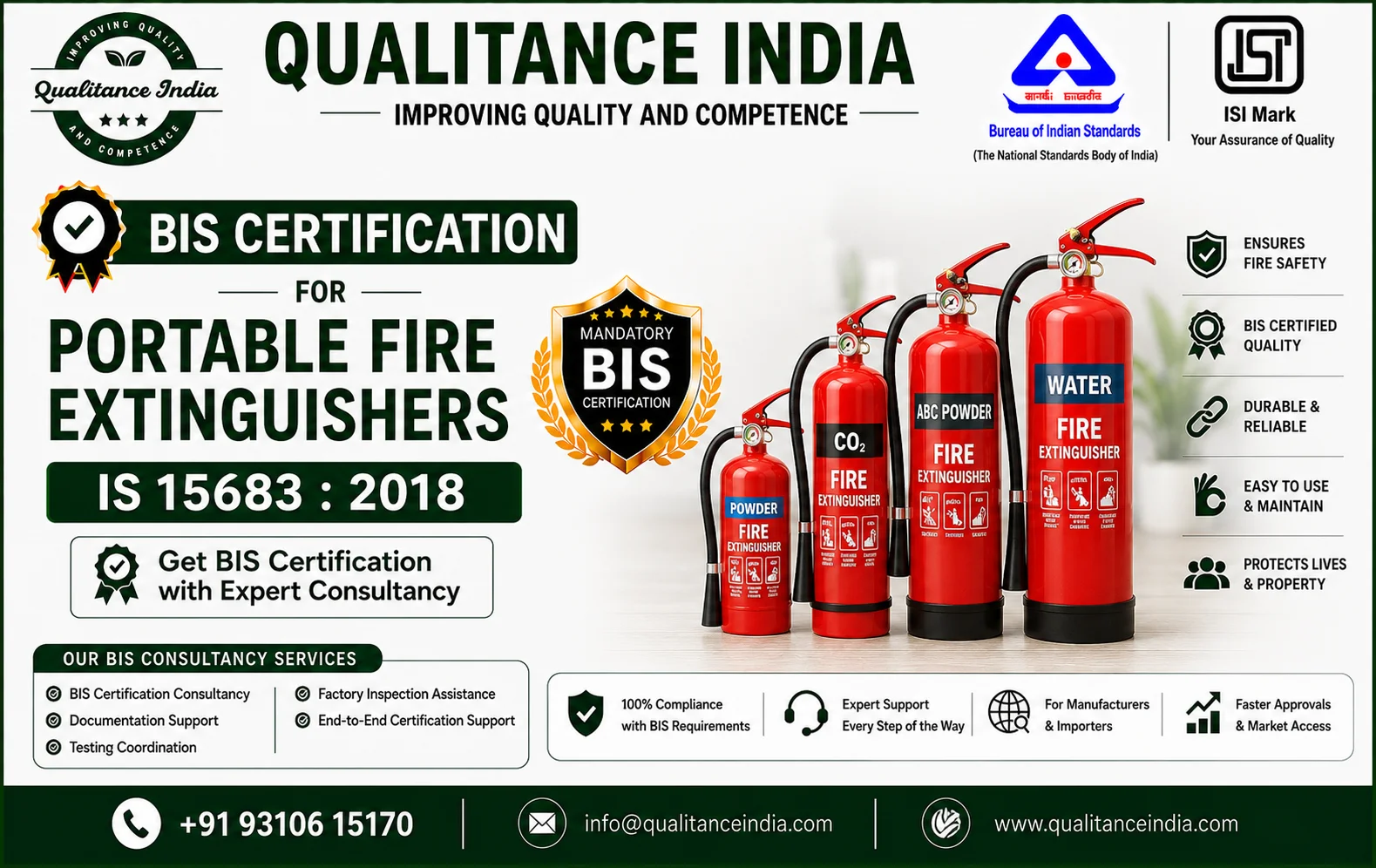
BIS Certification for Portable Fire Extinguishers as per IS 15683:2018
Introduction
Portable fire extinguishers are important safety equipment used for controlling and suppressing fires at an early stage. Because these products are directly related to fire safety, their construction, reliability, performance and safety need to meet defined requirements.
IS 15683:2018 – Portable Fire Extinguishers – Performance and Construction – Specification specifies requirements relating to the performance, reliability and safety of portable fire extinguishers.
The standard covers different types of portable fire extinguishers, including water-based, foam-based, powder-based, carbon dioxide, clean-agent and water-mist types.
For manufacturers covered under the applicable regulatory framework, obtaining the required BIS licence is an important part of bringing compliant portable fire extinguishers into the Indian market.
About Portable Fire Extinguishers
Portable fire extinguishers are manually operated devices designed to discharge an extinguishing medium onto a fire.
They are commonly installed in:
- Commercial buildings
- Offices
- Factories
- Warehouses
- Hotels
- Hospitals
- Schools and colleges
- Residential buildings
- Shopping centres
- Industrial facilities
- Electrical installations
- Vehicles and other locations where fire protection is required
A portable extinguisher should be easy to handle, reliable during an emergency and capable of delivering the required extinguishing performance.
IS 15683:2018 establishes requirements intended to ensure suitable performance, reliability and safety of these products.
What is IS 15683:2018?
IS 15683:2018 is titled:
Portable Fire Extinguishers – Performance and Construction – Specification
It is the first revision of the standard and covers requirements relating to the performance, reliability, safety and construction of portable fire extinguishers.
The standard covers several categories of extinguishing media and specifies requirements that manufacturers must fulfil for their products.
Types of Portable Fire Extinguishers Covered
IS 15683:2018 covers portable fire extinguishers of different types, including:
Water-Based Fire Extinguishers
These extinguishers use water as the principal extinguishing medium and are generally associated with fires involving ordinary combustible materials.
Foam-Based Fire Extinguishers
Foam extinguishers are designed for applications where foam is suitable for suppressing the fire.
Dry Powder Fire Extinguishers
The standard includes:
- ABC type
- BC type
- D type
Carbon Dioxide Fire Extinguishers
CO₂ extinguishers are commonly used for suitable electrical and flammable-liquid fire applications.
Clean Agent Fire Extinguishers
These use clean extinguishing agents designed for applications where residue-free fire suppression is important.
Water Mist Fire Extinguishers
Water-mist extinguishers discharge water in a fine mist for suitable fire applications.
These types are specifically identified in the BIS standard information for IS 15683:2018.
BIS Certification for Portable Fire Extinguishers
BIS Certification provides a framework through which manufacturers demonstrate conformity of their products with the applicable Indian Standard.
IS 15683:2018 is listed by BIS under Scheme-I, and the BIS product list identifies the associated Fire Extinguishers (Quality Control) Order, 2023.
A manufacturer seeking a BIS licence needs to demonstrate that its product, manufacturing process, testing arrangements and quality-control system comply with the applicable requirements.
Once the applicable certification requirements are successfully completed, the manufacturer can use the BIS Standard Mark according to the conditions of the licence.
Scope of IS 15683:2018
The standard specifies requirements for:
- Performance
- Reliability
- Safety
- Construction
- Extinguishing media
- Filling requirements
- Pressure requirements
- Operating performance
- Temperature resistance
- Leakage
- Impact resistance
- Vibration resistance
- Corrosion resistance
- Discharge performance
- Fire performance
- Product construction
- Marking
- Other applicable safety requirements
The exact requirements depend on the type and capacity of the fire extinguisher.
Requirements for Extinguishing Media
The extinguishing medium is an important part of a portable fire extinguisher.
Depending on the extinguisher type, the applicable requirements may relate to:
- Chemical composition
- Filling quantity
- Filling density
- Moisture
- Particle size
- Apparent density
- Water repellency
- Hygroscopicity
- Other characteristics
BIS laboratory information for IS 15683:2018 includes testing related to the main chemical constituents and physical characteristics of ABC, BC and D powders.
Manufacturers should therefore ensure that the extinguishing medium used in their products meets the applicable Indian Standard requirements.
Construction Requirements
The construction of a fire extinguisher must provide sufficient strength, durability and safety during normal use and operation.
Important construction-related areas may include:
- Cylinder/body
- Valve
- Discharge assembly
- Hose
- Coupling
- Safety locking device
- Pressure gauge where applicable
- Dip tube
- Filter
- Discharge horn
- Gaskets
- O-rings
- Handle
- Operating mechanism
- Protective components
The BIS Product Manual contains detailed requirements concerning the product and its construction.
Cylinder Body Material
Material selection for the cylinder body is an important consideration.
BIS issued a revised Product Manual in July 2024 that specifically modified the grouping guidelines and licence scope to incorporate the material of cylinder body. It also introduced requirements for marking the cylinder-body material in the Scheme of Inspection and Testing.
Therefore, manufacturers should carefully review the current Product Manual before preparing their BIS application.
Performance Requirements
Portable fire extinguishers need to demonstrate satisfactory performance under the applicable test conditions.
Important performance areas include:
- Discharge performance
- Fire extinguishing capability
- Operating performance
- Temperature resistance
- Leakage resistance
- Impact resistance
- Vibration resistance
- Corrosion resistance
- Pressure performance
- Intermittent discharge performance
- Tapping test
- Other applicable tests
BIS's laboratory information currently lists testing against several of these requirements for IS 15683:2018.
Fire Performance Test
The fire performance test is one of the most important evaluations for a portable fire extinguisher.
The purpose is to determine whether the extinguisher is capable of successfully controlling or extinguishing the specified fire under the applicable test conditions.
BIS's Product Manual specifies a separate sample requirement for fire performance testing. The current Product Manual indicates 14 samples for tests other than fire performance and 6 samples for fire performance testing.
The exact test arrangement depends on the type of extinguisher and applicable fire rating.
Pressure Requirements
Fire extinguishers operate under pressure or involve pressurized components, making pressure safety an important consideration.
Applicable assessment can include:
- Service pressure
- Maximum service pressure
- Pressure-related safety
- Leakage
- Burst-related requirements
- Pressure cycling
- Other pressure performance requirements
BIS laboratory information for IS 15683:2018 includes testing for pressure-related requirements.
Temperature Resistance
Portable fire extinguishers may be exposed to different environmental temperatures during storage and use.
Therefore, applicable testing evaluates the extinguisher's ability to withstand specified temperature changes and continue to meet the relevant performance requirements.
BIS laboratory information identifies resistance to temperature changes as one of the tests associated with IS 15683:2018.
Leakage Test
A fire extinguisher should not suffer unacceptable leakage during storage or operation.
Leakage testing is therefore an important part of product evaluation.
BIS's laboratory information identifies leakage testing under IS 15683:2018.
Impact and Vibration Tests
Portable fire extinguishers can be exposed to impacts and vibrations during:
- Transportation
- Handling
- Installation
- Storage
- Routine movement
The standard therefore includes applicable requirements for impact resistance and vibration resistance.
These tests help evaluate whether the extinguisher can maintain its required integrity and functionality after specified mechanical stresses.
Corrosion Resistance
Fire extinguishers may be installed in environments where moisture and other conditions can cause corrosion.
IS 15683:2018 includes corrosion-related requirements to help ensure durability and safety.
BIS laboratory information identifies both applicable corrosion testing and related product requirements.
Who Needs BIS Certification?
BIS Certification requirements may apply to manufacturers dealing with:
- Portable fire extinguishers
- Water fire extinguishers
- Foam fire extinguishers
- ABC powder extinguishers
- BC powder extinguishers
- D-type powder extinguishers
- CO₂ fire extinguishers
- Clean-agent extinguishers
- Water-mist extinguishers
It may be relevant to:
- Indian manufacturers
- Foreign manufacturers
- OEM manufacturers
- Fire-safety equipment manufacturers
- Fire extinguisher manufacturers supplying the Indian market
The exact regulatory applicability should be checked according to the current QCO and the manufacturer's product scope.
Fire Extinguishers Quality Control Order
BIS currently identifies IS 15683:2018 – Portable Fire Extinguishers under the Fire Extinguishers (Quality Control) Order, 2023.
This makes regulatory compliance particularly important for manufacturers and suppliers covered by the Order.
Manufacturers should check the latest QCO, amendments and applicable implementation provisions before manufacturing or supplying products covered by the regulatory framework.
Eligibility for BIS Licence
A manufacturer should generally have:
- Suitable manufacturing premises
- Appropriate production machinery
- Raw-material control
- Quality-control procedures
- Testing facilities or permitted testing arrangements
- Calibrated measuring equipment
- Product specifications
- Manufacturing process documentation
- Inspection procedures
- Qualified technical personnel
- Suitable storage facilities
- Proper product identification and marking arrangements
The actual requirements depend on the product type, manufacturing process and applicable BIS guidelines.
BIS Certification Process for Portable Fire Extinguishers
Product Assessment
First, the product is reviewed to determine its applicability under IS 15683:2018.
Standard and Product Review
The extinguisher type, extinguishing medium, capacity, fire rating, operating temperature and construction details are reviewed.
Factory Assessment
The manufacturing facility, machinery, testing arrangements and quality-control system are examined.
Documentation Preparation
The required technical and legal documents are prepared.
Sample Preparation
Representative samples are prepared according to the applicable BIS requirements.
Laboratory Testing
Samples are tested against the relevant requirements of IS 15683:2018.
Application Submission
The BIS application is prepared and submitted through the applicable certification process.
BIS Scrutiny
BIS reviews the application and supporting information.
Factory Inspection
Where required, BIS assesses the manufacturing facility and quality-control arrangements.
Test Report Evaluation
The laboratory results are reviewed against the applicable requirements.
Observation Closure
Any observations or non-conformities are addressed.
Licence Grant
After successful completion of the applicable requirements, the BIS licence may be granted.
Standard Mark
The manufacturer can use the BIS Standard Mark according to the conditions of the licence.
Documents Required
The documents generally required may include:
- Company registration documents
- Factory address proof
- Manufacturing licence
- Factory layout
- Manufacturing process flow
- Machinery list
- Product drawings
- Product specifications
- Raw-material details
- Cylinder-body material details
- Extinguishing-medium details
- Product capacity details
- Fire rating information
- Operating temperature information
- Testing equipment list
- Calibration certificates
- Quality-control plan
- Inspection records
- Test reports
- Product photographs
- Packaging details
- Marking details
- Trademark documents, where applicable
- Authorized signatory documents
- BIS application documents
The exact documents depend on the manufacturer's product and application.
Testing Requirements
Testing requirements depend on the type, capacity and configuration of the portable fire extinguisher.
Tests may include:
- Filling requirements
- Capacity
- Pressure requirements
- Operating performance
- Temperature resistance
- Leakage
- Impact resistance
- Vibration resistance
- Corrosion resistance
- Tapping test
- Intermittent discharge
- Fire performance
- Electrical conductivity of discharge where applicable
- Construction requirements
- Colour
- Component requirements
- Safety locking device
- Hose and coupling requirements
- Discharge assembly requirements
- Pressure gauge requirements where applicable
BIS LIMS currently lists extensive testing coverage for IS 15683:2018.
Laboratory Testing
BIS maintains laboratory information for testing against IS 15683:2018.
Current BIS LIMS entries show testing scopes for different types and capacities, with laboratory charges varying according to the testing scope.
Because testing requirements can vary significantly depending on the extinguisher type and capacity, manufacturers should identify the exact product scope before estimating testing costs.
Factory Inspection
During the factory assessment, important areas may include:
Raw Material
Verification of incoming materials and applicable certificates.
Manufacturing Process
Review of manufacturing operations and process controls.
Cylinder Manufacturing
Inspection of cylinder/body manufacturing and related processes.
Filling
Control of extinguishing-medium filling.
Assembly
Inspection of valves, hoses, discharge assemblies and safety components.
Testing
Review of in-house testing facilities and procedures.
Calibration
Verification of calibration status of relevant instruments.
Quality Control
Review of incoming, in-process and final inspection.
Traceability
Verification of batch and production records.
Marking
Verification that required product information is correctly marked.
Common Problems During Certification
Manufacturers may face delays because of:
- Incorrect product classification
- Wrong standard selection
- Incomplete product drawings
- Incorrect product grouping
- Inadequate testing facilities
- Missing calibration certificates
- Non-conforming raw materials
- Incorrect cylinder-body material declaration
- Inadequate quality records
- Test failure
- Leakage failure
- Pressure-test failure
- Fire-performance failure
- Corrosion-test failure
- Incorrect marking
- Incomplete documentation
- Factory not being ready for assessment
- Failure to address BIS observations
The revised 2024 Product Manual is especially important because it changed provisions relating to cylinder-body material, grouping and licence scope.
BIS Certification Cost
The total cost depends on the product and its testing scope.
Factors can include:
- BIS application fees
- Laboratory testing
- Number of extinguisher types
- Number of capacities
- Product grouping
- Fire performance testing
- Factory inspection
- Sample transportation
- Retesting, if required
- Documentation work
- Consultancy charges
BIS LIMS currently shows different testing charges depending on the laboratory and scope. For example, current listings show full testing scopes with charges in the range of approximately ₹1.36 lakh to ₹3.02 lakh before taxes, depending on the laboratory and scope shown.
Therefore, manufacturers should not rely on one standard testing price. A product-specific estimate should be prepared after identifying the exact extinguisher type, capacity and licence scope.
Certification Time
The time required depends on:
- Documentation readiness
- Product grouping
- Sample availability
- Laboratory availability
- Testing duration
- Factory readiness
- BIS scrutiny
- Inspection
- Test results
- Observations
- Retesting, if required
A realistic timeline should therefore be determined after reviewing the manufacturer's product and factory.
Benefits for Manufacturers
Better Product Reliability
The certification process evaluates important performance and safety requirements.
Improved Customer Confidence
BIS certification provides assurance that the product has undergone the applicable conformity assessment process.
Regulatory Compliance
It helps manufacturers meet applicable regulatory requirements under the relevant QCO framework.
Better Market Acceptance
Certified products can be supplied in accordance with the applicable regulatory requirements.
Stronger Brand Reputation
Compliance with Indian Standards can improve confidence among institutional and commercial customers.
Consistent Manufacturing
The certification process encourages systematic quality control and production monitoring.
Why Work With Qualitance India?
Qualitance India provides BIS certification consultancy support for manufacturers seeking certification for regulated products.
For portable fire extinguishers under IS 15683:2018, assistance can include:
- Product applicability review
- Standard verification
- Product grouping guidance
- QCO requirement guidance
- Documentation preparation
- Technical document review
- Testing laboratory coordination
- Sample preparation guidance
- BIS application assistance
- Factory inspection preparation
- Quality-control documentation
- Test report coordination
- Observation closure assistance
- Licence-related guidance
- Standard Mark requirements
Contact Qualitance India
Phone: +91-9310-615-170
Email: info@qualitanceindia.com
Website: qualitanceindia.com
Certification Journey
Product Identification
↓
IS 15683:2018 Applicability Check
↓
Product Type & Capacity Review
↓
Product Grouping Assessment
↓
Factory & Quality System Review
↓
Document Preparation
↓
Sample Preparation
↓
Laboratory Testing
↓
BIS Application
↓
BIS Scrutiny
↓
Factory Assessment
↓
Test Report Evaluation
↓
Observation Closure
↓
BIS Licence Grant
↓
Standard Mark Compliance
Frequently Asked Questions
1. What is IS 15683:2018?
IS 15683:2018 is the Indian Standard for Portable Fire Extinguishers – Performance and Construction – Specification.
2. Is BIS Certification required for portable fire extinguishers?
IS 15683:2018 is listed under BIS Scheme-I and is associated with the Fire Extinguishers (Quality Control) Order, 2023. Manufacturers covered by the applicable regulatory provisions need to meet the relevant BIS requirements.
3. What types of fire extinguishers are covered?
The standard covers water-based, foam-based, ABC/BC/D powder, carbon dioxide, clean-agent and water-mist types.
4. What is the BIS standard for portable fire extinguishers?
The applicable standard is IS 15683:2018.
5. What is the Fire Extinguishers QCO?
The applicable regulatory order is the Fire Extinguishers (Quality Control) Order, 2023. BIS lists IS 15683:2018 against this QCO.
6. What tests are conducted on fire extinguishers?
Depending on the product, testing can include pressure, leakage, temperature resistance, impact, vibration, corrosion, discharge, fire performance and construction-related tests.
7. Is fire performance testing required?
Yes, fire performance is an important part of evaluating portable fire extinguishers under the standard.
8. How many samples are required?
The current BIS Product Manual specifies 14 samples for tests other than fire performance and 6 samples for fire performance testing for the relevant certification activities.
9. What is product grouping?
Product grouping determines which variants may be represented within a particular BIS licence scope based on applicable grouping provisions.
10. Has the IS 15683 Product Manual been revised?
Yes. BIS issued a revised Product Manual in July 2024.
11. What changed in the revised Product Manual?
The revised manual modified provisions relating to grouping, licence scope and material of cylinder body, including marking requirements.
12. Is cylinder-body material important?
Yes. The revised Product Manual specifically incorporates cylinder-body material into grouping and licence-scope provisions.
13. Is leakage testing required?
Yes, leakage testing is included in the BIS testing information for IS 15683:2018.
14. Is corrosion testing required?
Applicable corrosion-resistance testing forms part of the requirements for portable fire extinguishers.
15. Is vibration testing required?
Vibration resistance is included among the applicable testing requirements.
16. Is impact testing required?
Impact resistance testing is included in the BIS laboratory scope for IS 15683:2018.
17. Can ABC powder extinguishers be certified under IS 15683?
Yes. ABC powder extinguishers are specifically included within the types covered by IS 15683:2018.
18. Can CO₂ extinguishers be covered?
Yes. Carbon dioxide extinguishers are among the extinguisher types covered by the standard.
19. What documents are required?
Documents generally include factory information, drawings, raw-material details, manufacturing process, testing equipment, calibration records, quality-control documents and product information.
20. How much does certification cost?
The cost depends on product type, capacity, grouping, testing scope, laboratory charges, inspection and other applicable expenses.
21. How long does certification take?
The timeline depends on documentation, laboratory testing, factory inspection and closure of observations.
22. Can an Indian manufacturer apply?
Yes, eligible manufacturers can apply under the applicable BIS certification procedure.
23. Can foreign manufacturers obtain certification?
Foreign manufacturers may have separate BIS conformity requirements depending on the applicable certification route and regulatory provisions.
24. Is ISI Mark allowed after certification?
The BIS Standard Mark can be used according to the conditions and scope of the granted BIS licence.
25. Can Qualitance India assist with IS 15683 certification?
Yes. Qualitance India can assist manufacturers with product assessment, documentation, testing coordination, application support and factory inspection preparation.
Short Questions and Answers
What is the BIS standard for fire extinguishers?
IS 15683:2018 is the Indian Standard for portable fire extinguishers covering performance and construction requirements.
Is IS 15683 under compulsory certification?
BIS lists IS 15683:2018 under Scheme-I and associates it with the Fire Extinguishers (Quality Control) Order, 2023.
Which fire extinguishers are covered?
Water, foam, ABC/BC/D powder, CO₂, clean-agent and water-mist extinguishers are covered.
What is tested under IS 15683?
Testing can cover pressure, leakage, temperature, impact, vibration, corrosion, discharge, fire performance and construction requirements.
How can manufacturers obtain BIS certification?
Manufacturers need to establish product conformity, prepare the required documents, complete applicable testing and factory assessment and fulfil BIS certification requirements.
Suggested Image ALT Text
- BIS Certification for Portable Fire Extinguishers
- Portable Fire Extinguisher IS 15683:2018
- IS 15683:2018 Fire Extinguisher Certification
- BIS Licence for Fire Extinguishers
- Portable Fire Extinguisher Testing
- Fire Extinguisher ISI Mark
- ABC Powder Fire Extinguisher BIS Certification
- CO2 Fire Extinguisher BIS Certification
- Water Fire Extinguisher IS 15683
- Fire Extinguisher Pressure Testing
- Fire Extinguisher Fire Performance Test
- Fire Extinguisher Quality Control Order
- IS 15683 BIS Licence
- Fire Safety Equipment BIS Certification
- Qualitance India Fire Extinguisher Certification Consultancy
Related Pages
आप इस page पर इन related services को naturally link कर सकते हैं:
- BIS Certification Consultancy
- ISI Mark Certification
- BIS Product Testing
- BIS Factory Inspection
- BIS Licence
- Fire Safety Product Certification
- Fire Extinguisher Testing
- BIS Certification for Dry Chemical Powder – IS 4308
- BIS Certification for Wheeled Fire Extinguishers – IS 16018
- BIS Certification for Fire Safety Equipment
Related Blog Topics
- BIS Certification Process for Portable Fire Extinguishers
- IS 15683:2018 Complete Guide for Fire Extinguisher Manufacturers
- Fire Extinguisher Testing Requirements under IS 15683
- Fire Extinguisher QCO 2023 Explained
- ABC Powder Fire Extinguisher BIS Certification
- CO2 Fire Extinguisher BIS Certification
- Water-Based Fire Extinguisher Certification
- Fire Extinguisher Pressure Testing Requirements
- Fire Extinguisher Fire Performance Testing
- IS 15683 Product Grouping Guidelines
- Fire Extinguisher Cylinder Material Requirements
- BIS Licence for Fire Extinguisher Manufacturers
- Documents Required for Fire Extinguisher BIS Certification
- Fire Extinguisher BIS Certification Cost
- Difference Between Portable and Wheeled Fire Extinguishers
Contact Qualitance India
Looking for BIS Certification for Portable Fire Extinguishers?
If you manufacture portable fire extinguishers, ABC/BC/D powder extinguishers, water extinguishers, foam extinguishers, CO₂ extinguishers, clean-agent extinguishers or water-mist extinguishers, professional guidance can make the certification process easier.
Qualitance India can support you from product applicability and documentation through testing, application submission, factory inspection preparation and licence-related compliance.
Call: +91-9310-615-170
Email: info@qualitanceindia.com
Website: Qualitance India
Get in touch with our team to discuss your IS 15683:2018 certification requirement.
Conclusion
Portable fire extinguishers are critical fire-safety products, and their performance and construction need to meet defined safety requirements.
IS 15683:2018 – Portable Fire Extinguishers – Performance and Construction – Specification covers several types of portable extinguishers and establishes requirements relating to performance, reliability, safety, construction and testing.
The standard is included under BIS Scheme-I and is associated with the Fire Extinguishers (Quality Control) Order, 2023.
Manufacturers should also take note of the revised July 2024 Product Manual, particularly the provisions concerning cylinder-body material, product grouping and licence scope.
If you are planning to manufacture or supply portable fire extinguishers in India, ensuring conformity with the applicable BIS requirements is an important step toward regulatory compliance and reliable product performance.