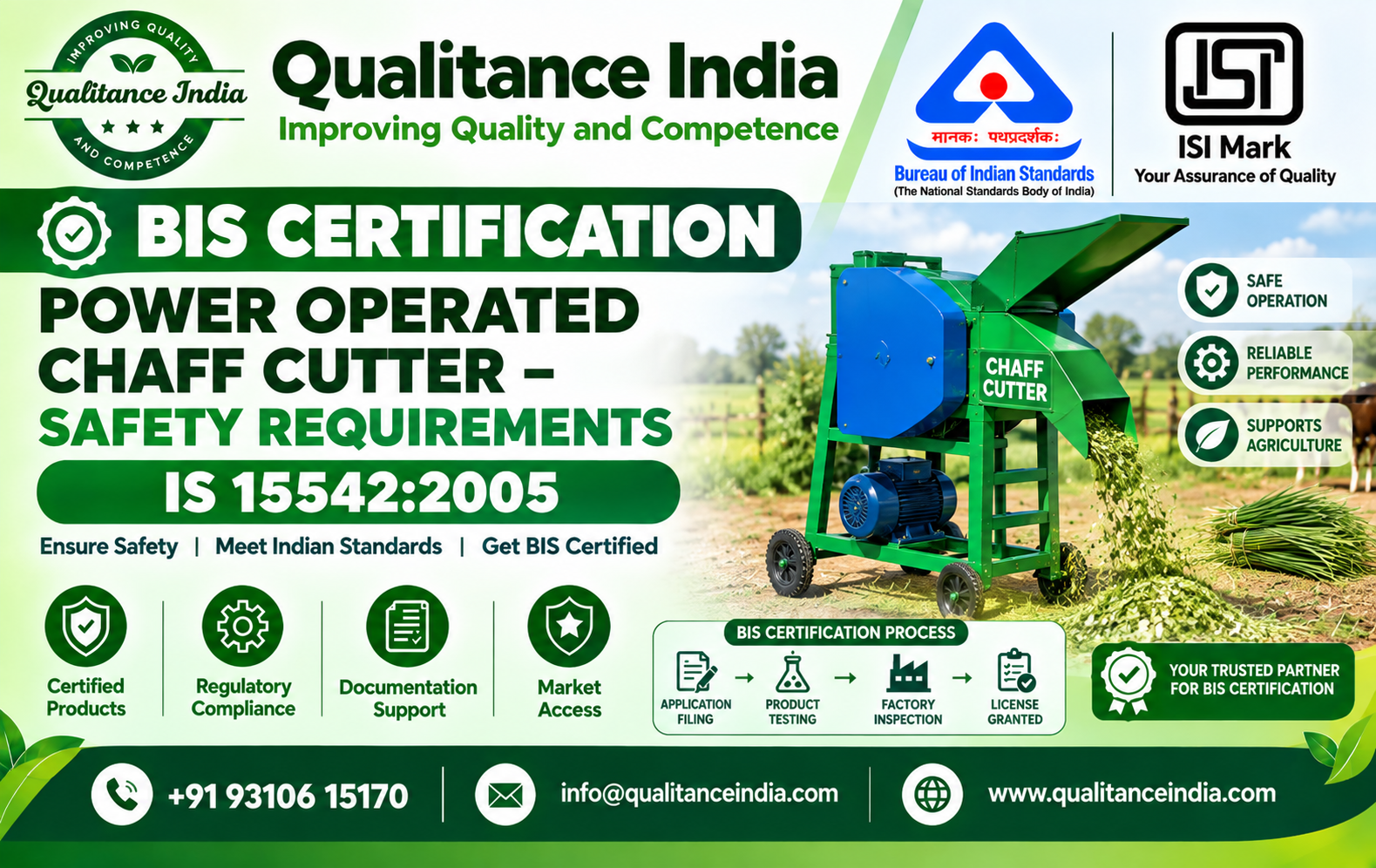
BIS Certification for Power Operated Chaff Cutter | IS 15542:2005 | ISI Mark
Introduction
A Power Operated Chaff Cutter is an agricultural machine used for cutting and processing fodder such as straw, hay and other crop residues into smaller pieces suitable for livestock feeding. These machines may be powered by an electric motor, diesel engine, tractor PTO or another suitable rotary power source.
Because a power-operated chaff cutter contains rotating shafts, blades, flywheels, feeding mechanisms, belts, pulleys and other moving parts, proper construction and operator protection are important. BIS certification for this product provides a structured conformity-assessment framework covering materials, construction, safety, testing and factory quality controls.
Manufacturers searching for BIS Certification for Power Operated Chaff Cutter under IS 15542:2005 should note an important regulatory development. BIS has revised the applicable requirements into IS 11459:2024 — Power Operated Chaff Cutter – Specification and Test Code. The revised standard merged the earlier IS 11459:1985, IS 15542:2005 and IS 7897:1975 requirements. BIS specified 28 November 2024 as the implementation date after which the old standards were to be withdrawn for licensing purposes.
Therefore, this article explains the historical IS 15542:2005 reference while also giving manufacturers the current BIS certification position under IS 11459:2024.
Important BIS Update: IS 15542:2005 Replaced by IS 11459:2024
The earlier standard:
IS 15542:2005 — Power Operated Chaff Cutter – Safety Requirements
has been superseded in the revised certification framework.
BIS issued implementation guidelines stating that:
IS 11459:1985 + IS 15542:2005 + IS 7897:1975 → IS 11459:2024
The revised standard is titled:
IS 11459:2024 — Power Operated Chaff Cutter – Specification and Test Code
BIS stated that the revised standard incorporates:
- Test methods previously contained in IS 7897:1975
- Blade specifications previously covered by IS 1511:1979
- Safety requirements previously covered by IS 15542:2005
- Updated raw-material requirements
- Additional component requirements, including pedestal bearing, discharge box and flywheel cover
The old-standard implementation ended on 28 November 2024, and BIS stated that licences were not to remain under the old standards after that date.
Current Standard for New Certification
IS No.: IS 11459:2024
Product: Power Operated Chaff Cutter
Edition: First Revision
Certification Scheme: Scheme-I
Marking: BIS Standard Mark / ISI Mark
BIS's current Product Manual for IS 11459:2024 confirms that certification is operated under Scheme-I and that the licence is granted for use of the Standard Mark.
What Is BIS Certification for Power Operated Chaff Cutter?
BIS Certification is a conformity-assessment process through which a manufacturer demonstrates that its product complies with the applicable Indian Standard.
For Power Operated Chaff Cutters, the current certification framework is based on IS 11459:2024.
The BIS Product Manual states that this certification operates under Scheme-I of the BIS Conformity Assessment Regulations, 2018. The manufacturer receives a licence to use the BIS Standard Mark on conforming production covered by the licence.
For manufacturers who previously referred to IS 15542:2005, the current applicable reference should therefore be updated to IS 11459:2024.
What Does IS 11459:2024 Cover?
IS 11459:2024 specifies requirements for Power Operated Chaff Cutters and provides both product specifications and test methods.
The standard applies to machines powered by:
- Electric motor
- Diesel engine
- Tractor PTO
- Other sources capable of providing the required rotary power
The BIS technical description explains that the standard addresses materials, construction, safety requirements and methods of testing.
Classification of Power Operated Chaff Cutters
The current standard classifies Power Operated Chaff Cutters using three primary characteristics.
1. Cutting Mechanism
The cutting mechanism may be:
- Flywheel type
- Cylinder type
2. Chaff Dropping Position
The cut chaff may be discharged as:
- Let-fall type
- Throw-away type
- Blow-up type
3. Feeding System
The machine may use:
- Chute-fed system
- Conveyor-fed system
These characteristics form an important part of the product information considered during certification and scope definition.
BIS Licence Scope for Power Operated Chaff Cutter
The current Product Manual states that the licence is granted for:
Power Operated Chaff Cutter
with the applicable model numbers mentioned in the licence scope.
Manufacturers must declare the details of each model intended to be covered. BIS grouping guidance requires extensive technical information for each model.
Important model information includes:
Power Unit
- Provision
- Type of prime mover
- Recommended power
- Type of drive
Main Drive
- Type
- Handle size
- Handle support size
- Belt size
- Pulley size
- Type of drive
- Main shaft diameter
Cutter Head
- Cylinder or flywheel type
- Number of blades
- Flywheel/cylinder diameter
- Throat size
- Recommended clearance between fixed and rotating blades
Feeding Mechanism
- Chute-fed or conveyor-fed
- Chaff-dropping type
- Feeding tray height
- Feeding tray length
- Feeding tray dimensions
- Tray inclination
- Conveyor type and size
- Number and dimensions of feed rolls
- Feeding capacity
Blowing Unit
- Number
- Type
- Number of blades
- Tip diameter
- Recommended speed
- Air displacement
- Feed blowpipe size
Transmission System
The manufacturer must provide information regarding power transmission and gear ratio from the main shaft to the:
- Feed rolls
- Conveyor
- Blower
- Cutter head
The recommended main-shaft speed is also recorded.
Overall Dimensions
The manufacturer must declare:
- Length
- Width
- Height
- Total mass
Transport Arrangement
Where applicable:
- Transport type
- Number of wheels
- Wheel size
- Wheel track
Materials
A material-of-construction data sheet is required for each model.
BIS Sample Requirements for Power Operated Chaff Cutter
Under the current IS 11459:2024 Product Manual, the sample quantity specified for laboratory testing during Grant of Licence, Change in Scope of Licence and Factory Surveillance is:
2 Nos.
However, an important feature of this certification is that the licence is operated on a Factory Testing basis. The Product Manual states that complete testing of a sample is carried out in the factory and that approximately 2 days are required for complete testing and inspection.
This is different from a certification system where the complete product-testing programme is performed only in an external laboratory.
The exact sample arrangements should nevertheless be coordinated with the BIS office and applicable testing facility for the particular application.
Raw Material Requirements
Raw-material conformity is an important part of the certification process.
The current Product Manual requires materials used for construction of the various chaff-cutter components to comply with Clause 5 of IS 11459:2024.
The blade must conform to Clause 6.
Conformity may be established through:
- Supplier test certificates
- Test reports from BIS-recognized laboratories
- Test reports from empanelled laboratories
- Reports from NABL-accredited laboratories complying with IS/ISO/IEC 17025
- In-house testing
- A suitable combination of these methods
as applicable.
Blade Requirements
The blade is a critical safety and performance component of a Power Operated Chaff Cutter.
The revised standard incorporated the blade specifications that were previously covered by IS 1511:1979.
The BIS technical description states that the blade hardness requirement is:
40 HRC to 45 HRC
This requirement is intended to support effective cutting performance and durability.
Manufacturers should maintain suitable records and controls demonstrating conformity of blade material and hardness.
Construction Requirements for Power Operated Chaff Cutter
The revised standard includes detailed construction requirements.
Important components and safety-related areas include:
- Cutting mechanism
- Feeding mechanism
- Flywheel
- Cutter head
- Front safety guards
- Blade cover
- Feeding chute
- Feeding chute cover
- Warning roller
- Conveyor
- Feed rolls
- Transmission system
- Blowing unit
- Discharge box
- Flywheel cover
- Bearings
- Power-transmission components
BIS specifically noted that the revised standard added pedestal bearing, discharge box and flywheel cover to the component list, while bush bearing was removed from the listed components.
Feeding Chute and Conveyor Safety
The feeding area is particularly important because the operator works near the material-feeding system and cutting mechanism.
The current BIS technical description specifies minimum dimensions including:
Minimum chute length: 900 mm
Minimum conveyor length: 1200 mm
The standard also requires a minimum 450 mm coverage of the chute or conveyor on the feed-roller side to protect the operator from injury.
Manufacturers should ensure that the actual production design complies with these requirements and that the dimensions remain consistent with the certified model.
Safety Guards
Power-operated chaff cutters contain exposed moving and rotating parts that can create significant hazards.
The revised BIS standard emphasizes protection of operators through suitable guards.
Safety-related components may include:
- Front safety guard
- Blade cover
- Flywheel cover
- Feeding chute cover
- Guards around moving parts
- Warning arrangements
- Protective arrangements around transmission components
The earlier IS 15542:2005 Product Manual also specifically identified front safety guard, feeding chute cover, warning roller, blade cover and other safety components as items requiring inspection on each chaff cutter.
Power Consumption and No-Load Testing
The current Product Manual identifies power consumption as a type-test parameter.
The indicative test equipment includes:
- Electric motor
- Ohm meter
- Volt meter
- Watt meter
- Energy meter
A multifunction meter may be used where suitable.
The manufacturer should ensure that the power unit and machine configuration used during certification accurately represent the production model.
Short-Run Testing
Short-run testing is an important performance and safety evaluation.
The current Product Manual identifies the following short-run test parameters:
- Quality of cut
- Quantity of cut
- Power requirement
- Visual observations
- Blowing efficiency
The indicative equipment includes suitable fodder, tachometer, weighing balance, energy meter, measuring tape and a device for measuring the circumferential speed of the blower tip.
Long-Run Testing
The revised product manual also specifies a long-run test.
The test uses appropriate equipment and fodder to evaluate the chaff cutter under extended operating conditions.
The long-run evaluation is part of the type-testing programme for each model and is to be repeated when there is a relevant change in design or materials.
Type Tests Under IS 11459:2024
The current BIS Product Manual identifies the following important type-testing areas.
General Checks
- Checking of specifications
- Checking of materials
- Visual observations
- Adjustments
No-Load Tests
- Power consumption
- Visual observations
Load Tests
- Short-run tests
- Quality of cut
- Quantity of cut
- Power requirement
- Visual observations
- Blowing efficiency
- Long-run test
The Product Manual states that type tests are conducted initially for each model and thereafter whenever there is a change in design or materials.
Routine Testing
The current Product Manual requires routine controls on each control unit.
Routine checks include:
- Checking of specifications
- Visual observations and adjustments
- Tests at no load
These controls are intended to ensure continued conformity of production with the applicable Indian Standard.
Control Unit for Power Operated Chaff Cutter
The BIS Product Manual recommends the following control-unit definition:
All Power Operated Chaff Cutters of the same model assembled in one day.
The manufacturer must apply the Quality Assurance Plan and maintain appropriate records for production covered by the certification.
Quality Assurance Plan
The manufacturer is expected to establish a Quality Assurance Plan covering regular testing and in-process controls.
The plan should define:
- Control unit
- Frequency of testing
- Number of samples
- Applicable tests
- In-process controls
- Record-keeping arrangements
The Quality Assurance Plan is to be submitted to the relevant BIS Branch Office for information, and the manufacturer must implement the plan and maintain test records.
In-House Testing Facility
The BIS Product Manual expects manufacturers to have an appropriately equipped and staffed in-house laboratory for routine requirements where necessary.
For routine tests identified with an R classification, in-house testing facilities are generally required for large-scale manufacturers.
For MSME manufacturers, the requirement to maintain a dedicated in-house laboratory for routine tests is optional. MSMEs may use:
- Common cluster-based testing facilities
- Shared testing facilities
- BIS-recognized or empanelled laboratories
- NABL-accredited laboratories complying with IS/ISO/IEC 17025
subject to the applicable provisions.
Test Equipment for Power Operated Chaff Cutter
The BIS Product Manual provides an indicative list of test equipment.
Important equipment includes:
For Construction
- Measuring tape
For Moisture Content of Chaff
- Analytical balance
- Aluminium dish
- Air oven
- Temperature indicator
- Desiccator
For Power Consumption
- Electric motor
- Ohm meter
- Volt meter
- Watt meter
- Energy meter
For Short-Run and Long-Run Testing
- Electric motor
- Suitable fodder
- Tachometer
- Weighing balance
- Energy meter
- Measuring tape
- Equipment for measuring blower-tip circumferential speed
BIS describes this list as indicative guidance rather than an exhaustive equipment specification.
Factory Inspection for BIS Certification
Factory inspection is an important part of certification because this product operates under a Factory Testing basis.
During the certification process, BIS may assess:
- Manufacturing infrastructure
- Testing facilities
- Raw-material control
- Product construction
- Safety guards
- Test equipment
- Calibration
- Quality-control records
- Production controls
- Marking and labelling
- Operator manual
- Test records
- Corrective actions for non-conforming products
The current Product Manual states that verification of revised-standard implementation, where required, may be carried out through a surveillance visit.
Calibration of Test Equipment
Manufacturers must maintain proper calibration controls for relevant test equipment.
The BIS certification framework expects the manufacturer to implement a calibration plan for applicable testing equipment.
Accurate calibration is especially important for:
- Tachometers
- Weighing balances
- Energy meters
- Voltmeters
- Wattmeters
- Dimensional measuring equipment
- Hardness-testing arrangements, where applicable
Product Marking and ISI Mark Requirements
After BIS certification, conforming Power Operated Chaff Cutters covered by the licence must bear the BIS Standard Mark in accordance with the licence.
The current Product Manual states that the Standard Mark must be incorporated legibly and indelibly on each chaff cutter and on the packaging, provided that the marked product conforms to all requirements.
An additional marking requirement specified by BIS is:
“For BIS certification details please visit www.bis.gov.in”
This additional wording is to appear on each chaff cutter and/or its packaging as specified in the Product Manual.
Operator Manual Requirement
Each certified Power Operated Chaff Cutter must be supplied with an operator's manual.
The current Product Manual states that the manual may be in:
- Hindi
- English
- Vernacular language
The manual must highlight safety aspects and precautions for safe operation of the chaff cutter.
Manufacturers should therefore prepare a proper operating and safety manual before certification.
BIS Certification Process for Power Operated Chaff Cutter
The certification process can broadly be understood as follows.
Step 1 – Product Assessment
Review the Power Operated Chaff Cutter model and its:
- Power unit
- Cutting mechanism
- Feeding system
- Chaff-dropping arrangement
- Transmission
- Blower
- Safety guards
- Dimensions
- Materials
Step 2 – Identify Current Standard
For current applications, identify IS 11459:2024, rather than relying on the withdrawn IS 15542:2005 requirements.
Step 3 – Technical Pre-Assessment
Review the product against the construction and safety requirements.
Step 4 – Documentation Preparation
Prepare company, factory, technical, material, model and testing-related documentation.
Step 5 – BIS Application
Submit the BIS application under Scheme-I through the applicable certification process.
Step 6 – Factory Inspection
BIS assesses the manufacturing and testing facilities and verifies the relevant product and quality-control arrangements.
Step 7 – Factory Testing
Complete testing is carried out on the chaff cutter at the factory in accordance with the applicable standard and Product Manual.
Step 8 – Quality Plan
Establish and implement the required Quality Assurance Plan.
Step 9 – BIS Review
BIS reviews the inspection findings, test results and supporting documentation.
Step 10 – Grant of Licence
Once the requirements are satisfactorily fulfilled, BIS grants the licence to use the Standard Mark / ISI Mark within the approved scope.
Documents Required for BIS Certification
Typical documents for a Power Operated Chaff Cutter BIS application can include:
- Manufacturer/company registration documents
- Factory address documents
- Manufacturing premises details
- Layout of manufacturing facilities
- Machinery and manufacturing-process details
- Product technical specification
- Model list
- Material details
- Blade material and hardness information
- Drawings
- Safety-guard details
- Power-unit details
- Feeding-system details
- Cutter-head details
- Blower details
- Transmission details
- Test equipment list
- Calibration records
- Quality Assurance Plan
- Internal test records
- Supplier test certificates
- Product photographs
- Operator manual
- Marking details
- Relevant BIS application forms and undertakings
The exact document set depends on the manufacturer, product configuration and BIS application stage.
Model Details Required Under IS 11459:2024
A manufacturer seeking certification should prepare a complete technical datasheet for each proposed model.
BIS specifically asks for details concerning:
- Power unit
- Main drive
- Cutter head
- Feeding mechanism
- Blowing unit
- Transmission system
- Overall dimensions
- Transport arrangement
- Materials
The Product Manual also states that samples of each model are to be tested to cover those models in the licence scope and that the licence scope may be restricted according to the manufacturing and testing facilities available.
Can Multiple Chaff Cutter Models Be Covered Under One BIS Licence?
The current grouping guidance requires the manufacturer to declare the technical details of each model number proposed for inclusion.
The manufacturer should not assume that models with different mechanical or operational characteristics can automatically be treated as identical.
Model differences may include:
- Power
- Prime mover
- Cutter type
- Number of blades
- Feeding arrangement
- Conveyor dimensions
- Feed-roll arrangement
- Blower configuration
- Transmission system
- Dimensions
- Transport system
- Materials
The final licence scope is determined based on the applicable grouping guidelines, manufacturing facilities and testing facilities.
BIS Marking Fee for Power Operated Chaff Cutter
BIS's current marking-fee schedule lists IS 11459 under:
Power-Operated Chaff Cutter – Specification and Test Code (First Revision)
The published marking-fee figures are:
Large Scale Manufacturer: ₹71,000
Medium Scale Manufacturer: ₹57,000
Small Scale Manufacturer: ₹35,500
Micro Scale Manufacturer: ₹14,200
The unit for the marking fee is 1 machine. BIS's published schedule also gives the applicable unit-rate slab information.
These are BIS marking-fee figures and should not be treated as the complete project cost. Other applicable certification expenses, inspection-related costs, testing expenses and professional consultancy charges may be separate.
What Is the Total Cost of BIS Certification?
The overall cost of BIS certification can depend on:
- Manufacturer scale
- BIS marking fee
- Applicable application/certification charges
- Factory inspection
- Testing arrangements
- Additional testing requirements
- Calibration
- Documentation
- Product modifications
- Consultancy
- Travel/logistics where applicable
Because the certification is operated on a Factory Testing basis, the cost structure should be assessed differently from products that depend entirely on outside laboratory testing.
A current project quotation should therefore be prepared after reviewing the manufacturer's factory, product models and existing testing facilities.
How Long Does BIS Certification Take?
The exact timeline depends on:
- Factory readiness
- Documentation
- Product conformity
- Testing facilities
- Calibration status
- BIS inspection scheduling
- Query resolution
- Corrective actions, if any
The current Product Manual states that 2 days are required for complete testing and inspection during the factory-based certification activity, but this refers to the inspection/testing activity itself and not the entire application-to-licence timeline.
The complete certification process may take longer depending on the application and BIS inspection schedule.
Common Reasons for Delay in Chaff Cutter BIS Certification
Manufacturers may face delays because of:
- Using the obsolete IS 15542:2005 reference for a new application
- Incomplete model details
- Missing material certificates
- Blade hardness problems
- Incorrect dimensions
- Inadequate safety guards
- Improper feeding-chute design
- Incorrect conveyor dimensions
- Flywheel-cover issues
- Transmission guarding problems
- Inadequate testing facilities
- Calibration problems
- Missing test records
- Incomplete Quality Assurance Plan
- Incorrect marking
- Missing operator manual
- Incomplete factory documentation
- Non-conforming product during factory inspection
- Delayed corrective action
Technical Checks Before BIS Inspection
Before the BIS inspection, the manufacturer should review the complete machine.
Machine Construction
Check the overall mechanical construction and component fixing.
Cutter Head
Verify:
- Cutter type
- Blade number
- Blade condition
- Blade hardness
- Blade clearance
- Cutter-head dimensions
Feeding System
Check:
- Chute length
- Conveyor length
- Feeding-tray dimensions
- Feed-roller arrangement
- Operator protection
Safety Guards
Verify:
- Front guard
- Blade cover
- Flywheel cover
- Chute cover
- Guards on exposed moving parts
Power Unit
Check:
- Prime mover
- Rated power
- Drive arrangement
- Power transmission
Blowing Unit
Verify:
- Blower type
- Blade number
- Speed
- Air displacement
Testing Equipment
Ensure relevant test equipment is available, functional and appropriately calibrated.
Documents
Keep:
- Test records
- Calibration certificates
- Material certificates
- Quality-control records
- Operator manual
- Product drawings
ready for inspection.
BIS Certification for Electric Motor Operated Chaff Cutters
An electrically powered chaff cutter is covered within the Power Operated Chaff Cutter product framework when it falls within the scope of the applicable standard.
For such machines, the manufacturer should pay particular attention to:
- Electric motor
- Power consumption
- Drive arrangement
- Rotating components
- Guards
- Electrical safety
- Mechanical transmission
- Factory testing
IS 11459:2024 covers chaff cutters operated by electric motors as well as other permissible sources of rotary power.
BIS Certification for Diesel and Tractor-PTO Chaff Cutters
The revised standard also recognizes chaff cutters powered by diesel engines, tractor PTO systems or another suitable rotary power source.
The certification scope must correspond to the actual power unit and transmission system of the machine.
The manufacturer should declare the applicable power-unit and drive details for each model.
Safety Importance of BIS Certification
Power-operated agricultural machines can present hazards from:
- Rotating blades
- Flywheels
- Feed rollers
- Belts
- Pulleys
- Shafts
- Blowers
- Moving transmission components
The revised standard consolidates the earlier safety requirements and test methods into a single specification and test code.
BIS has specifically explained that the earlier safety requirements under IS 15542:2005 were incorporated into Clause 15 of IS 11459:2024.
Transition from IS 15542:2005 to IS 11459:2024
Manufacturers who previously held certification under IS 15542:2005 should understand the transition.
BIS required existing licensees under both IS 11459:1985 and IS 15542:2005 to implement IS 11459:2024 by 28 November 2024. BIS also required evidence of conformity for additional or modified requirements and revised testing-equipment information.
The revised standard therefore represents more than a simple renumbering.
It combines:
Specifications + Test Methods + Blade Requirements + Safety Requirements
within the revised IS 11459:2024 framework.
Major Changes Introduced by IS 11459:2024
According to the BIS implementation guideline, the important changes include:
Test Methods Added
Test methods previously published in IS 7897:1975 have been incorporated.
Blade Requirements Added
Blade specifications previously covered by IS 1511:1979 have been incorporated.
Safety Requirements Integrated
Safety requirements previously covered by IS 15542:2005 have been incorporated.
Raw Materials Updated
Raw-material specifications for different components have been incorporated or updated.
Component List Changed
Pedestal bearing, discharge box and flywheel cover were added, while bush bearing was removed from the listed components.
ISI Mark on Power Operated Chaff Cutter
After receiving the BIS licence, only production covered by the approved scope and complying with the relevant Indian Standard should bear the Standard Mark.
The current Product Manual requires the Standard Mark to be applied legibly and indelibly on:
Each chaff cutter
and
The packaging
subject to the applicable requirements.
The product should also carry the additional BIS information prescribed in the Product Manual.
Role of Quality Control in Maintaining BIS Licence
Obtaining the BIS licence is only the beginning of ongoing compliance.
Manufacturers must continue to:
- Control raw materials
- Maintain production controls
- Perform routine tests
- Maintain test records
- Calibrate equipment
- Maintain safety features
- Control design changes
- Maintain marking requirements
- Keep the operator manual compliant
- Cooperate with surveillance inspections
The BIS Product Manual states that all production covered by the quality plan must be subject to the applicable inspection and testing controls and that test records must be maintained.
Change in Design or Material
Design changes should not be introduced without reviewing their BIS impact.
The current Product Manual states that type testing is conducted initially for each model and thereafter whenever there is a change in design or materials.
Therefore, changes to components such as:
- Blade
- Cutter head
- Feed mechanism
- Conveyor
- Blower
- Drive system
- Housing/guards
- Materials
- Power unit
may require technical reassessment before being incorporated into certified production.
Why Choose Qualitance India for BIS Certification?
Qualitance India provides BIS certification consultancy support for manufacturers of agricultural machinery and engineering products.
For Power Operated Chaff Cutters, our support can include:
Standard Identification
Reviewing the product and identifying the current applicable standard, including the transition from IS 15542:2005 to IS 11459:2024.
Technical Pre-Assessment
Reviewing machine construction, safety guards, feeding system, cutter head, materials and testing facilities.
Documentation Support
Assistance with technical specifications, model details, drawings, material records, Quality Assurance Plan and related documents.
BIS Application Support
Assistance with the BIS Scheme-I application and certification documentation.
Factory Inspection Coordination
Support in preparing the manufacturing facility and testing arrangements for BIS inspection.
Testing Support
Coordination and guidance for applicable factory testing and external testing requirements.
Marking and Manual Support
Guidance regarding Standard Mark, additional marking and operator-manual requirements.
Ongoing Compliance
Support for surveillance, scope changes, renewal and revised-standard requirements.
Quick Process for Power Operated Chaff Cutter BIS Certification
Product Assessment → Current Standard Identification → Technical Pre-Assessment → Document Preparation → BIS Application → Factory Readiness → BIS Inspection → Factory Testing → Quality Plan → BIS Review → Licence Grant → ISI Marking
Frequently Asked Questions About BIS Certification for Power Operated Chaff Cutter
1. What is the BIS standard for Power Operated Chaff Cutter?
The historical standard was IS 15542:2005, but the current standard is IS 11459:2024 — Power Operated Chaff Cutter – Specification and Test Code.
2. Is IS 15542:2005 still the current standard?
No. BIS implemented IS 11459:2024 as the revised standard and stated that the old standard would stand withdrawn after 28 November 2024.
3. What standards were merged into IS 11459:2024?
IS 11459:1985 and IS 15542:2005 were merged with IS 7897:1975 and revised as IS 11459:2024.
4. Is BIS certification under Scheme-I or Scheme-II?
Power Operated Chaff Cutter certification is operated under Scheme-I.
5. Does the product receive an ISI Mark?
Yes. The BIS Product Manual states that the licence is granted for use of the Standard Mark for IS 11459:2024.
6. What are the main classifications of chaff cutters?
The standard classifies them by cutting mechanism, chaff-dropping position and feeding system.
7. What are the two cutting mechanisms?
The two primary types are flywheel type and cylinder type.
8. What are the feeding-system types?
The principal feeding arrangements are chute-fed and conveyor-fed.
9. What is the required blade hardness?
The BIS technical description for IS 11459:2024 specifies blade hardness of 40 HRC to 45 HRC.
10. What is the minimum chute length?
The technical description specifies a minimum chute length of 900 mm.
11. What is the minimum conveyor length?
The technical description specifies a minimum conveyor length of 1200 mm.
12. What operator-protection coverage is required at the feed roller side?
The technical description specifies minimum 450 mm coverage of the chute or conveyor on the feed-roller side.
13. How many samples are required under the current Product Manual?
The Product Manual specifies 2 Nos. for the relevant laboratory sample quantity during Grant of Licence, Change in Scope of Licence and Factory Surveillance.
14. Is complete testing performed in a laboratory?
The current product manual states that the licence is operated on a Factory Testing basis and complete testing of a sample is to be performed in the factory.
15. How long does factory testing and inspection take?
The Product Manual indicates approximately 2 days for complete testing and inspection.
16. Is grouping required?
Yes. The current Product Manual provides grouping guidelines and requires technical details for each model.
17. Can several models be included in one licence?
Model coverage is possible according to the applicable grouping provisions, but each proposed model must be declared with its technical details, and the licence scope can be restricted according to available manufacturing and testing facilities.
18. What raw-material documents can be used?
Supplier certificates, reports from recognized/empanelled or NABL-accredited laboratories, and applicable in-house testing can be used to establish conformity.
19. Is an in-house laboratory required?
The current Product Manual expects appropriate routine-testing facilities. For MSME manufacturers, a dedicated in-house facility for routine tests is optional, subject to the alternative testing provisions specified by BIS.
20. What are the important type tests?
Type tests include specification and material checks, visual examination, power consumption, short-run testing and long-run testing.
21. What is checked during short-run testing?
Quality of cut, quantity of cut, power requirement, visual observations and blowing efficiency are identified as short-run test parameters.
22. What is checked during routine testing?
Routine testing includes specification checks, visual observations and adjustments, and no-load testing for each control unit.
23. What is the recommended control unit?
The recommended control unit is all Power Operated Chaff Cutters of the same model assembled in one day.
24. Is a Quality Assurance Plan required?
Yes. The manufacturer is expected to establish and implement a Quality Assurance Plan covering inspection, testing and process controls.
25. Is a calibration plan required?
Yes. Relevant testing equipment should be maintained under an appropriate calibration system.
26. Is an operator manual required?
Yes. Each chaff cutter must be supplied with an operator manual containing safety information and precautions.
27. In which languages can the operator manual be supplied?
The BIS Product Manual permits Hindi, English or a vernacular language.
28. Does BIS require marking on the chaff cutter itself?
Yes. The Standard Mark is to be incorporated legibly and indelibly on each chaff cutter and on the packaging as applicable.
29. Is there an additional marking statement?
Yes. BIS specifies the additional statement:
“For BIS certification details please visit www.bis.gov.in”
30. Can a manufacturer still apply for a new licence under IS 15542:2005?
For current licensing, manufacturers should use the revised IS 11459:2024 because BIS specified that after 28 November 2024 no licence was to be granted under the old standard.
31. What are the major changes from IS 15542:2005?
The revised standard incorporates earlier test methods, blade requirements and safety requirements and updates material and component requirements.
32. What components were added under the revised requirements?
Pedestal bearing, discharge box and flywheel cover were added to the component list. Bush bearing was removed from the listed components.
33. What is the current BIS marking fee?
The current published marking-fee schedule lists ₹71,000 for large-scale, ₹57,000 for medium-scale, ₹35,500 for small-scale and ₹14,200 for micro-scale manufacturers for IS 11459, with the unit specified as 1 machine.
34. Is the marking fee the total BIS certification cost?
No. Other applicable certification, inspection, testing, documentation and professional costs can be separate.e.
35. Does design change affect BIS testing?
Yes. The Product Manual specifies type testing initially for each model and again when there is a relevant change in design or materials.
36. Are safety guards important for certification?
Yes. Guards and protective arrangements for exposed moving parts are an important part of the product's safety requirements.
37. Can electric-motor-operated chaff cutters be certified?
Yes. IS 11459:2024 covers Power Operated Chaff Cutters run by an electric motor as well as other specified sources of rotary power.
38. Can diesel-powered chaff cutters be certified?
The revised standard covers machines operated by diesel engines and other suitable rotary-power sources within its scope.
39. Is factory inspection part of BIS certification?
Yes. The product operates on a Factory Testing basis, and manufacturing and testing facilities are subject to the applicable BIS assessment and surveillance requirements.
40. What should an applicant do if it previously held IS 15542:2005 certification?
The manufacturer should review the existing licence against the revised IS 11459:2024 requirements and follow the applicable implementation and scope-recasting provisions issued by BIS.
Frequently Searched Topics Related to Power Operated Chaff Cutter BIS Certification
BIS Certification for Power Operated Chaff Cutter
IS 15542:2005 BIS Certification
IS 11459:2024 BIS Certification
Power Operated Chaff Cutter ISI Mark
Chaff Cutter BIS Licence
Power Chaff Cutter BIS Certification
Agricultural Machinery BIS Certification
BIS Testing for Chaff Cutter
Chaff Cutter Standard Mark
BIS Certification Consultant for Agricultural Machinery
IS 11459:2024 ISI Mark Certification
Related BIS Certification Services
Manufacturers involved in agricultural machinery may also need to evaluate the applicable BIS requirements for other products such as:
- Manually Operated Chaff Cutters
- Agricultural Machinery
- Power-Operated Equipment
- Agricultural Implements
- Farm Machinery and Equipment
- Guards and Safety Components for Agricultural Machinery
The correct Indian Standard should always be identified according to the exact machine and its construction.
How Qualitance India Helps with BIS Certification
Qualitance India provides BIS certification consultancy support for manufacturers seeking the BIS Standard Mark for Power Operated Chaff Cutters and other products.
Our support includes:
Standard Identification Reviewing the product and identifying the current applicable BIS standard.
Technical Pre-Assessment Checking product construction, safety guards, materials, dimensions and testing facilities.
Documentation Support Assistance with model specifications, drawings, raw-material documents, Quality Assurance Plan and required BIS documentation.
BIS Application Support Assistance with the Scheme-I certification application.
Factory Inspection Preparation Helping manufacturers prepare their facilities, records and testing arrangements for BIS inspection.
Testing Coordination Support for arranging and documenting applicable factory testing and other required tests.
Marking & Manual Guidance Support for Standard Mark, additional marking and operator-manual requirements.
Ongoing Compliance Support Assistance for surveillance, scope modification, renewal and implementation of revised requirements.
Contact Qualitance India
Qualitance India BIS Certification & Compliance Consultancy
Phone: +91 93106 15170 Email: info@qualitanceindia.com Website: qualitanceindia.com
Manufacturers of Power Operated Chaff Cutters can contact Qualitance India for assistance with BIS Certification, ISI Mark licensing, IS 11459:2024 compliance, factory inspection preparation, testing, documentation and ongoing BIS compliance.
Conclusion
BIS Certification plays an important role in demonstrating conformity of Power Operated Chaff Cutters with the applicable Indian Standard and supporting safe, controlled manufacturing.
For historical references, IS 15542:2005 was the standard titled Power Operated Chaff Cutter – Safety Requirements. However, BIS has since revised the certification requirements into IS 11459:2024 — Power Operated Chaff Cutter – Specification and Test Code, combining the earlier requirements of IS 15542:2005, IS 11459:1985 and IS 7897:1975. BIS specified 28 November 2024 as the date after which the old standard could no longer be used for granting a licence.
The current certification framework operates under BIS Scheme-I, with the manufacturer receiving a licence to use the BIS Standard Mark / ISI Mark for conforming products within the approved scope.
Manufacturers should give particular attention to the machine's cutting mechanism, blade hardness, feeding system, safety guards, power unit, transmission, blower, dimensions, raw materials, factory testing, Quality Assurance Plan, marking and operator manual.
For professional assistance with BIS Certification for Power Operated Chaff Cutter, IS 11459:2024, ISI Mark licensing and BIS compliance, manufacturers can contact Qualitance India.