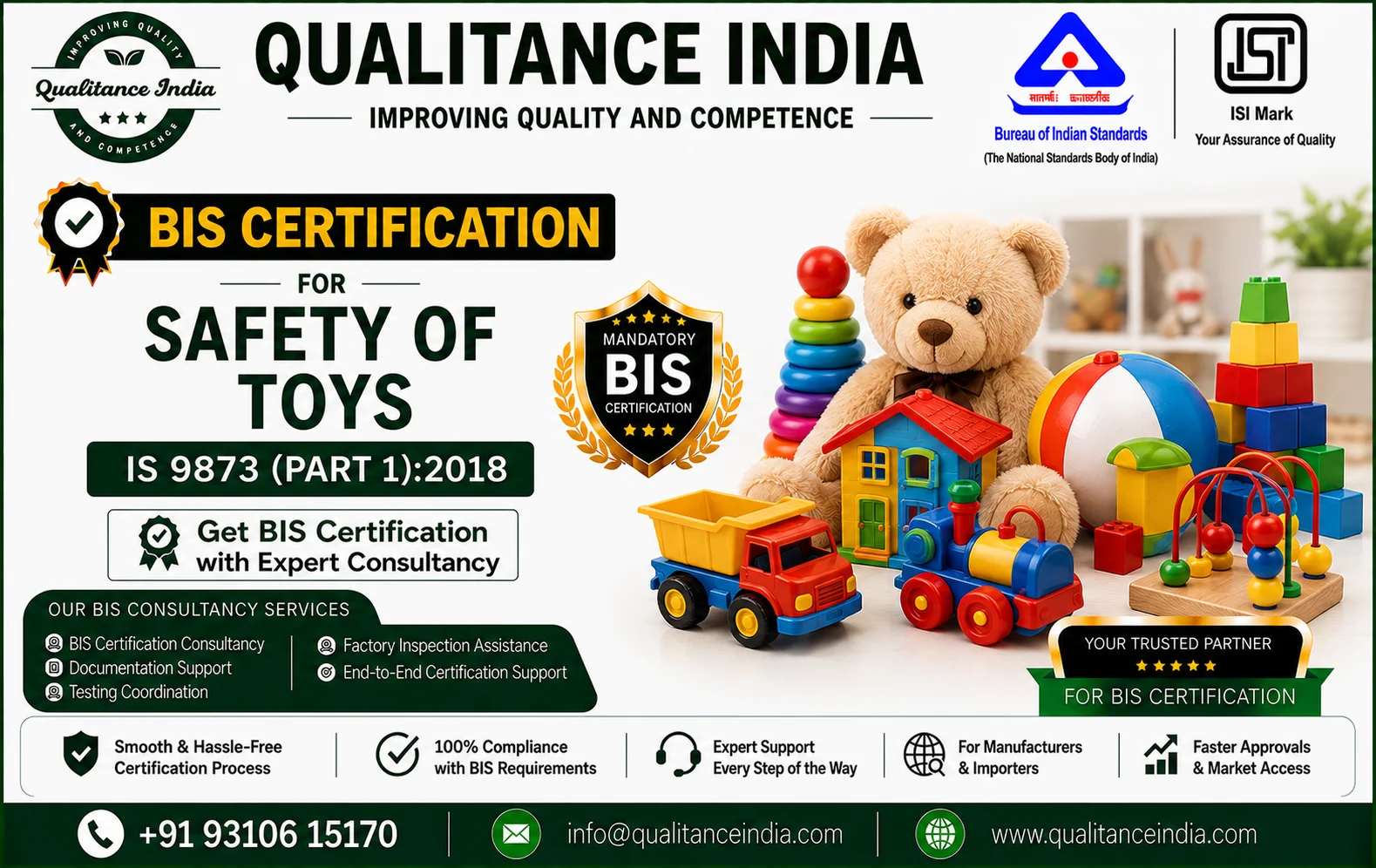
BIS Certification for Safety of Toys – IS 9873 (Part 1):2018
Introduction
BIS Certification for Safety of Toys is a mandatory regulatory compliance requirement for covered toys in India. BIS's current compulsory-certification listing identifies Non-Electric Toys against IS 9873 (Part 1):2018, under the Toys (Quality Control) Order, 2020, along with applicable related parts of the IS 9873 series.
IS 9873 Part 1 deals with safety aspects related to mechanical and physical properties of toys. The certification framework is intended to ensure that covered toys meet prescribed safety requirements before they are supplied in the Indian market.
For toy manufacturers, BIS certification generally involves identifying the applicable toy category, preparing the manufacturing and testing facilities, submitting the required application and documents, product testing, factory assessment and compliance with BIS marking requirements.
BIS has classified toys for certification purposes into Non-Electric Toys and Electric Toys. Non-electric toys use the applicable IS 9873 framework, while electric toys use IS 15644 as the primary standard. BIS also requires applicable secondary standards to be considered depending on the product.
Note: BIS's current standards and laboratory systems show newer revisions of IS 9873 Part 1, so manufacturers should verify the latest applicable standard/revision before filing a new application.
About the Product – Safety of Toys
Toys are products designed primarily for children for playing, learning, entertainment and skill development.
Examples include:
- Dolls
- Rattles
- Puzzles
- Building toys
- Construction toys
- Educational toys
- Activity toys
- Pull-along toys
- Push toys
- Soft toys
- Plastic toys
- Wooden toys
- Board games
- Ride-on toys
- Toy vehicles
- Pretend-play toys
- Preschool toys
- Infant toys
For BIS certification purposes, the exact applicability depends on the product characteristics, intended age group, construction, materials and whether the toy is electric or non-electric.
What is BIS Certification?
BIS Certification is a conformity-assessment mechanism operated by the Bureau of Indian Standards (BIS).
Under the applicable compulsory certification framework, manufacturers of covered products must demonstrate conformity with the relevant Indian Standard and obtain the appropriate BIS licence to use the Standard Mark.
For toys, BIS certification has been brought under compulsory certification through the Toys (Quality Control) Order, 2020. BIS states that safety of toys was brought under compulsory BIS certification with effect from 01 September 2020.
For domestic manufacturers, BIS states that applications are submitted online through the applicable BIS/Manakonline process. Foreign manufacturers follow the applicable Foreign Manufacturers Certification Scheme route.
What is IS 9873 (Part 1)?
IS 9873 (Part 1) is the Indian Standard dealing with:
Safety of Toys – Part 1: Safety Aspects Related to Mechanical and Physical Properties.
The BIS compulsory-certification listing currently identifies IS 9873 (Part 1):2018 for Non-Electric Toys.
At the same time, BIS's current standards page identifies IS 9873 (Part 1):2019 as the Fourth Revision, and BIS laboratory listings currently include testing against later revisions. Therefore, manufacturers should confirm which revision is applicable to their specific application/licence before certification.
Scope of IS 9873 Part 1
The standard focuses primarily on mechanical and physical safety aspects of toys.
Depending on the applicable toy category, requirements can address areas such as:
- Small parts
- Sharp points
- Sharp edges
- Shape and size
- Strength
- Accessibility
- Mechanical hazards
- Physical hazards
- Toy construction
- Certain foreseeable abuse conditions
- Components and attachments
- Stability
- Specific requirements for particular toy categories
The BIS Product Manual includes controls for requirements such as small parts, squeeze toys, rattles, fasteners, small balls, pompoms, preschool play figures and other toy-specific safety characteristics.
Products Covered
The BIS toy certification framework can cover various types of non-electric toys, subject to the applicable scope and classification.
Examples include:
- Plastic Toys
- Wooden Toys
- Dolls
- Rattles
- Puzzles
- Educational Toys
- Construction Toys
- Building Blocks
- Toy Vehicles
- Preschool Toys
- Activity Toys
- Pull Toys
- Push Toys
- Ride-On Toys
- Soft-Filled Toys
- Pretend-Play Toys
- Board Games
- Skill-Based Toys
- Infant Toys
- Children's Play Sets
The exact certification scope should be established based on the toy's design, materials, intended age group and applicable BIS classification.
Non-Electric Toys vs Electric Toys
BIS certification distinguishes between two broad categories.
| Toy Type | Primary Standard |
|---|---|
| Non-Electric Toys | IS 9873 Part 1 |
| Electric Toys | IS 15644 |
BIS's toy certification information states that non-electric toys are ordinary toys without a function dependent on electricity, while electric toys have at least one function dependent on electricity.
If a manufacturer requires certification for both categories, separate applications are required for each type.
Related Standards for Toy Safety
The toy certification framework involves more than mechanical and physical safety.
Depending on the product, applicable secondary standards may include:
IS 9873 Part 2
Safety of Toys – Part 2: Flammability
IS 9873 Part 3
Safety Requirements for Toys – Part 3: Migration of Certain Elements
IS 9873 Part 4
Safety of Toys – Part 4: Swings, Slides and Similar Activity Toys
IS 9873 Part 7
Requirements and Test Methods for Finger Paints
IS 9873 Part 9
Certain Phthalates Esters in Toys and Children's Products
BIS's compulsory-certification listing currently identifies these related standards for Non-Electric Toys.
Toys Quality Control Order – 2020
The Toys (Quality Control) Order, 2020 is the primary regulatory framework that brought covered toys under compulsory BIS certification.
The original QCO was notified on 25 February 2020, and BIS states that compulsory certification became effective from 01 September 2020.
The QCO has subsequently been amended. BIS's current compulsory-certification page lists the Toys (Quality Control) Amendment Order, 2024 and the Transition Facilitation (Quality Control) Order, 2026 alongside the Toys QCO.
The 2024 amendment also introduced a specific exemption relating to limited imports for R&D purposes by certified or applicant manufacturers, subject to conditions including quantity, non-commercial use and record-keeping.
Enforcement Date
BIS Toy Certification – 01 September 2020
BIS states that Safety of Toys was brought under compulsory BIS certification with effect from:
01 September 2020
under the Toys (Quality Control) Order, 2020.
Manufacturers should also check current amendments and transition provisions because the regulatory framework has been updated after the original QCO. BIS's current compulsory-certification listing includes the 2024 amendment and 2026 transition facilitation order.
Applicable QCO Details
Quality Control Order
Toys (Quality Control) Order, 2020
Relevant Product
Non-Electric Toys
BIS Standard
IS 9873 (Part 1):2018
Primary Safety Area
Mechanical and Physical Properties
Certification Scheme
Scheme-I / Standard Mark framework
Related Standards
- IS 9873 Part 2
- IS 9873 Part 3
- IS 9873 Part 4
- IS 9873 Part 7
- IS 9873 Part 9
BIS's current compulsory-certification page lists IS 9873 Part 1:2018 and the related toy standards under the Toys QCO 2020.
Who Needs BIS Certification?
BIS certification may be applicable to manufacturers of covered toys, including:
- Toy Manufacturers
- Plastic Toy Manufacturers
- Wooden Toy Manufacturers
- Educational Toy Manufacturers
- Baby Toy Manufacturers
- Preschool Toy Manufacturers
- Doll Manufacturers
- Puzzle Manufacturers
- Board Game Manufacturers
- Toy Vehicle Manufacturers
- Activity Toy Manufacturers
- Soft Toy Manufacturers
- Children's Product Manufacturers
- Toy OEM Manufacturers
- Eligible Foreign Toy Manufacturers
Important
A trader, distributor or marketer does not independently obtain a manufacturer BIS licence merely because they sell toys. BIS's toy FAQ states that a licence to use/apply the Standard Mark under Scheme-I is granted to the manufacturer of the product.
Eligibility Criteria
A toy manufacturer should generally have:
- Manufacturing premises
- Appropriate production machinery
- Suitable raw-material controls
- Toy manufacturing process
- Quality-control system
- Required testing facilities
- Testing personnel
- Calibration arrangements
- Product specifications
- Inspection procedures
- Finished-product control
- Required records and documentation
The exact testing facilities depend on the toy products for which the manufacturer seeks certification.
BIS's toy certification guidance states that testing facilities need to be established for the applicable requirements of the relevant toy standards for the toys covered by the licence application.
Complete BIS Certification Process for Toys
Step 1 – Product Identification
Identify:
- Toy type
- Electric/non-electric nature
- Intended age group
- Materials
- Design
- Product category
- Intended use
Step 2 – Applicable Standard Identification
Determine whether the product falls under:
IS 9873 Part 1
or another applicable primary standard such as IS 15644 for electric toys.
Step 3 – Applicable Secondary Standards
Check whether Parts 2, 3, 4, 7 or 9 apply to the product.
Step 4 – Product Classification
Determine the applicable toy category/sub-category and grouping.
Step 5 – Factory Assessment
Review:
- Manufacturing machinery
- Testing equipment
- Production process
- Quality-control system
- Raw materials
- Factory infrastructure
Step 6 – Documentation
Prepare all required technical and legal documents.
Step 7 – Sample Selection
Samples are selected according to applicable BIS sampling/grouping requirements.
BIS's Product Manual provides specific sampling guidance for toys and groups similar toy models into series based on factors such as similar design, materials and sub-category.
Step 8 – Product Testing
Conduct applicable tests through the required testing arrangements.
Step 9 – BIS Application
Submit the application through the applicable BIS online process.
Step 10 – Application Scrutiny
BIS reviews the application and supporting information.
Step 11 – Factory Inspection
BIS evaluates the manufacturing facility and quality-control arrangements.
Step 12 – Sample/Testing Verification
Applicable samples and test results are reviewed.
Step 13 – Observation Closure
Any technical or inspection observations must be addressed.
Step 14 – Grant of BIS Licence
After successful completion of applicable requirements, BIS may grant the licence.
Step 15 – ISI Mark
The manufacturer uses the BIS Standard Mark according to the licence and applicable marking requirements.
Step 16 – Continuing Compliance
The manufacturer must maintain product conformity, testing, quality control and applicable BIS requirements after obtaining the licence.
Required Documents for BIS Toy Certification
Common documents may include:
- Company registration documents
- Factory registration documents
- Factory address proof
- Manufacturing process flow chart
- Factory layout
- Machinery list
- Testing equipment list
- Calibration certificates
- Product specifications
- Product drawings
- Toy construction details
- Raw-material specifications
- Raw-material test certificates
- Quality-control plan
- Internal test reports
- Finished-product inspection records
- Product labels
- Packaging details
- Marking details
- Trademark documents
- Authorized signatory documents
- Manufacturing records
- Declaration documents
- BIS application documents
- Applicable undertakings
The exact document requirement should be checked against the current BIS application process and applicable Product Manual.
Testing Requirements
Testing is one of the most important stages of toy BIS certification.
For mechanical and physical safety, testing may address:
General Safety
- Material-related requirements
- Construction requirements
- Accessibility
- Mechanical hazards
Small Parts
Testing may be required to determine whether components can become hazardous small parts.
Sharp Points
Toys are evaluated for potentially hazardous sharp points.
Sharp Edges
Accessible edges may require evaluation according to the applicable requirements.
Strength
Certain toys and components may be subjected to strength or foreseeable-abuse testing.
Shape and Size
Specific requirements may apply to:
- Small balls
- Pompoms
- Rattles
- Squeeze toys
- Preschool figures
- Other specific toy components
The BIS Product Manual includes control requirements for small parts, squeeze toys, rattles, fasteners, small balls, pompoms and preschool play figures.
Additional Tests
Depending on the toy, applicable requirements may also include:
- Flammability
- Migration of certain elements
- Phthalates
- Finger paint requirements
- Activity toy requirements
BIS's laboratory system lists current testing arrangements for IS 9873 Part 1 and related toy standards.
Factory Inspection Process
BIS factory assessment can examine the manufacturer's ability to consistently produce conforming toys.
1. Manufacturing Facility
Inspection of:
- Factory premises
- Production areas
- Storage areas
- Testing laboratory
- Quality-control areas
2. Raw Material Control
Review of:
- Plastic
- Rubber
- Wood
- Paints
- Adhesives
- Fabrics
- Metal parts
- Other toy materials
3. Manufacturing Process
Depending on the toy:
- Moulding
- Cutting
- Assembly
- Stitching
- Painting
- Printing
- Finishing
- Packaging
4. Testing Facility
Review of:
- Testing equipment
- Calibration
- Test procedures
- Testing personnel
- Test records
5. Quality Control
Review of:
- Incoming inspection
- In-process inspection
- Finished-product inspection
- Batch records
- Rejection records
- Corrective action
6. Product Marking
Review of required:
- Product identification
- Manufacturer details
- Applicable warnings
- BIS Standard Mark
- Licence details
- Other required information
Toy Product Grouping and Sampling
BIS has established specific toy sampling/grouping principles.
For certification purposes, similar toy models made from the same materials and falling within a single applicable sub-category may be treated as a series, subject to BIS's applicable criteria.
The Product Manual provides that for non-electric toys, a representative model from a series may be selected for testing for Grant of Licence or Change in Scope, subject to the prescribed grouping conditions.
This is important because manufacturers with many toy models should prepare their product catalogue and grouping carefully before applying.
Common Reasons for BIS Toy Certification Rejection
Common compliance issues can include:
- Wrong standard identification
- Incorrect product classification
- Incomplete application
- Incomplete documents
- Insufficient testing facilities
- Failed toy safety test
- Small-part failure
- Sharp-edge failure
- Sharp-point failure
- Material non-conformity
- Flammability failure
- Chemical migration failure
- Phthalate non-compliance
- Inadequate quality-control records
- Calibration gaps
- Incorrect sampling
- Improper product grouping
- Inadequate factory infrastructure
- Incorrect product marking
- Failure to close BIS observations
BIS Certification Cost for Toys
There is no single fixed cost applicable to every toy manufacturer.
The overall cost may depend on:
- BIS application-related fees
- Product testing
- Number of toy categories
- Number of models
- Applicable secondary standards
- Testing laboratory
- Factory inspection
- Number of samples
- Product grouping
- Calibration
- Documentation
- Consultancy
- Re-testing, if required
Current BIS laboratory listings show that testing charges vary according to the applicable test, toy standard, laboratory and product requirements.
Therefore, manufacturers should obtain a product-specific cost assessment instead of relying on a generic BIS certification price.
BIS Certification Timeline for Toys
The certification timeline depends on:
- Product category
- Number of models
- Product grouping
- Testing requirements
- Laboratory availability
- Factory readiness
- Documentation
- BIS application scrutiny
- Factory inspection
- Test results
- Technical observations
- Re-testing requirements
A complete and technically accurate application can help reduce avoidable delays.
Benefits of BIS Certification for Toys
BIS certification provides important benefits to toy manufacturers:
Regulatory Compliance
Helps manufacturers meet applicable compulsory certification requirements.
Consumer Safety
Supports compliance with prescribed toy safety requirements.
Market Acceptance
BIS certification can strengthen acceptance of toys in the Indian market.
Brand Credibility
The BIS Standard Mark can provide greater confidence when used according to the applicable licence.
Quality Improvement
Certification encourages systematic product testing and quality control.
Better Manufacturing Controls
Manufacturers establish documented processes, testing and inspection systems.
Customer Trust
Certified products can provide additional confidence to buyers, retailers and institutional customers.
Why Choose Qualitance India?
Qualitance India provides professional BIS Certification Consultancy for toy manufacturers seeking certification support.
Our Services Include:
✓ Product Applicability Assessment ✓ IS 9873 Requirement Guidance ✓ Toy Category Identification ✓ Product Grouping Support ✓ BIS Documentation Support ✓ Testing Coordination ✓ Laboratory Coordination ✓ BIS Application Assistance ✓ Factory Inspection Preparation ✓ Quality-Control Documentation ✓ Technical Query Assistance ✓ ISI Mark Compliance Guidance ✓ End-to-End BIS Certification Support
Contact Qualitance India
Phone: +91-9310-615-170 Email: info@qualitanceindia.com Website: https://qualitanceindia.com/
Qualitance India – Improving Quality and Competence
Step-by-Step BIS Toy Certification Flow Chart
Toy Product Identification ↓ Electric / Non-Electric Classification ↓ Applicable Indian Standard Identification ↓ IS 9873 Part 1 Applicability Check ↓ Secondary Standards Assessment ↓ Toy Category & Product Grouping ↓ Factory Readiness Assessment ↓ Documentation Preparation ↓ Sample Selection ↓ Toy Safety Testing ↓ BIS Application Submission ↓ Application Scrutiny ↓ Factory Inspection ↓ Technical Observation Closure ↓ BIS Licence Grant ↓ ISI Mark Compliance ↓ Post-Licence Compliance
25 SEO FAQs
1. What is BIS Certification for Toys?
BIS Certification for Toys is the conformity-assessment process for covered toys to demonstrate compliance with applicable Indian Standards and regulatory requirements.
2. Is BIS Certification mandatory for toys in India?
Yes, covered toys are subject to compulsory BIS certification under the Toys (Quality Control) Order framework. BIS states that compulsory certification came into effect from 01 September 2020.
3. What is IS 9873 Part 1?
IS 9873 Part 1 deals with Safety of Toys – Safety Aspects Related to Mechanical and Physical Properties.
4. What is IS 9873 Part 1:2018?
IS 9873 (Part 1):2018 is identified in BIS's compulsory-certification listing for Non-Electric Toys.
5. What types of toys come under IS 9873 Part 1?
The standard is applicable to covered non-electric toys subject to the scope and classification requirements.
6. Are plastic toys covered by BIS certification?
Plastic toys may be covered depending on their product type, intended use, construction and applicable toy-safety requirements.
7. Are wooden toys covered under BIS?
Wooden toys can fall under the applicable BIS toy certification framework depending on their characteristics and intended use.
8. Is BIS certification required for non-electric toys?
Covered non-electric toys are subject to the BIS toy certification framework, with IS 9873 Part 1 identified as the primary standard in the current BIS listing.
9. What is the standard for electric toys?
BIS identifies IS 15644:2006 – Safety of Electric Toys as the primary standard for electric toys.
10. Are there other standards besides IS 9873 Part 1?
Yes. Depending on the product, applicable standards can include IS 9873 Parts 2, 3, 4, 7 and 9.
11. What does IS 9873 Part 2 cover?
IS 9873 Part 2 deals with flammability requirements for toys.
12. What does IS 9873 Part 3 cover?
IS 9873 Part 3 deals with migration of certain elements from toys.
13. What does IS 9873 Part 9 cover?
IS 9873 Part 9 addresses certain phthalate esters in toys and children's products.
14. What tests are required for toys?
Testing depends on the toy. Mechanical and physical testing can include small-part, strength, sharp-point, sharp-edge and other applicable safety tests. Additional standards may require chemical or flammability testing.
15. Is factory inspection required for toy BIS certification?
Factory assessment forms part of the applicable BIS certification process.
16. Who can obtain a BIS toy licence?
The BIS licence is granted to the manufacturer of the product under the applicable certification framework.
17. Can a distributor obtain a BIS toy licence?
A distributor or marketer cannot obtain the manufacturer BIS licence merely as a distributor. BIS states that the Standard Mark licence is granted to the manufacturer.
18. Can different factories use one BIS toy licence?
BIS states that a licence is linked to a specific manufacturing premises; separate applications are required for different manufacturing units.
19. How much does BIS certification for toys cost?
The cost depends on testing, product category, models, laboratory charges, inspection and other certification-related expenses.
20. How long does toy BIS certification take?
The timeline varies depending on product testing, documentation, factory readiness, BIS scrutiny and inspection.
21. What documents are required for BIS toy certification?
Documents can include factory details, manufacturing process, machinery, testing equipment, product specifications, quality-control documents, calibration records and product marking information.
22. Is ISI Mark required for BIS-certified toys?
For products covered under the compulsory Standard Mark framework, the manufacturer must follow the applicable BIS Standard Mark and licence conditions.
23. Can foreign toy manufacturers obtain BIS certification?
Eligible foreign manufacturers can apply through the applicable BIS Foreign Manufacturers Certification Scheme route.
24. What is the Toys Quality Control Order?
The Toys (Quality Control) Order, 2020 is the regulatory order under which covered toys were brought under compulsory BIS certification.
25. How can I get BIS Certification for Toys?
First identify the toy type and applicable standard, then complete product grouping, documentation, testing, BIS application and factory assessment as required.
FAQ Schema Content
Recommended Schema Type: FAQPage
Use the 25 FAQs above as visible FAQ content on the webpage and create matching FAQ structured data.
The schema answers should be exactly the same or substantially equivalent to the answers visible on the webpage.
Service Schema Suggestion
Schema Type: Service
Service Name: BIS Certification Consultancy for Safety of Toys
Service Type: BIS Certification Consultancy
Provider: Qualitance India
Area Served: India
Description: Professional BIS certification consultancy for toy manufacturers, including product applicability assessment, documentation, testing coordination, BIS application, factory inspection preparation and ISI Mark compliance support.
Organization Schema Suggestion
Schema Type: Organization
Organization Name: Qualitance India
Tagline: Improving Quality and Competence
Telephone: +91-9310-615-170
Email: info@qualitanceindia.com
Website: https://qualitanceindia.com/