
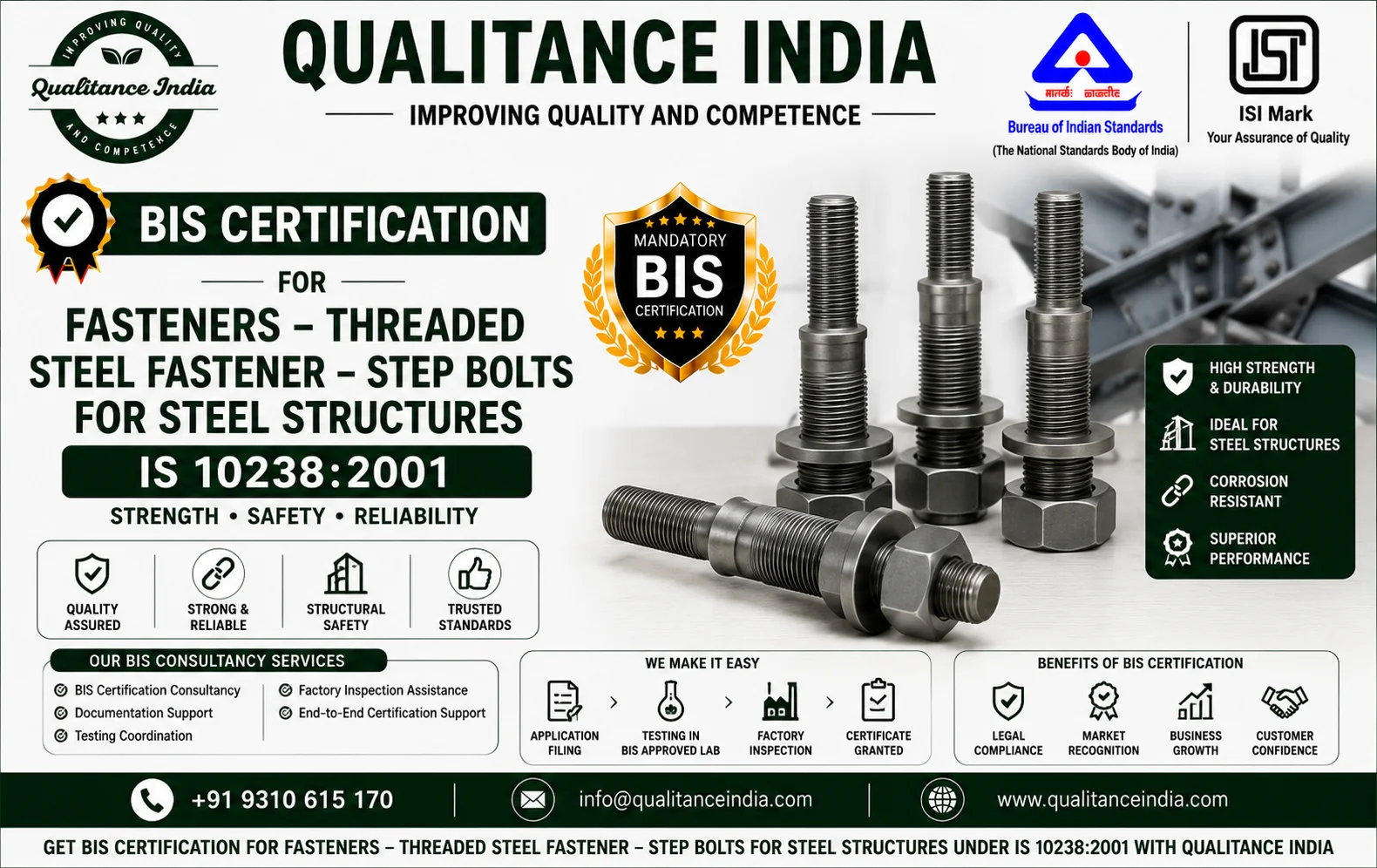
BIS Certification for Step Bolts for Steel Structures | IS 10238:2001 | BIS Licence
Introduction
BIS Certification for Step Bolts for Steel Structures is an important compliance requirement for manufacturers whose products fall under the applicable BIS certification and Quality Control Order framework.
IS 10238:2001 is the Indian Standard titled “Fasteners – Threaded Steel Fasteners – Step Bolts for Steel Structures – Specification.” BIS includes this standard under its Scheme-I / ISI Mark Scheme.
Step bolts are specialized threaded steel fasteners designed for use on steel structures, particularly where they provide footing for personnel accessing elevated structures. BIS's standards information describes their use in structures such as transmission towers and emphasizes dimensions, material properties, mechanical performance and safety.
The Bolts, Nuts and Fasteners (Quality Control) Order, 2023 specifically includes IS 10238:2001 among the covered Indian Standards.
For manufacturers, obtaining the applicable BIS licence involves product assessment, documentation, testing, manufacturing controls and compliance with BIS certification requirements.
About Step Bolts for Steel Structures
Step bolts are specially designed threaded steel fasteners used to provide a secure foothold for climbing or accessing steel structures.
They are particularly relevant to structures such as:
- Transmission towers
- Steel towers
- Elevated steel structures
- Utility structures
- Other structures where step bolts are specified
These bolts need to withstand the loads associated with personnel using them. Therefore, dimensional accuracy, mechanical properties, thread quality, finish and cantilever performance are important compliance considerations.
BIS information on IS 10238 describes step bolts as fasteners intended to provide secure footing for workers accessing steel structures.
What is BIS Certification?
BIS Certification is a conformity assessment system administered by the Bureau of Indian Standards (BIS).
For products covered under compulsory BIS certification requirements, manufacturers must demonstrate conformity with the applicable Indian Standard and fulfil the requirements of the relevant Quality Control Order.
IS 10238:2001 is currently listed by BIS under the Scheme-I (ISI Mark Scheme).
After obtaining the applicable BIS licence, a manufacturer is permitted to use the BIS Standard Mark in accordance with the licence and applicable BIS marking requirements.
What is IS 10238:2001?
IS 10238:2001 is titled:
Fasteners – Threaded Steel Fasteners – Step Bolts for Steel Structures – Specification
BIS's official Product Manual identifies IS 10238:2001 as the applicable standard and provides guidance for certification under Scheme-I.
The standard establishes requirements relating to the construction, material, dimensions, mechanical properties, finish and testing of step bolts intended for steel structures.
Scope of IS 10238:2001
IS 10238:2001 specifies requirements for threaded steel step bolts used for steel structures.
The standard addresses areas such as:
- Dimensions
- Material
- Thread requirements
- Mechanical properties
- Property class
- Finish
- Nuts
- Testing
- Cantilever performance
- Marking
- Packaging
- Inspection and acceptance requirements
BIS's Product Manual states that the standard covers one variety, M16 × 175 NN, property class 4.6, as shown in Figure 1.
This is an important point for manufacturers when determining product applicability and certification scope.
Products Covered
The product category covered is:
Threaded Steel Step Bolts for Steel Structures
Typical applications include:
- Transmission tower structures
- Electrical utility structures
- Steel towers
- Elevated steel frameworks
- Industrial steel structures
- Other steel structures requiring step bolts
The exact applicability should always be confirmed against the current standard, product design and BIS certification requirements.
Important Product Characteristics
For IS 10238:2001 compliance, manufacturers should pay attention to:
Dimensions
The step bolt must conform to applicable dimensional requirements.
Thread
Thread form, dimensions and quality need to meet the applicable requirements.
Material
The steel used for manufacturing must meet the relevant material requirements.
Property Class
The BIS Product Manual identifies property class 4.6 for the specified variety.
Mechanical Properties
Mechanical performance is an important part of conformity assessment.
Finish
The surface finish and applicable protection requirements need to comply with the standard.
Nuts
Applicable nut requirements should also be fulfilled.
Load-Bearing Performance
Step bolts must provide adequate performance when used as footholds.
Cantilever Performance
The cantilever test is a particularly important test for step bolts because it evaluates their performance under a specified load.
Applicable QCO Details
The Bolts, Nuts and Fasteners (Quality Control) Order, 2023 includes:
Product: Bolts, Nuts and Fasteners
Indian Standard: IS 10238:2001
Standard: Fasteners – Threaded Steel Fasteners – Step Bolts for Steel Structures
The QCO was published by the Government of India and specifically lists IS 10238:2001 among the covered standards.
BIS also currently lists IS 10238:2001 under its Scheme-I / ISI Mark product list.
Important: For a live website, the latest QCO amendments, notifications and implementation provisions should be checked before publishing a specific enforcement date.
Who Needs BIS Certification?
BIS Certification may be relevant for:
- Step bolt manufacturers
- Threaded steel fastener manufacturers
- Steel fastener manufacturers
- Transmission tower component manufacturers
- Tower hardware manufacturers
- OEM manufacturers
- Industrial fastener manufacturers
- Manufacturers supplying step bolts in India
- Manufacturers covered by the applicable QCO
Importers and foreign manufacturers may also have BIS-related compliance obligations depending on the applicable regulatory framework.
Eligibility Criteria for BIS Certification
A manufacturer should generally have:
Manufacturing Facility
A suitable factory capable of manufacturing the specified step bolts.
Manufacturing Machinery
Appropriate machinery for:
- Steel preparation
- Forging/forming
- Threading
- Machining
- Finishing
- Assembly
Quality Control System
Suitable inspection and quality-control procedures.
Testing Facilities
Required testing and measuring facilities or appropriate arrangements as permitted under the BIS certification framework.
Calibration
Relevant measuring and testing equipment should have valid calibration.
Technical Documents
The manufacturer should maintain:
- Product drawings
- Specifications
- Material details
- Manufacturing process
- Inspection procedures
Quality Records
Production, inspection and testing records should be maintained.
Complete BIS Certification Process
Step 1 – Product Applicability Assessment
Determine whether the manufactured step bolt falls under IS 10238:2001.
Step 2 – Product & Technical Review
Review:
- Product dimensions
- Material
- Property class
- Thread
- Nuts
- Finish
- Manufacturing process
Step 3 – Factory Assessment
Review the manufacturing facility, machinery, testing equipment and quality-control arrangements.
Step 4 – Documentation Preparation
Prepare the required BIS application and technical documents.
Step 5 – Sample Preparation
Prepare representative samples according to the applicable requirements.
Step 6 – Laboratory Testing
Conduct testing against applicable requirements of IS 10238:2001 and referenced standards.
Step 7 – BIS Application
Submit the application through the applicable BIS certification process.
Step 8 – BIS Scrutiny
BIS examines the submitted application and documents.
Step 9 – Factory Inspection
Where applicable, BIS assesses manufacturing and quality-control arrangements.
Step 10 – Sample Testing / Test Report Evaluation
Test results are evaluated for conformity.
Step 11 – Observation Closure
Any non-conformities or observations need to be addressed.
Step 12 – Licence Grant
After successful completion of the applicable requirements, BIS may grant the licence.
Step 13 – ISI Mark Compliance
The licensee must follow applicable BIS Standard Mark and marking requirements.
Required Documents
Typical documentation may include:
- Company registration documents
- Factory address proof
- Factory licence
- Manufacturing process flow chart
- Factory layout
- Machinery list
- Product drawings
- Product specifications
- Raw-material specifications
- Steel material certificates
- Thread specifications
- Product photographs
- Quality-control plan
- Testing equipment list
- Calibration certificates
- In-house test records
- External test reports, where applicable
- Manufacturing records
- Inspection records
- Trademark documents, where applicable
- Authorized signatory documents
- BIS application documents
- Product marking details
- Packaging details
The exact document set can vary according to the manufacturer and BIS application route.
Testing Requirements
Testing is a critical part of IS 10238:2001 compliance.
BIS's current laboratory database lists testing for IS 10238:2001, including mechanical properties, finish, dimensions and the cantilever test.
1. Dimensional Inspection
The dimensions of the step bolt are checked against applicable requirements.
2. Thread Inspection
The thread is examined for conformity with specified requirements.
3. Mechanical Properties
Mechanical properties are evaluated according to the applicable requirements.
The BIS Product Manual refers to the relevant requirements of IS 1367 (Part 3) for mechanical properties.
4. Tensile Strength
Applicable tensile strength requirements are evaluated.
5. Yield Strength
The relevant yield/proof-strength characteristics may be assessed according to the applicable property-class requirements.
6. Elongation
Elongation characteristics can form part of mechanical-property testing.
7. Hardness
Applicable hardness requirements may be evaluated.
8. Finish
Surface finish and applicable protective requirements are inspected.
9. Cantilever Test
The cantilever test is one of the key performance tests for step bolts.
BIS's standards information describes a test involving a 150 kg load, with a pre-test followed by the main test for 10 seconds, while observing for permanent deformation.
10. Nut Requirements
Where nuts are supplied with the step bolts, applicable requirements need to be fulfilled.
11. Material Verification
The raw material should meet the applicable material requirements.
12. Marking
The product and packaging must meet applicable marking requirements.
BIS's LIMS also lists separate testing/assessment entries for dimensions, finish and cantilever testing.
Referenced Standards
IS 10238:2001 works with other Indian Standards for certain requirements.
The BIS Product Manual specifically references IS 1367 (Part 3) for material/mechanical-property requirements and IS 14394 for hot-dip galvanized hexagon nuts used with step bolts.
Therefore, manufacturers should not consider IS 10238 in isolation. The applicable referenced standards and their latest versions should also be checked.
Factory Inspection Process
During BIS factory assessment, important areas can include:
Raw Material Inspection
Verification of steel grade and incoming material.
Manufacturing Process
Review of:
- Forming
- Forging
- Machining
- Threading
- Finishing
- Assembly
Threading Control
Inspection of thread dimensions and quality.
Dimensional Control
Verification of product dimensions.
Mechanical Testing
Review of testing arrangements and records.
Cantilever Test Facility
The manufacturer should have suitable arrangements for applicable cantilever testing, as required.
Calibration
Testing and measuring equipment should have valid calibration.
Quality Control
Incoming, in-process and final-product inspection should be controlled.
Traceability
Production and inspection records should be maintained.
Storage
Raw materials and finished products should be appropriately stored.
Common Reasons for BIS Application Rejection or Delay
- Incorrect Indian Standard selected
- Product does not match IS 10238 scope
- Incorrect dimensions
- Thread non-conformity
- Mechanical-property failure
- Material grade mismatch
- Property-class non-conformity
- Cantilever test failure
- Poor surface finish
- Inadequate testing facilities
- Calibration certificate issues
- Incomplete documents
- Incorrect product drawings
- Inadequate quality-control records
- Factory not ready for inspection
- Incorrect marking
- Failure to close BIS observations
- Incomplete test reports
BIS Certification Cost for Step Bolts
There is no single fixed BIS Certification cost applicable to every manufacturer.
The overall cost may depend on:
- BIS application fees
- Product testing
- Number of product varieties
- Factory inspection
- Laboratory charges
- Sample requirements
- Documentation
- Retesting
- Consultancy charges
- Other applicable BIS fees
BIS's LIMS currently shows laboratory-specific charges for IS 10238:2001. For example, current listings show different scopes and charges depending on the laboratory and testing coverage.
Therefore, manufacturers should obtain a product-specific cost estimate after technical evaluation.
BIS Certification Timeline
The actual timeline depends upon:
- Document readiness
- Sample availability
- Laboratory availability
- Testing results
- BIS scrutiny
- Factory inspection
- Observations
- Retesting, if applicable
Therefore, an exact timeline should be confirmed only after reviewing the manufacturer's product and factory readiness.
Benefits of BIS Certification
1. Regulatory Compliance
Helps manufacturers comply with applicable BIS/QCO requirements.
2. Product Quality
Ensures the product is evaluated against applicable Indian Standard requirements.
3. Structural Safety
Step bolts are used as footholds on elevated steel structures, making mechanical performance particularly important.
4. Customer Confidence
BIS certification can increase confidence among customers and institutional buyers.
5. Market Acceptance
Supports compliant supply of regulated step bolts.
6. Brand Credibility
The BIS Standard Mark can strengthen product credibility when used under valid authorization.
7. Consistent Manufacturing
Encourages systematic quality control and production monitoring.
Why Choose Qualitance India?
Qualitance India provides professional BIS Certification consultancy for manufacturers of fasteners, engineering products and other regulated products.
For IS 10238:2001 Step Bolts for Steel Structures, our support can include:
✓ Product Applicability Assessment
✓ IS Standard Verification
✓ QCO Requirement Guidance
✓ BIS Documentation
✓ Technical Documentation
✓ Testing Coordination
✓ Laboratory Guidance
✓ Sample Preparation Support
✓ BIS Application Assistance
✓ Factory Inspection Preparation
✓ Quality-Control Documentation
✓ Test Report Coordination
✓ Observation Closure Support
✓ BIS Licence Guidance
✓ ISI Mark Compliance Support
Contact Qualitance India
Phone: +91-9310-615-170
Email: info@qualitanceindia.com
Website: Qualitance India
Step-by-Step Flow Chart – Text Format
Product Identification
↓
IS 10238:2001 Applicability Check
↓
Product & Technical Assessment
↓
Factory Assessment
↓
Documentation Preparation
↓
Sample Preparation
↓
Laboratory Testing
↓
BIS Application
↓
BIS Application Scrutiny
↓
Factory Inspection
↓
Test Report Evaluation
↓
Observation Closure
↓
BIS Licence Grant
↓
ISI Mark Compliance
↓
Ongoing BIS Compliance
25 SEO FAQs
1. What is IS 10238:2001?
IS 10238:2001 is the Indian Standard for Fasteners – Threaded Steel Fasteners – Step Bolts for Steel Structures – Specification.
2. Is BIS Certification required for Step Bolts?
Step bolts covered by the applicable compulsory certification framework are subject to BIS requirements. IS 10238:2001 is included in the Bolts, Nuts and Fasteners QCO, 2023 and BIS Scheme-I listing.
3. What is the BIS standard for Step Bolts?
The applicable Indian Standard is IS 10238:2001.
4. What are Step Bolts used for?
Step bolts are used as footholds for accessing steel structures such as transmission towers and other elevated structures.
5. What size of Step Bolt is covered by IS 10238?
The BIS Product Manual identifies M16 × 175 NN, property class 4.6 as the one variety covered by the standard.
6. What property class is specified?
The BIS Product Manual identifies property class 4.6 for the specified variety.
7. What is the cantilever test for Step Bolts?
The cantilever test evaluates the load-bearing performance of the step bolt. BIS's standards information describes a 150 kg loading procedure and observation for permanent deformation.
8. Is cantilever testing required?
Yes, the BIS laboratory scope identifies the cantilever test for IS 10238:2001.
9. What mechanical tests are required?
Applicable mechanical-property assessment can include tensile strength, yield/proof strength, elongation and hardness-related requirements in accordance with the applicable referenced standard.
10. Which standard is referenced for mechanical properties?
The BIS Product Manual refers to IS 1367 (Part 3) for the applicable mechanical-property requirements.
11. Are nuts included with Step Bolts?
BIS's standards information describes step bolts as typically supplied with two hexagon nuts, subject to the applicable specification.
12. Is finish testing required?
Yes. BIS laboratory information includes finish-related requirements for IS 10238:2001.
13. Is dimensional testing required?
Yes. Dimensional requirements are part of the applicable BIS assessment/testing scope.
14. What is the QCO applicable to Step Bolts?
The Bolts, Nuts and Fasteners (Quality Control) Order, 2023 includes IS 10238:2001.
15. Is IS 10238 under the ISI Mark Scheme?
Yes. BIS currently lists IS 10238:2001 under the Scheme-I (ISI Mark Scheme).
16. What documents are required for BIS Certification?
Documents generally include factory details, product drawings, manufacturing process, machinery details, raw-material information, testing facilities, calibration records and quality-control documents.
17. How much does BIS Certification for Step Bolts cost?
The cost depends on BIS fees, testing, inspection, product scope, laboratory charges and consultancy requirements.
18. How long does BIS Certification take?
The timeline depends on documentation, testing, BIS processing, factory inspection and closure of observations.
19. What happens if Step Bolts fail the cantilever test?
The manufacturer needs to identify the cause of failure, make corrective changes and follow the applicable BIS retesting/compliance procedure.
20. Can a fastener manufacturer apply for BIS Certification?
Yes, an eligible manufacturer can apply subject to the applicable BIS requirements and QCO provisions.
21. Is BIS Certification applicable to imported Step Bolts?
Imported products may be subject to applicable BIS requirements depending on the regulatory framework and manufacturing origin.
22. Is testing available for IS 10238:2001?
Yes. BIS's LIMS currently lists laboratories with testing scope for IS 10238:2001.
23. Is the BIS licence issued for a specific manufacturer?
BIS certification is linked to the licensed manufacturing premises and applicable product scope.
24. Can Qualitance India help with IS 10238 Certification?
Yes. Qualitance India can assist with applicability assessment, documentation, testing coordination, BIS application and factory inspection preparation.
25. Why is BIS Certification important for Step Bolts?
Because step bolts are used as footholds on steel structures, compliance with specified dimensional, mechanical and load-performance requirements is important for reliable use.
FAQ Schema Content
Q: What is IS 10238:2001?
A: IS 10238:2001 is the Indian Standard for threaded steel step bolts used for steel structures.
Q: Is BIS Certification required for Step Bolts?
A: Step bolts covered by the applicable QCO and BIS certification framework must comply with the applicable BIS requirements.
Q: What is the size covered by IS 10238:2001?
A: The BIS Product Manual identifies M16 × 175 NN, property class 4.6, as the specified variety covered by the standard.
Q: What is the cantilever test for Step Bolts?
A: It is a load-performance test used to assess the ability of a step bolt to withstand the specified load without unacceptable permanent deformation.
Q: What is the BIS standard for Step Bolts?
A: The applicable standard is IS 10238:2001.
Service Schema Suggestion
Service Name: BIS Certification for Step Bolts for Steel Structures
Service Type: BIS Certification Consultancy
Applicable Standard: IS 10238:2001
Product: Threaded Steel Step Bolts for Steel Structures
Certification Scheme: Scheme-I / ISI Mark
Industry: Fasteners / Steel Products / Engineering Products
Provider: Qualitance India
Area Served: India
Organization Schema Suggestion
Organization Name: Qualitance India
Description: BIS Certification Consultancy and Compliance Services
Phone: +91-9310-615-170
Email: info@qualitanceindia.com
Website: https://qualitanceindia.com/
Home → BIS Certification → Fasteners → Step Bolts → IS 10238:2001
Article Schema Suggestion
Headline: BIS Certification for Step Bolts for Steel Structures | IS 10238:2001
Article Type: Article / BlogPosting
Author: Qualitance India
Publisher: Qualitance India
Article Section: BIS Certification / Fasteners
ISI : BIS Certification for Step Bolts, IS 10238:2001, Step Bolt BIS Licence, Step Bolt Testing, Threaded Steel Fasteners
Internal Linking Strategy
- BIS Certification Consultancy
- BIS Certification Process
- BIS Certification Cost
- BIS Testing Services
- BIS Factory Inspection
- ISI Mark Certification
- BIS QCO Compliance
- Fasteners BIS Certification
- Steel Product BIS Certification
- Product Testing Services
Related Fastener Pages
- BIS Certification for Hexagon Head Transmission Tower Bolts – IS 12427:2001
- BIS Certification for High Strength Structural Bolts – IS 3757:1985
- BIS Certification for High Strength Structural Nuts – IS 6623:2004
- BIS Certification for Hexagon Head Bolts – IS 1363
- BIS Certification for Threaded Steel Fasteners
These standards appear alongside IS 10238 in BIS's Scheme-I listing and/or the 2023 fasteners QCO framework.
External Authority References
BIS Product Manual
BIS Product Manual – IS 10238:2001
BIS Scheme-I / ISI Mark
BIS Laboratory Testing Information
BIS LIMS – IS 10238:2001 Testing
Bolts, Nuts and Fasteners QCO 2023
Bolts, Nuts and Fasteners QCO 2023
Related BIS Services
- BIS Certification for Step Bolts – IS 10238:2001
- BIS Certification for Transmission Tower Bolts – IS 12427:2001
- BIS Certification for High Strength Structural Bolts – IS 3757:1985
- BIS Certification for High Strength Structural Nuts – IS 6623:2004
- BIS Certification for Hexagon Head Bolts
- BIS Certification for Threaded Steel Fasteners
- BIS Certification for Steel Fasteners
- BIS Testing Services
- ISI Mark Certification
- BIS Factory Inspection Consultancy
High Search Intent Topics
- BIS Certification for Step Bolts – IS 10238:2001
- IS 10238:2001 – Complete BIS Certification Guide
- BIS Certification Process for Step Bolt Manufacturers
- IS 10238:2001 Testing Requirements
- Step Bolt Cantilever Test – BIS Requirements
- Step Bolts for Transmission Towers – BIS Certification
- BIS Certification for Threaded Steel Fasteners
- Step Bolt BIS Certification Cost
- Documents Required for IS 10238 BIS Licence
- Step Bolt Quality Control Order 2023
- IS 10238:2001 Mechanical Properties
- Step Bolt Dimension and Thread Requirements
- BIS Licence for Steel Fastener Manufacturers
- ISI Mark for Step Bolts
- IS 10238 vs IS 12427 – Difference Explained
Need BIS Certification for Step Bolts?
Are you a Step Bolt Manufacturer, Fastener Manufacturer, Steel Fastener Manufacturer or Transmission Tower Component Manufacturer looking for BIS Certification under IS 10238:2001?
Qualitance India can assist you with the complete BIS certification journey.
Our Support Includes:
✓ IS 10238:2001 Applicability Assessment
✓ QCO Compliance Guidance
✓ BIS Documentation
✓ Product Testing Coordination
✓ Laboratory Guidance
✓ Sample Preparation Support
✓ BIS Application Assistance
✓ Factory Inspection Preparation
✓ Quality-Control Documentation
✓ Mechanical Testing Guidance
✓ Cantilever Test Coordination
✓ Test Report Coordination
✓ Observation Closure
✓ BIS Licence Guidance
✓ ISI Mark Compliance
Contact Qualitance India
📞 +91-9310-615-170
📧 info@qualitanceindia.com
🌐 qualitanceindia.com
Get professional BIS Certification consultancy for Step Bolts for Steel Structures under IS 10238:2001.
Conclusion
IS 10238:2001 specifies requirements for Threaded Steel Step Bolts for Steel Structures. These specialized fasteners are used to provide footholds for personnel accessing elevated steel structures such as transmission towers.
The standard is included under the Bolts, Nuts and Fasteners (Quality Control) Order, 2023, and BIS currently lists it under the Scheme-I / ISI Mark Scheme.
For certification, manufacturers need to pay attention to material, dimensions, threads, mechanical properties, property class, finish, nuts and cantilever performance. BIS's current laboratory information confirms testing coverage for these important requirements.
If you are a manufacturer looking for BIS Certification for Step Bolts under IS 10238:2001, Qualitance India can provide end-to-end consultancy support covering standard verification, documentation, testing coordination, BIS application, factory inspection preparation and compliance assistance.