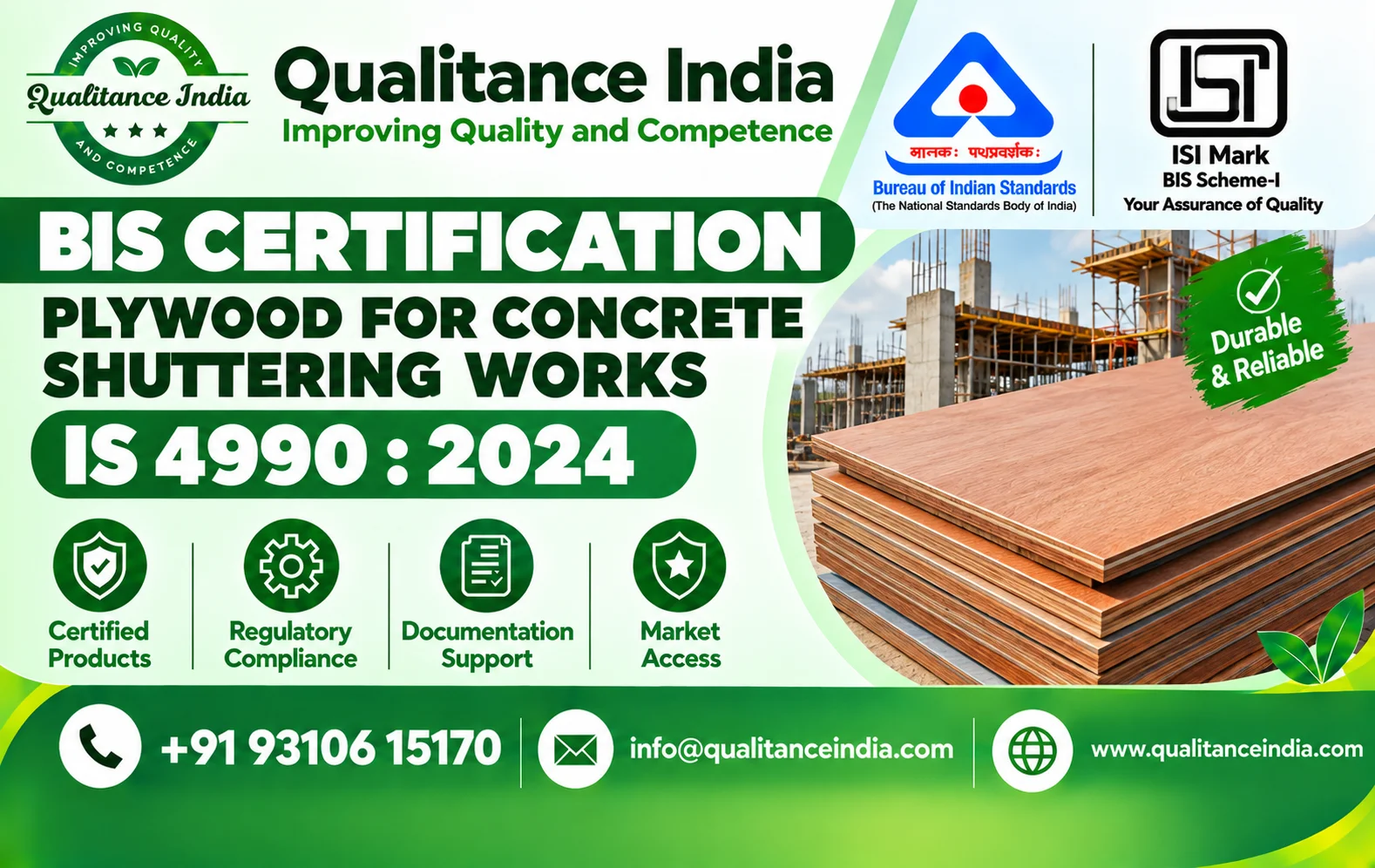
BIS Certification Consultancy for Plywood for Concrete Shuttering Works | IS 4990:2024
Introduction
Plywood used for concrete shuttering and formwork plays an important role in construction because it is subjected to the weight and pressure of wet concrete during casting and curing. The plywood needs to provide adequate strength, dimensional stability, water resistance, durability and reusability for effective shuttering applications.
The applicable Indian Standard is IS 4990:2024 – Plywood for Concrete Shuttering Works – Specification (Fourth Revision). BIS has issued a dedicated Product Manual for this standard under Scheme-I of the BIS (Conformity Assessment) Regulations, 2018.
For plywood manufacturers, exporters and businesses supplying construction materials in India, obtaining BIS certification for plywood for concrete shuttering works is an important compliance requirement.
The Plywood and Wooden Flush Door Shutters (Quality Control) Order, 2024 requires the specified plywood products to conform to the applicable Indian Standard and bear the Standard Mark under a BIS licence. The QCO came into force on 28 February 2025, with later enforcement dates for small and micro enterprises. The QCO also states that the latest version of the Indian Standards, including amendments notified by BIS, shall apply.
Therefore, manufacturers dealing with concrete shuttering plywood should understand the requirements of IS 4990:2024 and the applicable BIS certification procedure.
What is IS 4990:2024?
IS 4990:2024 is titled “Plywood for Concrete Shuttering Works – Specification” and is the Fourth Revision of the standard.
The standard specifies requirements for plywood intended for shuttering and formwork applications in concrete construction. BIS describes shuttering plywood as a product used in the construction industry for formwork during concrete casting, where the material must withstand the stresses associated with concrete pouring and curing.
The standard addresses important characteristics related to:
- Strength
- Bending performance
- Wet bending performance
- Tensile strength
- Water resistance
- Glue adhesion
- Moisture content
- Dimensional requirements
- Workmanship and finish
- Preservative treatment
- Formaldehyde requirements
- Durability and reusability-related properties
Is BIS Certification Mandatory for Shuttering Plywood?
Yes, the relevant plywood products covered under the Plywood and Wooden Flush Door Shutters (Quality Control) Order, 2024 are subject to compulsory use of the Standard Mark under a BIS licence.
The QCO includes Plywood for Concrete Shuttering Works under IS 4990:2011, while its note specifies that the latest version of the Indian Standard, including amendments notified by BIS, shall apply. Since BIS has subsequently published IS 4990:2024, manufacturers should follow the current applicable version for certification and conformity.
The QCO came into force on:
- 28 February 2025 for the general category
- 28 May 2025 for small enterprises
- 28 August 2025 for micro enterprises
The QCO also provides that goods manufactured domestically and meant for export are outside its application.
Manufacturers should nevertheless verify their exact status and applicable exemptions against the latest government/BIS notifications before placing products on the Indian market.
BIS Certification Scheme for IS 4990:2024
BIS operates certification for this product under Scheme-I, commonly associated with the ISI Mark certification scheme.
The official Product Manual for IS 4990:2024 specifically states that it is intended to ensure uniformity and transparency in certification under Scheme-I and can be used by prospective applicants seeking BIS certification.
Under Scheme-I, BIS evaluates the manufacturer's production facilities, quality-control system, testing capabilities and product conformity before granting the licence.
Once the licence is granted, the manufacturer can use the BIS Standard Mark on products covered by the approved licence scope, subject to the applicable BIS conditions.
Types of Plywood Covered Under IS 4990:2024
IS 4990:2024 covers plywood intended for concrete shuttering works and classifies it according to surface treatment/overlay.
The BIS technical material identifies three important types:
1. Plain Concrete Shuttering Plywood – CS
This is plywood intended for concrete shuttering applications without the specified polymer coating or suitable overlay.
2. Coated Concrete Shuttering Plywood – CSC
This type has a suitable polymer coating on the plywood surface for the intended shuttering application.
3. Film Faced Concrete Shuttering Plywood – CSFF
Film-faced plywood incorporates a suitable overlay/film intended to provide the required surface characteristics for concrete shuttering and formwork applications.
The standard also classifies plywood according to formaldehyde emission as E1 and E2 classes.
Raw Material Requirements
Raw materials are an important part of the BIS certification process.
The IS 4990:2024 Product Manual specifies that adhesives used for bonding veneers shall be based on a suitable synthetic resin conforming to the BWP grade of IS 848.
The manufacturer therefore needs to maintain appropriate records and demonstrate conformity of relevant raw materials during the applicable certification and surveillance activities.
Proper control of:
- Timber
- Veneers
- Adhesives
- Preservatives
- Surface coating/overlay materials
is important for maintaining consistent product quality.
Sample Requirement for BIS Certification
The official Product Manual specifies a sample quantity of:
Plywood – 1 sheet
for testing related to Grant of Licence, Change in Scope of Licence and Factory Surveillance, subject to the applicable sampling and testing provisions.
The actual sample dimensions, preparation and testing requirements should be confirmed with the applicable BIS Product Manual and laboratory before submitting samples.
Important Tests for Plywood as per IS 4990:2024
IS 4990:2024 contains a comprehensive set of requirements intended to evaluate the physical, mechanical and durability-related properties of concrete shuttering plywood.
Timber and Veneer Requirements
The raw material and veneer-related requirements are checked according to the applicable clauses of the standard.
Dimensions
Plywood dimensions are evaluated for conformity, including relevant requirements for:
- Length
- Width
- Thickness
- Squareness
- Edge straightness
Workmanship and Finish
The plywood is examined for workmanship and finish to ensure that the finished product complies with the requirements of the standard.
Moisture Content
Moisture content is an important property for plywood because excessive moisture can affect dimensional stability and performance.
Glue Shear Strength
Glue adhesion and shear strength are evaluated to determine whether the veneers have been adequately bonded.
Adhesion of Plies
The adhesion between plywood plies is also evaluated according to the applicable test requirements.
Resistance to Water
Water-resistance testing evaluates the ability of the plywood and adhesive bond to withstand the specified water exposure.
Water Resistance of Concrete Shuttering Plywood
The standard contains a specific water-resistance test for concrete shuttering plywood, which is important because shuttering plywood can come into contact with wet concrete and moisture during construction.
Mycological Testing
The Product Manual includes mycological testing related to properties such as glue shear strength and adhesion of plies.
Tensile Strength
Tensile strength is evaluated according to the applicable requirements of IS 4990:2024.
Static Bending Strength
Bending performance is important because shuttering plywood is subjected to loads during concrete casting.
The standard includes requirements related to bending performance in specified directions.
Wet Bending Strength
Wet bending performance is also evaluated because plywood used in concrete shuttering can be exposed to significant moisture.
The testing includes parameters related to:
- Modulus of Elasticity
- Modulus of Rupture
- Average and minimum individual values, as applicable
Retention of Preservative
Where preservative treatment is applicable, the retention of preservative is evaluated according to the standard.
Formaldehyde Content
IS 4990:2024 includes requirements related to formaldehyde content and emission classification.
The Product Manual and BIS laboratory listings identify E1 and E2 emission classes within the applicable product scope.
BIS Testing Charges for IS 4990:2024
Testing charges are not a single fixed amount because they depend on the laboratory, product type, size, emission class and exact test scope.
Current BIS LIMS listings show different testing packages for IS 4990:2024.
For example, current listings include testing packages around:
- ₹14,000
- ₹14,500
- ₹15,000
- ₹18,000
- ₹18,850
- ₹23,000
excluding applicable taxes, depending on the laboratory and scope.
Individual tests may also be listed separately in BIS LIMS. For example, current listings show separate charges for dimensions, water resistance, tensile strength, wet bending, preservative retention and formaldehyde testing.
Therefore, manufacturers should obtain the applicable laboratory quotation according to their exact product scope rather than relying on one fixed certification cost.
BIS Manufacturing and Quality Control Requirements
A manufacturer seeking BIS certification needs to demonstrate the ability to consistently manufacture plywood conforming to IS 4990:2024.
The manufacturing facility should have suitable arrangements for:
- Veneer preparation
- Veneer grading
- Adhesive preparation
- Glue spreading
- Assembly
- Pressing
- Conditioning
- Cutting
- Sanding
- Surface treatment or overlay application
- Finishing
- Quality inspection
- Product testing
The manufacturer should also maintain suitable quality-control records for raw materials, production and finished products.
Testing Equipment for Shuttering Plywood
The applicable laboratory and factory testing arrangements may include equipment for evaluating:
- Dimensions
- Thickness
- Squareness
- Edge straightness
- Moisture content
- Glue shear strength
- Adhesion of plies
- Water resistance
- Tensile strength
- Bending strength
- Wet bending strength
- Preservative retention
- Formaldehyde content
- Other applicable characteristics
The exact testing equipment and calibration requirements should be assessed against the latest BIS Product Manual and the manufacturer's intended licence scope.
BIS Quality Assurance and Inspection
BIS certification is not limited to a one-time laboratory test.
Under Scheme-I, the manufacturer needs to maintain continuous conformity through appropriate production controls and testing.
BIS may assess:
- Manufacturing process
- Raw material control
- Production facilities
- Testing facilities
- Quality-control system
- Calibration records
- Product test records
- Marking arrangements
- Finished product conformity
The manufacturer should therefore prepare the factory before the BIS assessment rather than arranging documentation only after an application has been submitted.
Documents Required for BIS Certification
A plywood manufacturer may need to prepare documents such as:
- Company registration documents
- Factory registration documents
- Factory address and layout
- Manufacturing process flow chart
- Product technical specifications
- Product drawings/specifications
- Details of plywood types
- Details of emission class
- Raw material specifications
- Timber and veneer details
- Adhesive details
- Preservative treatment details
- Surface coating/overlay details
- Machinery list
- Testing equipment list
- Calibration certificates
- In-house laboratory details
- Quality-control personnel details
- Test reports
- Trademark/brand documents
- Quality Assurance Plan
- Inspection and testing records
- BIS application documents
- Undertakings and declarations as applicable
The final documentation requirement depends on the manufacturer, product scope and current BIS application procedure.
BIS Certification Process for Plywood for Concrete Shuttering Works
The BIS certification process can generally be understood through the following stages.
Step 1: Identify the Applicable Standard
Confirm that the product falls within the scope of IS 4990:2024.
Step 2: Identify Product Type and Scope
Determine whether the product is:
- CS – Plain
- CSC – Coated
- CSFF – Film faced
and identify the applicable emission class, size and other relevant characteristics.
Step 3: Review Raw Materials
Confirm that relevant raw materials, including adhesive systems, meet the applicable requirements.
Step 4: Assess Factory Facilities
Review production machinery, laboratory equipment, personnel, calibration and quality-control systems.
Step 5: Prepare Samples
Prepare the required plywood sample according to BIS/laboratory requirements.
Step 6: Product Testing
Testing is carried out according to the applicable requirements of IS 4990:2024.
Step 7: Prepare BIS Application
The required company, technical and manufacturing documents are prepared and the application is submitted through the applicable BIS process.
Step 8: BIS Factory Assessment
BIS assesses the manufacturing facility and verifies production and testing capabilities.
Step 9: Compliance and Test Evaluation
BIS evaluates the applicable test results, factory assessment findings and documentation.
Step 10: Grant of BIS Licence
After satisfactory completion of the certification requirements, BIS may grant the licence for the approved product scope.
Step 11: Use of BIS Standard Mark
After receiving the licence, the manufacturer can use the BIS Standard Mark according to the licence conditions and applicable marking requirements.
Step 12: Maintain Continuous Compliance
The manufacturer must continue to comply with IS 4990:2024, the Quality Assurance Plan and BIS licence conditions.
BIS Certification for Foreign Plywood Manufacturers
Foreign manufacturers supplying concrete shuttering plywood to India may need to consider BIS certification requirements applicable to imported products.
The QCO specifically provides that goods manufactured domestically and meant for export are outside its application. However, this export exemption does not mean that overseas manufacturers supplying products into India are automatically exempt. The applicable import and BIS certification requirements should be checked for the particular product and transaction.
Eligible foreign manufacturers can explore the BIS Foreign Manufacturers Certification Scheme (FMCS) where applicable.
For overseas plywood manufacturers, professional BIS consultancy can help with:
- IS 4990:2024 applicability
- Product scope identification
- Technical documentation
- Testing arrangements
- Factory preparation
- Authorized Indian Representative requirements
- BIS application support
- Inspection preparation
- Compliance documentation
This is particularly useful for manufacturers searching for BIS certification for plywood, BIS licence for plywood manufacturers, BIS certification for foreign plywood manufacturers, or BIS certification for plywood export to India.
BIS Certification for Imported Shuttering Plywood
Importers and foreign manufacturers should understand that BIS compliance requirements can apply differently depending on whether the product is manufactured in India or outside India.
For imported concrete shuttering plywood intended for sale or use in India, manufacturers and importers should verify the current QCO and BIS requirements before shipment.
A foreign manufacturer should not assume that an importer can simply obtain a BIS licence on its behalf. The appropriate BIS certification route should be determined based on the manufacturing location and applicable certification scheme.
Why BIS Certification is Important for Plywood Manufacturers
BIS certification provides a formal conformity framework for products covered by the applicable QCO and Indian Standard.
For concrete shuttering plywood, conformity is particularly relevant because the product is used in construction applications where strength, water resistance, dimensional stability and durability are important.
BIS-certified plywood can be relevant for:
- Construction companies
- Infrastructure projects
- Real-estate projects
- Contractors
- Builders
- Government projects
- EPC companies
- Formwork contractors
- Construction-material distributors
- Institutional procurement
- Plywood manufacturers and exporters
Manufacturers should ensure that the actual product supplied matches the scope of their BIS licence.
Common Problems Faced by Manufacturers
Manufacturers may experience delays during BIS certification if they do not properly prepare their factory and technical documentation.
Common issues include:
- Using outdated IS 4990 information
- Incorrect product classification
- Incomplete product specifications
- Incorrect emission-class documentation
- Inadequate raw-material records
- Non-conforming adhesive
- Insufficient testing equipment
- Expired calibration certificates
- Incomplete test records
- Inadequate quality-control procedures
- Incorrect product marking
- Missing technical documents
- Poor preparation for factory inspection
- Testing the wrong product configuration
- Failure to maintain continuous conformity
Professional BIS certification consultancy can help identify these issues before the application and inspection stages.
How Qualitance India Can Help
Qualitance India provides BIS certification consultancy and compliance support for manufacturers dealing with products covered by Indian Standards.
For Plywood for Concrete Shuttering Works as per IS 4990:2024, our support can include:
- BIS applicability assessment
- IS 4990:2024 scope review
- Product classification assistance
- Documentation preparation
- BIS application support
- Laboratory testing coordination
- Test report coordination
- Factory inspection preparation
- Quality-control documentation
- Testing equipment guidance
- BIS query response support
- Licence process assistance
- Post-certification compliance guidance
- Support for eligible foreign manufacturers
Whether you are an Indian plywood manufacturer or an overseas company planning to supply concrete shuttering plywood to India, understanding the applicable BIS requirements before starting the certification process can help reduce avoidable delays.
Frequently Asked Questions
1. What is the BIS standard for concrete shuttering plywood?
The current standard is IS 4990:2024 – Plywood for Concrete Shuttering Works – Specification (Fourth Revision).
2. Is BIS certification mandatory for concrete shuttering plywood?
The Plywood and Wooden Flush Door Shutters QCO requires the specified products to conform to the applicable Indian Standard and bear the Standard Mark under a BIS licence. The QCO originally lists IS 4990:2011 but states that the latest version of the Indian Standard, including amendments notified by BIS, shall apply.
3. Which BIS scheme applies to IS 4990:2024?
The Product Manual states that certification operates under Scheme-I of the BIS (Conformity Assessment) Regulations, 2018.
4. What types of shuttering plywood are covered?
The standard covers plain concrete shuttering plywood, coated concrete shuttering plywood and film-faced concrete shuttering plywood, identified as CS, CSC and CSFF in the BIS technical material.
5. Which emission classes are covered?
The product is classified according to formaldehyde emission as E1 and E2 classes.
6. What sample quantity is specified?
The BIS Product Manual specifies one plywood sheet for the relevant certification testing activities.
7. What tests are required?
Testing can include dimensions, workmanship and finish, moisture content, glue shear strength, adhesion of plies, water resistance, tensile strength, bending strength, wet bending strength, preservative retention and formaldehyde-related tests, depending on the applicable scope.
8. Is formaldehyde testing required?
IS 4990:2024 includes formaldehyde-related requirements, including formaldehyde content and steady-state emission testing within the applicable scope. Some laboratories may have specific exclusions depending on their approved scope, so the exact test package should be verified before testing.
9. What adhesive is required?
The Product Manual specifies that adhesives used for bonding veneers shall be based on a suitable synthetic resin conforming to the BWP grade of IS 848.
10. How much does BIS testing cost?
Current BIS LIMS listings show different testing packages, including examples around ₹14,000–₹23,000 excluding taxes. The actual cost depends on laboratory, product scope and applicable tests.
11. Does the BIS certification cost include testing?
No. Laboratory testing charges and BIS-related certification/application expenses should be considered separately. The overall cost depends on the application scope, laboratory, factory assessment and other applicable requirements.
12. Does BIS inspect the plywood manufacturing factory?
For Scheme-I certification, factory assessment is part of the certification process, with BIS evaluating manufacturing and testing capabilities and conformity arrangements.
13. Can an MSME plywood manufacturer obtain BIS certification?
Yes. MSME manufacturers can obtain BIS certification subject to fulfilling the applicable requirements. The manufacturer should ensure that its production and testing arrangements satisfy the applicable BIS Product Manual.
14. Can an overseas plywood manufacturer obtain BIS certification?
Eligible foreign manufacturers can explore the applicable BIS Foreign Manufacturers Certification Scheme. The exact route should be confirmed according to the product, manufacturing location and current BIS requirements.
15. Is BIS certification required for plywood manufactured in India only for export?
The Plywood and Wooden Flush Door Shutters QCO states that it does not apply to goods manufactured domestically and meant for export.
16. Can imported shuttering plywood be sold in India without checking BIS requirements?
Manufacturers and importers should verify the applicable QCO and BIS requirements before importing and selling the product in India. Products covered by the QCO are subject to the applicable conformity requirements.
17. Can one BIS licence cover different plywood varieties?
The permitted licence scope depends on the applicable grouping guidelines, product type, emission class, size and other characteristics. The scope should be finalized before testing.
18. Is film-faced plywood covered by IS 4990:2024?
Yes. Film-faced concrete shuttering plywood is identified as CSFF within the scope classification described for the standard.
19. Why is wet bending strength important for shuttering plywood?
Concrete shuttering plywood can be exposed to moisture during construction. Wet bending requirements help evaluate its mechanical performance under the specified wet condition.
20. Why should manufacturers take BIS consultancy support?
BIS certification involves standard interpretation, product scope, testing, documentation, factory preparation and ongoing compliance. Professional consultancy can help coordinate these activities and reduce avoidable errors during the certification process.
Conclusion
Plywood for Concrete Shuttering Works as per IS 4990:2024 is an important construction material covered by a detailed Indian Standard addressing strength, water resistance, glue adhesion, dimensions, workmanship, preservative treatment, formaldehyde requirements and other quality characteristics.
The current BIS Product Manual places certification under Scheme-I, while the Plywood and Wooden Flush Door Shutters (Quality Control) Order, 2024 establishes compulsory Standard Mark requirements for the specified plywood products and provides that the latest applicable Indian Standard version shall apply.
Manufacturers should therefore ensure that their plywood, raw materials, manufacturing process, laboratory facilities, testing records and documentation are aligned with the current requirements of IS 4990:2024 before applying for a BIS licence.
Get BIS Certification Consultancy for IS 4990:2024
Qualitance India provides end-to-end BIS certification consultancy support for plywood manufacturers, construction-material manufacturers and eligible foreign manufacturers.
For assistance with BIS Certification for Plywood for Concrete Shuttering Works as per IS 4990:2024, contact:
Qualitance India Phone: +91-9310-615-170 Email: info@qualitanceindia.com Website: qualitanceindia.com
Get professional assistance for BIS licence, product testing, documentation, factory inspection preparation and certification support for IS 4990:2024.