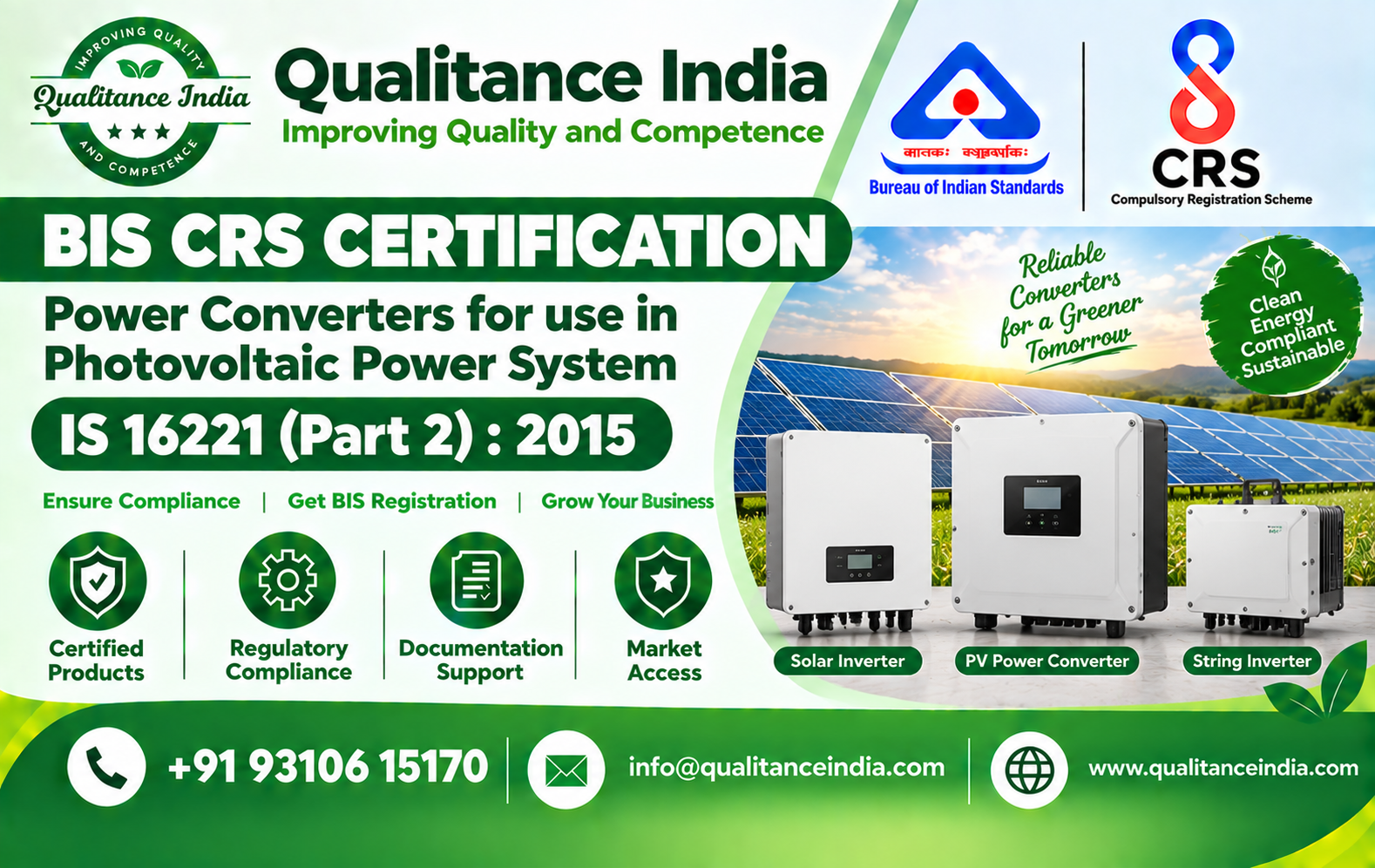
BIS CRS Certification for Power Converters for Use in Photovoltaic Power Systems | IS 16221 (Part 2):2015 | BIS Consultancy
Introduction
Photovoltaic (PV) power systems are an important part of India's growing renewable-energy infrastructure. Solar power systems use power converters and inverters to convert, control and manage electrical energy generated by photovoltaic modules for different applications.
Because these devices perform important electrical conversion and control functions, their safety is a significant consideration. The Bureau of Indian Standards (BIS) has specified requirements for Power Converters for Use in Photovoltaic Power Systems under IS 16221 (Part 2):2015.
The standard is titled “Safety of Power Converters for Use in Photovoltaic Power Systems: Part 2 Particular Requirements for Inverters” and is based on IEC 62109-2:2011. BIS describes the standard as covering safety requirements for photovoltaic-system inverters.
For manufacturers, importers and suppliers of solar inverters and applicable photovoltaic power converters, understanding the BIS certification requirements is important before supplying these products in the Indian market.
What Is IS 16221 (Part 2):2015?
IS 16221 (Part 2):2015 specifies particular safety requirements for inverters used in photovoltaic power systems.
The BIS standard corresponds to IEC 62109-2:2011. It is intended to address safety aspects of power conversion equipment used with photovoltaic systems.
The standard can apply to inverter configurations such as:
- Grid-interactive inverters
- Stand-alone inverters
- Multi-mode inverters
- PV inverters incorporating battery or energy-storage functionality, where applicable
- Other photovoltaic-system inverter configurations covered by the standard
The exact applicability depends on the design, intended use and technical characteristics of the product.
BIS Certification for Power Converters Used in Photovoltaic Power Systems
BIS records for compulsory certification identify Power Converters for Use in Photovoltaic Power Systems against IS 16221 (Part 2):2015. The associated title specifies the particular safety requirements for inverters.
A manufacturer seeking compliance generally needs to establish that its representative product meets the applicable requirements through testing and the prescribed BIS certification process.
For businesses entering the Indian solar equipment market, BIS compliance can therefore be an important part of product approval and market-entry planning.
Why BIS Certification Is Important for Solar Inverters
Solar inverters operate with potentially hazardous electrical energy and are connected to photovoltaic arrays, AC systems, batteries or utility networks depending on their configuration.
Appropriate safety assessment helps address areas such as:
- Protection against electric shock
- Fire safety
- Mechanical safety
- Environmental conditions
- Electrical insulation
- Thermal behaviour
- Component safety
- Enclosure protection
- Wiring and connections
- Protection systems
- Marking and documentation
- Safety-related software and firmware, where applicable
The BIS standard's safety framework specifically addresses hazards including electric shock, fire and mechanical hazards.
Products Covered Under the Scope
Depending on their construction and intended application, products that may require assessment under this category can include:
- Solar inverters
- Photovoltaic inverters
- Grid-connected solar inverters
- Off-grid solar inverters
- Stand-alone PV inverters
- Hybrid solar inverters
- Multi-mode PV inverters
- Solar power conversion equipment
- Inverters incorporating energy-storage functions
- Other power converters covered by the applicable requirements
The exact product classification should always be verified against the current BIS requirements and the technical construction of the equipment.
Grid-Connected Solar Inverters
Grid-interactive inverters convert DC electricity from photovoltaic arrays into AC electricity suitable for connection to an electrical grid.
These products may include functions such as:
- DC input from PV modules
- AC grid connection
- Maximum power point tracking
- Grid synchronization
- Protection functions
- Anti-islanding functions
- Monitoring and communication
- Remote control
- Fault detection
The inverter's complete technical configuration should be considered when determining the applicable testing and certification requirements.
Off-Grid and Stand-Alone Inverters
Off-grid solar inverters are designed for systems that may operate independently from the utility grid.
They can be used with:
- Solar PV modules
- Battery banks
- Charge controllers
- AC loads
- DC systems
- Energy-management systems
Where battery or energy-storage functionality is incorporated, the technical documentation should clearly identify the battery technology, electrical ratings and protection arrangements.
Hybrid Solar Inverters
Hybrid inverters can combine several operating functions, such as:
- Solar PV input
- Battery charging
- Battery discharge
- Grid input
- Backup output
- Load management
- Energy storage
- Grid interaction
Because these products can contain multiple operating modes and energy sources, the product configuration should be reviewed carefully before laboratory testing.
Safety Requirements Under IS 16221 (Part 2):2015
The standard covers a wide range of safety considerations for photovoltaic inverters.
Protection Against Electric Shock and Energy Hazards
The inverter is evaluated for protection against hazardous electrical energy and electric shock.
Relevant areas may include:
- Insulation
- Electrical separation
- Accessible conductive parts
- Protective earthing
- Electrical clearances
- Creepage distances
- Stored energy
- Fault conditions
Protection Against Mechanical Hazards
The physical construction of the equipment is assessed to address applicable mechanical hazards.
This can involve:
- Enclosure construction
- Stability
- Mounting
- Moving parts
- Mechanical strength
- Handles and carrying provisions
- Protection of internal components
Protection Against Fire Hazards
Fire-related safety is an important part of inverter evaluation.
Assessment can include:
- Protection against ignition
- Fire enclosure requirements
- Materials
- Internal fault conditions
- Overcurrent protection
- Short-circuit conditions
- Components associated with fire safety
Protection Against Environmental Conditions
PV inverters may be installed in demanding environments. Depending on the product, environmental assessment can consider conditions such as:
- Temperature
- Humidity
- Moisture
- Dust
- Outdoor exposure
- Corrosion
- UV exposure where applicable
Protection Against Liquid Hazards
For products intended for locations where exposure to liquids is possible, applicable liquid-related safety requirements may need to be assessed.
Protection Against Chemical Hazards
Applicable requirements may address potential chemical hazards associated with the equipment, components or operating environment.
Testing Requirements for IS 16221 (Part 2):2015
Testing is an important part of the BIS certification process.
Current BIS LIMS listings show laboratories offering testing against IS 16221 (Part 2):2015. The listed test scope includes areas such as:
- General test requirements
- Marking and documentation
- Environmental requirements and conditions
- Protection against electric shock and energy hazards
- Protection against mechanical hazards
- Protection against fire hazards
- Protection against sonic pressure hazards
- Protection against liquid hazards
- Protection against chemical hazards
- Physical requirements
- Components
- Software and firmware performing safety functions
Additional testing can apply depending on the inverter design and relevant clauses.
Important Tests for Solar Inverters
Depending on the product and applicable scope, testing may involve:
1. General Test Requirements
The laboratory verifies the applicable general requirements and test conditions for the equipment.
2. Electrical Safety Testing
Electrical safety characteristics are evaluated to determine whether the inverter provides the required protection against hazardous electrical conditions.
3. Thermal Testing
Thermal behaviour can be evaluated under relevant operating and fault conditions.
4. Single-Fault Condition Testing
The inverter may be evaluated under specified single-fault conditions to determine whether the resulting condition remains safe.
5. Backfeed Voltage Protection
Applicable inverters may require assessment of protection against backfeed voltage.
6. Electrical Rating Tests
The declared electrical ratings of the inverter are assessed according to the applicable requirements.
7. Grid-Interactive Inverter Testing
Where applicable, additional requirements may apply to grid-interactive inverters.
Current BIS laboratory listings specifically identify testing for additional requirements for grid-interactive inverters under IS 16221 (Part 2):2015.
BIS Testing Cost for IS 16221 (Part 2):2015
There is no single fixed testing price for every solar inverter.
The cost depends on factors such as:
- Inverter capacity
- Product construction
- Testing scope
- Laboratory
- Required environmental tests
- Applicable exclusions
- Grid-interactive functionality
- Battery/energy-storage functionality
- Number of representative models
- Additional testing requirements
Current BIS LIMS listings show substantial variation in laboratory charges. Examples include approximately ₹1.60 lakh, ₹2.04 lakh, ₹3.50 lakh, ₹5 lakh and higher, while some larger-capacity or more extensive testing programmes are listed at substantially higher amounts.
For example, a current BIS LIMS listing from CPRI shows testing for an inverter up to 500 kW at approximately ₹12.65 lakh, with the note that charges can depend on capacity and that the testing includes IS 16221 Part 1 because Part 2 refers to Part 1.
These are laboratory charges, not a universal BIS certification fee. The final amount should be confirmed with the selected BIS-recognized laboratory based on the exact inverter capacity and testing scope.
Relationship Between IS 16221 Part 1 and Part 2
Manufacturers should understand that IS 16221 Part 2 is not completely independent of Part 1.
Part 2 specifies particular requirements for photovoltaic inverters, while the applicable general requirements from the related standard framework also need to be considered.
This is reflected in current BIS laboratory information. For example, CPRI notes that its IS 16221 Part 2 testing charges include testing as per IS 16221 Part 1, because Part 2 refers to Part 1.
Therefore, manufacturers should not assume that testing only a limited set of Part 2 clauses will represent the complete certification testing programme.
Documents Required for BIS Certification
The exact documentation depends on the applicant, product and certification route. Common technical and application documents can include:
- Manufacturer name and address
- Manufacturing-unit details
- Brand/trademark details
- Product name
- Model numbers
- Product catalogue
- Technical datasheet
- Rated input voltage
- Rated output voltage
- Rated output power
- Maximum PV input voltage
- Maximum PV input current
- AC output specifications
- Frequency
- Battery specifications, where applicable
- Circuit diagrams
- Block diagrams
- PCB details
- User manual
- Installation instructions
- Product photographs
- Critical component details
- Safety-critical component information
- Power semiconductor details
- Transformer details, where applicable
- Enclosure information
- Software/firmware safety information, where applicable
- Existing test reports, where relevant
- Laboratory test report
- Brand authorization documents, where applicable
- BIS application documents
- Undertakings and declarations as applicable
Information Needed Before Laboratory Testing
Before sending a solar inverter to a laboratory, it is useful to prepare complete technical information regarding:
- DC input range
- Maximum PV voltage
- Maximum PV current
- AC output power
- AC output voltage
- Frequency
- Number of phases
- Grid connection
- Battery connection
- Battery chemistry
- Operating temperature
- Indoor/outdoor use
- IP rating
- Cooling method
- Communication interfaces
- Protection features
- MPPT configuration
- Maximum number of MPPT inputs
- Grid-interactive functionality
- Software-controlled safety functions
Providing accurate technical information helps the laboratory determine the applicable test scope.
BIS Certification Process for Solar Inverters
Step 1: Product Assessment
The inverter is reviewed to determine its product category, applicable BIS standard and certification requirements.
Step 2: Technical Documentation Review
The product datasheet, circuit diagram, component details, ratings and manuals are examined.
Step 3: Laboratory Selection
A suitable BIS-recognized laboratory having the required testing scope is identified.
Step 4: Testing
Representative samples are submitted to the laboratory and tested according to the applicable requirements of IS 16221 (Part 2):2015 and related requirements.
Step 5: Test Report
After successful testing, the laboratory prepares the relevant test documentation.
Step 6: BIS Application
The required application and supporting documents are prepared and submitted through the applicable BIS process.
Step 7: BIS Scrutiny
BIS reviews the application, test report and supporting documentation.
Step 8: Clarifications
If BIS raises queries or requires additional information, the applicant needs to provide the appropriate clarification or documents.
Step 9: Registration/Certification
After successful completion of the applicable requirements, the required BIS certification/registration is granted.
BIS Certification for Different Solar Inverter Capacities
Solar inverters are manufactured in a wide range of capacities, including:
- Residential solar inverters
- Small commercial inverters
- Industrial solar inverters
- Utility-scale inverters
Testing costs and laboratory requirements can vary considerably with capacity.
Current BIS LIMS information demonstrates this variation. Some laboratories publish capacity-wise charges, while others provide a complete test charge or proforma quotation depending on the inverter.
Therefore, manufacturers should provide the exact rated capacity when requesting a testing quotation.
BIS Certification for Imported Solar Inverters
Foreign manufacturers intending to supply photovoltaic inverters in India also need to evaluate the applicable BIS requirements.
The certification process may involve:
- Foreign manufacturer
- Indian representative/importer where applicable
- BIS-recognized laboratory
- BIS application
- Technical documentation
- Brand authorization
- Product testing
- Compliance follow-up
All product details should remain consistent across the product, test sample, test report, labels and BIS application.
Common Problems During Solar Inverter Certification
Manufacturers may face delays because of issues such as:
- Incorrect product classification
- Incomplete technical documentation
- Incorrect rated power
- Differences between test sample and production model
- Missing circuit diagrams
- Incomplete component information
- Unclear battery specifications
- Incorrect grid-interactive information
- Missing safety-related component details
- Incomplete software/firmware information
- Inconsistent model numbers
- Test report discrepancies
- Incomplete product markings
- Laboratory scope limitations
- Failure to address BIS queries properly
A technical pre-assessment before sample submission can help identify potential issues.
Product Marking and Documentation
The inverter should carry the applicable product identification, ratings, warnings and other required information.
Depending on the applicable requirements, product information can include:
- Manufacturer name
- Model number
- Rated input
- Rated output
- Rated power
- Frequency
- Serial number
- Safety warnings
- Installation information
- Applicable BIS marking/registration information
The exact marking requirements should be confirmed against the applicable BIS requirements at the time of certification.
Role of a BIS Certification Consultant
A BIS consultant can support manufacturers and importers with:
- Product classification
- Standard identification
- Technical document review
- Laboratory selection
- Testing coordination
- Test report review
- BIS application preparation
- Documentation support
- Clarification response
- Application follow-up
- Model and variant assessment
- Compliance guidance
For solar inverter manufacturers, professional coordination can be particularly useful because the testing programme can vary substantially according to inverter capacity and technical configuration.
Why Choose Qualitance India for BIS Consultancy?
Qualitance India provides professional BIS certification consultancy services for manufacturers and importers of electrical, electronic, solar and other regulated products.
For photovoltaic power converters and solar inverters, our support can include:
- BIS CRS/certification consultancy
- Product classification
- Applicable-standard verification
- Technical documentation support
- Laboratory coordination
- Sample testing coordination
- Test report review
- BIS application assistance
- Query and clarification support
- Certification follow-up
- Compliance guidance
We help manufacturers understand the applicable BIS requirements and organize the certification process from initial product assessment through application and approval.
Frequently Asked Questions
1. What is IS 16221 (Part 2):2015?
IS 16221 (Part 2):2015 is the Indian Standard for Safety of Power Converters for Use in Photovoltaic Power Systems: Part 2 Particular Requirements for Inverters. It is based on IEC 62109-2:2011.
2. Is BIS certification required for solar inverters?
Power Inverters for use in photovoltaic power systems were included in the government notification requiring compliance with IS 16221 (Part 2):2015, with the specified implementation date of 1 January 2019.
3. Which products are covered by IS 16221 Part 2?
The standard addresses particular safety requirements for inverters used in photovoltaic power systems.
4. Does IS 16221 Part 2 apply to grid-connected inverters?
Yes, grid-interactive photovoltaic inverters can fall within the scope, subject to the applicable product requirements.
5. Does it apply to off-grid solar inverters?
Applicable stand-alone photovoltaic inverter configurations can fall within the standard's scope.
6. Does it apply to hybrid solar inverters?
Hybrid or multi-mode inverter configurations may be covered depending on their design and intended operation.
7. Are battery-based solar inverters covered?
Inverters incorporating battery or energy-storage functions can fall within the relevant requirements. Their complete configuration should be assessed before testing.
8. Is testing mandatory?
Testing is a fundamental part of demonstrating conformity for the applicable BIS certification process.
9. How much does BIS testing cost for solar inverters?
There is no single fixed amount. Current BIS LIMS listings show laboratory charges ranging from several lakh rupees to substantially higher amounts depending on capacity, laboratory and testing scope.
10. Does inverter capacity affect testing cost?
Yes. Current BIS laboratory listings demonstrate capacity-based variations for certain laboratories and test programmes.
11. Is IS 16221 Part 1 also relevant?
Yes. Part 2 refers to the applicable general requirements of Part 1, and some laboratories explicitly include Part 1 testing within their Part 2 testing programme.
12. What documents are required?
Documents can include product specifications, circuit diagrams, component information, manuals, photographs, ratings, manufacturer details and the applicable laboratory test report.
13. Can a foreign manufacturer obtain BIS certification?
Foreign manufacturers can pursue the applicable BIS compliance route subject to the prescribed requirements and documentation.
14. Can multiple inverter models be covered together?
This depends on the similarity of the models and applicable BIS grouping/testing requirements. Model differences should be reviewed before laboratory testing.
15. Does the number of MPPT inputs matter?
MPPT configuration forms part of the inverter's technical characteristics and should be declared during product assessment.
16. Does an inverter's battery voltage affect certification?
Battery voltage and battery configuration can affect the technical assessment and should be accurately included in the product documentation.
17. Does outdoor installation affect testing?
Yes. The intended installation environment can affect applicable environmental and enclosure-related requirements.
18. Are software and firmware considered during testing?
Current BIS laboratory scopes for IS 16221 Part 2 include software and firmware performing safety functions, where applicable.
19. Can Qualitance India assist with BIS certification for solar inverters?
Yes. Qualitance India provides BIS certification consultancy, technical documentation assistance, laboratory coordination, testing support and BIS application assistance.
20. How can I start BIS certification for my photovoltaic inverter?
You can start by providing the inverter datasheet, model number, rated capacity, input/output ratings, circuit/block diagram, battery details if applicable, product photographs and manufacturer information. These details can be reviewed to determine the applicable certification route and testing requirements.
Get BIS Consultancy for Photovoltaic Power Converters and Solar Inverters
If you manufacture or import solar inverters, photovoltaic power converters, grid-connected inverters, off-grid inverters or hybrid solar inverters, Qualitance India can assist you with the BIS certification process.
Our consultancy support covers product assessment, applicable-standard verification, laboratory coordination, documentation, testing coordination, BIS application assistance and certification follow-up.
Qualitance India – BIS Certification Consultancy
Phone: +91-9310-615-170 Email: info@qualitanceindia.com Website: https://qualitanceindia.com/
Contact Qualitance India to discuss your photovoltaic inverter and understand the applicable BIS testing and certification requirements.
Conclusion
IS 16221 (Part 2):2015 establishes particular safety requirements for inverters used in photovoltaic power systems and is based on IEC 62109-2:2011. BIS and government records identify power inverters for photovoltaic power systems under this standard for compulsory compliance.
The certification process involves appropriate product classification, technical documentation, laboratory testing and submission of the required application documents. Testing requirements and costs can vary significantly according to inverter capacity, construction, operating mode and laboratory scope.
For manufacturers and importers entering or expanding in the Indian solar market, obtaining the correct BIS compliance support can help organize the certification process and address the applicable safety requirements for photovoltaic power converters and inverters.