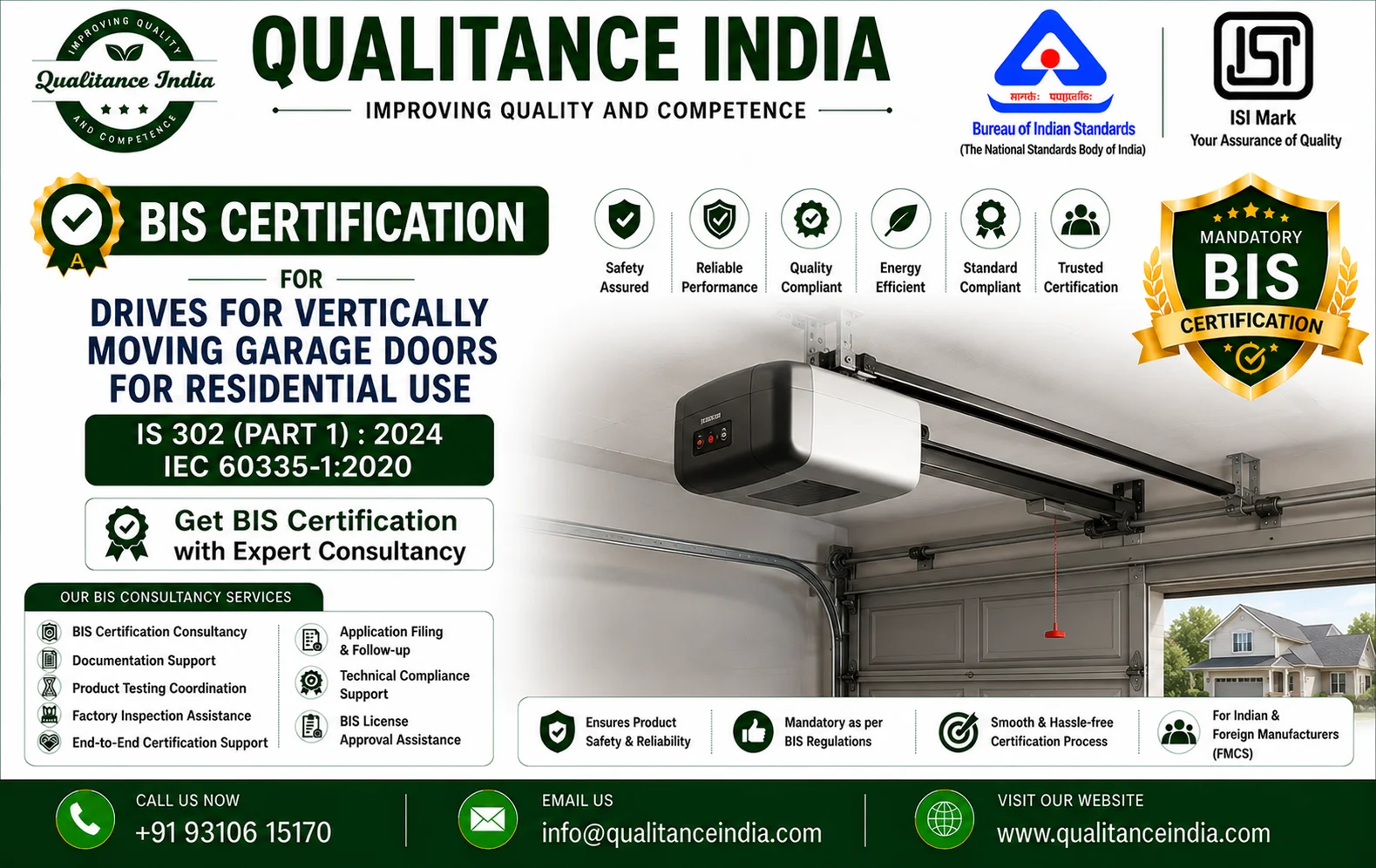
BIS Certification Consultancy for Drives for Vertically Moving Garage Doors for Residential Use – IS 302 (Part 1):2024 | IEC 60335-1:2020
Introduction
The Bureau of Indian Standards (BIS) has listed “Drives for Vertically Moving Garage Doors for Residential Use” under the upcoming implementation of the regulatory requirement based on IS 302 (Part 1):2024, aligned with IEC 60335-1:2020. The enforcement date listed by BIS is 01 October 2026. This makes it important for manufacturers and other businesses involved in the supply of covered electrical appliances to understand the applicable BIS certification requirements and begin compliance preparation in advance.
Drives for vertically moving garage doors are electrically operated systems designed to control the opening and closing movement of residential garage doors. Because these products involve electrical power, moving mechanical components and user interaction, appropriate safety and quality compliance is essential.
For manufacturers planning to manufacture or supply these products in the Indian market, early preparation can help reduce certification delays and ensure that the product, technical documentation, testing arrangements and manufacturing quality-control systems are ready before the applicable enforcement date.
Qualitance India provides professional BIS Certification Consultancy, documentation support, laboratory testing coordination, factory inspection assistance and end-to-end certification support for Indian and foreign manufacturers.
About Drives for Vertically Moving Garage Doors for Residential Use
Drives for vertically moving garage doors are motorized electrical systems used to operate residential garage doors automatically. The drive mechanism enables the door to move vertically, generally through an electric motor and associated control system.
These products may be used in residential garages where automated opening and closing provides convenience and controlled access. Depending on the product design, the system may include an electric motor, control unit, sensors, switches, remote-control functionality and other associated components.
As electrical equipment incorporating powered operation and moving parts, product safety, electrical protection and reliable operation are important considerations. Manufacturers should assess their products against the applicable Indian Standards and certification requirements before placing them in the Indian market.
What is BIS Certification?
BIS Certification is a conformity assessment mechanism administered by the Bureau of Indian Standards, India’s national standards body. It is intended to demonstrate that applicable products conform to relevant Indian Standards and regulatory requirements.
For products covered under mandatory certification requirements, manufacturers may need to obtain the applicable BIS license before manufacturing, importing or selling the product in India, subject to the specific regulatory framework.
The BIS certification process may involve:
Product evaluation
Applicable Indian Standard identification
Technical documentation
Product sample testing
Testing through applicable laboratories
Factory assessment or inspection
Quality control verification
BIS assessment
Grant of license
Post-certification compliance
The exact process depends on the applicable product standard and BIS certification scheme.
BIS Certification Requirement for Garage Door Drives
The BIS upcoming QCO information lists “Drives for Vertically Moving Garage Doors for Residential Use” under the group of electrical appliances associated with IS 302 (Part 1):2024 and IEC 60335-1:2020, with an enforcement date of 01 October 2026. The BIS page describes its list as advance information regarding QCOs issued by the concerned Ministry or Department that are due for implementation.
Manufacturers dealing with products within the applicable scope should therefore review their product specifications, technical documentation, manufacturing process and quality-control systems well before the enforcement date.
The exact certification pathway, scope and any product-specific requirements should be confirmed against the applicable final QCO, BIS notification and relevant certification guidelines.
Scope of IS 302 (Part 1):2024 | IEC 60335-1:2020
IS 302 (Part 1):2024 is associated with the safety requirements for household and similar electrical appliances and is aligned with IEC 60335-1:2020.
The BIS upcoming QCO listing includes a broad range of electrical appliances under this standard framework, including Drives for Vertically Moving Garage Doors for Residential Use. The listed enforcement date for this group is 01 October 2026.
For a particular garage door drive, manufacturers should determine the complete applicable standard requirements based on the exact product design, intended use, electrical characteristics and applicable product-specific requirements.
Where a relevant Part 2 or product-specific standard applies, it should be evaluated together with the general safety requirements of IS 302 (Part 1):2024.
Products Covered
The specific product category covered in this service is:
Drives for Vertically Moving Garage Doors for Residential Use
The product may include electrically operated drive systems used for automated movement of residential garage doors.
Depending on the product configuration, manufacturers should evaluate:
Electric motor-driven garage door mechanisms
Control systems
Electrical operating components
Drive units
Associated control equipment
Remote-operated drive systems
Automatic residential garage door operating systems
The exact applicability should be assessed according to the product’s technical design, intended application and applicable BIS requirements.
Enforcement Date: 01 October 2026
The enforcement date listed by BIS for the relevant electrical appliance group is:
01 October 2026
This means manufacturers and businesses dealing with applicable products should not wait until the enforcement date to begin the certification process.
BIS certification preparation may involve technical documentation, product testing, quality-control arrangements and factory-related compliance activities. Starting early can provide sufficient time to identify and correct technical or documentation gaps.
Manufacturers should aim to complete the necessary compliance activities before the applicable regulatory requirement becomes enforceable.
The BIS upcoming QCO page currently lists this product category under the relevant IS 302 (Part 1):2024 group with an enforcement date of 01 October 2026.
Applicable QCO and Regulatory Requirement
The product appears in the BIS “Upcoming QCOs – notified and due for implementation” information under the electrical appliance group associated with IS 302 (Part 1):2024 and IEC 60335-1:2020.
The BIS listing is maintained to provide stakeholders with advance information regarding QCO implementation dates. Therefore, manufacturers should verify the latest applicable QCO notification, scope and certification requirements before proceeding with commercial production or market placement.
Businesses should particularly verify:
Whether their exact product falls within the notified scope
Applicable Indian Standard requirements
Whether a product-specific standard is applicable
BIS certification scheme requirements
Testing requirements
Factory assessment requirements
Marking and labeling requirements
Implementation date
Any applicable exemptions
Who Needs BIS Certification?
Depending on the final regulatory applicability, the requirement may be relevant to businesses involved in manufacturing or supplying covered products in India.
Indian Manufacturers
Indian manufacturers producing applicable garage door drive systems should prepare for BIS compliance and ensure that their manufacturing facility and quality-control systems are capable of meeting the applicable requirements.
Foreign Manufacturers
Foreign manufacturers supplying covered products to the Indian market should assess the applicable BIS requirements before exporting products to India.
Depending on the applicable BIS certification scheme, foreign manufacturers may also need to meet additional requirements relating to representation and communication with BIS.
OEM Manufacturers
OEM manufacturers producing garage door drive systems for another brand should evaluate certification responsibilities based on the actual manufacturing arrangement and applicable BIS rules.
Private Label and Brand Owners
Businesses selling products under their own brand should verify whether brand authorization, manufacturer details or other documentation is required under the applicable certification framework.
Eligibility Criteria for BIS Certification
Before applying for BIS certification, manufacturers should ensure that:
The manufacturing facility is clearly identified.
The product is covered under the applicable Indian Standard.
The product design meets relevant technical requirements.
Required technical documents are available.
Product samples can be made available for testing.
Quality-control procedures are established.
Required testing facilities or arrangements are available.
Measuring and testing equipment is properly maintained and calibrated where required.
Manufacturing processes are documented.
Raw material and component controls are established.
The manufacturer is prepared for applicable BIS assessment or factory inspection requirements.
Complete BIS Certification Process
Step 1: Product Applicability Assessment
The first step is to determine whether the garage door drive falls within the scope of the applicable BIS requirement.
Qualitance India can help manufacturers review product details and identify the relevant certification pathway.
Step 2: Identify Applicable Indian Standard
The applicable standard should be identified based on product type, construction, intended use and technical characteristics.
For the product covered in this service, the relevant general standard referenced in the BIS upcoming QCO listing is IS 302 (Part 1):2024 / IEC 60335-1:2020.
Step 3: Technical Documentation
The manufacturer should prepare relevant product and factory documents.
This may include:
Product specifications
Technical drawings
Circuit diagrams
Bill of Materials
Component details
Manufacturing process
Quality Control Plan
Test equipment details
Calibration records
Factory information
Brand details
Step 4: BIS Application Preparation
The BIS application is prepared according to the applicable certification scheme and submitted through the prescribed process.
Incorrect or incomplete information can result in queries or delays.
Step 5: Product Sample Testing
The product sample is evaluated according to applicable requirements.
Testing may cover relevant safety and performance parameters depending on the standard and product configuration.
Step 6: Laboratory Testing
Testing is coordinated through an applicable BIS-recognized laboratory or as required under the relevant certification procedure.
The objective is to establish conformity with applicable Indian Standard requirements.
Step 7: Factory Inspection
Where required under the applicable BIS certification scheme, the manufacturing facility may be assessed by BIS.
The assessment may review:
Manufacturing facilities
Production processes
Quality-control systems
Testing arrangements
Raw material controls
Inspection procedures
Finished product controls
Step 8: Correction of Non-Conformities
If any deficiency is identified during testing or inspection, corrective action may be required.
Manufacturers should respond promptly and provide appropriate evidence of corrective action.
Step 9: BIS Assessment
BIS reviews the application, test reports, factory assessment information and other relevant documents.
Step 10: Grant of BIS License
After successful completion of the applicable certification requirements, BIS may grant the license according to the relevant certification scheme.
Step 11: Product Marking and Compliance
Once certification is granted, the manufacturer must follow applicable BIS marking and labeling requirements.
Step 12: Post-Certification Compliance
Manufacturers must continue to maintain product quality and comply with applicable license conditions and surveillance requirements.
Required Documents
The exact documentation depends on the product and certification scheme. Commonly required documents may include:
Company registration details
Manufacturing unit information
Factory address
Authorized signatory details
Product technical specifications
Product drawings
Circuit diagrams
Bill of Materials
Manufacturing process flow chart
Quality Control Plan
Raw material details
Component details
Test equipment list
Calibration certificates
In-house testing facility details
Brand or trademark documents
Authorization documents, where applicable
Previous test reports, where relevant
Other documents required by BIS
Proper documentation can significantly reduce delays during the certification process.
Laboratory Testing Requirements
Laboratory testing is an important part of the BIS certification process where testing is prescribed.
For garage door drive systems, testing requirements depend on the applicable standard and product configuration.
Testing may evaluate relevant areas such as:
Electrical safety
Protection against electric shock
Insulation
Leakage current
Dielectric strength
Heating
Abnormal operation
Mechanical safety
Construction
Marking and instructions
Other applicable safety requirements
The exact testing parameters must be determined according to the applicable standard and certification requirements.
Manufacturers should avoid submitting products for formal testing without first reviewing their technical compliance.
Factory Inspection Process
Factory inspection, where applicable, is conducted to assess whether the manufacturer has adequate facilities and controls to consistently produce compliant products.
The inspection may cover:
Raw material inspection
Production process
Assembly process
Quality control
In-process inspection
Final product inspection
Testing facilities
Measuring instruments
Calibration
Record maintenance
Non-conforming product control
Corrective action procedures
BIS may also evaluate whether the manufacturing process and quality-control system are capable of maintaining consistent product conformity.
Common Reasons for BIS Application Rejection or Delay
Some common issues that can cause delays include:
Incorrect standard selection
Incomplete documentation
Mismatch between product and submitted documents
Failed laboratory testing
Insufficient quality-control arrangements
Missing calibration certificates
Inadequate testing facilities
Incorrect labeling information
Incomplete technical drawings
Unclear manufacturing process
Trademark or brand documentation issues
Delayed response to BIS queries
Manufacturers can reduce these risks through proper pre-assessment and documentation preparation.
BIS Certification Cost Factors
The total cost of BIS certification varies depending on several factors.
Important cost factors may include:
BIS government fees
Laboratory testing charges
Number of product models
Product complexity
Testing requirements
Factory inspection expenses
Technical documentation
Consultancy charges
Testing equipment requirements
Foreign manufacturer-related requirements
The final cost should be assessed after reviewing the exact product, manufacturing facility and applicable certification requirements.
Qualitance India can help manufacturers understand the certification process and identify the major cost components before proceeding.
BIS Certification Timeline
The total timeline depends on:
Documentation readiness
Laboratory availability
Product testing
Test report results
BIS application processing
Factory inspection
Corrective actions
BIS queries
Final assessment
Manufacturers are advised to begin the certification process well before 01 October 2026 to allow sufficient time for testing, documentation and any corrective action that may be required.
No fixed timeline should be assumed because the actual duration can vary from case to case.
Benefits of BIS Certification
BIS certification can provide several important advantages.
Legal and Regulatory Compliance
Certification helps businesses meet applicable regulatory requirements for covered products.
Improved Product Safety
Compliance with relevant Indian Standards supports the safety and reliability of electrical products.
Consumer Confidence
BIS certification can increase customer confidence in the quality and conformity of products.
Market Access
Meeting mandatory certification requirements can help businesses maintain access to the Indian market.
Better Brand Credibility
A compliant product can strengthen the reputation of manufacturers and brands.
Reduced Compliance Risk
Early certification preparation can reduce the risk of regulatory delays and market disruption.
BIS Compliance Requirements After Certification
Obtaining a BIS license is not the end of the compliance process.
Manufacturers should continue to:
Maintain consistent product quality
Follow approved manufacturing processes
Maintain quality-control records
Conduct required testing
Maintain calibration records
Follow BIS marking requirements
Comply with license conditions
Inform BIS about applicable changes
Maintain required documentation
Cooperate with surveillance activities
Any significant change in product design, manufacturing location, brand or process should be evaluated for its impact on BIS certification.
BIS Marking and Labeling Requirements
After certification, manufacturers must follow the applicable BIS marking and labeling requirements.
Depending on the certification framework, product marking may include information such as:
BIS Standard Mark / ISI Mark
BIS license number
Manufacturer information
Product identification
Model details
Other mandatory information
The exact marking requirements must be confirmed according to the applicable BIS license and relevant certification guidelines.
Manufacturers should not use the BIS Standard Mark or claim BIS certification before receiving the applicable authorization.
Risks of Non-Compliance
Manufacturing, importing or selling products that fall under a mandatory certification requirement without fulfilling applicable compliance requirements may expose businesses to regulatory and commercial risks.
Potential consequences may include:
Regulatory action
Product withdrawal
Market restrictions
Seizure of non-compliant products
Financial penalties
Business disruption
Import-related complications
Damage to brand reputation
The exact consequences depend on the applicable law, QCO and regulatory enforcement provisions.
BIS Certification for Foreign Manufacturers
Foreign manufacturers supplying garage door drive products to India should assess BIS applicability before exporting.
The process may involve:
Product applicability assessment
Indian Standard identification
Technical documentation
Product testing
Factory assessment
BIS application
Authorized Indian Representative requirements, where applicable
BIS license approval
Import compliance
Foreign manufacturers should begin preparation early because international coordination, testing and factory assessment may require additional time.
How Qualitance India Can Help
Qualitance India provides professional BIS Certification Consultancy for manufacturers seeking compliance for Drives for Vertically Moving Garage Doors for Residential Use.
Our support includes:
BIS Certification Consultancy
Product Applicability Assessment
Indian Standard Identification
Documentation Support
BIS Application Filing
Laboratory Testing Coordination
Technical Compliance Support
Factory Inspection Assistance
BIS Query Handling and Follow-up
BIS License Approval Assistance
Post-Certification Compliance Guidance
We support both Indian and foreign manufacturers in navigating the BIS certification process with a structured and compliance-focused approach.
Step-by-Step BIS Certification Flow Chart
Product Identification
↓
BIS Applicability Assessment
↓
Applicable IS Standard Identification
↓
Technical Documentation
↓
BIS Application Preparation
↓
BIS Application Filing
↓
Product Sample Submission
↓
Laboratory Testing
↓
Factory Inspection, Where Applicable
↓
BIS Evaluation
↓
Corrective Action, If Required
↓
Final Assessment
↓
BIS License Approval
↓
Applicable BIS Marking
↓
Post-Certification Compliance
Why Choose Qualitance India?
Choosing the right BIS certification consultant can simplify the certification journey.
Qualitance India helps manufacturers with:
Expert BIS Certification Consultancy
End-to-End Certification Support
Documentation Assistance
Laboratory Testing Coordination
Factory Inspection Assistance
Technical Compliance Support
Application Filing and Follow-up
Support for Indian Manufacturers
Support for Foreign Manufacturers
Our goal is to help businesses understand applicable requirements, prepare correctly and reduce avoidable certification delays.
25 Frequently Asked Questions About BIS Certification for Garage Door Drives
1. What is BIS Certification for Drives for Vertically Moving Garage Doors?
BIS Certification is a conformity assessment process used to demonstrate compliance with applicable Indian Standards and regulatory requirements. For the relevant product category, the BIS upcoming QCO information references IS 302 (Part 1):2024 / IEC 60335-1:2020.
2. Is BIS Certification mandatory for garage door drives?
The BIS upcoming QCO listing includes Drives for Vertically Moving Garage Doors for Residential Use under the relevant electrical appliance group with an enforcement date of 01 October 2026. Manufacturers should verify the final applicable QCO and certification requirements for their exact product.
3. Which standard applies to these products?
The relevant BIS upcoming QCO listing references IS 302 (Part 1):2024 and IEC 60335-1:2020 for the electrical appliance group that includes this product category.
4. What is the enforcement date?
The enforcement date listed by BIS is 01 October 2026.
5. Who needs BIS Certification?
Manufacturers and other businesses whose products fall within the mandatory regulatory scope should assess and fulfill applicable BIS requirements.
6. Do foreign manufacturers need BIS Certification?
Foreign manufacturers supplying covered products to India should assess BIS requirements and follow the applicable certification procedure.
7. Is factory inspection required?
Factory inspection requirements depend on the applicable BIS certification scheme and product certification procedure.
8. Is laboratory testing required?
Where prescribed under the certification process, product testing must be conducted according to applicable requirements.
9. What documents are required?
Documents may include technical specifications, drawings, BOM, manufacturing process, quality-control documents, factory details and other documents prescribed by BIS.
10. How long does BIS Certification take?
The timeline varies depending on documentation, laboratory testing, factory inspection and BIS processing.
11. How much does BIS Certification cost?
The cost depends on government fees, laboratory testing, product models, factory requirements and consultancy support.
12. Can Qualitance India help with testing?
Yes. Qualitance India provides laboratory testing coordination and certification support.
13. Can foreign manufacturers get BIS Certification support?
Yes. Qualitance India supports Indian and foreign manufacturers with BIS certification consultancy.
14. What happens if the product fails testing?
The manufacturer may need to identify the cause of failure, make corrective changes and undergo applicable re-testing.
15. Can multiple models be covered under one BIS license?
Model coverage depends on the applicable BIS certification scheme, product similarity and applicable guidelines.
16. What is the ISI Mark?
The ISI Mark is a BIS Standard Mark used under applicable BIS certification schemes to indicate conformity with the relevant Indian Standard.
17. Can a manufacturer use the BIS Mark before certification?
No. Manufacturers should not use the applicable BIS Standard Mark unless authorized under the relevant certification framework.
18. What is the role of factory inspection?
Factory inspection, where applicable, helps assess manufacturing capability, quality control and testing arrangements.
19. Why should manufacturers start early?
Early preparation allows time for documentation, testing, corrective action and certification processing before the applicable enforcement date.
20. What is IS 302 (Part 1):2024?
IS 302 (Part 1):2024 is the Indian Standard referenced for the relevant electrical appliance safety framework associated with IEC 60335-1:2020.
21. Does IEC 60335-1:2020 apply to the product?
The BIS upcoming QCO listing references the product group with IS 302 (Part 1):2024 and IEC 60335-1:2020. The exact applicable requirements should be assessed for the specific product.
22. What are common reasons for BIS certification delays?
Incomplete documentation, testing failures, incorrect product information, inadequate quality-control arrangements and delayed responses can contribute to delays.
23. Does BIS Certification improve market acceptance?
Certification can support regulatory compliance, product credibility and customer confidence where certification is mandatory or commercially relevant.
24. What support does Qualitance India provide?
Qualitance India provides applicability assessment, documentation support, testing coordination, application filing, factory inspection assistance and BIS license support.
25. How can I start BIS Certification for my garage door drive?
You can contact Qualitance India for a product applicability assessment and guidance on the applicable BIS certification process.
Strong Lead Generation CTA
Need BIS Certification for Drives for Vertically Moving Garage Doors for Residential Use?
The enforcement date of 01 October 2026 is approaching. Manufacturers should start their BIS compliance preparation early to allow sufficient time for product assessment, documentation, laboratory testing and applicable certification procedures.
Qualitance India provides end-to-end BIS Certification Consultancy for Indian and foreign manufacturers.
Get professional support for:
BIS Applicability Assessment
Documentation
Product Testing Coordination
BIS Application Filing
Factory Inspection Assistance
Technical Compliance
BIS License Approval
Contact Qualitance India today.
Phone: +91 93106 15170
Email: info@qualitanceindia.com
Website: https://qualitanceindia.com/
Conclusion
Drives for Vertically Moving Garage Doors for Residential Use are included in the BIS upcoming QCO information under the electrical appliance group associated with IS 302 (Part 1):2024 and IEC 60335-1:2020, with an enforcement date of 01 October 2026.
Manufacturers should use the time before enforcement to assess their products, identify applicable standards, prepare technical documentation, review quality-control systems and understand the required BIS certification process.
Early compliance preparation can help reduce avoidable delays and support a smoother transition to mandatory regulatory requirements.
If you are a manufacturer or supplier of Drives for Vertically Moving Garage Doors for Residential Use and need professional BIS Certification Consultancy, Qualitance India can assist you throughout the certification journey—from applicability assessment and documentation to testing coordination, factory inspection assistance and license approval support.
Contact Qualitance India for expert BIS Certification Consultancy and prepare your product for the upcoming 01 October 2026 enforcement date.
Need help with BIS certification for this product?
Get a free consultation from our compliance experts — we handle testing, documentation and the complete BIS process for you.
BIS Certification Readiness Checklist 2026
- Documents, testing & factory requirements in one place
- Covers ISI Mark, CRS, FMCS & Hallmarking
- Tick-box format — share it with your team