
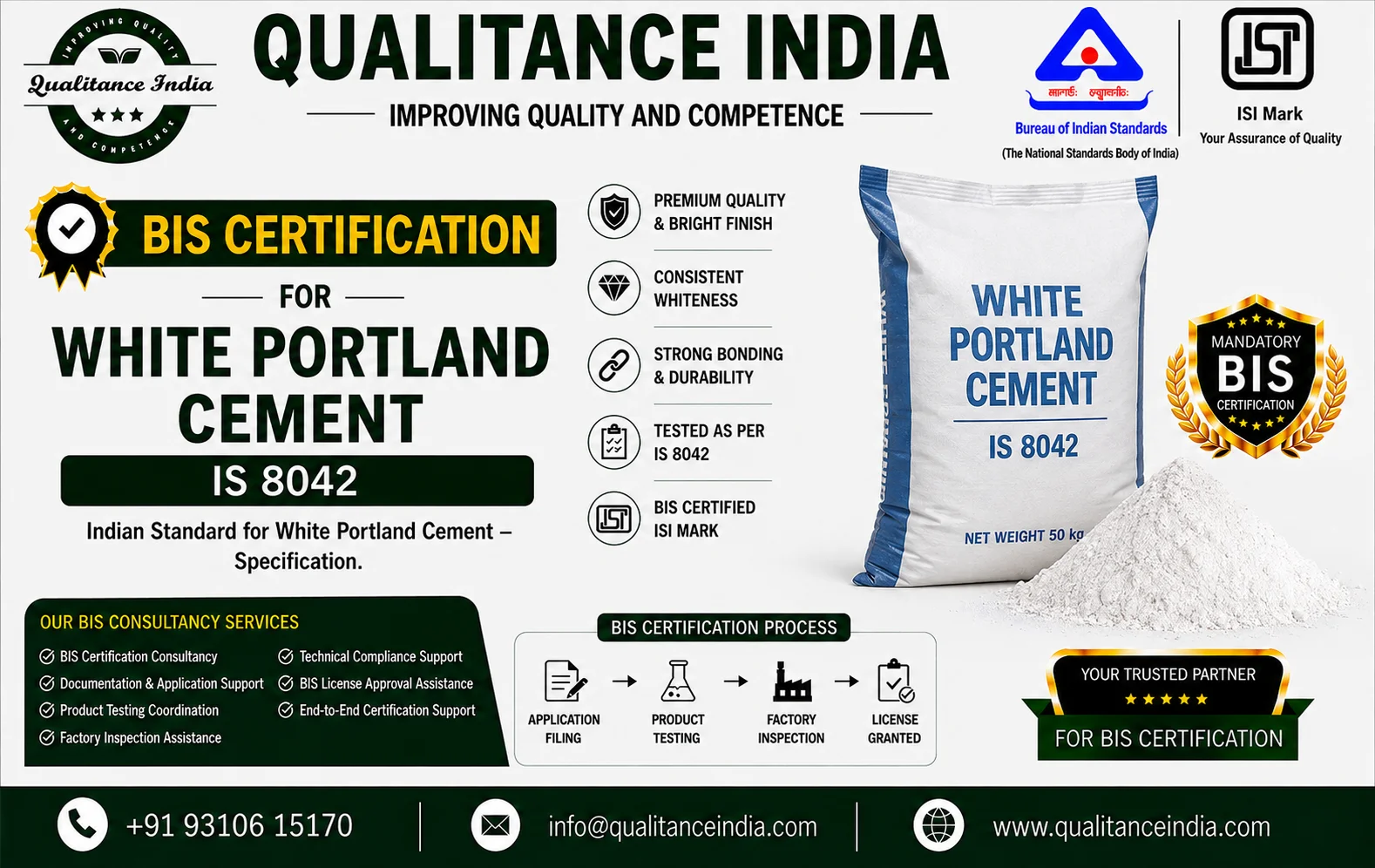
BIS Certification Consultancy for White Portland Cement | IS 8042:2015
Introduction
White Portland Cement is a specialized hydraulic cement known for its characteristic white colour and is commonly used where appearance, colour consistency and cement performance are important. It is widely used for architectural finishes, decorative concrete, tile grouts, tile adhesives, precast decorative products, wall finishes and other applications where a clean and uniform appearance is required.
In India, White Portland Cement is covered under IS 8042:2015 – White Portland Cement – Specification (Third Revision). BIS includes White Portland Cement in its compulsory certification framework under Scheme-I, and the current BIS Product Manual provides detailed requirements for sampling, testing, grouping, inspection and certification.
Qualitance India provides end-to-end BIS Certification consultancy for White Portland Cement manufacturers, including applicability assessment, BIS application preparation, product testing coordination, documentation, Quality Assurance Plan support, factory inspection preparation and BIS licence assistance.
What is White Portland Cement?
White Portland Cement is a hydraulic cementing material manufactured from Portland cement clinker, gypsum and permitted additives, designed to produce a white-coloured cement while meeting specified chemical and physical performance requirements. BIS technical material notes that limestone, dolomite and marble may be used as performance improvers, individually or in combination, subject to the specified limit.
White Portland Cement combines cementitious performance with a distinctive colour that makes it particularly suitable for aesthetic and architectural work.
Applications of White Portland Cement
White Portland Cement is commonly used for:
- Interior wall finishes
- Exterior wall finishes
- Architectural panels
- Decorative concrete
- Precast decorative products
- Tile grouts
- Tile adhesives
- Surface finishing
- Coloured concrete and cement-based decorative applications
- Architectural and aesthetic construction work
BIS’s technical compendium specifically identifies aesthetic applications such as interior and exterior wall finishes and architectural panels, as well as use in tile filler gaps and tile adhesives.
BIS Standard for White Portland Cement
The applicable standard is:
IS 8042:2015 – White Portland Cement – Specification
The current BIS material identifies this as the Third Revision.
The current BIS Product Manual available for certification is:
PM/IS 8042/2/October 2023
The Product Manual records:
- Product: White Portland Cement
- Standard: IS 8042:2015
- Amendments: 1
- Certification Scheme: Scheme-I
- Sample size: 8 kg for physical tests and 1 kg for chemical tests
- Grouping: Refer Annex A
- Testing equipment: Annex B
- Scheme of Inspection and Testing: Annex C
Is BIS Certification Mandatory for White Portland Cement?
Yes.
BIS’s current Scheme-I compulsory-certification list includes:
IS 8042 – White Portland Cement
under the cement category. The BIS listing identifies cement varieties, including White Portland Cement, under the compulsory certification framework.
For manufacturers supplying covered White Portland Cement in India, BIS certification and use of the Standard Mark are therefore important regulatory requirements.
Current BIS Certification Framework
White Portland Cement certification is operated under:
Scheme-I of the BIS Conformity Assessment Regulations, 2018
The Product Manual is intended to be used by BIS offices, existing licensees and prospective applicants for certification activities.
The certification process evaluates both physical and chemical characteristics of the cement.
BIS Product Manual for White Portland Cement
The current Product Manual PM/IS 8042/2/October 2023 states:
| Particular | Requirement |
|---|---|
| Product | White Portland Cement |
| Indian Standard | IS 8042:2015 |
| Revision | Third Revision |
| Amendments | 1 |
| Certification Scheme | Scheme-I |
| Physical Test Sample | 8 kg |
| Chemical Test Sample | 1 kg |
| Grouping | Annex A |
| Test Equipment | Annex B |
| Inspection & Testing | Annex C |
The Product Manual also identifies tests that can potentially be completed within one day, including insoluble residue, loss on ignition, fineness, setting time and degree of whiteness.
Sample Quantity for BIS Testing
The current Product Manual specifies:
8 kg for physical testing
and
1 kg for chemical testing.
Manufacturers should ensure that representative samples are prepared, packed and identified appropriately before laboratory submission.
Raw Material Requirements
The Product Manual identifies:
Performance improver, if added – as per Clause 4.1.1 of IS 8042.
The manufacturing process may involve:
- Portland cement clinker
- Gypsum
- Permitted performance improvers
- Other process materials as applicable
BIS technical information states that limestone, dolomite and marble may be added as performance improvers, individually or in combination, with the total addition limited to not more than 10 percent.
Manufacturing Process of White Portland Cement
A typical manufacturing process includes the following stages.
1. Raw Material Selection
Suitable raw materials are selected to meet the chemical and colour requirements of White Portland Cement.
2. Raw Material Preparation
Raw materials are crushed, proportioned and prepared for clinker production.
3. Clinker Production
The prepared raw mix is processed in the cement manufacturing system to produce white Portland cement clinker.
4. Clinker Cooling
The clinker is cooled under controlled conditions.
5. Gypsum Addition
The required quantity of gypsum is introduced.
6. Performance Improver Addition
Where applicable, permitted performance improvers are incorporated within the prescribed limits.
7. Grinding
Clinker and gypsum, with permitted additions, are ground to the required fineness.
8. Quality Control
The finished cement is tested for applicable physical, chemical and colour-related requirements.
9. Packing
Conforming cement is packed in suitable airtight bags or containers.
10. Marking and Dispatch
The product is marked and dispatched according to applicable BIS requirements.
Physical Requirements of White Portland Cement
BIS technical information identifies several important physical requirements for White Portland Cement under IS 8042:2015.
Colour
White Portland Cement must comply with the specified whiteness requirement.
Fineness
The specified minimum fineness is:
225 m²/kg by Blaine method.
Setting Time
The requirements include:
Initial setting time: Not less than 30 minutes
Final setting time: Not more than 10 hours.
Soundness
Soundness requirements include:
Autoclave expansion: Not more than 0.8%
Le-Chatelier expansion: Not more than 10 mm.
Chemical Requirements of White Portland Cement
The chemical requirements include several important parameters.
Loss on Ignition
Maximum:
7 percent.
Insoluble Residue
Maximum:
4 percent.
Magnesia
Maximum:
6 percent.
Sulphuric Anhydride
Maximum:
3.5 percent.
Chloride
Maximum:
0.1 percent.
Main BIS Tests for White Portland Cement
The Product Manual and BIS technical material identify a combination of chemical, physical and whiteness-related tests.
1. Insoluble Residue
Insoluble residue is determined according to the applicable requirements of the standard.
The current Product Manual identifies this as one of the tests that may be completed in a day.
2. Loss on Ignition
Loss on ignition measures the mass loss of cement under specified heating conditions and is an important chemical-control parameter.
3. Fineness
Fineness is determined using the prescribed cement-testing method.
BIS technical information specifies a minimum Blaine fineness of 225 m²/kg.
4. Setting Time
Both:
- Initial setting time
- Final setting time
are evaluated.
5. Soundness
Soundness is evaluated using the applicable methods, including:
- Le-Chatelier method
- Autoclave method
6. Compressive Strength
Cement strength is tested at the specified ages using the applicable cement-testing method.
BIS LIMS records for IS 8042 identify compressive-strength testing at different specified ages under IS 4031 (Part 6).
7. Drying Shrinkage
The applicable drying-shrinkage requirement is tested according to the relevant cement-testing method.
BIS LIMS listings identify IS 4031 (Part 10) for this test.
8. Degree of Whiteness
Degree of whiteness is a distinctive characteristic of White Portland Cement.
The Product Manual specifically identifies degree of whiteness among the tests that may be completed in a day.
9. Chemical Analysis
Chemical analysis is performed according to:
IS 4032 – Methods of Chemical Analysis of Hydraulic Cement
The current BIS laboratory records identify testing of parameters including:
- Ratio of lime to silica, alumina and iron oxide
- Iron oxide
- Insoluble residue
- Magnesia
- Total sulphur content as sulphuric anhydride
- Loss on ignition
- Chloride content.
Transverse Strength Test
The Product Manual states that:
Transverse strength test is an optional test as per agreement between purchaser and manufacturer.
Where this requirement is included, the applicable test and conformity requirements must be addressed accordingly.
Test Methods Referenced for White Portland Cement
White Portland Cement testing relies on established Indian Standards for cement testing and chemical analysis.
Important references include:
IS 4031 – Methods of Physical Tests for Hydraulic Cement
and
IS 4032 – Methods of Chemical Analysis of Hydraulic Cement.
Depending on the parameter, different parts of IS 4031 are applicable.
Examples include:
- IS 4031 Part 2 – Fineness
- IS 4031 Part 3 – Soundness
- IS 4031 Part 5 – Setting time
- IS 4031 Part 6 – Compressive strength
- IS 4031 Part 8 – Transverse strength
- IS 4031 Part 10 – Drying shrinkage
Current BIS LIMS records confirm these testing references for IS 8042.
BIS Grouping Guidelines
The current Product Manual directs applicants to Annex A for grouping guidelines.
The manufacturer should therefore review the applicable grouping provisions before finalizing:
- Product varieties
- Grade/type
- Sampling
- Laboratory testing
- Proposed licence scope
Grouping should be planned before sample submission so that the desired certification scope is properly represented.
Quality Assurance Plan for White Portland Cement
A manufacturer applying for BIS certification should establish a Quality Assurance Plan covering:
- Raw-material inspection
- Clinker quality
- Gypsum control
- Performance-improver control
- Grinding control
- Fineness
- Setting time
- Soundness
- Strength
- Chemical composition
- Whiteness
- Drying shrinkage
- Product packing
- Batch identification
- Calibration
- Rejection and corrective action
The quality plan should correspond with the applicable BIS Scheme of Inspection and Testing.
Control Unit for White Portland Cement
The applicable control-unit definition and testing frequency should be established according to the current Scheme of Inspection and Testing for IS 8042.
The manufacturer should maintain traceability between:
Raw Materials → Clinker → Grinding Batch → Cement Batch → Laboratory Test → Packing → Dispatch
This enables effective control over Standard Mark-bearing production.
In-House Laboratory Requirements
White Portland Cement manufacturers need suitable testing arrangements for the applicable physical, chemical and whiteness-related tests.
Typical laboratory capabilities may include:
- Cement physical testing
- Chemical analysis
- Fineness testing
- Setting-time testing
- Soundness testing
- Strength testing
- Drying-shrinkage testing
- Whiteness measurement
- Chemical composition testing
The exact in-house and subcontracted test requirements should be determined from the applicable Product Manual and Scheme of Inspection and Testing.
Testing Equipment Required
Depending on the certification scope, laboratory facilities can include:
- Blaine air-permeability apparatus
- Standard cement sieves
- Vicat apparatus
- Le-Chatelier apparatus
- Autoclave
- Cement mortar cube moulds
- Compression testing machine
- Balance
- Drying oven
- Muffle furnace
- Chemical-analysis equipment
- Spectrophotometer/whiteness measurement system
- Drying-shrinkage equipment
- Temperature-controlled laboratory facilities
- Appropriate chemical glassware
The actual equipment list should be prepared according to the applicable BIS Product Manual and the manufacturer’s certification scope.
Factory Inspection for BIS Certification
During factory inspection, BIS may assess:
Raw Materials
The manufacturer should demonstrate effective control over clinker, gypsum and any permitted performance improver.
Manufacturing Process
The production process should be capable of consistently producing cement meeting IS 8042 requirements.
Laboratory
Testing facilities should be available for the relevant routine tests.
Calibration
Testing equipment should have appropriate calibration or verification records.
Quality Records
The manufacturer should maintain:
- Raw-material records
- Production records
- Test reports
- Batch records
- Calibration records
- Rejection records
- Corrective-action records
- Dispatch records
Product Marking
The Standard Mark should be used only on conforming production covered by the licence.
BIS Marking and Packing Requirements
White Portland Cement should be packed appropriately and marked according to the applicable standard and BIS certification requirements.
BIS technical material specifies that the cement is to be packed in airtight bags or containers. Marking information includes the manufacturer’s name, trade mark, type of cement and batch number.
The applicable BIS certification documents should also be followed for Standard Mark and licence-related information.
BIS Testing Laboratories for IS 8042
Current BIS LIMS records show multiple laboratories with testing scopes for IS 8042:2015 – White Portland Cement – Specification (Third Revision).
The available laboratory listings include testing capabilities for:
- Chemical analysis
- Fineness
- Soundness
- Setting time
- Compressive strength
- Drying shrinkage
- Other applicable cement properties
Laboratory scope and validity should be checked before submitting samples.
Current BIS Testing Charges for White Portland Cement
Current BIS LIMS records show substantial variation in testing charges depending on laboratory and scope.
Examples include:
- Approximately ₹8,500 for an all-grade displayed scope at one listing.
- Approximately ₹9,360 for a displayed IS 8042 scope at another current listing.
- Approximately ₹12,050 for a complete-facility listing.
- Approximately ₹13,500 for another displayed all-grade scope.
- Approximately ₹41,965 for a broader displayed testing scope at another laboratory.
These are laboratory testing charges for displayed scopes, not the total BIS certification cost.
Actual charges can vary based on:
- Laboratory
- Testing scope
- Applicable tests
- Sample quantity
- Optional requirements
- Taxes
- Laboratory discounts or commercial terms
Total BIS Certification Cost for White Portland Cement
The total certification expenditure depends on:
- BIS application/certification-related charges
- Laboratory testing
- Number of product varieties
- Testing equipment
- Calibration
- Factory inspection
- Documentation
- Quality-plan preparation
- Sample preparation
- Re-testing, if required
- Consultancy support
Therefore, a fixed BIS certification price cannot be applied to every White Portland Cement manufacturer.
Documents Required for BIS Certification
Typical documents may include:
- Company registration documents
- Factory address proof
- Factory layout
- Manufacturing process flow chart
- Machinery list
- Cement-plant details
- Clinker production details
- Grinding-unit details
- Raw-material information
- Gypsum details
- Performance-improver details
- Product specification
- Testing-equipment list
- Calibration certificates
- Laboratory test reports
- In-house test records
- Quality Assurance Plan
- Production records
- Batch records
- Technical personnel details
- GST/business documents
- Trademark details
- Authorization documents
- Packing and marking information
- BIS declarations and undertakings
The final documentation depends on the manufacturer’s manufacturing setup and proposed licence scope.
Common Reasons for BIS Certification Delays
White Portland Cement manufacturers may face delays because of:
- Incorrect product scope
- Incomplete documentation
- Inadequate laboratory facilities
- Fineness failure
- Setting-time failure
- Soundness failure
- Strength failure
- Whiteness failure
- Chemical-composition failure
- Chloride or sulphate-related non-conformity
- Drying-shrinkage failure
- Calibration problems
- Incomplete production records
- Raw-material control issues
- Factory inspection observations
- Incorrect product marking
A factory and laboratory readiness assessment before submitting the application can reduce avoidable delays.
Who Needs BIS Certification for White Portland Cement?
Manufacturers producing White Portland Cement for the Indian market are subject to the applicable BIS certification framework.
This can include:
- Cement manufacturers
- Integrated cement plants
- Grinding units
- White-cement producers
- Construction-material manufacturers producing covered cement
- Organizations supplying White Portland Cement to the Indian market
The exact regulatory position should always be checked against the current BIS and government requirements applicable to the product and manufacturing arrangement.
Benefits of BIS Certification
BIS certification can help White Portland Cement manufacturers achieve:
- Compliance with applicable Indian regulatory requirements
- Authorization to use the BIS Standard Mark
- Better customer confidence
- Improved product consistency
- Stronger quality control
- Better traceability
- Improved acceptance in construction markets
- Better institutional credibility
- More systematic laboratory controls
BIS Certification for White Portland Cement – Quick Process
Factory Assessment → Product Scope Review → Documentation → BIS Application → Sample Preparation → Laboratory Testing → Factory Inspection → Compliance Closure → BIS Licence → Standard Marking
Why Choose Qualitance India?
Qualitance India provides professional BIS Certification consultancy for White Portland Cement manufacturers.
Our support can include:
- BIS applicability assessment
- IS 8042 compliance review
- Product-scope planning
- Documentation preparation
- Laboratory coordination
- Sample planning
- Product testing coordination
- Testing-equipment guidance
- Quality Assurance Plan support
- Factory inspection preparation
- Technical compliance assistance
- Non-conformity response support
- BIS licence follow-up
- Post-certification compliance guidance
We help manufacturers organize the technical, testing and documentation requirements required for BIS certification.
Frequently Asked Questions
1. What is BIS Certification for White Portland Cement?
It is the BIS conformity-assessment process through which a manufacturer demonstrates that White Portland Cement conforms to IS 8042:2015 and obtains authorization to use the BIS Standard Mark within the approved scope.
2. Which standard applies to White Portland Cement?
The applicable standard is IS 8042:2015 – White Portland Cement – Specification, identified in current BIS material as the Third Revision.
3. Is BIS certification mandatory for White Portland Cement?
Yes. BIS’s current compulsory Scheme-I list includes IS 8042 under the cement category.
4. What is the current BIS Product Manual?
The current available Product Manual is PM/IS 8042/2/October 2023.
5. How much sample is required for BIS testing?
The Product Manual specifies 8 kg for physical tests and 1 kg for chemical tests.
6. Is product grouping applicable?
Yes. The Product Manual directs applicants to Annex A for grouping guidelines.
7. What are the major physical requirements?
Major physical requirements include colour/whiteness, fineness, setting time, soundness, strength and applicable dimensional or performance characteristics.
8. What is the minimum fineness requirement?
The specified minimum Blaine fineness is 225 m²/kg.
9. What is the initial setting-time requirement?
Initial setting time must be not less than 30 minutes.
10. What is the final setting-time requirement?
Final setting time must be not more than 10 hours.
11. What are the soundness requirements?
The specified limits include not more than 0.8% autoclave expansion and not more than 10 mm Le-Chatelier expansion.
12. What is the maximum loss on ignition?
The specified maximum is 7%.
13. What is the maximum insoluble residue?
The specified maximum is 4%.
14. What is the maximum magnesia content?
The specified maximum is 6%.
15. What is the maximum sulphuric anhydride content?
The specified maximum is 3.5%.
16. What is the maximum chloride content?
The specified maximum is 0.1%.
17. Is degree of whiteness tested?
Yes. Degree of whiteness is one of the specified tests in the Product Manual.
18. What are the major chemical tests?
Chemical analysis includes parameters such as lime/silica/alumina/iron-oxide relationships, iron oxide, insoluble residue, magnesia, sulphuric anhydride, loss on ignition and chloride content.
19. Which standard is used for physical testing?
The physical tests are based on applicable parts of IS 4031 – Methods of Physical Tests for Hydraulic Cement.
20. Which standard is used for chemical analysis?
Chemical analysis is based on IS 4032 – Methods of Chemical Analysis of Hydraulic Cement.
21. Is compressive strength tested?
Yes. Current BIS laboratory scopes for IS 8042 include compressive-strength testing at specified ages using IS 4031 Part 6.
22. Is drying shrinkage tested?
Yes. Current BIS laboratory records identify drying-shrinkage testing under IS 4031 Part 10.
23. Is transverse strength compulsory?
The current Product Manual identifies transverse strength as an optional test based on agreement between purchaser and manufacturer.
24. What performance improvers can be used?
BIS technical information states that limestone, dolomite and marble may be used as performance improvers individually or in combination, with the total addition limited to 10%.
25. What is the BIS sample quantity?
For physical testing, 8 kg; for chemical testing, 1 kg.
26. Is an in-house laboratory required?
The manufacturer needs suitable testing arrangements for the applicable routine tests. The exact in-house and subcontracting requirements should be determined from the current Product Manual and Scheme of Inspection and Testing.
27. Can external laboratories be used?
Where subcontracting is permitted under the applicable certification documents, the relevant testing may be carried out through the permitted external laboratory arrangements.
28. What is the current testing cost for White Portland Cement?
Current BIS LIMS listings show different charges depending on laboratory and scope, with displayed examples from about ₹8,500 to ₹41,965.
29. Does the laboratory charge include BIS certification fees?
No. Laboratory testing charges are separate from BIS certification-related expenses.
30. Can Qualitance India provide complete BIS consultancy for White Portland Cement?
Yes. Qualitance India provides end-to-end support covering applicability review, documentation, laboratory coordination, product testing, Quality Assurance Plan preparation, factory inspection readiness and BIS licence support.
Frequently Searched Topics
- BIS Certification for White Portland Cement
- IS 8042:2015 BIS Certification
- BIS Licence for White Cement
- White Portland Cement BIS Mark
- White Cement Testing
- IS 8042 Testing
- BIS Testing for Cement
- White Cement Laboratory Testing
- White Cement Fineness Test
- White Cement Setting Time Test
- White Cement Soundness Test
- White Cement Compressive Strength Test
- White Cement Whiteness Test
- White Cement Chemical Analysis
- BIS Testing Charges for White Cement
- BIS Consultant for Cement Manufacturer
- White Portland Cement Certification in India
- IS 8042 Product Certification
- White Cement Quality Certification
- BIS Consultancy for White Cement
Related BIS Certification Services
Qualitance India also provides BIS consultancy for manufacturers of:
Cement & Construction Materials | Aluminium Products | Steel Products | Chemicals | Electrical Products | Engineering Products | Fire-Safety Products | Textiles | Consumer Products
Our services include:
BIS Certification Consultancy | BIS Licence | ISI Mark Certification | Product Testing | Documentation Support | Factory Inspection Assistance | Quality Plan Preparation | Technical Compliance Support | Scope Extension | Licence Renewal | End-to-End BIS Support
Contact Qualitance India
Qualitance India
BIS Certification Consultancy for Manufacturers
Phone: +91 93106 15170
Email: info@qualitanceindia.com
Website: https://qualitanceindia.com/
Manufacturers of White Portland Cement can contact Qualitance India for assistance with IS 8042:2015 BIS Certification, laboratory testing, documentation, product scope planning, factory inspection preparation and BIS licence support.
Conclusion
White Portland Cement is a specialized cement used extensively in architectural, decorative and aesthetic construction applications where both appearance and cement performance are important.
IS 8042:2015 – White Portland Cement – Specification is included in the BIS compulsory certification framework under Scheme-I. The current BIS Product Manual PM/IS 8042/2/October 2023 specifies 8 kg for physical testing and 1 kg for chemical testing, refers to Annex A for grouping, Annex B for test equipment and Annex C for the Scheme of Inspection and Testing.
The standard contains important physical and chemical requirements covering fineness, setting time, soundness, strength, whiteness, insoluble residue, loss on ignition, magnesia, sulphuric anhydride and chloride. BIS laboratory records also confirm active testing scopes for these and related cement properties.
For manufacturers, successful certification depends on consistent raw-material quality, controlled clinker and grinding processes, reliable laboratory testing, proper documentation, calibration, quality records and correct product marking.
With professional support from Qualitance India, White Portland Cement manufacturers can receive end-to-end assistance for BIS certification, including documentation, product testing coordination, Quality Assurance Plan preparation, factory inspection readiness and BIS licence processing.
Need help with BIS certification for this product?
Get a free consultation from our compliance experts — we handle testing, documentation and the complete BIS process for you.
BIS Certification Readiness Checklist 2026
- Documents, testing & factory requirements in one place
- Covers ISI Mark, CRS, FMCS & Hallmarking
- Tick-box format — share it with your team