
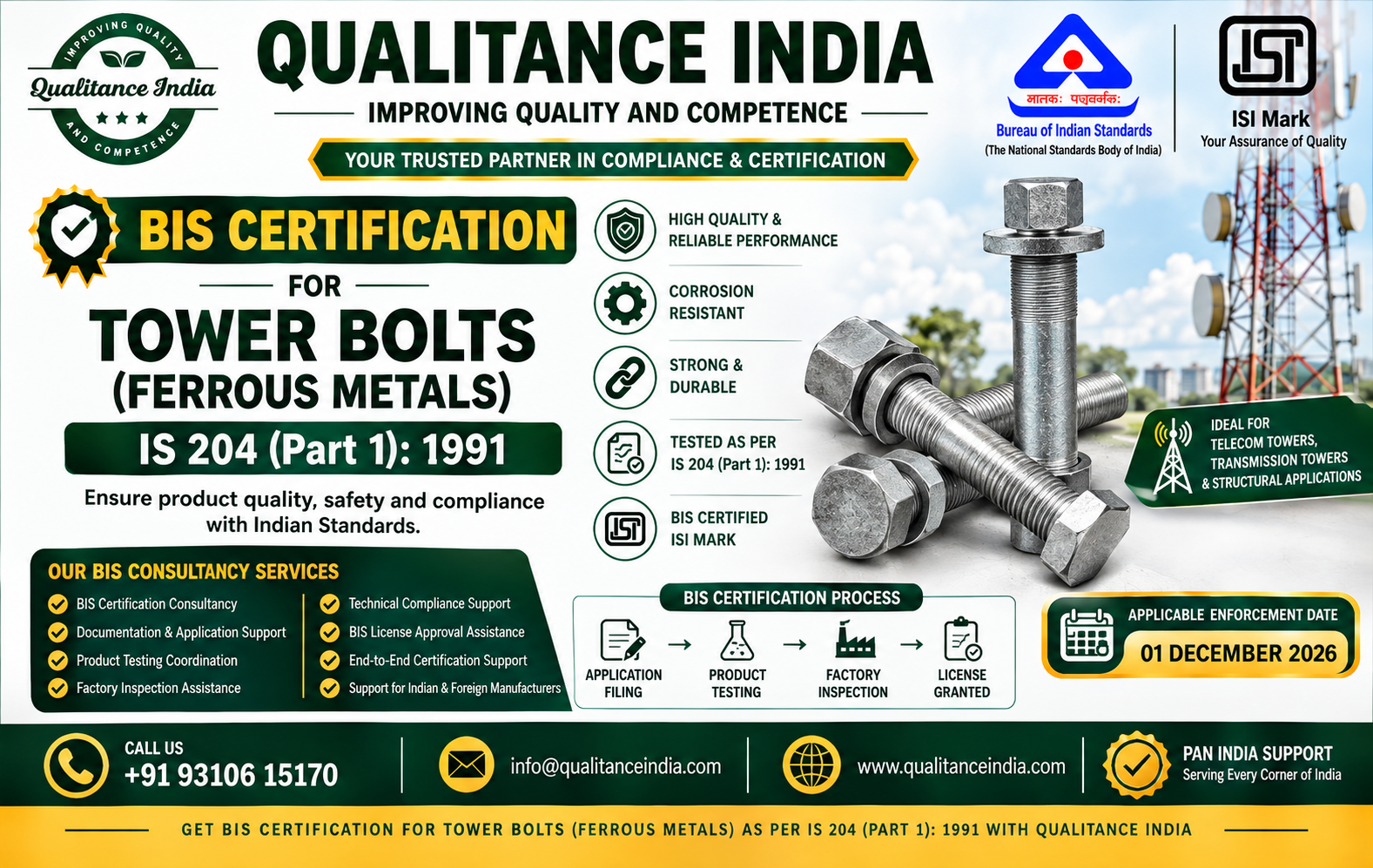
BIS Certification Consultancy for Tower Bolts (Ferrous Metals) | IS 204 (Part 1):1991
Introduction
Tower bolts are widely used as building hardware for securing doors, windows, cabinets, furniture and other movable fittings. Because these components directly affect fastening, closing and locking functionality, consistent dimensions, material quality, workmanship and surface finish are important.
For Tower Bolts – Ferrous Metals, the applicable Indian Standard is IS 204 (Part 1):1991. BIS provides a product manual for certification of these tower bolts under Scheme-I, and the current BIS Scheme-I product listing includes IS 204 (Part 1):1991.
Qualitance India provides complete BIS Certification consultancy for Tower Bolts, covering product and standard identification, documentation, testing coordination, BIS application support, factory inspection preparation, licence processing and post-licence compliance.
What is IS 204 (Part 1):1991?
IS 204 (Part 1):1991 is the Indian Standard covering Tower Bolts – Specification: Part 1 – Ferrous Metals.
The standard covers tower bolts manufactured using ferrous materials and addresses important requirements relating to construction, dimensions, finish, marking and packing.
The BIS product manual identifies the product as “Tower Bolts – Ferrous Metals” and provides certification guidance under Scheme-I.
BIS material describing this standard identifies several tower-bolt designs, including:
- Barrel tower bolts
- Semi-barrel tower bolts
- Riveted or spot-welded tower bolts
- Skeleton tower bolts
These products are generally used as hardware fittings for doors, windows, cabinets and similar applications.
Current BIS Status of IS 204 (Part 1):1991
The current BIS Scheme-I page lists IS 204 (Part 1):1991 – Tower Bolts – Ferrous Metals among products covered under the ISI Mark Scheme.
BIS’s product manual currently available for this product is PM/IS 204 (Part 1)/1/May 2020. The manual states that the document is intended for BIS offices, licence holders and prospective applicants seeking certification under Scheme-I. It records three amendments for the standard in that manual.
The current BIS LIMS also identifies the standard as IS 204: Part 1 (1991), Tower Bolts – Specification: Part 1 ferrous metals (Fifth Revision).
Is BIS Certification Mandatory for Tower Bolts?
Tower Bolts – Ferrous Metals are covered by the Bolts, Nuts and Fasteners Quality Control framework, under which the applicable products are required to conform to the specified Indian Standard and certification requirements.
For IS 204 (Part 1):1991, the QCO implementation timelines were established through the Bolts, Nuts and Fasteners regulatory framework. Current compliance references report implementation from 1 August 2024 for other than micro and small enterprises, 1 November 2024 for small enterprises, and 1 February 2025 for micro enterprises.
Businesses should verify the latest applicable notification and exemptions before manufacturing, importing or selling regulated products.
What Products Are Covered?
The BIS grouping guidelines identify the following major types:
Barrel Tower Bolts
Types:
- Type 1A
- Type 1B
Specified sizes include:
75 mm, 100 mm, 125 mm, 150 mm, 175 mm, 200 mm, 225 mm, 250 mm and 300 mm.
Semi-Barrel Tower Bolts
Types:
- Type 2A
- Type 2B
- Type 3A
- Type 3B
Specified sizes include:
75 mm, 100 mm, 125 mm, 150 mm, 175 mm, 200 mm, 225 mm, 250 mm, 300 mm, 375 mm and 450 mm.
Riveted or Spot-Welded Tower Bolts
Types:
- Type 4A
- Type 4B
Specified sizes include:
100 mm, 125 mm, 150 mm, 175 mm, 200 mm, 225 mm, 250 mm, 300 mm, 375 mm, 450 mm, 600 mm, 750 mm and 900 mm.
Skeleton Tower Bolts
Type:
- Type 5
Specified sizes include:
375 mm, 450 mm, 600 mm, 750 mm and 900 mm.
The standard also allows sizes, dimensions and shapes other than those specified in the standard where agreed between the manufacturer and purchaser, subject to the applicable requirements.
Raw Materials for Tower Bolts
The applicable product requirements specify raw-material provisions under Clause 4 and Table 5 of IS 204 (Part 1):1991.
BIS reference material identifies ferrous material options used for tower bolts, including mild-steel sheets, mild-steel bars and cast iron. The referenced grades include:
- Grade HR1 of IS 1079:2017
- Grade CR2 of IS 513 (Part 1):2016
- Grade E 300-C of IS 2062:2011
- Grade FG 150 of IS 210:2009 for cast-iron components
The product manual further states that MS sheets and MS bars used shall be ISI Marked. For other materials, additional testing may not be required where the material is accompanied by a suitable test certificate or is ISI marked, subject to the prescribed provisions.
Manufacturing Process for Tower Bolts
A typical manufacturing process may include:
Raw Material Inspection → Cutting/Blanking → Forming → Drilling/Punching → Barrel/Plate Formation → Riveting or Spot Welding → Bolt Assembly → Surface Finishing → Inspection → Marking → Packing
The exact manufacturing sequence depends on the tower-bolt design and production technology.
The manufacturer must be able to demonstrate control over production and the applicable conformity requirements.
BIS Certification Requirements for Tower Bolts
The BIS Product Manual identifies the major certification requirements under:
- Material
- Manufacture
- Dimensions
- Finish
- Marking
- Packing
The manual specifies a sample size of 5 pieces for the certification process.
Main Tests for Tower Bolts
1. Material Verification
The material used for the tower bolt must comply with the applicable material requirements of IS 204 (Part 1):1991.
The product manual provides for material control for MS sheets and MS bars and prescribes appropriate material certification/testing arrangements.
2. Manufacture
The manufacturing requirements under Clause 5 are checked to ensure proper construction and workmanship.
The BIS manual lists manufacture, dimensions and applicable coating thickness among the activities that may be completed in a day.
3. Dimensions and Tolerances
Dimensions are an important part of tower-bolt conformity.
Depending on the design, the specified dimensional checks can include:
- Overall size
- Bolt length
- Bolt plate dimensions
- Barrel dimensions
- Socket dimensions
- Bolt diameter
- Plate thickness
- Bore diameter
- Staple dimensions
- Screw-hole provisions
The manual references Tables 1, 2, 3 and 4 of IS 204 (Part 1):1991 for dimensional requirements.
4. Surface Finish
Tower bolts may be supplied with the specified surface finishes applicable to the product.
The product manual includes finish requirements and references testing arrangements for:
- Nickel-chrome plating
- Copper oxidized finish
- Zinc plating
The corresponding testing references include IS 1068, IS 1378 and IS 1573, as applicable.
5. Marking
Conforming production covered by the BIS licence is required to carry the Standard Mark in accordance with the applicable requirements.
The manufacturer must follow the marking provisions of IS 204 (Part 1):1991 and the applicable BIS licence conditions.
6. Packing
Packing of tower bolts must comply with the applicable requirements of Clause 9 of IS 204 (Part 1):1991.
BIS Grouping Guidelines for Tower Bolts
Product grouping is an important part of BIS certification because a manufacturer may produce multiple types and sizes.
The BIS Product Manual provides grouping based on:
- Product description
- Type
- Size
For each tower-bolt type, the grouping guideline requires testing of the smallest and highest size to cover the specified size range for that type.
For example, the licence scope can be established for a particular type and size range based on the prescribed representative samples.
The manufacturer must declare the varieties proposed for inclusion in the licence, and the licence scope may be restricted according to the manufacturer’s manufacturing and testing capabilities. BIS also expects varieties included in the licence scope to be tested in rotation to the extent possible.
BIS Testing Equipment for Tower Bolts
The Product Manual identifies important equipment for testing and inspection.
For Manufacture
- Micrometer
- Countersunk head of wood screws as per IS 6760
For Dimensions and Tolerances
- Vernier caliper
- Micrometer
- Countersunk head of wood screws as per IS 6760
For Surface Finish
Applicable testing equipment and chemicals associated with:
- IS 1068
- IS 1573
- IS 1378
The equipment list in the product manual is indicative and is not necessarily exhaustive.
BIS Laboratory Requirements
A suitable laboratory is required to carry out the specified tests according to the certification requirements.
The Product Manual states that the manufacturer shall maintain a suitably equipped laboratory and appropriately trained/staffed facility for the relevant tests.
A calibration plan for test equipment must also be prepared, and test records must be maintained.
For permitted subcontracted testing, the manual allows subcontracting to a laboratory recognized by BIS or a Government laboratory empanelled by BIS, subject to the prescribed conditions.
Quality Control and Scheme of Inspection and Testing
A proper internal quality-control system is essential for maintaining the BIS licence.
The manufacturer is expected to maintain:
- Test records
- Calibration records
- Material records
- Production records
- Inspection records
- Finish/coating records
- Non-conformity records
The Product Manual provides levels of control for material, manufacture, dimensions and finish. For example, dimensional testing is prescribed on 5 samples for each type and size from every hour of production under the listed scheme.
Where a dimensional sample fails, the manual prescribes additional checking of the affected hourly production before conforming products are marked.
Control of Raw Materials
The quality of tower bolts depends heavily on incoming material.
A manufacturer should maintain suitable records for:
- Steel sheet
- Steel bar
- Cast iron, where applicable
- Plating materials/processes
- Purchased components
- Supplier test certificates
- Incoming inspection
The material provisions of the Product Manual should be followed for each applicable raw material category.
Factory Inspection for BIS Certification
Factory assessment is an important part of obtaining a BIS product licence.
During the certification process, the manufacturer’s facility should be prepared to demonstrate:
- Manufacturing capability
- Product-specific machinery
- Inspection and measurement facilities
- Testing arrangements
- Raw-material controls
- Quality-control procedures
- Calibration
- Production records
- Product identification
- Marking arrangements
- Packing arrangements
Qualitance India assists manufacturers in preparing the factory and documentation before the applicable BIS assessment.
BIS Certification Process for Tower Bolts
The typical process is:
Step 1: Product and manufacturer details review
Step 2: Confirmation of IS 204 (Part 1):1991 applicability
Step 3: Review of tower-bolt types and sizes
Step 4: Grouping and proposed licence scope
Step 5: Factory infrastructure assessment
Step 6: Documentation preparation
Step 7: Sample preparation
Step 8: Product testing
Step 9: BIS application filing
Step 10: Factory inspection/assessment
Step 11: Compliance with observations, if any
Step 12: BIS licence processing
Step 13: Standard Mark implementation
Step 14: Ongoing BIS compliance
Documents Required for BIS Certification
Typical documents may include:
- Company registration documents
- Factory address proof
- Factory ownership/lease documents
- Manufacturing process flow chart
- Factory layout
- Machinery list
- Testing equipment list
- Calibration certificates
- Product drawings/specifications
- Raw-material details
- Raw-material test certificates
- Quality-control documents
- Test reports
- Authorized signatory details
- Applicable declarations and undertakings
- Brand/trademark documents, where applicable
The final checklist depends on the manufacturer’s setup and the applicable BIS requirements.
BIS Certification Consultancy for Tower Bolt Manufacturers
Qualitance India provides complete support for manufacturers seeking BIS certification for Tower Bolts – Ferrous Metals as per IS 204 (Part 1):1991.
Our services include:
Product Identification
We review your tower-bolt product, type, size, material and design to determine the correct certification route.
BIS Applicability Assessment
We help determine the applicable standard, regulatory requirements and certification scheme.
Grouping Support
We review the proposed varieties and help identify the appropriate representative samples and licence scope.
Documentation Support
We assist in preparing and organizing the documents needed for the application.
Testing Coordination
We coordinate product testing according to the applicable requirements and sample plan.
Factory Inspection Preparation
We help review machinery, testing facilities, calibration, production controls and documentation before inspection.
BIS Application Filing
We assist in preparing and submitting the BIS application and supporting documents.
Query & Compliance Support
Where technical or documentary queries arise, we assist in coordinating the required responses.
Licence & Post-Licence Support
We provide support for licence-related compliance, renewal and other applicable BIS activities.
BIS Testing Charges for Tower Bolts
BIS LIMS currently shows active testing scopes for IS 204: Part 1 (1991).
One current LIMS listing shows a displayed testing charge of ₹5,500 excluding taxes for an all-scope entry, while another current laboratory listing shows ₹3,300 excluding taxes and notes a 10% concession for BIS. Actual charges depend on the laboratory, scope of testing, sample requirements and applicable services.
Testing charges should therefore be confirmed from the selected laboratory before sample submission.
Cost of BIS Certification for Tower Bolts
The total cost of BIS certification is not limited to laboratory testing.
Typical cost components can include:
- BIS application and government fees
- Product testing charges
- Sample preparation
- Factory readiness
- Calibration
- Testing equipment
- Documentation
- Inspection-related expenses
- Consultancy charges
- Licence-related fees
- Ongoing compliance expenses
The actual amount depends on the manufacturer, product scope, number of types/sizes, testing arrangement and factory condition.
How Long Does BIS Certification Take?
The certification timeline varies according to:
- Product complexity
- Number of tower-bolt varieties
- Testing schedule
- Documentation readiness
- Factory infrastructure
- Laboratory availability
- Inspection scheduling
- Resolution of BIS queries
Manufacturers can reduce delays by preparing their product scope, factory facilities and technical documents before filing the application.
Common Reasons for BIS Certification Delays
Incorrect Product Scope
The manufacturer may try to include too many varieties without suitable testing or manufacturing capability.
Wrong Sample Selection
Representative samples may not properly cover the proposed product grouping.
Incomplete Documentation
Missing factory, machinery, testing or product information can lead to queries.
Testing Failure
Failure of dimensions, finish or other requirements can result in retesting or corrective action.
Inadequate Testing Facilities
The factory may not have the required measurement and quality-control arrangements.
Calibration Issues
Expired or missing calibration certificates can create compliance problems.
Incorrect Marking
The Standard Mark and related marking requirements must be implemented correctly.
Who Needs BIS Certification for Tower Bolts?
The certification requirement is particularly relevant to manufacturers of tower bolts made from ferrous metals who manufacture products falling within the applicable regulatory framework.
It may also be relevant to:
- OEM manufacturers
- Hardware manufacturers
- Building-hardware manufacturers
- Door-hardware manufacturers
- Furniture-hardware manufacturers
- Government suppliers
- Institutional suppliers
- Businesses supplying regulated tower bolts to the Indian market
Importers and sellers should separately verify the applicable regulatory requirements, exemptions and responsibility for conformity.
Benefits of BIS Certification for Tower Bolt Manufacturers
Quality Assurance
Certification establishes conformity with the applicable Indian Standard.
Better Market Acceptance
Certified products can be more readily accepted where BIS compliance is required.
Improved Buyer Confidence
Government, institutional and commercial buyers can verify compliance through the applicable certification framework.
Standardized Product Quality
The product is manufactured under defined requirements relating to material, construction, dimensions and finish.
Regulatory Compliance
BIS certification helps manufacturers address mandatory requirements when the product is covered by the applicable QCO.
Business Opportunities
BIS-compliant products can support opportunities where purchasers specifically require BIS-certified tower bolts.
Tower Bolts for Government & Institutional Supply
Tower bolts are commonly associated with building hardware and are used on doors, windows, cabinets, furniture and other fittings.
Where government departments, institutional buyers, contractors or procurement platforms specify BIS-certified products, manufacturers should ensure that their BIS licence covers the exact product varieties being supplied.
A licence should not be assumed to cover sizes or types that are outside the approved scope.
Why Choose Qualitance India?
Qualitance India provides end-to-end BIS consultancy for manufacturers who need practical support throughout the certification process.
We help with:
Product & Standard Identification
Correct identification of IS 204 (Part 1):1991 requirements.
BIS Documentation
Application documents and technical information.
Testing Coordination
Sample planning and laboratory coordination.
Factory Preparation
Readiness for BIS assessment and inspection.
Licence Processing
Application, follow-up and compliance support.
Post-Licence Assistance
Renewal, compliance and applicable BIS support.
Quick BIS Certification Checklist for Tower Bolts
Before applying, the manufacturer should review:
☑ Correct Indian Standard identified
☑ Tower-bolt type identified
☑ Sizes finalized
☑ Proposed grouping prepared
☑ Raw materials conforming
☑ Manufacturing machinery available
☑ Testing equipment available
☑ Calibration records available
☑ Product drawings/specifications ready
☑ Quality-control system established
☑ Samples prepared
☑ Testing completed
☑ BIS documents prepared
☑ Factory ready for inspection
☑ Marking and packing arrangements ready
Frequently Asked Questions
1. What is IS 204 (Part 1):1991?
IS 204 (Part 1):1991 is the Indian Standard for Tower Bolts – Specification, Part 1 covering ferrous metals.
2. Is BIS certification required for tower bolts?
Tower Bolts – Ferrous Metals are included under the applicable BIS Scheme-I and Bolts, Nuts and Fasteners regulatory framework. The current applicable QCO and exemptions should be checked for the specific manufacturer and transaction.
3. What is the BIS certification scheme for tower bolts?
The BIS Product Manual identifies certification under Scheme-I.
4. What is the sample size for BIS certification?
The product manual specifies a sample size of 5 pieces.
5. What types of tower bolts are covered?
The grouping guidelines cover barrel, semi-barrel, riveted or spot-welded and skeleton tower bolts.
6. What sizes are covered by the standard?
The available grouping guidelines specify different size ranges according to the tower-bolt type. Sizes include ranges beginning from 75 mm for certain designs and extending up to 900 mm for some riveted/spot-welded and skeleton configurations.
7. Can custom-size tower bolts be manufactured?
The product manual notes that the standard permits sizes, dimensions and shapes other than those specified, where agreed between manufacturer and purchaser, subject to applicable provisions.
8. Is product grouping available?
Yes. BIS provides grouping guidelines based on type and size.
9. How are samples selected for grouping?
The grouping guideline requires the smallest and highest size of each type to be tested for covering the corresponding size range.
10. What are the major tests for tower bolts?
Major conformity areas include material, manufacture, dimensions, finish, marking and packing.
11. Is coating or plating tested?
Yes, where applicable. The product manual includes requirements for finish and references testing arrangements for nickel-chrome, copper oxidized and zinc finishes.
12. Is factory inspection required?
The BIS certification process involves assessment of the manufacturing and quality-control capability applicable to the product and scheme.
13. Is an in-house laboratory required?
The product manual requires a suitably equipped laboratory and provides provisions for permitted subcontracting of testing.
14. Are calibration records required?
Yes. The product manual specifically requires a calibration plan for test equipment and maintenance of relevant test records.
15. Can testing be outsourced?
Where permitted, the manual allows subcontracting to a BIS-recognized laboratory or Government laboratory empanelled by BIS.
16. What raw materials are used for ferrous tower bolts?
Depending on construction, ferrous tower bolts can use specified steel sheets, steel bars and cast-iron components meeting the applicable material requirements.
17. What steel grades are referenced?
BIS reference material identifies Grade HR1 of IS 1079:2017, Grade CR2 of IS 513 (Part 1):2016 and Grade E 300-C of IS 2062:2011 for steel components.
18. What cast-iron grade is referenced?
Grade FG 150 of IS 210:2009 is referenced for cast-iron parts.
19. What equipment is needed?
Important equipment includes micrometers, vernier calipers and other tools appropriate to the applicable dimensions and finish tests.
20. Does the BIS licence cover all tower-bolt sizes automatically?
No. The licence scope depends on the approved product types, sizes and grouping, as well as the manufacturer’s manufacturing and testing capability.
21. Can a manufacturer include several tower-bolt types in one licence?
The proposed varieties can be included according to the applicable grouping and scope provisions, subject to testing and manufacturing capability.
22. What if the manufacturer produces only one type?
The licence scope can be limited to the type and size range for which the manufacturer demonstrates compliance.
23. Is BIS marking required?
Conforming production covered by the BIS licence is required to carry the Standard Mark according to applicable BIS and standard requirements.
24. What is the role of quality control?
Quality control ensures continued conformity of production through material, manufacturing, dimensional and finish checks.
25. Can BIS certification be obtained for a new tower-bolt manufacturer?
Yes, an eligible manufacturer can apply subject to meeting the applicable certification, manufacturing, testing and quality requirements.
26. Can an MSME obtain BIS certification?
Eligible MSMEs can apply for BIS certification, subject to the product-specific requirements and any applicable QCO provisions.
27. Can Qualitance India help with BIS testing?
Yes. We provide testing coordination and sample-planning support.
28. Can Qualitance India help with factory inspection preparation?
Yes. We review the applicable manufacturing, testing, documentation and quality-control requirements before inspection.
29. Can Qualitance India help with BIS renewal?
Yes. We provide support for licence renewal and continuing compliance requirements.
30. How can I start BIS certification for tower bolts?
Share your product details, sizes, types, material specifications, factory information and existing test documents with Qualitance India for an initial certification assessment.
Related BIS Certification Services
Qualitance India also provides consultancy for:
- BIS Certification
- ISI Mark Certification
- BIS Scheme-I Certification
- BIS Licence Renewal
- BIS Scope Extension
- Product Testing Coordination
- BIS Documentation
- Factory Inspection Assistance
- Quality Control Order Applicability
- Product Grouping Guidance
- Technical Compliance Support
- BIS Licence Processing
Related Topics
You may also be interested in:
- BIS Certification for Tower Bolts – Non-Ferrous Metals
- BIS Certification for Stainless Steel Tower Bolts
- BIS Certification for Tee and Strap Hinges
- BIS Certification for Parliament Hinges
- BIS Certification for Rim Latches
- BIS Certification for Mild Steel Sliding Door Bolts
- BIS Certification for Building Hardware Products
- BIS Certification for High Strength Structural Bolts
- BIS Certification for High Strength Structural Nuts
Contact Qualitance India
Qualitance India – Your Certification & Compliance Partner
Phone: +91 93106 15170
Email: info@qualitanceindia.com
Website: https://qualitanceindia.com/
For BIS Certification of Tower Bolts (Ferrous Metals) as per IS 204 (Part 1):1991, Qualitance India provides end-to-end consultancy from product identification and testing to BIS application, factory inspection preparation, licence processing and compliance support.
Conclusion
Tower Bolts – Ferrous Metals are important building-hardware components where proper dimensions, material quality, manufacturing and surface finish directly affect product performance.
For manufacturers covered by the applicable regulatory framework, BIS Certification under IS 204 (Part 1):1991 requires more than simply submitting an application. Product grouping, representative sample selection, testing, quality control, factory readiness, documentation and correct Standard Mark implementation all need to be managed properly.
With Qualitance India’s end-to-end BIS Certification consultancy, manufacturers can receive professional support throughout the certification journey—from identifying the correct product scope and preparing samples to testing, factory inspection preparation, BIS application and post-licence compliance.
Need BIS Certification for Tower Bolts (Ferrous Metals)? Contact Qualitance India for complete BIS licence and compliance support.
Need help with BIS certification for this product?
Get a free consultation from our compliance experts — we handle testing, documentation and the complete BIS process for you.
BIS Certification Readiness Checklist 2026
- Documents, testing & factory requirements in one place
- Covers ISI Mark, CRS, FMCS & Hallmarking
- Tick-box format — share it with your team