BIS Certification for Unplasticized PVC Pipes for Potable Water Supplies | IS 4985:2021 | ISI Mark
Introduction
Unplasticized PVC (PVC-U) pipes are widely used for water supply applications because of their durability, chemical resistance and suitability for different pressure-rated water distribution systems. When these pipes are intended for potable water supplies, compliance with the applicable Indian Standard is an important requirement for manufacturers.
IS 4985:2021 specifies requirements for Unplasticized PVC Pipes for Potable Water Supplies. BIS has issued a product manual for this standard under Scheme-I of the BIS Conformity Assessment Regulations, 2018, which provides guidance for certification, sampling, grouping, inspection and testing.
For manufacturers seeking to obtain an ISI Mark licence for Unplasticized PVC Pipes, BIS certification involves product testing, factory assessment, quality-control arrangements and compliance with the applicable Scheme of Inspection and Testing.
This article explains the BIS certification process for Unplasticized PVC Pipes under IS 4985:2021, including applicable product requirements, testing, documents, factory inspection, scope of licence and the role of a BIS certification consultant.
What is IS 4985:2021?
IS 4985:2021 – Unplasticized PVC Pipes for Potable Water Supplies is the applicable Indian Standard covering specified PVC-U pipes intended for potable water supplies.
The standard covers requirements for plain-ended and socket-ended pipes, including pipes designed for jointing with elastomeric sealing rings and solvent cement. It also covers pipes used for water supply applications, including relevant agricultural applications.
The BIS Product Manual identifies the product under the following certification scope:
Unplasticized PVC Pipes for Potable Water Supplies – IS 4985:2021
The licence scope can include parameters such as:
- Class of pipe / pressure rating
- Nominal size
- Type of pipe
- End configuration
- Applicable additional parameters, including Lead-Free (LF), where relevant
The revised BIS Product Manual also incorporates updated grouping guidelines and Scheme of Inspection and Testing requirements.
Is BIS Certification Mandatory for Unplasticized PVC Pipes?
BIS certification requirements depend on the applicable government notification and compulsory certification framework for the product.
BIS explains that although BIS certification is generally voluntary, the Central Government can make compliance compulsory for specified products through Quality Control Orders (QCOs). Where a product is covered by compulsory certification, manufacturers are required to comply with the applicable BIS requirements and use the Standard Mark under the prescribed BIS licence or conformity route.
For manufacturers of PVC-U pipes, the applicable regulatory position should therefore be checked against the latest government notification and BIS requirements before placing the product on the Indian market.
What Does the ISI Mark Mean for PVC-U Pipes?
The ISI Mark indicates that the product has been certified by BIS against the applicable Indian Standard under the relevant certification scheme.
For Unplasticized PVC Pipes, the manufacturer must obtain the applicable BIS licence before legally using the Standard Mark in the manner permitted by BIS.
The ISI Mark is not simply a logo that a manufacturer can print on packaging. It is connected to a valid BIS licence and the approved scope of the product.
Manufacturers should therefore ensure that:
- The correct Indian Standard is followed.
- The manufacturing facility maintains the required quality-control system.
- Products are tested as required.
- The BIS licence scope accurately covers the manufactured pipe.
- Marking requirements are followed.
- The Standard Mark is used only in accordance with BIS requirements.
Product Coverage Under IS 4985:2021
IS 4985:2021 covers PVC-U pipes for potable water supply applications and provides requirements relating to different pipe classifications and configurations.
The BIS Product Manual identifies Type A and Type B within the licence scope. The standard also addresses different pressure classes and nominal sizes.
Depending on the manufacturer's product range, the certification scope may cover different combinations of:
- Pressure class
- Nominal diameter
- Pipe type
- Plain-ended pipes
- Socketed pipes for elastomeric sealing ring jointing
- Socketed pipes for solvent cement jointing
The exact scope of a BIS licence should be established according to the applicable grouping guidelines rather than assuming that one tested pipe automatically covers the entire product range.
Important Requirements for Manufacturing PVC-U Pipes
Manufacturers applying for BIS certification should ensure that their production process is capable of consistently producing pipes conforming to IS 4985:2021.
The BIS Product Manual identifies PVC resin and applicable additives among the raw-material requirements. PVC resin is addressed under the relevant clause of IS 4985, while additives are referenced to IS 10148.
The manufacturing facility should have suitable controls for:
- Raw-material procurement
- PVC resin verification
- Additive control
- Compounding
- Extrusion
- Dimensional control
- Socket formation, where applicable
- Cutting and finishing
- Product identification
- In-process inspection
- Finished-product testing
- Batch/lot traceability
- Calibration of measuring and testing equipment
Consistent process control is particularly important because PVC-U pipes must satisfy both dimensional and performance requirements.
Key Tests for IS 4985:2021
Testing is an important part of the BIS certification process.
The current BIS LIMS records for IS 4985:2021 show testing facilities covering various requirements of the standard. Depending on the applicable scope and laboratory, testing can include the following areas.
1. Visual Appearance
The pipe surface and overall appearance are examined to ensure compliance with the applicable requirements.
The product should be free from unacceptable defects that could affect its performance or intended use.
2. Dimensions
Dimensional checks can include:
- Mean outside diameter
- Outside diameter at specified points
- Wall thickness
- Ovality
- Length
- Socket dimensions, where applicable
Dimensional conformity is important for proper installation and jointing.
3. Opacity
Opacity testing is carried out as specified by the standard to verify the applicable requirement for the pipe.
4. Reversion Test
The reversion test evaluates dimensional changes after exposure to specified conditions and is an important quality-control test for PVC-U pipes.
5. Vicat Softening Temperature
Vicat softening temperature testing helps assess the thermal characteristics of the PVC-U material.
6. Density
Density testing is included among the physical characteristics addressed in the applicable testing scope.
7. Sulphated Ash Content
Sulphated ash testing is used to assess the material composition against the applicable requirement.
8. Hydrostatic Pressure Test
Hydrostatic pressure testing is one of the important performance tests for PVC-U water-supply pipes.
The BIS LIMS records include hydrostatic pressure testing for both type testing and acceptance testing, as applicable. Separate provisions are also shown for integral sealing-ring sockets and plumbing pipes.
9. Resistance to External Blows
The standard includes testing for resistance to external blows at the specified temperature.
10. Effect on Water
Because these pipes may be used for potable water supplies, the applicable effect on water requirements are particularly important.
The current BIS LIMS scope includes testing related to substances such as lead and other specified toxic substances, depending on the applicable requirements and test scope.
11. VCM Content and PVC Resin Requirements
The current BIS LIMS records also identify testing related to VCM content and PVC resin requirements under the applicable clauses.
BIS Testing Charges for IS 4985:2021
Testing charges vary according to the BIS-recognized laboratory, product range, nominal diameter, testing scope and applicable test requirements.
Current BIS LIMS listings show examples of complete or defined testing scopes for IS 4985:2021 ranging from approximately ₹8,000 to ₹32,200, depending on the laboratory and scope. These figures should not be treated as a fixed BIS certification cost because laboratory charges and test scope can vary.
For example, a current BIS LIMS listing shows testing for Type A/Type B, Classes 1–6 and specified pipe sizes at ₹8,000 excluding taxes, while another laboratory lists a broader scope up to DN 315 mm at ₹32,200 excluding applicable taxes.
Therefore, manufacturers should obtain the applicable laboratory quotation based on their actual product scope before estimating the complete certification budget.
Sample Requirements for BIS Certification
The BIS Product Manual has been revised over time.
The current October 2023 Product Manual specifies a sample size of 10 pipes of 1 metre length for the complete test.
Earlier versions of the product manual contained different sample requirements, which is why manufacturers should always follow the latest applicable BIS Product Manual rather than relying on an old certification document.
BIS Grouping Guidelines for PVC-U Pipes
Manufacturers often produce PVC-U pipes in multiple sizes, pressure classes and configurations.
BIS provides grouping guidelines to determine how products can be represented during testing and how the certification scope may be established.
The current Product Manual specifically directs applicants to Annex A for grouping guidelines.
Proper grouping is important because selecting the wrong representative product can lead to additional testing, delays or an unnecessarily restricted licence scope.
A manufacturer should therefore prepare its complete product range before finalizing the testing plan.
BIS Factory Inspection for IS 4985:2021
BIS certification under Scheme-I involves assessment of the manufacturing facility and verification of the manufacturer's ability to consistently manufacture products conforming to the applicable standard.
During the certification process, BIS may evaluate areas such as:
- Manufacturing infrastructure
- Raw-material control
- Production facilities
- Testing facilities
- Quality-control arrangements
- Calibration records
- Inspection and testing procedures
- Finished-product control
- Internal quality records
- Personnel responsible for testing and quality control
- Implementation of the applicable Scheme of Inspection and Testing
The manufacturer's in-house testing facilities should be suitable for the applicable requirements, while tests that require specialized equipment may be coordinated through an appropriate BIS-recognized laboratory as permitted by the certification process.
Scheme of Inspection and Testing
The Scheme of Inspection and Testing (SIT) is an important part of BIS product certification.
For IS 4985:2021, the BIS Product Manual contains the applicable Scheme of Inspection and Testing and related certification guidance.
The SIT helps establish:
- What needs to be tested
- Frequency of testing
- Acceptance criteria
- Records to be maintained
- Responsibility for inspection
- Controls required during production
- Actions to be taken when a product does not conform
Manufacturers should implement the applicable SIT at the factory rather than treating it as paperwork required only during the initial application.
Documents Required for BIS ISI Mark Certification
A manufacturer applying for BIS certification for Unplasticized PVC Pipes may need documents such as:
- Company/manufacturer details
- Manufacturing address
- Factory layout
- Manufacturing process flow
- List of manufacturing machinery
- List of testing equipment
- Calibration certificates
- Raw-material specifications
- Raw-material test certificates, where applicable
- Product specifications
- Quality-control procedures
- Internal test reports
- Laboratory test reports
- Details of technical and quality-control personnel
- Details of manufacturing facilities
- Applicable legal/company documents
- Trademark information, where applicable
- Authorization documents, where applicable
- Undertakings and declarations required by BIS
The exact documentation depends on the applicant's business structure, manufacturing location, product scope and BIS application requirements.
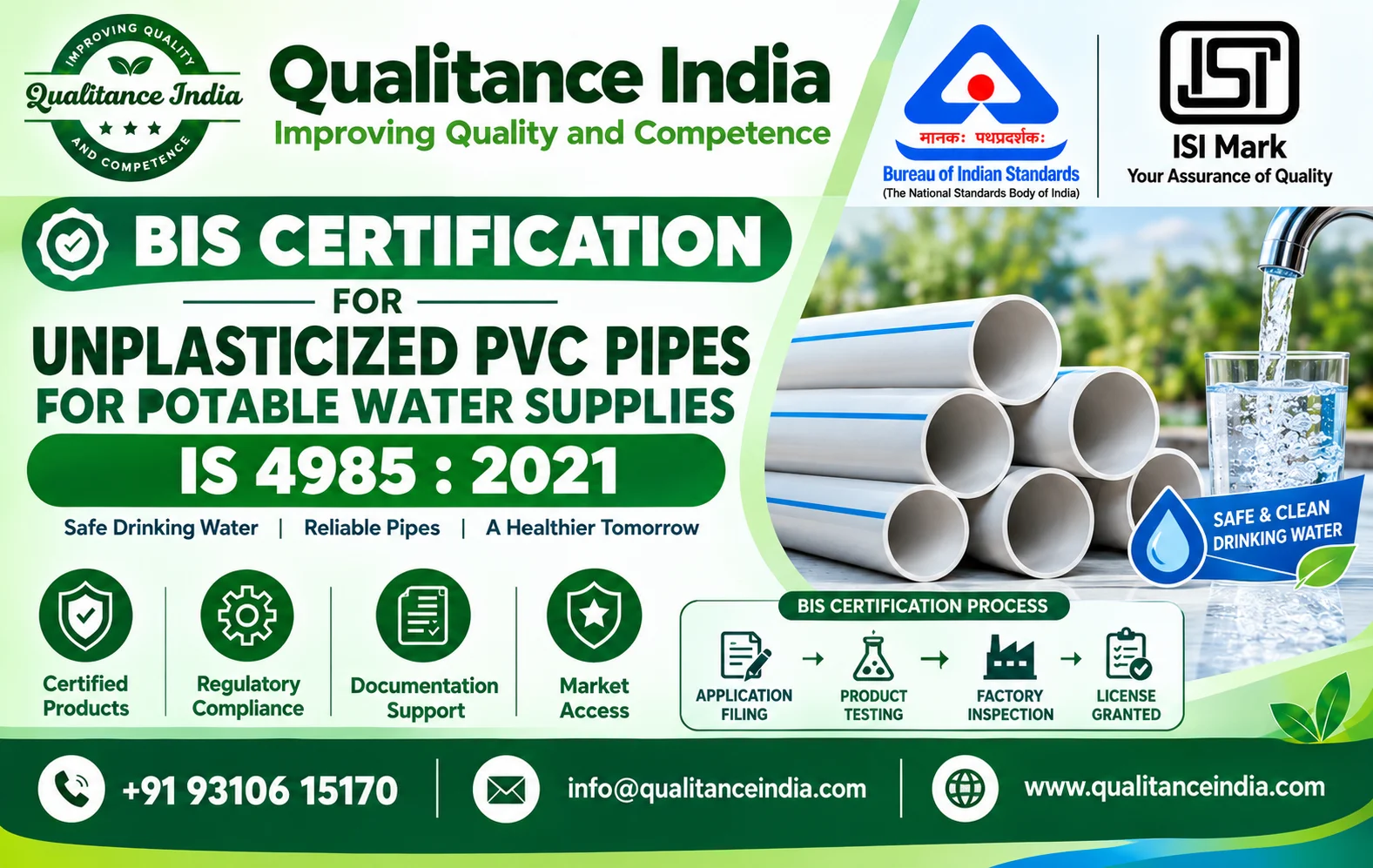
BIS Certification Process for Unplasticized PVC Pipes
The general certification journey can be understood through the following steps.
Step 1: Identify the Applicable Standard
First, the manufacturer should confirm that the product falls under IS 4985:2021 – Unplasticized PVC Pipes for Potable Water Supplies.
Step 2: Review the Product Range
Prepare details of all pipe sizes, pressure classes, types and end configurations intended to be covered.
Step 3: Determine the BIS Grouping
The applicable BIS grouping guidelines should be reviewed to determine the representative samples and proposed licence scope.
Step 4: Prepare the Factory and Testing Facilities
The manufacturing unit should have appropriate machinery, inspection facilities and testing arrangements required for the product.
Step 5: Product Testing
Samples are tested against the applicable requirements of IS 4985:2021 through the appropriate testing route.
Step 6: Submit the BIS Application
The manufacturer submits the required application and supporting documents through the BIS certification system.
Step 7: BIS Factory Assessment
BIS assesses the manufacturing facility and verifies the implementation of the required quality-control and testing arrangements.
Step 8: Address Non-Conformities
If any non-conformity is identified during testing or factory assessment, the manufacturer needs to take appropriate corrective action.
Step 9: BIS Licence Grant
After satisfactory completion of the applicable certification requirements, BIS may grant the licence covering the approved product scope.
Step 10: Use of ISI Mark
After obtaining the licence, the manufacturer can use the BIS Standard Mark in accordance with the conditions and scope of the licence.
Why Correct Licence Scope Matters
A BIS licence does not automatically cover every PVC-U pipe manufactured by a company.
The approved scope can identify parameters such as:
- Product name
- Pressure class
- Nominal size
- Type
- End configuration
- Additional applicable parameters
The current BIS Product Manual specifically provides for these scope elements.
Manufacturers planning to add new sizes, pressure classes or product configurations should therefore check whether a scope extension or additional testing is required before selling those products with the BIS Standard Mark.
Lead-Free PVC Pipes
The current BIS Product Manual identifies Lead-Free (LF) as an additional parameter where applicable.
Manufacturers supplying PVC-U pipes for applications where lead-free requirements are applicable should ensure that the relevant formulation, raw materials, testing and certification scope are aligned with the applicable requirements.
This should be addressed during certification planning rather than after the licence has already been granted.
Common Reasons for Delay in BIS Certification
Manufacturers can experience delays when important certification requirements are not prepared correctly before testing or inspection.
Common issues include:
- Incorrect product classification
- Incomplete product range information
- Incorrect grouping of sizes
- Inadequate testing facilities
- Missing calibration certificates
- Incomplete raw-material records
- Product samples not matching the proposed scope
- Non-conforming laboratory test results
- Incomplete factory documentation
- Incorrect marking arrangements
- Lack of implementation of the applicable SIT
- Delayed corrective action after inspection
Proper preparation before submitting the BIS application can reduce avoidable delays.
Benefits of BIS Certification for PVC-U Pipe Manufacturers
Obtaining BIS certification and using the ISI Mark in accordance with the approved licence can help manufacturers demonstrate conformity with the applicable Indian Standard.
For manufacturers, certification can support:
- Compliance with applicable regulatory requirements
- Market acceptance
- Demonstration of product quality
- Better control over manufacturing processes
- Structured quality-control practices
- Customer confidence
- Participation in projects and procurement where BIS compliance is specified
- Clear identification of certified product scope
For potable water supply products, conformity to applicable requirements is especially important because the product comes into contact with water intended for human consumption.
Why Choose Qualitance India for BIS Certification Consultancy?
Obtaining BIS certification for PVC-U pipes involves more than submitting an application. Manufacturers need to understand the applicable standard, grouping guidelines, testing requirements, factory requirements and certification documentation.
Qualitance India provides professional BIS certification consultancy support for manufacturers seeking BIS/ISI Mark certification.
Our support can include:
- BIS certification requirement assessment
- IS 4985:2021 compliance guidance
- Product scope and grouping guidance
- Documentation support
- Application preparation assistance
- Testing laboratory coordination
- Sample testing coordination
- Factory inspection preparation
- Quality-control documentation support
- Scheme of Inspection and Testing guidance
- Non-conformity support
- BIS licence application assistance
- Scope-extension guidance
- Post-certification compliance support
Our objective is to help manufacturers understand the certification requirements and move through the BIS process in a structured manner.
Frequently Asked Questions
1. What is the BIS standard for Unplasticized PVC Pipes for Potable Water Supplies?
The applicable Indian Standard is IS 4985:2021 – Unplasticized PVC Pipes for Potable Water Supplies.
2. Is IS 4985:2021 an ISI Mark standard?
Yes. BIS has issued a Product Manual for IS 4985:2021 under Scheme-I, which is the BIS product certification/ISI Mark route.
3. What types of PVC-U pipes can be covered?
The certification scope can include Type A and Type B pipes, different pressure classes, nominal sizes and specified end configurations, subject to the applicable grouping guidelines.
4. Can plain-ended PVC pipes be certified?
Yes. Plain-ended pipes are included among the end configurations identified in the BIS Product Manual.
5. Can socketed PVC pipes be certified?
Yes. The scope includes socketed pipes for elastomeric sealing ring jointing and socketed pipes for solvent cement jointing.
6. What are the major tests for IS 4985:2021?
Testing can include dimensions, visual appearance, opacity, reversion, Vicat softening temperature, density, hydrostatic pressure, resistance to external blows, effect on water and other applicable physical, chemical and mechanical requirements.
7. How many samples are required?
The current October 2023 BIS Product Manual specifies 10 pipes of 1 metre length for complete testing.
8. Is factory inspection involved?
BIS product certification under Scheme-I involves assessment of the manufacturing facility and verification of the applicable production, inspection and testing arrangements.
9. Does the manufacturer need testing equipment?
The manufacturer needs appropriate inspection and testing facilities required under the applicable certification requirements and Scheme of Inspection and Testing.
10. Can one BIS licence cover different pipe sizes?
The licence scope can cover multiple sizes where permitted by the applicable grouping guidelines and supported by the required testing and certification requirements.
11. Can different pressure classes be included?
Different pressure classes may be included subject to the applicable grouping, testing and BIS licence-scope requirements.
12. What is a BIS scope extension?
A scope extension is the process of adding additional products, sizes, pressure classes or other permitted parameters to an existing BIS licence after satisfying the applicable requirements.
13. Is Lead-Free certification possible?
The current Product Manual identifies Lead-Free (LF) as an additional parameter where applicable.
14. Are recycled materials allowed?
Material requirements must be evaluated against the applicable provisions of IS 4985:2021 and the approved manufacturing formulation. Manufacturers should not assume that externally sourced recycled PVC is automatically acceptable.
15. How much does BIS testing cost for PVC-U pipes?
Testing costs depend on the laboratory and product scope. Current BIS LIMS listings show different charges for IS 4985:2021, including examples around ₹8,000 and ₹32,200 for specified scopes, excluding taxes.
16. How long does BIS certification take?
The timeline depends on documentation readiness, laboratory testing, factory assessment, corrective actions and BIS processing. A fixed timeline should not be promised without reviewing the manufacturer's product and factory details.
17. Can a manufacturer apply for multiple pipe sizes together?
Yes, manufacturers can plan a certification scope covering multiple sizes, but the applicable BIS grouping guidelines must be followed.
18. What happens if a sample fails testing?
The manufacturer may need to investigate the cause, implement corrective action and follow the applicable BIS procedure for handling the non-conformity and further testing.
19. Can an overseas manufacturer obtain BIS certification?
Foreign manufacturers may be eligible for BIS certification subject to the applicable BIS procedures, requirements for foreign manufacturers and the relevant certification framework.
20. Can Qualitance India help with IS 4985:2021 certification?
Yes. Qualitance India provides consultancy support for BIS certification, including documentation, testing coordination, application assistance, factory inspection preparation and certification support.
Get BIS Certification for PVC-U Pipes with Professional Consultancy Support
If you manufacture Unplasticized PVC Pipes for Potable Water Supplies and require BIS Certification / ISI Mark Licence as per IS 4985:2021, proper preparation of your product scope, testing plan, documentation and factory compliance is essential.
Qualitance India can assist manufacturers throughout the BIS certification process, from initial requirement assessment to testing, documentation, factory inspection preparation and licence-related support.
Qualitance India BIS Certification Consultancy Phone: +91-9310-615-170 Email: info@qualitanceindia.com Website: qualitanceindia.com
Contact our BIS certification team to discuss your PVC-U pipe product range and understand the applicable certification requirements for IS 4985:2021.
Conclusion
BIS Certification for Unplasticized PVC Pipes for Potable Water Supplies under IS 4985:2021 involves compliance with product requirements, testing, grouping guidelines, manufacturing controls, inspection and the applicable Scheme of Inspection and Testing.
The current BIS Product Manual provides specific guidance regarding product scope, grouping, sampling, testing and licensing requirements, while BIS LIMS provides current laboratory information and testing facilities for IS 4985:2021.
For manufacturers, preparing the correct product scope and testing strategy before applying can help avoid unnecessary delays and additional testing. Professional BIS consultancy can also simplify documentation, laboratory coordination and factory inspection preparation.