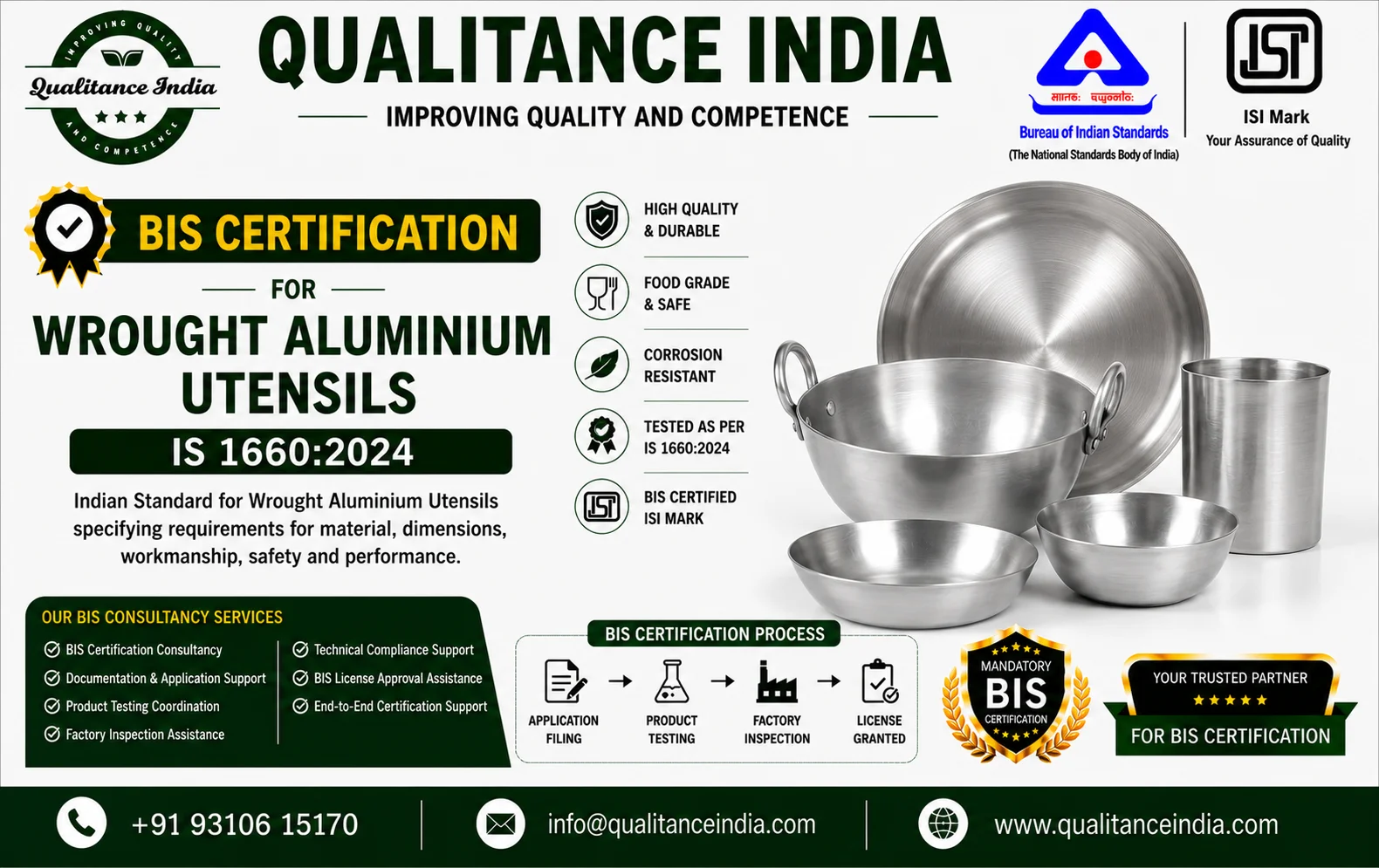
BIS Certification Consultancy for Wrought Aluminium Utensils | IS 1660:2024 | BIS & ISI Mark Certification
Introduction
Aluminium utensils are widely used in Indian households, restaurants, hotels, commercial kitchens, food-service operations and institutional facilities because aluminium is lightweight, economical and has good heat-conducting properties. Wrought aluminium cookware is commonly manufactured into products such as frying pans, sauce pans, tawas and other household cooking utensils.
In India, IS 1660:2024 – Wrought and Cast Aluminium Utensils – Specification (Second Revision) establishes requirements for commonly used wrought and cast aluminium utensils. BIS’s technical compendium states that the standard covers utensils up to 30 litres capacity and addresses material, thickness, shape, dimensions, manufacture, finish and product-performance requirements. The standard includes products such as utensils, thick-bottom utensils, compartmental trays and lunch boxes.
The current BIS Product Manual PM/IS 1660/4/October 2024 operates certification under Scheme-I of the BIS Conformity Assessment Regulations, 2018. It specifies a sample size of two utensils, detailed product grouping, applicable raw-material standards, testing equipment and a Scheme of Inspection and Testing.
IS 1660:2024 is included in the compulsory BIS framework for cookware and utensils. BIS’s current Scheme-I listing places it under Cookware, Utensils and Cans for Food and Beverages, and BIS’s October 2025 newsletter states that the Cookware, Utensils and Cans for Foods and Beverages (Quality Control) Order, 2025 came into force from 1 October 2025 and specifically includes IS 1660:2024 – Wrought and Cast Aluminium Utensils. BIS’s current compulsory-certification page also records subsequent 2026 QCO entries.
For manufacturers, BIS certification is therefore not simply a testing exercise. Product classification, manufacturing process, utensil type, coating, classification, size, induction-friendly base, raw-material conformity, factory testing arrangements and continuing quality control all need to be properly planned.
Qualitance India provides end-to-end BIS Certification Consultancy for Wrought Aluminium Utensils as per IS 1660:2024, including product applicability assessment, product grouping, raw-material review, sample preparation, laboratory testing coordination, documentation, BIS application assistance, factory inspection preparation and licence support.
What is IS 1660:2024?
IS 1660:2024 is titled:
“Wrought and Cast Aluminium Utensils – Specification (Second Revision)”
The current BIS Product Manual identifies certification under Scheme-I and is intended to guide BIS offices, existing licence holders and prospective applicants seeking certification.
The standard establishes requirements for commonly used wrought and cast aluminium utensils and covers important characteristics including:
- Material
- Sheet thickness
- Shape
- Dimensions
- Classification
- Fabrication
- Handles
- Workmanship
- Finish
- Plain finish
- Anodic coating
- Hard anodic coating
- Non-stick coating
- Ceramic coating
- Powder coating
- High-temperature liquid-resistant coating
- Induction-compatible base
- Thermal and performance requirements
- Capacity
- Marking
BIS’s technical compendium also identifies performance, thermal, free-fall and capacity tests among the tests specified to ensure reliable use of the utensils.
What are Wrought Aluminium Utensils?
Wrought aluminium utensils are cooking or food-use utensils manufactured from wrought aluminium or aluminium alloy products through mechanical working processes rather than casting the finished utensil body.
Depending on the product design, manufacturing may involve processes such as:
- Blanking
- Pressing
- Deep drawing
- Spinning
- Forming
- Trimming
- Machining
- Handle fixing
- Surface treatment
- Coating
The current Product Manual also covers cast aluminium utensils, meaning the certification framework for IS 1660:2024 is broader than wrought utensils alone.
Aluminium Utensils Covered Under IS 1660:2024
The current Product Manual identifies the following product categories within the licence scope:
Wrought Aluminium Utensils
Wrought aluminium utensils manufactured through mechanical working processes.
Cast Aluminium Utensils
Aluminium utensils manufactured through casting.
Utensils
General utensils covered by the relevant figures and provisions of the standard.
Compartmental Trays
Multi-compartment aluminium trays covered under the standard.
Lunch Boxes
Aluminium lunch boxes covered by the applicable provisions.
Thick Bottom Utensils
Utensils with thicker bottom construction as specified in the standard.
Wrought Utensils with Other Shapes and Dimensions
The Product Manual also provides a separate grouping category for wrought aluminium utensils whose shape and dimensions are not covered by the specified standard configurations.
Scope of BIS Licence for Aluminium Utensils
The current BIS Product Manual defines licence scope based on multiple product parameters.
These include:
- Manufacturing process
- Type of utensil
- Classification
- Nominal diameter/size
- Type of coating
- Induction-friendly base, where applicable
The recognized utensil types include:
- Utensils
- Compartmental trays
- Lunch boxes
- Thick-bottom utensils
- Certain wrought utensils having shapes and dimensions outside the standard configurations.
The classification is:
Light / Medium / Heavy
The coating categories identified by the current Product Manual include:
- Plain
- Hard anodic
- Anodic
- Non-stick
- Ceramic
- High-temperature liquid resistant
- Powder coated
For products having an induction-friendly base, the Product Manual states that such cookware is to be tested separately.
Capacity Covered Under IS 1660:2024
BIS’s technical compendium states that the standard covers commonly used wrought and cast aluminium utensils up to 30 litres capacity.
The exact capacity, shape, diameter, size and thickness requirements depend on the particular utensil type and classification.
Manufacturers should therefore verify the applicable table, figure and dimensional provisions before finalising the BIS licence scope.
Material Requirements for Aluminium Utensils
Material quality is one of the most important aspects of aluminium utensil certification because the utensils are intended for food-related use.
BIS technical information states that aluminium used in utensils must have a minimum purity of 99.0 percent, with specified limits on impurities such as:
- Iron
- Silicon
- Copper
- Manganese
These controls support the required product quality and resistance characteristics.
The current Product Manual identifies raw-material standards depending on the component.
For the main body, applicable references include:
- IS 21
- IS 737
- IS 617, as applicable
For other aluminium components and parts, the Product Manual identifies:
- IS 21
- IS 617
- IS 734
- IS 737
as applicable.
Is BIS Certification Mandatory for Wrought Aluminium Utensils?
Yes, the product is covered by the compulsory BIS certification framework applicable to IS 1660:2024.
BIS’s current Scheme-I page specifically lists:
IS 1660:2024 – Wrought Aluminium Utensils
under Cookware, Utensils and Cans for Food and Beverages. The same page records the applicable QCO notifications through 2026.
BIS’s October 2025 newsletter states that the Cookware, Utensils and Cans for Foods and Beverages (Quality Control) Order, 2025 came into force on 1 October 2025 and lists IS 1660:2024 – Wrought and Cast Aluminium Utensils among the covered products.
Therefore, manufacturers supplying products covered by IS 1660:2024 should obtain the applicable BIS licence before using the Standard Mark and supplying regulated products in the Indian market.
Cookware, Utensils and Cans Quality Control Order
The current BIS compulsory-certification framework groups IS 1660:2024 with other cookware, utensils and food/beverage packaging standards.
The current BIS page identifies the category as:
Cookware, Utensils and Cans for Food and Beverages
and lists, among others:
| Product | Indian Standard |
|---|---|
| Stainless Steel Cookware | IS 14756:2022 |
| Wrought Aluminium Utensils | IS 1660:2024 |
| Stainless Steel Sinks for Domestic Purposes | IS 13983:1994 |
| Three-piece Round Open Top Metal Cans | IS 18427:2024 |
| Aluminium Cans for Beverages | IS 14407:2023 |
The BIS page records the applicable QCO notifications and amendments through 2026.
Important Regulatory Update
Manufacturers should use the current regulatory position rather than older references to aluminium-utensil requirements.
The current BIS Product Manual is specifically issued for IS 1660:2024 and dated October 2024. BIS’s October 2025 newsletter states that the Cookware, Utensils and Cans QCO came into force from 1 October 2025, and the current BIS compulsory-certification page records further notifications through 2026.
The current standard is therefore IS 1660:2024, and manufacturers should align their product specifications, laboratory testing, manufacturing controls and licence scope with this edition and the latest BIS/QCO requirements.
Who Needs BIS Certification for Aluminium Utensils?
BIS certification is relevant to manufacturers producing covered products such as:
- Wrought Aluminium Utensil Manufacturers
- Cast Aluminium Utensil Manufacturers
- Aluminium Cookware Manufacturers
- Aluminium Tawa Manufacturers
- Aluminium Frying Pan Manufacturers
- Aluminium Sauce Pan Manufacturers
- Aluminium Lunch Box Manufacturers
- Aluminium Compartment Tray Manufacturers
- Thick Bottom Utensil Manufacturers
- Aluminium Kitchenware Manufacturers
- Institutional Kitchenware Manufacturers
- OEM Manufacturers
- Contract Manufacturers
Importers, sellers and other businesses dealing with regulated products should verify their specific obligations under the applicable QCO and BIS framework.
BIS Certification Eligibility Requirements
A manufacturer seeking BIS certification should have an appropriate manufacturing facility and an effective quality-control system.
Depending on the manufacturing process, the factory may require:
- Aluminium sheet or material handling facilities
- Pressing equipment
- Deep-drawing machinery
- Spinning machinery
- Forming equipment
- Trimming equipment
- Casting facility, where applicable
- Bottom-thickness processing equipment
- Handle assembly facilities
- Coating facility, where applicable
- Anodizing facility, where applicable
- Non-stick coating facility, where applicable
- Ceramic or powder coating facility, where applicable
- Induction base assembly facility
- Dimensional inspection equipment
- Thickness measurement equipment
- Coating test equipment
- Quality-control personnel
- Calibration arrangements
- Production records
- Test records
- Raw-material traceability
The scope of required facilities depends on the actual manufacturing process and product configurations proposed for the BIS licence.
BIS Certification Process for Wrought Aluminium Utensils
Step 1 – Product Applicability Assessment
The product is first reviewed against IS 1660:2024.
The assessment includes:
- Wrought or cast process
- Utensil type
- Size
- Classification
- Sheet thickness
- Coating
- Induction base
- Product construction
Step 2 – Manufacturing Process Identification
The manufacturer must identify whether the products are made through:
Wrought/mechanical working
or
Casting
The Product Manual treats these as separate grouping parameters.
Step 3 – Product Type Finalisation
The manufacturer identifies the applicable category:
- Utensil
- Compartmental tray
- Lunch box
- Thick bottom utensil
- Other qualifying wrought utensil shape/dimension
Step 4 – Classification Finalisation
The product is classified as:
- Light
- Medium
- Heavy
Step 5 – Coating Assessment
The applicable surface condition is identified:
- Plain
- Anodic
- Hard anodic
- Non-stick
- Ceramic
- High-temperature liquid resistant
- Powder coated
Step 6 – Induction Base Assessment
Where the cookware contains an induction-friendly base, this must be identified separately because BIS grouping requires induction-compatible cookware to be tested separately.
Step 7 – Product Grouping
The licence scope and representative samples are determined according to Annex A of the current Product Manual.
Step 8 – Documentation Preparation
Technical, factory and quality-control documents are prepared.
Step 9 – Sample Preparation
The Product Manual specifies:
Sample Size: 2 utensils.
Step 10 – Laboratory Testing
Representative samples are tested for the applicable requirements of IS 1660:2024.
Step 11 – BIS Application
The manufacturer submits the BIS application with the required documents and supporting information.
Step 12 – Factory Assessment
BIS assesses the manufacturing, testing and quality-control arrangements.
Step 13 – Observation Closure
Any observations raised during assessment are addressed with corrective actions and supporting evidence.
Step 14 – BIS Licence Grant
After successful conformity assessment, BIS grants the licence for the approved scope.
Step 15 – ISI Marking
The manufacturer can apply the BIS Standard Mark to products covered by the approved licence and meeting all applicable requirements.
BIS Sample Size for Aluminium Utensils
The current BIS Product Manual specifies:
Two Utensils
as the sample size.
However, product grouping determines which sample configurations need to be tested.
For example, wrought and cast utensils are tested separately. For Groups I to III, one sample from each applicable group, coating type and classification is tested to cover the relevant size range. Group IV and Group V have their own grouping provisions.
This means manufacturers should finalise their desired product scope before sending samples to a laboratory.
Product Grouping under IS 1660:2024
Product grouping is one of the most important parts of BIS certification for aluminium utensils.
The current Product Manual identifies grouping according to:
Manufacturing Process
- Wrought
- Cast
Type of Utensil
Group I – Utensils
Group II – Compartmental Trays
Group III – Lunch Boxes
Group IV – Thick Bottom Utensils
Group V – Wrought Aluminium Utensils with shapes and dimensions not covered under the specified provisions.
Coating
- Plain
- Hard anodic
- Anodic
- Non-stick
- Ceramic
- High-temperature liquid resistant
- Powder coated
Classification
- Light
- Medium
- Heavy
Induction-Friendly Base
- Yes
- No
All of these parameters can influence the required representative samples and licence scope.
Detailed Grouping Provisions
For Groups I to III, the Product Manual provides for one sample from each applicable group, coating type and classification to cover the relevant nominal diameter/size range for that tested configuration.
For Group IV – Thick Bottom Utensils, one sample from an applicable nominal diameter/size and each coating type can cover the relevant range subject to the Product Manual provisions.
For Group V, one sample from an applicable inner diameter and coating type can cover the applicable inner-diameter range, while the shape and dimensions of each such utensil are to be declared to BIS for records.
An important provision is that where coated utensils are tested—such as hard anodic, anodic, non-stick, ceramic, high-temperature liquid-resistant or powder-coated utensils—the corresponding plain utensils of that group can also be covered, subject to the stated grouping provisions.
Cookware having an induction-friendly base must be tested separately.
Raw Material Requirements
The Product Manual provides detailed raw-material references.
Main Body
The main body can use aluminium material conforming to the applicable requirements of:
- IS 21
- IS 737
- IS 617
as specified for the relevant construction.
Other Aluminium Components
Other aluminium components and parts can be based on:
- IS 21
- IS 617
- IS 734
- IS 737
as applicable.
Aluminium Lids
For aluminium lids, the Product Manual identifies:
- IS 21
- IS 737
For steel lids, specific grades of IS 6911 are applicable as specified in IS 1660.
Tempered Glass Lid Rim
The rim of a tempered glass lid is linked to:
- IS 5522
- IS 15997
as applicable.
Lunch Box Clips and Wires
The Product Manual identifies Designation 19000 of IS 739 for relevant clip wires and aluminium alloy wire components.
Handle Rivets
For rivets used to fix handles, the Product Manual identifies applicable aluminium grades/designations from IS 739 / IS 740, and relevant stainless-steel grades from IS 6527 / IS 6528, depending on the construction.
Flame Guard Strips
Applicable strips for flame guards can refer to:
- IS 737
- IS 1285
- IS 6911
as applicable.
Testing Requirements for IS 1660:2024
Testing is a major part of aluminium utensil certification because the product must satisfy requirements relating to dimensions, construction, finish, coating, thermal performance and safe usage.
BIS’s Product Manual identifies a detailed testing framework.
Thickness of Aluminium Sheet
Thickness is a fundamental requirement because the standard classifies utensils into Light, Medium and Heavy categories with applicable thickness requirements.
The Product Manual identifies a micrometer for checking sheet thickness and permissible reduction in thickness.
Thickness checks may be especially important during incoming-material inspection and final product verification.
Material Composition
Material requirements are verified against the applicable provisions and referenced Indian Standards.
BIS technical information notes the importance of aluminium purity and limits for specified impurities including iron, silicon, copper and manganese.
Shape and Dimensions
Shape and dimensions are important for:
- Fit
- Capacity
- Uniformity
- Interchangeability
- Proper cooking performance
- Handle positioning
- Lid compatibility
The Product Manual identifies measuring scale and vernier caliper among the equipment used for nominal size verification.
Classification
Utensils are classified as:
- Light
- Medium
- Heavy
This classification is directly incorporated into the grouping and certification scope.
Fabrication
The manufacturing and fabrication requirements cover the proper forming and construction of the utensil.
Manufacturers need to maintain production controls so that utensils are free from unacceptable distortion or defects.
Workmanship and Finish
BIS technical information states that utensils should be clean and reasonably free from:
- Distortion
- Dents
- Wrinkles
- Wavy surfaces
- Burrs
- Scratches
- Pitting
- Deep tool marks
- Other surface defects
These requirements are important for both usability and appearance.
Handles
Where handles are provided, their attachment and performance need to satisfy the applicable requirements.
The current Product Manual includes handles as a routine inspection item and identifies one sample per control unit for the relevant control.
Plain Aluminium Utensils
Plain utensils are utensils without a special surface coating.
The Product Manual allows plain utensils to be covered in specified grouping situations when coated variants have been tested, subject to the relevant requirements.
Anodic Coating
Anodized aluminium utensils require control over the applicable coating characteristics.
The Product Manual identifies:
- Coating thickness
- Sealing quality
- Colour and appearance
among relevant controls.
For anodic coating thickness, BIS identifies a coat-thickness meter and references IS 1868 for applicable measurement.
Hard Anodic Coating
Hard anodized utensils have additional requirements.
The Product Manual includes:
- Workmanship and finish
- Coating thickness
- Abrasion resistance
- Colour
- Hardness
as applicable controls.
The testing equipment includes suitable hard-anodized coating equipment and a test setup according to IS 6057.
Non-Stick Coating
For non-stick coated utensils, the current Product Manual identifies requirements for:
- Visual defects
- Coating thickness
- Non-stick quality
- Salt-water corrosion resistance
- Adhesion
The relevant testing references IS 9730 for applicable coating testing.
Ceramic Coating
The Product Manual includes separate provisions for food-grade ceramic coating on the inside of cookware.
The applicable controls include:
- Visual defects
- Coating thickness
- Non-stick quality
- Salt-water corrosion resistance
- Adhesion
with relevant test methods under the specified provisions.
Powder Coating and Other Exterior Coatings
The current Product Manual separately identifies powder coating, ceramic coating and high-temperature liquid-resistant coating for the outside of cookware.
Relevant controls include:
- Coating thickness
- Adhesion
- Thermal shock, where specified
- Maximum toxic-metal limits for applicable coatings
The toxic-metal test is identified as a subcontractable test in the Product Manual.
Toxic Metals in Coated Utensils
For applicable PTFE, ceramic, powder and other specified coatings, the Product Manual includes a requirement for the maximum limit of toxic metals.
This test is identified as a subcontractable requirement and is scheduled at one sample once a month for each type of coating in the recommended inspection scheme.
This is a particularly important consideration for food-contact cookware.
Induction-Compatible Base
Modern aluminium cookware may be provided with an induction-friendly base.
The current Product Manual states that cookware provided with an induction-friendly base shall be tested separately.
The Product Manual’s equipment list identifies an induction cooktop and gas stove for the relevant induction-bottom test.
Nominal Capacity
Capacity is an important requirement for the utensil.
The Product Manual includes nominal capacity as a routine control, with one sample per control unit in the recommended inspection scheme.
BIS technical information also identifies capacity testing as one of the tests specified for aluminium utensils.
Performance and Thermal Requirements
BIS’s technical compendium identifies performance and thermal tests among the requirements for wrought and cast aluminium utensils. It also refers to free-fall and capacity tests.
The exact test requirements depend on the type of utensil, construction and applicable clauses of IS 1660:2024.
Salt Water Corrosion Test
Salt-water corrosion testing is an important requirement for applicable coated cookware.
The Product Manual lists a gas stove with cylinder among the indicative equipment for this test and specifically notes that salt-water corrosion testing is one of the tests that may prevent all requirements from being completed in a single day.
Adhesion Test
Coating adhesion is checked for applicable coated utensils.
The Product Manual identifies a test arrangement using:
- Thermometer
- New razor blade
- Adhesive tape
for the applicable adhesion test.
BIS Testing Equipment for Aluminium Utensils
The current Product Manual provides an indicative list of major testing equipment, including:
- Micrometer
- Measuring scale
- Vernier caliper
- Coat thickness meter
- Emery paper
- Eddy-current or magnetic coating-thickness meter
- Gas stove with cylinder
- Plastic spatula
- Thermometer
- New razor blade
- Adhesive tape
- Test setup as per IS 1868
- Test setup as per IS 6057
- Test setup as per IS 9730
- Induction cooktop
- Gas stove
The Product Manual clearly states that the list is indicative only and not exhaustive.
Scheme of Inspection and Testing
The current Product Manual includes a detailed Scheme of Inspection and Testing.
Manufacturers are expected to implement a Quality Assurance Plan consisting of regular testing and in-process controls designed to ensure that products bearing the Standard Mark conform to all requirements of IS 1660:2024.
The manufacturer is expected to define:
- Control unit
- Testing frequency
- Number of samples
- In-process checks
- Final tests
- Recordkeeping system
The Quality Assurance Plan is submitted to the BIS Branch Office for information, and the manufacturer is expected to maintain the corresponding test records.
Control Unit for Aluminium Utensils
For guidance, the Product Manual defines the control unit as:
The quantity of utensils made by the same manufacturing process, of the same type, coating and classification, manufactured from the same sheet thickness in a day.
This means a factory producing:
- The same process
- Same utensil type
- Same coating
- Same Light/Medium/Heavy classification
- Same sheet thickness
can establish its daily production as the control unit for quality monitoring.
Routine Testing Requirements
The recommended inspection framework includes controls such as:
| Requirement | Recommended Control |
|---|---|
| Sheet thickness | Random check, each consignment |
| Material | One sample, each consignment |
| Fabrication | Adequate control over whole production |
| Shape and dimensions | One sample, each control unit |
| Handles | One sample, each control unit |
| Workmanship and finish | Adequate control over whole production |
| Anodic coating thickness | 5% of total or minimum 5 pieces, weekly |
| Anodic sealing quality | 2 pieces, weekly |
| Colour and appearance | Each piece |
| Hard anodic coating thickness | 5% of total or minimum 5 pieces, weekly |
| Hard anodic abrasion resistance | One, every day |
| Non-stick coating thickness | 5% of total or minimum 5 pieces, weekly |
| Non-stick corrosion resistance | 2 pieces, weekly |
| Non-stick adhesion | One, every day |
| Toxic-metal limits for specified coatings | One, monthly for each coating type |
| Induction-compatible base | One, monthly |
| Nominal capacity | One, each control unit |
These are the recommended levels of control provided in the current Product Manual; manufacturers must implement their submitted Quality Assurance Plan and meet all requirements of the Indian Standard.
In-House Laboratory Requirements
The Product Manual distinguishes between tests requiring in-house capability and tests that may be subcontracted.
Routine tests designated R require the relevant testing arrangement, while S identifies tests for which subcontracting is permitted. Subcontracting may be to a BIS-recognized/empanelled laboratory or another laboratory with valid NABL accreditation as per IS/ISO/IEC 17025.
For MSME manufacturers, maintaining an in-house laboratory for routine tests marked “R” is optional. MSMEs may use:
- Common cluster-based facilities
- Shared testing facilities
- BIS-recognized/empanelled laboratories
- NABL-accredited laboratories meeting the applicable requirements
For large-scale manufacturers, the Product Manual expects an in-house laboratory equipped at least for the routine tests marked “R”, along with a calibration plan. It also permits the use of shared testing facilities under the applicable BIS guidelines.
This provision can be particularly useful for smaller aluminium cookware manufacturers that do not maintain a complete testing laboratory.
Raw Material Inspection and Traceability
A manufacturer should establish a systematic incoming-material inspection system.
Important records include:
- Aluminium material specification
- Grade
- Sheet thickness
- Supplier name
- Purchase documents
- Material test certificate
- Incoming inspection
- Batch/lot number
- Material traceability
- Approval status
The Product Manual also provides specific raw-material references for aluminium bodies, lids, clips, wires, rivets and flame guards.
Manufacturing Process for Wrought Aluminium Utensils
A typical manufacturing process may involve:
- Aluminium sheet/material receiving
- Incoming inspection
- Material identification
- Sheet cutting
- Blanking
- Pressing or deep drawing
- Spinning, where applicable
- Forming
- Trimming
- Bottom-thickness processing, where applicable
- Handle preparation
- Riveting or handle attachment
- Surface cleaning
- Anodizing, where applicable
- Hard anodizing, where applicable
- Non-stick coating, where applicable
- Ceramic/powder/liquid coating, where applicable
- Induction-base assembly, where applicable
- Dimensional inspection
- Capacity inspection
- Handle inspection
- Coating inspection
- Final quality inspection
- Testing
- Packing
- Marking
The actual production route depends on whether the product is wrought or cast and on the coating and construction selected.
Manufacturing Process for Cast Aluminium Utensils
Where cast utensils are manufactured, the process may include:
- Aluminium material preparation
- Melting
- Chemical/material control
- Mould preparation
- Casting
- Cooling
- Fettling
- Trimming
- Machining
- Bottom finishing
- Handle attachment
- Surface finishing
- Coating, where applicable
- Dimensional inspection
- Capacity check
- Performance testing
- Final inspection
- Packing
- Marking
Because the BIS grouping separates wrought and cast manufacturing processes, the intended product category should be finalised before sample selection.
BIS Factory Inspection for Aluminium Utensils
Factory assessment is an important part of BIS Scheme-I certification.
During inspection, BIS may examine:
Raw Material Area
Storage, identification and traceability of aluminium materials and components.
Forming and Manufacturing Section
Machinery for pressing, drawing, spinning, forming or casting.
Handle Assembly
Riveting, attachment and quality control of handles.
Surface Treatment
Anodizing, hard anodizing or other coating operations where applicable.
Non-Stick Coating
Facilities and process controls for PTFE or equivalent approved coating systems where included in the product scope.
Induction Base
Facilities and controls for induction-compatible cookware.
Testing Laboratory
Availability of required routine testing equipment.
Calibration
Calibration status and records for measuring instruments and test equipment.
Quality Assurance
Implementation of the submitted Quality Assurance Plan.
Production Records
Records supporting control-unit production.
Test Records
Routine and subcontracted test reports.
Marking and Packing
Correct BIS Standard Marking and product/package identification.
Product Grouping and Licence Scope Planning
Product grouping should be determined before testing because a manufacturer may produce many sizes and configurations.
The current Product Manual requires the firm to declare the varieties of aluminium utensils intended to be covered in the licence. It also states that the licence scope may be restricted according to the manufacturer’s manufacturing and testing capabilities.
Therefore, manufacturers should not simply list every utensil they manufacture. The practical licence scope should be aligned with:
- Production capability
- Test capability
- Product grouping
- Coating type
- Classification
- Size
- Manufacturing process
Marking Requirements
BIS marking is an important part of certified production.
The current Product Manual requires the Standard Mark, as given in the licence schedule, to be marked on each utensil, provided the marked product conforms to all requirements of the specification.
The Product Manual also requires the licence number and BIS website details to be marked at an appropriate place on the product or package, using the specified wording:
“For details of BIS certification please visit www.bis.gov.in”.
Only conforming production covered by the BIS licence should carry the Standard Mark. Non-conforming products must be controlled and disposed of in accordance with applicable BIS requirements.
Documents Required for BIS Certification
A manufacturer should generally prepare:
- Company registration documents
- Factory address proof
- Factory layout
- Manufacturing process flow chart
- Machinery list
- Product drawings
- Product catalogue
- Product specifications
- Utensil type details
- Classification details
- Size/diameter details
- Sheet thickness details
- Coating details
- Induction-base details
- Raw-material specifications
- Supplier details
- Material test certificates
- Aluminium grade details
- Testing equipment list
- Calibration certificates
- Quality Assurance Plan
- Inspection procedure
- Production records
- Test records
- Laboratory reports
- Coating reports
- Product photographs
- Packaging details
- Marking details
- Authorised signatory documents
- Trademark documents, where applicable
The exact document requirements depend on the actual manufacturing process and proposed licence scope.
Common Reasons for BIS Certification Delays
Manufacturers may experience delays because of:
- Incorrect product classification
- Incorrect manufacturing-process declaration
- Incorrect grouping
- Wrong Light/Medium/Heavy classification
- Incorrect sheet thickness
- Dimensional non-conformity
- Material non-conformity
- Poor workmanship
- Surface defects
- Handle-related problems
- Anodic coating failure
- Hard anodic coating failure
- Non-stick coating failure
- Poor coating adhesion
- Corrosion-resistance failure
- Toxic-metal test failure
- Induction-base problems
- Capacity test failure
- Inadequate testing equipment
- Missing calibration records
- Incorrect sample selection
- Incomplete Quality Assurance Plan
- Poor batch traceability
- Factory not ready for assessment
- Incorrect marking
- Incomplete documentation
A technical review before laboratory testing can significantly reduce avoidable certification problems.
BIS Certification Cost for Wrought Aluminium Utensils
There is no single fixed total BIS certification cost applicable to every manufacturer.
The overall cost may depend on:
- BIS application fees
- Laboratory testing
- Product type
- Wrought or cast manufacturing
- Number of product groups
- Coating type
- Classification
- Number of sizes
- Induction base
- Factory assessment
- Testing equipment
- Calibration
- Documentation
- Retesting
- Consultancy charges
Current BIS LIMS records show laboratory-specific charges for IS 1660:2024. Current listings include examples such as:
- ₹25,000
- ₹31,000
- ₹35,000
depending on the laboratory and the listed testing scope.
These amounts are laboratory testing charges, not the complete BIS certification cost. Application fees, factory assessment, equipment, calibration, documentation, retesting and consultancy may be additional.
Laboratory charges can change, so manufacturers should confirm the latest quotation before testing.
BIS Certification Timeline for Aluminium Utensils
The certification timeline depends on:
- Product scope
- Grouping
- Sample availability
- Laboratory availability
- Coating type
- Test requirements
- Application scrutiny
- Factory readiness
- Factory assessment
- Observation closure
The current Product Manual states that all tests can be completed in a day except the Salt Water Corrosion test and the Limit of Toxic Metals for coated utensils.
Accordingly, the actual laboratory timeline can be longer when these tests are applicable.
Manufacturers can reduce delays by preparing samples, documents, testing equipment, Quality Assurance Plan and raw-material records in advance.
Benefits of BIS Certification for Wrought Aluminium Utensils
Regulatory Compliance
Helps manufacturers comply with the applicable BIS and Cookware/Utensils QCO framework.
ISI Mark
Eligible manufacturers can use the BIS Standard Mark on conforming products covered by the licence.
Better Product Quality
BIS testing and inspection help maintain consistency in dimensions, material, construction and finish.
Safer Food-Contact Products
Material and coating requirements help control important characteristics of cookware intended for food use.
Better Coating Performance
Applicable testing helps evaluate anodized, non-stick, ceramic and other coated surfaces.
Customer Confidence
A valid BIS licence can strengthen buyer confidence in aluminium cookware quality and conformity.
Market Acceptance
Certification is important where the QCO requires BIS conformity and Standard Marking.
Better Production Control
The Quality Assurance Plan encourages systematic inspection and testing.
Business Credibility
BIS certification can strengthen the manufacturer’s position with distributors, retailers, institutional buyers and commercial kitchens.
Why Choose Qualitance India?
Qualitance India provides professional BIS Certification Consultancy for manufacturers seeking BIS and ISI Mark certification.
For Wrought Aluminium Utensils as per IS 1660:2024, our consultancy support can include:
- Product applicability assessment
- IS 1660:2024 requirement review
- Wrought/cast process assessment
- Utensil type assessment
- Light/Medium/Heavy classification review
- Size and thickness assessment
- Coating assessment
- Induction-base assessment
- Product grouping guidance
- Raw-material review
- Sample selection guidance
- Laboratory testing coordination
- Testing-equipment guidance
- Documentation preparation
- Quality Assurance Plan support
- BIS application assistance
- Factory inspection preparation
- Calibration and quality-record guidance
- Observation closure support
- BIS licence assistance
Our objective is to help manufacturers manage the certification process in an organized manner, from product assessment and grouping through laboratory testing, BIS application, factory assessment and licence approval.
Contact Qualitance India
Phone: +91 93106 15170
Email: info@qualitanceindia.com
Website: qualitanceindia.com
BIS Certification Process – Quick Flow
Product Identification
↓
IS 1660:2024 Requirement Review
↓
Wrought / Cast Process Assessment
↓
Utensil Type Identification
↓
Light / Medium / Heavy Classification
↓
Size & Thickness Assessment
↓
Coating Assessment
↓
Induction Base Assessment
↓
Product Grouping & Scope Finalisation
↓
Documentation Preparation
↓
Sample Preparation – 2 Utensils
↓
Laboratory Testing
↓
Test Report Review
↓
BIS Application
↓
Application Scrutiny
↓
Factory Assessment
↓
Observation Closure
↓
BIS Licence Grant
↓
ISI Mark on Approved Aluminium Utensils
Frequently Asked Questions
1. What is IS 1660:2024?
IS 1660:2024 is the Indian Standard for Wrought and Cast Aluminium Utensils – Specification (Second Revision).
2. Does IS 1660:2024 cover only wrought utensils?
No. The current standard and Product Manual cover both Wrought Aluminium Utensils and Cast Aluminium Utensils.
3. Is BIS certification mandatory for aluminium utensils under IS 1660:2024?
Yes, IS 1660:2024 is included in the current compulsory BIS framework for cookware and utensils. BIS lists it under the applicable QCO category.
4. Which QCO covers IS 1660:2024?
IS 1660:2024 is listed under the Cookware, Utensils and Cans for Foods and Beverages QCO framework. BIS’s October 2025 newsletter states that the 2025 order came into force from 1 October 2025.
5. What products are covered under IS 1660:2024?
The Product Manual identifies utensils, compartmental trays, lunch boxes, thick bottom utensils and specified wrought utensils with other shapes and dimensions.
6. What classifications are available?
The standard’s certification scope identifies:
- Light
- Medium
- Heavy
7. What types of coatings are covered?
The current Product Manual identifies:
- Plain
- Hard anodic
- Anodic
- Non-stick
- Ceramic
- High-temperature liquid resistant
- Powder coated
8. Is induction cookware covered?
Yes. The Product Manual specifically provides for induction-friendly base and states that such cookware must be tested separately.
9. What is the BIS sample size?
The current Product Manual specifies two utensils as the sample size.
10. How does product grouping work?
Grouping is based on manufacturing process, utensil group, coating, classification and induction-base status, with separate provisions for Groups I to V.
11. Can one sample cover multiple sizes?
Subject to the applicable grouping provisions, a representative sample can cover a specified range of sizes within a group. The exact grouping depends on the product type, coating and classification.
12. Are wrought and cast utensils grouped together?
No. The Product Manual states that samples of wrought and cast utensils are tested separately for the applicable grouping.
13. What raw material is used for the main aluminium body?
The Product Manual identifies IS 21, IS 737 and IS 617, as applicable, for the main body material.
14. What is the aluminium purity requirement?
BIS technical information states that aluminium used in the utensils must have a minimum purity of 99.0%, with specified limits for impurities.
15. What defects should aluminium utensils be free from?
Utensils should be clean and reasonably free from distortion, dents, wrinkles, wavy surfaces, burrs, scratches, pitting, deep tool marks and other surface defects.
16. What tests are required for aluminium utensils?
Applicable testing can include thickness, material, fabrication, shape and dimensions, handles, workmanship and finish, coating characteristics, corrosion resistance, adhesion, induction-base requirements, thermal/performance tests and capacity.
17. Is coating thickness tested?
Yes. The Product Manual includes coating-thickness testing for anodic, hard anodic and other applicable coatings.
18. Is salt-water corrosion testing required?
For applicable coated utensils, yes. Salt-water corrosion is included in the testing framework.
19. Is toxic-metal testing required for coated cookware?
For applicable PTFE, ceramic, powder and certain other coatings, the Product Manual includes maximum limits for toxic metals and identifies this as a subcontractable test.
20. Is an in-house laboratory mandatory for MSME manufacturers?
For routine tests designated “R”, the Product Manual states that the in-house laboratory requirement is optional for MSME manufacturers. They may use common cluster facilities, shared facilities or suitable recognized/NABL-accredited laboratories.
21. What laboratory arrangement is expected for large-scale manufacturers?
Large-scale manufacturers are expected to maintain in-house capability for routine tests marked “R”, with a calibration plan. Shared testing facilities are also permitted under the applicable BIS provisions.
22. What is the control unit?
The recommended control unit is the quantity of utensils manufactured in a day using the same manufacturing process, type, coating, classification and sheet thickness.
23. What marking is required?
The Standard Mark must be marked on each conforming utensil covered by the licence. The Product Manual also requires the licence number and the specified BIS website statement on the product or package.
24. Can non-conforming utensils carry the BIS Mark?
No. Only production conforming to the Indian Standard and covered under the licence should carry the Standard Mark.
25. How much does BIS testing for IS 1660:2024 cost?
Current BIS LIMS listings show laboratory-specific examples such as ₹25,000, ₹31,000 and ₹35,000, depending on the laboratory and testing scope. These amounts are excluding applicable taxes where indicated.
26. Is the laboratory testing fee the complete BIS certification cost?
No. BIS application fees, factory assessment, testing equipment, calibration, documentation, retesting and consultancy expenses may be additional.
27. How long does BIS testing take?
The current Product Manual states that all tests can be completed in a day except the Salt Water Corrosion test and Limit of Toxic Metals for coated utensils.
28. Is factory inspection required?
Manufacturers seeking BIS certification should be prepared for assessment of their manufacturing, quality-control and testing arrangements under Scheme-I.
29. What documents are required for BIS certification?
Typical documents include factory details, product drawings, manufacturing process, machinery list, raw-material information, product scope, testing equipment, calibration records, Quality Assurance Plan, production records and test reports.
30. Can Qualitance India help with BIS Certification for Wrought Aluminium Utensils?
Yes. Qualitance India provides product assessment, grouping guidance, documentation, testing coordination, BIS application assistance, factory inspection preparation and Quality Assurance Plan support.
People Also Ask
What is BIS certification for wrought aluminium utensils?
It is the BIS conformity-assessment process for demonstrating that covered wrought aluminium utensils comply with IS 1660:2024 and the applicable QCO requirements.
What is the latest BIS standard for aluminium utensils?
The current standard is IS 1660:2024 – Wrought and Cast Aluminium Utensils – Specification (Second Revision).
Is IS 1660:2024 under a QCO?
Yes. BIS lists IS 1660:2024 under the current Cookware, Utensils and Cans for Foods and Beverages compulsory-certification framework.
What types of aluminium utensils are covered?
The Product Manual covers utensils, compartmental trays, lunch boxes, thick-bottom utensils and specified wrought utensils with other shapes and dimensions.
What classifications are covered?
Light, Medium and Heavy classifications are identified in the current Product Manual.
What coatings are covered under IS 1660:2024?
Plain, anodic, hard anodic, non-stick, ceramic, high-temperature liquid-resistant and powder coatings are identified in the current licence scope.
Is induction-friendly aluminium cookware covered?
Yes. Induction-friendly cookware is covered, but the Product Manual specifies separate testing for this configuration.
What is the sample size for IS 1660:2024?
The Product Manual specifies two utensils.
What material is required for aluminium utensils?
The Product Manual identifies applicable aluminium material standards such as IS 21, IS 617 and IS 737, depending on the component and construction.
What tests are conducted on aluminium cookware?
Testing can include thickness, material, dimensions, fabrication, handles, workmanship, coatings, corrosion resistance, adhesion, thermal/performance requirements and capacity.
Is coating toxic-metal testing required?
For specified coated utensils, yes. The Product Manual includes maximum toxic-metal limits for applicable coatings.
Is BIS certification required for aluminium tawa and frying pans?
Where the product falls within the scope of IS 1660:2024 and applicable QCO requirements, the manufacturer must comply with the BIS certification framework.
How do I get an ISI Mark for aluminium utensils?
The manufacturer must complete the applicable BIS certification process, pass the required testing, satisfy factory requirements and obtain the BIS licence before applying the Standard Mark as permitted by the licence.
Frequently Searched Topics
- BIS Certification for Wrought Aluminium Utensils
- BIS Certification for Aluminium Utensils
- IS 1660:2024 Certification
- BIS Licence for Aluminium Cookware
- ISI Mark for Aluminium Utensils
- Aluminium Utensils BIS Certification
- Wrought Aluminium Cookware Certification
- Aluminium Tawa BIS Certification
- Aluminium Frying Pan BIS Certification
- Aluminium Sauce Pan BIS Certification
- Aluminium Lunch Box BIS Certification
- Thick Bottom Aluminium Utensils BIS Certification
- Non-Stick Aluminium Utensils BIS Certification
- Anodized Aluminium Utensils BIS Certification
- Induction Aluminium Cookware BIS Certification
- Cookware BIS Certification
- Utensils QCO
- BIS Certification Consultancy
- BIS Testing for Aluminium Utensils
- BIS Consultant for Cookware
Related BIS Certification Services
- BIS Certification for Stainless Steel Utensils – IS 14756:2022
- BIS Certification for Stainless Steel Sinks – IS 13983:1994
- BIS Certification for Aluminium Cans for Beverages – IS 14407:2023
- BIS Certification for Three-Piece Round Open Top Metal Cans – IS 18427:2024
- BIS Certification for Low Nickel Austenitic Stainless Steel Sheet and Strip for Utensils – IS 15997:2012
- BIS Certification for Aluminium Products
- BIS Certification for Cookware
- BIS Certification for Food-Contact Products
- BIS & ISI Mark Certification
- BIS Laboratory Testing Coordination
- BIS Factory Inspection Assistance
- BIS Documentation Support
Useful Website Service Topics
Manufacturers researching aluminium utensil certification may also need information about:
- BIS Certification Consultancy
- BIS Application Filing
- BIS Product Testing
- BIS Factory Inspection Assistance
- BIS Documentation Preparation
- BIS Licence Support
- BIS Scope Extension
- BIS Licence Renewal
- BIS Quality Assurance Plan
- BIS Testing Equipment Guidance
- BIS Regulatory Compliance
These topics can be connected with the corresponding Qualitance India service pages to help manufacturers quickly find the appropriate certification support.
Product Image Text Suggestions
For a service banner or website image, suitable wording includes:
BIS Certification for Wrought Aluminium Utensils
IS 1660:2024 | BIS Licence | ISI Mark
Wrought & Cast Aluminium Utensils Certification
Aluminium Cookware BIS Certification Consultancy
IS 1660:2024 BIS Testing & Certification
Suggested descriptive text for website images:
- Wrought aluminium utensils as per IS 1660:2024
- BIS certification for aluminium cookware
- Aluminium tawa and frying pan BIS certification
- BIS and ISI Mark for aluminium utensils
- Aluminium cookware testing and certification in India
Share-Ready Post
BIS Certification for Wrought Aluminium Utensils – IS 1660:2024
Manufacturing aluminium cookware, tawas, frying pans, sauce pans, lunch boxes or other aluminium utensils?
IS 1660:2024 – Wrought and Cast Aluminium Utensils – Specification covers important requirements for material, thickness, dimensions, workmanship, handles, coatings, capacity and applicable performance characteristics.
The current BIS Product Manual provides:
✔ Scheme-I certification
✔ Sample size of 2 utensils
✔ Wrought and cast product grouping
✔ Light / Medium / Heavy classification
✔ Plain, anodic, hard anodic and other coating categories
✔ Separate treatment for induction-friendly cookware
✔ Quality Assurance Plan
✔ Testing and inspection requirements
✔ BIS Standard Mark requirements
Qualitance India provides complete consultancy support for BIS certification, including product assessment, grouping, documentation, sample preparation, laboratory testing coordination, BIS application and factory inspection preparation.
Qualitance India
📞 +91 93106 15170
📧 info@qualitanceindia.com
🌐 qualitanceindia.com
Conclusion
IS 1660:2024 – Wrought and Cast Aluminium Utensils – Specification (Second Revision) is the current Indian Standard for the covered aluminium utensil category. The standard addresses important requirements relating to material, thickness, manufacturing, dimensions, classification, handles, workmanship, finish, coatings, capacity and applicable performance characteristics.
The current BIS Product Manual PM/IS 1660/4/October 2024 operates certification under Scheme-I and specifies a sample size of two utensils. It also establishes detailed grouping based on manufacturing process, utensil type, coating, classification and induction-friendly base.
A major feature of the current framework is the wide range of product configurations that can be covered, including utensils, compartmental trays, lunch boxes, thick-bottom utensils and certain wrought utensils with other shapes and dimensions. The scope further distinguishes Light, Medium and Heavy classifications and a wide range of coatings such as plain, anodic, hard anodic, non-stick, ceramic, powder and high-temperature liquid-resistant coatings.
Raw-material conformity is also important. The Product Manual identifies applicable standards for aluminium bodies, lids, clips, rivets and other components, while BIS technical information states that aluminium used in the utensils must have a minimum purity of 99.0% with controlled impurity levels.
Testing can include sheet thickness, material, fabrication, shape and dimensions, handles, workmanship and finish, coating thickness, abrasion resistance, hardness, non-stick performance, salt-water corrosion, adhesion, toxic-metal limits, induction compatibility and nominal capacity, along with other applicable performance and thermal requirements.
The Product Manual also provides important provisions for manufacturer testing facilities. MSME manufacturers can use common cluster or shared facilities and recognized/NABL-accredited laboratories for applicable routine testing arrangements, while large manufacturers are expected to maintain suitable in-house routine-testing capability or use permitted shared facilities.
For continuing production control, the recommended control unit is based on utensils produced using the same manufacturing process, utensil type, coating, classification and sheet thickness during a day. The manufacturer must implement a Quality Assurance Plan and maintain test records.
BIS’s current compulsory-certification page lists IS 1660:2024 under the Cookware, Utensils and Cans category, while BIS’s October 2025 newsletter confirms that the relevant Cookware, Utensils and Cans for Foods and Beverages (Quality Control) Order, 2025 came into force on 1 October 2025. The current BIS page also records subsequent 2026 notifications.
Current BIS LIMS records show laboratory-specific testing charges such as ₹25,000, ₹31,000 and ₹35,000 for different listed IS 1660:2024 scopes. These are testing charges only and do not represent the complete BIS certification cost.
For manufacturers, successful BIS certification depends on correctly planning the wrought or cast process, utensil category, classification, dimensions, thickness, coating, induction base, raw materials, testing facilities, Quality Assurance Plan, documentation and licence scope before the application is submitted.
Qualitance India provides end-to-end BIS Certification Consultancy for Wrought Aluminium Utensils as per IS 1660:2024, including product assessment, product grouping, raw-material review, sample preparation, laboratory testing coordination, documentation, BIS application support, factory inspection preparation, Quality Assurance Plan support and licence assistance.
For BIS Certification and ISI Mark Consultancy for Wrought Aluminium Utensils, contact Qualitance India today.
Phone: +91 93106 15170
Email: info@qualitanceindia.com
Website: qualitanceindia.com
Need help with BIS certification for this product?
Get a free consultation from our compliance experts — we handle testing, documentation and the complete BIS process for you.
BIS Certification Readiness Checklist 2026
- Documents, testing & factory requirements in one place
- Covers ISI Mark, CRS, FMCS & Hallmarking
- Tick-box format — share it with your team