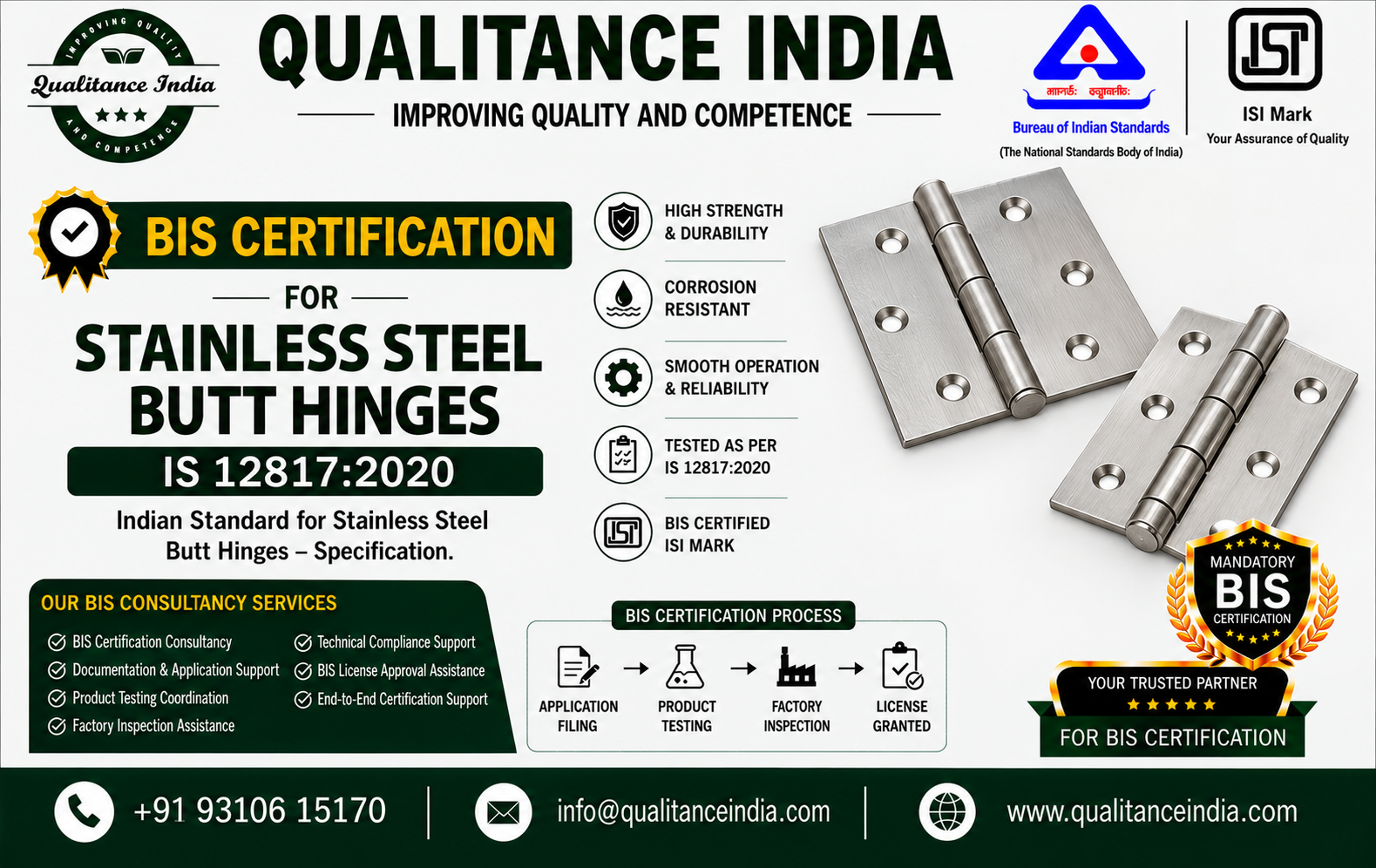
BIS Certification for Stainless Steel Butt Hinges | IS 12817:2020 | BIS Consultancy
Introduction
Stainless steel butt hinges are widely used in doors, windows, cabinets, furniture, architectural hardware and other applications where reliable movement, strength, dimensional accuracy and resistance to corrosion are important.
In India, manufacturers supplying stainless steel butt hinges covered under IS 12817:2020 are required to comply with the applicable BIS certification requirements under the Hinges (Quality Control) Order. The current BIS Scheme-I listing identifies IS 12817:2020 – Stainless Steel Butt Hinges as a product covered under compulsory certification.
The applicable BIS Product Manual is PM/IS 12817/2/January 2021, which provides the sampling, grouping, testing equipment, inspection and testing requirements and licensing scope for stainless steel butt hinges. The product manual specifies a sample size of 12 hinges.
Qualitance India provides complete assistance to manufacturers for documentation, product testing, BIS application filing, factory inspection preparation and BIS licence support for stainless steel butt hinges.
What Is IS 12817:2020?
IS 12817:2020 is the Indian Standard for Stainless Steel Butt Hinges – Specification. The current BIS Product Manual identifies it as the applicable standard and describes it as the standard for stainless steel butt hinges.
The standard covers requirements relating to:
- Materials
- Types of stainless steel butt hinges
- Sizes and dimensions
- Manufacturing
- Knuckles and hinge pins
- Screw holes
- Finish
- Marking
- Packing
The BIS product information also describes stainless steel butt hinges in six principal types:
- Light weight (narrow) hinges
- Light weight unequal flap hinges
- Medium weight hinges
- Medium weight (narrow) hinges
- Heavy weight unequal flap hinges
- Heavy weight hinges
Why Is BIS Certification Required for Stainless Steel Butt Hinges?
The Government of India notified the Hinges (Quality Control) Order, 2025, under which hinges covered by the listed Indian Standards must conform to the respective standards and bear the BIS Standard Mark under a BIS licence according to Scheme-I. The order specifically includes IS 12817:2020 – Stainless Steel Butt Hinges.
For IS 12817:2020, the implementation date specified in the 2025 QCO is 1 July 2025.
The QCO does not apply to products manufactured domestically for export. It also contains a specific limited exemption for certain imported quantities used for research and development by hinge manufacturers, subject to the conditions stated in the order.
Therefore, manufacturers supplying stainless steel butt hinges in the Indian market should obtain the applicable BIS licence before commercial supply.
Current BIS and QCO Position for IS 12817:2020
As of September 2026, BIS continues to list:
IS 12817:2020 – Stainless Steel Butt Hinges
under the compulsory certification framework. The BIS Scheme-I page also lists the Hinges QCO 2023, QCO 2024, QCO 2025, relevant 2026 exemption orders and the Transition Facilitation (Quality Control) Order, 2026.
The 2025 QCO superseded the 2024 QCO and requires the listed hinge products to bear the Standard Mark under a BIS Scheme-I licence, with implementation for IS 12817:2020 from 1 July 2025.
Important 2026 Regulatory Development
The Government also issued the Transition Facilitation (Quality Control) Order, 2026, dated 25 June 2026. This introduces a regulated facilitation mechanism for certain products covered under specified QCOs, including the Hinges QCO. It does not remove the underlying conformity requirement; the relevant Indian Standard continues to apply.
Manufacturers should therefore evaluate their exact business situation and applicable route before relying on any transition/facilitation provision.
Types of Stainless Steel Butt Hinges Covered
IS 12817:2020 classifies stainless steel butt hinges according to type and size.
The six listed types are:
1. Light Weight Narrow Hinges
These are intended for comparatively lighter applications and are manufactured with narrower flaps.
2. Light Weight Unequal Flap Hinges
These have unequal flap dimensions and are intended for applications requiring a different flap configuration.
3. Medium Weight Hinges
These are designed for medium-duty door and hardware applications.
4. Medium Weight Narrow Hinges
These combine medium-weight construction with a narrow hinge configuration.
5. Heavy Weight Unequal Flap Hinges
These are intended for comparatively heavier applications where an unequal flap arrangement is required.
6. Heavy Weight Hinges
These are designed for heavier-duty applications and require appropriate dimensional and manufacturing conformity.
The BIS Product Manual specifically uses these six types for product grouping.
Material Requirements for Stainless Steel Butt Hinges
Material conformity is an important part of BIS certification.
The BIS Product Manual states that the raw material requirements are to be as per Clause 4.1 of IS 12817:2020.
The BIS product information specifies:
- Stainless steel for the flap shall conform to IS 6911
- Stainless steel for the pin shall conform to IS 6528
The Product Manual’s inspection scheme further requires the incoming material consignment to be ISI marked and accompanied by the manufacturer’s test certificate.
Manufacturers should therefore maintain proper incoming raw-material records, material identification and corresponding test certificates.
Product Types and Grouping for BIS Licence
Correct product grouping is extremely important because it determines how many varieties need to be submitted for testing and what sizes/types may be covered under one licence.
According to Annex A of the BIS Product Manual, stainless steel butt hinges are grouped on the basis of:
Type
- Light weight narrow
- Light weight unequal flap
- Medium weight
- Medium weight narrow
- Heavy weight unequal flap
- Heavy weight
Size
Sizes are considered according to Tables 1 to 6 of IS 12817:2020.
Minimum and Maximum Size Sampling
For each type, the Product Manual requires:
One sample of minimum size and one sample of maximum size to cover the sizes for that particular type.
The firm must declare the varieties it intends to cover in the licence.
The BIS Product Manual also states that the licence scope may be restricted according to the manufacturer’s manufacturing and testing capabilities. During operation of the licence, varieties covered in the licence are to be tested in rotation to the extent possible.
Practical Example
Suppose a manufacturer produces:
- Light weight hinges – several sizes
- Medium weight hinges – several sizes
- Heavy weight hinges – several sizes
The manufacturer should not assume that one arbitrary hinge sample automatically covers every type. The grouping must be prepared according to the applicable BIS Product Manual and the declared manufacturing range.
Proper grouping can reduce unnecessary testing while ensuring that the requested licence scope is technically supportable.
BIS Sample Size for Stainless Steel Butt Hinges
The official Product Manual specifies:
Sample Size: 12 Hinges
However, the exact sample selection should be planned according to the product grouping and the type/size scope being applied for.
For this reason, manufacturers should finalize the proposed licence scope before sending samples for testing.
Tests Required for IS 12817:2020
The BIS Product Manual identifies the major testing and inspection requirements under the standard.
The important areas include:
1. Material
Material requirements are checked with reference to Clause 4.1 of IS 12817:2020 and the referenced stainless steel standards.
The material requirements include the applicable requirements for flap and pin materials.
2. Dimensions and Tolerances
Dimensional conformity is a major requirement.
The BIS testing scope includes characteristics such as:
- Length
- Breadth
- Breadth B1
- Breadth B2
- Flap thickness
- Hinge pin diameter
- Number of knuckles
- Number of screw holes
- Holes for screw number
- Screw-hole positions
These are evaluated with reference to Clause 6 and Tables 1 to 6 of IS 12817:2020.
3. Manufacture
Manufacturing requirements cover the construction and workmanship features of the hinge.
The Product Manual identifies manufacture under Clause 7, including:
- General manufacture
- Knuckles
- Pins
- Screw holes and related requirements
4. Finish
The hinge finish is also subject to the standard.
The Scheme of Inspection and Testing requires finish to be checked on each hinge.
5. Marking
Products covered by the licence must be marked in accordance with the applicable requirements of IS 12817:2020.
6. Packing
Packing must comply with the applicable standard requirements. The BIS Product Manual specifically refers to the packing provisions of IS 12817:2020.
Testing Equipment Required
The Product Manual identifies the major equipment required for testing.
Important equipment includes:
- Vernier callipers
- Micrometer
- Dial thickness gauge
- Tri-square
- Appropriate screws for checking screw-hole requirements
The Product Manual states that the list is indicative and should not be treated as exhaustive.
A manufacturer applying for BIS certification should maintain appropriate inspection and testing facilities according to the applicable requirements and approved certification arrangements.
Tests That Can Be Completed in One Day
According to the Product Manual, the following tests can be carried out in a day:
- Dimensions and tolerances – Clause 6
- Manufacture – Clause 7
Other requirements, especially material-related evaluation or laboratory work involving referenced material standards, may require additional time depending on the laboratory and testing arrangement.
Scheme of Inspection and Testing
The Product Manual provides a Scheme of Inspection and Testing for licensed manufacturers.
Laboratory Facility
A suitable laboratory is required, equipped and staffed for carrying out the specified tests.
The manufacturer must also prepare a calibration plan for testing equipment and maintain records of tests performed to establish conformity.
Control Unit
For stainless steel butt hinges, the Product Manual defines a control unit as:
All hinges of the same type and size, manufactured from the same lot of raw materials under identical conditions in a day.
This definition is important for production inspection and testing records.
Factory Testing and Inspection Requirements
For dimensions and tolerances, the Product Manual specifies sampling of 5 samples from each control unit.
At the start of production, 10 samples are to be tested. If all are conforming, the normal frequency may then be followed. If there is a failure, the machine is to be reset and another 10 samples are tested as specified in the Product Manual. Production during the one hour before resetting the machine is not to be marked.
For manufacture, the Product Manual specifies:
5 samples from each control unit.
For finish:
Each hinge is subject to the specified control.
BIS Certification Process for Stainless Steel Butt Hinges
The BIS certification process generally involves the following stages.
Step 1 – Product and Standard Assessment
The manufacturer’s product specifications, types, sizes, material grades and manufacturing process are reviewed against IS 12817:2020.
Step 2 – Determine Product Grouping
The proposed licence scope is mapped according to the six product types and applicable size requirements.
Step 3 – Prepare Factory and Quality Documents
Technical and factory documents are prepared according to BIS requirements.
Step 4 – Arrange Product Samples
Samples are selected according to the Product Manual and proposed scope.
Step 5 – Product Testing
Testing is carried out through the applicable BIS-recognized laboratory/testing route for the required characteristics.
Step 6 – Online BIS Application
The application is submitted through the BIS certification system with the required technical, manufacturing and testing information.
Step 7 – Factory Inspection
BIS assesses the manufacturing facility, production controls, testing facilities, records, raw-material control and conformity arrangements.
Step 8 – Corrective Action
If any observation or non-conformity is raised, appropriate corrective action and supporting evidence are submitted.
Step 9 – Grant of BIS Licence
After satisfactory evaluation and completion of applicable requirements, BIS grants the licence for the approved product scope.
Step 10 – Maintain Compliance
After obtaining the licence, the manufacturer must continue production, inspection, testing, marking and record maintenance according to BIS requirements.
Documents Required for BIS Certification
The exact document list depends on the manufacturer and application structure, but commonly required information includes:
- Company registration documents
- Factory address and manufacturing details
- Manufacturing process flow chart
- List of manufacturing machinery
- List of testing equipment
- Calibration certificates
- Factory layout
- Raw-material specifications
- Raw-material test certificates
- Product drawings
- Product specifications
- Type and size details
- Quality-control procedures
- In-house test records
- External laboratory test reports, where applicable
- Technical personnel details
- Quality-control personnel details
- Packaging and marking details
- Application-related declarations and undertakings
- Previous BIS licence details, where applicable
Manufacturing Process for Stainless Steel Butt Hinges
A typical manufacturing flow may include:
Stainless Steel Raw Material → Cutting/Blank Preparation → Forming → Flap Manufacturing → Knuckle Formation → Pin Preparation → Hole Making → Assembly → Finishing → Inspection → Packing
The exact process depends on the manufacturer’s technology and product design.
The manufacturing system should consistently produce hinges conforming to the declared dimensions, construction and finish requirements.
Marking Requirements
Products manufactured under an approved BIS licence are required to carry the applicable BIS Standard Mark in accordance with the certification requirements and the licence conditions.
The manufacturer’s marking system should correctly reflect the applicable standard and any additional identification required under the relevant BIS instructions.
Incorrect or incomplete marking can create compliance issues even where the physical product meets the technical requirements.
Packing Requirements
Stainless steel butt hinges must be packed according to the applicable provisions of IS 12817:2020.
The Product Manual specifically requires packing in accordance with the relevant clause of the standard.
Proper product identification, quantity, packaging and traceability should be maintained.
BIS Testing Cost for IS 12817:2020
There is no single universal testing price applicable to every laboratory and every licence scope.
The current BIS LIMS listings show different laboratory-specific testing packages for IS 12817:2020. For example, current listings display packages around ₹5,800, ₹10,000, ₹14,000 and ₹14,800, depending on the laboratory, product scope and test coverage.
Therefore, a manufacturer should not calculate the complete BIS project cost merely from one laboratory’s displayed amount.
The overall cost may include:
- Product testing
- BIS application-related charges
- Inspection expenses
- Licence-related government fees
- Marking-related charges
- Sample transportation
- Calibration
- Factory preparation
- Consultant fees
- Corrective action or additional testing, if required
The final amount depends on product type, number of varieties, grouping, test scope, factory condition and the applicable BIS fee structure.
How Long Does BIS Certification Take?
The actual timeline depends on:
- Product readiness
- Correct product grouping
- Sample availability
- Laboratory schedule
- Test results
- Documentation quality
- Factory readiness
- BIS inspection scheduling
- Closure of observations, if any
A technically well-prepared manufacturer can normally move much faster than an applicant who submits incomplete documents or incorrect samples.
The most common cause of delay is often not the BIS application itself, but incorrect scope selection, incomplete technical documentation or product non-conformity during testing.
Common Reasons for Delay or Failure
Manufacturers should pay attention to the following issues:
Incorrect Product Grouping
Selecting an unsuitable type or size for testing can create problems in achieving the desired licence scope.
Dimensional Non-Conformity
Length, breadth, flap thickness, pin diameter, knuckles or screw-hole dimensions may fail if production tooling is not properly controlled.
Raw Material Documentation Issues
Required material certificates or traceability documents may be missing or inconsistent.
Poor Finish
The Product Manual requires finish control on every hinge, making consistent surface quality important.
Inadequate Factory Testing Facilities
Missing or unsuitable inspection equipment can affect factory inspection readiness.
Calibration Issues
Testing and measuring instruments should have appropriate calibration arrangements.
Incomplete Production Records
Control-unit inspection records, raw-material records, test results and corrective-action records should be properly maintained.
Incorrect Marking
The product and packaging must meet applicable marking requirements.
Benefits of BIS Certification for Stainless Steel Butt Hinges
BIS certification helps manufacturers demonstrate conformity with the applicable Indian Standard.
Major business benefits include:
- Legal compliance for covered products
- Permission to use the BIS Standard Mark as applicable
- Better customer confidence
- Improved product quality control
- Greater acceptance among institutional buyers
- Better documentation and traceability
- Stronger market credibility
- Easier participation in quality-sensitive procurement opportunities
Who Needs BIS Certification for IS 12817:2020?
BIS certification is relevant to manufacturers producing stainless steel butt hinges covered by IS 12817:2020 for the Indian market.
This includes manufacturers supplying hinges for applications such as:
- Residential doors
- Commercial doors
- Industrial doors
- Windows and architectural hardware
- Furniture
- Cabinets
- Interior hardware
- Other applications covered by the standard
The exact applicability should always be checked against the current QCO and product scope.
Can an Importer Apply for BIS Certification?
BIS certification under the applicable compulsory certification framework is fundamentally linked to the manufacturer and manufacturing premises.
For imported products, the appropriate BIS route depends on the foreign manufacturer’s status, the applicable certification scheme and the regulatory requirements for the product.
Importers should therefore identify the actual manufacturer and applicable certification route before importing stainless steel butt hinges covered by the QCO.
Can One BIS Licence Cover Multiple Sizes?
Yes, multiple sizes may be covered depending on the applicable grouping provisions and the manufacturer’s declared scope.
For IS 12817:2020, the Product Manual provides a type-and-size-based grouping approach using minimum and maximum sizes for each type.
However, the final scope depends on the approved application, manufacturing capability and testing capability.
Can One Sample Cover All Types of Hinges?
Not automatically.
The Product Manual requires minimum and maximum size samples for each type to cover the sizes belonging to that particular type.
Therefore, grouping must be planned before sample submission.
Frequently Asked Questions
1. What is BIS Certification for Stainless Steel Butt Hinges?
It is the BIS conformity certification required for applicable stainless steel butt hinges manufactured to IS 12817:2020 and covered under the Hinges Quality Control Order.
2. What is the standard number for stainless steel butt hinges?
The applicable Indian Standard is IS 12817:2020.
3. Is BIS certification mandatory for stainless steel butt hinges?
Yes, IS 12817:2020 is included in the Hinges Quality Control Order framework, with implementation from 1 July 2025 under the 2025 QCO.
4. What is the BIS Product Manual number?
The applicable Product Manual is PM/IS 12817/2/January 2021.
5. How many samples are required?
The Product Manual specifies 12 hinges as the sample size.
6. How many types are covered under IS 12817:2020?
The Product Manual identifies six types of stainless steel butt hinges.
7. What stainless steel is used for the hinge flap?
The flap material is required to conform to the applicable requirements of IS 6911.
8. What standard applies to the hinge pin?
The hinge pin material is required to conform to IS 6528.
9. Is testing required?
Yes. Dimensions, manufacture, finish and applicable material requirements are among the key conformity areas.
10. Is a factory inspection required?
BIS certification involves assessment of the manufacturing and conformity-control arrangements applicable to the licence.
11. Is an in-house laboratory required?
Suitable laboratory arrangements and testing facilities are required according to the applicable BIS requirements and the approved certification arrangements. The Product Manual specifies laboratory and calibration requirements.
12. What equipment is required?
Major equipment listed in the Product Manual includes vernier callipers, micrometer, dial thickness gauge and tri-square, together with appropriate screws for relevant checks.
13. What is the control unit?
A control unit consists of hinges of the same type and size made from the same lot of raw materials under identical conditions in one day.
14. How frequently are dimensions checked?
The Product Manual specifies 5 samples from each control unit for dimensional and tolerance checks, subject to the detailed control provisions in the scheme.
15. Is finish checked on every hinge?
Yes. The Product Manual specifies finish control on each hinge.
16. Can the BIS licence scope be restricted?
Yes. The Product Manual states that scope may be restricted based on manufacturing and testing capabilities.
17. Can all sizes of one type be covered?
Subject to the grouping provisions, minimum and maximum size samples can be used to cover sizes within a type.
18. Does the QCO apply to export-only production?
The 2025 Hinges QCO specifically excludes goods manufactured domestically for export.
19. Is BIS certification the same as an ISO certificate?
No. BIS certification demonstrates conformity of the specified product with the applicable Indian Standard, whereas ISO certification generally relates to a management system or another defined certification scope.
20. What happens after BIS certification?
The manufacturer must continue conforming production, testing, marking and record maintenance according to the licence and applicable BIS requirements.
21. Can a manufacturer add more sizes later?
Additional sizes or types may be added through the applicable BIS scope-extension procedure, subject to technical evaluation and sampling requirements.
22. Are current BIS testing charges fixed?
No. Laboratory-specific testing charges can vary according to scope and test coverage. Current BIS LIMS entries show different packages for IS 12817:2020.
23. Can a consultant handle BIS application work?
Yes. A BIS consultant can assist with technical documentation, product grouping, testing coordination, application preparation, factory inspection preparation and follow-up.
24. What is the biggest issue in hinge BIS applications?
Incorrect scope and grouping can create unnecessary testing, delays or a licence scope that does not adequately cover the manufacturer’s actual range.
25. Why should manufacturers verify the current QCO before applying?
Because BIS standards, QCOs, amendments, exemptions and regulatory procedures can change. The BIS compulsory-certification listing itself records multiple QCO and 2026 regulatory updates for hinges.
People Also Ask
Is BIS mandatory for stainless steel hinges in India?
Yes, stainless steel butt hinges covered under IS 12817:2020 are included in the Hinges QCO framework.
Which IS code is applicable to stainless steel butt hinges?
IS 12817:2020.
What is the sample size for IS 12817?
The Product Manual specifies 12 hinges.
What are the types of stainless steel butt hinges?
There are six types identified in the Product Manual: light weight narrow, light weight unequal flap, medium weight, medium weight narrow, heavy weight unequal flap and heavy weight.
Is factory inspection required for BIS licence?
The BIS certification process includes assessment of the manufacturer’s production and conformity arrangements.
What raw material standard is used for stainless steel hinge flaps?
IS 6911 is referenced for flap material.
What standard is used for stainless steel hinge pins?
IS 6528 is referenced for pin material.
How is product grouping done for IS 12817?
Grouping is based on hinge type and size, with minimum and maximum size sampling for each type.
Quick BIS Certification Process
Product Assessment → Type & Size Grouping → Documentation → Sample Selection → Testing → BIS Application → Factory Inspection → Corrective Action → Licence Grant → Regular Compliance
Related BIS Certification Services
Qualitance India provides consultancy support for a wide range of hardware and engineering products, including:
- Stainless Steel Butt Hinges – IS 12817:2020
- Steel Butt Hinges – IS 1341:2018
- Non-Ferrous Metal Butt Hinges – IS 205:1992
- Tee and Strap Hinges – IS 206:2010
- Parliament Hinges – IS 362:1991
- Continuous (Piano) Hinges – IS 3818:1992
- Steel Back Flap Hinges – IS 3843:1995
- Double-Acting Spring Hinges – IS 453:1993
- Cabinet Hinges – IS 18297:2023
These hinge standards are included within the BIS compulsory certification framework listed by BIS.
Why Choose Qualitance India for BIS Certification?
Qualitance India provides end-to-end assistance to manufacturers seeking BIS certification.
Our support includes:
- BIS applicability assessment
- IS standard identification
- Product grouping and scope planning
- Technical documentation
- BIS application filing
- Product testing coordination
- Test report coordination
- Factory inspection preparation
- Quality-control documentation
- BIS query support
- Corrective-action assistance
- Licence approval support
- Scope extension assistance
- Post-licence compliance guidance
Our objective is to help manufacturers complete the certification process with the correct product scope and proper technical preparation.
BIS Certification for Stainless Steel Butt Hinges – Contact Qualitance India
Manufacturing Stainless Steel Butt Hinges for the Indian market and need BIS certification under IS 12817:2020?
Qualitance India provides complete consultancy support from applicability assessment and product grouping through testing, documentation, factory inspection preparation and BIS licence approval.
Qualitance India
BIS Certification Consultancy
Phone: +91 93106 15170
Email: info@qualitanceindia.com
Website: https://qualitanceindia.com/
Conclusion
BIS Certification for Stainless Steel Butt Hinges under IS 12817:2020 is an important compliance requirement for applicable products covered by the Hinges Quality Control Order.
Successful certification depends on more than simply submitting a BIS application. Manufacturers need the correct product grouping, compliant stainless steel raw materials, appropriate dimensions, suitable manufacturing controls, testing facilities, calibration arrangements, inspection records and proper marking and packing.
The BIS Product Manual specifies 12 hinges as the certification sample size, provides type-and-size grouping requirements and establishes the inspection and testing framework for licensed manufacturers.
With proper technical preparation and professional coordination, manufacturers can make the BIS certification process more structured and avoid common delays caused by incorrect scope, incomplete documents or product non-conformity.
For professional assistance with BIS Certification for Stainless Steel Butt Hinges as per IS 12817:2020, Qualitance India can support the complete certification process from application preparation to final licence approval.
Need help with BIS certification for this product?
Get a free consultation from our compliance experts — we handle testing, documentation and the complete BIS process for you.
BIS Certification Readiness Checklist 2026
- Documents, testing & factory requirements in one place
- Covers ISI Mark, CRS, FMCS & Hallmarking
- Tick-box format — share it with your team