BIS Certification Consultancy for Wrought Aluminium & Aluminium Alloy Plates | IS 736:1986
Introduction
Wrought Aluminium and Aluminium Alloy Plates are widely used in general engineering, fabrication, transportation, industrial equipment, construction, machinery and other applications where controlled mechanical properties, chemical composition, dimensional accuracy and surface quality are important.
For manufacturers supplying these products in India, compliance with the applicable Indian Standard and BIS certification requirements is essential where the product falls under a mandatory Quality Control Order.
The relevant standard is IS 736:1986 – Specification for Wrought Aluminium and Aluminium Alloy Plate for General Engineering Purposes. The BIS Product Manual identifies the product under Scheme-I of the BIS Conformity Assessment Regulations, 2018. (bis.gov.in)
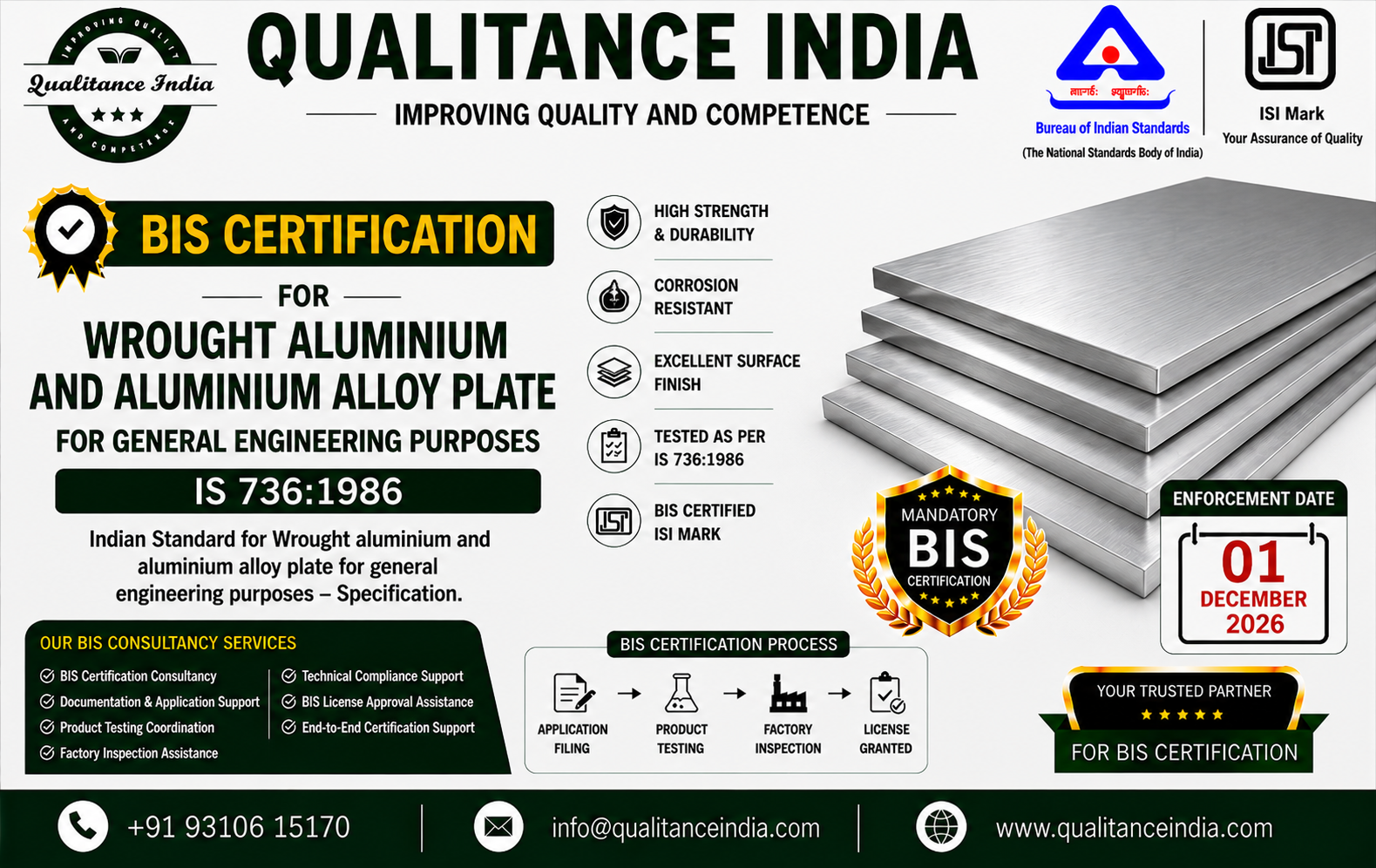
BIS has also listed Wrought aluminium and aluminium alloy plate for general engineering purposes – IS 736:1986 in the upcoming Quality Control Order implementation schedule, with an implementation date of 1 December 2026. (bis.gov.in)
Qualitance India provides end-to-end BIS Certification consultancy for Wrought Aluminium and Aluminium Alloy Plate manufacturers, including product-scope assessment, documentation, laboratory testing coordination, factory inspection preparation and BIS licence support.
What Are Wrought Aluminium and Aluminium Alloy Plates?
Wrought aluminium and aluminium alloy plates are flat rolled aluminium products manufactured through processes such as casting, hot rolling and cold rolling, followed by suitable heat treatment and finishing where applicable.
These plates are selected for properties such as:
- Low density
- Good strength-to-weight ratio
- Corrosion resistance
- Machinability
- Formability
- Thermal conductivity
- Good fabrication characteristics
- Suitable mechanical properties
The exact properties depend on the aluminium alloy, temper/condition, dimensions and manufacturing process.
BIS Standard for Aluminium and Aluminium Alloy Plates
The applicable standard is:
IS 736:1986 – Specification for Wrought Aluminium and Aluminium Alloy Plate for General Engineering Purposes
The BIS Product Manual available for certification is:
PM/IS 736/1/March 2022
The Product Manual identifies:
- Product: Wrought Aluminium and Aluminium Alloy Plate
- Standard: IS 736:1986
- Certification Scheme: Scheme-I
- Amendments recorded in the Product Manual: Nil
- Sampling reference: IS 736:1986 (bis.gov.in)
Current BIS LIMS records describe the same IS 736 product as the Third Revision and show active laboratory testing scopes for the standard. (lims.bis.gov.in)
Important Current Regulatory Update
The regulatory position is particularly important for manufacturers planning certification in 2026.
BIS’s current upcoming-QCO schedule lists:
Wrought aluminium and aluminium alloy plate for general engineering purposes – IS 736:1986
with an implementation date of:
1 December 2026. (bis.gov.in)
This means manufacturers planning to supply covered products in the Indian market should complete their BIS compliance preparation in advance rather than waiting until the implementation date.
The applicable Quality Control Order framework also provides that the latest version of the relevant Indian Standard, including amendments notified by BIS, will apply. Manufacturers should therefore use the current BIS requirements applicable at the time of certification.
Is BIS Certification Mandatory for Aluminium Plates?
The mandatory requirement is linked to the applicable Aluminium and Aluminium Alloy Products Quality Control Order.
The QCO schedules include:
IS 736:1986 – Wrought aluminium and aluminium alloy plate for general engineering purposes. (bis.gov.in)
BIS’s current implementation page gives 1 December 2026 as the due implementation date for this product. (bis.gov.in)
Manufacturers should therefore be prepared to meet the applicable BIS certification requirements before placing covered products on the Indian market after the relevant enforcement date.
Scope of IS 736:1986
IS 736 applies to wrought aluminium and aluminium alloy plates for general engineering purposes.
The product scope is based on characteristics such as:
- Aluminium or aluminium alloy
- Designation/grade
- Temper or condition
- Dimensions
- Applicable mechanical properties
- Chemical composition
The manufacturer’s exact scope must be finalized according to the current standard, applicable tables and BIS certification documents.
BIS Product Manual for IS 736
The Product Manual provides the practical framework for certification under Scheme-I.
Important information includes:
| Particular | Requirement |
|---|---|
| Product | Wrought Aluminium and Aluminium Alloy Plate |
| Indian Standard | IS 736:1986 |
| Scheme | Scheme-I |
| Product Manual | PM/IS 736/1/March 2022 |
| Amendments in Product Manual | Nil |
| Sampling | As per IS 736:1986 |
| Testing | Chemical, mechanical and dimensional requirements |
The Product Manual states that it can be used by BIS Branch Offices, existing licensees and prospective applicants for certification activities. (bis.gov.in)
Raw Material Requirements
The current Product Manual states that there is no specific raw-material requirement for sampling, with the applicable material requirements governed by IS 736 itself. (bis.gov.in)
For manufacturing control, important inputs may include:
- Primary aluminium
- Aluminium alloying additions
- Alloy ingots
- Recycled aluminium, where permitted
- Grain refiners
- Process materials
Manufacturers should maintain proper records of:
- Heat number
- Charge composition
- Alloy designation
- Chemical analysis
- Casting records
- Rolling records
- Heat-treatment records
Chemical Composition Requirements
Chemical composition is a major requirement for aluminium and aluminium alloy plates.
Current BIS LIMS records for IS 736 show testing for elements including:
- Aluminium
- Copper
- Magnesium
- Silicon
- Iron
- Manganese
- Zinc
- Titanium
- Chromium
- Vanadium
The applicable combination limits and individual limits depend on the alloy designation specified in the standard. (lims.bis.gov.in)
Laboratories may also test specified combined-element limits such as:
- Chromium + Manganese
- Copper + Silicon + Iron + Manganese
- Other applicable combinations
according to the relevant table and alloy designation. (lims.bis.gov.in)
Manufacturing Process of Aluminium Plates
A typical manufacturing process can include:
1. Raw Material Preparation
Aluminium and alloying materials are charged according to the required alloy composition.
2. Melting
The materials are melted under controlled conditions.
3. Alloy Adjustment
Chemical composition is adjusted according to the specified alloy designation.
4. Casting
Molten metal is cast into suitable slabs or billets.
5. Homogenization
Where applicable, cast material undergoes controlled thermal treatment.
6. Rolling
The material is hot rolled and/or cold rolled to achieve the required dimensions and properties.
7. Heat Treatment
Heat treatment is applied where required by the alloy and temper.
8. Straightening and Finishing
The plate is levelled, straightened, trimmed and finished.
9. Inspection and Testing
Chemical, mechanical and dimensional checks are performed.
10. Packing and Marking
Conforming products are identified and marked according to BIS requirements.
Major Tests for IS 736:1986
Current BIS laboratory records show the following major testing areas for IS 736. (lims.bis.gov.in)
1. Freedom from Defects
The plates are inspected for visible defects and workmanship-related issues.
The Product Manual and laboratory scope identify freedom from defects as a conformity requirement.
2. Chemical Composition
Chemical composition is tested against the limits applicable to the alloy designation.
This is one of the most important tests for determining whether the material corresponds to the declared aluminium alloy.
3. Aluminium Content
The applicable aluminium-content requirement is checked.
4. Copper
Copper content is verified against the permitted range.
5. Magnesium
Magnesium content is tested where applicable.
6. Silicon
Silicon is checked against the relevant composition limit.
7. Iron
Iron content is controlled because excessive iron can affect the properties and composition of aluminium alloys.
8. Manganese
Manganese content is checked according to the applicable alloy requirement.
9. Zinc
Zinc is analysed where applicable.
10. Titanium and Grain-Refining Elements
Titanium and other applicable grain-refining elements are controlled as specified.
11. Chromium
Chromium is tested where applicable.
12. Vanadium
Vanadium is tested according to the applicable alloy requirements.
Mechanical Properties Testing
Mechanical properties are an important part of BIS certification for aluminium plates.
Current BIS laboratory scopes identify testing for:
0.2% Proof Strength
The 0.2% proof strength is tested to determine the specified yield-related mechanical performance of the plate.
Tensile Strength
Tensile strength is determined according to the applicable test method.
Elongation
Elongation is measured during tensile testing.
These mechanical parameters are evaluated against the grade/designation and condition requirements of the standard. (lims.bis.gov.in)
Dimensions and Tolerances
Dimensional accuracy is another important requirement.
The plates can be checked for:
- Thickness
- Width
- Length
- Flatness
- Other applicable dimensional characteristics
Current BIS laboratory listings specifically identify Dimensions & Tolerances as a test area for IS 736:1986. (lims.bis.gov.in)
Test Equipment Required for Aluminium Plates
The exact laboratory equipment depends on the licence scope and tests assigned to the manufacturer.
Typical equipment can include:
- Vernier calipers
- Micrometers
- Steel scales
- Measuring tapes
- Thickness gauges
- Straight edges
- Flatness gauges
- Weighing balances
- Spectrometer/OES or equivalent chemical-analysis equipment
- Universal testing machine
- Extensometer
- Sample-cutting equipment
- Heat-treatment furnace
- Temperature-measuring instruments
- Surface-inspection equipment
The current BIS LIMS entries demonstrate the need for facilities capable of chemical composition, tensile properties and dimensional testing. (lims.bis.gov.in)
In-House Testing Facility
The manufacturer should establish suitable testing facilities for the tests required under the applicable Scheme of Inspection and Testing.
The laboratory should have:
- Qualified personnel
- Suitable equipment
- Calibration records
- Documented test methods
- Reference standards
- Traceable measurements
- Test records
Where specific testing is permitted to be subcontracted, an appropriate recognized/accredited external laboratory can be used according to the applicable BIS requirements.
Quality Assurance Plan
A comprehensive Quality Assurance Plan for aluminium plates should cover:
- Incoming raw-material inspection
- Alloy composition control
- Melting control
- Casting control
- Homogenization
- Rolling parameters
- Heat treatment
- Temper/condition control
- Dimensional inspection
- Mechanical testing
- Chemical analysis
- Surface inspection
- Product traceability
- Rejection procedures
- Calibration
- Final inspection
- Product marking
The quality plan should correspond to the current BIS certification requirements and the applicable Scheme of Inspection and Testing.
Control Unit for Aluminium Plates
The control-unit definition should be finalized according to the applicable BIS inspection and testing documentation for the manufacturer’s product scope.
In practice, manufacturers should maintain traceability based on factors such as:
- Alloy designation
- Heat number
- Temper
- Production batch
- Rolling condition
- Heat-treatment batch
- Dimensions
A robust traceability system helps connect finished plates with the corresponding raw-material and production records.
Factory Inspection for BIS Certification
During a BIS inspection, the manufacturing facility may be evaluated for:
Raw Material Control
Records of aluminium and alloy materials should be available.
Melting and Casting
BIS may verify the manufacturer’s ability to control alloy composition and casting operations.
Rolling
Rolling equipment and process controls should be appropriate for the proposed product scope.
Heat Treatment
Where required, temperature control and batch records should be maintained.
Laboratory
Relevant testing equipment should be available and calibrated.
Quality Records
Important records include:
- Chemical analysis
- Mechanical testing
- Dimensional inspection
- Heat-treatment records
- Production records
- Rejection records
- Calibration certificates
- Final inspection
Product Scope and Designation
Before beginning BIS testing, manufacturers should prepare a detailed product matrix containing:
- Aluminium/alloy designation
- Temper/condition
- Plate dimensions
- Thickness range
- Width range
- Length range
- Applicable mechanical requirements
The scope should be aligned with the latest applicable standard and BIS requirements.
Proper planning can prevent the manufacturer from testing an unnecessarily narrow or unsuitable combination.
BIS Marking Requirements
Products covered under a BIS licence and conforming to the applicable requirements must be marked according to the relevant BIS certification conditions.
The manufacturer should ensure:
- Standard Mark is used only on conforming products
- Licence information is displayed as required
- Product identification is maintained
- Traceability is available
- Non-conforming products are not represented as BIS-certified
The exact marking arrangement should be confirmed against the applicable Product Manual and licence conditions.
Current BIS Testing Charges for IS 736:1986
Current BIS LIMS records show different testing charges depending on the laboratory and scope.
Examples include:
EKO Pro Engineers Private Limited
A current listing shows approximately ₹7,000 excluding taxes for an extensive displayed IS 736:1986 testing scope covering chemical composition, mechanical properties, dimensions and freedom from defects. (lims.bis.gov.in)
Delhi Test House
A current listing shows approximately ₹12,000 excluding taxes for its displayed IS 736 scope. (lims.bis.gov.in)
URS Products and Testing Pvt. Ltd.
A current listing shows approximately ₹12,000 for the displayed scope. (lims.bis.gov.in)
QA Testing Laboratories
A current listing shows approximately ₹20,500 excluding taxes for the displayed scope. (lims.bis.gov.in)
Jawaharlal Nehru Aluminium Research Development and Design Center
A current listing shows approximately ₹3,200 for the displayed testing scope. (lims.bis.gov.in)
These are laboratory-specific charges for the displayed scopes and should not be treated as a fixed market price or total BIS certification cost.
Total Cost of BIS Certification
The overall BIS certification cost depends on:
- BIS certification-related charges
- Product testing
- Number of alloy/designation varieties
- Temper/condition
- Size range
- Testing equipment
- Calibration
- Factory inspection
- Sample preparation
- Documentation
- Re-testing, if necessary
- Consultancy support
Manufacturers should calculate the project cost only after the proposed product scope has been finalized.
Documents Required for BIS Certification
Typical documents may include:
- Company registration documents
- Factory address proof
- Factory layout
- Manufacturing process flow chart
- Machinery list
- Furnace details
- Casting equipment details
- Rolling-mill details
- Heat-treatment details
- Product specifications
- Alloy/designation details
- Temper/condition details
- Dimension range
- Raw-material information
- Chemical-analysis records
- Test reports
- Testing equipment list
- Calibration certificates
- Quality Assurance Plan
- Production records
- Technical personnel details
- GST/business documents
- Trademark information
- Authorization documents
- Proposed product marking
- BIS declarations and undertakings
The final document list depends on the manufacturer and proposed licence scope.
BIS Certification Process for Aluminium and Aluminium Alloy Plates
The usual process is:
Factory Assessment → Product Scope Finalization → Documentation → BIS Application → Sample Preparation → Laboratory Testing → Factory Inspection → Compliance Closure → BIS Licence Grant → Standard Marking
The product scope should be finalized carefully before sample testing because chemical composition, mechanical properties and dimensional requirements depend on the declared alloy/designation and product condition.
Common Reasons for BIS Certification Delays
Aluminium plate manufacturers can face delays because of:
- Incorrect alloy designation
- Incorrect temper selection
- Incomplete product scope
- Chemical composition failure
- Tensile-strength failure
- Proof-strength failure
- Elongation failure
- Dimensional non-conformity
- Surface-defect issues
- Inadequate testing facilities
- Calibration problems
- Incomplete heat-treatment records
- Poor heat-number traceability
- Missing laboratory documentation
- Factory inspection observations
- Incorrect product marking
A technical assessment before applying can help identify these issues.
Who Needs BIS Certification for Aluminium Plates?
Manufacturers producing covered Wrought Aluminium and Aluminium Alloy Plates for the Indian market should prepare for the applicable BIS certification requirement under the relevant Quality Control Order.
Potential users and sectors include:
- Engineering manufacturers
- Fabrication companies
- Industrial equipment manufacturers
- Automotive component manufacturers
- Aerospace-related applications
- Machinery manufacturers
- Electrical and industrial equipment
- Construction and infrastructure
- General engineering industries
- Metal service centres
The exact applicability depends on the product and the applicable QCO provisions.
Benefits of BIS Certification
BIS certification can help manufacturers achieve:
- Compliance with applicable Indian regulatory requirements
- Authorization to use the BIS Standard Mark
- Better customer confidence
- Improved product consistency
- Better material traceability
- Stronger acceptance among industrial buyers
- Better quality-control systems
- Improved documentation
- Greater market credibility
Why Choose Qualitance India?
Qualitance India provides BIS Certification consultancy for manufacturers of Wrought Aluminium and Aluminium Alloy Plates.
Our support can include:
- Product applicability assessment
- BIS application preparation
- IS 736 compliance guidance
- Product-scope planning
- Alloy/designation assessment
- Documentation preparation
- Sample planning
- Laboratory coordination
- Chemical and mechanical testing coordination
- Testing-equipment guidance
- Quality Assurance Plan support
- Factory inspection preparation
- Non-conformity response support
- BIS licence follow-up
- Post-certification compliance support
We help manufacturers organize their technical, laboratory and documentation requirements before proceeding with BIS certification.
BIS Certification for Aluminium Plates – Quick Process
Manufacturer Assessment → Product Scope → Documentation → BIS Application → Sample Testing → Factory Inspection → Compliance → BIS Licence → Standard Mark
Frequently Asked Questions
1. What is BIS Certification for Wrought Aluminium and Aluminium Alloy Plates?
It is the BIS conformity assessment process through which a manufacturer demonstrates that the covered aluminium plates conform to the applicable Indian Standard and obtains authorization to use the BIS Standard Mark.
2. Which standard applies to Aluminium Plates for General Engineering Purposes?
The specified standard is IS 736:1986 – Specification for Wrought Aluminium and Aluminium Alloy Plate for General Engineering Purposes. (bis.gov.in)
3. Is BIS certification mandatory for IS 736 plates?
IS 736:1986 is included in the Aluminium and Aluminium Alloy Products Quality Control framework, with BIS currently showing 1 December 2026 as the implementation date for this product. (bis.gov.in)
4. What is the implementation date for IS 736:1986 under the current schedule?
The current BIS upcoming-QCO page lists 1 December 2026. (bis.gov.in)
5. What certification scheme applies?
The BIS Product Manual is issued under Scheme-I of the BIS Conformity Assessment Regulations, 2018. (bis.gov.in)
6. What is the current BIS Product Manual?
The available Product Manual is PM/IS 736/1/March 2022. (bis.gov.in)
7. Is there a current revision of IS 736?
Current BIS LIMS entries identify IS 736:1986 as the Third Revision while retaining the IS number and year in the laboratory listing. (lims.bis.gov.in)
8. What are the major tests for aluminium plates?
Major requirements include freedom from defects, chemical composition, 0.2% proof strength, tensile strength, elongation, dimensions and tolerances. (lims.bis.gov.in)
9. Which chemical elements are tested?
Depending on the alloy, testing can include aluminium, copper, magnesium, silicon, iron, manganese, zinc, titanium, chromium and vanadium, together with applicable combined-element limits. (lims.bis.gov.in)
10. Is tensile testing required?
Yes. Tensile strength and elongation are identified in current BIS laboratory scopes for IS 736. (lims.bis.gov.in)
11. Is 0.2% proof-strength testing required?
Yes. The current BIS LIMS scope identifies 0.2% proof strength as a test parameter. (lims.bis.gov.in)
12. Are dimensions and tolerances tested?
Yes. Dimensions and tolerances are specifically included in the current laboratory testing scope. (lims.bis.gov.in)
13. Is freedom from defects checked?
Yes. Freedom from defects is an identified requirement for IS 736 testing. (lims.bis.gov.in)
14. What raw materials are used?
Typical production inputs include primary aluminium, aluminium alloys, alloying additions and other controlled charge materials according to the applicable alloy specification.
15. Is chemical composition important for BIS certification?
Yes. The aluminium alloy must meet the chemical-composition limits specified for its declared designation.
16. Is heat treatment required?
Heat treatment requirements depend on the alloy and declared condition/temper. Where applicable, the manufacturer should maintain controlled furnace and batch records.
17. Is an in-house laboratory required?
The applicable testing arrangement depends on the certification documents and the type of tests. Manufacturers should establish suitable facilities for required routine testing and use permitted external laboratories where subcontracting is allowed.
18. Can external laboratories be used?
Where subcontracting is permitted, the manufacturer can use the appropriate recognized/accredited laboratory route under the applicable BIS requirements.
19. What is the current laboratory testing cost?
Current BIS LIMS listings show examples ranging from approximately ₹3,200 to ₹20,500 for displayed IS 736 testing scopes, depending on laboratory and included tests. (lims.bis.gov.in)
20. Does laboratory testing cost include the BIS licence cost?
No. Laboratory testing charges are separate from BIS certification-related charges and other project expenses.
21. What documents are required?
Typical documents include factory information, machinery details, manufacturing process, alloy details, testing facilities, calibration records, test reports, quality documents and company/legal documents.
22. What happens if the aluminium plate fails laboratory testing?
The manufacturer should determine the cause of failure, implement corrective action and follow the applicable BIS retesting/compliance procedure.
23. Is factory inspection required?
Factory assessment/inspection is an important part of the BIS licensing process where applicable.
24. Can one BIS licence cover multiple aluminium alloy grades?
The final licence scope depends on the applicable grouping and testing provisions. Manufacturers should finalize the desired alloy/designation and condition scope before sample testing.
25. Can multiple thicknesses be covered?
The answer depends on the applicable grouping provisions and the tested scope. Product dimensions should be planned before the BIS application.
26. What information should be finalized before testing?
Manufacturers should finalize:
- Alloy/designation
- Temper/condition
- Thickness
- Width
- Length
- Mechanical-property requirements
- Intended licence scope
27. Why is traceability important?
Traceability connects the finished plate with its raw-material heat, chemical composition, production batch, heat treatment and final inspection, helping demonstrate consistent conformity.
28. What is the implementation date shown by BIS for IS 736?
The current BIS upcoming-QCO schedule shows 1 December 2026. (bis.gov.in)
29. Can Qualitance India help with IS 736 laboratory testing?
Yes. Qualitance India can coordinate product testing and assist with selecting an appropriate laboratory according to the proposed certification scope.
30. Can Qualitance India provide complete BIS consultancy?
Yes. Qualitance India provides end-to-end assistance including product assessment, documentation, laboratory coordination, technical compliance, factory inspection preparation and BIS licence support.
Frequently Searched Topics
- BIS Certification for Aluminium Plate
- IS 736:1986 BIS Certification
- BIS Licence for Aluminium Alloy Plate
- Wrought Aluminium Plate BIS
- Aluminium Alloy Plate BIS Certification
- IS 736 Testing
- Aluminium Plate Testing Laboratory
- BIS Testing Charges for Aluminium Plate
- Aluminium Chemical Composition Testing
- Aluminium Tensile Strength Test
- Aluminium 0.2% Proof Strength Test
- Aluminium Plate Dimension Testing
- BIS Mark for Aluminium Plate
- Aluminium Plate Manufacturer BIS Licence
- BIS Consultant for Aluminium Products
- IS 736 Product Certification
- Aluminium Alloy Plate Certification in India
- Wrought Aluminium BIS Certification
Related BIS Certification Services
Qualitance India also provides BIS consultancy for manufacturers of various products covered under Indian Standards and mandatory Quality Control Orders.
Our services include:
BIS Certification Consultancy | BIS Licence | ISI Mark Certification | Product Testing | Documentation Support | Factory Inspection Assistance | Quality Plan Preparation | Technical Compliance Support | Scope Extension | Licence Renewal | End-to-End BIS Support
Contact Qualitance India
Qualitance India
BIS Certification Consultancy for Manufacturers
Phone: +91 93106 15170
Email: info@qualitanceindia.com
Website: https://qualitanceindia.com/
Manufacturers of Wrought Aluminium and Aluminium Alloy Plates can contact Qualitance India for assistance with IS 736 certification, product testing, alloy-scope planning, documentation, factory inspection preparation and BIS licence support.
Conclusion
Wrought Aluminium and Aluminium Alloy Plates are important engineering materials where chemical composition, mechanical properties, dimensions and freedom from defects must be properly controlled.
IS 736:1986 – Specification for Wrought Aluminium and Aluminium Alloy Plate for General Engineering Purposes is covered within the Aluminium and Aluminium Alloy Products regulatory framework. BIS’s current implementation schedule shows 1 December 2026 as the implementation date for this product. (bis.gov.in)
The BIS Product Manual PM/IS 736/1/March 2022 provides the certification framework under Scheme-I, while current BIS LIMS records show active laboratory scopes covering chemical composition, 0.2% proof strength, tensile strength, elongation, dimensions and freedom from defects. (bis.gov.in)
Manufacturers planning to supply covered aluminium plates in India should therefore begin their compliance preparation well before the 1 December 2026 implementation date. Proper product-scope planning, alloy control, testing arrangements, traceability and factory readiness are essential for a smooth BIS certification process.
With professional assistance from Qualitance India, manufacturers can receive end-to-end support for documentation, laboratory testing, technical compliance, factory inspection preparation and BIS licence processing for Wrought Aluminium and Aluminium Alloy Plates.
Need help with BIS certification for this product?
Get a free consultation from our compliance experts — we handle testing, documentation and the complete BIS process for you.
BIS Certification Readiness Checklist 2026
- Documents, testing & factory requirements in one place
- Covers ISI Mark, CRS, FMCS & Hallmarking
- Tick-box format — share it with your team