
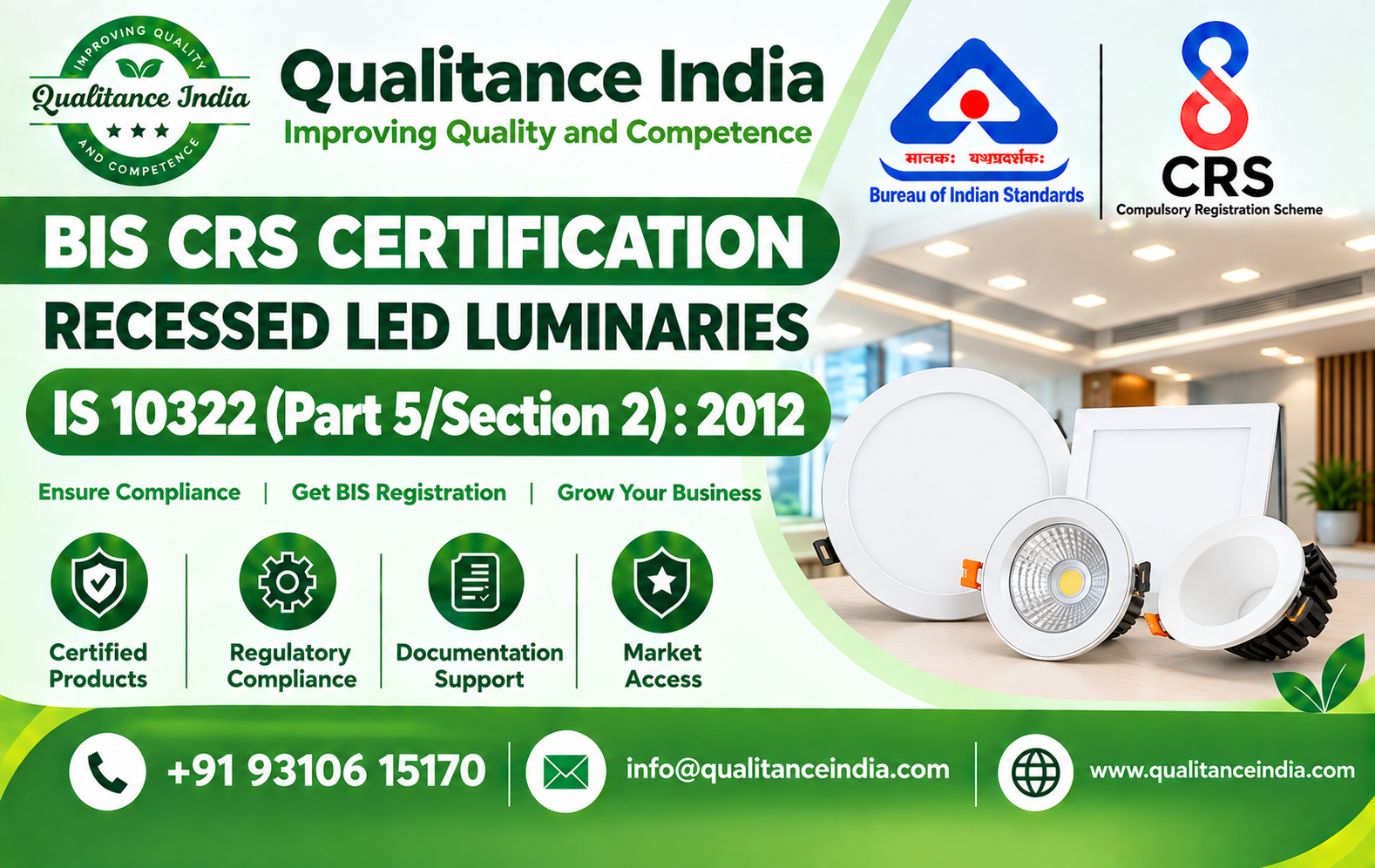
BIS CRS Certification for Recessed LED Luminaires | IS 10322 (Part 5/Section 2):2012 | BIS Consultancy
Introduction
Recessed LED Luminaires are lighting products designed to be installed within or recessed into ceilings, walls or other mounting surfaces. They are widely used in residential buildings, offices, hotels, retail stores, commercial interiors, hospitals, educational institutions and architectural lighting applications.
Because these products contain electrical components and are installed within or close to building surfaces, electrical safety, insulation, thermal performance, construction and photometric characteristics are important.
Under the Bureau of Indian Standards (BIS) Compulsory Registration Scheme (CRS), Recessed LED Luminaires are covered under IS 10322 (Part 5/Section 2):2012. BIS's current CRS standard table now lists both the 2012 edition and the revised IS 10322 (Part 5/Sec 2):2026 for Recessed LED Luminaires.
Important BIS Update for 2026
BIS has revised the standard from:
IS 10322 (Part 5/Sec 2):2012 → IS 10322 (Part 5/Sec 2):2026
The revised 2026 edition is identified as the Second Revision and covers recessed luminaires and recessed air-handling luminaires. BIS's latest circular dated 31 July 2026 extended the concurrent-running period for the old and revised standards until 02 February 2027.
BIS's March 2026 implementation guideline identifies the principal changes specific to Section 2 as:
- Requirements specific to recessed luminaires that were previously located in IS 10322 Part 1 are incorporated into Section 2.
- Requirements for air-handling luminaires have been introduced.
- Additional marking requirements have been introduced.
- References to IS 10322 Part 1 have been updated.
Therefore, manufacturers should consider the standard transition carefully when applying for new CRS approval or updating an existing registration.
What Is BIS CRS Certification for Recessed LED Luminaires?
BIS CRS is a conformity-assessment and registration framework applicable to specified electronic and electrical products.
The official BIS Scheme-II list identifies:
Product: Recessed LED Luminaires Standard: IS 10322 (Part 5/Section 2):2012
The BIS standard table currently lists both the 2012 and 2026 versions.
For a CRS application, the manufacturer must demonstrate conformity through testing at a BIS-recognized laboratory and then submit the required application and supporting documents to BIS.
After approval, the registered manufacturer must follow the applicable BIS CRS marking and product-labelling requirements.
BIS Standard for Recessed LED Luminaires
The earlier standard is:
IS 10322 (Part 5/Section 2):2012 Luminaires – Part 5: Particular Requirements – Section 2: Recessed Luminaires
The official BIS test report format identifies the test item as Recessed Luminaires and provides a dedicated compliance report format for the standard.
BIS's 2015 revision communication states that IS 10322 (Part 5/Sec 2):1985 was revised to the 2012 edition and that the 2012 standard covers the safety and photometric requirements of recessed luminaires.
The current CRS database lists the revised:
IS 10322 (Part 5/Sec 2):2026 – Luminaires Part 5: Particular Requirements Section 2: Recessed Luminaires and Recessed Air-Handling Luminaires (Second Revision).
Recessed LED Luminaires Under BIS CRS
The CRS framework specifically identifies Recessed LED Luminaires against IS 10322 (Part 5/Section 2):2012. BIS's current CRS page also records the product under S.O. 2742(E) dated 17 August 2017, subsequently superseded by the Electronics and Information Technology Goods (Requirement of Compulsory Registration) Order, 2021 and subsequent amendments.
This means manufacturers supplying covered recessed LED luminaires in India need to maintain the applicable BIS CRS compliance and registration.
Scope of Recessed LED Luminaire Certification
The 2012 standard is for recessed luminaires and includes requirements applicable to LED and LED-module-based recessed luminaires. BIS's earlier implementation guidance specifically states that the revised 2012 standard specifies requirements for recessed luminaires for LED and LED modules.
Typical recessed products can include:
- Recessed LED downlights
- Recessed ceiling lights
- Recessed spotlights
- Recessed panel-type luminaires
- Recessed architectural luminaires
- Recessed commercial lighting
- Recessed office lighting
- Recessed decorative luminaires
- Other recessed LED lighting assemblies within the applicable scope
The exact applicability should be determined from the physical construction, electrical design, mounting arrangement and intended use of the product.
Important Technical Features of Recessed LED Luminaires
A typical recessed LED luminaire can include:
- LED module
- LED driver/control gear
- Housing
- Heat sink
- Reflector
- Lens or optical cover
- Terminal block
- Internal wiring
- External wiring, where applicable
- Mounting clips or springs
- Insulating parts
- Ceiling/wall mounting accessories
- Gaskets and sealing parts, where applicable
Changes in any of these features may affect the applicable testing requirements and model coverage.
BIS Testing Requirements for Recessed LED Luminaires
The official BIS Uniform Test Report Format for IS 10322 (Part 5/Sec 2):2012 identifies the following major testing areas:
- Marking
- Construction
- Creepage Distances and Clearances
- Provision for Earthing
- Terminals
- External and Internal Wiring
- Protection Against Electric Shock
- Endurance Tests and Thermal Tests
- Resistance to Dust and Moisture
- Insulation Resistance and Electric Strength
- Resistance to Heat, Fire and Tracking
- Photometric Tests
The test report format also contains broader classification and general-test sections before these technical evaluations.
1. General Test Requirements
The laboratory establishes the applicable testing conditions and records the general product information.
The BIS TRF includes fields for:
- Product description
- Model tested
- Representative models
- Model specifications
- Supply connections
- Technical considerations
This information forms an important part of defining the tested product and its representative model family.
2. Classification of Recessed Luminaires
The BIS test report format provides for classification of luminaires according to applicable characteristics, including:
- Type of protection
- Degree of protection
- Suitability for mounting on normally flammable surfaces
- Suitability for non-combustible mounting materials
- Normal-use classification
- Rough-service classification
The manufacturer should ensure that the declared classification accurately represents the actual product.
3. Marking Requirements
Correct marking is essential during BIS testing.
The 2012 BIS test format checks:
- Mandatory markings
- Position of marking
- Symbols and text
- Additional information
- Language of instructions
- Nominal frequency
- Operating temperature
- Warning symbols
- Wiring diagrams
- Special conditions
- Power factor and supply current information
- Indoor-use information where applicable
- Other product-specific information
During the 2026 revision, BIS has also introduced additional marking requirements specifically for recessed luminaires.
4. Construction Requirements
Construction is one of the most important parts of recessed luminaire conformity testing.
The BIS TRF examines numerous construction-related matters, including:
- Terminals and supply connections
- Switch arrangements where applicable
- Insulating linings and sleeves
- Double or reinforced insulation
- Electrical connections
- Current-carrying parts
- Screws and mechanical connections
- Cable glands
- Component fixing
- Mechanical security
- Protection of insulation
- Enclosure and mounting arrangements
A recessed light should be designed so that installation within the intended mounting surface does not compromise electrical or thermal safety.
5. Creepage Distances and Clearances
The laboratory evaluates the electrical insulation distances between applicable conductive and insulating parts.
This is particularly important for:
- LED PCBs
- Driver assemblies
- Terminal areas
- Internal wiring
- Metal housings
- Accessible conductive parts
Insufficient clearance or creepage can result in non-conformity during testing.
6. Provision for Earthing
Where protective earthing is applicable, the luminaire must have a suitable earthing arrangement.
The assessment can involve:
- Earth terminal
- Protective conductor
- Earth continuity
- Mechanical security
- Connection to accessible conductive parts
Metal-bodied recessed luminaires require particular attention to protective-earth arrangements where applicable.
7. Terminals
Terminals and supply connections are evaluated for appropriate construction and security.
The official TRF identifies checks for:
- Screw terminals
- Screwless terminals
- Supply conductors
- Terminal blocks
- Contact with metal parts
- Heat-resistant wiring and sleeves
- Switch-related requirements
8. External and Internal Wiring
Wiring is assessed for the appropriate cable type, size, insulation, routing and protection.
The BIS TRF includes checks for:
- Means of connection
- Cable type
- Nominal cross-sectional area
- Cable compliance
- Cable entries
- Insulating bushings
- Cord anchorage
- External wiring
- Internal wiring
- Through wiring
- Conductor arrangement
- Earth conductor identification
The actual production configuration should remain consistent with the tested design.
9. Protection Against Electric Shock
Protection against accidental contact with hazardous live parts is a fundamental requirement.
The laboratory assesses whether the construction provides appropriate protection under the relevant test conditions.
This may involve:
- Insulation systems
- Barriers
- Enclosures
- Accessible metal parts
- Earth connections
- Protective arrangements
- Internal spacing
10. Endurance and Thermal Tests
Recessed luminaires are frequently installed in enclosed ceiling spaces, making thermal management important.
The BIS test program includes endurance and thermal evaluation.
Depending on the construction, the assessment can involve:
- LED temperature
- Driver temperature
- Insulation temperature
- Housing temperature
- Heat-sink performance
- Thermal stability
- Operation under applicable conditions
- Condition of components after endurance testing
Poor thermal design can result in premature LED/driver failure and may also cause a laboratory non-conformity.
11. Resistance to Dust and Moisture
Where applicable, the luminaire is evaluated for resistance to dust and moisture.
The BIS test structure includes resistance to dust and moisture as a separate compliance area.
This can be particularly relevant for recessed luminaires designed for:
- Bathrooms
- Kitchens
- Commercial areas
- Covered outdoor spaces
- Damp locations
- Applications where an IP rating is declared
The declared protection rating should correspond to the actual product construction.
12. Insulation Resistance and Electric Strength
The insulation system is assessed through insulation-resistance and electric-strength tests.
These tests are intended to verify that the electrical insulation can withstand the prescribed test conditions.
Important areas include:
- Driver insulation
- Internal wiring
- PCB insulation
- Accessible conductive parts
- Metal enclosure
- Terminal areas
13. Resistance to Heat, Fire and Tracking
Materials used in the recessed luminaire are examined against the applicable requirements for heat, fire and tracking.
The testing can involve relevant:
- Insulating materials
- Plastic housings
- Terminal parts
- Driver enclosures
- Internal supporting parts
- Materials exposed to elevated temperatures
This is particularly relevant where polymeric materials are used near LED modules or drivers.
14. Photometric Testing
Photometric testing is specifically included in the 2012 BIS Uniform Test Report Format for recessed luminaires.
The optical configuration may involve:
- LED module arrangement
- Lens
- Reflector
- Diffuser
- Beam distribution
- Light output
- Optical alignment
The tested optical configuration should correspond to the model and representative family covered by the application.
Recessed LED Luminaires and Mounting Surfaces
A recessed luminaire is designed for installation within a mounting surface. Therefore, the relationship between the luminaire and the mounting environment is important.
The BIS classification section specifically addresses suitability for mounting on:
- Normally flammable surfaces
- Non-combustible materials
The manufacturer should clearly establish the intended mounting conditions and ensure that the tested construction corresponds to the installation instructions.
Electrical and Mechanical Design Checks Before Testing
Before submitting a recessed LED luminaire to the laboratory, manufacturers should review:
Driver and LED Module
Check driver rating, LED module configuration, thermal behaviour and insulation.
PCB
Check creepage, clearance, conductor spacing and component placement.
Housing
Confirm enclosure strength, material construction and mounting arrangement.
Mounting Clips
Ensure springs, clips and other mounting components provide secure installation.
Wiring
Review cable size, insulation, routing and strain-relief arrangements.
Earthing
Check protective-earth arrangements where required.
Thermal Design
Verify heat dissipation and component temperature.
Marking
Ensure product label information matches the technical documentation and model.
2012 Standard to 2026 Standard Transition
The current BIS CRS database lists both:
IS 10322 (Part 5/Sec 2):2012
and
IS 10322 (Part 5/Sec 2):2026.
BIS's March 2026 guideline originally prescribed 02 August 2026 as the end of concurrent running. However, BIS's 31 July 2026 circular extended concurrent running to:
02 February 2027.
Major Changes Specific to Recessed Luminaires
The 2026 revision introduces:
1. Recessed-luminaire requirements previously located in IS 10322 Part 1 are incorporated into Section 2.
2. Requirements for recessed air-handling luminaires are introduced.
3. Additional marking requirements are introduced.
4. References to IS 10322 Part 1 are updated.
Recessed Air-Handling Luminaires in the 2026 Standard
One notable change in the 2026 edition is the introduction of requirements for recessed air-handling luminaires.
This is relevant to products designed to combine recessed lighting with an air-handling function.
Manufacturers producing ventilation-integrated or air-handling recessed lighting should therefore assess the product against the revised standard rather than assuming that the previous 2012 scope fully covers the new configuration.
Broader Changes in IS 10322 Part 1:2026
The 2026 revision of the general luminaire requirements also includes changes such as:
- Introduction of IPX9
- EMF safety requirements
- Modified marking provisions
- PELV provisions
- Additional touch-current and touch-voltage requirements
- Requirements for controllable control gear providing SELV outputs
- Battery/EDLC-operated luminaire requirements
- Extended photobiological requirements
Because Section 2 references Part 1, manufacturers should review the relevant general requirements applicable to their product.
Is IS 10322 (Part 5/Sec 2):2012 Still Relevant in 2026?
Yes, during the current transition period.
BIS's latest circular specifically states that concurrent running of the 2012 and 2026 editions for Recessed LED Luminaires has been extended until 02 February 2027.
Manufacturers should nevertheless plan migration to the revised standard in advance rather than waiting until the end of the concurrent-running period.
For new applications, existing registrations, model additions and changes in scope, the exact applicable standard version should be confirmed with the recognized laboratory and BIS requirements applicable at the time of submission.
BIS CRS Testing Process for Recessed LED Luminaires
Step 1 – Product Assessment
Review:
- Product type
- Model numbers
- Brand
- Rated voltage
- Rated power
- Driver
- LED module
- Housing
- Mounting arrangement
- IP rating
- Optical system
Step 2 – Standard Identification
Determine whether the product is to be assessed under:
IS 10322 (Part 5/Sec 2):2012
or
IS 10322 (Part 5/Sec 2):2026
according to the current transition provisions.
Step 3 – Technical Pre-Assessment
Review the product before sending samples to identify possible issues with:
- Construction
- Wiring
- Insulation
- Earthing
- Thermal design
- Mounting
- Marking
- Optical arrangement
Step 4 – Select BIS-Recognized Laboratory
BIS requires products to be tested through a laboratory recognized for the applicable CRS testing scope.
Step 5 – Generate Test Request
The applicant enters sample details and selects an approved laboratory through the CRS portal.
Step 6 – Send Samples
BIS currently instructs applicants to send the sample and Test Request to the selected laboratory within 60 days of Test Request generation. The QR code should be displayed or pasted on the sample/packet.
Step 7 – Laboratory Testing
The laboratory evaluates the sample against the applicable requirements.
Step 8 – Verify the Test Report
Before submission, verify:
- Manufacturer name
- Factory address
- Brand
- Model numbers
- Product description
- Rating
- Standard reference
- Test results
- Representative models
Step 9 – Online CRS Application
BIS requires online submission using the prescribed process.
The test report should be not more than 90 days old at the time of online submission.
Step 10 – Hard Copy Submission
The hard copy of the application, original test report and prescribed undertaking should be submitted within 15 days of the online application.
Step 11 – BIS Scrutiny
BIS examines the application and may raise queries.
Step 12 – Query Resolution
The applicant responds to deficiencies and submits the required clarification or documentation.
Step 13 – CRS Approval
After satisfactory completion of the process, BIS grants the applicable CRS approval/registration.
Test Report Validity for BIS CRS
BIS's current online application instructions state that the test report should be not more than 90 days old at the time of online submission.
This makes coordination between laboratory testing and the BIS application important.
Manufacturers should avoid unnecessary delays between receipt of the laboratory report and online application submission.
Sample Requirements for Recessed LED Luminaires
The exact sample quantity should be confirmed with the selected BIS-recognized laboratory based on the product configuration and the applicable test program.
The official 2012 TRF records:
- Model tested
- Representative models
- Product specifications
- Variation from family representative
- Supply connections
Accordingly, sample planning should consider:
- Different wattages
- Different housing sizes
- Different drivers
- Different LED modules
- Different optical configurations
- Different mounting arrangements
- Different IP ratings
- Different construction types
The laboratory should confirm the final sample configuration before dispatch.
Model and Series Coverage for Recessed LED Luminaires
Manufacturers often produce multiple models differing in:
- Wattage
- Diameter
- Cut-out size
- Housing material
- Driver
- LED module
- Colour temperature
- Beam angle
- Lens
- Reflector
- IP rating
- Mounting mechanism
- Input voltage
The BIS test report format specifically includes representative models and variations from the family representative.
Model grouping should therefore be established based on actual technical similarity rather than only on model names.
Can Different Wattages Be Covered Under One CRS Application?
Different wattages may potentially be covered within the applicable model-family structure, but this cannot be assumed automatically.
Wattage changes may affect:
- LED quantity
- Driver
- PCB
- Internal wiring
- Thermal management
- Housing
- Optical characteristics
A technical review should therefore be completed before deciding representative models.
Can Different Sizes of Recessed Lights Be Included?
Possibly, depending on the similarities and differences in construction.
The key consideration is whether the different sizes retain sufficiently similar construction and applicable safety characteristics.
Where a change in size also changes:
- Driver
- LED arrangement
- Heat sink
- Housing
- Mounting system
- Optical system
additional evaluation may be required.
Can Different IP Ratings Be Covered?
Different IP-rated configurations should be carefully reviewed.
An IP rating is dependent on the actual enclosure, seals, openings and construction.
A higher or different IP configuration should not automatically be assumed to be represented by a different model with another enclosure design.
Documents Required for BIS CRS Certification
Typical documents may include:
- Factory/business licence
- Manufacturer company details
- Factory address proof
- Brand/trademark details
- Product technical specifications
- Product datasheet
- Model list
- Circuit diagram
- Product photographs
- Product label/marking artwork
- User manual, where applicable
- LED module and driver details
- Test report from BIS-recognized laboratory
- Authorized signatory details
- Affidavit-cum-undertaking
- Authorization documents, where applicable
- AIR documents for eligible foreign manufacturers
BIS requires applicants in India to submit the prescribed Format C affidavit-cum-undertaking. Foreign applicants without an eligible liaison office or branch office in India must appoint an Authorized Indian Representative (AIR) and follow the prescribed documentation requirements.
BIS CRS for Foreign Manufacturers of Recessed LED Luminaires
Foreign manufacturers can obtain CRS approval for covered Recessed LED Luminaires.
A foreign applicant that does not have a liaison office or branch office in India must appoint an Authorized Indian Representative (AIR) according to BIS requirements.
The AIR acts as the designated Indian representative for the regulatory process and BIS communication.
CRS Marking Requirements for Recessed LED Luminaires
After approval, the manufacturer must follow the applicable CRS marking requirements.
The product marking should be consistent with:
- Approved brand
- Model/reference
- Applicable Indian Standard
- Rated parameters
- Registration number
- Prescribed symbols and information
BIS's CRS instructions require the applicable marking to be clear, legible and compliant with the prescribed requirements.
The 2026 Section 2 revision also introduces additional marking requirements, making label review particularly important during transition.
BIS Testing Charges for Recessed LED Luminaires
Testing charges vary considerably by laboratory, test scope, applicable standard version and exclusions.
Current Examples for IS 10322 (Part 5/Sec 2):2012
BIS LIMS currently shows laboratory-specific examples including:
- ₹27,500
- ₹35,000
- ₹40,000
- ₹45,000
- ₹55,000
- ₹58,000
- ₹71,500
These charges are shown by BIS LIMS as exclusive of taxes and can have laboratory-specific scope limitations or exclusions.
Current Examples for IS 10322 (Part 5/Sec 2):2026
BIS LIMS currently shows examples such as:
- ₹50,000
- ₹55,000
- ₹75,000
- ₹78,000
- ₹85,000
- ₹1,28,500
- ₹1,50,000
Again, these are laboratory-specific and may include particular exclusions or scope limitations.
Therefore, manufacturers should obtain a current quotation from the selected BIS-recognized laboratory before budgeting.
BIS Government Fees and Other Costs
The overall CRS project cost is generally made up of:
Laboratory Testing Charges + BIS Government Fees + Additional Test Report Charges, if applicable + Consultancy Charges + Applicable Taxes
Because BIS revised Scheme-II validity provisions in 2026, manufacturers should use the current BIS fee schedule applicable at the time of filing rather than relying on old two-year fee assumptions.
BIS's latest Scheme-II validity communication states that licences are initially granted for five years, with fees payable annually in advance, and renewal is for a further five years.
CRS Approval Validity and Renewal
BIS issued revised Scheme-II provisions in 2026 under which:
- Licence/approval is initially granted for 5 years.
- Applicable fees are paid on an annual basis.
- Renewal is granted for a further 5 years.
- Annual fees and production details must be submitted by the applicable due date to maintain operation.
This is important because older CRS webpages may still display the previous two-year validity wording. The latest 2026 BIS communication should be followed for current validity provisions.
BIS CRS Processing Timeline
BIS's CRS instructions state a normal time of 20 working days for grant of Registration, subject to satisfactory processing.
The complete project also includes laboratory testing.
A typical sequence is:
Product Review → Sample Preparation → Test Request → Laboratory Testing → Test Report → Online CRS Application → Hard Copy Submission → BIS Scrutiny → Query Resolution → CRS Approval
Actual project duration can vary depending on:
- Laboratory queue
- Product complexity
- Testing duration
- Documentation quality
- Model-family issues
- Test failures
- BIS queries
Common Reasons for Delay or Failure
Manufacturers may encounter delays because of:
- Incorrect standard selection
- Failure to consider the 2026 revision
- Wrong model numbers
- Brand mismatch
- Factory address mismatch
- Incorrect marking
- PCB creepage/clearance issues
- Wiring problems
- Earthing problems
- Insulation failure
- Thermal problems
- Dust/moisture failure
- Construction non-conformity
- Photometric issues
- Incomplete documents
- Incorrect affidavit/undertaking
- Delayed hard-copy submission
- Delayed response to BIS queries
BIS's own instructions state that incomplete applications and delayed responses to queries can cause delays in grant of registration.
Technical Pre-Assessment Before Laboratory Testing
A pre-testing review can help identify issues before sample submission.
Check the Driver
Verify:
- Input/output ratings
- Insulation
- Thermal performance
- Component quality
- Compatibility with LED module
Check the PCB
Review:
- Creepage
- Clearance
- Component spacing
- Insulating barriers
- Conductor routing
Check the Housing
Verify:
- Housing material
- Mechanical strength
- Mounting structure
- Heat-sink design
Check the Wiring
Review:
- Cable size
- Insulation
- Routing
- Terminals
- Protection against sharp edges
Check Mounting
Confirm:
- Spring/clip arrangement
- Installation method
- Ceiling cut-out requirements
- Fixing security
Check Marking
Ensure product labels match the model, rating and application documents.
Check Optical System
Ensure LED, lens, reflector and diffuser configurations match the model submitted for testing.
BIS CRS Certification for Downlights and Recessed Lights
Many products marketed as:
- LED Downlights
- Recessed Downlights
- Recessed Ceiling Lights
- Recessed Spotlights
- Recessed LED Panels
- Recessed Architectural Lights
may require assessment under the appropriate BIS luminaire category.
The actual classification depends on the product's construction and intended use, not merely the commercial name.
Manufacturers should therefore identify the applicable BIS product category before laboratory testing.
Important 2026 Transition for Existing CRS Holders
Existing manufacturers with approvals based on the 2012 standard should review the revised 2026 requirements during the current transition.
BIS's implementation guideline states that existing licensees must implement the revised standard through complete test reports for applicable lead models and an undertaking covering the other applicable series models.
Because concurrent running has been extended until 02 February 2027, manufacturers now have the extended period specified by BIS to complete the migration.
Particular attention should be given to:
- Revised Part 1 requirements
- Additional Section 2 marking requirements
- Air-handling luminaires, where applicable
- Product construction
- Electrical insulation
- Thermal design
- Model coverage
- Revised test requirements
Difference Between BIS CRS and BIS ISI Mark Certification
Recessed LED Luminaires are covered under BIS Scheme-II / CRS, rather than the conventional Scheme-I product licence route.
The CRS process involves:
- Testing at a BIS-recognized laboratory
- Online application
- Submission of required documents
- BIS scrutiny
- Grant of CRS approval/registration
- Applicable BIS marking
BIS officially lists Recessed LED Luminaires under the CRS product schedule.
Can Imported Recessed LED Luminaires Be Sold in India?
Imported products covered by the CRS framework must comply with the applicable BIS requirements before commercial placement in the Indian market.
For foreign manufacturers without an eligible Indian liaison office or branch, BIS requires an Authorized Indian Representative according to the applicable procedure.
Manufacturing Location and CRS
The manufacturing location is an important part of CRS registration.
A manufacturer producing the same product at another manufacturing location should evaluate the need for a separate application according to BIS requirements applicable to that registration.
The product, brand, factory address and test report should remain consistent throughout the application.
Model Inclusion After CRS Registration
A registered manufacturer can apply for inclusion of additional models of the same product and brand under the applicable registration, subject to BIS requirements.
BIS's inclusion process requires the existing credentials to be used, followed by laboratory testing and online inclusion based on the applicable test report.
The additional model should be technically suitable for coverage under the existing product registration.
Renewal of BIS CRS Approval
BIS provides an online process for renewal.
The latest 2026 Scheme-II provisions state that renewal is granted for a further five-year period, with applicable fees paid annually in advance.
Manufacturers should monitor:
- Standard revisions
- New models
- Brand changes
- Factory changes
- Product modifications
- Marking changes
- Annual fee requirements
How Qualitance India Helps with BIS CRS Certification for Recessed LED Luminaires
Qualitance India provides BIS CRS certification consultancy support for manufacturers and businesses dealing in Recessed LED Luminaires.
Our support can include:
Product and Standard Identification
Review of the product design and identification of the applicable BIS CRS standard.
Technical Pre-Assessment
Review of electrical construction, wiring, insulation, thermal design, marking and model configuration before testing.
Laboratory Coordination
Assistance with selection of a suitable BIS-recognized laboratory and coordination of sample submission.
Documentation Support
Guidance for preparing:
- Product specifications
- Model lists
- Marking details
- Manufacturer documents
- Test-related documents
- Affidavit and undertaking
Test Report Review
Checking the test report for:
- Manufacturer details
- Factory address
- Brand
- Models
- Ratings
- Applicable standard
- Test results
CRS Application Support
Assistance with online application and supporting documentation.
BIS Query Support
Support in responding to queries and deficiencies raised during scrutiny.
Model Inclusion and Renewal
Assistance with additional model inclusion, renewal and continued compliance.
2012 to 2026 Transition Support
Support for manufacturers migrating from IS 10322 (Part 5/Sec 2):2012 to IS 10322 (Part 5/Sec 2):2026.
Quick Process for BIS CRS Certification of Recessed LED Luminaires
Product Assessment → Standard Identification → Technical Review → BIS-Recognized Laboratory → Test Request → Sample Submission → Laboratory Testing → Test Report → CRS Application → Hard Copy Submission → BIS Scrutiny → Query Resolution → CRS Approval
Frequently Asked Questions About BIS CRS Certification for Recessed LED Luminaires
1. Is BIS CRS Certification required for Recessed LED Luminaires?
Yes. Recessed LED Luminaires are listed under the BIS CRS framework against IS 10322 (Part 5/Section 2):2012.
2. What is the BIS standard for Recessed LED Luminaires?
The earlier standard is IS 10322 (Part 5/Sec 2):2012. BIS also currently lists the revised IS 10322 (Part 5/Sec 2):2026.
3. What is the title of IS 10322 Part 5 Section 2?
Luminaires – Part 5: Particular Requirements – Section 2: Recessed Luminaires.
4. Does the 2012 standard cover LED luminaires?
Yes. BIS's implementation guidance states that the 2012 standard specifies requirements for recessed luminaires for LED and LED modules.
5. What is the revised 2026 standard?
IS 10322 (Part 5/Sec 2):2026, covering recessed luminaires and recessed air-handling luminaires.
6. Is the 2012 standard still relevant in September 2026?
Yes. BIS has extended concurrent running of the 2012 and 2026 standards until 02 February 2027.
7. What changed in the 2026 standard?
BIS identifies incorporation of recessed-luminaire requirements from Part 1, introduction of air-handling luminaire requirements, additional marking and updated Part 1 references.
8. Is photometric testing required?
The official 2012 BIS test report format includes Photometric Tests as a separate testing area.
9. Are thermal tests required?
Yes. Endurance and thermal tests are part of the BIS test structure.
10. Is dust and moisture testing required?
Yes, the 2012 testing structure includes resistance to dust and moisture.
11. Is insulation testing required?
Yes. Insulation resistance and electric-strength testing are included.
12. Is earthing tested?
Yes. Provision for earthing is a separate test area.
13. Are creepage and clearance distances checked?
Yes. Creepage distances and clearances are separately evaluated.
14. Are terminals checked?
Yes. The BIS TRF contains separate requirements for screw and screwless terminals and supply connections.
15. Is internal wiring checked?
Yes. External and internal wiring is separately evaluated.
16. Is marking checked?
Yes. Mandatory marking, position, symbols, instructions and other information are included in the BIS test format.
17. Can different wattage models be covered together?
Possibly, subject to the applicable representative-model and technical-similarity requirements. Different wattages should be assessed before testing.
18. Can different sizes be covered?
Potentially, depending on the technical similarities and differences between the models.
19. Can different IP ratings be included?
This requires technical assessment because different enclosure and sealing arrangements can result in different testing requirements.
20. How many samples are required?
The exact sample quantity should be confirmed with the selected BIS-recognized laboratory because it depends on model range, construction and test program.
21. Which laboratory can test Recessed LED Luminaires?
The product should be tested through a laboratory recognized by BIS for the applicable CRS standard and scope.
22. How old can the test report be?
The test report should be not more than 90 days old at the time of online application.
23. Within how many days should the sample be sent to the laboratory?
BIS currently states that the sample and Test Request should be sent within 60 days of Test Request generation.
24. Within how many days should hard copies be submitted?
Hard copies are required within 15 days of online submission.
25. What is the normal BIS processing time?
BIS states a normal time of 20 working days for grant of Registration, subject to satisfactory processing.
26. What is the testing cost under the 2012 standard?
Current BIS LIMS examples include approximately ₹27,500 to ₹71,500, depending on laboratory and testing scope.
27. What is the testing cost under the 2026 standard?
Current BIS LIMS examples include approximately ₹50,000 to ₹1,50,000, depending on the laboratory and scope.
28. Are laboratory charges inclusive of GST?
The BIS LIMS figures are generally displayed as exclusive of taxes.
29. Does a foreign manufacturer need an AIR?
A foreign applicant without an eligible liaison office or branch office in India must appoint an Authorized Indian Representative according to BIS requirements.
30. Can imported Recessed LED Luminaires be registered?
Yes, foreign manufacturers can apply under the applicable CRS framework subject to BIS requirements.
31. Can additional models be added later?
Yes, eligible additional models can be requested for inclusion under the applicable registration.
32. How long is CRS approval valid under the latest provisions?
BIS's 2026 Scheme-II validity provisions state an initial period of five years, with annual fee payments.
33. How long is renewal granted for?
The latest BIS Scheme-II communication provides for renewal for a further five years, subject to the applicable requirements.
34. Is CRS the same as ISI Mark certification?
No. Recessed LED Luminaires are covered under the BIS Scheme-II/CRS framework.
35. Does product construction affect testing?
Yes. Housing, driver, PCB, wiring, insulation, mounting and optical construction can affect the applicable test program.
36. Does the mounting surface matter?
Yes. The BIS classification section considers suitability for mounting on normally flammable and non-combustible surfaces.
37. Are air-handling recessed luminaires covered under the 2012 standard?
The 2026 revision introduces requirements for recessed air-handling luminaires.
38. Is there an additional marking requirement under the 2026 revision?
Yes. BIS specifically identifies additional marking requirements for recessed luminaires.
39. What can cause laboratory failure?
Potential problems include construction, insulation, creepage/clearance, wiring, earthing, thermal behaviour, moisture resistance, fire/material characteristics and photometric performance.
40. Why should manufacturers start the 2026 transition early?
The revised standard introduces new requirements and the concurrent-running period ends on 02 February 2027, so manufacturers should plan revised testing and implementation in advance.
Frequently Searched Topics Related to Recessed LED Luminaire BIS Certification
BIS CRS Certification for Recessed LED Luminaires
Recessed LED Light BIS Registration
IS 10322 Part 5 Section 2 Certification
IS 10322:2012 Recessed Luminaires
IS 10322:2026 Recessed Luminaires
BIS Testing for Recessed LED Lights
BIS Recognized Laboratory for Recessed LED Luminaires
BIS Certification for Recessed Downlights
CRS Registration for LED Luminaires
BIS Consultant for Recessed LED Lights
Recessed Light Certification in India
Related BIS CRS Lighting Products
Manufacturers of LED luminaires may also need to evaluate related product categories under the IS 10322 series, including:
- Fixed General Purpose LED Luminaires
- LED Luminaires for Road and Street Lighting
- LED Flood Lights
- LED Hand Lamps
- LED Lighting Chains
- LED Luminaires for Emergency Lighting
BIS's current CRS standard table lists the corresponding older and revised standards for these categories.
Why Choose Qualitance India for BIS CRS Certification?
Qualitance India provides BIS certification and compliance consultancy services for manufacturers seeking CRS approval.
Our support includes:
Product & Standard Assessment Identification of the applicable standard and review of the current transition requirements.
Technical Pre-Testing Review Review of construction, electrical design, wiring, insulation, thermal design, marking and model configuration.
Laboratory Coordination Assistance with BIS-recognized laboratory selection and sample submission.
Documentation Support Guidance for preparing manufacturer, product, model and application documentation.
Test Report Review Checking laboratory reports before submission to BIS.
CRS Application Support Assistance with online application and supporting documents.
BIS Query Assistance Support for responding to deficiencies and queries.
Model Inclusion and Renewal Support for additional model inclusion and renewal requirements.
2026 Standard Transition Support Assistance in migrating from IS 10322 (Part 5/Sec 2):2012 to IS 10322 (Part 5/Sec 2):2026.
Contact Qualitance India for BIS CRS Certification
Qualitance India BIS Certification & Compliance Consultancy
Phone: +91 93106 15170 Email: info@qualitanceindia.com Website: https://qualitanceindia.com/
For professional assistance with BIS CRS Certification for Recessed LED Luminaires, IS 10322 Part 5 Section 2 testing, laboratory coordination, CRS application, model inclusion, renewal and 2012-to-2026 standard transition, contact Qualitance India.
Conclusion
BIS CRS Certification is an important compliance requirement for Recessed LED Luminaires covered under IS 10322 (Part 5/Section 2):2012. BIS currently lists both the 2012 standard and the revised IS 10322 (Part 5/Sec 2):2026 in its CRS standard database.
The 2026 revision introduces important changes including the incorporation of recessed-luminaire requirements from Part 1, requirements for recessed air-handling luminaires, additional marking requirements and updated references to IS 10322 Part 1.
BIS has extended the concurrent-running period of the old and revised standards until 02 February 2027.
The CRS process involves product and standard identification, technical review, testing at a BIS-recognized laboratory, preparation and verification of the test report, online application, hard-copy submission, BIS scrutiny and query resolution.
For manufacturers of recessed LED lighting products, early planning of testing, documentation, model coverage and revised-standard implementation can help maintain regulatory compliance.
Qualitance India provides professional consultancy support for BIS CRS Certification for Recessed LED Luminaires, IS 10322 Part 5 Section 2 testing, CRS registration, model inclusion, renewal and revised-standard transition.