
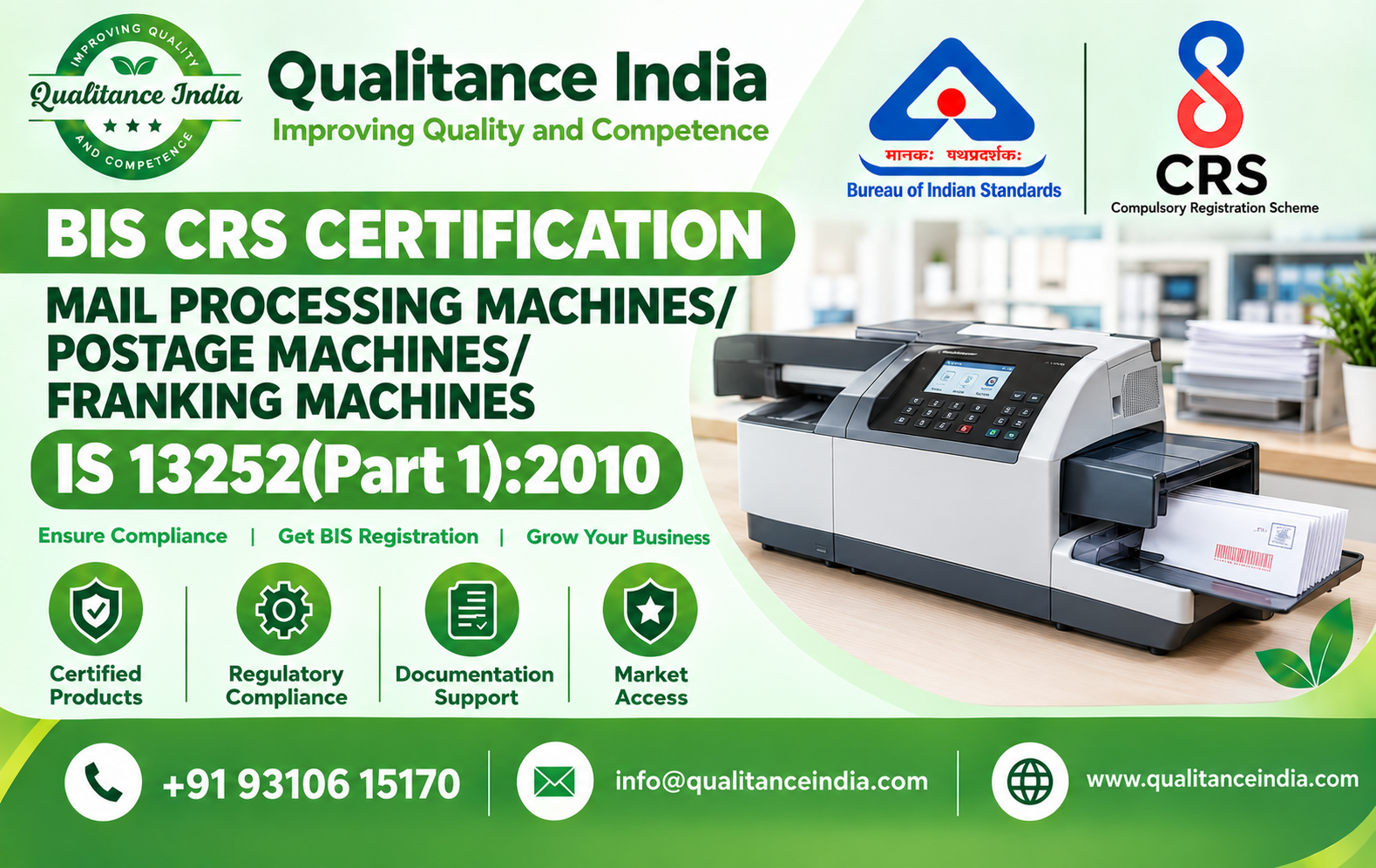
BIS CRS Certification for Mail Processing Machines, Postage Machines & Franking Machines | IS 13252 (Part 1):2010 | BIS Consultancy
Introduction
Mail Processing Machines, Postage Machines and Franking Machines are electronic equipment used for handling, processing, sorting, printing, weighing, recording or managing postal and mailing operations.
These machines can incorporate processors, displays, keyboards, printers, motors, scanners, communication interfaces, power supplies and other electronic assemblies. Because they contain electrical and electronic circuitry, product safety and conformity requirements are important before covered products are placed on the Indian market.
Under the BIS Compulsory Registration Scheme (CRS), Mail Processing Machines, Postage Machines and Franking Machines are specifically listed under:
IS 13252 (Part 1):2010 – Information Technology Equipment – Safety: Part 1 – General Requirements.
BIS's official CRS product list identifies all three categories with an implementation date of 13 May 2015. BIS also maintains a dedicated uniform test-report format for these products.
An important point for manufacturers is that BIS's revised CRS guidance provides 10 samples for each of the three categories and requires a separate licence for Mail Processing Machines, Postage Machines and Franking Machines.
Qualitance India provides end-to-end consultancy support for BIS CRS registration, including product applicability assessment, laboratory coordination, technical documentation, application filing, clarification handling and registration support.
What Is BIS CRS Certification?
The Compulsory Registration Scheme (CRS) is a BIS conformity-assessment framework applicable to specified electronic and information-technology products.
Under CRS, the manufacturer is required to establish conformity of the product with the applicable Indian Standard through testing at a laboratory recognized by BIS. After obtaining the applicable test report, the manufacturer applies to BIS for registration along with the prescribed documents.
For the products covered in this article, the applicable standard is:
IS 13252 (Part 1):2010
BIS's official uniform test-report list specifically identifies:
- Mail Processing Machines
- Postage Machines
- Franking Machines
under this Indian Standard.
What Is IS 13252 (Part 1):2010?
IS 13252 (Part 1):2010 is titled:
Information Technology Equipment – Safety: Part 1 – General Requirements
BIS laboratory listings identify it as the Second Revision.
The standard establishes safety requirements applicable to information-technology equipment. Depending on the design and construction of a machine, the applicable assessment can cover areas such as electrical safety, insulation, protection against electric shock, fire hazards, temperature, mechanical construction, wiring, components, marking and instructions.
The actual test program should always be determined from the specific equipment configuration and the applicable requirements of the standard.
Are Mail Processing, Postage and Franking Machines Covered Under BIS CRS?
Yes.
BIS's current CRS product database specifically lists:
MAIL PROCESSING MACHINES/POSTAGE MACHINES/FRANKING MACHINES
against IS 13252 (Part 1):2010, with implementation from 13 May 2015.
BIS also maintains a dedicated uniform test-report category for the three products.
Therefore, manufacturers of covered products supplying them in India should evaluate and fulfil the applicable CRS requirements before commercial placement.
Mail Processing Machines, Postage Machines and Franking Machines – Product Categories
Although these products are listed together in the BIS CRS framework, the applicable BIS guidance distinguishes them into three separate categories:
1. Mail Processing Machines
These are machines used for automated or semi-automated handling and processing of mail.
Depending on their design, they may perform functions such as:
- Mail handling
- Sorting
- Processing
- Scanning
- Feeding
- Document handling
- Data processing
2. Postage Machines
Postage machines are used for postal-related operations such as processing and handling postage information and related mailing functions.
3. Franking Machines
Franking machines are specialized equipment used to apply or record postage information electronically or mechanically on mail.
Modern machines can include:
- Display
- Keyboard
- Printer
- Processor
- Memory
- Communication interface
- Weighing system
- Power supply
- Scanner
- Electronic control system
The precise functions vary by product and manufacturer.
Important BIS Licence Structure
One of the most important points for manufacturers is that these three product categories are not automatically covered under one common licence.
The BIS revised CRS document specifies:
- Mail Processing Machines – 10 samples – Separate licence
- Postage Machines – 10 samples – Separate licence
- Franking Machines – 10 samples – Separate licence
The BIS guidance therefore treats them as separate product/licence categories even though they are grouped under the broader heading of Mail Processing Machines/Postage Machines/Franking Machines.
This distinction should be considered before laboratory testing and application planning.
BIS Sample Requirement
According to the BIS CRS guidance for this product category:
Mail Processing Machines
Sample requirement: 10
Postage Machines
Sample requirement: 10
Franking Machines
Sample requirement: 10
Each category is subject to a separate licence.
The exact sample configuration should be confirmed with the selected BIS-recognized laboratory before dispatch.
The samples should represent the actual product model and configuration for which registration is being sought.
Safety Requirements for Mail Processing and Franking Equipment
Testing under IS 13252 (Part 1):2010 focuses on safety requirements.
Depending on the machine's design, applicable evaluation may involve:
- Protection against electric shock
- Electrical insulation
- Dielectric strength
- Leakage current
- Protective earthing
- Temperature rise
- Abnormal operation
- Protection against fire
- Mechanical safety
- Enclosure requirements
- Creepage and clearance
- Internal wiring
- Terminals
- Power supply
- Components
- Marking
- Instructions and warnings
Machines with motors, heaters, printers, scanners, power supplies or other electronic assemblies may require assessment of the corresponding safety characteristics.
The final test program should be confirmed by the recognized laboratory according to the product's construction.
BIS Testing for Mail Processing Machines
Testing is a core part of the CRS process.
The manufacturer submits the product to a BIS-recognized laboratory for evaluation against the applicable requirements of IS 13252 (Part 1):2010.
BIS's official test-report list includes a specific entry for:
MAIL PROCESSING MACHINES/POSTAGE MACHINES/FRANKING MACHINES
under this standard.
Before sending samples, manufacturers should ensure that the laboratory has the appropriate current testing scope.
Product Identification Before Testing
Correct product identification is essential.
The following details should remain consistent:
Manufacturer + Brand + Product Category + Model + Technical Configuration
Important information may include:
- Product name
- Brand
- Model number
- Manufacturer
- Manufacturing address
- Input voltage
- Rated frequency
- Power consumption
- Power supply
- Communication interfaces
- Printer configuration
- Display
- Scanner
- Motors
- Accessories
- Product label
A mismatch between the product tested and the product described in the application can lead to clarification or delay.
BIS CRS Registration Process
Step 1 – Product Applicability Assessment
First, determine whether the product falls within the Mail Processing Machine, Postage Machine or Franking Machine category under the current CRS framework.
Step 2 – Identify the Correct Product Category
Because separate licences are specified for the three categories, the correct classification should be established before testing.
Step 3 – Finalize Manufacturer and Factory Details
The legal name and address of the manufacturing unit should be correctly established.
Step 4 – Finalize Brand and Model
Brand and model details should be frozen before submission of samples.
Step 5 – Generate Test Request
The manufacturer uses the BIS CRS portal to enter sample details and select an approved laboratory. BIS's current registration system provides this online workflow.
Step 6 – Submit Samples to Laboratory
BIS currently requires the sample and Test Request to be sent to the selected laboratory within 60 days of generation of the Test Request.
Step 7 – Product Testing
The laboratory tests the machine according to the applicable requirements of IS 13252 (Part 1):2010.
Step 8 – Verify the Test Report
After the laboratory issues the report, the applicant reviews and verifies the report on the CRS portal.
Step 9 – Submit CRS Application
The verified test report is used for the online CRS registration application.
Step 10 – Submit Documents
The prescribed documents, declarations and fee details are submitted.
Step 11 – BIS Scrutiny
BIS examines the application and supporting documentation.
Step 12 – Clarification, if Required
Any BIS observations or queries must be addressed.
Step 13 – Registration Grant
After satisfactory completion of the applicable process, BIS grants the CRS registration.
Test Report Validity for CRS Application
BIS's current CRS instructions state that the test report submitted with the online application should be not more than 90 days old at the time of submission.
Therefore, manufacturers should coordinate laboratory testing and application filing carefully.
A technically satisfactory report that is not submitted within the applicable validity period may create avoidable problems.
Documents Required for BIS CRS Certification
The exact document checklist depends on the application and manufacturer, but commonly required documents include:
- Manufacturer registration/business documents
- Manufacturing-unit name and address proof
- Product technical specification
- Product photographs
- Product label
- User manual
- Circuit diagram
- Block diagram
- PCB details
- Critical component list
- Power-supply information
- Transformer information, where applicable
- Motor information, where applicable
- Printer details
- Scanner details
- Test report from BIS-recognized laboratory
- Brand ownership documents
- Brand authorization documents, where applicable
- Authorized signatory details
- Affidavit-cum-undertaking
- Other documents prescribed by BIS
BIS's current CRS instructions require applicants to provide documentary proof establishing the name and address of the manufacturing unit and its manufacturing activity.
Technical File Requirements
A technical file for a Mail Processing, Postage or Franking Machine may include:
Product Details
- Product name
- Brand
- Model
- Product description
- Intended use
- Product photographs
Electrical Details
- Rated voltage
- Rated frequency
- Rated current/power
- Power supply
- Adapter
- Fuse
- Protection devices
Electronic Details
- Circuit diagram
- Block diagram
- PCB drawings
- Component list
- Critical components
- Communication modules
Mechanical Details
- Enclosure
- Internal construction
- External photographs
- Moving parts
- Motors
- Feed mechanisms
Functional Details
- Printing mechanism
- Scanning system
- Display
- Keyboard
- Weighing system, where applicable
- Communication interfaces
User Information
- User manual
- Installation instructions
- Safety instructions
- Warning information
Brand Requirements
A product may be sold under:
- Manufacturer-owned brand
- Private-label brand
- OEM brand
- Third-party brand
Where a third-party brand is used, the appropriate authorization documents should be prepared.
The manufacturer should finalize the brand before product testing because the test report and registration application need consistent product identification.
Requirements for Foreign Manufacturers
Foreign manufacturers without a liaison office or branch office in India are required to appoint an Authorized Indian Representative (AIR) according to the applicable BIS CRS procedure.
BIS's current application instructions expressly require foreign applicants without an Indian liaison office or branch office to appoint an AIR.
The AIR acts as the Indian representative for communication and regulatory matters.
The following should remain aligned:
Foreign Manufacturer → Brand → Product → Model → AIR → Test Report → BIS Application
Requirements for Indian Manufacturers
Indian manufacturers should ensure that the following details are consistent:
- Factory legal name
- Factory address
- Product name
- Brand
- Model
- Test report
- Application
- Product label
- Supporting documents
Any inconsistency can lead to additional clarification.
Product Label and Marking
The product marking must comply with the applicable CRS requirements.
BIS's CRS FAQ provides the self-declaration marking format as:
“Self Declaration - Conforming to IS 13252:2010” followed by the Registration Number.
The declaration should preferably be marked on the product. If product-size limitations make this impractical, it may be placed on the packaging. The marking should be indelible, legible and clearly visible.
Manufacturers should ensure that:
- Brand is correct
- Model is correct
- Manufacturer details are correct
- Product identification is consistent
- Required CRS marking is properly applied
Multiple Models and Model Inclusion
Mail Processing, Postage and Franking Machines may be manufactured in multiple models.
Differences can occur in:
- Machine size
- Power consumption
- Printing mechanism
- Processor
- PCB
- Display
- Scanner
- Motor
- Communication interface
- Power supply
- Functional configuration
Therefore, model coverage should be evaluated carefully before relying on one test report for multiple variants.
For an already registered manufacturer, BIS provides a formal process for requesting inclusion of new models of the same product and brand under the same registration number, subject to the applicable requirements. The current inclusion procedure also requires the relevant test report to be within 90 days of issue at online submission.
One Licence for All Three Categories?
No.
This is a particularly important point.
BIS's revised product-category guidance states:
Mail Processing Machines – Separate licence
Postage Machines – Separate licence
Franking Machines – Separate licence
Each category has a specified sample requirement of 10.
Therefore, a manufacturer dealing in more than one of these categories should plan the registration process separately.
BIS Testing Cost for Mail Processing, Postage and Franking Machines
Testing charges vary by laboratory and can change over time.
Current BIS LIMS listings provide different laboratory-specific charges.
For example, one current BIS LIMS listing shows:
₹78,000 for Mail Processing Machine/Postage Machine/Franking Machines under IS 13252 (Part 1):2010.
Another current BIS laboratory listing shows:
₹1,36,500 for Mail Processing/Postage/Franking Machines.
Another laboratory listing groups these products in a Class III category with a displayed charge of ₹40,000.
These amounts are laboratory-specific testing charges excluding applicable taxes.
They should not be treated as a single universal BIS testing fee.
The complete project cost may additionally include:
- BIS registration charges
- Laboratory testing
- Sample transportation
- Documentation
- Additional testing
- Retesting, if required
- Brand documentation
- AIR-related expenses
- Consultancy charges
How Much Does BIS CRS Registration Cost?
The total cost depends on:
- Product category
- Laboratory selected
- Number of models
- Product configuration
- Testing scope
- Additional testing requirements
- Manufacturer location
- Brand structure
- Documentation
- Applicable BIS charges
Mail Processing Machines, Postage Machines and Franking Machines should also be budgeted separately because BIS specifies separate licences for the three categories.
How Long Does BIS CRS Certification Take?
The overall project duration depends on:
- Sample readiness
- Laboratory availability
- Testing time
- Test result
- Documentation completeness
- Product modifications
- Application accuracy
- BIS scrutiny
- Query resolution
BIS's current CRS procedure provides a normal processing workflow after submission of the required documents and hard copies. Manufacturers should nevertheless consider laboratory testing and sample logistics separately from BIS's internal processing period.
The test report also needs to meet the applicable 90-day requirement at online submission.
Common Reasons for BIS CRS Delays
Incorrect Product Category
Mail Processing, Postage and Franking Machines are separate licence categories under the BIS guidance.
Model Number Mismatch
The model submitted for registration should correspond to the tested product.
Manufacturing Address Mismatch
Factory information should match the supporting documents and laboratory report.
Brand Documentation Issues
Brand ownership or authorization may need clarification.
Incomplete Technical Documentation
Missing diagrams, specifications or component details can delay the process.
Product Modification After Testing
Changes to the PCB, power supply, printer, motor or other important components can affect the technical identity of the tested product.
Non-Conforming Sample
The machine must satisfy the applicable safety requirements.
Expired Test Report
BIS requires the test report to be within 90 days at the time of online submission.
Delay in Sending Sample
The sample and Test Request should be sent to the selected laboratory within 60 days of Test Request generation.
Is Factory Inspection Required Under CRS?
CRS follows a testing-and-registration framework and is different from many conventional BIS Scheme-I product certification procedures.
The primary basis is the prescribed laboratory test report and registration documentation.
Manufacturers should nevertheless maintain control over the registered product configuration and ensure continued compliance with applicable requirements.
Benefits of BIS CRS Registration
For manufacturers of covered Mail Processing, Postage and Franking Machines, CRS registration provides important advantages:
- Compliance with applicable Indian regulatory requirements
- Demonstration of product safety conformity
- Improved customer confidence
- Better market acceptance
- Greater credibility with institutional buyers
- Better product traceability
- Support for commercial distribution
- Structured product safety evaluation
These machines are often used in commercial, postal, logistics and institutional environments, making reliable product safety especially important.
Who Needs BIS CRS Registration?
The requirement is relevant to manufacturers whose products fall under the specified CRS categories.
This may include manufacturers producing:
- Mail processing machines
- Postage machines
- Franking machines
- Electronic mail-handling equipment falling within the defined product category
The exact classification should be verified from the actual product function and current BIS requirements.
Can an Importer Apply for CRS Registration?
CRS registration is associated with the manufacturer and manufacturing location.
BIS's FAQ states that registration is for the manufacturer/factory and that the manufacturer is responsible for getting imported products tested through a BIS-recognized laboratory. An importer may function on behalf of the manufacturer only under authorization.
For foreign manufacturers without an Indian liaison office or branch office, the applicable AIR requirement must also be followed.
Separate Registration for Different Manufacturing Locations
BIS states that the Unique Registration Number is for a unique manufacturing location, meaning separate application is required for another manufacturing location.
Therefore, manufacturers operating multiple production facilities should assess each location separately.
What Happens After CRS Registration?
After registration, the manufacturer should maintain conformity of the registered products.
This includes:
- Maintaining the approved product configuration
- Maintaining correct brand/model identification
- Applying required marking
- Controlling critical components
- Maintaining technical documentation
- Following applicable BIS requirements
- Tracking registration validity
- Completing renewal requirements
Any significant product change should be reviewed before continuing under the existing registration.
Renewal of BIS CRS Registration
BIS states that CRS registration is initially granted for two years and is renewed according to the applicable procedure.
Manufacturers should monitor:
- Registration expiry date
- Product models
- Brand
- Factory address
- Product modifications
- Regulatory updates
Renewal should be initiated according to the current BIS requirements.
Difference Between BIS CRS and BIS ISI Certification
BIS operates multiple conformity-assessment schemes.
BIS CRS Registration is used for specified electronic and IT products and is based primarily on testing through recognized laboratories followed by registration.
BIS Scheme-I/ISI Mark Certification follows a different framework and may include factory assessment, product testing and continuing conformity requirements.
Mail Processing Machines, Postage Machines and Franking Machines covered under this CRS category follow the CRS registration route.
Quick BIS CRS Process
Product Applicability Check
↓
Identify Mail Processing / Postage / Franking Category
↓
Manufacturer & Factory Verification
↓
Brand & Model Finalization
↓
Generate Test Request
↓
Select BIS-Recognized Laboratory
↓
Submit 10 Samples
↓
Testing as per IS 13252 (Part 1):2010
↓
Test Report Verification
↓
Online CRS Application
↓
Submit Documents & Undertakings
↓
BIS Scrutiny
↓
Clarification, if Required
↓
Separate CRS Registration/Licence for Applicable Category
↓
Ongoing Compliance
Frequently Asked Questions
1. What is BIS CRS Certification for Mail Processing Machines?
It is the BIS Compulsory Registration Scheme process applicable to Mail Processing Machines covered under the relevant CRS requirements and IS 13252 (Part 1):2010.
2. What standard applies to Mail Processing Machines?
IS 13252 (Part 1):2010. BIS specifically identifies Mail Processing Machines under this standard.
3. What standard applies to Postage Machines?
IS 13252 (Part 1):2010.
4. What standard applies to Franking Machines?
IS 13252 (Part 1):2010.
5. Are all three products covered under CRS?
Yes. BIS lists Mail Processing Machines/Postage Machines/Franking Machines in its CRS product list.
6. What is the implementation date?
The BIS CRS product list shows 13 May 2015 for these products.
7. How many samples are required?
The BIS revised guidance specifies 10 samples for each category.
8. Is one licence issued for all three categories?
No. BIS guidance specifies a separate licence for Mail Processing Machines, Postage Machines and Franking Machines.
9. Is laboratory testing required?
Yes. Product testing through the applicable BIS-recognized laboratory is a fundamental part of CRS registration.
10. How old can the test report be?
At online submission, the test report should not be more than 90 days old.
11. How long do I have to send the sample after generating the Test Request?
BIS currently instructs applicants to send the sample and Test Request to the laboratory within 60 days of Test Request generation.
12. What is the current testing cost?
Testing charges vary by laboratory. Current BIS LIMS examples include approximately ₹78,000, ₹1,36,500 and ₹40,000 depending on laboratory and scope.
13. Does the laboratory testing charge include BIS registration fees?
No. Laboratory testing and BIS registration-related costs are separate.
14. Does factory inspection take place under CRS?
CRS is primarily a laboratory-testing and registration framework rather than the conventional factory-inspection model associated with many Scheme-I licences.
15. Can an importer apply for registration?
Registration is for the manufacturer. An importer may act on behalf of the manufacturer only under applicable authorization.
16. Does a foreign manufacturer need an AIR?
A foreign applicant without a liaison office or branch office in India has to appoint an Authorized Indian Representative under the applicable BIS procedure.
17. Can different factories share one registration?
BIS states that a Unique Registration Number is for a unique manufacturing location, so separate applications are required for different manufacturing locations.
18. What documents are required?
Common documents include manufacturer proof, factory address proof, technical documents, product label, brand documents, laboratory test report and prescribed declarations.
19. Is brand authorization required?
Where the brand is owned by another entity, applicable brand authorization documents are required.
20. Can multiple models be included?
Model inclusion is possible subject to the applicable BIS procedure and technical requirements. BIS provides a specific procedure for inclusion of new models of the same product and brand.
21. Can one test report cover Mail Processing, Postage and Franking Machines?
Manufacturers should not assume this. BIS's revised guidance specifically provides separate licences for the three categories.
22. Does the product need a BIS/CRS marking?
Yes. The applicable CRS self-declaration marking requirements need to be followed. BIS's FAQ specifies the relevant self-declaration wording and registration-number requirement.
23. What happens if the product fails testing?
The manufacturer needs to address the applicable non-conformity and follow the laboratory/BIS procedure before proceeding with registration.
24. Can the product be modified after testing?
Significant changes should be reviewed before relying on an earlier test report.
25. How long is CRS registration valid?
BIS states that registration is initially granted for two years and is renewed according to the applicable procedure.
26. What is the first step for Franking Machine CRS registration?
The first step is to verify the product classification, manufacturer, model, applicable standard and current CRS requirements before laboratory testing.
27. Can Qualitance India arrange laboratory testing?
Yes. Qualitance India provides testing coordination and certification consultancy support.
28. Can Qualitance India file the CRS application?
Yes. Qualitance India can assist with documentation, application filing and BIS CRS registration follow-up.
People Also Ask
Is BIS registration mandatory for Franking Machines in India?
Franking Machines are specifically listed under the BIS CRS framework against IS 13252 (Part 1):2010.
Which IS code is required for Franking Machine BIS registration?
IS 13252 (Part 1):2010.
Which standard applies to Postage Machines?
IS 13252 (Part 1):2010.
How many samples are required for Franking Machine testing?
The BIS guidance specifies 10 samples for Franking Machines.
Does Mail Processing Machine need a separate BIS licence?
Yes. BIS specifies a separate licence for Mail Processing Machines.
Does Postage Machine need a separate licence?
Yes. BIS specifies a separate licence for Postage Machines.
Does Franking Machine need a separate licence?
Yes. BIS specifies a separate licence for Franking Machines.
What is the Franking Machine BIS testing cost?
Laboratory charges vary. Current BIS LIMS listings include examples of ₹78,000 and ₹1,36,500 for this combined product category at different laboratories.
How old can the CRS test report be?
The report should not be more than 90 days old at the time of online application submission.
Does a foreign manufacturer need an Indian representative?
A foreign applicant without an Indian liaison office or branch office must appoint an Authorized Indian Representative under the applicable BIS procedure.
Related BIS CRS Products Under IS 13252 (Part 1):2010
BIS also identifies numerous other electronic and IT products under IS 13252 (Part 1):2010, including:
- Automatic Data Processing Machines
- Printers and Plotters
- Scanners
- Set Top Boxes
- Telephone Answering Machines
- Wireless Keyboards
- Cash Registers
- Copying Machines/Duplicators
- Passport Readers
- Point of Sale Terminals
- Smart Card Readers
- Power Banks for Portable Applications
- Mail Processing Machines
- Postage Machines
- Franking Machines
- Power Adaptors for IT Equipment
- Mobile Phones
- Keyboard
- Automatic Teller Cash Dispensing Machines
- USB Type External Hard Disk Drives
- USB Type External Solid-State Storage Devices
- Standalone SMPS with output voltage up to 48 V
The specific applicability, standard and current requirements should be checked for each product category separately.
Why Choose Qualitance India for BIS CRS Consultancy?
Qualitance India provides complete consultancy assistance for electronic and IT products requiring BIS CRS registration.
Our services include:
- CRS applicability assessment
- Product classification
- Applicable IS standard identification
- Product and model review
- Brand assessment
- Laboratory selection
- Sample submission coordination
- Product testing coordination
- Test report support
- Technical document preparation
- Brand authorization support
- AIR coordination for foreign manufacturers
- CRS application filing
- BIS query handling
- Registration follow-up
- Model inclusion support
- Renewal guidance
- Post-registration compliance support
Our objective is to help manufacturers complete the CRS process with properly aligned technical, testing and regulatory documentation.
BIS CRS Certification for Mail Processing, Postage & Franking Machines – Contact Qualitance India
Are you a Mail Processing Machine, Postage Machine or Franking Machine manufacturer, OEM, brand owner or importer looking for BIS CRS Registration under IS 13252 (Part 1):2010?
Qualitance India provides professional consultancy support from product applicability assessment and laboratory testing through documentation, application filing and BIS registration.
Qualitance India BIS CRS Certification Consultancy
Phone: +91 93106 15170 Email: info@qualitanceindia.com Website: https://qualitanceindia.com/
Conclusion
Mail Processing Machines, Postage Machines and Franking Machines are specifically covered under the BIS Compulsory Registration Scheme against IS 13252 (Part 1):2010. BIS's current CRS product list identifies these categories with an implementation date of 13 May 2015, and BIS maintains a dedicated test-report category for them.
A particularly important compliance point is that BIS's revised CRS guidance specifies 10 samples for each product category and a separate licence for Mail Processing Machines, Postage Machines and Franking Machines.
The registration process involves correct product classification, model and brand finalization, laboratory testing, test-report verification, technical documentation and online BIS application. BIS currently requires the submitted test report to be no more than 90 days old, while the sample and Test Request should be sent to the selected laboratory within 60 days of Test Request generation.
Laboratory testing charges vary substantially between laboratories. Current BIS LIMS listings provide different laboratory-specific prices, so manufacturers should confirm the latest applicable scope and quotation before submitting samples.
For professional assistance with BIS CRS Certification for Mail Processing Machines, Postage Machines and Franking Machines as per IS 13252 (Part 1):2010, Qualitance India provides end-to-end consultancy support covering product assessment, testing coordination, documentation, application filing and BIS CRS registration.