
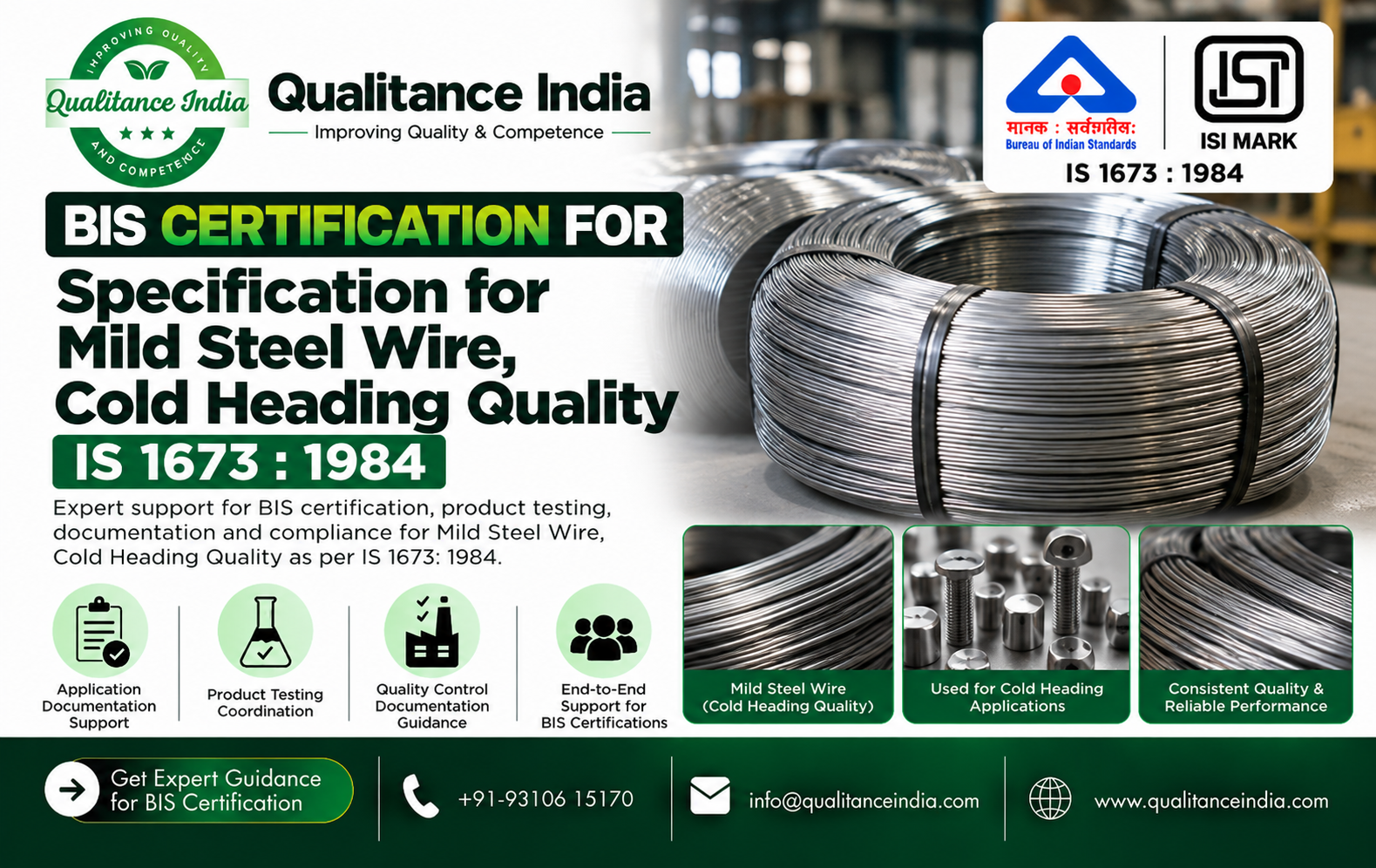
BIS Certification for Mild Steel Wire – Cold Heading Quality | IS 1673:1984 – Qualitance India
BIS Certification for Mild Steel Wire – Cold Heading Quality (IS 1673:1984)
Mild steel wire used for cold heading is an important raw material in the manufacturing of screws, fasteners and other formed metal components. Its chemical composition, mechanical properties, dimensional accuracy and surface quality directly influence the performance of the finished products.
To ensure consistent product quality in the Indian market, Mild Steel Wire, Cold Heading Quality is covered under IS 1673:1984 – Specification for Mild Steel Wire, Cold Heading Quality.
Manufacturers supplying this product in India must comply with the applicable BIS certification requirements and obtain the required ISI Mark licence under Scheme-I.
In this article, we explain the scope of IS 1673:1984, mandatory certification status, important testing requirements, manufacturing and quality-control considerations, documents required and the process for obtaining a BIS licence.
1. What is IS 1673:1984?
IS 1673:1984 is the Indian Standard titled:
Specification for Mild Steel Wire, Cold Heading Quality (Second Revision).
The standard specifies requirements for cold-drawn mild steel wire suitable for manufacturing components through cold heading and thread-rolling processes.
The published standard covers two grades of cold-drawn mild steel wire, with diameters ranging from 1.60 mm to 12.50 mm.
The wire is intended for applications where the material must withstand forming operations without unacceptable cracking or other defects.
Typical applications include:
- Machine screws
- Industrial fasteners
- Threaded components
- Cold-headed metal components
- Engineering and automotive components
The exact product scope and applicable grade must be confirmed against the standard and the manufacturer’s actual product specifications.
2. Is BIS Certification Mandatory for Mild Steel Wire under IS 1673?
Yes. BIS certification is mandatory for Mild Steel Wire, Cold Heading Quality covered under IS 1673:1984.
The product is included in the Ministry of Steel’s Steel and Steel Products (Quality Control) Order, 2024.
The applicable regulatory framework is:
| Particular | Details |
|---|---|
| Product | Mild Steel Wire, Cold Heading Quality |
| Indian Standard | IS 1673:1984 |
| QCO | Steel and Steel Products (Quality Control) Order, 2024 |
| QCO notification | S.O. 3716(E), dated 29 August 2024 |
| Schedule | Schedule 1, Serial No. 67 |
| Certification scheme | BIS Scheme-I |
| Certification mark | ISI Standard Mark |
| Certifying authority | Bureau of Indian Standards (BIS) |
The 2024 QCO specifies implementation with immediate effect for IS 1673:1984. The 2025 amendment deferring certain other entries does not list Serial No. 67 among the deferred entries.
Accordingly, manufacturers covered by the QCO must obtain the applicable BIS licence and comply with the Standard Mark requirements before supplying the regulated product in the Indian market.
Important: QCO applicability should always be checked against the latest Ministry of Steel notifications, including any subsequent amendments or product-specific exemptions.
3. Product Scope under IS 1673:1984
IS 1673:1984 covers cold-drawn mild steel wire intended for cold heading and thread rolling.
The standard specifies two grades of wire and covers the following principal characteristics:
- Chemical composition
- Mechanical properties
- Tensile strength
- Reverse torsion behaviour
- Crushing characteristics
- Dimensions and tolerances
- Freedom from defects
The manufacturer should identify the exact grade, diameter range and product configuration proposed for certification.
A product made to a different Indian Standard should not automatically be considered covered by IS 1673 merely because it is also mild steel wire.
4. Technical and Quality Requirements under IS 1673:1984
The standard establishes technical requirements to ensure that the wire is suitable for cold forming operations.
4.1 Chemical Composition
Chemical composition is an important factor in determining the formability and mechanical behaviour of mild steel wire.
The standard specifies chemical requirements for the applicable grades. The relevant chemical parameters include:
- Carbon
- Manganese
- Sulphur
- Phosphorus
- Silicon
The chemical composition must conform to the applicable limits specified in IS 1673:1984, including its applicable amendments.
Manufacturers should maintain traceability between incoming steel, heat numbers, production batches and finished wire coils.
4.2 Mechanical Properties
The wire must satisfy the mechanical requirements prescribed by the standard.
Important mechanical characteristics include:
- Ultimate tensile strength
- Reverse torsion performance
- Crushing test performance
These tests help establish whether the wire has the required strength and can withstand the forming operations for which it is intended.
4.3 Reverse Torsion Test
The reverse torsion test is used to assess the wire’s ability to withstand repeated twisting without unacceptable failure.
The test helps identify problems associated with material quality, internal defects and processing conditions.
4.4 Crushing Test
The crushing test evaluates the wire’s behaviour under the deformation conditions specified in the standard.
It is an important quality check for wire intended for cold forming applications.
4.5 Dimensions and Tolerances
The wire must comply with the dimensional requirements specified in IS 1673:1984.
Manufacturers should establish suitable inspection arrangements for:
- Wire diameter
- Dimensional tolerances
- Product consistency
- Surface condition
4.6 Freedom from Defects
The finished wire should be free from defects that may adversely affect its intended use.
Manufacturers should establish suitable inspection and process controls to prevent unacceptable surface defects and other non-conformities.
Note: Exact numerical limits, test conditions and acceptance criteria must be taken from the applicable edition of IS 1673:1984 and its amendments. They should not be replaced with generic mild-steel wire specifications.
5. Testing Requirements for BIS Certification
Product testing is an important part of BIS certification.
The BIS laboratory information system lists testing requirements for IS 1673:1984, including the following parameters:
| Test / Inspection | Purpose |
|---|---|
| Chemical analysis – Carbon | Verification of carbon content |
| Chemical analysis – Manganese | Verification of manganese content |
| Chemical analysis – Sulphur | Verification of sulphur content |
| Chemical analysis – Phosphorus | Verification of phosphorus content |
| Chemical analysis – Silicon | Verification of silicon content |
| Ultimate tensile strength | Verification of mechanical strength |
| Reverse torsion test | Evaluation of torsional performance |
| Crushing test | Evaluation of deformation behaviour |
| Dimensions and tolerances | Verification of dimensional conformity |
| Freedom from defects | Assessment of surface and product quality |
The final testing programme should be established using the current standard, amendments and applicable BIS product certification requirements.
Laboratory testing charges: BIS LIMS entries show laboratory-specific charges. One published laboratory scope lists a total testing charge of ₹15,000 for IS 1673:1984, with individual test charges displayed separately. This is a laboratory-specific reference, not a universal BIS testing fee. Actual charges should be confirmed with the selected laboratory.
6. Manufacturing and Quality Control Requirements
A manufacturer applying for BIS certification should demonstrate that its production and inspection arrangements are capable of consistently producing wire conforming to IS 1673:1984.
Depending on the actual manufacturing process, the following operations may be relevant:
- Procurement and inspection of steel wire rod.
- Verification of incoming raw material.
- Wire drawing.
- Intermediate process inspection.
- Heat treatment or other processing, where applicable to the manufacturing route.
- Final dimensional inspection.
- Mechanical and chemical testing.
- Coil identification and batch traceability.
- Final inspection and dispatch control.
The actual manufacturing process and equipment required will depend on the product and the manufacturer’s declared scope.
The factory should maintain suitable records for raw materials, production, inspection, testing, non-conforming products and calibration.
7. Documents Required for BIS Certification
The following documents are generally relevant when preparing a BIS application for Mild Steel Wire, Cold Heading Quality.
A. Company Documents
- Company registration certificate or constitution documents
- GST registration certificate
- PAN card
- Factory address proof
- Factory layout plan
- Authorised signatory details
- Identity and address proof of authorised signatory
- Manufacturing unit details
B. Manufacturing Documents
- Manufacturing process flow chart
- List of manufacturing machinery
- Machinery details and specifications
- Manufacturing capacity details
- Product specifications
- Grade and size range proposed for certification
- Raw material specifications
- Process control procedure
C. Quality Control and Testing Documents
- Quality control plan
- Inspection and testing plan
- In-house laboratory equipment list
- Calibration certificates
- Testing procedures
- Raw material inspection records
- In-process inspection records
- Finished product inspection records
- Test reports, wherever applicable
- Non-conformity and corrective action procedure
D. BIS Application Documents
- Application form and supporting information
- Product description and proposed scope
- Trademark or brand ownership/authorisation documents, where applicable
- Factory and laboratory details
- Undertakings and declarations required by BIS
- Applicable application and processing fee payment details
BIS may require additional documents depending on the manufacturing arrangement, factory infrastructure and application category.
8. BIS Certification Process for Mild Steel Wire
The certification process generally involves the following stages:
Step 1: Product and Standard Verification
The manufacturer must confirm that the product falls within the scope of IS 1673:1984.
The applicable grade, wire diameter and proposed certification scope should be identified before filing the application.
Step 2: Factory and Laboratory Assessment
The manufacturing facility should be reviewed for its production infrastructure, inspection arrangements and quality-control system.
The manufacturer should identify which tests can be conducted in-house and which tests require external laboratory support, as permitted under applicable BIS requirements.
Step 3: Preparation of BIS Application
The application and supporting documents are prepared and submitted through the applicable BIS online application process.
Step 4: Product Testing
Samples are tested against the applicable requirements of IS 1673:1984.
The manufacturer must address any non-conformities identified during testing.
Step 5: BIS Factory Inspection
BIS may conduct a factory inspection to assess:
- Manufacturing facilities
- Production process
- Testing infrastructure
- Quality-control arrangements
- Raw material and finished product records
- Sample selection and testing arrangements
- Product marking and traceability
Step 6: Grant of Licence
After satisfactory assessment of the application, factory facilities and product conformity, BIS may grant the licence.
The manufacturer can use the ISI Standard Mark only in accordance with the licence conditions and applicable BIS marking requirements.
Step 7: Compliance after Licence Grant
After obtaining the BIS licence, the manufacturer must maintain continuous conformity.
This includes:
- Routine product testing
- Maintenance of quality records
- Calibration of testing equipment
- Control of production processes
- Compliance with marking requirements
- Cooperation with BIS surveillance and inspections
9. BIS Certification for Foreign Manufacturers
Foreign manufacturers intending to supply Mild Steel Wire, Cold Heading Quality in India must also comply with the applicable BIS certification requirements.
Such manufacturers may apply under the Foreign Manufacturers Certification Scheme (FMCS).
The process generally involves:
- Application to BIS under the applicable FMCS procedure
- Appointment of an Authorised Indian Representative (AIR), where required
- Submission of factory and product documents
- Assessment of manufacturing and testing infrastructure
- BIS factory inspection
- Product sample testing
- Grant of licence, subject to satisfactory compliance
Foreign manufacturers should plan for the additional documentation, inspection and coordination requirements associated with FMCS.
10. Common Challenges in BIS Certification
Manufacturers may encounter several issues during the certification process.
1. Incorrect product scope: Applying under the wrong Indian Standard or declaring an incomplete product range can create delays.
2. Inadequate testing infrastructure: The factory may not have the equipment or arrangements required for the applicable tests.
3. Incomplete documentation: Missing calibration records, inspection procedures and production records can affect factory assessment.
4. Product testing failures: Chemical composition or mechanical test results may not meet the standard’s requirements.
5. Poor batch traceability: Manufacturers should maintain clear identification of raw materials, production batches and finished wire coils.
6. Marking non-compliance: The Standard Mark must be used only after licence grant and in accordance with BIS requirements.
A structured pre-assessment can help identify these issues before the formal certification process.
11. BIS Certification Cost for Mild Steel Wire
The total cost of BIS certification depends on the type of manufacturer, product scope, factory infrastructure and testing requirements.
The overall cost may include:
- BIS application fee
- BIS licence fee
- Annual marking fee
- Product testing charges
- Sample transportation charges
- Laboratory charges
- Inspection-related expenses
- Consultancy and documentation charges, if professional assistance is engaged
The actual fee structure should be verified against the latest BIS fee schedule and applicable certification procedure.
A manufacturer should not rely on a single estimated figure without first confirming the product scope, testing requirements and existing factory infrastructure.
12. Why Choose Qualitance India for BIS Certification?
Qualitance India provides professional assistance to manufacturers seeking BIS product certification and regulatory compliance in India.
Our support for Mild Steel Wire, Cold Heading Quality under IS 1673:1984 can include:
- Product and Indian Standard applicability review
- BIS certification feasibility assessment
- Application documentation support
- Manufacturing process review
- Quality control documentation
- Testing and laboratory coordination
- Factory inspection preparation
- Assistance in addressing non-conformities
- Post-licence compliance guidance
Our objective is to help manufacturers establish a practical and compliant certification process.
Qualitance India – Improving Quality & Competence
For BIS certification assistance, contact us:
Website: https://qualitanceindia.com
Email: info@qualitanceindia.com
Phone / WhatsApp: +91 93106 15170
13. Frequently Asked Questions (FAQs)
Q1. Which Indian Standard applies to Mild Steel Wire, Cold Heading Quality?
IS 1673:1984 – Specification for Mild Steel Wire, Cold Heading Quality.
Q2. Is BIS certification mandatory for Mild Steel Wire under IS 1673?
Yes. IS 1673:1984 is included in Schedule 1, Serial No. 67 of the Steel and Steel Products (Quality Control) Order, 2024, with implementation specified as immediate effect.
Q3. Which BIS certification scheme applies to IS 1673:1984?
The applicable certification route is BIS Scheme-I, under which the manufacturer obtains a licence to use the ISI Standard Mark.
Q4. What is the diameter range covered by IS 1673:1984?
The published standard covers cold-drawn mild steel wire from 1.60 mm to 12.50 mm diameter.
Q5. What tests are required for BIS certification under IS 1673?
The testing programme includes chemical analysis, ultimate tensile strength, reverse torsion, crushing, dimensional checks and freedom from defects, as applicable under the standard.
Q6. Can a foreign manufacturer obtain BIS certification for IS 1673?
Yes. Foreign manufacturers can apply through the applicable BIS Foreign Manufacturers Certification Scheme.
Q7. Can a manufacturer use the ISI Mark before obtaining a BIS licence?
No. The ISI Standard Mark must not be used without the required BIS licence.
Q8. What is the cost of BIS certification for Mild Steel Wire?
The cost depends on BIS fees, product testing charges, factory infrastructure, sample requirements and other applicable expenses. A project-specific estimate should be prepared after reviewing the manufacturer’s scope.
Q9. Does BIS certification cover every size and grade automatically?
The approved scope depends on the product classification, applicable standard and BIS certification assessment. The proposed grades and sizes should be clearly identified during application preparation.
Conclusion
BIS certification under IS 1673:1984 is an important compliance requirement for manufacturers of Mild Steel Wire, Cold Heading Quality covered under the Steel and Steel Products QCO.
Manufacturers should ensure that their product conforms to the applicable chemical, mechanical, dimensional and quality requirements before applying for the BIS licence.
Proper documentation, suitable testing arrangements, batch traceability and effective production controls can help establish a smooth certification process and support continued compliance after licence grant.
Need assistance with BIS Certification for Mild Steel Wire – Cold Heading Quality?
Connect with Qualitance India for professional guidance on BIS application preparation, product testing, factory readiness and certification support.
Qualitance India – Improving Quality & Competence
References and Regulatory Sources
- Bureau of Indian Standards – Scheme-I Products under Compulsory Certification: https://www.bis.gov.in/product-certification/products-under-compulsory-certification/scheme-1/
- Ministry of Steel – Steel and Steel Products (Quality Control) Order, 2024, S.O. 3716(E), dated 29 August 2024.
- Ministry of Steel – Steel and Steel Products (Quality Control) Amendment Order, 2025, S.O. 5134(E), dated 20 November 2025.
- BIS Laboratory Information Management System – IS 1673:1984 testing scope and laboratory charges: https://lims.bis.gov.in/
- IS 1673:1984 – Specification for Mild Steel Wire, Cold Heading Quality (Second Revision).
Need help with BIS certification for this product?
Get a free consultation from our compliance experts — we handle testing, documentation and the complete BIS process for you.
BIS Certification Readiness Checklist 2026
- Documents, testing & factory requirements in one place
- Covers ISI Mark, CRS, FMCS & Hallmarking
- Tick-box format — share it with your team