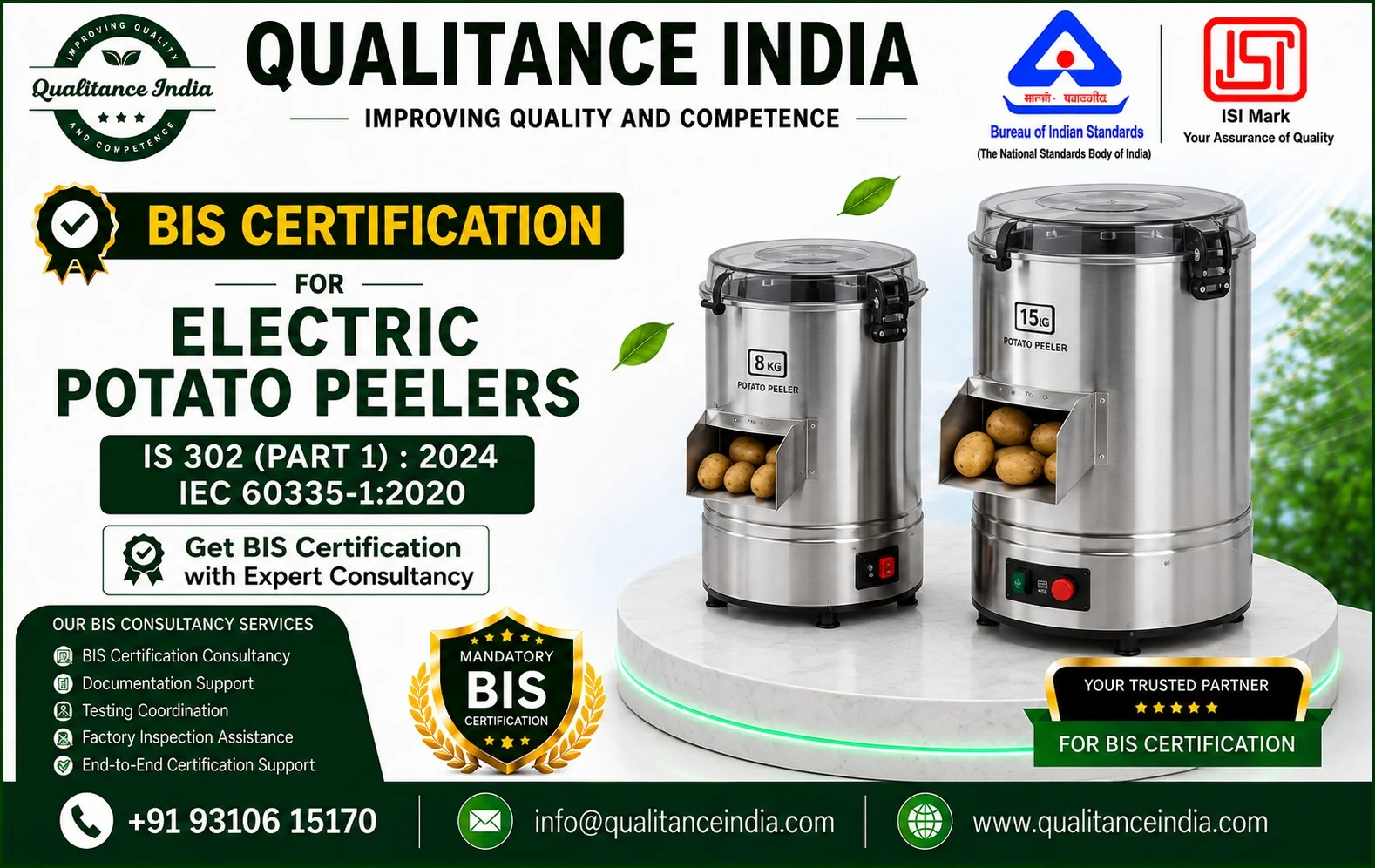
BIS Certification for Electric Potato Peelers | IS 302 (Part 1):2024 | IEC 60335-1:2020
Introduction
BIS Certification for Electric Potato Peelers is an important compliance requirement for manufacturers and businesses dealing with electrically operated potato peeling appliances in India. The BIS testing scope for IS 302 (Part 1):2024 specifically lists Electric Potato Peeler among the illustrative products covered for applicable testing under the standard. The standard is identical under dual numbering to IEC 60335-1:2020.
IS 302 (Part 1):2024 specifies general safety requirements for covered household and similar electrical appliances. Depending on the product’s design, rated voltage, intended application and specific construction, additional product-specific requirements or a relevant Part 2 standard may also need to be evaluated.
Qualitance India provides professional BIS Certification Consultancy for Electric Potato Peelers, including product applicability assessment, technical documentation support, laboratory testing coordination, BIS application assistance and factory inspection preparation.
About the Product
An Electric Potato Peeler is an electrically operated appliance designed to remove the outer skin or peel from potatoes and potentially other suitable vegetables, depending on its intended design and application.
Electric Potato Peelers may be used in:
- Household kitchens
- Restaurants
- Hotels
- Catering businesses
- Commercial kitchens
- Food preparation facilities
- Institutional kitchens
- Food processing environments
Depending on the design, an Electric Potato Peeler may include:
- Electric motor
- Rotating peeling mechanism
- Abrasive peeling surface
- Rotating drum or chamber
- Food-contact components
- Control switches
- Electrical wiring
- Power supply
- Protective housing
- Safety interlocks
- Electrical insulation
Because the appliance is electrically operated and may contain rotating mechanical components, appropriate electrical and mechanical safety requirements need to be evaluated under the applicable BIS certification framework.
What is BIS Certification?
BIS Certification is a conformity assessment mechanism administered by the Bureau of Indian Standards (BIS) to ensure that products comply with applicable Indian Standards.
For products covered under mandatory certification requirements, manufacturers may need to obtain a BIS licence before manufacturing, importing, selling or distributing the product in India.
Depending on the applicable certification scheme, the process may involve:
- Product classification
- Applicable Indian Standard identification
- QCO applicability assessment
- Product testing
- Technical documentation
- BIS application
- Factory inspection
- Compliance verification
- Grant of BIS licence
- Authorized use of the Standard Mark/ISI Mark, where applicable
The exact certification requirements should be determined based on the product’s technical characteristics and current regulatory framework.
Scope of IS 302 (Part 1):2024
IS 302 (Part 1):2024 / IEC 60335-1:2020 is titled:
Household and Similar Electrical Appliances – Safety – Part 1: General Requirements.
The standard provides general safety requirements for covered electrical appliances and addresses areas such as:
- Protection against electric shock
- Electrical insulation
- Leakage current
- Electric strength
- Temperature rise
- Abnormal operation
- Mechanical safety
- Construction requirements
- Internal wiring
- Components
- Earthing
- Power input
- Marking and instructions
- Resistance to heat and fire
- Other applicable safety requirements
BIS’s official standard details identify IS 302 (Part 1):2024 as identical under dual numbering to IEC 60335-1:2020. The standard applies to covered household and similar electrical appliances, including applicable DC-supplied and battery-operated appliances.
BIS LIMS specifically lists Electric Potato Peeler among the products included in a laboratory’s testing scope under IS 302 Part 1:2024.
Products Covered
Depending on the exact product design and applicable certification requirements, this category may include:
- Electric Potato Peelers
- Electric Potato Peeling Machines
- Motor-Operated Potato Peelers
- Household Electric Potato Peelers
- Commercial Electric Potato Peelers
- Food Preparation Electric Potato Peelers
- Similar electrically operated peeling appliances, where applicable
The official BIS LIMS testing scope specifically mentions Electric Potato Peeler among illustrative products for IS 302 Part 1:2024 testing.
Note: The final applicability and certification route should be confirmed based on the exact product construction, rated voltage, intended use and applicable BIS requirements.
Enforcement Date
The applicable enforcement date depends on the relevant Quality Control Order (QCO) and the product’s specific classification.
BIS’s current compulsory-certification listing includes Safety of Household, Commercial and Similar Electrical Appliances (Quality Control) Order requirements for applicable electrical appliances under IS 302 (Part 1):2024 / IEC 60335-1:2020. The BIS listing currently shows 1 October 2026 as the implementation date for the relevant upcoming QCO entry covering applicable electrical appliances.
Manufacturers should verify the latest applicable QCO, amendments and implementation notifications before placing the product on the Indian market.
Applicable QCO Details
The Safety of Household, Commercial and Similar Electrical Appliances (Quality Control) Order applies to specified electrical appliances intended for household, commercial or similar applications, subject to its scope and exclusions.
The applicable framework covers electrical appliances within the specified voltage limits that are not already covered by another QCO. BIS’s implementation circular explains that appliances already covered under another QCO are excluded from this QCO’s scope.
Before applying, manufacturers should verify:
- Product category
- Rated voltage
- Intended application
- Applicable Indian Standard
- Applicable QCO
- Implementation date
- Whether another QCO applies
- Applicable BIS conformity assessment scheme
For an Electric Potato Peeler, product applicability should be confirmed based on the exact technical specifications and intended use.
Who Needs BIS Certification?
Depending on the applicable QCO and BIS certification framework, the following businesses may need BIS certification:
- Indian manufacturers
- Foreign manufacturers
- Exporters supplying Electric Potato Peelers to India
- OEM manufacturers
- Contract manufacturers
- Private-label manufacturers
- Brand owners
- Manufacturers of covered food preparation appliances
- Importers dealing with covered products
For eligible foreign manufacturers, the Foreign Manufacturers Certification Scheme (FMCS) may be applicable.
Eligibility Criteria
Generally, an applicant may need:
- Legally established manufacturing facility
- Defined manufacturing process
- Adequate production infrastructure
- Quality control arrangements
- Required testing facilities or testing arrangements
- Competent technical personnel
- Product technical specifications
- Product drawings
- Electrical circuit diagrams
- Manufacturing process documentation
- Raw material information
- Component details
- Applicable test reports
The exact eligibility criteria depend on the applicable BIS certification scheme.
Complete BIS Certification Process
Step 1: Product Applicability Assessment
The Electric Potato Peeler is evaluated to determine:
- Applicable Indian Standard
- Product category
- Product scope
- Rated voltage
- Intended application
- QCO applicability
- Relevant certification scheme
Step 2: Technical Documentation
Required technical, manufacturing and legal documents are prepared.
Step 3: Product Testing
Product samples are tested according to the applicable requirements through the appropriate BIS-recognized laboratory/testing route.
Step 4: BIS Application
The applicable BIS application is prepared and submitted.
Step 5: Application Scrutiny
BIS reviews the application and supporting documents.
Step 6: Factory Inspection
Where required, BIS assesses the manufacturing facility and quality control arrangements.
Step 7: Sample Verification and Testing
Samples may be evaluated according to the relevant certification procedure.
Step 8: Observation Closure
Any technical observations or non-conformities must be addressed.
Step 9: BIS Licence Grant
After successful completion of applicable requirements, the BIS licence may be granted.
Step 10: Post-Licence Compliance
The manufacturer must maintain ongoing compliance with applicable BIS requirements, testing, marking and surveillance provisions.
Required Documents
Common documents may include:
- Company registration documents
- Factory address proof
- Manufacturing unit details
- Factory layout
- Manufacturing process flow chart
- Production machinery list
- Testing equipment list
- Calibration certificates
- Quality control plan
- Product technical specifications
- Product drawings
- Electrical circuit diagrams
- User manual
- Product labels
- Trademark authorization
- Raw material details
- Component details
- Test reports
- Authorized signatory documents
- Brand ownership documents
- Undertakings and declarations
- Other BIS-required documents
The final document list depends on the applicable certification scheme and product requirements.
Testing Requirements
Electric Potato Peelers may require testing according to the applicable requirements of IS 302 (Part 1):2024.
Depending on product construction, testing may evaluate:
- Electrical safety
- Protection against electric shock
- Leakage current
- Electric strength
- Insulation resistance
- Temperature rise
- Power input
- Current input
- Abnormal operation
- Motor operation
- Mechanical strength
- Stability
- Mechanical hazards
- Earthing
- Internal wiring
- Resistance to heat and fire
- Marking and instructions
The BIS laboratory testing scope for IS 302 Part 1:2024 includes relevant areas such as classification, marking, construction, protection against electric shock, motor-operated appliance tests, temperature rise, leakage current/electric strength and mechanical safety requirements.
Testing requirements may vary according to the product’s exact construction and applicable certification route.
Factory Inspection Process
During a BIS factory inspection, the manufacturing facility may be evaluated for:
- Production capability
- Manufacturing process
- Quality control arrangements
- Testing facilities
- Testing equipment
- Calibration records
- Raw material control
- In-process inspection
- Finished product inspection
- Product identification
- Record maintenance
- Complaint handling
- Standard Marking controls
Proper preparation for factory inspection can help manufacturers identify and address compliance gaps.
Common Reasons for Application Rejection
Common issues may include:
- Incorrect standard selection
- Incorrect product classification
- Incomplete application
- Missing technical documents
- Incorrect product specifications
- Product outside declared scope
- Failed laboratory testing
- Inadequate testing arrangements
- Missing calibration certificates
- Factory inspection non-conformities
- Incorrect product marking
- Mismatch in manufacturer details
- Unresolved BIS observations
- Failure to meet applicable requirements
Professional consultancy can help manufacturers identify potential compliance issues before application submission.
Cost Factors
The total BIS Certification cost may depend on:
- BIS application fees
- Government charges
- Laboratory testing charges
- Factory inspection expenses
- Sample transportation
- Testing equipment requirements
- Documentation
- Consultancy charges
- Travel expenses
- Product complexity
- Number of models
- Product variants
- Additional testing requirements
BIS laboratory charges can also vary between laboratories and according to the testing scope. Therefore, the final cost should be assessed based on the specific Electric Potato Peeler model and applicable testing requirements.
Timeline
The BIS Certification timeline may vary depending on:
- Product complexity
- Applicable testing requirements
- Laboratory availability
- Documentation readiness
- Application scrutiny
- Factory inspection
- Testing results
- Resolution of observations
Complete and accurate documentation can help minimize avoidable delays.
Benefits of BIS Certification
BIS Certification can help manufacturers and businesses to:
- Meet applicable regulatory requirements
- Demonstrate product conformity
- Improve customer confidence
- Support legal market access
- Improve product quality
- Reduce compliance risks
- Strengthen brand credibility
- Expand market opportunities
- Improve business reputation
Why Choose Qualitance India?
Qualitance India provides professional BIS Certification Consultancy services to manufacturers, importers and businesses seeking product compliance support.
Our services may include:
✓ Product Applicability Assessment
✓ Applicable Standard Identification
✓ QCO Applicability Guidance
✓ BIS Certification Guidance
✓ Documentation Support
✓ Laboratory Testing Coordination
✓ BIS Application Assistance
✓ Factory Inspection Preparation
✓ Technical Compliance Support
✓ BIS Query Assistance
✓ End-to-End Certification Coordination
Qualitance India – Improving Quality and Competence
Frequently Asked Questions
1. Is BIS Certification mandatory for Electric Potato Peelers?
Electric Potato Peelers fall within the BIS testing scope for IS 302 (Part 1):2024. Whether a specific product requires mandatory BIS certification depends on the applicable QCO, product classification, rated voltage, intended use and whether another QCO applies.
2. Which standard applies to Electric Potato Peelers?
IS 302 (Part 1):2024 / IEC 60335-1:2020 provides general safety requirements applicable to covered electrical appliances. BIS LIMS specifically lists Electric Potato Peeler among illustrative products under the standard’s testing scope.
3. What is IS 302 (Part 1):2024?
IS 302 (Part 1):2024 is the Indian Standard for general safety requirements applicable to covered household and similar electrical appliances.
4. Is IEC 60335-1:2020 related to IS 302 Part 1:2024?
Yes. BIS identifies IS 302 (Part 1):2024 as identical under dual numbering to IEC 60335-1:2020.
5. How can I get BIS Certification for an Electric Potato Peeler?
The process generally involves product applicability assessment, standard and QCO verification, documentation, testing, BIS application, factory inspection where applicable and fulfilment of certification requirements.
6. What documents are required?
Documents may include company information, factory details, technical specifications, drawings, circuit diagrams, test reports and quality control documents.
7. Is product testing required?
Testing requirements depend on the applicable certification scheme and product requirements. Electric Potato Peeler is listed in the BIS testing scope for IS 302 Part 1:2024.
8. Is factory inspection mandatory?
Factory inspection requirements depend on the applicable BIS conformity assessment scheme.
9. Can an importer apply for BIS Certification?
Eligibility depends on the applicable BIS certification scheme and the status of the applicant under the relevant framework.
10. Can foreign manufacturers obtain BIS Certification?
Yes. Eligible foreign manufacturers may obtain BIS certification under the applicable certification scheme, including FMCS where relevant.
11. How much does BIS Certification cost?
The cost depends on testing, government fees, inspection, documentation and product-specific requirements.
12. How long does BIS Certification take?
The timeline varies depending on product testing, documentation, application scrutiny and inspection requirements.
13. What happens if the Electric Potato Peeler fails testing?
The manufacturer may need to identify the cause of failure, implement corrective action and complete applicable re-testing.
14. Can one BIS licence cover multiple Electric Potato Peeler models?
This depends on product similarity, applicable grouping requirements and BIS licensing provisions.
15. Is BIS Certification required for imported Electric Potato Peelers?
If the specific product is covered by a mandatory QCO, applicable foreign manufacturers and importers must comply with the relevant requirements.
16. Can Qualitance India help with BIS documentation?
Yes. Qualitance India provides BIS documentation and certification consultancy support.
17. Can Qualitance India help with product testing?
Yes. Testing coordination support can be provided based on applicable certification requirements.
18. What is the BIS Standard Mark?
The Standard Mark indicates conformity with applicable Indian Standard requirements under the relevant BIS certification framework where its use is authorized.
19. Can BIS Certification be obtained without testing?
Where testing is prescribed under the applicable certification scheme, the required testing must be completed.
20. What is BIS factory inspection?
BIS factory inspection is an assessment of the manufacturing facility, production capability and quality control arrangements as required by the applicable certification procedure.
21. What causes BIS Certification delays?
Incomplete documentation, testing delays, technical discrepancies and unresolved BIS observations may cause delays.
22. Do all Electric Potato Peelers require BIS Certification?
The requirement depends on the exact product classification, rated voltage, intended application, applicable QCO and whether another QCO covers the product.
23. What is the difference between BIS Certification and BIS Registration?
BIS Certification and BIS Registration under schemes such as CRS are different conformity assessment routes. The applicable route depends on the product category and regulatory requirements.
24. Does BIS Certification improve product credibility?
Yes. Where applicable, BIS certification demonstrates conformity with relevant standards and can improve customer confidence.
25. How can I start BIS Certification for my Electric Potato Peeler?
Start with a product applicability assessment to identify the applicable Indian Standard, QCO and certification scheme, followed by testing and the appropriate BIS certification process.
Need BIS Certification for Electric Potato Peelers?
Are you a manufacturer, importer or brand owner dealing with Electric Potato Peelers for the Indian market?
Don’t let documentation problems, testing delays or compliance issues affect your business.
Qualitance India can assist you with:
✓ Product Applicability Assessment
✓ Applicable Standard Identification
✓ QCO Applicability Guidance
✓ BIS Documentation Support
✓ Product Testing Coordination
✓ BIS Application Assistance
✓ Factory Inspection Preparation
✓ End-to-End BIS Certification Consultancy
Contact Qualitance India today for professional BIS Certification consultancy support.
Call / WhatsApp: +91-9310-615-170
Email: info@qualitanceindia.com
Conclusion
BIS Certification for Electric Potato Peelers is an important compliance consideration for manufacturers, importers and businesses involved in electrically operated food preparation appliances. BIS laboratory information specifically includes Electric Potato Peeler within the illustrative testing scope associated with IS 302 (Part 1):2024. The exact mandatory certification requirement, however, should be confirmed based on the product’s classification, rated voltage, intended application, applicable QCO and whether any other QCO applies.
The certification process may involve product applicability assessment, technical documentation, laboratory testing, BIS application, factory inspection and compliance verification.
Qualitance India provides professional BIS Certification Consultancy, documentation assistance, testing coordination and factory inspection support to help manufacturers and businesses navigate the certification process.
Need help with BIS certification for this product?
Get a free consultation from our compliance experts — we handle testing, documentation and the complete BIS process for you.
BIS Certification Readiness Checklist 2026
- Documents, testing & factory requirements in one place
- Covers ISI Mark, CRS, FMCS & Hallmarking
- Tick-box format — share it with your team