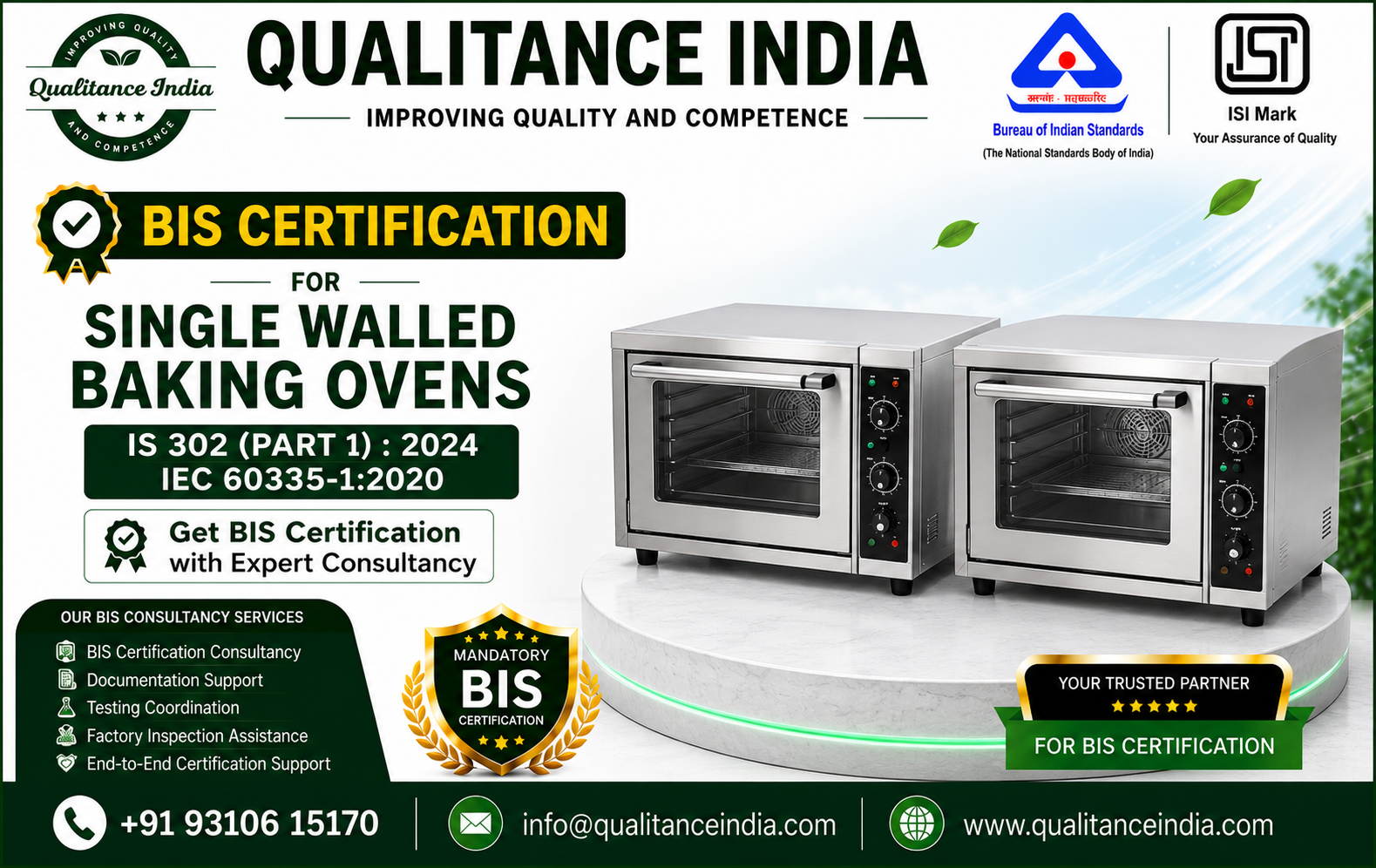
BIS Certification for Single Walled Baking Ovens | IS 302 (Part 1):2024 | IEC 60335-1:2020 | Qualitance India
INTRODUCTION
Single Walled Baking Ovens are electrical appliances used for baking, cooking, heating and other food preparation applications. These products may be used in households, commercial kitchens, bakeries, restaurants, hotels, food service establishments and other professional environments.
For manufacturers, importers, foreign manufacturers, OEMs, ODMs and brand owners planning to manufacture, import or sell applicable baking ovens in India, understanding the relevant BIS Certification requirements is an important part of regulatory compliance.
Depending on the product design, electrical specifications, intended use and applicable Indian Standard, a Single Walled Baking Oven may be subject to specific safety and conformity assessment requirements. The general safety framework under IS 302 (Part 1):2024, associated with IEC 60335-1:2020, may be relevant to applicable household and similar electrical appliances. However, the exact product-specific requirements must be assessed carefully, including whether a relevant Part 2 standard applies to the particular oven.
Qualitance India provides professional BIS Certification Consultancy for Single Walled Baking Ovens, helping businesses understand product applicability, identify relevant standards, prepare documentation, coordinate testing, support BIS application procedures and prepare for applicable factory inspection requirements.
ABOUT SINGLE WALLED BAKING OVENS
A Single Walled Baking Oven is an oven designed with a single-wall construction and used for baking, cooking or heating food products.
Depending on the product design, it may include:
- Electrical heating elements
- Thermostats
- Temperature controllers
- Temperature sensors
- Timers
- Thermal cut-outs
- Heating chambers
- Electrical wiring
- Switches
- Control panels
- Power supply connections
- Safety protection mechanisms
Single Walled Baking Ovens may be manufactured for domestic, commercial or professional applications.
The exact BIS certification applicability should not be determined only by the product name. The product’s technical construction, rated voltage, rated power, intended application and applicable Indian Standards should be evaluated.
WHAT IS BIS CERTIFICATION?
BIS Certification is a conformity assessment system administered by the Bureau of Indian Standards (BIS).
The certification system is designed to help ensure that applicable products conform to the requirements of relevant Indian Standards.
Depending on the applicable certification scheme, the process may involve:
- Product applicability assessment
- Identification of the applicable Indian Standard
- Technical documentation
- Product testing
- BIS application
- Factory assessment or inspection
- Quality-control verification
- Resolution of BIS queries
- Grant of BIS Licence
- Authorization for use of the ISI Mark, where applicable
For businesses dealing with regulated electrical appliances, obtaining the required BIS certification before placing the product on the Indian market can be an important legal and commercial requirement.
WHY IS BIS CERTIFICATION IMPORTANT FOR SINGLE WALLED BAKING OVENS?
Where BIS certification is mandatory for the applicable product category, certification helps businesses demonstrate compliance with relevant Indian Standards and regulatory requirements.
The major advantages include:
Regulatory Compliance
Helps businesses meet applicable mandatory certification requirements.
Product Safety
Supports conformity with relevant electrical and product safety requirements.
Market Access
Where certification is mandatory, it supports legal placement of the product in the Indian market.
Customer Confidence
Certification can increase trust among customers, distributors and business partners.
Brand Credibility
Compliance with applicable Indian Standards can strengthen the professional reputation of a business.
Quality Control
The certification process encourages systematic quality-control practices.
APPLICABLE INDIAN STANDARD – IS 302 (PART 1):2024
IS 302 (Part 1):2024 | IEC 60335-1:2020
IS 302 (Part 1):2024 provides general safety requirements for applicable household and similar electrical appliances and is associated with the safety framework of IEC 60335-1:2020.
For applicable electrical baking appliances, safety evaluation may include requirements related to:
- Protection against electric shock
- Electrical insulation
- Leakage current
- Electric strength
- Temperature rise
- Protection against overheating
- Abnormal operation
- Mechanical safety
- Moisture resistance
- Mechanical strength
- Construction
- Internal wiring
- Components
- Supply connections
- Marking
- Instructions
- Protection against fire
However, IS 302 (Part 1):2024 should not automatically be considered the only applicable standard for every type of Single Walled Baking Oven.
The product should be technically assessed to determine whether a relevant product-specific Part 2 standard is also applicable.
WHAT IS IEC 60335-1:2020?
IEC 60335-1:2020 is an international safety standard framework covering applicable household and similar electrical appliances.
It addresses general safety principles and requirements intended to reduce risks associated with electrical appliances during normal use and foreseeable abnormal conditions.
The Indian Standard IS 302 (Part 1):2024 is the relevant Indian standard framework that should be considered for applicable products in the Indian regulatory context.
For BIS certification, businesses should always verify the current Indian Standard and applicable BIS certification requirements rather than relying solely on an international standard reference.
SCOPE OF THE STANDARD
The general safety requirements under the applicable standard framework may cover electrical appliances intended for:
- Household use
- Commercial use
- Similar applications
Product applicability may depend on factors including:
- Rated voltage
- Rated power
- AC or DC supply
- Intended use
- Product construction
- Heating mechanism
- Installation method
- Portable or fixed installation
- Household or commercial application
The final applicability must be confirmed through a product-specific technical assessment.
PRODUCTS THAT MAY REQUIRE ASSESSMENT
Depending on the product design and applicable regulatory requirements, the assessment may include:
- Single Walled Baking Ovens
- Electric Baking Ovens
- Countertop Baking Ovens
- Commercial Baking Ovens
- Household Baking Ovens
- Professional Baking Ovens
- Electric Food Baking Ovens
- Similar Electrical Heating Appliances
Different product types may be governed by different product-specific requirements.
Therefore, manufacturers should confirm the applicable standard before beginning the BIS certification process.
BIS IMPLEMENTATION / ENFORCEMENT DATE
The implementation or enforcement date applicable to a particular Single Walled Baking Oven should be confirmed from the latest official BIS notification, Quality Control Order and applicable regulatory documents.
Important Date Information
Proposed / Provided Implementation Date for This Service: 01 August 2026
However, businesses should verify the exact applicability and effective date from the latest official notification before manufacturing, importing or selling the regulated product.
The actual compliance timeline may depend on:
- Product category
- Applicable QCO
- Amendment notifications
- Manufacturer classification
- Effective date specified in the notification
Why Start Early?
Businesses should begin the BIS certification process well before the effective date because the complete process may involve:
Product Assessment → Documentation → Testing → Application → BIS Scrutiny → Factory Inspection, Where Applicable → Compliance → Licence
Starting early can help reduce the risk of product launch delays and regulatory non-compliance.
APPLICABLE QCO DETAILS
Where a Quality Control Order applies to the relevant product category, the QCO may specify:
- Product coverage
- Applicable Indian Standard
- Mandatory certification requirements
- Effective date
- Manufacturer requirements
- Certification conditions
- ISI Mark requirements
The latest applicable QCO should always be checked before making a final compliance decision.
QCO Compliance Flow
Check QCO Applicability
↓
Identify Applicable Indian Standard
↓
Complete Product Testing
↓
Prepare BIS Application
↓
Complete Applicable Inspection
↓
Resolve Compliance Requirements
↓
Obtain BIS Licence
↓
Follow ISI Mark Requirements
WHO NEEDS BIS CERTIFICATION CONSULTANCY?
BIS Certification Consultancy may be relevant for:
Indian Manufacturers
Companies manufacturing applicable Single Walled Baking Ovens in India.
Foreign Manufacturers
Overseas manufacturers supplying applicable products to the Indian market.
Importers
Businesses importing applicable baking ovens into India.
OEM Manufacturers
Manufacturers producing products for another company’s brand.
ODM Companies
Companies providing product design and manufacturing solutions.
Brand Owners
Companies selling products under their own brand name.
Private Label Businesses
Businesses purchasing products from manufacturers and selling them under their own brand.
ELIGIBILITY CRITERIA
Before starting the certification process, an applicant may need:
- Manufacturing facility
- Product models
- Applicable Indian Standard
- Product technical specifications
- Product samples
- Technical documentation
- Manufacturing process
- Quality-control system
- Testing arrangements
- Calibration system
- Product labels
- User instructions
- Brand or trademark details
Foreign manufacturers may have additional requirements depending on the applicable BIS certification scheme.
COMPLETE BIS CERTIFICATION PROCESS
STEP 1: PRODUCT APPLICABILITY ASSESSMENT
The first step is to determine whether BIS certification is applicable to the Single Walled Baking Oven.
The product should be assessed based on:
- Product construction
- Rated voltage
- Rated power
- Intended application
- Heating method
- Electrical design
STEP 2: IDENTIFICATION OF APPLICABLE STANDARD
The applicable Indian Standard is identified.
The general safety requirements may involve:
IS 302 (Part 1):2024 | IEC 60335-1:2020
A relevant product-specific Part 2 standard should also be checked where applicable.
STEP 3: MODEL AND VARIANT ASSESSMENT
The models and variants are reviewed to determine:
- Model grouping
- Critical components
- Product variations
- Required test samples
- Certification scope
STEP 4: DOCUMENT PREPARATION
Technical, legal and manufacturing documents are prepared according to the applicable certification requirements.
STEP 5: PRODUCT TESTING
Required product testing is completed through the appropriate testing process.
STEP 6: TEST REPORT REVIEW
Test reports are reviewed to ensure consistency between:
- Product
- Model
- Technical specifications
- Components
- Applicable standard
STEP 7: BIS APPLICATION
The BIS application is prepared and submitted through the applicable certification process.
STEP 8: BIS SCRUTINY
BIS reviews the application and supporting documentation.
STEP 9: FACTORY INSPECTION
Where applicable, the manufacturing facility may be assessed by BIS.
STEP 10: QUERY RESOLUTION
Any queries or observations raised during the process are addressed.
STEP 11: COMPLIANCE VERIFICATION
Required corrective actions are completed.
STEP 12: BIS LICENCE
After successful completion of the applicable requirements, the BIS Licence may be granted.
STEP 13: ISI MARK COMPLIANCE
The ISI Mark must be used only according to applicable BIS Licence conditions and marking requirements.
REQUIRED DOCUMENTS
COMPANY DOCUMENTS
- Certificate of Incorporation
- Company registration documents
- Factory registration
- Factory address proof
- Authorized signatory details
PRODUCT DOCUMENTS
- Product photographs
- Product catalogue
- Product specifications
- Model list
- User manual
- Product drawings
TECHNICAL DOCUMENTS
- Circuit diagram
- Wiring diagram
- Bill of Materials
- Critical component list
- Component datasheets
- Electrical ratings
- Heating element details
- Control system details
MANUFACTURING DOCUMENTS
- Manufacturing flow chart
- Factory layout
- Quality-control plan
- Inspection procedure
- Testing procedure
TESTING DOCUMENTS
- Test reports
- Calibration certificates
- Testing equipment list
- Laboratory details
BRAND DOCUMENTS
- Trademark certificate
- Trademark authorization
- Brand ownership documents
The exact documents may vary according to the applicable BIS certification scheme.
TESTING REQUIREMENTS
Testing requirements depend on the applicable Indian Standard and certification scheme.
Potential safety evaluation areas may include:
- Protection against electric shock
- Electrical insulation
- Leakage current
- Electric strength
- Temperature rise
- Abnormal operation
- Overheating protection
- Mechanical strength
- Moisture resistance
- Construction
- Internal wiring
- Components
- Marking
- Instructions
For electrical baking ovens, technical evaluation may also consider:
- Heating elements
- Thermostat
- Temperature controller
- Thermal cut-out
- Overheating protection
- Heating chamber
- Electrical insulation
- Earthing
- Power cord
- Plug
- Switches
- Temperature sensors
The final test plan must be confirmed according to the applicable product-specific standard.
FACTORY INSPECTION PROCESS
Where factory inspection is applicable, assessment may include:
Manufacturing Process
- Production line
- Assembly process
- Raw materials
- Component storage
Quality Control
- Incoming inspection
- In-process inspection
- Final inspection
Testing Facilities
- Electrical safety testing
- Functional testing
- Routine testing
Calibration
- Calibration of testing equipment
- Calibration records
- Traceability
Documentation
- Quality records
- Inspection records
- Test records
Product Verification
- Product models
- Critical components
- Product construction
- Manufacturing process
COMMON REASONS FOR BIS APPLICATION REJECTION OR DELAY
BIS applications may face delays due to:
- Incorrect product classification
- Incorrect standard selection
- Incomplete documentation
- Incorrect test report
- Model mismatch
- Sample mismatch
- Missing critical component information
- Incorrect factory details
- Inadequate quality-control documents
- Calibration issues
- Inadequate testing facilities
- Incorrect product marking
- Incomplete BIS application
- Delayed response to BIS queries
- Factory inspection non-conformity
- Product testing failure
- Technical specification mismatch
A pre-certification technical review can help identify potential problems before formal application submission.
BIS CERTIFICATION COST FACTORS
There is no single fixed cost for every Single Walled Baking Oven BIS Certification application.
The total cost may depend on:
- BIS application fees
- Product testing charges
- Laboratory fees
- Number of models
- Number of variants
- Factory location
- Inspection requirements
- Travel expenses
- Applicable certification scheme
- Consultancy charges
For Cost Assessment
Businesses should provide:
- Product name
- Product photographs
- Technical specifications
- Product catalogue
- Model list
- Manufacturer details
- Factory location
This information can help determine the likely certification route and cost factors.
BIS CERTIFICATION TIMELINE
The timeline depends on:
- Documentation readiness
- Product testing
- Laboratory availability
- Test report review
- BIS scrutiny
- Factory inspection
- Query resolution
- Corrective actions
Recommended Approach
If the product is subject to mandatory certification with an implementation date of 01 August 2026, businesses should start the certification planning process well in advance.
BENEFITS OF BIS CERTIFICATION
1. Regulatory Compliance
Helps businesses meet applicable mandatory requirements.
2. Product Safety
Demonstrates conformity with relevant safety requirements.
3. Market Access
Supports market entry where certification is mandatory.
4. Customer Confidence
Improves trust among customers and distributors.
5. Brand Reputation
Strengthens brand credibility.
6. Business Growth
Supports expansion in regulated markets.
7. Better Quality Management
Encourages systematic manufacturing and quality-control practices.
ISI MARK REQUIREMENTS
Where BIS certification is mandatory under an applicable certification scheme, the product may need to comply with applicable ISI Mark requirements.
The ISI Mark should not be used without the required BIS authorization.
Manufacturers should ensure that:
- Correct marking requirements are followed
- Product labels are compliant
- Licence details are correctly displayed
- Packaging requirements are followed
- Certification scope matches the product
POST-CERTIFICATION COMPLIANCE
Obtaining a BIS Licence is not necessarily the end of the compliance process.
Businesses may need to maintain:
- Product quality
- Manufacturing consistency
- Testing records
- Calibration records
- Quality-control procedures
- BIS marking requirements
- Licence conditions
- Renewal requirements
- Applicable surveillance requirements
Any changes in product design, critical components or manufacturing location should be reviewed for potential certification impact.
WHY CHOOSE QUALITANCE INDIA?
Qualitance India provides professional BIS Certification Consultancy support for manufacturers, importers, foreign manufacturers, OEMs, ODMs and brand owners.
Our support may include:
✔ Product Applicability Assessment
✔ Applicable Standard Identification
✔ BIS Documentation Support
✔ Product Testing Coordination
✔ BIS Application Assistance
✔ Factory Inspection Preparation
✔ BIS Query Support
✔ Technical Compliance Guidance
✔ ISI Mark Compliance Support
✔ Certification Process Coordination
Our Approach
Assess → Identify → Prepare → Test → Apply → Inspect → Comply → Certify
Our objective is to simplify the BIS certification journey and help businesses understand their applicable compliance requirements.
STEP-BY-STEP BIS CERTIFICATION FLOW CHART
Product Enquiry
↓
Product Applicability Assessment
↓
Applicable Standard Identification
↓
Product-Specific Standard Assessment
↓
Model & Variant Assessment
↓
Technical Documentation
↓
Product Testing
↓
Test Report Review
↓
BIS Application Preparation
↓
BIS Application Submission
↓
BIS Scrutiny
↓
Factory Inspection / Assessment, Where Applicable
↓
Query Resolution
↓
Compliance Verification
↓
BIS Licence Grant
↓
ISI Mark Compliance
↓
Post-Certification Compliance
30 SEO-FRIENDLY FAQs
1. Is BIS Certification mandatory for Single Walled Baking Ovens?
The requirement depends on the exact product category and applicable BIS/QCO requirements. Where certification is mandatory, the required BIS Licence must be obtained before placing the regulated product on the Indian market.
2. Which BIS Standard applies to Single Walled Baking Ovens?
The applicable standard depends on the exact product design and intended use. IS 302 (Part 1):2024 may provide general safety requirements for applicable electrical appliances, while a product-specific Part 2 standard may also need to be evaluated.
3. What is IS 302 (Part 1):2024?
IS 302 (Part 1):2024 provides general safety requirements for applicable household and similar electrical appliances.
4. What is IEC 60335-1:2020?
IEC 60335-1:2020 is an international general safety standard framework for applicable household and similar electrical appliances.
5. Is a Part 2 standard applicable to Baking Ovens?
A product-specific Part 2 standard may apply depending on the exact type, design and intended application of the oven.
6. What documents are required for BIS Certification?
Documents may include company documents, factory details, product specifications, circuit diagrams, BOM, technical documents, test reports, quality-control documents and brand information.
7. Is product testing required?
Testing may be required as part of the applicable BIS certification process.
8. Is factory inspection mandatory?
Factory inspection depends on the applicable BIS certification scheme and product category.
9. How much does BIS Certification cost?
The cost depends on testing requirements, number of models, laboratory charges, factory location, inspection requirements and other certification-related costs.
10. How long does BIS Certification take?
The timeline depends on documentation, testing, laboratory availability, BIS scrutiny, inspection and query resolution.
11. Can foreign manufacturers obtain BIS Certification?
Yes, foreign manufacturers may obtain certification subject to the applicable BIS certification scheme and requirements.
12. Can importers apply for BIS Certification?
The eligibility of an importer depends on the applicable BIS certification scheme and licence structure.
13. What is the ISI Mark?
The ISI Mark is used under applicable BIS certification arrangements to indicate conformity with the relevant Indian Standard.
14. Can multiple models be covered under one BIS Licence?
Model grouping depends on applicable BIS requirements and similarities in product construction and critical characteristics.
15. What happens if the product fails testing?
Corrective action, product modification and retesting may be required.
16. What causes BIS Certification delays?
Incomplete documents, incorrect standard selection, testing issues, model mismatch and delayed query responses can cause delays.
17. Is BIS Certification required for commercial Baking Ovens?
Applicability depends on the product category, intended use and applicable BIS/QCO requirements.
18. Is BIS Certification required for countertop Baking Ovens?
The exact product specifications and applicable regulatory requirements should be assessed.
19. Can OEM manufacturers obtain BIS Certification?
The applicable certification scheme determines the appropriate certification arrangement.
20. Can private-label brands sell certified Baking Ovens?
The certification and licence-holder arrangement must comply with applicable BIS requirements.
21. What is BIS Factory Inspection?
It is an assessment of the manufacturing facility, production process, quality control and testing capabilities where applicable.
22. Can Qualitance India help with BIS Testing?
Yes, Qualitance India can provide consultancy and testing coordination support.
23. Can Qualitance India help with BIS Documentation?
Yes, documentation preparation and review support can be provided according to applicable requirements.
24. Can Qualitance India assist foreign manufacturers?
Yes, consultancy support can be provided for applicable foreign manufacturer certification routes.
25. How can I check BIS applicability for my Baking Oven?
A product-specific technical applicability assessment should be conducted against the latest BIS standards and applicable QCO requirements.
26. Can existing test reports be used?
Acceptance depends on applicable BIS requirements, laboratory status and report validity.
27. Is BIS Certification renewable?
Renewal requirements depend on the applicable BIS certification scheme and current BIS regulations.
28. Can new models be added after certification?
Additional models may be added through the applicable model inclusion or scope extension process, subject to BIS requirements.
29. What information should I send to a BIS Consultant?
You should provide product photographs, technical specifications, model list, manufacturer details and factory location.
30. How do I start BIS Certification for a Single Walled Baking Oven?
Contact Qualitance India with your product details for an initial applicability assessment and guidance on the certification process.
PEOPLE ALSO ASK – PAA QUESTIONS
- Is BIS Certification mandatory for Baking Ovens?
- What is the BIS Standard for Electric Baking Ovens?
- What is IS 302 Part 1:2024?
- Is IEC 60335-1:2020 applicable to Baking Ovens?
- What documents are needed for BIS Certification?
- How much does BIS Certification cost?
- How long does BIS Certification take?
- Is factory inspection required for BIS Certification?
- Can foreign manufacturers obtain BIS Certification?
- How do I get an ISI Mark for a Baking Oven?
FEATURED SNIPPET OPTIMIZED ANSWERS
What is BIS Certification for Single Walled Baking Ovens?
BIS Certification for Single Walled Baking Ovens is the applicable conformity assessment process used to demonstrate compliance with relevant Indian Standards and BIS requirements. Depending on the certification scheme, it may involve product testing, documentation, BIS application, factory assessment and licence grant.
How to Get BIS Certification for a Single Walled Baking Oven?
To obtain BIS Certification, first determine product applicability, identify the relevant Indian Standard, prepare technical documents, complete required testing, submit the BIS application, complete applicable factory assessment and resolve BIS queries before licence grant.
How Much Does BIS Certification Cost?
The cost depends on the applicable certification scheme, testing requirements, number of models, laboratory charges, factory location, inspection requirements and consultancy costs.
How Long Does BIS Certification Take?
The timeline depends on documentation readiness, product testing, laboratory availability, BIS scrutiny, factory inspection and query resolution.
STRONG LEAD GENERATION CTA
Need BIS Certification for Single Walled Baking Ovens?
Are you a manufacturer, importer, foreign manufacturer, OEM, ODM or brand owner dealing with Single Walled Baking Ovens?
Do you need assistance with:
✔ BIS Applicability Assessment
✔ Applicable Indian Standard Identification
✔ Product Testing
✔ BIS Documentation
✔ BIS Application
✔ Factory Inspection Preparation
✔ BIS Query Resolution
✔ ISI Mark Compliance
Qualitance India can help you understand the applicable BIS certification requirements and guide you through the certification process.
Contact Qualitance India
Phone: +91-9310-615-170
Email: info@qualitanceindia.com
Website: https://qualitanceindia.com/
Start Your BIS Certification Process Today
Send your product catalogue, technical specifications, product photographs, model list and manufacturer details to Qualitance India for an initial BIS applicability assessment.
Get Expert BIS Certification Consultancy Support with Qualitance India.
CONCLUSION
BIS Certification for applicable Single Walled Baking Ovens is an important compliance consideration for manufacturers, importers, foreign manufacturers, OEMs, ODMs and brand owners operating in India.
The exact certification requirements depend on the product’s construction, electrical specifications, intended use, applicable Indian Standards and relevant BIS/QCO provisions. IS 302 (Part 1):2024 | IEC 60335-1:2020 may provide general safety requirements for applicable electrical appliances, while a relevant product-specific Part 2 standard should also be evaluated wherever applicable.
Businesses should not determine BIS applicability based only on the product name. A detailed technical assessment can help identify the correct standard, testing requirements, documentation and certification route.
If your product is affected by a mandatory certification requirement with an implementation date of 01 August 2026, early preparation is recommended to allow sufficient time for testing, documentation, application processing and applicable inspection requirements.
Qualitance India provides professional BIS Certification Consultancy for Single Walled Baking Ovens, supporting businesses with product applicability assessment, standard identification, documentation, testing coordination, BIS application assistance and factory inspection preparation.
Contact Qualitance India today to understand your BIS Certification requirements and start your compliance journey.
Need help with BIS certification for this product?
Get a free consultation from our compliance experts — we handle testing, documentation and the complete BIS process for you.
BIS Certification Readiness Checklist 2026
- Documents, testing & factory requirements in one place
- Covers ISI Mark, CRS, FMCS & Hallmarking
- Tick-box format — share it with your team