
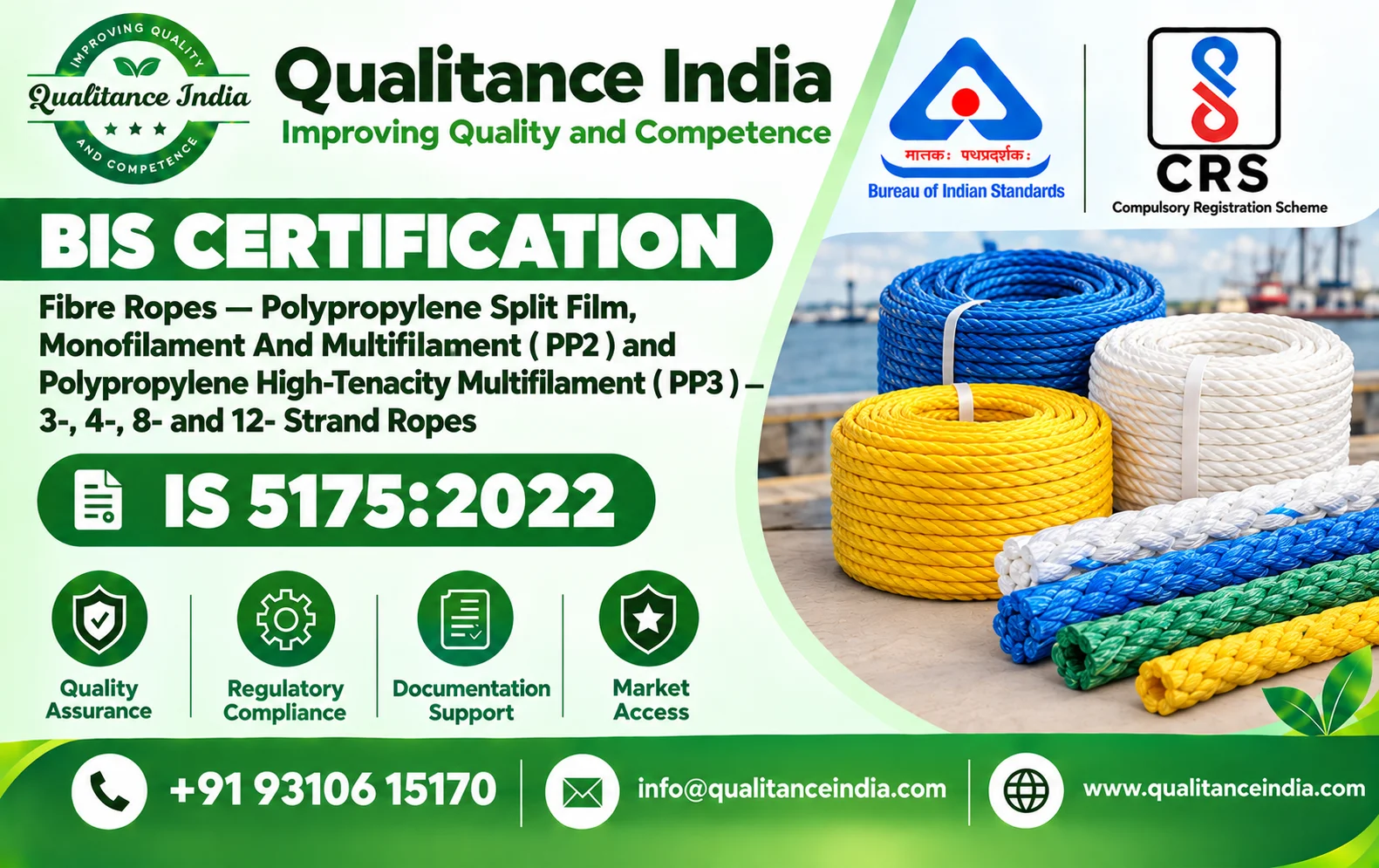
BIS Certification for Polypropylene Fibre Ropes | IS 5175:2022 | 3, 4, 8 & 12 Strand Ropes |
Introduction
Polypropylene fibre ropes are widely used in marine operations, agriculture, construction, transportation, fishing, logistics, industrial applications and other general-purpose uses. Their performance depends on factors such as the polypropylene material, rope construction, linear density, diameter and minimum breaking strength.
To establish conformity of specified polypropylene fibre ropes with Indian requirements, IS 5175:2022 provides the applicable technical requirements.
The standard is titled Fibre Ropes – Polypropylene Split Film, Monofilament and Multifilament (PP2) and Polypropylene High-Tenacity Multifilament (PP3) – 3-, 4-, 8- and 12-Strand Ropes. It is aligned with ISO 1346:2021.
The product is also covered under the Ropes and Cordages (Quality Control) Order, 2024, under which the specified goods must conform to the corresponding Indian Standard and bear the Standard Mark under a BIS licence in accordance with Scheme-I. The QCO came into force on 1 April 2025, with a separate commencement date of 1 July 2025 for Small and Micro Enterprises for domestic production. The Order does not apply to goods meant for export.
For manufacturers, exporters, importers and overseas companies supplying these ropes to India, understanding the BIS certification requirements before commercial production or import is therefore important.
What is IS 5175:2022?
IS 5175:2022 is the fourth revision of the Indian Standard for specified polypropylene fibre ropes.
The standard covers ropes made from:
- Polypropylene split film
- Polypropylene monofilament
- Polypropylene multifilament
- Polypropylene high-tenacity multifilament
The standard identifies PP2 and PP3 material categories and covers four principal rope constructions:
- Type A – 3-strand hawser-laid rope
- Type B – 4-strand shroud-laid rope
- Type L – 8-strand braided rope
- Type T – 12-strand braided rope
It also specifies requirements relating to designation, general requirements, linear density and minimum breaking strength.
Is BIS Certification Mandatory for Polypropylene Fibre Ropes?
Yes, specified polypropylene fibre ropes are covered under the Ropes and Cordages (Quality Control) Order, 2024.
The QCO includes Fibre ropes – Polypropylene split film, monofilament and multifilament (PP2) and polypropylene high-tenacity multifilament (PP3) – 3-, 4-, 8- and 12-strand ropes, corresponding to IS 5175:2022. The QCO requires conformity to the Indian Standard and the use of the Standard Mark under a BIS licence under Scheme-I.
Implementation Dates
For the Ropes and Cordages QCO:
- 1 April 2025: General commencement.
- 1 July 2025: Commencement for Small and Micro Enterprises for domestic production.
These dates are specified in the 2024 QCO.
A later amendment issued on 5 June 2026 created a temporary exemption concerning goods specified at serial number 7 that are made out of recycled plastic waste, for twelve months from publication of that amendment. Manufacturers dealing with such products should verify the precise applicability of this exemption before relying on it.
What Does the BIS ISI Mark Mean for Polypropylene Ropes?
The BIS Standard Mark, commonly referred to as the ISI Mark, is used under a valid BIS licence and indicates conformity with the applicable Indian Standard within the approved certification scope.
For covered polypropylene fibre ropes, manufacturers should not treat the ISI Mark as a general quality logo. The product must be covered by an appropriate BIS licence, and the marking must comply with the licence conditions.
The BIS Scheme-I listing currently includes IS 5175:2022 under Ropes and Cordages compulsory certification.
Which Polypropylene Ropes Are Covered?
IS 5175:2022 covers the specified polypropylene fibre ropes manufactured using PP2 and PP3 materials and four strand constructions.
3-Strand Polypropylene Rope
Type A is a 3-strand hawser-laid rope.
4-Strand Polypropylene Rope
Type B is a 4-strand shroud-laid rope.
8-Strand Polypropylene Rope
Type L is an 8-strand braided rope.
12-Strand Polypropylene Rope
Type T is a 12-strand braided rope.
These four constructions are expressly identified in the BIS Product Manual and current BIS laboratory scope.
PP2 and PP3 Polypropylene Fibre Ropes
The standard distinguishes between different polypropylene material categories.
PP2 covers polypropylene split film, monofilament and multifilament rope materials.
PP3 covers polypropylene high-tenacity multifilament.
The applicable material category should be correctly identified before testing and preparation of the BIS certification scope.
A manufacturer should not assume that certification for one material category automatically covers every other polypropylene material category.
Rope Types Under IS 5175:2022
The BIS Product Manual identifies the licence scope using Type A/B/L/T, corresponding to the four constructions. It also identifies size using the applicable reference number, which corresponds approximately to rope diameter. The material and termination configuration are also relevant to the licence scope.
Therefore, manufacturers should prepare their product range carefully before beginning testing.
Unspliced and Eye-Spliced Polypropylene Ropes
The BIS Product Manual identifies both:
- Unspliced ropes
- Ropes with eye-spliced terminations
as relevant scope parameters.
The proposed licence scope should therefore clearly identify which varieties the manufacturer intends to cover.
Key Requirements Under IS 5175:2022
The standard addresses several important characteristics of polypropylene fibre ropes.
General Requirements
The rope must comply with the applicable general requirements relating to its construction, constituent materials, treatment and other characteristics.
Current BIS LIMS testing scopes include checks associated with general requirements and rope construction.
Construction and Manufacture
The construction of the rope must correspond to the applicable rope type.
This includes the arrangement and construction of the strands and yarns used to manufacture the rope.
Lay or Pitch
The applicable pitch or length of lay is an identified requirement.
BIS LIMS currently lists pitch or length-of-lay testing for IS 5175:2022.
Linear Density
Linear density is an important physical characteristic specified under the standard.
The BIS LIMS scope identifies linear-density testing under the relevant tables of IS 5175:2022.
Minimum Breaking Strength
The standard specifies minimum breaking strength requirements for the applicable rope type, material and reference number.
This is one of the key performance characteristics evaluated during testing.
Marking and Labelling
The standard contains marking and labelling requirements, and current BIS laboratory scopes identify applicable marking and labelling checks.
Important BIS Tests for Polypropylene Fibre Ropes
Testing is an essential part of BIS certification.
Depending on the product configuration and applicable scope, testing may include:
- Material identification
- General requirements
- Construction and structure
- Rope type
- Pitch or length of lay
- Diameter/reference number
- Linear density
- Minimum breaking force
- Workmanship
- Treatment
- Marking and labelling
- Packaging and delivery-length requirements
Current BIS LIMS records show these types of testing parameters for IS 5175:2022.
Diameter and Reference Number
The BIS Product Manual identifies reference number as an important part of the certification scope, with the reference number corresponding approximately to rope diameter.
The manufacturer therefore needs to identify the reference numbers of the ropes intended to be covered by the BIS licence.
Linear Density Testing
Linear density is tested according to the applicable requirements of IS 5175:2022.
Current BIS LIMS listings include linear-density testing for the relevant tables covering polypropylene rope types.
The result must meet the applicable nominal value and tolerance requirements for the selected rope construction and reference number.
Minimum Breaking Force Testing
Minimum breaking force is one of the most important performance parameters for fibre ropes.
The test establishes whether the rope can meet the minimum breaking-force requirement corresponding to its applicable type, material and reference number.
Current BIS LIMS listings specifically identify Minimum Breaking Force testing under Clause 6 and the relevant tables of IS 5175:2022.
UV Treatment and Stabilization
Polypropylene ropes may require suitable treatment or stabilization for their intended service conditions.
The BIS laboratory scope identifies testing/checks associated with UV inhibitor/stabilizer identification as part of the applicable general requirements in some laboratory testing packages.
Manufacturers should ensure that the material formulation and treatment used in production are consistent with the requirements applicable to their certified product.
BIS Testing Charges for IS 5175:2022
Testing charges are not one fixed amount for every manufacturer.
They depend on:
- Laboratory
- Rope type
- Material category
- Reference number
- Testing scope
- Applicable parameters
- Number of varieties being evaluated
Current BIS LIMS listings show different testing packages. For example, one current listing shows ₹9,600 excluding taxes for an indicated testing scope, while another laboratory lists ₹7,250 excluding taxes and other current laboratory entries show different amounts.
Another current BIS laboratory scope lists a testing package of approximately ₹14,900 excluding taxes for IS 5175:2022.
Therefore, manufacturers should obtain the applicable laboratory quotation after finalizing the proposed BIS product scope.
BIS Product Sampling and Grouping
The grouping and sampling strategy is particularly important for polypropylene ropes because the standard covers multiple materials, constructions, reference numbers and termination configurations.
The BIS Product Manual specifies scope parameters including:
- Type A/B/L/T
- Reference number
- Material
- Unspliced ropes
- Eye-spliced termination ropes
The Product Manual states that the licence scope is to be established using these product characteristics.
Manufacturers should therefore avoid selecting samples randomly without first preparing a complete product-scope matrix.
Can One Sample Cover Multiple Rope Sizes?
The applicable grouping provisions should be reviewed carefully.
The earlier BIS grouping guidance for this product family established that testing a higher reference number could allow coverage of lower reference numbers, subject to the applicable manufacturing and testing facilities. The revised Product Manual should be followed for current applications.
Therefore, manufacturers should have the current BIS Product Manual reviewed before finalizing their sample-selection plan.
BIS Factory Inspection for Polypropylene Rope Manufacturers
Because the product is covered under Scheme-I, BIS certification involves assessment of the manufacturer's manufacturing infrastructure, process controls, quality-control system and testing capabilities.
BIS explains that certification involves assessment of manufacturing infrastructure, process controls, quality control and testing capabilities, together with establishing product conformity through applicable testing.
During factory assessment, manufacturers should be prepared for evaluation of:
- Raw-material storage
- Polypropylene yarn/fibre control
- Rope-making machinery
- Twisting/braiding equipment
- Treatment facilities
- Cutting and coiling facilities
- Testing equipment
- Calibration records
- Quality-control procedures
- Finished-product inspection
- Product identification
- Batch records
- Internal testing
- Marking arrangements
Manufacturing Process for Polypropylene Fibre Ropes
The manufacturing process can vary depending on the rope type and material.
A typical manufacturing operation may involve:
Raw Material → Yarn/Fibre Preparation → Treatment/Stabilization → Strand Formation → Twisting/Braiding → Rope Formation → Finishing → Cutting/Coiling → Inspection & Testing → Packing
The actual process must be appropriate for the rope construction and conform to the requirements applicable to the manufacturer's certified product.
Scheme of Inspection and Testing
The Scheme of Inspection and Testing (SIT) is an important part of BIS certification.
The BIS Product Manual for IS 5175:2022 refers to the applicable Scheme of Inspection and Testing and testing-equipment requirements.
The manufacturer should maintain appropriate controls for:
- Incoming raw materials
- Production
- Rope construction
- Linear density
- Breaking force
- Dimensions/reference number
- Marking
- Finished-product inspection
- Calibration
- Non-conforming products
- Records and traceability
Documents Required for BIS Certification
A manufacturer applying for BIS certification for polypropylene fibre ropes may need:
- Company registration documents
- Factory address details
- Manufacturing process flow
- Factory layout
- Machinery list
- Testing-equipment list
- Calibration certificates
- Raw-material specifications
- Supplier documents
- Product specifications
- Rope construction details
- PP2/PP3 material details
- Reference-number/size details
- Internal test reports
- Quality-control procedures
- Technical personnel details
- BIS application documents
- Brand/trademark documents, where applicable
- Undertakings and declarations required by BIS
The exact documentation should be confirmed according to the current BIS application procedure and the manufacturer's specific circumstances.
BIS Certification Process for Polypropylene Fibre Ropes
Step 1: Identify the Applicable Standard
Confirm that the product falls under IS 5175:2022.
Step 2: Prepare the Product Range
List all:
- PP2 products
- PP3 products
- 3-strand ropes
- 4-strand ropes
- 8-strand ropes
- 12-strand ropes
- Reference numbers
- Unspliced ropes
- Eye-spliced ropes
Step 3: Determine the Certification Scope
Review the current BIS Product Manual and grouping provisions to determine representative samples and proposed licence varieties.
Step 4: Review Factory Facilities
Check whether the factory has the required manufacturing machinery, testing equipment and quality-control arrangements.
Step 5: Conduct Product Testing
Samples are tested against the applicable requirements of IS 5175:2022 through the appropriate BIS-recognized testing route.
Step 6: Prepare and Submit BIS Application
The manufacturer submits the application and supporting documents through the applicable BIS certification process.
Step 7: Factory Assessment
BIS assesses the manufacturing facility and verifies production and quality-control arrangements.
Step 8: Address Non-Conformities
Any non-conformity identified during testing or assessment must be addressed according to the applicable BIS procedure.
Step 9: BIS Licence Grant
After successful completion of the applicable requirements, BIS may grant the licence for the approved product scope.
Step 10: ISI Marking
The manufacturer may use the BIS Standard Mark according to the licence conditions and approved scope.
BIS Certification for Foreign Manufacturers
The Ropes and Cordages QCO applies to specified goods supplied in India, while the QCO itself excludes goods meant for export.
Therefore, an overseas manufacturer producing polypropylene ropes exclusively for export outside India is not brought within this particular QCO merely because the product conforms to IS 5175:2022.
However, an international manufacturer exporting polypropylene fibre ropes to India needs to consider BIS certification because the product is covered under compulsory certification for the Indian market.
BIS operates the Foreign Manufacturers Certification Scheme (FMCS) for eligible foreign manufacturers. BIS states that FMCS provides a route for a foreign manufacturer to obtain a BIS licence for products conforming to an Indian Standard.
BIS FMCS for Overseas Polypropylene Rope Manufacturers
Foreign manufacturers supplying IS 5175:2022 polypropylene ropes to India can require BIS certification under FMCS, subject to the applicable requirements.
This is relevant for manufacturers located in:
- China
- Vietnam
- Thailand
- Indonesia
- Taiwan
- South Korea
- Japan
- Germany
- Italy
- Turkey
- United Arab Emirates
- United Kingdom
- United States
- Other countries exporting polypropylene ropes to India
BIS requires a foreign applicant to nominate an Authorized Indian Representative (AIR) as part of the FMCS process.
BIS also states that, from 1 June 2026, FMCS applications are accepted only through the online portal rather than offline/hard-copy submission.
BIS Certification for Imported Polypropylene Ropes
Importers should understand that purchasing polypropylene ropes from an overseas supplier does not itself replace the manufacturer's BIS certification obligations where a QCO applies.
BIS's FMCS FAQ explains that for products covered by compulsory certification, imports into India require the applicable Standard Mark under a valid BIS licence.
For this reason, international manufacturers planning to supply polypropylene ropes to India should review BIS requirements before shipping commercial consignments.
Can an Importer Apply for the BIS Licence?
Under FMCS, the application is made by the foreign manufacturer, not simply by an importer acting on behalf of the manufacturer. BIS's FMCS FAQ specifically states that an importer cannot apply for the licence on behalf of the foreign manufacturer.
This is an important point for international suppliers and Indian importers planning a new product launch.
Common Reasons for BIS Certification Delays
Manufacturers may face delays because of:
- Incorrect product classification
- Incomplete product range
- Incorrect reference numbers
- Wrong grouping strategy
- Inadequate testing facilities
- Missing calibration certificates
- Incomplete raw-material records
- Non-conforming breaking-force results
- Incorrect linear-density results
- Incomplete marking arrangements
- Missing quality-control records
- Unprepared factory inspection
- Incomplete BIS application documents
For foreign manufacturers, additional issues can include:
- AIR documentation
- Incomplete FMCS documents
- Factory inspection coordination
- Sample transportation
- Testing arrangements in India
- Delays in responding to BIS queries
Proper preparation before application can reduce avoidable delays.
Benefits of BIS Certification for Polypropylene Rope Manufacturers
BIS certification can help manufacturers demonstrate conformity with the applicable Indian Standard and meet compulsory certification requirements for the Indian market.
For manufacturers, BIS certification can support:
- Regulatory compliance
- Indian market access
- Use of the BIS Standard Mark
- Customer confidence
- Structured quality control
- Product traceability
- Better manufacturing consistency
- Procurement opportunities where BIS certification is specified
For international manufacturers, obtaining BIS certification can support lawful supply of covered polypropylene fibre ropes to the Indian market.
Why Choose Qualitance India for BIS Certification?
BIS certification for polypropylene fibre ropes involves product classification, material identification, rope construction, reference-number selection, testing, documentation and factory compliance.
Qualitance India provides BIS certification consultancy support for Indian manufacturers as well as eligible overseas manufacturers supplying products to India.
Our consultancy support can include:
- IS 5175:2022 requirement assessment
- Product-scope evaluation
- PP2/PP3 scope guidance
- Rope-type assessment
- Reference-number/grouping guidance
- Testing laboratory coordination
- Sample testing support
- BIS application documentation
- Factory inspection preparation
- Quality-control documentation
- Scheme of Inspection and Testing guidance
- Non-conformity support
- BIS licence assistance
- Scope-extension guidance
- FMCS consultancy for foreign manufacturers
- Authorized Indian Representative coordination support
Whether you are an Indian polypropylene rope manufacturer, foreign manufacturer, exporter, importer, distributor or international brand entering the Indian market, the certification requirements should be reviewed according to your manufacturing location and intended market.
Frequently Asked Questions
1. What is the BIS standard for polypropylene fibre ropes?
The applicable standard is IS 5175:2022, covering polypropylene split film, monofilament and multifilament PP2 and polypropylene high-tenacity multifilament PP3 ropes in 3-, 4-, 8- and 12-strand constructions.
2. Is BIS certification mandatory for polypropylene fibre ropes?
Yes. IS 5175:2022 is included in the Ropes and Cordages (Quality Control) Order, 2024, which requires the specified product to conform to the Indian Standard and bear the Standard Mark under a BIS licence.
3. When did the Ropes and Cordages QCO come into force?
The QCO came into force on 1 April 2025, with 1 July 2025 specified for Small and Micro Enterprises for domestic production.
4. Which rope constructions are covered by IS 5175:2022?
The standard covers 3-strand, 4-strand, 8-strand and 12-strand ropes.
5. What are Type A, B, L and T ropes?
Type A is 3-strand hawser-laid, Type B is 4-strand shroud-laid, Type L is 8-strand braided and Type T is 12-strand braided.
6. What is PP2 in IS 5175:2022?
PP2 covers polypropylene split film, monofilament and multifilament rope materials.
7. What is PP3?
PP3 refers to polypropylene high-tenacity multifilament.
8. Can unspliced ropes be certified?
Yes. The BIS Product Manual identifies unspliced ropes as a licence-scope parameter.
9. Can eye-spliced polypropylene ropes be certified?
Yes. Ropes with eye-spliced terminations are also identified in the BIS Product Manual.
10. What are the major tests for IS 5175:2022?
Important testing areas include construction, lay, diameter/reference number, linear density, minimum breaking force, general requirements and marking/labelling.
11. How much does BIS testing cost?
Current BIS LIMS listings show different laboratory charges, including examples around ₹7,250, ₹9,600 and ₹14,900 excluding taxes for specified testing scopes.
12. Is factory inspection required?
Scheme-I BIS product certification involves assessment of manufacturing infrastructure, process controls, quality control and testing capabilities.
13. Can one BIS licence cover multiple rope sizes?
The licence scope can include multiple varieties subject to the applicable grouping and testing requirements. The current Product Manual should be used to determine the appropriate scope.
14. Can one sample cover all four rope constructions?
Manufacturers should not assume this. The BIS Product Manual identifies Type A/B/L/T as separate scope parameters, and the sampling/grouping requirements should be followed for the varieties intended to be licensed.
15. Does the QCO apply to ropes meant only for export?
The Ropes and Cordages QCO states that it does not apply to goods or articles meant for export.
16. Does a foreign manufacturer need BIS certification to sell polypropylene ropes in India?
For covered products supplied to the Indian market, the applicable BIS certification requirement must be fulfilled. Foreign manufacturers can use the FMCS route where applicable.
17. Does an overseas manufacturer need an Authorized Indian Representative?
Yes. BIS FMCS requires the foreign applicant to nominate an Authorized Indian Representative according to the applicable requirements.
18. Can an Indian importer obtain the FMCS licence instead of the foreign manufacturer?
No. BIS states that under FMCS the application is made by the foreign manufacturer, not by an importer on behalf of the manufacturer.
19. Can an international manufacturer use an ISO 1346 certificate instead of BIS certification?
IS 5175:2022 is aligned with ISO 1346:2021, but conformity to an international standard alone does not replace a BIS licence where Indian regulations require BIS certification. The applicable BIS certification route must be followed for the Indian market.
20. Can Qualitance India help foreign polypropylene rope manufacturers?
Yes. Qualitance India provides consultancy support for BIS certification, testing coordination, documentation, FMCS-related requirements and Indian-market compliance for eligible overseas manufacturers.
Get BIS Certification for Polypropylene Fibre Ropes
If you manufacture Polypropylene Fibre Ropes under IS 5175:2022, including 3-strand, 4-strand, 8-strand or 12-strand ropes, obtaining the appropriate BIS certification is important for supplying covered products in the Indian market.
Qualitance India assists manufacturers with the complete BIS certification process, including product-scope assessment, testing coordination, documentation, factory inspection preparation and licence support.
For overseas manufacturers and international suppliers, our consultancy can also help with understanding the BIS FMCS process, Authorized Indian Representative requirements and Indian-market compliance.
Qualitance India – BIS Certification Consultancy
Phone: +91-9310-615-170 Email: info@qualitanceindia.com Website: qualitanceindia.com
Contact Qualitance India to discuss your polypropylene rope models, materials, strand construction and manufacturing location.
Conclusion
IS 5175:2022 establishes requirements for specified polypropylene fibre ropes manufactured from PP2 and PP3 materials in 3-, 4-, 8- and 12-strand constructions. The standard is aligned with ISO 1346:2021 and covers important characteristics including construction, linear density and minimum breaking strength.
The product is included in the Ropes and Cordages (Quality Control) Order, 2024, under which covered polypropylene ropes must conform to IS 5175:2022 and bear the Standard Mark under a BIS licence. The QCO commenced from 1 April 2025, with a specific commencement date for Small and Micro Enterprises producing domestically.
Manufacturers should carefully plan their product scope because material type, rope construction, reference number and termination configuration can affect certification and testing requirements.
For foreign manufacturers supplying polypropylene ropes to India, BIS Foreign Manufacturers Certification Scheme (FMCS) provides the relevant certification route, subject to applicable requirements.
With proper testing, documentation, factory preparation and product-scope planning, manufacturers can approach BIS certification in a structured manner.
Qualitance India provides BIS certification consultancy for Indian manufacturers, foreign manufacturers, exporters and international companies seeking BIS compliance for the Indian market.