BIS CRS Certification for Automatic Teller Cash Dispensing Machines | IS 13252 (Part 1):2010 | BIS Consultancy
Introduction
Automatic Teller Cash Dispensing Machines, commonly associated with ATM and automated cash-dispensing systems, are electronic information technology equipment that incorporate electrical, electronic and control components. Because these machines interact with electrical power and may incorporate various electronic modules, safety compliance is an important requirement for manufacturers supplying them in India.
Automatic Teller Cash Dispensing Machines are covered under IS 13252 (Part 1):2010, titled Information Technology Equipment – Safety: Part 1 General Requirements (Second Revision).
BIS laboratory records currently identify Automatic Teller Cash Dispensing Machines within the testing scope of IS 13252 (Part 1):2010.
For manufacturers, obtaining the applicable BIS CRS certification and maintaining conformity with the relevant requirements is an important part of the product compliance process.
Qualitance India provides professional BIS certification consultancy, including product applicability review, technical documentation, laboratory testing coordination, BIS application assistance and compliance support.
What Is BIS CRS Certification for Automatic Teller Cash Dispensing Machines?
BIS CRS certification is a conformity assessment framework applicable to specified electronic and IT products covered by compulsory certification requirements.
For Automatic Teller Cash Dispensing Machines, the applicable standard is:
IS 13252 (Part 1):2010
Title: Information Technology Equipment – Safety: Part 1 General Requirements (Second Revision)
The BIS laboratory system currently identifies Automatic Teller Cash Dispensing Machines among the products tested under this standard.
The purpose of the certification process is to establish that the covered product complies with the applicable safety requirements before it is supplied in the Indian market.
Applicable Indian Standard
The relevant Indian Standard is:
IS 13252 (Part 1):2010
Information Technology Equipment – Safety: Part 1 General Requirements
The standard addresses safety requirements applicable to information technology equipment and associated electrical and electronic equipment.
For an Automatic Teller Cash Dispensing Machine, the applicable conformity assessment should consider the complete equipment configuration, including its electrical input, power interface, electronic circuits, enclosure, safety protection and other applicable components.
Why Is BIS Certification Important for Automatic Teller Cash Dispensing Machines?
BIS certification provides a structured conformity framework for covered products.
For manufacturers and suppliers, compliance can help with:
- Meeting applicable Indian regulatory requirements
- Demonstrating conformity with the applicable safety standard
- Supporting product acceptance in the Indian market
- Providing technical compliance documentation
- Supporting customer and institutional procurement requirements
- Establishing confidence in product safety
- Maintaining consistency between tested and production models
Manufacturers should ensure that the product submitted for testing accurately represents the configuration intended for commercial supply.
Who Needs BIS CRS Certification?
The applicable BIS requirements should be evaluated by manufacturers supplying covered Automatic Teller Cash Dispensing Machines in India.
This may include:
- Indian manufacturers
- Foreign manufacturers
- OEM manufacturers
- Contract manufacturers
- Private-label manufacturers, subject to the applicable BIS requirements
- Manufacturers introducing new models or product variants
The exact certification arrangement depends on the manufacturer, brand, product configuration and applicable BIS requirements.
Safety Requirements Covered Under IS 13252 (Part 1):2010
IS 13252 (Part 1):2010 contains various safety requirements for information technology equipment.
Depending on the product configuration and applicable testing scope, evaluation can involve areas such as:
- Power interface
- Markings and instructions
- Protection from electric shock and energy hazards
- SELV circuits
- TNV circuits
- Limited current circuits
- Limited power sources
- Earthing and bonding
- Overcurrent and earth-fault protection
- Safety interlocks
- Electrical insulation
- Clearances and creepage distances
- Mechanical strength
- Stability
- Protection against hazardous energy
- Temperature-related safety
- Fire-related requirements
- Components
- Wiring and connections
- Enclosure and construction
- Other applicable safety provisions
The exact test programme depends on the product design and applicable laboratory scope.
BIS Testing for Automatic Teller Cash Dispensing Machines
Product testing is an important part of demonstrating conformity with IS 13252 (Part 1):2010.
Current BIS LIMS records specifically list Automatic Teller Cash Dispensing Machines in the scope of laboratories conducting testing under IS 13252 (Part 1):2010.
Laboratory evaluation can involve multiple clauses of the standard. Current BIS LIMS examples include tests relating to:
- Power interface
- Markings and instructions
- Protection against electric shock
- SELV circuits
- TNV circuits
- Limited current circuits
- Limited power sources
- Earthing and bonding
- Overcurrent and earth-fault protection
- Safety interlocks
- Electrical insulation
- Creepage and clearance
- Stability
- Mechanical strength
The applicable tests should be confirmed with the selected laboratory based on the actual ATM/cash-dispensing-machine configuration.
BIS Testing Charges
There is no single fixed laboratory testing price for every Automatic Teller Cash Dispensing Machine.
Current BIS LIMS records show different charges at different laboratories.
For example:
- One current listing shows approximately ₹35,000 for Automatic Teller Cash Dispensing Machines.
- Another BIS LIMS listing shows approximately ₹50,000 for the product category.
- Another current laboratory listing shows approximately ₹60,000 for the group that includes Automatic Teller Cash Dispensing Machines.
- A separate current listing shows approximately ₹1,25,000 for Automatic Teller Cash Dispensing Machines.
These examples demonstrate why manufacturers should not treat one amount as a universal BIS testing fee. Laboratory scope, product configuration, test requirements and applicable taxes can affect the final cost.
What Does BIS Testing Evaluate?
The laboratory evaluation is intended to determine whether the equipment complies with the applicable safety requirements.
For an Automatic Teller Cash Dispensing Machine, important considerations can include:
Electrical Safety
The equipment's electrical circuits, insulation, protective measures and power connections are evaluated against applicable requirements.
Protection Against Electric Shock
The design should provide appropriate protection against access to hazardous live parts and electrical energy.
Earthing and Bonding
Where applicable, protective earthing and bonding arrangements are assessed.
Insulation and Clearances
Electrical insulation, creepage distances and clearances are evaluated according to the applicable requirements.
Mechanical Safety
The enclosure and equipment construction should provide the required mechanical protection.
Stability
The equipment should remain stable under the conditions specified by the applicable requirements.
Marking and Instructions
Required product markings, ratings, warnings and instructions should be properly provided.
Documents Required for BIS CRS Certification
The documentation requirements depend on the product and application. Manufacturers may need to prepare:
- Company registration documents
- Manufacturing unit details
- Manufacturer address
- Brand/trademark details
- Product technical specification
- Model numbers
- Electrical ratings
- Circuit diagrams
- PCB details
- Bill of materials
- Component details
- Product photographs
- User manual
- Installation instructions
- Safety instructions
- Existing test reports, where available
- Authorized signatory documents
- Laboratory documents
- BIS application-related documents
The final document list should be confirmed according to the specific product and current BIS requirements.
BIS CRS Certification Process for Automatic Teller Cash Dispensing Machines
Step 1: Product Applicability Review
The product is reviewed to determine its applicability under IS 13252 (Part 1):2010 and the relevant BIS certification requirements.
Step 2: Technical Documentation
Product specifications, electrical details, circuit diagrams, photographs, manuals and other required information are compiled.
Step 3: Model and Configuration Review
The manufacturer’s models are reviewed to determine the applicable testing and grouping requirements.
Step 4: Laboratory Selection
A suitable BIS-recognized laboratory with the required testing scope is selected.
Step 5: Sample Submission
The appropriate product sample is submitted to the selected laboratory.
Step 6: Product Testing
The laboratory conducts the applicable safety tests according to IS 13252 (Part 1):2010.
Step 7: Test Report
After completion of testing, the applicable laboratory test report is prepared.
Step 8: BIS Application
The manufacturer submits the required BIS application and supporting documentation.
Step 9: BIS Scrutiny
BIS examines the submitted information and may raise queries or request additional documents.
Step 10: Registration/Certification
After successful completion of the applicable requirements, the BIS registration/certification process can be completed according to the applicable scheme.
Product Model and Series Considerations
Automatic Teller Cash Dispensing Machines can be manufactured in multiple configurations.
Different models may have differences in:
- Electrical ratings
- Power supply
- Display configuration
- Keyboard or input arrangement
- Enclosure
- PCB design
- Communication interfaces
- Cash-dispensing mechanisms
- Security modules
- Internal components
- Software or firmware
- Additional peripheral equipment
The manufacturer should review the applicable BIS product grouping requirements before testing.
Correct model grouping can help ensure that the appropriate products are represented during laboratory evaluation.
Manufacturing Quality Control
Manufacturers should maintain suitable production controls so that commercial products remain consistent with the configuration evaluated during certification.
Important areas can include:
- Incoming component inspection
- PCB inspection
- Power-supply verification
- Wiring inspection
- Earthing checks
- Insulation checks
- Assembly inspection
- Functional testing
- Safety testing
- Model identification
- Batch or serial-number traceability
- Calibration of measuring equipment
- Final product inspection
Maintaining appropriate production controls helps reduce the risk of differences between the certified configuration and commercially supplied equipment.
BIS Marking and Labelling
After obtaining the applicable BIS registration, manufacturers must comply with the relevant requirements governing product marking and labelling.
Depending on the applicable requirements, product information may include:
- Manufacturer name
- Brand name
- Model number
- Electrical ratings
- Applicable standard information
- Required safety information
- BIS registration-related information
- Other mandatory declarations
The exact marking requirements should be followed according to the applicable BIS registration conditions.
BIS Certification for Indian Manufacturers
Indian manufacturers producing Automatic Teller Cash Dispensing Machines should evaluate the applicable BIS requirements before placing covered products on the Indian market.
Manufacturers should be prepared with:
- Suitable manufacturing facilities
- Technical product documentation
- Representative product samples
- Quality-control arrangements
- Electrical and safety test records
- Model and brand information
- Appropriate testing arrangements
Qualitance India can assist manufacturers in organizing these requirements.
BIS Certification for Foreign Manufacturers
Foreign manufacturers intending to supply Automatic Teller Cash Dispensing Machines to India should also review the applicable BIS requirements.
Depending on the circumstances, the certification process may involve:
- Manufacturer documentation
- Product technical information
- Authorized representative arrangements, where applicable
- Laboratory testing
- BIS application
- Product marking and compliance requirements
Foreign manufacturers should verify the current requirements applicable to their particular manufacturing and supply arrangement.
Is Factory Inspection Required for BIS CRS?
BIS CRS should not automatically be treated as identical to the traditional ISI Mark licensing process.
The applicable certification procedure depends on the product and current BIS requirements. Product testing and documentation form important parts of the conformity process.
Whether any additional inspection, verification or assessment is required should be determined according to the current requirements applicable to the specific application.
Common Reasons for BIS Certification Delays
Manufacturers may experience delays when technical and application information is incomplete or inconsistent.
Common issues include:
- Incorrect standard identification
- Incomplete technical documents
- Incorrect model numbers
- Differences between tested and production configurations
- Incomplete circuit diagrams
- Missing component information
- Test failures
- Incomplete test reports
- Incorrect product markings
- Delayed responses to BIS queries
Preparing the technical file before testing can help make the certification process more organized.
How Qualitance India Helps with BIS CRS Certification
Qualitance India provides BIS certification consultancy for manufacturers of Automatic Teller Cash Dispensing Machines.
Our support can include:
- Product applicability review
- BIS standard identification
- Documentation support
- Model and product grouping guidance
- Laboratory selection assistance
- Testing coordination
- Sample coordination
- Test report assistance
- BIS application preparation
- Technical compliance support
- BIS query assistance
- Application follow-up
- Registration support
Our goal is to help manufacturers manage their BIS certification requirements efficiently.
Frequently Asked Questions
1. Is BIS certification required for Automatic Teller Cash Dispensing Machines?
Automatic Teller Cash Dispensing Machines are included in current BIS laboratory testing scopes under IS 13252 (Part 1):2010. The applicable compulsory certification requirements should be followed for covered products.
2. Which standard applies to Automatic Teller Cash Dispensing Machines?
The applicable standard is IS 13252 (Part 1):2010 – Information Technology Equipment – Safety: Part 1 General Requirements.
3. What type of product is covered?
BIS laboratory listings specifically identify Automatic Teller Cash Dispensing Machines under the IS 13252 (Part 1):2010 testing scope.
4. What safety aspects are tested?
Testing can include electrical safety, protection against electric shock, insulation, earthing, clearances and creepage, mechanical strength, stability, markings and other applicable safety requirements.
5. How much does BIS testing cost?
Current BIS LIMS listings show different laboratory charges, including examples around ₹35,000, ₹50,000, ₹60,000 and ₹1,25,000, depending on the laboratory and testing scope.
6. Is ₹35,000 the fixed BIS testing fee?
No. ₹35,000 is an example from one current BIS LIMS laboratory listing. Testing charges vary between laboratories and according to scope.
7. What documents are required?
Documents may include product specifications, circuit diagrams, model information, electrical ratings, photographs, manuals, manufacturer details, component information and BIS application documents.
8. Is a circuit diagram required?
Technical information such as circuit diagrams may be required for laboratory evaluation and certification, depending on the product configuration and applicable requirements.
9. Can multiple models be covered?
Model coverage depends on the applicable BIS grouping requirements and similarities between the products. The grouping should be evaluated before testing.
10. Can an OEM manufacturer obtain BIS certification?
An OEM manufacturer can evaluate the applicable BIS certification route based on its manufacturing arrangement, product, brand and applicable requirements.
11. Can foreign manufacturers obtain BIS certification?
Foreign manufacturers supplying covered products to India should evaluate and comply with the applicable BIS requirements.
12. Is factory inspection mandatory?
CRS should not automatically be considered identical to the traditional ISI Mark licensing process. The applicable assessment requirements should be confirmed for the specific application.
13. What happens if the product fails testing?
The manufacturer should identify the reason for non-conformity, make appropriate corrective changes where necessary and follow the applicable retesting or conformity-assessment procedure.
14. How long does BIS certification take?
The timeline depends on documentation, laboratory testing, test results, application scrutiny and responses to BIS queries. A fixed timeline cannot be guaranteed without reviewing the application.
15. Does certification cover the software installed in the machine?
The applicable BIS assessment primarily concerns the equipment and requirements covered by the relevant standard. The exact treatment of software or firmware depends on the equipment configuration and applicable standard requirements.
16. Does the certification cover cash-dispensing functionality?
The applicable certification assessment is based on the requirements of the relevant BIS standard. Functional or banking-specific requirements outside the standard may be governed by other applicable regulations or specifications.
17. Can Qualitance India coordinate laboratory testing?
Yes. Qualitance India can assist with laboratory selection, sample coordination and testing-related support.
18. Can Qualitance India help prepare the BIS application?
Yes. We provide documentation and application support for manufacturers seeking applicable BIS certification.
19. What should I provide for an initial consultation?
Manufacturers can provide the product name, model list, electrical ratings, manufacturer details, brand information and available technical documents for an initial applicability review.
20. How can I start BIS CRS certification for an Automatic Teller Cash Dispensing Machine?
You can contact Qualitance India with your product and manufacturer details. Our consultants can review the applicable requirements and guide you through documentation, testing and the BIS application process.
Get BIS CRS Certification Consultancy for Automatic Teller Cash Dispensing Machines
If you manufacture or supply Automatic Teller Cash Dispensing Machines and require BIS certification support under IS 13252 (Part 1):2010, Qualitance India can assist with product review, technical documentation, laboratory testing coordination and BIS application support.
Qualitance India – BIS Certification Consultancy
Phone: +91-9310-615-170 Email: info@qualitanceindia.com Website: qualitanceindia.com
Get professional assistance for BIS CRS Certification for Automatic Teller Cash Dispensing Machines, IS 13252 (Part 1):2010, BIS testing, documentation and registration support.
Conclusion
Automatic Teller Cash Dispensing Machines fall within the product scope currently identified by BIS laboratories under IS 13252 (Part 1):2010 – Information Technology Equipment – Safety: Part 1 General Requirements. Current BIS LIMS records specifically include Automatic Teller Cash Dispensing Machines in the testing scope and show that laboratory charges can vary significantly between facilities.
Manufacturers should ensure that the product configuration, electrical safety, technical documentation, model information and testing arrangements are aligned with the applicable BIS requirements.
With proper documentation, appropriate laboratory testing and professional BIS consultancy support, manufacturers can manage the certification process in a structured manner.
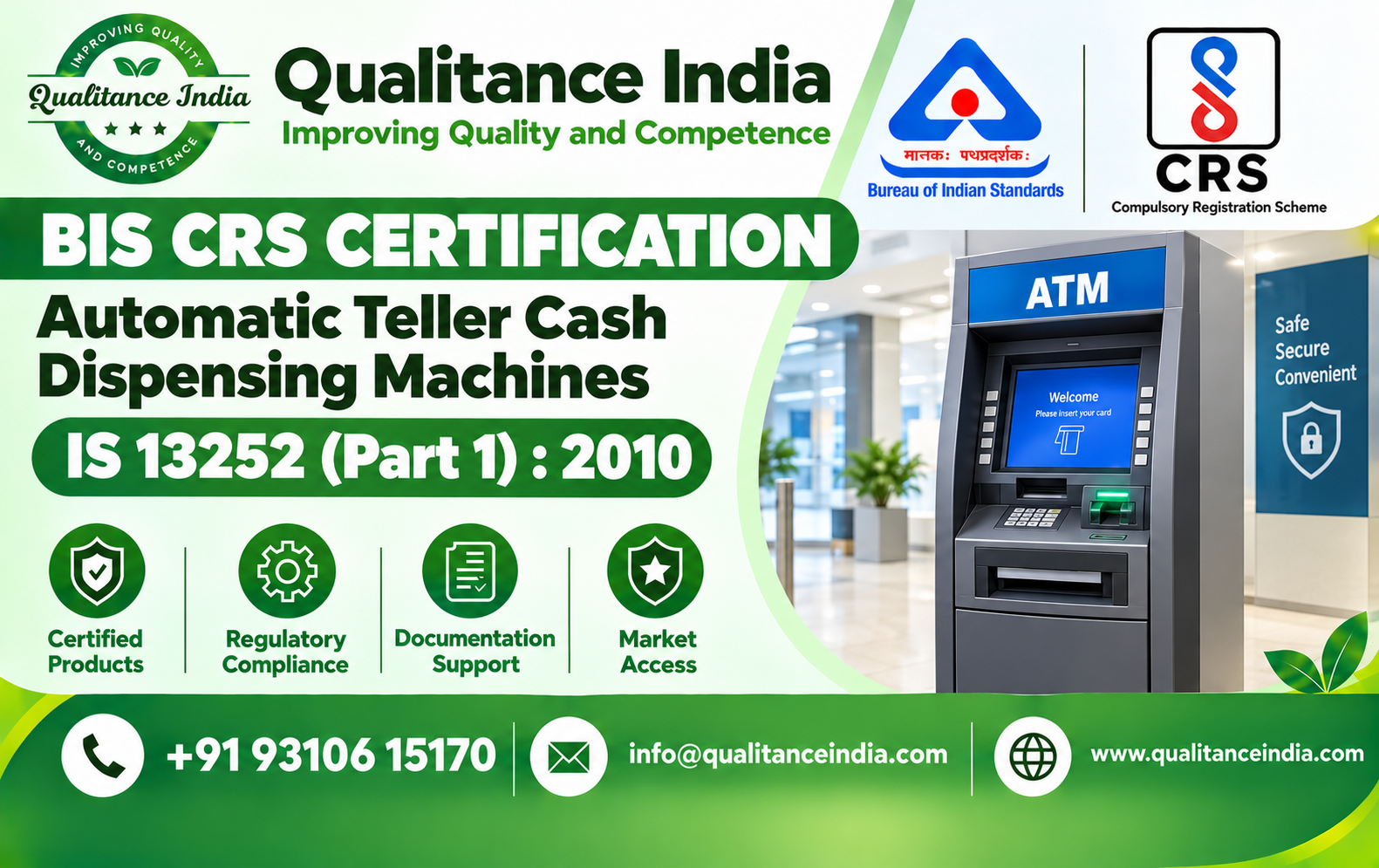
Suggested Image Caption: BIS CRS Certification for Automatic Teller Cash Dispensing Machines as per IS 13252 (Part 1):2010
Hashtags: #BISCertification #BISCRS #AutomaticTeller #CashDispensingMachine #ATM #IS13252 #BISConsultancy #BISRegistration #ITEquipment #BISIndia