BIS Certification for Foreign Manufacturers | FMCS, Scheme-I & Scheme-II CRS
Introduction
For manufacturers located outside India, entering the Indian market often requires more than simply exporting products to an Indian importer. Depending on the product category and the applicable Indian regulatory requirement, the manufacturer may need to comply with the relevant Indian Standard and obtain the applicable BIS certification or registration before the product can be legally marketed in India.
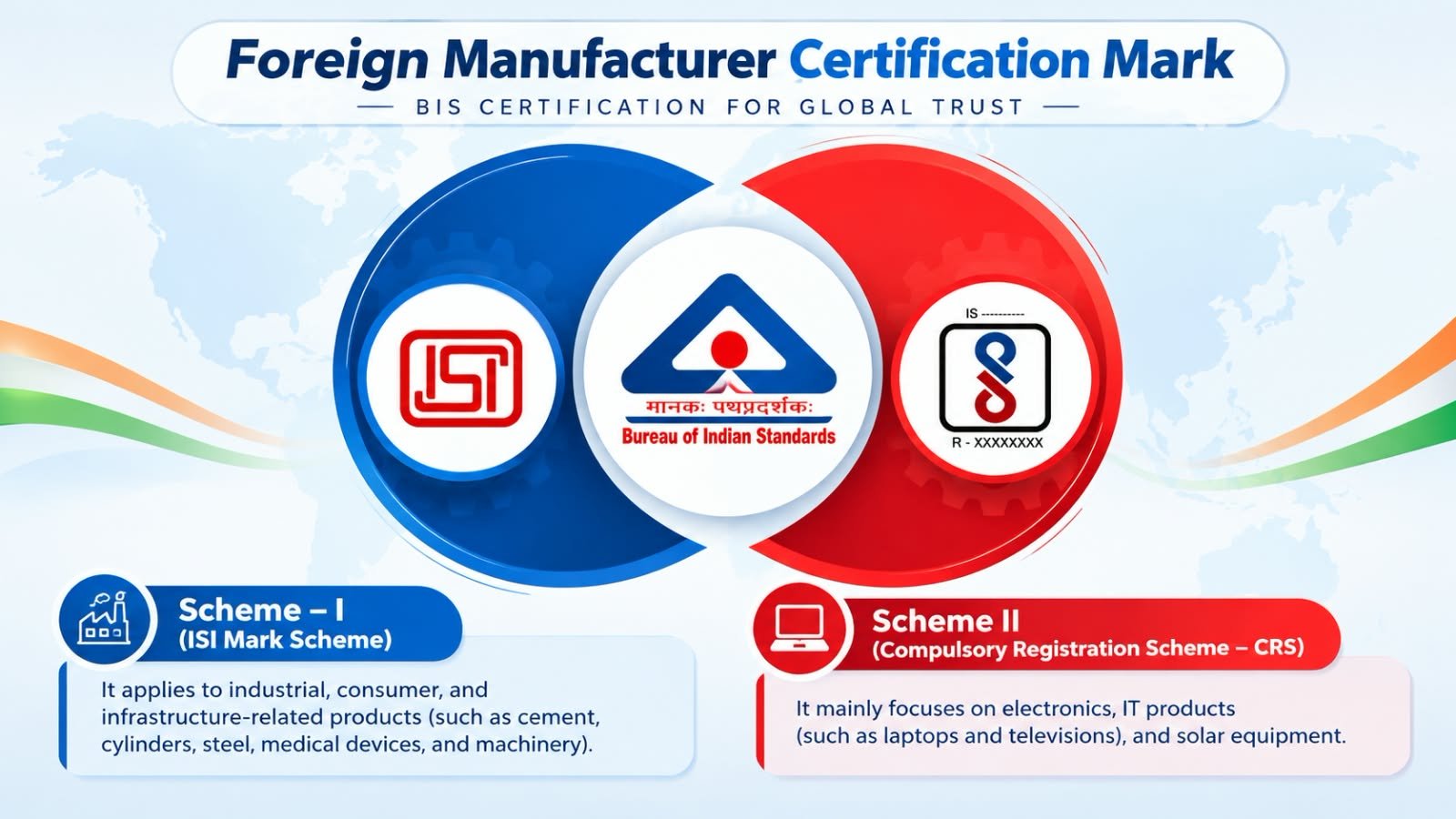
The Bureau of Indian Standards (BIS) operates different conformity assessment routes. For foreign manufacturers, one important route is the Foreign Manufacturers Certification Scheme (FMCS). Under FMCS, BIS can grant a licence to a foreign manufacturer for using the BIS Standard Mark on products conforming to the relevant Indian Standard. BIS states that FMCS generally applies to products other than Electronics & IT goods notified under MeitY's Compulsory Registration Scheme.
For notified Electronics and IT products, the applicable route can instead be Scheme-II / Compulsory Registration Scheme (CRS). BIS's current Scheme-II list includes products such as laptops, tablets, televisions, smart watches, Bluetooth speakers, CCTV products, power adaptors, UPS/inverters and other notified categories.
Therefore, a foreign manufacturer planning to sell products in India should first identify the product, applicable Indian Standard, applicable BIS scheme and current regulatory notification before beginning the certification process.
What Is BIS Certification for Foreign Manufacturers?
BIS certification for foreign manufacturers is the process through which an overseas manufacturer demonstrates conformity of its products with applicable Indian Standards and obtains the appropriate BIS approval for the Indian market.
Under FMCS, the licence is granted to the foreign manufacturer for products manufactured at the specified manufacturing premises and conforming to the requirements of the relevant Indian Standard.
This means that a foreign manufacturer cannot simply rely on an international test report or an ISO/IEC standard certificate when Indian regulations specifically require BIS conformity.
BIS has clearly stated that, under FMCS, test reports based only on IEC or another standard are not accepted where the relevant Indian Standard is applicable. Testing must address the requirements of the applicable Indian Standard.
What Is FMCS?
FMCS stands for Foreign Manufacturers Certification Scheme.
BIS has operated FMCS since 2000. The scheme enables eligible manufacturers whose manufacturing premises are located outside India to obtain BIS certification for products conforming to relevant Indian Standards.
FMCS is particularly relevant for international manufacturers supplying products to India where the applicable conformity assessment route is BIS Scheme-I.
A foreign manufacturer applying under FMCS must have the necessary manufacturing facilities, testing arrangements and competent personnel required for the applicable Indian Standard. BIS also requires acceptance of the applicable Scheme of Testing and Inspection and licence conditions.
Scheme-I and Scheme-II: What Is the Difference?
One of the most important points for foreign manufacturers is understanding that Scheme-I and Scheme-II are different BIS conformity assessment routes.
Scheme-I – ISI Mark / Certification Scheme
Scheme-I is the traditional BIS product certification route used for many industrial, consumer, construction, electrical, mechanical, chemical and other products.
For a foreign manufacturer, FMCS is the relevant BIS certification mechanism for eligible products manufactured outside India.
Where a product is covered by a mandatory Quality Control Order or another compulsory requirement, the applicable BIS certification becomes a regulatory requirement for the specified product.
The exact requirement depends on the product and the applicable notification.
Scheme-II – Compulsory Registration Scheme (CRS)
Scheme-II is a registration-based conformity assessment scheme based on self-declaration of conformity for notified products.
The current BIS Scheme-II list includes numerous Electronics and IT products such as laptops, tablets, televisions, smart watches, CCTV cameras, power adaptors, Bluetooth speakers and other notified categories.
Therefore, a foreign electronics manufacturer should not automatically apply for FMCS simply because the company is located outside India. The manufacturer should first check whether the product falls under CRS or another applicable BIS route.
Important: FMCS Is Not the Same as CRS
This distinction is extremely important for manufacturers searching for terms such as:
BIS Certification for Foreign Manufacturers
BIS FMCS Certification
BIS Licence for Foreign Manufacturers
BIS Certification for Export to India
BIS ISI Mark for Imported Products
BIS CRS Registration for Foreign Manufacturers
These terms can refer to different regulatory routes.
FMCS is a BIS certification scheme specifically designed for foreign manufacturers and generally excludes Electronics & IT products notified under MeitY's CRS. CRS is a separate Scheme-II registration route for products notified under the applicable Compulsory Registration Orders.
The correct route should therefore be determined product-by-product.
Who Can Apply for BIS FMCS?
Manufacturers having their factory outside India can apply under FMCS.
BIS specifies that the foreign manufacturer should:
- Manufacture the product at the declared manufacturing premises.
- Have the necessary manufacturing machinery and facilities.
- Have arrangements and equipment for required testing.
- Have competent testing personnel.
- Ensure conformity with the applicable Indian Standard.
- Accept the applicable Scheme of Testing and Inspection.
- Accept BIS licence terms and conditions.
- Nominate an Authorized Indian Representative (AIR).
A separate application is required for each product/Indian Standard and each manufacturing location, subject to applicable BIS provisions.
What Is an Authorized Indian Representative (AIR)?
An Authorized Indian Representative (AIR) is an important part of the FMCS process.
The AIR must be located in India and must accept responsibility for compliance with the applicable BIS requirements, licence conditions and related obligations on behalf of the foreign manufacturer.
BIS states that the AIR should be an Indian resident. If the foreign manufacturer has an Indian branch or office, an appropriate employee may preferably be nominated. Where there is no Indian branch or office, the manufacturer may nominate an eligible person in accordance with BIS requirements.
The AIR's name is endorsed in the BIS licence.
The AIR may also be required to represent the foreign manufacturer before BIS when necessary and facilitate compliance-related activities.
Can an Indian Importer Apply for FMCS on Behalf of a Foreign Manufacturer?
No.
BIS's FMCS FAQ states that an importer cannot apply for the BIS licence on behalf of the foreign manufacturer under FMCS. The application is made by the foreign manufacturer.
The importer, distributor or Indian business may have an important commercial role, but that does not change the identity of the manufacturer applying for FMCS certification.
This is an important point for overseas companies looking for BIS certification through an Indian importer.
BIS Certification Process for Foreign Manufacturers
The FMCS process generally involves several stages.
Step 1 – Identify the Product and Indian Standard
The first step is identifying the exact product and applicable Indian Standard.
The manufacturer should confirm:
- Product name
- Product model
- Product construction
- Manufacturing location
- Applicable Indian Standard
- Applicable BIS scheme
- Whether certification is mandatory
- Testing requirements
- Product-specific guidelines
- Sampling requirements
- Marking requirements
Correct standard identification is critical because the wrong standard can lead to inappropriate testing and delays.
Step 2 – Review Manufacturing and Testing Facilities
The foreign factory should review its production and quality-control infrastructure against the applicable Indian Standard.
This may include:
- Manufacturing machinery
- Production process controls
- Quality-control arrangements
- Factory testing equipment
- Calibration records
- Qualified technical personnel
- Raw-material controls
- Inspection facilities
- Product testing procedures
BIS specifically requires foreign manufacturers applying under FMCS to have appropriate manufacturing and testing capabilities.
Step 3 – Appoint an AIR
The foreign manufacturer must nominate an Authorized Indian Representative who satisfies BIS requirements.
The AIR becomes an important communication and compliance point between the overseas manufacturer and BIS.
Step 4 – Prepare Documentation
The application package generally requires technical, manufacturing, company and representative-related information.
Documents can include:
- Company registration documents
- Factory details
- Manufacturing process information
- Product specifications
- Test equipment details
- Calibration documents
- Quality-control information
- Technical documents
- Brand/trademark information
- AIR nomination
- Applicable declarations and undertakings
- Product-specific documents
- Other documents required by BIS
The exact document list depends on the product and applicable BIS requirements.
Step 5 – Testing
Product testing is one of the most important parts of BIS certification.
The applicable tests must be determined according to the relevant Indian Standard and BIS requirements.
An overseas manufacturer should not assume that an existing CE, UL, IEC, ISO or other international test report will automatically satisfy BIS requirements.
BIS specifically states in its FMCS FAQ that test reports as per the relevant Indian Standard are required rather than reports merely based on IEC or another standard.
Step 6 – BIS Application
BIS has provided online application facilities for FMCS through the Manakonline portal.
As per the current BIS instructions, offline/hard-copy FMCS applications were accepted only up to 31 May 2026. From 1 June 2026, BIS states that only applications submitted through the online portal will be accepted.
Therefore, foreign manufacturers applying now should follow the current online application procedure.
Step 7 – Factory Assessment and Verification
FMCS involves assessment of the foreign manufacturing premises and verification of manufacturing and testing capabilities as part of the certification process.
BIS may assess the factory infrastructure, quality-control system, testing arrangements and conformity of the product with the applicable Indian Standard.
Samples may also be drawn for testing as required under the certification process.
Step 8 – BIS Grant of Licence
After satisfactory completion of the applicable assessment, testing and documentation requirements, BIS may grant the licence subject to the applicable conditions.
The foreign manufacturer can then use the BIS Standard Mark in accordance with the licence and applicable marking requirements.
Documents Required for Foreign Manufacturer BIS Certification
The exact documentation varies according to the product and standard, but manufacturers should generally be prepared with:
- Manufacturer's company profile
- Factory registration documents
- Factory address and contact details
- Manufacturing process flow
- Product technical specifications
- Product drawings where applicable
- Bill of materials where applicable
- Quality-control plan
- Testing equipment list
- Calibration certificates
- Internal test procedures
- Competency details of testing personnel
- Product labels and marking information
- Brand/trademark documents
- AIR nomination documents
- Undertakings and declarations
- Applicable test reports
- Product-specific BIS documents
- Other documents requested during application scrutiny
Documents in languages other than Hindi or English may require appropriate translation in accordance with BIS requirements.
Is BIS Certification Mandatory for Every Foreign Product?
No.
BIS certification is not automatically mandatory for every imported product.
BIS explains that certification is generally voluntary, but the Government of India makes compliance compulsory for specified products through Quality Control Orders and other applicable notifications.
Therefore, before importing or selling a product in India, a foreign manufacturer should check whether its product is covered by:
- A Quality Control Order
- Compulsory Registration Order
- BIS compulsory certification requirement
- Another applicable regulatory notification
- A voluntary BIS certification requirement
The regulatory position should always be checked against the current notification applicable to the specific product.
BIS Certification for Foreign Electronics Manufacturers
Foreign electronics and IT manufacturers need special attention because many notified Electronics and IT products are regulated under Scheme-II / CRS rather than FMCS.
The current BIS Scheme-II list includes categories such as:
- Laptops and notebooks
- Tablets
- Televisions
- Smart watches
- CCTV cameras
- Power adaptors
- Bluetooth speakers
- Set-top boxes
- Barcode scanners
- Digital cameras
- Video cameras
- Wireless headphones and earphones
- Smart speakers
- UPS/inverters
- Induction stoves
- Extended Reality products
- Other notified products
The exact applicable Indian Standard and current notification must be checked because product categories and standards can be updated or migrated.
BIS Certification for Foreign Industrial Manufacturers
Foreign manufacturers of industrial and consumer products may encounter BIS requirements under Scheme-I and FMCS depending on the product.
Examples can include products from areas such as:
- Steel and metal products
- Construction materials
- Mechanical products
- Machinery
- Electrical equipment
- Cables
- Pipes
- Rubber and plastic products
- Chemicals
- Consumer products
- Safety products
- Automotive-related products
- Industrial components
The applicable route cannot be determined only from the country of manufacture. The product's Indian Standard and current Government/BIS notification determine the relevant requirement.
BIS Certification for Export to India
Foreign companies searching for BIS certification for export to India should start compliance planning before commercial shipments begin.
A practical sequence is:
Product identification → Indian Standard identification → BIS scheme identification → testing assessment → factory/document review → AIR appointment where required → BIS application → assessment/testing → licence/registration → compliant marking → import and sale in India.
Starting this process early can help identify testing, labelling, documentation or manufacturing gaps before the product reaches the Indian market.
BIS Certification for International Brands Selling in India
International brands may manufacture products in one country while selling them under a brand name in India.
In such cases, the manufacturer should carefully review:
- Manufacturer details
- Brand ownership
- Trademark documents
- Manufacturing location
- Product models
- Product variants
- Indian Standard
- BIS scheme
- Label requirements
- Importer/distributor information
- AIR requirements where applicable
Brand and manufacturer information should be consistent throughout the certification documentation and product marking.
Common Reasons for Delay in Foreign Manufacturer BIS Certification
Some common issues that can create delays include:
Incorrect Indian Standard
Using an international standard without confirming the corresponding Indian Standard can result in unsuitable testing.
Incomplete Documentation
Missing company, factory, technical or AIR documents can lead to queries during application scrutiny.
Inadequate Factory Testing Facilities
FMCS applicants should have the required testing arrangements and competent personnel for the applicable Indian Standard.
Incorrect Product Scope
If models, variants or product configurations are not properly defined, additional clarification may be required.
Incorrect Marking or Labelling
The product and packaging should follow applicable BIS marking requirements.
Poor Coordination With the Laboratory
Testing should be planned according to the applicable Indian Standard and BIS requirements.
Delayed Responses
BIS's application guidance notes that incomplete applications, delayed responses to queries and delayed payments can contribute to delays in grant of licence.
Why Foreign Manufacturers Work With a BIS Certification Consultant
International manufacturers may be familiar with CE, IEC, ISO, UL or other international compliance systems but may not be familiar with India's BIS procedures.
A BIS certification consultant can assist with:
- Indian Standard identification
- BIS scheme identification
- Product scope assessment
- Documentation preparation
- Testing coordination
- Factory readiness review
- AIR-related coordination
- BIS application support
- Query response coordination
- Inspection/assessment assistance
- Marking and labelling guidance
- Certification follow-up
- Renewal and post-certification compliance support
For foreign companies, this can make communication and coordination with the Indian certification system more structured.
BIS Certification Consultancy for Foreign Manufacturers
Qualitance India provides BIS certification consultancy and compliance support for manufacturers looking to enter or expand in the Indian market.
Our support can include:
- BIS FMCS consultancy
- BIS certification for foreign manufacturers
- BIS Scheme-I / ISI Mark certification support
- BIS CRS consultancy for applicable products
- Indian Standard identification
- Documentation support
- Product testing coordination
- Factory inspection/assessment assistance where applicable
- BIS application support
- Technical compliance assistance
- BIS licence and registration support
- Foreign manufacturer compliance coordination
The applicable BIS route is first evaluated according to the product, Indian Standard and current regulatory requirement.
Why Choosing the Correct BIS Scheme Matters
One of the most common mistakes made by international manufacturers is assuming that every foreign product requires FMCS.
That is not correct.
A foreign manufacturer may need:
FMCS / Scheme-I for an applicable product requiring BIS certification through that route, or
Scheme-II / CRS for a product specifically covered under the applicable Compulsory Registration requirements, particularly notified Electronics and IT products.
BIS itself distinguishes FMCS from CRS.
Therefore, the first step should always be product-specific regulatory assessment.
Frequently Asked Questions
1. What is FMCS in BIS?
FMCS stands for Foreign Manufacturers Certification Scheme. It is a BIS certification scheme through which eligible foreign manufacturers can obtain a BIS licence for products conforming to relevant Indian Standards.
2. Can a foreign manufacturer obtain a BIS licence?
Yes. Manufacturers whose factories are located outside India can apply under FMCS for eligible products.
3. Is FMCS applicable to electronics and IT products?
Generally, FMCS does not cover Electronics and IT products notified by MeitY under CRS. Such products may fall under Scheme-II/CRS.
4. What is Scheme-I in BIS?
Scheme-I is the BIS certification/Mark Scheme under which eligible products can receive a BIS licence for use of the Standard Mark.
5. What is Scheme-II in BIS?
Scheme-II is a registration-based conformity assessment scheme based on self-declaration of conformity for applicable products.
6. Is CRS the same as FMCS?
No. FMCS and CRS are separate BIS conformity assessment routes.
7. Does a foreign manufacturer need an AIR?
For FMCS, the foreign applicant must nominate an Authorized Indian Representative who satisfies BIS requirements.
8. Can an Indian importer apply for FMCS?
No. Under FMCS, the foreign manufacturer is the applicant.
9. Can a foreign manufacturer use an IEC test report?
An IEC report by itself should not be assumed to satisfy BIS requirements. BIS states that the relevant Indian Standard test requirements must be addressed.
10. Does every imported product require BIS certification?
No. Mandatory BIS requirements apply to specified products covered by applicable Government notifications, QCOs or other compulsory requirements.
11. Is BIS certification required before exporting products to India?
Where the product is subject to a mandatory BIS requirement, the applicable certification or registration requirements must be satisfied before the product is legally marketed/imported as required by the applicable regulation.
12. Can foreign manufacturers apply online for FMCS?
Yes. BIS currently provides online FMCS application through the Manakonline portal. From 1 June 2026, BIS states that only online FMCS applications are accepted.
13. Does the foreign factory need testing facilities?
FMCS applicants are required to have appropriate testing arrangements/equipment and competent testing personnel at the manufacturing premises as applicable to the Indian Standard.
14. Is factory assessment part of FMCS?
FMCS involves assessment of the foreign manufacturing premises and verification of relevant manufacturing and testing capabilities as part of the certification process.
15. Can one application cover multiple factories?
BIS states that a separate application is required for each product/Indian Standard and each manufacturing location, subject to applicable provisions.
16. Can an international brand obtain BIS certification for an overseas factory?
Yes, an eligible foreign manufacturer can apply through the applicable BIS route for its overseas manufacturing premises.
17. Is BIS certification the same as CE certification?
No. CE marking and BIS certification/registration are different regulatory systems. Where Indian regulations require BIS conformity, the applicable Indian requirements must be addressed separately.
18. Can an overseas manufacturer use an Indian consultant?
Yes. A foreign manufacturer can engage a BIS certification consultant for documentation, testing coordination, application support and other compliance activities. However, the manufacturer's legal obligations and BIS requirements remain applicable.
19. What products can be covered under FMCS?
FMCS can cover products conforming to relevant Indian Standards, subject to the applicable BIS scheme and product-specific requirements. BIS states that FMCS generally applies to products other than Electronics & IT Goods notified by MeitY.
20. How can a foreign manufacturer know whether it needs FMCS or CRS?
The manufacturer should identify the exact product, applicable Indian Standard and current Government/BIS notification. Based on these factors, the applicable BIS route—such as FMCS/Scheme-I or Scheme-II/CRS—can be determined.
Conclusion
For an international manufacturer entering the Indian market, understanding the difference between BIS FMCS, Scheme-I and Scheme-II CRS is an important first step toward regulatory compliance.
FMCS provides a BIS certification route for eligible foreign manufacturers, while Scheme-II/CRS applies to products covered under the relevant registration requirements. BIS requires foreign manufacturers under FMCS to meet applicable Indian Standard requirements, maintain appropriate manufacturing and testing capabilities and nominate an Authorized Indian Representative.
Whether you are a manufacturer from China, Germany, Italy, Japan, Korea, Taiwan, Vietnam, the USA, the UK, Turkey, UAE or another country, the correct BIS route should be identified according to your specific product and Indian regulatory requirement.
If you are looking for BIS certification for foreign manufacturers, BIS FMCS consultancy, BIS ISI Mark certification, BIS CRS registration, BIS certification for export to India, or Indian Standard compliance support, Qualitance India can assist with the certification process from initial product assessment through documentation, testing coordination and application support.
Qualitance India – BIS Certification Consultancy
Phone: +91-9310-615-170 Email: info@qualitanceindia.com Website: https://qualitanceindia.com/