BIS Certification for Stainless Steel Blooms, Billets and Slabs for Forgings – IS 6529:1996 Qualitance India
BIS Certification for Stainless Steel Blooms, Billets and Slabs for Forgings – IS 6529:1996
Stainless steel blooms, billets and slabs are important semi-finished steel products used in the manufacture of forged components for industrial, engineering, automotive, infrastructure and other applications. Their chemical composition, internal quality, heat treatment, hardness and dimensional accuracy directly influence the performance of the final forged product.
To ensure consistent quality and conformity with Indian requirements, the Bureau of Indian Standards (BIS) has prescribed IS 6529:1996 – Stainless Steel Blooms, Billets and Slabs for Forgings – Specification.
Manufacturers supplying these products to the Indian market must consider the applicable Steel and Steel Products Quality Control Order (QCO) and obtain the required BIS licence before undertaking regulated manufacturing, import or sale.
This article explains the scope of IS 6529:1996, mandatory certification requirements, product testing, sample requirements, grouping, documentation and the BIS certification process.
1. Overview of IS 6529:1996
IS 6529:1996 specifies requirements for stainless steel blooms, billets and slabs intended for further processing into forged products.
These semi-finished products may be produced from stainless steel ingots or continuously cast slabs, blooms or billets. Processing methods may include rolling, extrusion, hammering or pressing.
The standard addresses product characteristics that are important for subsequent forging operations, including:
- Chemical composition and steel designation
- Freedom from defects
- Heat-treatment condition
- Hardness
- Dimensional tolerances
- Corrosion resistance, where specified
The applicable steel grade and product requirements depend on the intended end use and the purchaser’s requirements.
2. Is BIS Certification Mandatory for IS 6529:1996?
Yes. Stainless Steel Blooms, Billets and Slabs for Forging are covered under the Steel and Steel Products (Quality Control) Order, 2024.
The product is listed at Serial No. 92 of the relevant QCO schedule under IS 6529:1996.
The QCO specifies implementation with immediate effect. An earlier Ministry of Steel order had extended the enforcement date under the previous order to 26 August 2021. The subsequent 2024 QCO also includes the product in its schedule.
Accordingly, manufacturers and importers supplying covered products in India must ensure compliance with the applicable BIS certification requirements.
Important: The QCO applicability should be checked against the exact product description, applicable ITC (HS) classification, current notifications and any relevant exemptions. The 2024 QCO lists the following ITC (HS) codes for this product:
- 72181000
- 72189100
- 72189910
- 72189990
A manufacturer should verify the classification of its actual product with the relevant trade and regulatory authorities before relying on an HS code for compliance decisions.
3. Products Covered Under IS 6529:1996
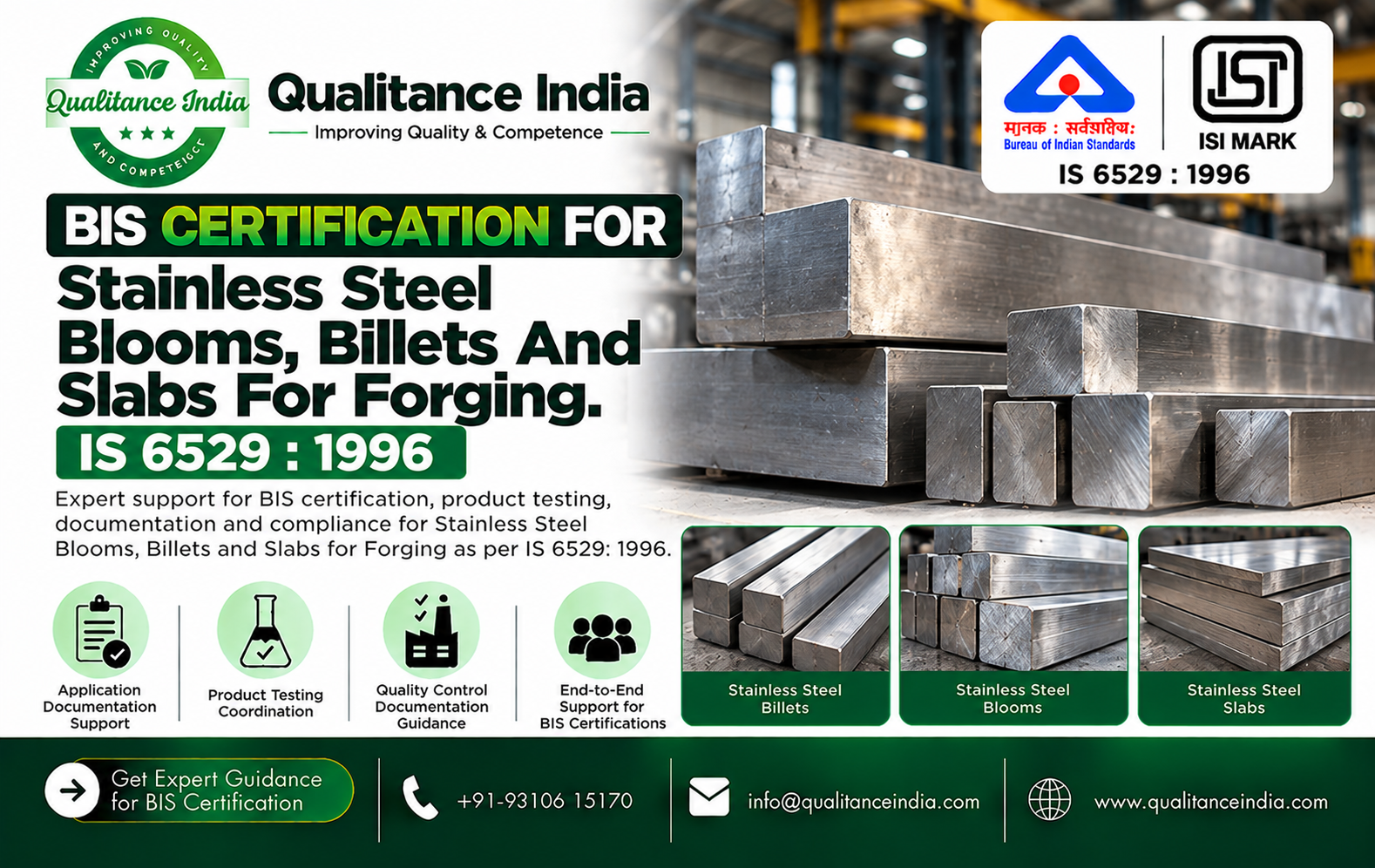
The standard covers the following stainless steel semi-finished products intended for forging:
A. Stainless Steel Blooms
Blooms are semi-finished steel products with a relatively large cross-section, used as input material for further rolling, forging or other manufacturing operations.
B. Stainless Steel Billets
Billets are semi-finished steel products with a smaller cross-section than blooms. They are commonly used for producing forged components and other steel products.
C. Stainless Steel Slabs
Slabs are semi-finished steel products with a rectangular cross-section and are used for further processing, including forging applications covered by the standard.
The BIS licence scope should clearly identify the product form, steel designation, condition and applicable dimensions.
4. Steel Grades and Product Conditions
The BIS Product Manual for IS 6529:1996 identifies different stainless steel families, including:
- Austenitic stainless steels
- Ferritic stainless steels
- Martensitic stainless steels
Examples of steel designations appearing in the product manual include X02Cr19Ni10, X04Cr19Ni9, X04Cr12, X07Cr17, X12Cr12 and X20Cr13.
The product may also be supplied in different conditions, such as:
- Rolled
- Forged
- Annealed
- Other applicable conditions as covered by the standard
The exact grade and condition must be assessed against the current Indian Standard and the manufacturer’s intended scope of production.
5. Key Quality Requirements Under IS 6529:1996
The standard establishes requirements to ensure that stainless steel semi-finished products are suitable for subsequent forging operations.
5.1 Chemical Composition
Chemical composition is a critical requirement because the proportion of alloying elements determines the properties and performance of stainless steel.
The chemical composition must conform to the specified steel designation.
Testing and verification may include relevant elements such as:
- Carbon
- Chromium
- Nickel
- Manganese
- Silicon
- Sulphur
- Phosphorus
- Other specified alloying elements, as applicable to the grade
The actual chemical limits must be taken from the applicable grade requirements in IS 6529 and its referenced standards. Manufacturers should not use generic stainless steel composition limits in place of the specified grade requirements.
5.2 Freedom from Defects
The products should be free from defects that adversely affect their intended use and subsequent processing.
Manufacturers should establish suitable inspection and process-control arrangements to identify surface and other relevant defects.
5.3 Heat Treatment
Heat-treatment requirements are important for achieving the required metallurgical condition of the material.
The applicable heat-treatment condition should be controlled and documented in accordance with the relevant grade and product requirements.
5.4 Hardness
Hardness is an important characteristic for stainless steel products intended for forging.
The manufacturer must ensure that the supplied material conforms to the applicable hardness requirements of the standard.
5.5 Dimensional Tolerances
Blooms, billets and slabs must conform to the applicable dimensional requirements.
The manufacturer should maintain suitable measuring instruments and inspection records for the dimensions covered by the product specification.
5.6 Corrosion Resistance
Corrosion resistance is an important property of stainless steel. The applicable corrosion-resistance requirement should be considered according to the product grade and purchaser’s specified requirements.
The BIS Product Manual identifies corrosion resistance as an optional requirement for the licence scope.
6. Testing Requirements for BIS Certification
Testing is an essential part of BIS certification under IS 6529:1996. The manufacturer must demonstrate that the product conforms to the applicable requirements of the standard.
The BIS Product Manual identifies the following sample requirements.
| Test purpose | Sample requirement specified in Product Manual |
|---|---|
| Instrumental chemical analysis | 5 pieces of 5 cm |
| Wet chemical analysis | 50 g drillings |
| Mechanical tests | 1 sample of 1.5 m |
The exact test programme should be finalised using the applicable standard, product manual and the requirements of the BIS-recognised laboratory.
Important tests and checks
The compliance assessment may include:
- Chemical composition analysis
- Heat-treatment verification
- Hardness testing
- Dimensional measurement
- Corrosion-resistance testing, where applicable
- Inspection for freedom from defects
Corrosion-resistance testing can require additional time. The BIS Product Manual notes that the Huey test takes more than 10 days and the Moneypenny Strauss method takes more than one day. Therefore, testing and project timelines should account for the selected corrosion test method.
7. Product Grouping and Scope of BIS Licence
Product grouping is an important part of the BIS application process.
The BIS Product Manual for IS 6529:1996 provides product grouping guidelines in Annex A. The licence scope is structured around relevant product characteristics, including:
- Steel designation
- Product condition
- Product variety and dimensions
- Corrosion-resistance requirement, where applicable
The scope format identified in the Product Manual includes:
Product: Stainless Steel Blooms, Billets and Slabs for Forgings
Steel Designation: Applicable steel grade
Condition: Rolled, Forged, Annealed, etc.
Variety (Size):
- Billets: applicable dimensions
- Blooms: applicable dimensions
- Slabs: applicable dimensions
Optional Requirement: With or without corrosion resistance
The manufacturer should prepare a proposed scope carefully. Applying for an unnecessarily broad scope without the required manufacturing and testing capability can create complications during inspection and assessment.
8. In-House Laboratory Requirements
Manufacturers applying for BIS certification should establish adequate in-house quality-control and testing arrangements as required by the applicable Scheme-I requirements and Product Manual.
The laboratory should be capable of carrying out the relevant routine tests and inspections or have an appropriate arrangement for tests that cannot be conducted in-house, subject to BIS requirements.
Typical laboratory and quality-control arrangements may include:
- Chemical analysis facilities
- Hardness testing equipment
- Dimensional measuring instruments
- Equipment for applicable mechanical tests
- Corrosion-resistance testing arrangements, where required
- Calibration records for measuring and testing equipment
- Trained testing and quality-control personnel
The exact equipment list and test capability should be checked against Annex B of the BIS Product Manual and the applicable standard.
9. Scheme of Inspection and Testing (SIT)
The manufacturer must establish a documented Scheme of Inspection and Testing to ensure that production consistently conforms to IS 6529:1996.
The SIT should define:
- Control-unit identification
- Inspection and testing stages
- Frequency of testing
- Acceptance criteria
- Records to be maintained
- Handling of non-conforming products
- Responsibilities of quality-control personnel
The BIS Product Manual provides the applicable inspection and testing guidance in Annex C.
The manufacturer should prepare its internal inspection plan in line with the product manual rather than adopting an unrelated testing frequency.
10. Documents Required for BIS Certification
Manufacturers should prepare the following documents before submitting a BIS application.
A. Company Documents
- Company incorporation certificate or relevant business registration
- Factory address proof
- GST registration certificate, as applicable
- Authorisation letter for the application signatory
- Details of the manufacturing premises
B. Manufacturing Documents
- Manufacturing process flow chart
- Details of manufacturing machinery
- Product and grade details
- Raw material procurement details
- Production capacity
- Details of heat treatment and other relevant processes
- Factory layout
C. Laboratory and Quality-Control Documents
- List of testing equipment
- Calibration certificates
- Laboratory test procedures
- Details of testing personnel
- Quality-control procedures
- Inspection and testing records
- Scheme of Inspection and Testing
D. Product Documents
- Product specifications
- Steel designation and grade details
- Product dimensions
- Heat-treatment condition
- Sample details
- Test reports, where available
- Product marking details
E. Other Documents
- Trademark registration or authorisation, where applicable
- Undertakings and declarations prescribed by BIS
- Applicable application forms and supporting documents
The final document list should be confirmed against the current BIS application requirements and the manufacturer’s specific scope.
11. BIS Certification Process for Stainless Steel Blooms, Billets and Slabs
The general process for obtaining BIS certification under IS 6529:1996 is as follows.
Step 1: Product and Standard Assessment
Confirm that the product falls within the scope of IS 6529:1996 and the applicable QCO.
Step 2: Scope Finalisation
Identify the steel grades, product forms, dimensions, manufacturing conditions and optional requirements proposed for inclusion in the licence.
Step 3: Factory and Laboratory Readiness
Review manufacturing facilities, testing equipment, quality-control arrangements and personnel.
Step 4: Sample Testing
Arrange testing of representative samples as per the applicable standard and BIS Product Manual.
Step 5: Online Application
Submit the application and supporting documents through the applicable BIS online application system.
Step 6: BIS Factory Inspection
BIS may assess the manufacturing facility, production controls, laboratory arrangements, records and overall conformity with the certification requirements.
Step 7: Compliance and Grant of Licence
Address any observations or non-conformities raised during the assessment. BIS will process the application and grant the licence subject to fulfilment of the applicable requirements.
Step 8: ISI Marking
After grant of licence, the manufacturer must follow BIS marking requirements and the conditions of the licence.
Note: The above is a general process overview. The actual sequence and documentation may vary depending on the application route and current BIS procedures.
12. BIS Certification for Foreign Manufacturers
Foreign manufacturers supplying stainless steel blooms, billets and slabs for forging to India must also assess the applicable BIS certification requirements.
Where certification is required, overseas manufacturers generally apply under the Foreign Manufacturers Certification Scheme (FMCS).
The process may involve:
- Nomination of an Authorised Indian Representative (AIR), where required
- Submission of factory and product documentation
- Assessment of manufacturing and testing facilities
- BIS inspection of the overseas manufacturing premises
- Product sample testing
- Compliance with applicable licence and marking conditions
Foreign manufacturers should plan for additional time and coordination for factory inspection, sample movement, testing and regulatory documentation.
13. Common Challenges Faced by Manufacturers
Manufacturers may encounter the following challenges while preparing for BIS certification:
1. Incorrect product classification: Confusion between stainless steel semi-finished products intended for rolling and those intended for forging.
2. Incorrect licence scope: Failure to identify the required grades, dimensions, conditions and optional requirements.
3. Inadequate laboratory facilities: Missing or unsuitable testing equipment and calibration records.
4. Incomplete testing arrangements: Delays in arranging tests, particularly where corrosion-resistance testing is required.
5. Inadequate quality records: Missing production, inspection, heat-treatment and test records.
6. QCO compliance gaps: Failure to check the latest applicable QCO notifications and implementation requirements.
A proper technical review before filing the application can help reduce avoidable delays.
14. How Qualitance India Can Help
Qualitance India provides consultancy and technical support for manufacturers seeking BIS product certification and regulatory compliance in India.
Our support for IS 6529:1996 certification can include:
- Product applicability and QCO assessment
- Review of the applicable Indian Standard
- Licence scope finalisation
- Manufacturing facility gap assessment
- In-house laboratory readiness assessment
- Testing coordination with suitable laboratories
- Preparation of quality-control documentation
- Scheme of Inspection and Testing preparation
- BIS application documentation support
- Factory inspection preparation
- Assistance in addressing BIS observations
Our objective is to help manufacturers understand the applicable requirements and establish a practical compliance system.
Qualitance India
Improving Quality & Competence
Website: https://qualitanceindia.com
Email: info@qualitanceindia.com
Phone / WhatsApp: +91 93106 15170
15. Frequently Asked Questions (FAQs)
Q1. Which Indian Standard applies to stainless steel blooms, billets and slabs for forging?
The applicable Indian Standard is IS 6529:1996 – Stainless Steel Blooms, Billets and Slabs for Forgings.
Q2. Is BIS certification mandatory for stainless steel blooms, billets and slabs for forging?
Yes. The product is included under the Steel and Steel Products (Quality Control) Order, 2024. Manufacturers and importers should comply with the applicable BIS certification requirements and verify any relevant exemption.
Q3. Which products are covered under IS 6529:1996?
The standard covers stainless steel blooms, billets and slabs intended for forging applications.
Q4. Which steel grades are covered?
The Product Manual identifies austenitic, ferritic and martensitic stainless steel families. The exact applicable grades should be checked against the Indian Standard.
Q5. What samples are required for BIS testing?
The Product Manual specifies five pieces of 5 cm for instrumental chemical analysis, 50 g drillings for wet chemical analysis and one 1.5 m sample for mechanical tests.
Q6. Is corrosion-resistance testing required?
The Product Manual identifies corrosion resistance as an optional requirement for the licence scope. The applicable test requirement should be determined from the selected product scope and standard.
Q7. Can a manufacturer apply for blooms, billets and slabs under one licence?
The proposed scope should be assessed against the BIS product grouping guidelines in Annex A of the Product Manual. Product form, steel designation, condition and dimensions must be considered before finalising the scope.
Q8. Can foreign manufacturers obtain BIS certification?
Yes. Foreign manufacturers can apply under the applicable BIS Foreign Manufacturers Certification Scheme, subject to fulfilment of the prescribed requirements.
Q9. How long does BIS certification take?
The timeline depends on documentation readiness, factory inspection scheduling, sample testing, laboratory availability and BIS assessment. Corrosion-resistance testing may require additional time. A reliable project timeline should be prepared after reviewing the product scope and testing requirements.
Q10. Can Qualitance India assist with BIS certification under IS 6529:1996?
Yes. Qualitance India can assist with product applicability assessment, scope finalisation, documentation, laboratory readiness, testing coordination and factory inspection preparation.
Conclusion
BIS certification under IS 6529:1996 is an important regulatory requirement for stainless steel blooms, billets and slabs intended for forging and covered by the applicable Steel and Steel Products Quality Control Order.
Manufacturers should pay particular attention to steel designation, product condition, dimensional scope, chemical composition, heat treatment, hardness, corrosion resistance and the required quality-control arrangements.
A structured compliance assessment before submitting the BIS application can help manufacturers prepare their facilities, documentation and testing arrangements more effectively.
Need assistance with BIS Certification for Stainless Steel Blooms, Billets and Slabs for Forgings?
Contact Qualitance India for technical guidance and end-to-end consultancy support.
Official References
- BIS Product Manual: PM/IS 6529/1, November 2020 – Stainless Steel Blooms, Billets and Slabs for Forgings.
- Indian Standard: IS 6529:1996 – Stainless Steel Blooms, Billets and Slabs for Forgings – Specification.
- Steel and Steel Products (Quality Control) Order, 2024.
- Ministry of Steel order dated 28 May 2021 extending the enforcement date for IS 6529:1996 under the earlier QCO.
Need help with BIS certification for this product?
Get a free consultation from our compliance experts — we handle testing, documentation and the complete BIS process for you.
BIS Certification Readiness Checklist 2026
- Documents, testing & factory requirements in one place
- Covers ISI Mark, CRS, FMCS & Hallmarking
- Tick-box format — share it with your team