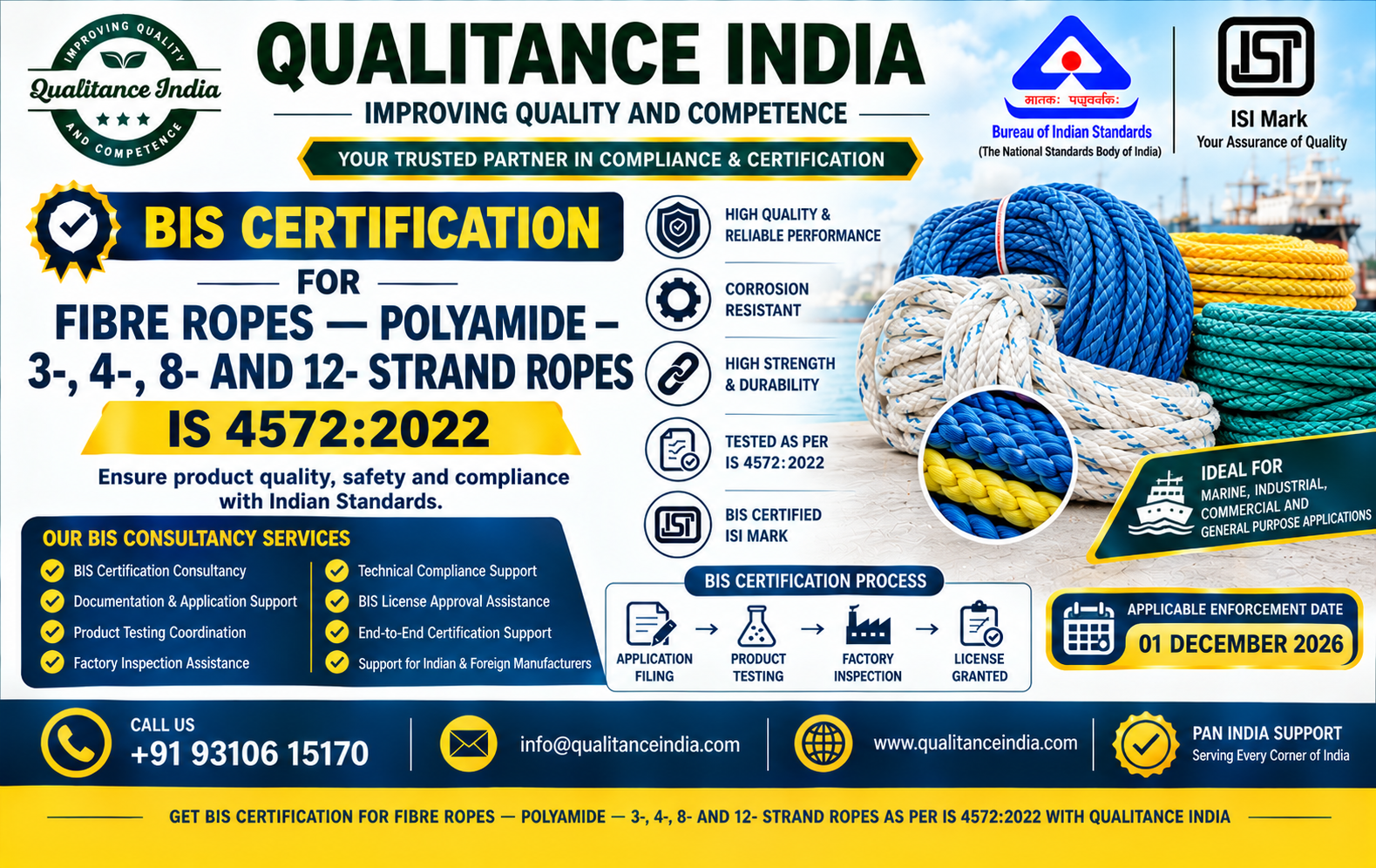
BIS Certification Consultancy for Fibre Ropes – Polyamide 3, 4, 8 & 12 Strand | IS 4572:2022
Introduction
Polyamide fibre ropes, commonly known as nylon ropes, are high-strength synthetic ropes used where flexibility, resilience, abrasion resistance and reliable breaking performance are important. They are manufactured in different constructions, including 3-strand, 4-strand, 8-strand and 12-strand forms.
Because fibre ropes can be used in demanding applications such as marine operations, mooring, towing, lifting-related applications, industrial handling and other general-service environments, consistent rope construction, linear density, dimensions and minimum breaking strength are important.
The applicable Indian Standard is IS 4572:2022 – Fibre Ropes — Polyamide — 3-, 4-, 8- and 12-Strand Ropes. The standard is the fifth revision and is identical to ISO 1140:2021. BIS Product Manual PM/4572/2, July 2022 provides the certification framework under Scheme-I.
The product is also covered by the Ropes and Cordages (Quality Control) Order, 2024, which makes the Standard Mark under a BIS licence according to Scheme-I compulsory for the listed products, including polyamide 3-, 4-, 8- and 12-strand ropes. The order came into force on 1 April 2025, with a separate commencement date of 1 July 2025 for small and micro enterprises for domestic production.
Qualitance India provides complete BIS Certification consultancy for Polyamide Fibre Ropes, including product assessment, scope planning, grouping, sample preparation, testing coordination, documentation, factory inspection preparation, BIS application filing, licence processing and post-licence compliance.
What is IS 4572:2022?
IS 4572:2022 is titled:
“Fibre Ropes — Polyamide — 3-, 4-, 8- and 12-Strand Ropes”
The standard specifies requirements for:
- 3-strand hawser-laid polyamide ropes
- 4-strand shroud-laid polyamide ropes
- 8-strand braided polyamide ropes
- 12-strand braided polyamide ropes
BIS technical material identifies four construction types:
- Type A – 3-strand hawser-laid rope
- Type B – 4-strand shroud-laid rope
- Type L – 8-strand braided rope
- Type T – 12-strand braided rope.
The standard establishes requirements including:
- Construction
- Manufacture
- Rope designation
- Linear density
- Minimum breaking strength
- Physical properties
- Lay
- Marking/labelling
- Packaging
- Delivery length.
Current BIS Certification Status
The current BIS Scheme-I listing includes:
IS 4572:2022 – Fibre Ropes — Polyamide — 3-, 4-, 8- and 12-Strand Ropes
under the Ropes and Cordages product category. The same BIS listing also records the 2026 amendment to the Ropes and Cordages QCO.
The current Product Manual is:
PM/4572/2 – July 2022
It specifies:
- Standard: IS 4572:2022 / ISO 1140:2021
- Amendments to standard: 00
- Raw-material sampling requirement: No specific requirement
- Grouping: Annex A
- Sample size: 10 metres
- Testing equipment: Annex B
- Scheme of Inspection and Testing: Annex C.
Is BIS Certification Mandatory for Polyamide Fibre Ropes?
Yes.
The Ropes and Cordages (Quality Control) Order, 2024 specifically lists:
Fibre ropes – Polyamide 3-, 4-, 8- and 12-strand ropes – IS 4572:2022
The order requires the specified product to conform to the corresponding Indian Standard and bear the Standard Mark under a BIS licence in accordance with Scheme-I.
The QCO does not apply to goods or articles meant for export.
Important QCO Dates
The 2024 QCO provides:
General implementation: 1 April 2025
Small and Micro Enterprises for domestic production: 1 July 2025.
2026 Amendment
The Ropes and Cordages (Quality Control) Amendment Order, 2026, dated 5 June 2026, amended the 2024 QCO by inserting a temporary provision for goods under Schedule Serial No. 7 made from recycled plastic waste. This specific provision concerns the polypropylene rope entry under Serial No. 7 and therefore does not directly change the IS 4572:2022 polyamide-rope entry at Serial No. 6.
Types of Polyamide Ropes Covered
Type A – 3-Strand Hawser-Laid Rope
This is a three-strand construction in which the strands are laid together in a hawser-laid configuration.
Type B – 4-Strand Shroud-Laid Rope
This construction uses four strands in a shroud-laid arrangement.
Type L – 8-Strand Braided Rope
This is a braided construction made using eight strands.
Type T – 12-Strand Braided Rope
This is a braided construction made using twelve strands.
Why BIS Certification is Important for Polyamide Ropes
A fibre rope’s performance depends on many factors, including construction, fibre/yarn quality, rope diameter, linear density, manufacturing process and breaking strength.
BIS certification helps establish a controlled conformity framework for the product.
For manufacturers and buyers, certification supports:
- Standardized product construction
- Controlled linear density
- Required minimum breaking strength
- Consistent manufacturing
- Proper identification and labelling
- Documented inspection and testing
- Better product traceability.
BIS’s technical overview of IS 4572 specifically notes that the standard establishes requirements for designation, linear density, minimum breaking strength, construction, manufacture, lay, labelling and packaging.
Raw Material Requirements
The current Product Manual states:
No specific raw-material requirement for sampling purposes.
However, the rope is manufactured from polyamide material, and the manufacturer must maintain suitable controls over the input materials used in production.
Important records can include:
- Polyamide yarn procurement
- Supplier details
- Material identification
- Batch/lot records
- Incoming inspection
- Yarn quality information
- Production traceability.
The manufacturer should ensure that its input material and manufacturing process produce rope conforming to the current Indian Standard.
BIS Product Grouping for IS 4572:2022
Grouping is provided under Annex A of the Product Manual.
The licence scope identifies:
- Construction Type: A / B / L / T
- Reference Number: Up to and including a declared reference number
- Type of Stabilization: 1 or 2 in accordance with IS/ISO 9554.
Grouping by Rope Type
Separate samples are required for the different construction types.
Therefore:
- Type A should be considered separately.
- Type B should be considered separately.
- Type L should be considered separately.
- Type T should be considered separately.
Grouping by Size
The Product Manual’s grouping provisions allow the highest size/reference number from each applicable type to be tested to cover the range of sizes under that type, subject to the applicable conditions. This means scope planning is important before sample submission.
Stabilization
The licence scope also identifies:
Type of Stabilization: 1 or 2 according to IS/ISO 9554.
The manufacturer should therefore clearly identify its stabilization arrangement before finalizing the proposed licence scope.
BIS Sample Size for Polyamide Fibre Ropes
The Product Manual specifies:
Sample Size: 10 metres.
This sample is used for the applicable testing programme.
Correct sample selection is important because the certification scope may depend on:
- Rope construction
- Reference number/size
- Stabilization type
- Test capability.
Main BIS Tests for IS 4572:2022
1. Construction and Manufacture
The construction and manufacture of the rope are checked according to the applicable requirements.
This includes inspection of:
- Number of strands
- Rope construction
- Lay
- Manufacturing quality
- Overall workmanship.
2. Lay
Lay is an important characteristic of stranded rope.
The Product Manual specifies routine checking of lay and references IS/ISO 9554:2019.
3. Linear Density
Linear density is an important parameter used to characterize the rope.
The Product Manual references IS 7071:2021 for testing linear density.
4. Minimum Breaking Strength
Minimum breaking strength is one of the most important performance requirements.
The rope must meet the minimum breaking strength corresponding to its construction and reference number.
The Product Manual references IS 7071:2021 for this test.
5. Physical Properties
The current Product Manual lists Physical Properties as part of the applicable test programme under Clause 6.
The exact physical properties and relevant test requirements should be assessed against the applicable standard and rope type.
6. Marking and Labelling
Marking and labelling are included under Clause 5.2.
The manufacturer must ensure that the certified rope is properly identified according to the applicable requirements.
7. Packaging
Packaging is part of the inspection and testing requirements.
The Product Manual includes packaging, invoicing and delivered length as part of the applicable checks.
8. Delivered Length
The actual delivered length of rope is an important commercial and conformity characteristic.
The Product Manual includes delivered length under the prescribed inspection provisions.
Tests That Can Be Completed in One Day
The BIS Product Manual specifically states that:
Construction, Manufacture, Marking and Delivery Length
can be tested according to the applicable requirements.
It also states that:
Linear Density and Minimum Breaking Force can be carried out in a day provided the sample is conditioned.
This is useful for manufacturers planning laboratory schedules.
Conditioning of Samples
Because rope properties can be affected by environmental conditions, appropriate conditioning of the sample is important before determining linear density and minimum breaking strength.
The Product Manual specifically links the one-day testing possibility for these properties to the sample being conditioned.
BIS Testing Equipment for Polyamide Ropes
The Product Manual refers manufacturers and BIS offices to Annex B for the test-equipment list.
For the major tests, the manufacturing/testing facility should provide suitable equipment for:
Length Measurement
- Calibrated measuring arrangement
- Measuring tape or equivalent suitable device
- Flat measurement area where necessary
Linear Density
- Accurate weighing balance
- Measuring arrangement for rope length
- Conditioning facility where applicable.
Minimum Breaking Strength
- Rope tensile/breaking-strength testing machine
- Suitable grips or rope fixtures
- Load-measuring system
- Recording arrangement.
Construction and Lay
- Measuring tools
- Suitable rope inspection equipment
- Equipment for checking strand and lay characteristics.
The manufacturer’s actual equipment list should be finalized from Annex B, the current Indian Standard and the proposed certification scope.
Laboratory Requirements
A manufacturer applying for BIS certification should maintain suitable testing arrangements for the tests applicable to its scope.
Important laboratory requirements include:
- Suitable test equipment
- Qualified testing personnel
- Calibration programme
- Test methods
- Test records
- Sample identification
- Traceability
- Non-conformity control.
The Product Manual’s Scheme of Inspection and Testing specifies whether equipment is required in-house or whether particular tests may be subcontracted. It states that subcontracting, where permitted, is to a laboratory recognized by BIS or a Government laboratory empanelled by BIS.
Scheme of Inspection and Testing
The Product Manual’s Annex C provides the inspection and testing framework.
The key controls include:
| Requirement | Test/Check | Frequency |
|---|---|---|
| Construction & Manufacture | IS/ISO 9554:2019 | All coils, each control unit |
| Lay | IS/ISO 9554:2019 | 3 coils, each control unit |
| Marking & Labelling | IS/ISO 9554:2019 | 3 coils, each control unit |
| Packaging, Invoicing & Delivered Length | IS/ISO 9554:2019 | 3 coils, each control unit |
| Linear Density | IS 7071:2021 | 3 coils, each control unit |
| Minimum Breaking Strength | IS 7071:2021 | 3 coils, each control unit |
These requirements are stated in the current Product Manual’s inspection table.
Control Unit for Polyamide Fibre Ropes
The control unit is an important concept because testing frequencies are linked to it.
The manufacturer should define and control production in a manner that allows traceability between:
- Rope construction
- Reference number/size
- Stabilization type
- Raw materials
- Production date
- Coil/batch identification
- Test results
- Dispatch information.
The exact control-unit definition and records should be implemented according to the approved Scheme of Inspection and Testing.
Marking Requirements
The current BIS framework requires the product covered under the QCO to bear the Standard Mark under a BIS licence according to Scheme-I.
The BIS technical material for IS 4572 states that each coil shall have a label firmly fixed in place and providing information regarding:
- Constituent material
- Identification of manufacturer
- Country of origin
- Reference number
- Delivered length
- Reference to the standard.
The final marking arrangement should be implemented according to the applicable standard and BIS licence conditions.
Packaging and Labelling
Packaging is not simply a commercial activity for this product.
The applicable requirements address:
- Coil identification
- Product information
- Delivered length
- Manufacturer identification
- Country of origin
- Reference number
- Standard reference
- BIS marking.
Proper labelling also supports traceability throughout supply and distribution.
Manufacturing Process for Polyamide Fibre Ropes
A typical manufacturing process may include:
Polyamide Material/Yarn Receipt → Incoming Inspection → Yarn Preparation → Twisting/Stranding → Rope Formation → Stabilization → Finishing → Length Measurement → Breaking Strength Testing → Linear Density Testing → Visual Inspection → Labelling → Coiling → Packing
The actual production process varies by rope construction.
Type A
Yarn Preparation → Strand Formation → Hawser Laying → Stabilization → Inspection → Coiling
Type B
Yarn Preparation → Strand Formation → Four-Strand Shroud Laying → Stabilization → Inspection → Coiling
Type L
Yarn Preparation → Eight-Strand Braiding → Stabilization → Inspection → Coiling
Type T
Yarn Preparation → Twelve-Strand Braiding → Stabilization → Inspection → Coiling
The process must consistently produce rope conforming to the relevant requirements.
Important Manufacturing Controls
Manufacturers should pay particular attention to:
Yarn Quality
Incoming polyamide yarn must be properly identified and controlled.
Strand Construction
The correct number and arrangement of strands must be maintained.
Lay
Lay characteristics must remain within the applicable requirements.
Linear Density
Rope weight per unit length must remain controlled.
Breaking Strength
The finished rope must meet the applicable minimum breaking strength.
Stabilization
The declared stabilization type should be consistently maintained.
Length
Delivered length must be properly measured and documented.
Coiling
Coils should be prepared so that identification and traceability remain intact.
BIS Factory Inspection for Rope Manufacturers
During BIS assessment, the manufacturer should be prepared to demonstrate:
- Raw-material storage
- Polyamide yarn control
- Rope-making machinery
- Stranding/braiding machinery
- Stabilization process
- Length measurement
- Breaking-strength testing
- Linear-density testing
- Calibration
- Quality-control records
- Product identification
- Coil traceability
- Marking and packaging.
Qualitance India helps manufacturers review factory preparedness before the applicable BIS assessment.
BIS Certification Process for Polyamide Fibre Ropes
The typical process is:
Product Identification → IS 4572:2022 Applicability → Construction Type Selection → Reference Number/Size → Stabilization Type → Scope Planning → Grouping Review → Factory Assessment → Sample Preparation → Laboratory Testing → Documentation → BIS Application → Factory Inspection → Compliance → BIS Licence → Standard Marking → Post-Licence Compliance
The exact process may vary depending on the factory, product scope and applicable BIS requirements.
Documents Required for BIS Certification
Common documents may include:
- Company registration documents
- Factory address proof
- Factory ownership/lease documents
- Authorized signatory details
- Manufacturing process flow chart
- Factory layout
- Rope-making machinery details
- Braiding/stranding machinery details
- Stabilization equipment details
- Testing equipment list
- Calibration certificates
- Product specifications
- Construction type
- Reference number/size details
- Polyamide material details
- Test reports
- Quality-control documents
- Production records
- Coil traceability records
- Marking/label details
- Packing details
- Applicable declarations and undertakings
- Trademark documents, where applicable.
BIS Testing Cost for IS 4572:2022
The current BIS LIMS includes an active entry for:
IS 4572 (2022) – Fibre ropes – Polyamide 3-, 4-, 8- and 12-strand ropes (fifth revision).
The current BIS Central Laboratory listing shows testing scope covering:
- Linear density
- Minimum breaking strength
- Type A
- Type B
- Type L
- Type T
- Physical properties.
However, the current Central Laboratory entry does not display a total testing amount in the retrieved listing. Therefore, it would be inappropriate to quote a fixed current BIS laboratory price without confirming the selected laboratory and current scope.
Testing charges can vary according to:
- Rope type
- Reference number
- Scope
- Laboratory
- Tests included
- Sample requirements
- Applicable taxes.
Cost of BIS Certification for Polyamide Fibre Ropes
The total certification cost may include:
- BIS application fees
- Product testing
- Sample preparation
- Laboratory testing
- Testing equipment
- Calibration
- Factory preparation
- Inspection-related expenses
- Documentation
- Consultancy charges
- Licence-related expenses
- Ongoing quality-control costs.
The final cost depends mainly on the proposed scope and existing factory/testing facilities.
How Long Does BIS Certification Take?
The certification timeline depends on:
- Rope construction type
- Reference-number range
- Stabilization type
- Sample readiness
- Laboratory availability
- Testing
- Documentation
- Factory inspection schedule
- Response to BIS observations.
Because the Product Manual states that linear density and minimum breaking force can be completed in one day when the sample is conditioned, the routine testing stage can be relatively straightforward once the correct sample and facilities are ready.
Common Reasons for BIS Certification Delays
Wrong Rope Construction
The manufacturer may not correctly identify Type A, B, L or T.
Wrong Scope
The requested reference-number range may not match the available manufacturing/testing capability.
Incorrect Sample
The sample may not represent the proposed certification scope.
Breaking Strength Failure
Inadequate yarn quality or poor rope construction can cause failure.
Linear Density Failure
Variation in rope construction or yarn input can cause the measured linear density to fall outside requirements.
Lay Problems
Incorrect stranding or braiding control can affect lay.
Stabilization Problems
Inconsistent stabilization can affect the declared product characteristics.
Poor Traceability
Coils should remain linked to raw material, production and test records.
Calibration Problems
Testing equipment must have valid calibration status.
Marking Problems
Improper coil labelling can create compliance and traceability issues.
Documentation Gaps
Incomplete factory, product or technical documentation can delay the application.
Who Needs BIS Certification for Polyamide Fibre Ropes?
The requirements are relevant to manufacturers producing polyamide fibre ropes covered under IS 4572:2022 and the applicable Ropes and Cordages QCO.
This may include manufacturers supplying:
- Marine industries
- Shipping companies
- Mooring applications
- Towing applications
- Industrial users
- Infrastructure projects
- Material-handling industries
- Government departments
- Institutional buyers
- Rope distributors and brand owners sourcing regulated products.
Importers and traders should separately verify their responsibilities under the applicable regulatory framework.
Benefits of BIS Certification
Regulatory Compliance
BIS certification is required for the regulated product under the applicable QCO framework.
Quality Assurance
Testing establishes conformity with important rope-performance requirements.
Product Consistency
Construction, linear density and breaking strength are brought under systematic quality control.
Buyer Confidence
Certified ropes provide confidence where conformity to IS 4572:2022 is required.
Government & Institutional Supply
Certification supports procurement where BIS compliance is specified.
Better Traceability
Coil-level labelling and inspection records provide stronger production traceability.
BIS Certification Consultancy for Polyamide Fibre Rope Manufacturers
Qualitance India provides complete BIS consultancy for:
IS 4572:2022 – Fibre Ropes — Polyamide — 3-, 4-, 8- and 12-Strand Ropes
Product & Standard Identification
We review the product and confirm the applicable Indian Standard.
Construction-Type Assessment
We identify whether your product is:
- Type A
- Type B
- Type L
- Type T.
Scope Planning
We help define:
- Reference number/size
- Rope construction
- Stabilization type
- Proposed licence scope.
Grouping Guidance
We assist in selecting representative samples according to Annex A.
Sample Preparation
We help arrange the required 10-metre sample.
Testing Coordination
We coordinate:
- Construction checks
- Lay
- Linear density
- Minimum breaking strength
- Physical-property testing
- Marking and packaging checks.
Documentation Support
We assist with application and technical documentation.
Factory Inspection Preparation
We review machinery, testing facilities, calibration and quality-control systems.
BIS Application Filing
We assist with preparing and submitting the BIS certification application.
Inspection Assistance
We help prepare the factory for BIS assessment.
Compliance & Query Support
We assist with technical and documentary observations.
Licence Processing
We support the certification process through the licence stage.
Post-Licence Compliance
We provide continuing assistance for applicable renewal, scope and compliance activities.
Quick BIS Certification Checklist
Before applying for BIS certification for polyamide fibre ropes:
☑ IS 4572:2022 applicability confirmed
☑ Type A/B/L/T identified
☑ Reference number/size range finalized
☑ Stabilization type identified
☑ Grouping requirements reviewed
☑ Polyamide yarn control established
☑ Rope-making machinery available
☑ Stranding/braiding machinery available
☑ Stabilization arrangement available
☑ Linear-density testing arrangement available
☑ Breaking-strength testing arrangement available
☑ Calibration records available
☑ 10-metre sample prepared
☑ Product testing completed
☑ Test reports reviewed
☑ Coil labelling prepared
☑ BIS documentation completed
☑ Factory ready for inspection
☑ Standard Mark implementation prepared
Frequently Asked Questions
1. What is IS 4572:2022?
IS 4572:2022 is the Indian Standard for Fibre Ropes — Polyamide — 3-, 4-, 8- and 12-Strand Ropes and is identical to ISO 1140:2021.
2. What is the revision of IS 4572:2022?
It is the fifth revision of the standard.
3. Which rope constructions are covered?
Type A, Type B, Type L and Type T are covered.
4. What is Type A rope?
Type A is a 3-strand hawser-laid rope.
5. What is Type B rope?
Type B is a 4-strand shroud-laid rope.
6. What is Type L rope?
Type L is an 8-strand braided rope.
7. What is Type T rope?
Type T is a 12-strand braided rope.
8. Is BIS certification mandatory for IS 4572:2022?
Yes. The product is listed in the Ropes and Cordages (Quality Control) Order, 2024 and is required to bear the Standard Mark under a BIS licence according to Scheme-I.
9. What is the current BIS Product Manual?
The current Product Manual identified is PM/4572/2, July 2022.
10. What is the certification scheme?
Certification is under Scheme-I.
11. What is the sample size?
The Product Manual specifies 10 metres.
12. Is there a specific raw-material sample requirement?
The Product Manual states no specific raw-material requirement for sampling.
13. Is product grouping available?
Yes. Grouping is provided under Annex A.
14. How is grouping carried out?
The scope identifies construction type, reference number and stabilization type. Representative samples are selected according to the applicable grouping provisions.
15. Can one size cover multiple sizes?
The grouping provisions allow the highest reference number/size from each type to cover the applicable range, subject to the stated conditions and manufacturing/testing capability.
16. What is the stabilization type?
The Product Manual identifies Type 1 or Type 2 stabilization according to IS/ISO 9554.
17. What are the main BIS tests?
Important tests include construction, manufacture, lay, linear density, minimum breaking strength, physical properties, marking, packaging and delivered length.
18. Which standard is referenced for linear density?
The Product Manual references IS 7071:2021.
19. Which standard is referenced for minimum breaking strength?
The Product Manual references IS 7071:2021.
20. Is lay tested?
Yes. Lay is checked according to IS/ISO 9554:2019.
21. Can linear density and breaking force be tested in one day?
Yes, the Product Manual states this is possible provided the sample is conditioned.
22. Is delivered length controlled?
Yes. Delivered length is specifically included in the inspection programme.
23. Is marking tested?
Yes. Marking and labelling are included under Clause 5.2.
24. Is packaging part of certification?
Yes. Packaging, invoicing and delivered length are included in the applicable inspection programme.
25. What information should be on the coil label?
The BIS technical material states that each coil should have a firmly fixed label identifying constituent material, manufacturer, country of origin, reference number, delivered length and the standard reference.
26. Is Standard Marking mandatory?
Yes. The applicable QCO requires the listed rope products to bear the Standard Mark under a BIS licence according to Scheme-I.
27. Can a manufacturer apply for more than one rope type?
Yes, provided the manufacturer has the required manufacturing and testing capability and satisfies the applicable grouping and testing provisions.
28. Can Type A, B, L and T be treated as one group?
No. The Product Manual identifies separate construction types, and representative samples are required accordingly.
29. Is a laboratory required?
Suitable testing capability must be maintained for the applicable certification scope. The Product Manual specifies required testing equipment and identifies provisions for subcontracting certain tests where permitted.
30. Can testing be outsourced?
Where permitted under the Product Manual, testing may be subcontracted to a BIS-recognized laboratory or Government laboratory empanelled by BIS.
31. Is calibration required?
Testing equipment should be appropriately calibrated and calibration records maintained as part of the quality system.
32. Is factory inspection required?
The manufacturer must demonstrate suitable manufacturing, testing and quality-control capability under the applicable BIS certification process.
33. What is the current testing charge?
The current BIS Central Laboratory listing shows IS 4572:2022 testing scope but does not display a total price in the retrieved entry. The exact charge should therefore be confirmed from the selected laboratory before sample submission.
34. What does the 2024 Ropes and Cordages QCO say?
It requires listed rope products, including IS 4572:2022 polyamide fibre ropes, to conform to the applicable Indian Standard and bear the Standard Mark under a BIS licence according to Scheme-I.
35. When did the QCO come into force?
The general commencement date was 1 April 2025, with 1 July 2025 for small and micro enterprises for domestic production.
36. Does the QCO apply to export goods?
No. The 2024 QCO states that it does not apply to goods or articles meant for export.
37. Did the 2026 QCO amendment change IS 4572:2022 requirements?
The 5 June 2026 amendment added a temporary provision relating to recycled-plastic products under Schedule Serial No. 7, which is the polypropylene-rope entry. It does not directly amend the polyamide IS 4572:2022 entry at Serial No. 6.
38. Can MSME manufacturers obtain BIS certification?
Yes, eligible MSME manufacturers can obtain certification subject to the applicable BIS requirements and QCO provisions.
39. Can a trader directly obtain a manufacturer’s BIS licence?
BIS product certification is associated with the certified manufacturing operation. Traders should verify their specific role and sourcing arrangement.
40. Can Qualitance India help with BIS Certification for Polyamide Fibre Ropes?
Yes. Qualitance India provides complete consultancy covering standard applicability, scope planning, grouping, sample preparation, testing coordination, documentation, factory inspection preparation, BIS application, licence processing and post-licence compliance.
Related BIS Certification Services
Qualitance India also provides consultancy for:
- BIS Certification
- ISI Mark Certification
- Fibre Rope Certification
- Polyamide Rope Certification
- Polyester Fibre Rope Certification
- Polypropylene Fibre Rope Certification
- Mixed Polyolefin Rope Certification
- BIS Scheme-I Certification
- BIS Licence Renewal
- BIS Scope Extension
- Product Testing Coordination
- BIS Documentation
- Factory Inspection Assistance
- Quality Control Order Applicability
- Product Grouping Guidance
- Technical Compliance Support
Related Rope & Cordage Standards
Manufacturers may also need to evaluate:
- IS 1084:2005 – Manila Ropes
- IS 11066:2022 – Fibre Ropes — Polyester — 3-, 4-, 8- and 12-Strand Ropes
- IS 14928:2001 – Composite Synthetic Fibre Ropes
- IS 14929:2022 – Mixed Polyolefin Fibre Ropes
- IS 1804:2004 – Steel Wire Ropes – Fibre Main Cores
- IS 5175:2022 – Polypropylene 3-, 4-, 8- and 12-Strand Ropes
- IS 8674:2013 – Polyethylene 3- and 4-Strand Ropes
- IS 17609:2021 – Polyester/Polyolefin Dual Fibre Ropes
These products are listed in the 2024 Ropes and Cordages QCO.
Why Choose Qualitance India?
Qualitance India provides complete BIS Certification consultancy for rope and cordage manufacturers.
Product Assessment
We identify the correct Indian Standard and certification route.
Construction-Type Assessment
We help determine whether the rope is Type A, B, L or T.
Scope Planning
We assess reference-number range and stabilization type.
Grouping Guidance
We help plan representative samples according to the Product Manual.
Testing Coordination
We coordinate construction, lay, linear density, breaking-strength and other applicable testing.
Documentation Support
We assist in preparing BIS application and factory documentation.
Factory Preparation
We review rope-making machinery, testing facilities, calibration and quality-control systems.
Application Filing
We assist with BIS application preparation and submission.
Inspection Assistance
We help prepare the manufacturing unit for BIS assessment.
Compliance Support
We assist with technical and documentary observations.
Licence Processing
We support the certification process through the licence stage.
Post-Licence Compliance
We provide ongoing assistance for applicable BIS renewal, scope and compliance requirements.
Contact Qualitance India
Qualitance India – Your Certification & Compliance Partner
Phone: +91 93106 15170
Email: info@qualitanceindia.com
Website: https://qualitanceindia.com/
For BIS Certification of Fibre Ropes – Polyamide 3, 4, 8 & 12 Strand as per IS 4572:2022, Qualitance India provides complete consultancy covering product assessment, construction classification, grouping, sample planning, testing, documentation, factory inspection preparation, BIS application, licence processing and post-licence compliance.
Conclusion
IS 4572:2022 is the fifth revision of the Indian Standard for Fibre Ropes — Polyamide — 3-, 4-, 8- and 12-Strand Ropes and is identical to ISO 1140:2021. The standard covers Type A 3-strand hawser-laid, Type B 4-strand shroud-laid, Type L 8-strand braided and Type T 12-strand braided polyamide ropes.
The BIS Product Manual PM/4572/2, July 2022 specifies a 10-metre sample, grouping requirements under Annex A, testing equipment under Annex B and the Scheme of Inspection and Testing under Annex C. It identifies important conformity areas including construction, lay, linear density, minimum breaking strength, physical properties, marking, packaging and delivered length.
The product is covered by the Ropes and Cordages (Quality Control) Order, 2024, which requires the Standard Mark under a BIS licence according to Scheme-I. The QCO became effective on 1 April 2025 for general manufacturers and on 1 July 2025 for small and micro enterprises involved in domestic production.
For manufacturers, successful BIS certification depends on correct construction classification, scope planning, representative sample selection, controlled rope manufacturing, suitable testing facilities, calibration, quality records, proper coil labelling and compliance with the applicable inspection and testing system.
Qualitance India provides end-to-end BIS Certification consultancy for Polyamide Fibre Ropes, helping manufacturers manage the complete certification process from product assessment and testing through BIS application, factory inspection, licence processing and continuing compliance.
Need BIS Certification for Fibre Ropes – Polyamide 3, 4, 8 & 12 Strand as per IS 4572:2022? Contact Qualitance India for complete BIS licence and compliance support.
Need help with BIS certification for this product?
Get a free consultation from our compliance experts — we handle testing, documentation and the complete BIS process for you.
BIS Certification Readiness Checklist 2026
- Documents, testing & factory requirements in one place
- Covers ISI Mark, CRS, FMCS & Hallmarking
- Tick-box format — share it with your team