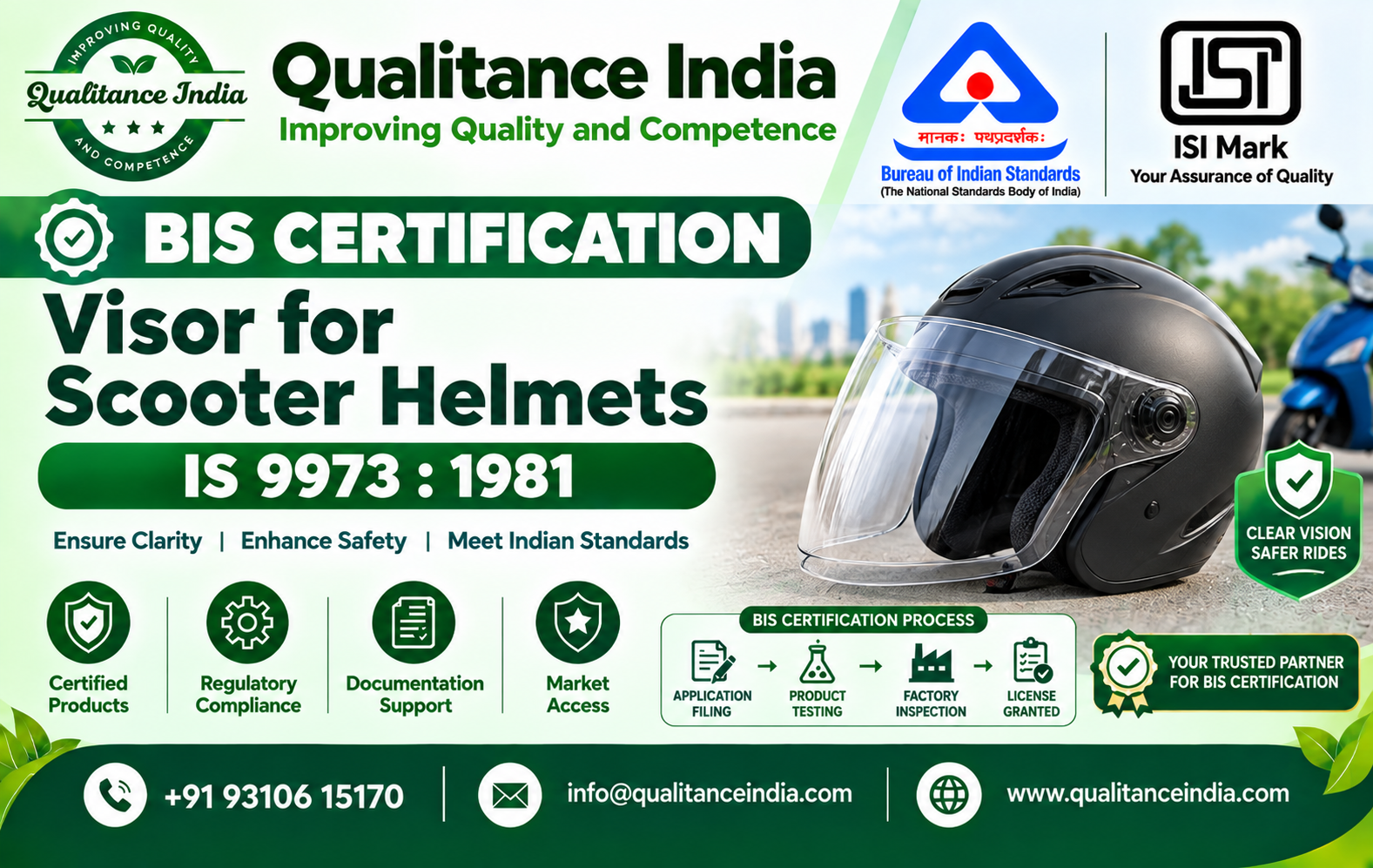
BIS Certification for Visor for Scooter Helmets | IS 9973:1981 | ISI Mark
Introduction
A visor is an important accessory fitted to a motorcycle or scooter helmet to help protect the rider's eyes and face from wind, insects and other external obstacles while maintaining an adequate field of vision. Because the visor directly affects visibility and protective performance, its material, design, impact resistance, optical properties, finish and marking need to conform to applicable requirements.
In India, the requirements for Visor for Scooter Helmets are specified in IS 9973:1981 – Specification for Visor for Scooter Helmets. BIS has issued a product manual for this product under Scheme-I of the BIS Conformity Assessment Regulations, 2018, making it suitable for manufacturers seeking a BIS licence to use the Standard Mark (ISI Mark). The current BIS Product Manual records one amendment to the standard.
The BIS standard defines the visor as a complete assembly consisting of a visor screen with suitable provision for attachment to the helmet.
What Is IS 9973:1981?
IS 9973:1981 is the Indian Standard titled:
“Specification for Visor for Scooter Helmets”
The standard covers requirements relating to:
- Material
- Construction
- Design
- Workmanship
- Impact resistance
- Penetration resistance
- Flammability
- Optical performance
- Field of vision
- Mass
- Instructions
- Marking
The standard states that it covers visors used with motorcycle and scooter helmets and is an adjunct to the applicable helmet standard.
What Is a Visor Under IS 9973?
IS 9973 defines a visor as the complete assembly of the visor screen together with suitable provision for attachment to the helmet.
The visor screen is the curved transparent plastic material intended to provide protection to the rider's eyes and face.
This means that certification consideration is not limited only to the transparent plastic sheet. The complete visor assembly, including its attachment arrangement, is relevant to conformity assessment.
BIS Certification for Visor for Scooter Helmets
BIS certification for this product is carried out under Scheme-I.
Under Scheme-I, BIS grants a licence to a manufacturer to use the Standard Mark / ISI Mark on products that conform to the relevant Indian Standard and whose manufacturing and testing capabilities have been assessed by BIS.
BIS explains that Scheme-I involves assessment of the manufacturer's manufacturing infrastructure, process controls, quality-control and testing capabilities, together with conformity assessment of the product.
For IS 9973, the BIS Product Manual specifically confirms that the licence scope is:
Visor for scooter helmets as per IS 9973:1981.
Is BIS Certification Mandatory for IS 9973:1981?
BIS certification under Scheme-I is generally voluntary unless the Government of India makes compliance compulsory through a Quality Control Order or another statutory requirement.
Therefore, manufacturers should check the current applicable regulatory position for their product and market before treating the licence as a mandatory requirement.
Where a valid BIS licence is obtained, the manufacturer is authorized to use the applicable Standard Mark (ISI Mark) on conforming production in accordance with BIS licence conditions. BIS describes the Standard Mark as an indication that the certified product conforms to the applicable Indian Standard under the BIS conformity assessment system.
Scope of IS 9973:1981
The standard covers visors used for motorcycle and scooter helmets.
It addresses requirements for:
Material: The plastic visor-screen material must be selected so that it satisfies the specified performance requirements.
Fixing hardware: The bolt used for fixing the visor screen to the helmet shell is required to be corrosion resistant.
Design: The visor should be of adjustable/detachable type for quick and easy attachment to and removal from the helmet.
Shape: The standard provides the typical shape and fixing arrangement.
Width: The width of the visor along the curvature is specified as not less than 30 cm.
Material Requirements
The plastic material selected for the visor screen must be capable of satisfying the performance requirements specified in Clause 5 of IS 9973.
The standard also requires the bolt used to fix the visor screen to the helmet shell to be corrosion resistant.
For manufacturers, this means that the raw material and fastening components should be selected with the required performance in mind rather than considering only appearance or transparency.
Design Requirements
The visor is required to be of adjustable/detachable type design so that it can be attached to and removed from the safety helmet quickly and easily.
The standard provides a typical shape and fixing arrangement.
It also specifies that the visor width measured along its curvature should not be less than 30 cm.
Manufacturers should therefore ensure that:
- The mounting mechanism is secure.
- The visor can be attached properly to the helmet.
- The visor can be detached as intended.
- The finished shape is consistent with the applicable requirements.
- The complete visor assembly fits the intended helmet configuration.
BIS Testing Requirements for Visor for Scooter Helmets
IS 9973:1981 includes a series of performance and quality tests.
The principal tests are:
- Impact Resistance
- Penetration Resistance
- Flammability
- Distortion
- Spherical and Cylindrical Error
- Prismatic Error
- Diffuse Transmittance
- Light Transmission
- Field of Vision
- Workmanship and Finish
- Mass
These tests are identified in the BIS Product Manual and current BIS LIMS listings.
1. Impact Resistance Test
The visor is subjected to an impact using a 50 g steel spherical ball.
According to the standard, the ball is dropped from a height of 1 metre onto the specified location on the visor.
The visor should not fracture or become separated from its mounting arrangement during the test.
This test is important because the visor must withstand the type of impact represented by the prescribed test without breaking away from the helmet attachment.
2. Penetration Resistance Test
The penetration test uses a pointed projectile consisting of a sewing-machine needle fixed in a holder weighing 50 g.
The projectile is dropped from a height of 1 metre onto the specified area of the visor.
The visor must not fracture or be pierced through by the impact.
This test evaluates the visor's resistance to penetration by a pointed object under the specified test conditions.
3. Flammability Test
The visor material is tested for resistance to burning using the method referred to in the standard.
The standard specifies that the rate of burning shall not be greater than 3 cm/minute.
The BIS Product Manual identifies a burner, bare copper wire and other equipment for this evaluation.
4. Optical Distortion Test
Optical clarity is particularly important for a helmet visor.
The standard states that there should be no visually detectable distortion of objects seen through the visor by the unaided eye.
This ensures that the visor does not produce visible distortion that could interfere with normal viewing.
5. Spherical and Cylindrical Error
The spherical and cylindrical error must comply with the specified optical limit.
IS 9973 specifies a maximum spherical and cylindrical error of 0.25 dioptre when tested according to the prescribed method.
This is one of the important optical conformity requirements for the visor.
6. Prismatic Error
The standard also specifies limits for prismatic error.
The maximum prismatic error is:
0.5 dioptre
The maximum difference between the prismatic power of the left and right side vision areas is also specified as:
0.5 dioptre
These requirements help control optical displacement produced by the curved visor.
7. Diffuse Transmittance
Diffuse transmittance is another important optical characteristic.
The standard specifies that diffuse transmittance shall not exceed 5 percent under the prescribed test method.
A visor with excessive diffuse transmittance can produce undesirable scattering of light and reduce visual clarity.
8. Light Transmission
IS 9973 specifies a minimum light transmission of:
80 percent
Adequate light transmission is necessary to maintain clear visibility through the visor.
Manufacturers should therefore pay particular attention to:
- Plastic material
- Thickness
- Surface finish
- Colour/tint
- Processing conditions
- Optical quality
9. Field of Vision
The visor must provide the field of vision specified in the applicable helmet standard referenced by IS 9973.
The BIS Product Manual identifies field-of-vision testing using head forms, helmets, a 50 N load and an angle-measuring arrangement.
The field-of-vision requirement is important because a visor should not unnecessarily restrict the rider's visual area.
10. Workmanship and Finish
The visor screen should be optically clear and free from:
- Surface imperfections
- Scratches
- Bubbles
- Irregularities causing visual defects
The edges should be smoothly finished and free from:
- Burrs
- Protrusions
- Sharp irregularities
Good workmanship is therefore not only an aesthetic requirement; it is directly connected with the optical and safety performance of the visor.
11. Mass Requirement
The mass of the complete visor should not exceed 350 g.
Where the mass exceeds 350 g, the mass determined to the nearest 10 g must be shown on the label attached to the visor.
Manufacturers should therefore verify the complete finished assembly, rather than measuring only the transparent visor screen.
Instructions Supplied with the Visor
IS 9973 also specifies that each visor should be supplied with a printed card attached with a tag.
The instructions include guidance such as:
- Avoid formation of scratches and accumulation of dirt.
- Do not use organic solvents or materials containing organic solvents, such as metal polish, waxes or polishes, for cleaning the visor.
- Use a soft cloth for removing dust and dirt.
Manufacturers should incorporate the required instructions into their packaging and product documentation.
Marking Requirements Under IS 9973:1981
Each visor is required to be marked with:
a) Manufacturer's name or trade-mark
b) Year of manufacture
The standard also provides for the use of the ISI Certification Mark where the manufacturer is licensed under the applicable BIS provisions.
Once a BIS licence is granted, the manufacturer's actual Standard Mark usage must comply with the licence conditions and current BIS marking requirements.
BIS Product Manual Sampling Requirement
One of the most important practical details for applicants is the sample requirement.
According to the BIS Product Manual for IS 9973:1981:
Sample Size: 5 Nos. of visors and 1 helmet for all tests.
The same manual states:
Grouping Guidelines: Not Applicable.
It also states that all tests can be completed in a day, subject to the applicable laboratory arrangements.
This makes sample planning relatively straightforward compared with products that require extensive model-grouping or multiple raw-material samples.
Is Model Grouping Applicable?
The BIS Product Manual specifically states:
Grouping Guidelines: Not Applicable.
Therefore, manufacturers should not assume that different visor designs, sizes or variants can automatically be combined under one grouping arrangement.
The scope of the licence is simply specified as:
Visor for scooter helmets.
BIS Control Unit for Visor Manufacturing
The BIS Scheme of Inspection and Testing in the product manual defines the control unit as:
The entire quantity of visors manufactured from the same material under similar conditions in a day.
This control-unit concept is important for the manufacturer's internal quality-control system.
Factory Quality Control Requirements
For BIS certification, manufacturers need to establish appropriate testing and quality-control arrangements.
The IS 9973 Product Manual requires that:
- A suitably equipped laboratory be maintained.
- The test equipment be appropriately calibrated.
- A calibration plan be prepared.
- Test records be maintained.
- Labelling and marking be carried out as per IS 9973.
- Production be controlled through defined control units.
- Non-conforming products be properly dealt with.
Sub-contracting of tests is permitted under the manual to a laboratory recognized by BIS or a Government laboratory empanelled by BIS.
Test Equipment Required
The BIS Product Manual identifies major equipment such as:
For Material Requirements
- Salt spray chamber
For Design
- Vernier caliper
- Steel scale
For Impact Resistance
- Impact test apparatus
- Air conditioner
- Steel spherical ball
For Penetration Resistance
- Test apparatus
- Pointed projectile with 50 g weight
For Flammability
- Burner
- 0.71 mm bare copper wire
- Protractor
- Stopwatch
For Optical Errors
- Standard lenses
- Telescope
- Adjustable light source with condenser
For Transmittance
- Haze meter
- Integrating sphere
For Field of Vision
- Head forms
- Helmets of various sizes
- 50 N load
- Angle protractor or gauge
For Mass
- Weighing balance and weights
The Product Manual states that this equipment list is indicative and should not be treated as exhaustive.
BIS Certification Process for Visor for Scooter Helmets
Obtaining an ISI Mark licence involves assessment of the manufacturer's capabilities and the product's conformity.
Step 1 – Identify the Standard
Confirm that the product falls within the scope of:
IS 9973:1981 – Visor for Scooter Helmets
Step 2 – Study the Product Requirements
Review material, design, dimensions, attachment system, optical properties, impact resistance, penetration resistance, flammability, workmanship and marking.
Step 3 – Prepare Manufacturing and Testing Facilities
BIS requires the manufacturer to establish appropriate manufacturing infrastructure, process controls, quality controls and testing capabilities.
Step 4 – Prepare Samples
As specified by the Product Manual:
5 visors + 1 helmet.
Step 5 – Product Testing
The applicable testing is performed at an appropriate BIS-recognized laboratory or through the permissible testing arrangement under the certification process.
Step 6 – Application to BIS
The application is submitted online through the BIS certification system. BIS's current application information directs manufacturers to identify the standard, analyze the required manufacturing/testing capability and submit applications through manakonline.
Step 7 – Factory Assessment
BIS assesses the manufacturing premises, process controls and testing capabilities as applicable.
Step 8 – Review of Product Conformity
The conformity of the product is established through the prescribed testing and assessment mechanism.
Step 9 – Grant of Licence
On successful completion of the assessment and applicable requirements, BIS grants the licence to use the Standard Mark.
BIS Inspection for IS 9973 Certification
Factory assessment is an important part of Scheme-I certification.
During the certification process, BIS may evaluate:
- Manufacturing facilities
- Raw-material controls
- Production process
- Product dimensions
- Quality-control arrangements
- In-house testing facilities
- Calibration records
- Test records
- Product marking
- Packing and instructions
- Handling of non-conforming products
BIS explains that Scheme-I certification involves assessment of manufacturing and testing capabilities and continued surveillance after grant of licence.
Documents Required for BIS Certification
The exact document checklist depends on the application and current BIS requirements, but manufacturers should generally prepare:
- Company/firm registration documents
- Factory address documents
- Manufacturing process information
- Plant and machinery details
- Testing equipment details
- Calibration certificates
- Quality-control procedures
- Product drawings
- Technical specifications
- Raw-material details
- Internal test records
- Product photographs
- Product marking details
- Packing and instruction details
- Authorized signatory information
- Application forms and undertakings
- Test reports, where applicable
- Other documents prescribed by BIS during application
BIS's current application guidance specifically advises manufacturers to document manufacturing infrastructure, process controls, quality control and testing capabilities before applying.
BIS Testing Charges for IS 9973:1981
Testing charges vary depending on the laboratory.
Current BIS LIMS listings show laboratory-specific examples for IS 9973:1981, including:
- ₹7,000
- ₹15,000
- ₹18,000
- ₹18,800
These are laboratory testing charges and are shown exclusive of applicable taxes. The scope and validity of each laboratory listing should be checked before selecting the laboratory.
For example, the current BIS LIMS database shows one listing from Testtex India Laboratories, Noida at ₹7,000, with individual charges for impact, penetration, flammability, distortion, optical errors, transmittance, field of vision and mass.
Another current LIMS listing shows a total testing charge of ₹15,000.
Therefore, the actual testing budget should be finalized after obtaining a laboratory quotation for the exact application.
BIS Marking Fee for IS 9973
BIS's current marking-fee schedule lists IS 9973 with a marking-fee structure shown as:
- ₹60,000
- ₹48,000
- ₹30,000
- ₹12,000
with the applicable enterprise/category slab determined according to the current BIS marking-fee provisions. The schedule also lists a standard packing/marking quantity of 1 piece for this product.
The applicable marking fee should always be verified against the latest BIS fee notification at the time of application or licence operation because BIS updates product marking-fee schedules periodically. BIS's product-fee page shows that further marking-fee amendments were issued during 2026.
BIS Government Fees
For a Scheme-I product certification application, BIS currently states that the application requires an application fee of ₹1,000.
BIS also states an inspection fee of ₹7,000 per man-day, payable before the preliminary inspection visit.
After the decision to grant the licence, the applicant is required to pay the annual licence fee of ₹1,000 plus the applicable minimum marking fee.
The complete project cost can therefore include:
Application Fee + Inspection Charges + Testing Charges + Annual Licence Fee + Minimum Marking Fee + Applicable Taxes + Consultancy Charges
Timeline for BIS ISI Mark Certification
The timeline depends on the certification route, completeness of the application, testing arrangements, inspection scheduling and response to queries.
BIS states that the average time for grant of licence is generally:
- About 1 month under Option-II
- About 4 months under Option-I
from receipt and recording of a complete application, although actual timing can vary.
BIS also identifies possible causes of delay such as:
- Queries
- Inspection scheduling
- Sample deposition
- Pending fee payments
- Incomplete applications
Therefore, manufacturers should plan sufficient time for the complete certification process rather than considering only laboratory testing time.
Why Optical Quality Is Important for a Helmet Visor
The visor must allow clear viewing through the transparent screen.
IS 9973 specifically controls:
- Visual distortion
- Spherical/cylindrical error
- Prismatic error
- Diffuse transmittance
- Light transmission
- Field of vision
This means that a visor may look visually clear to the naked eye but still require technical optical testing before it can conform to the standard.
Common Reasons for Testing Failure
Manufacturers should pay attention to the following potential problems:
Material Problems
The selected plastic material may not achieve the required impact, penetration or optical performance.
Impact Failure
The visor may crack or separate from its mounting arrangement during the prescribed impact test.
Penetration Failure
The visor may be pierced or fractured during the penetration test.
Flammability Failure
The material may exceed the permitted burning rate.
Optical Distortion
The visor may create visible image distortion.
Excessive Optical Error
Spherical, cylindrical or prismatic error may exceed the specified limits.
Low Light Transmission
Light transmission may fall below the required 80 percent.
Excessive Diffuse Transmittance
Diffuse transmittance may exceed the permitted 5 percent.
Poor Field of Vision
The visor may fail to provide the specified field of vision.
Workmanship Problems
Scratches, bubbles, surface irregularities, burrs or sharp edges may result in non-conformity.
Excessive Mass
The completed visor may exceed 350 g.
Pre-Testing Checklist for Manufacturers
Before sending samples to the laboratory, manufacturers should verify:
Product Design
Check the attachment system, adjustability, dimensions and overall construction.
Material
Confirm that the plastic material is suitable for the required impact, penetration, flammability and optical requirements.
Dimensions
Verify the visor geometry and minimum width requirement.
Optical Quality
Check for:
- Distortion
- Optical errors
- Light transmission
- Surface imperfections
Edges
Make sure all edges are smooth and free from burrs and projections.
Mounting Hardware
Confirm that fixing bolts meet the applicable corrosion-resistance requirement.
Mass
Check the complete finished visor.
Instructions
Prepare the required cleaning and care instructions.
Marking
Confirm manufacturer's name/trademark and year of manufacture.
BIS Certification for Indian and Foreign Manufacturers
Indian manufacturers can apply for a BIS product certification licence under Scheme-I through the BIS certification system.
Foreign manufacturers can use BIS's Foreign Manufacturers Certification Scheme (FMCS) for products eligible under that route. BIS states that FMCS provides a BIS licence to foreign manufacturers for use of the Standard Mark on products conforming to Indian Standards, and online submission is available through the manakonline portal.
The exact procedure and representative requirements for a foreign manufacturer should be checked against the current BIS FMCS provisions.
ISI Mark for Visor for Scooter Helmets
Once the BIS licence has been granted, the manufacturer may use the applicable Standard Mark (ISI Mark) on conforming production in accordance with the licence conditions.
BIS's current licence-grant documentation specifies that licensed production within the scope of the licence is to be marked with the Standard Mark and that the licence number is assigned to the manufacturer.
Manufacturers should use only the marking format authorized by BIS and should not display an ISI Mark before receiving the applicable licence.
Why Choose Qualitance India for BIS Certification of Visor for Scooter Helmets?
Qualitance India provides BIS certification consultancy support for manufacturers seeking BIS licences and ISI Mark certification.
Our support can include:
Standard Identification
Reviewing the product and confirming the applicable Indian Standard.
Technical Pre-Assessment
Checking material, design, dimensions, optical requirements, marking and documentation before testing.
Sample Preparation
Guidance for the BIS-required sample set of visors and helmet.
Laboratory Coordination
Assistance in coordinating testing with an appropriate BIS-recognized laboratory.
Test Report Review
Reviewing laboratory reports for manufacturer details, product details, test results and other application-related information.
BIS Application Support
Assistance with online BIS application and supporting documentation.
Factory Inspection Support
Guidance for manufacturing, quality-control and testing arrangements required for BIS assessment.
Query Resolution
Support for responding to BIS observations and deficiencies.
ISI Mark Licence Support
Assistance throughout the process leading to grant and operation of the BIS certification licence.
Renewal and Compliance
Support with ongoing BIS licence requirements, marking, documentation and renewal.
Quick Process for BIS Certification for Visor for Scooter Helmets
Product Assessment → IS 9973:1981 Review → Technical Pre-Assessment → Sample Preparation → Laboratory Testing → BIS Application → Factory Assessment → Compliance Review → Licence Grant → ISI Mark Usage
Frequently Asked Questions About BIS Certification for Visor for Scooter Helmets
1. What is the BIS standard for scooter helmet visors?
The applicable standard is IS 9973:1981 – Specification for Visor for Scooter Helmets.
2. Is IS 9973 under Scheme-I?
Yes. The BIS Product Manual identifies IS 9973:1981 under Scheme-I.
3. Can the ISI Mark be used on this product?
Yes, after the manufacturer obtains the applicable BIS licence and complies with the licence conditions.
4. How many amendments does IS 9973:1981 have?
The BIS Product Manual records one amendment.
5. What is the sample requirement?
The BIS Product Manual specifies 5 visors and 1 helmet for all tests.
6. Is grouping applicable?
No. The Product Manual states grouping guidelines are not applicable.
7. Can all tests be completed in one day?
The Product Manual states that all tests are possible in a day.
8. What is the minimum visor width?
The standard states that the width of the visor along the curvature shall not be less than 30 cm.
9. What is the maximum mass of the complete visor?
The complete visor mass should not exceed 350 g.
10. What happens if the visor weighs more than 350 g?
If the mass exceeds 350 g, the mass determined to the nearest 10 g must be shown on the visor label.
11. What is the minimum light transmission requirement?
The minimum light transmission specified by IS 9973 is 80 percent.
12. What is the diffuse-transmittance limit?
Diffuse transmittance shall not be more than 5 percent.
13. What is the spherical and cylindrical error limit?
The maximum specified spherical and cylindrical error is 0.25 dioptre.
14. What is the prismatic error limit?
The maximum prismatic error is 0.5 dioptre, with a maximum difference of 0.5 dioptre between the applicable left and right side vision areas.
15. What impact test is performed?
A 50 g steel spherical ball is dropped from a height of 1 metre under the prescribed conditions. The visor should not fracture or separate from its mounting.
16. What penetration test is performed?
A pointed projectile with a 50 g holder is dropped from 1 metre under the prescribed conditions. The visor must not fracture or be pierced through.
17. What is the flammability requirement?
The specified burning rate shall not exceed 3 cm/minute.
18. What are the workmanship requirements?
The visor should be optically clear and free from scratches, bubbles, surface imperfections and visual irregularities. Edges must be smooth and free from burrs and protrusions.
19. What marking is required?
Each visor must be marked with the manufacturer's name or trademark and year of manufacture.
20. Are instructions required?
Yes. The visor is to be supplied with a printed instruction card containing the prescribed care and cleaning instructions.
21. Is the visor itself defined in the standard?
Yes. The standard defines the visor as the complete assembly of visor screen with suitable provision for attachment to the helmet.
22. What material requirement applies?
The plastic material for the visor screen must be selected so that it satisfies the performance requirements of the standard, and the fixing bolt must be corrosion resistant.
23. Is the visor required to be detachable?
The standard specifies an adjustable/detachable design for quick and easy attachment to and removal from the helmet.
24. What is the control unit?
The complete quantity of visors manufactured from the same material under similar conditions in one day constitutes a control unit according to the Product Manual.
25. Is in-house testing capability required?
BIS requires appropriate manufacturing and testing capabilities to be assessed for Scheme-I licensing. The Product Manual also specifies maintenance of suitable laboratory facilities and calibrated equipment.
26. Can testing be subcontracted?
The Product Manual permits subcontracting to a laboratory recognized by BIS or a Government laboratory empanelled by BIS.
27. What are current laboratory testing charges?
Current BIS LIMS listings show examples of approximately ₹7,000, ₹15,000 and ₹18,000–₹18,800, depending on laboratory and scope, exclusive of applicable taxes.
28. What is the BIS marking fee?
The current BIS marking-fee schedule lists IS 9973 with applicable slabs of ₹60,000, ₹48,000, ₹30,000 and ₹12,000, subject to the applicable manufacturer/category provisions.
29. What is the BIS application fee?
BIS currently states an application fee of ₹1,000 for product certification licensing.
30. What is the BIS inspection fee?
BIS currently states an inspection fee of ₹7,000 per man-day.
31. What is the annual licence fee?
BIS states an annual licence fee of ₹1,000, in addition to the applicable minimum marking fee.
32. How long does BIS certification take?
BIS states that average grant time is generally around one month under Option-II and four months under Option-I, subject to complete application, testing, inspection, queries and other conditions.
33. Can foreign manufacturers obtain BIS certification?
Yes. BIS operates the Foreign Manufacturers Certification Scheme for eligible foreign manufacturers.
34. Is BIS certification automatically mandatory for every visor manufacturer?
Not necessarily. Scheme-I certification is generally voluntary unless a government order makes compliance compulsory. The current regulatory position should be checked for the intended market.
35. Can a visor fail even when it looks clear?
Yes. Optical tests such as distortion, spherical/cylindrical error, prismatic error, diffuse transmittance and light transmission are technical requirements and require testing.
Frequently Searched Topics Related to BIS Certification for Helmet Visors
BIS Certification for Visor for Scooter Helmets
IS 9973:1981 BIS Certification
ISI Mark for Helmet Visor
BIS Licence for Scooter Helmet Visor
Visor for Scooter Helmets IS 9973
Helmet Visor BIS Testing
BIS Testing for Scooter Helmet Visor
BIS Certification Consultant for Helmet Accessories
IS 9973 Testing Laboratory
BIS ISI Mark Certification India
Related BIS Certification Services
Manufacturers operating in the helmet and protective-equipment sector may also need to evaluate applicable BIS standards for:
- Protective helmets for motorcycle riders
- Industrial safety helmets
- Other helmet components and accessories
- Personal protective equipment
- Safety-related plastic products
The correct Indian Standard should be selected according to the exact product and its intended use.
Why Qualitance India for IS 9973 BIS Certification?
Qualitance India provides professional BIS certification consultancy for manufacturers seeking BIS licences and ISI Mark certification.
We assist with:
Standard Identification Identification of the appropriate Indian Standard and certification route.
Technical Review Review of product design, materials, optical characteristics and marking.
Sample & Laboratory Coordination Support for sample preparation and testing arrangements.
Documentation Preparation and review of BIS application documents and technical information.
Factory Inspection Support Assistance in preparing manufacturing and quality-control arrangements.
BIS Application Support throughout the BIS online application process.
Query Resolution Assistance with responding to BIS observations and deficiencies.
Licence & ISI Mark Support Support through licence grant and subsequent compliance.
Renewal & Compliance Assistance with continuing BIS certification requirements.
Contact Qualitance India
Qualitance India BIS Certification & Compliance Consultancy
Phone: +91 93106 15170 Email: info@qualitanceindia.com Website: https://qualitanceindia.com/
For assistance with BIS Certification for Visor for Scooter Helmets under IS 9973:1981, laboratory testing, ISI Mark licence, factory inspection, documentation and BIS compliance, contact Qualitance India.
Conclusion
IS 9973:1981 – Specification for Visor for Scooter Helmets provides requirements for the material, design, construction, performance, optical quality, workmanship, mass, instructions and marking of scooter and motorcycle helmet visors. The BIS Product Manual places the product under Scheme-I, specifies 5 visors and 1 helmet for testing, states that grouping is not applicable and defines the relevant factory control requirements.
Important technical requirements include impact resistance, penetration resistance, flammability, optical distortion, spherical and cylindrical error, prismatic error, diffuse transmittance, light transmission and field of vision. The standard also specifies a maximum complete visor mass of 350 g and requires manufacturer identification and year of manufacture on each visor.
For manufacturers seeking to obtain a BIS licence and use the ISI Mark on visor products, proper preparation of the product, testing facilities, quality-control system, documentation and factory processes is essential.
Qualitance India provides end-to-end consultancy support for BIS Certification for Visor for Scooter Helmets | IS 9973:1981 | ISI Mark, including standard identification, testing coordination, documentation, factory assessment support, BIS application, query handling and licence compliance.