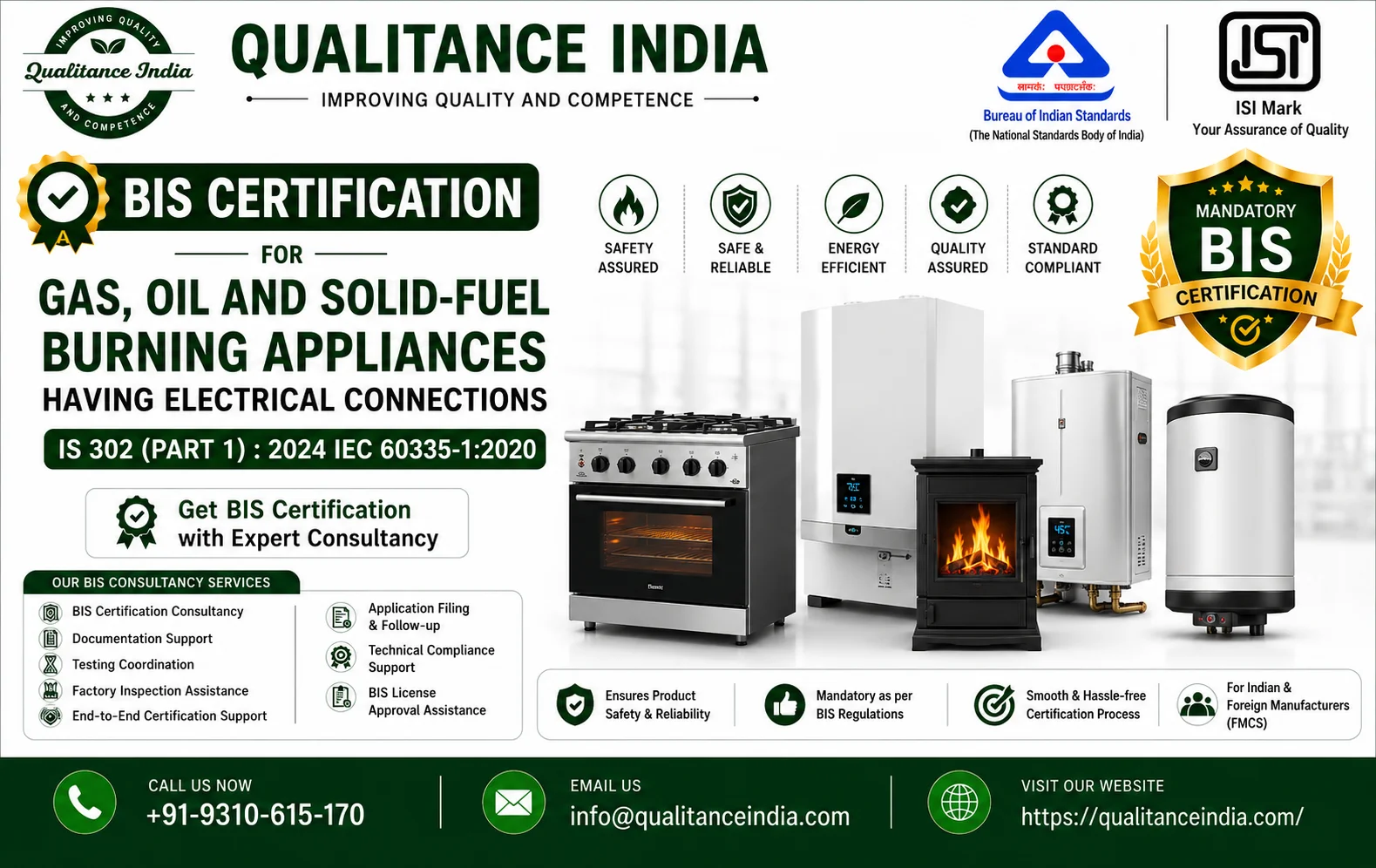
BIS Certification Consultancy for Gas, Oil & Solid-Fuel Burning Appliances IS 302 (Part 1):2024 | Complete BIS Approval Guide
Introduction
The Government of India has introduced important compliance requirements for electrical appliances under the Safety of Household, Commercial and Similar Electrical Appliances (Quality Control) Order. Under the latest regulatory framework, specified electrical appliances are required to comply with applicable Indian Standards and obtain BIS Certification under the applicable conformity assessment scheme before being placed in the Indian market.
One of the important standards in this regulatory framework is IS 302 (Part 1):2024 / IEC 60335-1:2020, titled “Household and Similar Electrical Appliances – Safety – Part 1: General Requirements.” The standard provides general safety requirements for electrical appliances intended for household, commercial, and similar applications.
The notified list under the QCO includes “Gas, Oil and Solid-Fuel Burning Appliances Having Electrical Connections” among the illustrative categories covered by IS 302 (Part 1):2024 / IEC 60335-1:2020. The official BIS upcoming QCO information lists 01 October 2026 as the implementation date for the general category, while the 2026 QCO specifies 01 January 2027 for small enterprises and 01 April 2027 for micro enterprises.
For manufacturers, importers, OEMs, brand owners, and foreign manufacturers supplying products to India, understanding the applicable BIS requirements in advance is essential. Certification may involve identification of the applicable standard, technical documentation, product testing, BIS application, factory assessment and ongoing compliance.
This guide explains the BIS Certification requirements for Gas, Oil and Solid-Fuel Burning Appliances Having Electrical Connections, the relevance of IS 302 (Part 1):2024 / IEC 60335-1:2020, QCO applicability, implementation dates, eligibility, certification process, testing requirements, documentation, factory inspection, cost factors, timelines and post-certification compliance.
About the Product
Gas, oil and solid-fuel burning appliances having electrical connections are appliances that use gas, oil or solid fuel as a source of energy or combustion and also incorporate electrical components or electrical connections.
Depending on their design and intended application, electrical components may be used for functions such as:
• Ignition
• Electronic controls
• Timers
• Temperature control
• Fans or blowers
• Pumps
• Sensors
• Safety controls
• Display systems
• Automatic shut-off mechanisms
• Monitoring systems
The presence of electrical connections introduces additional electrical safety considerations. Therefore, appliances within the applicable scope must be evaluated against relevant safety requirements.
The exact applicability of certification should always be determined by reviewing the product design, intended use, rated voltage, electrical characteristics, applicable QCO provisions and any relevant product-specific standard.
What IS BIS Certification?
BIS Certification is a conformity assessment mechanism operated by the Bureau of Indian Standards (BIS) to verify that products conform to applicable Indian Standards.
For products covered under the relevant mandatory Quality Control Order, manufacturers are required to obtain the applicable BIS licence and comply with the prescribed certification requirements.
The BIS certification framework helps ensure that products meet defined requirements related to:
• Safety
• Quality
• Performance
• Reliability
• Manufacturing controls
• Testing
• Product conformity
For products covered under Scheme-I, certification generally involves assessment of the manufacturer’s capability to consistently produce conforming products, including evaluation of manufacturing processes, testing arrangements and product compliance.
BIS maintains a product certification framework under Scheme-I (ISI Mark Scheme), and its official product certification resources list IS 302 (Part 1):2024 / IEC 60335-1:2020 within the electrical appliances category.
Understanding IS 302 (Part 1):2024 / IEC 60335-1:2020
IS 302 (Part 1):2024 is titled:
“Household and Similar Electrical Appliances – Safety – Part 1: General Requirements.”
It is the seventh revision of the standard and is identical under dual numbering to IEC 60335-1:2020, according to the BIS standard details page.
The standard establishes general safety requirements applicable to household and similar electrical appliances.
The requirements are intended to address potential hazards associated with electrical appliances, including risks related to:
• Electric shock
• Fire
• Excessive temperature
• Insulation failure
• Abnormal operation
• Mechanical hazards
• Moisture
• Leakage current
• Dielectric strength
• Construction
• Components
• Internal wiring
• Earthing
• Protection against access to live parts
The exact tests and requirements applicable to a particular appliance depend on the product construction and the relevant applicable standard framework.
Scope of IS 302 (Part 1):2024
The IS 302 (Part 1):2024 standard provides general safety requirements for household and similar electrical appliances.
The 2026 QCO covers electrical appliances intended for household, commercial or similar applications within the specified rated-voltage limits and lists various appliance categories illustratively, including Gas, Oil and Solid-Fuel Burning Appliances Having Electrical Connections.
The broader QCO scope includes appliances with:
• Rated voltage not exceeding 250 V for single-phase appliances
• Rated voltage within the specified limit for other appliances as prescribed by the QCO
The applicability should be assessed based on the current notified QCO and the specific product characteristics.
A critical point for manufacturers is that appliances already covered under another applicable Quality Control Order may be excluded from the scope of this particular QCO. BIS’s implementation guidance has specifically noted that appliances already covered under another QCO are not covered under the Safety of Household, Commercial and Similar Electrical Appliances QCO.
Therefore, a proper BIS applicability assessment should be completed before starting the certification process.
Products Covered
The official QCO provides an illustrative list of electrical appliances under the IS 302 (Part 1):2024 / IEC 60335-1:2020 framework.
The list includes categories such as:
• Vacuum Cleaners and Water Suction Cleaning Appliances
• Spin Extractors
• Cooking Ranges, Hobs, Ovens and Similar Appliances
• Electrical Shavers, Hair Clippers and Similar Appliances
• Tumbler Dryers
• Warming Plates and Similar Appliances
• Frying Pans, Deep Fat Fryers and Similar Appliances
• Appliances for Heating Liquids
• Massage Appliances
• Electric Forced Convection Ovens
• Steam Cookers
• Steam-Convection Ovens
• Humidifiers
• Commercial Electric Hoods
• Vaporizers
• Gas, Oil and Solid-Fuel Burning Appliances Having Electrical Connections
• Electrolysers
• Skin Beauty Care Appliances
• Furniture with Electrically Motorized Parts
• Commercial Vacuum Packaging Appliances
• Hand-Held Electric Engraving Tools
• DC Supplied / Battery-Operated Vacuum Cleaners
• DC Supplied / Battery-Operated Shavers and Trimmers
• DC Supplied / Battery-Operated Massage Appliances
• DC Supplied / Battery-Operated Blenders and Juicers
• DC Supplied / Battery-Operated Toothbrushes and Oral Hygiene Appliances
• DC Supplied / Battery-Operated Foot Warmers and Heating Mats
• DC Supplied / Battery-Operated Air Purifiers
The list is not a substitute for a product-specific applicability assessment. Manufacturers should verify the latest QCO, amendments and applicable standards before applying for certification.
Enforcement Date
The enforcement timeline is an important consideration for manufacturers.
For the general category under the 2026 QCO:
01 October 2026 – Implementation for general enterprises
01 January 2027 – Implementation for small enterprises
01 April 2027 – Implementation for micro enterprises
The BIS upcoming QCO page separately lists 01 October 2026 as the implementation date for the general category for the IS 302 (Part 1):2024 / IEC 60335-1:2020 entry.
Manufacturers should not wait until the enforcement date to begin the certification process.
Testing, documentation, technical evaluation and BIS processing can require significant preparation time. Businesses should start the compliance process early to avoid supply-chain disruption.
Aluminium QCO 2026 – Important Note
This product is not part of the Aluminium QCO 2026.
The applicable regulatory framework for this topic is the Safety of Household, Commercial and Similar Electrical Appliances (Quality Control) Order.
Therefore, the appropriate regulatory focus for this service page should be:
“BIS Certification under IS 302 (Part 1):2024 / IEC 60335-1:2020 and the applicable Electrical Appliances QCO.”
This distinction is important for SEO accuracy and regulatory clarity.
Who Needs BIS Certification?
BIS certification requirements may apply to manufacturers of products covered under the applicable QCO.
The relevant business categories may include:
Indian Manufacturers
Companies manufacturing covered electrical appliances in India may need to obtain the applicable BIS licence before the relevant implementation date.
Foreign Manufacturers
Foreign manufacturers supplying covered products to the Indian market may require BIS certification under the applicable provisions.
OEM Manufacturers
OEM manufacturers producing appliances for another brand should assess certification requirements based on the actual manufacturer, product and brand arrangement.
Brand Owners
Brand owners selling products manufactured by an OEM should ensure that the applicable certification and marking requirements are properly addressed.
Importers
Importers should verify that imported products and their manufacturers comply with the applicable BIS requirements before commercial importation.
Eligibility Criteria
A manufacturer seeking BIS certification should generally have:
• A clearly identifiable manufacturing facility
• Defined manufacturing processes
• Appropriate production equipment
• Quality control procedures
• Required testing arrangements
• Suitable inspection and measuring equipment
• Calibration systems
• Technical documentation
• Product specifications
• Traceability arrangements
• Competent personnel
• Ability to comply with the applicable Indian Standard
The exact requirements may vary depending on the product category and BIS certification guidelines.
Why Start BIS Certification Before 01 October 2026?
Waiting until the last moment can create unnecessary business risks.
Manufacturers may need time for:
Product applicability assessment
↓
Technical documentation
↓
Sample preparation
↓
Laboratory testing
↓
Test report review
↓
BIS application
↓
Factory assessment
↓
Correction of non-conformities
↓
Final approval
Therefore, businesses planning to manufacture or supply these products in India should begin preparation well before the applicable enforcement date.
Complete BIS Certification Process – Overview
The certification journey can broadly be understood as:
- Product Applicability Assessment
- Identification of Applicable Indian Standard
- Technical Gap Assessment
- Documentation Preparation
- Product Sample Preparation
- Laboratory Testing
- Test Report Evaluation
- BIS Application Submission
- Technical Scrutiny
- Factory Assessment / Inspection, as applicable
- Addressing BIS Queries
- Compliance Verification
- Grant of BIS Licence
- ISI Marking
- Post-Certification Compliance
The detailed process, documents, testing and factory inspection requirements will be covered in Part 2.
Key Safety Areas to Consider
For appliances with electrical connections, manufacturers should pay particular attention to:
Electrical Shock Protection
Products should be designed to protect users from hazardous electrical contact.
Insulation
Electrical insulation should be suitable for the operating conditions and construction of the appliance.
Earthing
Where applicable, appropriate earthing provisions should be maintained.
Temperature
The appliance should comply with applicable temperature-rise requirements.
Abnormal Operation
The product may need to be evaluated under abnormal operating conditions as prescribed by the applicable requirements.
Fire Risk
The construction and components should address potential fire hazards.
Moisture Protection
Where appliances are exposed to moisture, applicable protection requirements should be considered.
Mechanical Safety
Moving or accessible parts should not create unacceptable hazards.
Component Safety
Critical components should comply with relevant requirements.
The specific tests and acceptance criteria should always be determined from the applicable standard and BIS product-specific certification guidelines.
Why Choose Qualitance India?
Qualitance India provides professional BIS Certification Consultancy services for manufacturers and businesses seeking compliance with Indian regulatory requirements.
Our support can include:
Product Applicability Assessment
Applicable Indian Standard Identification
BIS Documentation Support
Technical Documentation Assistance
Laboratory Testing Coordination
BIS Application Filing Support
Factory Inspection Preparation
BIS Query Assistance
Certification Process Coordination
ISI Marking Guidance
Post-Certification Compliance Support
Renewal Assistance
We help manufacturers understand the regulatory requirements and prepare for the BIS certification journey in a structured manner.
Whether you are an Indian manufacturer, foreign manufacturer, OEM, importer or brand owner, our team can assist you in evaluating your BIS compliance requirements.
Frequently Asked Questions
1. What is BIS Certification for Gas, Oil and Solid-Fuel Burning Appliances?
BIS Certification is a conformity assessment process that verifies whether applicable products comply with relevant Indian Standards and mandatory regulatory requirements. Gas, Oil and Solid-Fuel Burning Appliances Having Electrical Connections may fall under the applicable electrical appliance QCO framework and require compliance with IS 302 (Part 1):2024 / IEC 60335-1:2020, subject to product-specific applicability.
2. Is BIS Certification mandatory for Gas, Oil and Solid-Fuel Burning Appliances?
For products covered by the applicable Quality Control Order, BIS Certification becomes mandatory from the relevant implementation date. Manufacturers should verify the latest QCO and applicable product scope before manufacturing, importing or selling covered products in India.
3. What is IS 302 (Part 1):2024?
IS 302 (Part 1):2024 is the Indian Standard titled Household and Similar Electrical Appliances – Safety – Part 1: General Requirements. It is identical to IEC 60335-1:2020 under dual numbering.
4. What is IEC 60335-1:2020?
IEC 60335-1:2020 is an international standard containing general safety requirements for household and similar electrical appliances. IS 302 (Part 1):2024 is aligned with this standard.
5. What is the BIS enforcement date for these appliances?
Under the 2026 QCO framework, the implementation date for the general category is 01 October 2026. Separate implementation dates may apply to small and micro enterprises according to the applicable QCO provisions.
6. Can foreign manufacturers obtain BIS Certification?
Yes. Foreign manufacturers supplying products covered by mandatory BIS requirements to the Indian market may need to obtain the applicable BIS certification and comply with the requirements applicable to overseas manufacturers.
7. Do importers need BIS Certification?
Importers should ensure that products they import are compliant with applicable mandatory BIS requirements. The exact responsibility depends on the product, manufacturer and applicable regulatory framework.
8. What documents are required for BIS Certification?
Documents may include company information, factory details, manufacturing process, product specifications, drawings, test reports, testing equipment details, calibration records and other documents required by BIS.
9. Is laboratory testing required?
Product testing is generally an important part of BIS certification. Testing requirements depend on the applicable Indian Standard and product construction.
10. Is factory inspection required?
Under the applicable BIS certification scheme, factory assessment or inspection may be required to verify manufacturing capability and quality control arrangements.
11. How long does BIS Certification take?
The timeline varies depending on product complexity, testing requirements, documentation, laboratory availability and BIS processing. Manufacturers should start early to meet applicable implementation dates.
12. What is the cost of BIS Certification?
The cost depends on factors such as product category, testing requirements, number of models, laboratory charges, BIS fees, inspection expenses and consultancy requirements.
13. Can one BIS Licence cover multiple models?
This depends on the applicable product scope, standard, model similarity and BIS certification requirements. A model-by-model assessment may be required.
14. What happens if the product fails laboratory testing?
If the product fails applicable tests, corrective action may be required. The product may need modification and retesting before certification can proceed.
15. Can a manufacturer use the ISI Mark before obtaining a BIS Licence?
No. The ISI Mark must only be used in accordance with the applicable BIS authorization and marking requirements.
16. What is the difference between BIS Registration and BIS Certification?
BIS Certification generally refers to the licensing process under schemes such as Scheme-I, while BIS Registration is commonly used in other BIS conformity assessment frameworks such as CRS. The correct terminology depends on the applicable product and scheme.
17. Does IS 302 (Part 1):2024 apply to all electrical appliances?
No. Applicability depends on the product category, scope, rated voltage, intended use and applicable regulatory requirements. Products already covered under another applicable QCO may be treated separately.
18. What testing is required under IS 302 (Part 1):2024?
Testing depends on the product. Areas may include electrical safety, insulation, dielectric strength, leakage current, temperature rise, abnormal operation, mechanical safety and other applicable requirements.
19. Can Qualitance India help with BIS Certification?
Yes. Qualitance India provides consultancy support including applicability assessment, documentation assistance, testing coordination, BIS application support, factory inspection preparation and compliance guidance.
20. When should manufacturers start the BIS Certification process?
Manufacturers should begin as early as possible, preferably several months before the applicable enforcement date, because product testing, documentation and factory assessment can take time.
21. Is BIS Certification required for products manufactured only for export?
The applicability depends on the specific QCO and exemption provisions. Manufacturers should verify the latest official notification and conditions before relying on an exemption.
22. What is the role of BIS-recognized laboratories?
Recognized laboratories conduct applicable product testing according to the relevant Indian Standards and certification requirements.
23. What happens during BIS factory inspection?
BIS may evaluate manufacturing facilities, production processes, quality control procedures, testing arrangements, calibration records and the manufacturer’s ability to consistently produce compliant products.
24. What are common reasons for BIS Certification delays?
Common reasons include incomplete documents, incorrect standard selection, failed tests, inadequate testing facilities, calibration issues, product-test report mismatch and delayed responses to BIS queries.
25. Is BIS Certification a one-time process?
No. After certification, manufacturers must continue to maintain product conformity, quality systems, records and marking requirements. Surveillance and other compliance activities may apply.
26. What is the BIS ISI Mark?
The ISI Mark is a conformity mark used under BIS licensing schemes for products certified against applicable Indian Standards.
27. Can BIS Certification be obtained without product testing?
Testing requirements depend on the applicable certification scheme and product. For products requiring conformity assessment, applicable testing and evaluation requirements must be fulfilled.
28. What should manufacturers do before 01 October 2026?
Manufacturers should confirm applicability, identify the correct standard, review product compliance, prepare documentation, arrange testing and begin the certification process well before the applicable implementation date.
Benefits of BIS Certification
Obtaining BIS Certification can provide several important benefits:
Legal Compliance
Helps manufacturers meet applicable mandatory regulatory requirements.
Market Access
Enables compliant products to be placed in the Indian market where certification is mandatory.
Consumer Confidence
Demonstrates commitment to product quality and safety.
Brand Reputation
A valid BIS licence can strengthen credibility among customers and business partners.
Quality Assurance
Encourages systematic manufacturing and quality control.
Reduced Compliance Risk
Helps reduce the risk associated with non-compliant products.
Business Opportunities
BIS compliance can be important for participating in supply chains and institutional procurement where certification is required.
Get BIS Certification with Expert Consultancy
Are you manufacturing or planning to manufacture Gas, Oil and Solid-Fuel Burning Appliances Having Electrical Connections?
Is your product covered under IS 302 (Part 1):2024 / IEC 60335-1:2020?
Are you preparing for the upcoming BIS QCO requirements?
Qualitance India can assist you with:
Product Applicability Assessment
Applicable Standard Identification
Documentation Support
Laboratory Testing Coordination
BIS Application Support
Factory Inspection Preparation
Technical Compliance Assistance
Post-Certification Support
Start your BIS Certification process early and prepare your business for upcoming regulatory requirements.
Contact Qualitance India Today
Phone: +91 93106 15170
Email: info@qualitanceindia.com
Website: qualitanceindia.com
“IMPROVING QUALITY AND COMPETENCE”
Conclusion
BIS Certification for Gas, Oil and Solid-Fuel Burning Appliances Having Electrical Connections is an important regulatory consideration for manufacturers supplying products to the Indian market.
With IS 302 (Part 1):2024 / IEC 60335-1:2020 providing general safety requirements and the applicable Quality Control Order establishing mandatory compliance requirements for covered products, manufacturers should carefully assess their products and begin the certification process in advance.
The complete BIS Certification journey may involve product applicability assessment, standard identification, documentation, laboratory testing, application submission, technical evaluation, factory assessment and ongoing compliance.
The most important step is to determine the exact applicability of the current QCO and applicable Indian Standard for the specific product. Manufacturers should also monitor amendments and updated BIS notifications to ensure continued compliance.
By preparing early, maintaining proper documentation and implementing an effective quality control system, manufacturers can reduce certification delays and improve their readiness for the applicable enforcement date.
Qualitance India provides professional BIS Certification Consultancy to help manufacturers, importers, OEMs and foreign companies understand and navigate the BIS compliance process.
For expert assistance with BIS Certification for Gas, Oil and Solid-Fuel Burning Appliances, contact Qualitance India today.
Need help with BIS certification for this product?
Get a free consultation from our compliance experts — we handle testing, documentation and the complete BIS process for you.
BIS Certification Readiness Checklist 2026
- Documents, testing & factory requirements in one place
- Covers ISI Mark, CRS, FMCS & Hallmarking
- Tick-box format — share it with your team