BIS Certification for Galvanized Structural Steel | IS 16732:2019 – Qualitance India
BIS Certification for Galvanized Structural Steel | IS 16732:2019
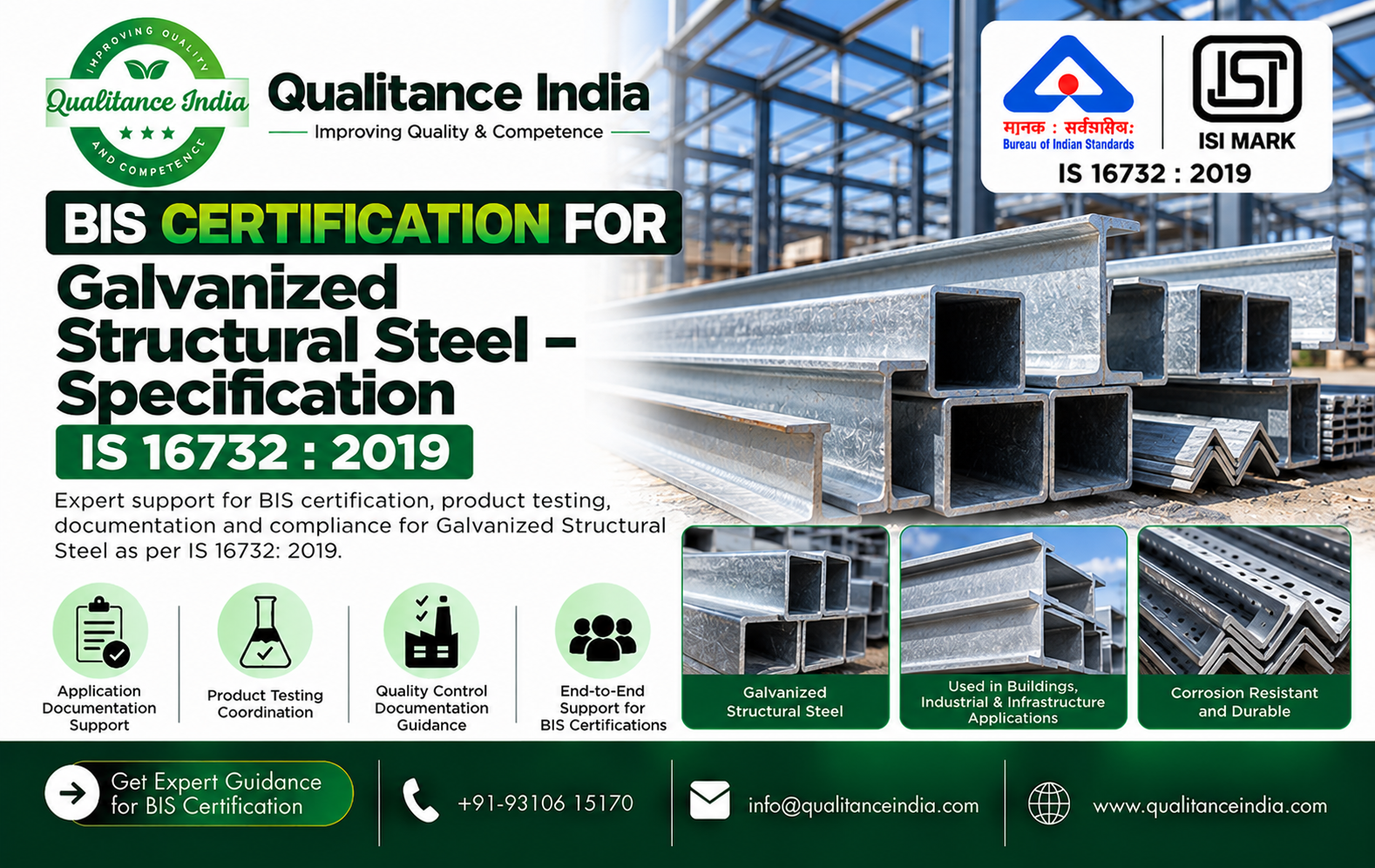
Galvanized structural steel is widely used in infrastructure, construction and industrial applications where structural strength and corrosion resistance are equally important. The zinc coating protects the steel from corrosion and helps improve its durability, particularly in outdoor environments.
Products such as galvanized steel angles, channels, beams, plates, strips, flats and bars are used in structures exposed to weather, moisture and other environmental conditions.
To ensure the quality and reliability of these products, the Bureau of Indian Standards (BIS) has established requirements under IS 16732:2019 – Galvanized Structural Steel – Specification.
The standard covers chemical composition, mechanical properties, dimensional requirements and zinc coating characteristics. It also includes different grades of galvanized structural steel to meet varying structural requirements.
Galvanized Structural Steel is covered under the Ministry of Steel’s Quality Control Order framework. Manufacturers supplying products covered by the applicable QCO must obtain the required BIS licence and comply with the Standard Mark requirements.
This article explains the product scope, mandatory certification requirements, grades, testing parameters, documentation and the process for obtaining BIS certification under IS 16732:2019.
1. What is IS 16732:2019?
IS 16732:2019 is the Indian Standard titled:
Galvanized Structural Steel – Specification.
The standard specifies requirements for steel intended for use as hot-dip galvanized structural steel.
It covers conventional and micro-alloyed steel products, including:
- Plates
- Strips
- Shapes and sections
- Angles
- Tees
- Beams
- Channels
- Flats
- Bars
- Other applicable structural steel sections
The products are intended for structural applications involving welded, bolted and riveted connections.
Typical applications include:
- Transmission line towers
- Power transmission structures
- Substation structures
- Industrial structures
- Outdoor steel structures
- Infrastructure projects
- Structural fabrication
- General engineering applications
The standard is particularly relevant where structural strength and resistance to atmospheric corrosion are required.
2. Is BIS Certification Mandatory for Galvanized Structural Steel?
<badge color=”success”>Mandatory BIS certification</badge>
Yes. Galvanized Structural Steel covered under IS 16732:2019 is included in the Steel and Steel Products (Quality Control) Order, 2024.
The applicable regulatory framework is:
| Particular | Details |
|---|---|
| Product | Galvanized Structural Steel |
| Indian Standard | IS 16732:2019 |
| Standard title | Galvanized Structural Steel – Specification |
| QCO | Steel and Steel Products (Quality Control) Order, 2024 |
| QCO notification | S.O. 3716(E), dated 29 August 2024 |
| QCO schedule | Schedule 1, Serial No. 140 |
| Implementation period | Six months from the date of notification |
| Certification scheme | BIS Scheme-I |
| Certification mark | ISI Standard Mark |
| Certifying authority | Bureau of Indian Standards |
The QCO requires covered products to conform to the applicable Indian Standard and bear the BIS Standard Mark under a valid licence.
The product entry also identifies applicable ITC (HS) codes, which should be checked against the actual product classification and current customs tariff.
Important regulatory considerations:
- The QCO applies to manufacturers supplying products covered by its scope in the Indian market.
- Imported products are also subject to applicable BIS requirements.
- A manufacturer must obtain the required BIS licence for the manufacturing unit.
- A valid BIS licence must cover the product and applicable scope.
- The applicable test certificate bearing the Standard Mark must accompany each covered consignment, as required by the QCO.
The QCO includes specific provisions and exemptions, including an export-related exception for qualifying products manufactured domestically for export. Such exemptions must be assessed against the actual transaction and notification conditions.
Manufacturers should verify the latest amendments and implementation provisions before commencing production or importation.
3. Grades of Galvanized Structural Steel under IS 16732:2019
IS 16732:2019 covers nine grades of galvanized structural steel, ranging from EG250 to EG650.
The grades correspond to different levels of chemical composition, yield stress and tensile strength.
The standard also specifies different quality designations within the grades, namely:
- A
- BR
- B0
- C
These quality designations specify requirements relating to the mode of deoxidation.
The grade and quality should be selected according to the required structural application and the applicable technical requirements.
| Grade range | Description |
|---|---|
| EG250 | Structural steel grade |
| EG275 | Structural steel grade |
| EG300 | Structural steel grade |
| EG350 | Structural steel grade |
| EG400 | Structural steel grade |
| EG450 | Structural steel grade |
| EG500 | Structural steel grade |
| EG550 | Structural steel grade |
| EG650 | Structural steel grade |
The manufacturer should refer to the complete standard for the exact chemical and mechanical requirements applicable to each grade and quality.
Note: The grade names alone are not sufficient to establish product conformity. The applicable quality designation, dimensions, mechanical requirements and zinc coating requirements must also be considered.
4. Technical Requirements under IS 16732:2019
IS 16732:2019 establishes requirements to ensure that galvanized structural steel has suitable strength, ductility, dimensional accuracy and corrosion protection.
The principal technical requirements include the following.
4.1 Chemical Composition
Chemical composition determines the material characteristics of structural steel, including strength, ductility and weldability.
The standard specifies chemical composition requirements for the applicable grades and qualities.
The chemical parameters may include:
- Carbon
- Manganese
- Silicon
- Sulphur
- Phosphorus
- Other specified alloying or micro-alloying elements, where applicable
Micro-alloying elements such as niobium, vanadium and titanium may be used in the manufacture of applicable steel grades.
The manufacturer must ensure that the chemical composition complies with the limits specified for the declared grade and quality.
Heat-wise chemical analysis and raw material traceability should be maintained.
4.2 Mechanical Properties
Mechanical properties determine the ability of structural steel to withstand loading and deformation.
IS 16732:2019 includes requirements relating to:
- Yield stress
- Tensile strength
- Percentage elongation
- Other applicable mechanical characteristics
The applicable limits depend on the steel grade, product form and relevant provisions of the standard.
4.3 Bend Test
The bend test evaluates the ability of the steel to withstand bending without unacceptable cracking or failure.
It is used to assess ductility and the suitability of the material for forming and fabrication operations.
4.4 Impact Test
The impact test evaluates the ability of the material to absorb energy under impact loading.
This is particularly relevant for structural applications where toughness is an important consideration.
The test requirements and applicable conditions must be followed as specified in the standard.
4.5 Dimensional Requirements
Galvanized structural steel must comply with the applicable dimensional requirements.
Depending on the product form, dimensional inspection may cover:
- Thickness
- Width
- Length
- Section dimensions
- Shape and profile
- Other applicable tolerances
The manufacturer should establish appropriate measuring and inspection arrangements for each product category.
4.6 Freedom from Defects
The finished product should be free from defects that may adversely affect its intended structural application or corrosion protection.
The manufacturer should maintain suitable inspection procedures for surface condition and product quality.
4.7 Zinc Coating Requirements
Hot-dip galvanizing is an essential feature of galvanized structural steel.
The zinc coating provides a protective barrier between the steel substrate and the surrounding environment.
IS 16732:2019 includes requirements for:
- Zinc coating thickness
- Coating uniformity
- Coating quality
- Surface condition
- Other applicable galvanizing characteristics
The coating must conform to the requirements prescribed by the standard.
Proper control of the galvanizing process is essential for achieving consistent coating quality and corrosion protection.
5. Testing Requirements for BIS Certification
Product testing is an important part of the BIS certification process.
For Galvanized Structural Steel under IS 16732:2019, the principal testing parameters include the following:
| Test / Inspection | Purpose |
|---|---|
| Chemical composition | Verification of grade-wise chemical requirements |
| Tensile test | Evaluation of mechanical strength |
| Bend test | Assessment of bending performance |
| Impact test | Evaluation of impact toughness |
| Dimensional inspection | Verification of dimensional conformity |
| Freedom from defects | Assessment of surface and product quality |
| Zinc coating thickness / mass | Verification of coating quantity |
| Zinc coating uniformity | Assessment of coating uniformity |
5.1 Chemical Composition Test
Chemical analysis verifies whether the steel conforms to the chemical composition requirements for the declared grade and quality.
The manufacturer should maintain heat-wise test reports and traceability records.
5.2 Tensile Test
The tensile test determines the mechanical properties of the steel.
It is used to evaluate parameters such as yield stress, tensile strength and percentage elongation, as applicable.
5.3 Bend Test
The bend test checks whether the material can withstand the specified bending conditions without unacceptable cracking.
It helps assess the ductility and forming characteristics of the steel.
5.4 Impact Test
The impact test evaluates the toughness of the steel under the prescribed test conditions.
It helps establish the suitability of the material for applications where impact resistance is relevant.
5.5 Zinc Coating Test
Zinc coating testing is essential for confirming the corrosion protection characteristics of galvanized structural steel.
The standard includes requirements for coating thickness and uniformity.
Relevant test methods and references include:
- IS 6745 – Methods for determination of mass of zinc coating on zinc-coated iron and steel articles.
- IS 12860 – Metallic coating thickness by X-ray fluorescence technique.
- IS 2633 – Method for testing uniformity of coating on zinc-coated articles.
The applicable test method must be selected according to the product and requirements of IS 16732:2019.
5.6 Dimensional and Visual Inspection
Dimensional checks verify the product’s conformity with the specified dimensions and tolerances.
Visual inspection helps identify surface defects, coating irregularities and other unacceptable conditions.
Important: The above is a summary of the main testing areas. The exact test methods, frequency, acceptance criteria and sample requirements must be confirmed from the current standard and applicable BIS certification documents.
6. Manufacturing and Quality Control Requirements
Manufacturers applying for BIS certification should demonstrate that their production process and quality-control system are capable of consistently producing conforming galvanized structural steel.
Depending on the manufacturing arrangement, the process may involve:
- Procurement of steel raw material.
- Verification of incoming steel.
- Steel processing and preparation.
- Rolling, cutting or section manufacturing, as applicable.
- Dimensional inspection.
- Surface preparation before galvanizing.
- Hot-dip galvanizing.
- Control of zinc bath and galvanizing parameters.
- Coating inspection and testing.
- Final product inspection.
- Identification, marking and packaging.
- Dispatch with required test documentation.
The actual manufacturing sequence depends on whether the applicant manufactures the steel substrate, carries out galvanizing, or undertakes both activities.
The factory should maintain records covering:
- Raw material procurement
- Heat-wise chemical analysis
- Production and process control
- Dimensional inspection
- Galvanizing process parameters
- Zinc coating inspection
- Finished product testing
- Calibration of testing equipment
- Non-conforming product control
- Corrective and preventive actions
- Product identification and traceability
7. Documents Required for BIS Certification
The following documents are generally relevant when preparing a BIS application for Galvanized Structural Steel under IS 16732:2019.
A. Company Documents
- Company registration certificate or constitution documents
- GST registration certificate
- PAN card
- Factory address proof
- Authorised signatory details
- Identity and address proof of authorised signatory
- Factory layout plan
- Details of manufacturing premises
B. Manufacturing Documents
- Manufacturing process flow chart
- List of manufacturing machinery
- Machinery details and specifications
- Production capacity details
- Product specifications
- Proposed grade and quality details
- Product dimensions and section details
- Raw material specifications
- Galvanizing process details
- Process control procedures
C. Quality Control and Testing Documents
- Quality control plan
- Inspection and testing plan
- In-house laboratory equipment list
- Calibration certificates
- Chemical analysis reports
- Tensile test reports
- Bend test reports
- Impact test reports, where applicable
- Zinc coating test reports
- Dimensional inspection records
- Finished product inspection records
- Non-conformity and corrective action procedures
D. BIS Application Documents
- BIS application and supporting information
- Product description and proposed scope
- Trademark or brand authorisation documents, where applicable
- Factory and laboratory details
- Applicable declarations and undertakings
- Relevant fee payment details
Additional documents may be required depending on the manufacturing arrangement and the scope of the application.
8. BIS Certification Process for Galvanized Structural Steel
The certification process generally involves the following stages.
Step 1: Product and Standard Applicability Review
Confirm that the product falls within the scope of IS 16732:2019.
Identify the product forms, grades, quality designations and dimensions proposed for certification.
Step 2: Manufacturing Facility Assessment
Review the factory’s manufacturing infrastructure, galvanizing facilities, inspection arrangements and testing capabilities.
If the applicant outsources certain manufacturing or processing operations, the arrangement should be reviewed against the applicable BIS requirements.
Step 3: Preparation of BIS Application
Prepare the required company, factory, manufacturing and product documentation.
The proposed scope should clearly identify the grades and product forms for which the licence is requested.
Step 4: Product Testing
Arrange testing against the applicable requirements of IS 16732:2019.
The testing programme includes relevant chemical, mechanical, dimensional and galvanizing checks.
Step 5: BIS Factory Inspection
BIS may inspect the manufacturing facility to assess:
- Manufacturing machinery
- Production process
- Galvanizing facilities
- Testing infrastructure
- Quality-control arrangements
- Raw material records
- Inspection and testing records
- Product marking and traceability
- Sample selection and testing
Step 6: Grant of BIS Licence
After satisfactory assessment of the application, factory infrastructure and product conformity, BIS may grant the licence to use the ISI Standard Mark.
The manufacturer must follow all licence conditions and applicable marking requirements.
Step 7: Post-Licence Compliance
After obtaining the licence, the manufacturer must maintain continuous conformity through:
- Routine product testing
- Heat-wise traceability
- Galvanizing process control
- Calibration of testing equipment
- Maintenance of quality records
- Compliance with marking requirements
- Cooperation with BIS surveillance activities
9. BIS Certification for Foreign Manufacturers
Foreign manufacturers intending to supply Galvanized Structural Steel in India must also comply with the applicable BIS certification requirements.
They may apply under the Foreign Manufacturers Certification Scheme (FMCS).
The process generally involves:
- Product and standard applicability review
- Submission of the applicable BIS application
- Appointment of an Authorised Indian Representative, where required
- Submission of manufacturing and quality-control documents
- Assessment of factory and testing infrastructure
- BIS factory inspection
- Product sample testing
- Grant of licence, subject to satisfactory compliance
Importers should verify that the overseas manufacturer’s BIS licence covers the actual product and proposed supply scope.
10. BIS Certification Cost for Galvanized Structural Steel
The total cost of BIS certification depends on the manufacturer’s product scope, factory infrastructure, testing arrangements and applicable BIS fee structure.
Potential cost components include:
- BIS application fee
- BIS licence fee
- Annual marking fee
- Product testing charges
- Sample preparation and transportation
- Laboratory charges
- Inspection-related expenses
- Consultancy and documentation charges, where professional assistance is engaged
The actual testing cost depends on the number of tests, product form, grade and laboratory selected.
A manufacturer should obtain a project-specific estimate after reviewing the manufacturing facility and proposed product scope.
11. Common Challenges in BIS Certification
Manufacturers may encounter the following challenges during certification.
1. Incorrect product classification: Products must fall within the scope of IS 16732:2019. Other galvanized steel products may be covered by different Indian Standards.
2. Grade and quality selection: The manufacturer must correctly identify the applicable grade and quality designation.
3. Chemical composition failures: The steel may fail to meet the required grade-wise chemical composition.
4. Mechanical test failures: Tensile, bend or impact test results may not conform to the applicable requirements.
5. Zinc coating non-conformity: Inadequate coating thickness or non-uniform coating can result in test failures.
6. Inadequate testing facilities: The factory may not have suitable equipment or arrangements for all required tests.
7. Incomplete traceability: Manufacturers should maintain records connecting the steel heat, production batch, galvanizing operation and finished product.
8. Inadequate galvanizing process control: Inconsistent surface preparation and galvanizing parameters can affect the final coating quality.
A preliminary factory and documentation assessment can help identify these issues before the formal BIS application.
12. Why Choose Qualitance India for BIS Certification?
Qualitance India provides professional consultancy and regulatory compliance support for manufacturers seeking BIS product certification in India.
For Galvanized Structural Steel under IS 16732:2019, our support can include:
- Product and Indian Standard applicability review
- BIS certification feasibility assessment
- Grade and product scope review
- Manufacturing process assessment
- Galvanizing process documentation
- Quality-control documentation
- Laboratory and product testing coordination
- BIS application preparation
- Factory inspection preparation
- Assistance in addressing non-conformities
- Post-licence compliance guidance
Our objective is to help manufacturers understand the applicable regulatory requirements and establish a practical certification process.
Qualitance India – Improving Quality & Competence
Website: https://qualitanceindia.com
Email: info@qualitanceindia.com
Phone / WhatsApp: +91 93106 15170
13. Frequently Asked Questions (FAQs)
Q1. Which Indian Standard applies to Galvanized Structural Steel?
IS 16732:2019 – Galvanized Structural Steel – Specification.
Q2. Is BIS certification mandatory for Galvanized Structural Steel?
Yes. Galvanized Structural Steel under IS 16732:2019 is included in the Steel and Steel Products (Quality Control) Order, 2024.
Q3. Which BIS certification scheme applies to IS 16732:2019?
The applicable certification route is BIS Scheme-I, under which the manufacturer obtains a licence to use the ISI Standard Mark.
Q4. Which grades are covered under IS 16732:2019?
The standard covers nine grades ranging from EG250 to EG650.
Q5. What are the quality designations under IS 16732:2019?
The standard includes quality designations A, BR, B0 and C, relating to the mode of deoxidation.
Q6. What tests are required for Galvanized Structural Steel?
The main testing areas include chemical composition, tensile test, bend test, impact test, dimensional inspection, freedom from defects and zinc coating tests.
Q7. Is zinc coating testing required?
Yes. Zinc coating requirements are an important part of the standard. Coating thickness or mass and uniformity must conform to the applicable requirements.
Q8. Can a foreign manufacturer obtain BIS certification for IS 16732:2019?
Yes. Foreign manufacturers can apply through the applicable BIS Foreign Manufacturers Certification Scheme, subject to the relevant requirements.
Q9. Can a manufacturer use the ISI Mark before obtaining a BIS licence?
No. The Standard Mark must not be used without the required BIS licence.
Q10. What is the cost of BIS certification for Galvanized Structural Steel?
The cost depends on BIS fees, testing charges, product scope, factory infrastructure and other applicable expenses. A project-specific quotation should be prepared after reviewing the manufacturer’s requirements.
14. Conclusion
Galvanized Structural Steel is an important material for infrastructure, construction and industrial applications where structural strength and corrosion resistance are essential.
IS 16732:2019 establishes requirements for steel plates, strips, shapes, sections, flats and bars intended for hot-dip galvanized structural applications.
The standard covers nine grades ranging from EG250 to EG650 and includes requirements relating to chemical composition, mechanical properties, dimensional conformity and zinc coating quality.
Since the product is included in the Steel and Steel Products Quality Control Order, manufacturers covered by the notification must ensure compliance with the applicable BIS certification requirements before supplying the product in the Indian market.
Proper product classification, testing arrangements, galvanizing process control and documentation are essential for successful certification and continued compliance.
Need assistance with BIS Certification for Galvanized Structural Steel?
Contact Qualitance India for professional guidance on product applicability, BIS application preparation, product testing, factory readiness and certification support.
Qualitance India – Improving Quality & Competence
Official References and Further Reading
- Bureau of Indian Standards – IS 16732:2019, Galvanized Structural Steel – Specification: https://www.services.bis.gov.in/
- BIS – Compendium of Indian Standards on Coated Steel Sheets and Strips: https://www.services.bis.gov.in/tmp/compendium_2025-06-02-05-38-40.pdf
- Ministry of Steel – Steel and Steel Products (Quality Control) Order, 2024.
- BIS – Products under Compulsory Certification: https://www.bis.gov.in/product-certification/products-under-compulsory-certification/
- BIS – Product Certification Process: https://www.bis.gov.in/product-certification/product-certification-process/
- BIS Laboratory Information Management System: https://lims.bis.gov.in/
Need help with BIS certification for this product?
Get a free consultation from our compliance experts — we handle testing, documentation and the complete BIS process for you.
BIS Certification Readiness Checklist 2026
- Documents, testing & factory requirements in one place
- Covers ISI Mark, CRS, FMCS & Hallmarking
- Tick-box format — share it with your team