
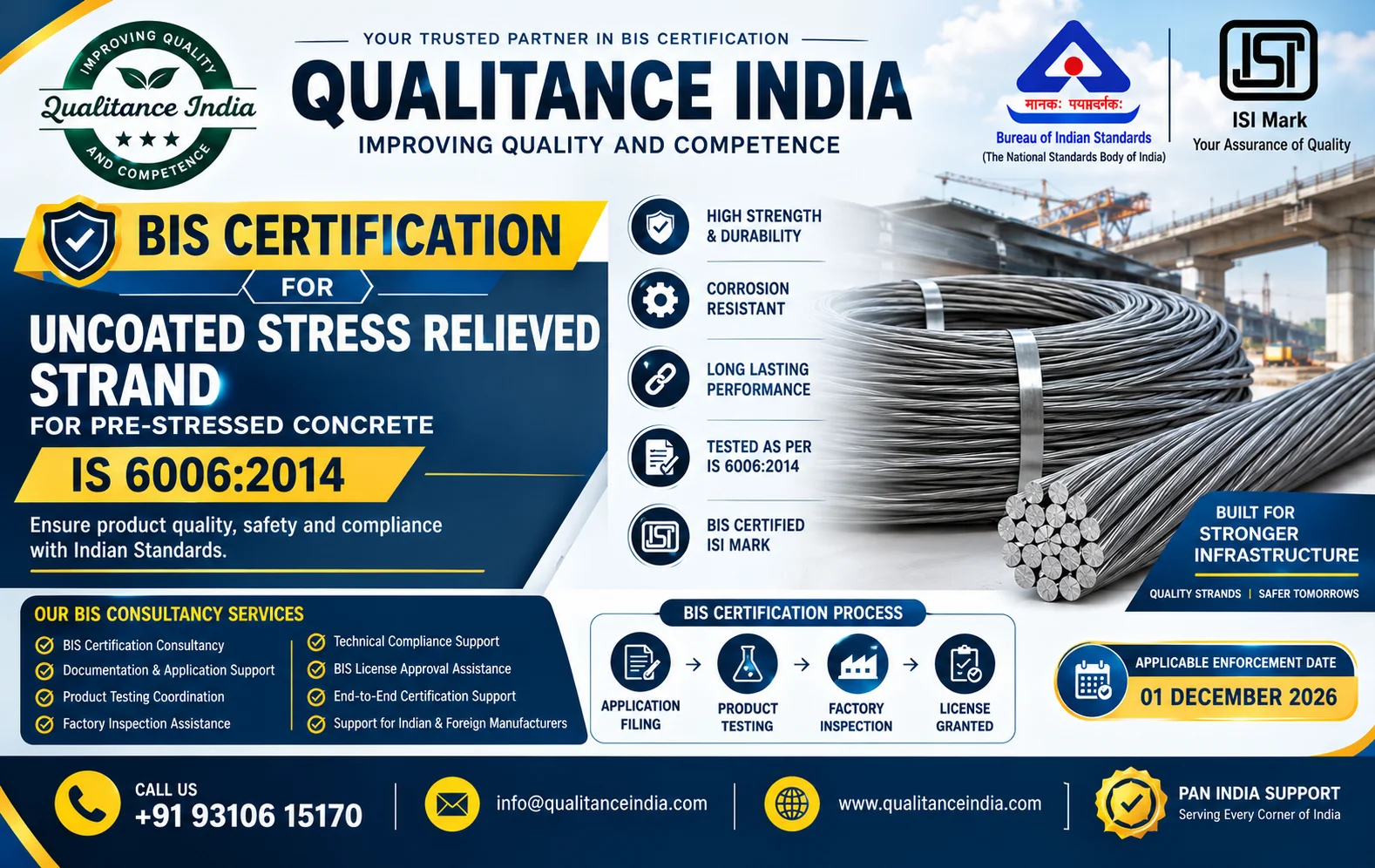
BIS Certification Consultancy for Uncoated Stress Relieved Strand for Prestressed Concrete | IS 6006:2014
Introduction
Uncoated stress relieved strands are high-strength steel products used extensively in prestressed concrete construction. They are critical components in systems where concrete is intentionally subjected to compressive stresses through the application of tensioned steel, making the quality and long-term performance of the strand extremely important.
Uncoated stress relieved strand must possess controlled mechanical properties, dimensional accuracy, suitable chemical composition and low relaxation characteristics so that it can perform reliably in prestressed concrete structures.
The applicable Indian Standard is IS 6006:2014 – Uncoated Stress Relieved Strand for Prestressed Concrete – Specification (Second Revision). The BIS Product Manual identifies certification under Scheme-I, with requirements covering two-wire, three-wire and seven-wire strands, Classes 1 and 2 where applicable, sampling, grouping, testing, quality control and marking.
The product is also covered by the Steel and Steel Products (Quality Control) Order, 2024. The order requires the specified steel products, including IS 6006:2014, to bear the BIS Standard Mark under a BIS licence in accordance with Scheme-I. IS 6006:2014 is listed with ITC(HS) Code 73121030 and an implementation date of with immediate effect.
Qualitance India provides complete BIS Certification consultancy for Uncoated Stress Relieved Strand, including product assessment, grouping, sample planning, testing coordination, documentation, BIS application filing, factory inspection preparation, licence processing and continuing compliance support.
What is IS 6006:2014?
IS 6006:2014 is the Indian Standard titled:
“Uncoated Stress Relieved Strand for Prestressed Concrete – Specification”
It covers the requirements for the manufacture, supply and testing of uncoated, stress relieved, high tensile steel strands intended for use in prestressed concrete. The standard covers:
- Two-wire strand
- Three-wire strand
- Seven-wire strand
- Seven-wire Class 1
- Seven-wire Class 2
The standard controls important properties such as:
- Chemical composition
- Strand construction
- Nominal diameter
- Dimensional tolerances
- Breaking strength
- Proof load
- Elongation
- Relaxation
- Workmanship
- Finish
Is BIS Certification Mandatory for IS 6006:2014?
Yes.
IS 6006:2014 is included in the Steel and Steel Products (Quality Control) Order, 2024. The QCO provides that specified steel products must bear the Standard Mark under a BIS licence according to Scheme-I. IS 6006:2014 is specifically included in the Schedule and is subject to implementation with immediate effect.
The BIS Scheme-I listing also identifies IS 6006:2014 – Uncoated Stress Relieved Strand for Prestressed Concrete among steel and iron products covered under the applicable BIS certification framework.
Therefore, manufacturers supplying this regulated product in India should assess their BIS licence requirements before manufacture, sale or supply.
Current BIS Product Manual for IS 6006:2014
The BIS Product Manual identified for this product is:
PM/IS 6006/1/January 2019
The Product Manual is intended for BIS Regional/Branch Offices, licence holders and prospective applicants seeking certification under Scheme-I. It specifies:
- Product title
- Raw material requirements
- Grouping guidelines
- Sample requirements
- Testing equipment
- Scheme of Inspection and Testing
- Product scope
- Test certificate
- Marking provisions
Products Covered Under IS 6006:2014
The standard covers the following basic strand constructions:
Two-Wire Strand
A strand consisting of two individual wires.
Three-Wire Strand
A strand consisting of three individual wires.
Seven-Wire Strand
A strand consisting of seven wires.
Seven-wire strands are further classified into:
- Class 1
- Class 2
BIS Grouping Guidelines for Uncoated Stress Relieved Strand
Grouping is an important part of the BIS certification process because manufacturers may produce different strand constructions, wire diameters and classes.
The BIS Product Manual groups the product broadly as follows:
Group I
- 2-ply 2 mm
- 2-ply 3 mm
Group II
- 3-ply 3 mm
Group III
Seven-wire Class 1 strands including:
- 6.3 mm
- 7.9 mm
- 9.5 mm
- 11.1 mm
- 12.7 mm
- 15.2 mm
Group IV
Seven-wire Class 2 strands including:
- 9.5 mm
- 11.1 mm
- 12.7 mm
- 15.2 mm
The Product Manual states that the highest size of wire from each group shall be tested to cover the varieties within that group.
The firm must declare the varieties proposed for inclusion in the licence, while the final scope may be restricted according to the manufacturer’s manufacturing and testing capabilities. During licence operation, BIS should ensure that varieties in the licence scope are tested in rotation as far as possible.
BIS Sample Requirement for IS 6006:2014
The Product Manual specifies the following sample requirements:
3 metres for mechanical testing
3 metres for relaxation testing
50 grams of drillings for chemical testing
The correct representative sample must be selected according to the proposed licence scope and grouping requirements.
Sample preparation is particularly important where the manufacturer wants coverage of multiple strand sizes or classes.
Raw Material Requirements
The Product Manual identifies wire – Clause 4.1 of IS 6006:2014 as the relevant raw-material provision.
The standard also incorporates general requirements for the supply of metallurgical materials through IS 1387 and references appropriate steel and wire standards for material and testing requirements.
Manufacturers should maintain effective control over:
- Incoming wire
- Wire grade
- Heat/cast traceability
- Supplier documents
- Chemical composition
- Mechanical properties
- Incoming inspection
- Production records
- Finished coil identification
Manufacturing Process for Stress Relieved Strand
A typical production process may include:
Raw Material Receipt → Inspection → Wire Preparation → Cleaning/Surface Preparation → Wire Drawing → Stranding → Stress Relieving/Stabilizing → Dimensional Inspection → Mechanical Testing → Relaxation Testing → Chemical Verification → Surface Inspection → Coiling → Marking → Packing
The exact process varies according to plant design and manufacturing technology.
Process control must ensure that the finished strand consistently meets the applicable requirements of IS 6006:2014.
What Does “Stress Relieved” Mean?
Stress relieving is a manufacturing treatment used to stabilize the mechanical behaviour of the steel strand after wire drawing and stranding.
The treatment is particularly important for prestressed concrete applications because excessive relaxation of the steel under sustained stress can reduce the effectiveness of prestressing over time.
Therefore, relaxation performance is one of the key characteristics of the product.
Main BIS Tests for IS 6006:2014
The standard identifies several important quality parameters.
1. Chemical Composition
Chemical composition must comply with the applicable requirements of IS 6006:2014.
The standard references chemical analysis methods for relevant elements, including phosphorus and sulphur.
Chemical testing is performed using an appropriate sample prepared from the strand.
2. Strand Construction
The finished product must meet the requirements for the specified strand construction.
The construction is relevant to:
- Number of wires
- Arrangement
- Strand configuration
- Workmanship
3. Nominal Diameter
The nominal diameter of the strand is a critical dimensional parameter.
Diameter is checked against the applicable tolerance requirements given in the standard.
4. Weight
The mass/weight of the strand is checked according to the applicable requirements.
5. Breaking Strength
Breaking strength is one of the principal mechanical properties.
The test determines whether the finished strand can withstand the required tensile load.
A suitable Universal Testing Machine is used for the tensile test.
6. Proof Load
Proof-load requirements are part of the mechanical-performance requirements identified for IS 6006:2014.
The proof-load test provides an additional measure of performance under specified loading.
7. Elongation
Elongation is determined during the tensile test.
The strand must meet the applicable elongation requirement associated with its designation and class.
8. Relaxation
Relaxation is one of the most important tests for stress-relieved strand.
The test evaluates the loss of stress under specified sustained loading over time.
The Product Manual specifically requires separate sampling for relaxation testing, and current BIS LIMS records show laboratory testing arrangements that distinguish relaxation testing from the other mechanical tests.
9. Workmanship and Finish
The finished strand must meet the prescribed workmanship and finish requirements.
The inspection checks help ensure that the product is suitable for use in prestressed concrete and is free from unacceptable defects.
Why Relaxation Testing is Important
Prestressed concrete strands remain under significant tensile stress during service.
If the steel experiences excessive relaxation, the stress level can gradually decrease and affect the prestressing force.
For this reason, relaxation performance is an important part of the quality evaluation of stress-relieved strand.
The current BIS LIMS listings show that relaxation testing may be a substantial part of the laboratory cost and test duration. One current listing shows ₹30,000 specifically for a 1000-hour relaxation test, while another complete listed scope shows ₹37,000 including the 1000-hour relaxation test.
BIS Testing Equipment for Stress Relieved Strand
The BIS Product Manual provides an equipment list under Annex B.
Depending on the specific tests and laboratory arrangement, important equipment includes:
Tensile Testing
- Universal Testing Machine
- Suitable tensile fixtures
- Measuring arrangement for elongation
Dimensional Measurement
- Micrometer
- Precision measuring instruments
Relaxation Testing
- Relaxation testing apparatus
- Load-maintaining arrangement
- Temperature-control arrangement
- Appropriate timing/recording system
Chemical Testing
- Chemical-analysis equipment
- Analytical balance
- Laboratory glassware
- Heating equipment
- Reagents
- Suitable instrumentation depending on the analytical method
The final equipment requirement must be assessed against the current Product Manual, IS 6006:2014 and the exact proposed licence scope.
Laboratory Requirements
The BIS Scheme of Testing and Inspection states that a suitably equipped and staffed laboratory shall be maintained for carrying out the prescribed tests.
It also requires:
- Periodic checking/calibration of test equipment
- Maintenance of calibration records
- Maintenance of test and inspection records
- Availability of records for BIS review
A strong laboratory arrangement is therefore important for both initial BIS certification and continued licence compliance.
External Laboratory Testing
The manufacturer’s test arrangements should be planned according to the current BIS provisions and the scope of its facilities.
For specialized tests such as long-duration relaxation testing, an appropriately equipped external laboratory may be required where permitted by the certification framework.
Current BIS LIMS records show that some laboratories have limitations for relaxation testing. For example, one current BIS laboratory listing states that its facility is not available for the Stress Relaxation test, while other laboratories list dedicated relaxation charges.
Therefore, laboratory selection should be made before dispatching the samples.
Scheme of Inspection and Testing
The Scheme of Testing and Inspection requires the manufacturer to maintain a systematic quality-control programme.
The prescribed controls cover the production and testing of the product and require appropriate records.
The manufacturer should maintain controls over:
- Raw material
- Chemical composition
- Wire dimensions
- Strand construction
- Weight
- Breaking strength
- Proof load
- Elongation
- Relaxation
- Workmanship
- Finish
- Coil identification
- Test certification
The scheme applies the prescribed levels of control to the complete production covered by the certification.
Control Unit and Production Traceability
For a product such as prestressed concrete strand, traceability is particularly important.
The manufacturer’s quality system should allow a finished coil or production batch to be traced to:
- Raw-material heat/cast
- Wire production
- Stranding process
- Stress-relieving process
- Test results
- Coil number
- Dispatch details
The Product Manual and Scheme of Inspection and Testing require appropriate records and traceability arrangements.
BIS Test Certificate
The Scheme of Testing and Inspection provides for a test certificate for each consignment of ISI-certified material.
The certificate is intended to contain:
- ISI/BIS marking information
- Coil or bundle number
- Size and designation
- Corresponding test results
The Product Manual’s sample test certificate states that the material conforms to IS 6006:2014 and records the relevant chemical and mechanical test results against the order/consignment details.
Marking Requirements
The BIS Scheme of Testing and Inspection specifies that the Standard Mark is to be applied to the finished coil through a metallic or cardboard label securely attached to the coil, provided the coil conforms to all requirements.
Each coil is also required to carry identification including:
- Manufacturer name
- Registered trademark, if applicable
- Name of material
- Size designation and class, where applicable
- Length of strand
- “Made in India”, where required
- Coil number
The exact marking arrangement should be implemented according to the licence schedule, applicable BIS instructions and the current certification requirements.
Factory Inspection for BIS Certification
The manufacturing facility must demonstrate that it can consistently produce compliant strand.
Important factory areas include:
Raw Material Section
- Wire/rod storage
- Heat/cast identification
- Incoming inspection
- Material certificates
Wire Manufacturing
- Drawing equipment
- Die control
- Lubrication
- Diameter control
Stranding Section
- Stranding machine
- Wire arrangement
- Strand geometry
- Process control
Stress-Relieving Section
- Heating/stabilizing equipment
- Temperature control
- Process records
Testing Laboratory
- UTM
- Diameter measurement
- Weight measurement
- Chemical testing
- Relaxation testing or permitted external arrangement
Quality Control
- Inspection records
- Test reports
- Calibration records
- Non-conformity records
- Coil traceability
- Dispatch records
Qualitance India assists manufacturers in preparing these areas before the applicable BIS assessment.
BIS Certification Process for Uncoated Stress Relieved Strand
The typical certification process is:
Product Identification → IS 6006:2014 Applicability Check → Product Scope → Strand Construction/Class Selection → Grouping Review → Factory Assessment → Laboratory Assessment → Sample Preparation → Testing → Documentation → BIS Application → Factory Inspection → Compliance → BIS Licence → Standard Marking → Ongoing Compliance
The actual process may vary depending on the manufacturer’s current facilities, existing certification status and BIS requirements.
Documents Required for BIS Certification
Common documents include:
- Company registration documents
- Factory address proof
- Factory ownership/lease documents
- Authorized signatory details
- Manufacturing process flow chart
- Factory layout
- Machinery list
- Stranding-machine details
- Stress-relieving equipment details
- Testing equipment list
- Calibration certificates
- Product drawings/specifications
- Strand size/designation details
- Raw-material specifications
- Material certificates
- Test reports
- Quality-control documents
- Production records
- Test records
- Coil identification procedure
- Applicable declarations and undertakings
- Trademark/brand documents, where applicable
The final checklist should be prepared based on the manufacturer’s exact product scope and current BIS requirements.
Current BIS Testing Charges for IS 6006:2014
Current BIS LIMS listings show active testing facilities for IS 6006:2014.
Examples include:
₹4,035 excluding the Proof Stress and Relaxation Tests at one BIS laboratory listing.
Another current laboratory listing shows:
₹6,300 excluding relaxation test
₹30,000 for a 1000-hour relaxation test
₹37,000 including the 1000-hour relaxation test.
These are laboratory-specific displayed charges and may change based on scope, test inclusions, exclusions, laboratory and applicable taxes.
Because relaxation testing can substantially affect both cost and certification timeline, it should be planned at the beginning of the certification process.
Cost of BIS Certification for Stress Relieved Strand
The complete certification cost can include:
- BIS application charges
- BIS licence-related fees
- Laboratory testing
- Relaxation testing
- Sample preparation
- Factory inspection expenses
- Calibration
- Laboratory equipment
- Documentation
- Consultancy charges
- Ongoing compliance costs
The final cost depends on:
- Strand type
- Number of groups
- Class
- Designations
- Testing facilities
- In-house laboratory capability
- External laboratory requirements
- Relaxation testing arrangement
How Long Does BIS Certification Take?
The certification timeline depends heavily on the testing programme.
Routine mechanical and dimensional testing may be completed much faster than long-duration relaxation testing.
Current BIS LIMS listings demonstrate that 100-hour and 1000-hour relaxation testing may be offered separately, with the 1000-hour test involving a significantly longer test period.
Other factors affecting the timeline include:
- Sample readiness
- Laboratory availability
- Factory readiness
- Documentation
- Application processing
- Factory inspection
- Resolution of BIS observations
Common Reasons for BIS Certification Delays
Incorrect Strand Scope
Selecting too many designations or classes without proper testing arrangements can complicate the application.
Incorrect Grouping
The representative sample must be selected according to the BIS grouping guidelines.
Relaxation-Test Planning
Long-duration testing needs to be planned early.
Mechanical Test Failure
Breaking strength, proof load or elongation failure can result in corrective action.
Dimensional Non-Conformity
Incorrect strand diameter or construction can affect conformity.
Chemical Non-Conformity
Raw-material composition outside the required limits can result in failure.
Poor Stress-Relieving Control
Inconsistent stabilization conditions can affect relaxation performance.
Laboratory Gaps
The manufacturer may not have the required laboratory equipment.
Calibration Problems
Missing or expired calibration certificates can affect inspection readiness.
Incomplete Traceability
Coil numbers, raw-material records and test results should remain linked.
Who Needs BIS Certification for IS 6006:2014?
The requirements are relevant to manufacturers of uncoated stress relieved steel strands for prestressed concrete covered by the applicable QCO.
Potential users/suppliers include manufacturers supplying:
- Prestressed concrete producers
- Infrastructure projects
- Bridges
- Flyovers
- Railway projects
- Precast concrete manufacturers
- Industrial structures
- Construction contractors
- Government infrastructure projects
- Power and utility structures
Importers and traders should separately verify their legal responsibilities under the applicable steel QCO.
Benefits of BIS Certification
Regulatory Compliance
BIS certification is required for the regulated product under the applicable QCO framework.
Quality Assurance
The certification process establishes systematic material, production and testing controls.
Structural Reliability
Conforming strand helps provide confidence in the steel component used in prestressed concrete systems.
Buyer Confidence
BIS-certified material can help demonstrate compliance to project owners and institutional buyers.
Government & Infrastructure Opportunities
Certification supports supply where BIS compliance is specified by regulations, tenders or procurement specifications.
Production Consistency
Regular testing and traceability improve manufacturing control.
BIS Certification Consultancy for Prestressed Concrete Strand Manufacturers
Qualitance India provides end-to-end support for manufacturers seeking BIS certification for IS 6006:2014.
Product & Standard Identification
We review your strand product and confirm the applicable Indian Standard and certification route.
Scope & Grouping Guidance
We help determine:
- Two-wire strand
- Three-wire strand
- Seven-wire strand
- Class 1
- Class 2
- Applicable designations
Sample Planning
We help arrange:
- Mechanical samples
- Relaxation samples
- Chemical-test drillings
Testing Coordination
We coordinate the applicable laboratory testing and help plan specialized relaxation testing.
Documentation Support
We help prepare and organize the application and technical documents.
Factory Preparation
We review manufacturing, stranding, stress-relieving, laboratory and quality-control facilities.
BIS Application Filing
We assist with preparing and submitting the BIS certification application.
Factory Inspection Assistance
We help prepare the manufacturer for the applicable BIS assessment.
Query & Compliance Support
We assist in coordinating responses to technical and documentary observations.
Licence Processing
We support the BIS certification process through the licence stage.
Post-Licence Compliance
We provide ongoing support for renewal, scope and other applicable BIS compliance activities.
Quick BIS Certification Checklist
Before starting BIS certification for IS 6006:2014, ensure:
☑ IS 6006:2014 applicability confirmed
☑ Product construction identified
☑ Class identified
☑ Proposed sizes/designations finalized
☑ Grouping reviewed
☑ Wire/raw material traceability established
☑ Wire-drawing facility available
☑ Stranding machine available
☑ Stress-relieving equipment available
☑ UTM available
☑ Relaxation-testing arrangement established
☑ Chemical-testing facility available
☑ Calibration certificates available
☑ Quality-control system established
☑ Representative samples prepared
☑ Test reports completed
☑ BIS documents prepared
☑ Factory ready for assessment
☑ Test certificate format prepared
☑ BIS marking arrangements established
Frequently Asked Questions
1. What is IS 6006:2014?
IS 6006:2014 is the Indian Standard for Uncoated Stress Relieved Strand for Prestressed Concrete – Specification.
2. Is BIS certification mandatory for IS 6006:2014?
Yes. IS 6006:2014 is included in the Steel and Steel Products (Quality Control) Order, 2024, which requires the specified product to bear the Standard Mark under a BIS licence according to Scheme-I.
3. Which BIS scheme applies?
Certification is under Scheme-I.
4. What types of strand are covered?
The standard covers two-wire, three-wire and seven-wire strands. Seven-wire strands are classified as Class 1 and Class 2.
5. What is the sample requirement?
The Product Manual specifies 3 metres for mechanical testing, 3 metres for relaxation testing and 50 grams of drillings for chemical testing.
6. Is product grouping available?
Yes. The Product Manual provides grouping guidelines based on strand construction, size and class.
7. Which sample is used for grouping?
The highest size of wire from each group is tested to cover the varieties within that group, subject to the grouping provisions and manufacturing/testing capability.
8. Can one sample cover all strand sizes?
Not automatically. Coverage depends on the applicable group and the representative sample selected under the BIS grouping guidelines.
9. What are the main tests?
Important tests include chemical composition, strand construction, diameter, weight, breaking strength, proof load, elongation, relaxation and workmanship/finish.
10. Is relaxation testing required?
Yes. Relaxation is a key requirement of the standard and is separately addressed in the Product Manual and testing arrangements.
11. Why is relaxation testing important?
It assesses the loss of stress under sustained loading and is important for the long-term performance of prestressing steel.
12. What is a proof-load test?
Proof-load testing verifies performance under the specified proof-loading condition.
13. Is tensile testing required?
Yes. Breaking strength and related tensile properties are important mechanical requirements.
14. Is elongation tested?
Yes. Elongation forms part of the mechanical-performance requirements.
15. Is chemical testing required?
Yes. Chemical composition is an important conformity requirement.
16. What raw material is specified?
The Product Manual identifies wire under Clause 4.1 of IS 6006:2014 as the relevant raw-material provision.
17. Is a Universal Testing Machine required?
A suitable UTM is required for the applicable tensile testing.
18. Is a relaxation testing machine required?
An appropriate relaxation-testing arrangement is required for the applicable relaxation test.
19. Does every laboratory offer relaxation testing?
No. Current BIS LIMS records show that some laboratories do not offer stress-relaxation testing, while others provide dedicated relaxation-test facilities.
20. Can relaxation testing affect the certification timeline?
Yes. Long-duration relaxation tests can significantly extend the laboratory-testing schedule.
21. What is the current relaxation testing cost?
Current BIS LIMS examples show approximately ₹30,000 for a 1000-hour relaxation test at one laboratory, with another displayed package at ₹37,000 including the 1000-hour test.
22. What is the current non-relaxation testing cost?
One current BIS laboratory listing shows ₹4,035 excluding proof-stress and relaxation testing.
23. Are these laboratory charges fixed?
No. Charges vary by laboratory, test scope, exclusions, testing facility and applicable taxes.
24. Is factory inspection required?
The BIS certification process requires the manufacturer to demonstrate suitable manufacturing and testing capability.
25. Is an in-house laboratory required?
The Scheme of Testing and Inspection requires a suitably equipped and staffed laboratory for the prescribed testing arrangements.
26. Are calibration records required?
Yes. Testing equipment must be periodically checked/calibrated and records maintained.
27. Are test records required?
Yes. Test and inspection records must be maintained and made available to BIS when required.
28. Is a test certificate required?
Yes. The BIS Scheme of Testing and Inspection provides for a test certificate for each consignment of certified material.
29. What information is given on the coil?
The prescribed coil label includes manufacturer identification, material name, size/designation and class where applicable, strand length and coil number.
30. Can Qualitance India help with BIS certification for IS 6006:2014?
Yes. Qualitance India provides complete consultancy covering product scope, grouping, sample planning, testing coordination, documentation, factory preparation, BIS application, inspection assistance, licence processing and post-licence compliance.
Related BIS Certification Services
Qualitance India also provides consultancy for:
- BIS Certification
- ISI Mark Certification
- Steel Product Certification
- Prestressed Concrete Steel Certification
- BIS Scheme-I Certification
- BIS Licence Renewal
- BIS Scope Extension
- Product Testing Coordination
- BIS Documentation
- Factory Inspection Assistance
- Quality Control Order Applicability
- Product Grouping Guidance
- Technical Compliance Support
Related Steel & Prestressed Concrete Products
Manufacturers may also require BIS certification consultancy for:
- IS 6003 – Indented Wire for Prestressed Concrete
- IS 1785 (Part 1) – Cold-Drawn Stress Relieved Steel Wire for Prestressed Concrete
- IS 1785 (Part 2) – Plain Hard-Drawn Steel Wire for Prestressed Concrete
- IS 14268:2022 – Uncoated Stress Relieved Low Relaxation Seven-Wire Strand for Prestressed Concrete
- Fusion Bonded Epoxy Coated Reinforcing Bars
- Other regulated prestressing steel products
The applicable standard should always be verified against the exact product before certification.
Why Choose Qualitance India?
Qualitance India provides complete BIS consultancy for manufacturers requiring certification for regulated steel products.
Product Assessment
We identify the applicable Indian Standard and certification route.
Scope Planning
We help determine the appropriate product types, classes and designations.
Grouping Guidance
We help select representative samples according to BIS grouping provisions.
Testing Coordination
We coordinate mechanical, chemical and relaxation testing.
Documentation
We assist with preparation of BIS application documents and technical records.
Factory Preparation
We review machinery, laboratory facilities, calibration and quality-control arrangements.
Application Support
We assist with BIS application filing and follow-up.
Factory Inspection Assistance
We help prepare the unit for BIS assessment.
Licence Processing
We support the certification process through the licence stage.
Post-Licence Compliance
We provide support for applicable renewal, scope extension and continuing compliance.
Contact Qualitance India
Qualitance India – Your Certification & Compliance Partner
Phone: +91 93106 15170
Email: info@qualitanceindia.com
Website: https://qualitanceindia.com/
For BIS Certification of Uncoated Stress Relieved Strand for Prestressed Concrete as per IS 6006:2014, Qualitance India provides complete support from product assessment and grouping to testing, documentation, factory inspection preparation, BIS application, licence processing and post-licence compliance.
Conclusion
Uncoated stress relieved strand is a critical high-strength steel component used in prestressed concrete construction. Its breaking strength, proof load, elongation, diameter, chemical composition, relaxation performance, workmanship and finish must be carefully controlled to ensure reliable performance.
IS 6006:2014 covers two-wire, three-wire and seven-wire strands, including Class 1 and Class 2 seven-wire strands. The BIS Product Manual provides specific grouping guidelines and requires 3 metres for mechanical testing, 3 metres for relaxation testing and 50 grams of drillings for chemical testing.
The product is covered by the Steel and Steel Products (Quality Control) Order, 2024, which requires the Standard Mark under a BIS licence according to Scheme-I, with IS 6006:2014 listed for immediate implementation.
For manufacturers, successful BIS certification requires much more than laboratory testing. Proper product grouping, sample selection, raw-material traceability, manufacturing controls, stress-relieving arrangements, laboratory facilities, calibration, relaxation testing, documentation and factory readiness all need to be managed correctly.
Qualitance India provides end-to-end BIS Certification consultancy for Uncoated Stress Relieved Strand for Prestressed Concrete, helping manufacturers manage testing, documentation, factory assessment, application processing, licensing and ongoing compliance.
Need BIS Certification for Uncoated Stress Relieved Strand as per IS 6006:2014? Contact Qualitance India for complete BIS licence and compliance support.
Need help with BIS certification for this product?
Get a free consultation from our compliance experts — we handle testing, documentation and the complete BIS process for you.
BIS Certification Readiness Checklist 2026
- Documents, testing & factory requirements in one place
- Covers ISI Mark, CRS, FMCS & Hallmarking
- Tick-box format — share it with your team