
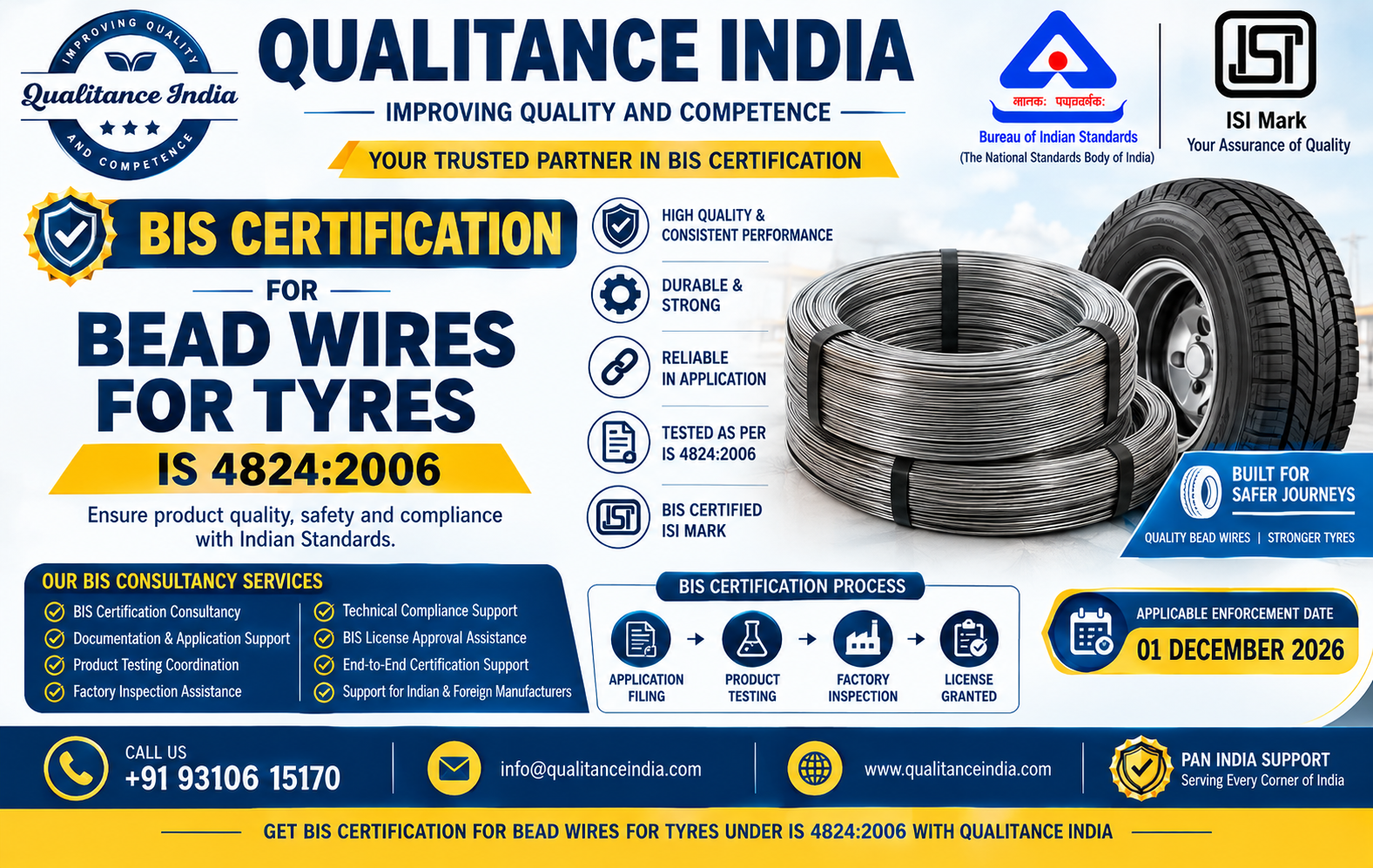
BIS Certification Consultancy for Bead Wires for Tyres | IS 4824:2006
Introduction
Bead wires are high-strength steel wires used in tyre manufacturing to reinforce the tyre bead and help maintain the required shape, strength and seating of a tyre on the wheel rim. Because bead wire is a critical component of tyre construction, properties such as tensile strength, torsion, dimensions, coating and surface quality require careful control.
Manufacturers and businesses often search for BIS Certification for Bead Wires for Tyres as per IS 4824:2006. However, there is an important revision update that must be understood before starting a new certification process.
BIS revised IS 4824:2006 to IS 4824:2022 – Bead Wire for Tyres – Specification, and BIS implementation guidelines stated that the revised standard was to be implemented by 28 October 2022, after which IS 4824:2006 would stand withdrawn.
The current BIS resources list IS 4824:2022 and its product manual, while the current Scheme-I page continues to identify Bead Wires for Tyres as a product under the ISI Mark framework.
Qualitance India provides complete BIS Certification consultancy for Bead Wires for Tyres, including standard applicability assessment, product scope, grouping, testing coordination, documentation, factory preparation, BIS application, inspection assistance, licence processing and ongoing compliance.
Important Update: IS 4824:2006 Revised to IS 4824:2022
This is the first point a manufacturer should understand.
BIS issued guidelines explaining that:
IS 4824:2006 → IS 4824:2022
The revised standard introduced significant technical and scope changes. BIS specifically highlighted that:
- Bead wires are now classified into NT (Normal Standard Tensile Strength) and HT (High Tensile Strength) categories.
- The size range is now 0.80 mm to 2.10 mm.
- The earlier 0.78 mm size was deleted from the scope.
- The chemical composition requirements were updated.
- Coating test methods were incorporated.
- Requirements for breaking load and bend testing were removed from the revised standard.
The revised product manual identifies the current scope as:
- Product: Bead Wire for Tyres
- Standard: IS 4824:2022
- Sizes: 0.80 mm up to and including 2.10 mm
- Tensile strength: NT and HT
- Coatings: Copper, Bronze low-tin (Sn), Bronze high-tin (Sn), Brass
Therefore, a manufacturer looking for a new licence today should not simply prepare an application around the withdrawn IS 4824:2006 requirements.
What is IS 4824?
The current standard is IS 4824:2022 – Bead Wire for Tyres – Specification.
The older IS 4824:2006 product manual described bead wire as a product certified under Scheme-I and included requirements concerning nominal size and finish.
The revised standard provides a more structured classification based on tensile-strength level, wire size and coating type.
Is BIS Certification Required for Bead Wires for Tyres?
Yes. Bead Wires for Tyres under IS 4824:2022 are included in the Steel and Steel Products (Quality Control) Order, 2024.
The QCO identifies IS 4824:2022 and specifies that the covered steel product is to comply with the applicable Indian Standard and carry the Standard Mark under a BIS licence in accordance with Scheme-I. The listed implementation is with immediate effect under the relevant order.
The QCO framework also contains provisions for specified export-related exemptions. Manufacturers and importers should verify the latest notification and their exact circumstances before relying on an exemption.
Current BIS Status of Bead Wire Certification
BIS currently provides product-specific information for:
IS 4824:2022 – Bead Wire for Tyres – Specification
The current BIS product-manual resource lists IS 4824:2022, while the older IS 4824:2006 manual remains available in the BIS product-manual archive/resources for reference to the previous framework.
This distinction is important for manufacturers with older licences or technical documents.
Product Classification Under IS 4824:2022
The current Product Manual establishes the following major classifications.
Tensile Strength Level
Two levels are covered:
- NT – Normal Standard Tensile Strength
- HT – High Tensile Strength
Wire Size
The current standard covers:
0.80 mm to 2.10 mm inclusive.
Coating Types
The current Product Manual identifies four coating types:
- Copper
- Bronze – Low Tin (Sn)
- Bronze – High Tin (Sn)
- Brass
Raw Material Requirements
The 2022 Product Manual states that there is no specific raw-material requirement in its sampling section.
This is different from the earlier 2006 framework.
Under the older Product Manual, the steel used for bead wire was required to be killed steel and was subject to nitrogen analysis occasionally. Wire-drawing units using ISI-marked wire rods generally used wire rods conforming to IS 7904.
For current certification, manufacturers should work against the requirements of IS 4824:2022, rather than relying on the raw-material provisions of the withdrawn 2006 framework.
BIS Grouping Guidelines for Bead Wires
Grouping is an important part of the certification process.
The current grouping guidelines under IS 4824:2022 are based on:
- Tensile-strength level
- Wire diameter
- Coating type
Sample for Each Tensile-Strength Level
The grouping guidelines state that:
One sample of the smallest wire diameter for each tensile-strength level is to be drawn to cover the applicable sizes and tensile-strength levels in the proposed licence scope.
Therefore, NT and HT scope planning should be carried out separately.
Separate Samples for Coatings
A separate sample is required for each type of coating proposed to be included in the scope.
For example, if a manufacturer wants to cover:
- NT
- HT
- Copper coating
- Bronze low-tin coating
the required representative samples need to be planned according to the grouping guidelines.
Scope Based on Manufacturing Capability
The Product Manual states that the licence/inclusion can cover the applicable sizes, tensile-strength levels and coating types when the sample passes, provided the manufacturer has the necessary manufacturing and testing facilities for all the varieties proposed.
BIS also provides for rotation of sizes, tensile-strength levels and coatings for independent testing during licence operation.
BIS Sample Size for Bead Wire
The current Product Manual for IS 4824:2022 specifies:
Approximately 25 metres of bead wire for complete testing.
This is an important difference from the older IS 4824:2006 Product Manual, which specified:
- 15 pieces of 45 cm length for mechanical tests
- 5 pieces of 45 cm length for chemical tests.
Manufacturers starting current certification should follow the current IS 4824:2022 sampling requirements.
Main BIS Tests for Bead Wires
The current testing requirements are based on the revised standard.
Important areas of conformity include:
1. Chemical Composition
Chemical composition is an important requirement for bead wire.
The Product Manual identifies testing for:
- Carbon
- Sulphur
- Phosphorus
- Manganese
- Silicon
- Nitrogen
The listed methods include instrumental and alternative chemical-analysis techniques.
2. Tensile Test
Tensile properties are central to the NT and HT classification.
Testing equipment includes a Universal Testing Machine, and the Product Manual identifies tensile testing as one of the principal conformity requirements.
3. Torsion Test
Torsion performance is another important mechanical property.
The Product Manual identifies a dedicated torsion-testing machine for this requirement.
4. Coating Weight
Coating weight is checked according to the current standard requirements.
The revised standard incorporated methods for testing coating weight.
5. Coating Adhesion
Adhesion of the coating is an important requirement for bead wires because the wire is ultimately embedded within the tyre structure.
The revised Product Manual retains adhesion testing as part of the applicable conformity assessment, and the grouping guidance specifically addresses factory adhesion testing during preliminary inspection.
6. Diameter and Dimensional Tolerances
The wire diameter must comply with the required size and tolerance.
The Product Manual identifies a micrometer for dimensional measurement.
7. Bead Wire Test
The earlier IS 4824:2006 framework included a bead-wire test as a specific test item.
Under the revised standard, manufacturers should follow the current test programme prescribed under IS 4824:2022 and its current BIS product manual.
8. Freedom from Defects
Finished bead wire is required to be free from harmful defects.
The previous Product Manual specifically required inspection to ensure the finished wire was circular in section and free from scales, splits, spills and other harmful defects.
Manufacturers should maintain equivalent control under the current standard requirements.
Important Change: Bend and Breaking-Load Requirements
One significant revision from the 2006 standard to 2022 is that BIS’s implementation guideline states that the requirements for breaking load and bend testing were removed from the revised standard.
This means manufacturers should not blindly use old 2006 test checklists when preparing for current certification.
BIS Testing Equipment for Bead Wire
The current Product Manual identifies major equipment and laboratory facilities for applicable testing.
Chemical Analysis
Possible equipment includes:
- Spectrometer
- Spectrophotometer
- Carbon and sulphur analysis equipment
- Muffle furnace
- Hot plate
- Electronic balance
- Oven
- Glassware
- Standard reference materials
- Chemical reagents
The exact arrangement depends on the selected analytical method.
Tensile Test
- Universal Testing Machine
- Appropriate tensile-test fixtures
Torsion Test
- Torsion testing machine
Dimensional Test
- Micrometer
- Measuring instruments
Coating Tests
- Coating-weight testing equipment
- Adhesion-testing equipment
- Appropriate pressure/temperature arrangement where required
The equipment list in the Product Manual is intended as guidance and should be considered together with the full applicable standard and certification requirements.
In-House Laboratory Requirements
A manufacturer applying for BIS certification should have appropriate testing arrangements for the tests applicable to its proposed scope.
The earlier BIS Product Manual explicitly required a suitably equipped and staffed laboratory, a calibration plan for testing equipment and maintenance of test records.
The current product manual should be used for determining the exact test-facility and outsourcing provisions applicable to an IS 4824:2022 application.
Scheme of Inspection and Testing
A controlled inspection and testing system is essential for continued BIS compliance.
The manufacturer’s quality system should provide control over:
- Raw material
- Steel grade/material traceability
- Drawing process
- Tensile properties
- Torsion
- Diameter
- Coating
- Adhesion
- Surface condition
- Production lots/coils
- Test records
- Calibration
- Non-conforming material
Under the older 2006 Product Manual, the control unit was defined as wire drawn to the same nominal size and finish, manufactured under essentially similar conditions using steel from one cast in a day.
For current certification, the manufacturer should establish the control-unit and inspection requirements according to the IS 4824:2022 Product Manual/SIT.
Marking Requirements
The earlier BIS Product Manual required the Standard Mark and licence number to be incorporated according to the licence schedule and standard requirements, together with the BIS website statement:
“For details of BIS certification please visit www.bis.gov.in”
For current production, the manufacturer must follow the marking provisions prescribed under the current IS 4824:2022 certification framework and licence.
Only conforming production covered by the BIS licence should be marked with the Standard Mark.
Test Certificate
The earlier Product Manual required a test certificate for each consignment of BIS-certified bead wire containing:
- Standard Mark
- Cast/control-unit number
- Corresponding test results.
Current documentation and test-certificate requirements should be followed according to the active IS 4824:2022 certification requirements.
Handling of Non-Conforming Material
Non-conforming bead wire must be properly identified and segregated.
The earlier BIS Product Manual required defective or rejected material to be disposed of in a manner that prevents misuse and required records covering the quantity, cast/coil/control-unit information and disposal method.
A robust rejection-control procedure should therefore be established as part of the factory quality system.
BIS Certification Process for Bead Wires
The typical certification process is:
Product Assessment → Current Standard Verification → Scope Planning → NT/HT Selection → Coating Selection → Grouping Review → Factory Assessment → Sample Preparation → Product Testing → Documentation → BIS Application → Factory Inspection → Compliance → BIS Licence → Standard Marking → Ongoing Surveillance/Compliance
The exact process can vary depending on the manufacturer’s existing facilities and certification status.
Documents Required for BIS Certification
Common documents may include:
- Company registration documents
- Factory address proof
- Factory ownership or lease documents
- Authorized signatory details
- Manufacturing process flow chart
- Factory layout
- Machinery list
- Wire-drawing equipment details
- Coating equipment details
- Testing equipment list
- Calibration certificates
- Product specifications
- Wire-size details
- Tensile-strength classification
- Coating details
- Raw-material information
- Test reports
- Quality-control documents
- Production records
- Applicable declarations and undertakings
- Brand/trademark information where applicable
The final checklist should be prepared according to the current BIS application requirements.
Factory Inspection for Bead Wire Manufacturers
The manufacturing facility should be prepared to demonstrate the ability to consistently produce conforming bead wire.
Important areas may include:
Wire Drawing
- Rod preparation
- Drawing machines
- Die arrangement
- Lubrication/control
- Wire diameter control
Heat Treatment
Where applicable:
- Furnace/heat-treatment arrangement
- Temperature control
- Process records
Surface Treatment/Coating
- Coating line
- Coating-material control
- Coating-weight control
- Adhesion control
Testing Laboratory
- Tensile testing
- Torsion testing
- Dimensional testing
- Chemical analysis
- Coating testing
Quality Control
- Incoming material inspection
- Process inspection
- Finished product testing
- Traceability
- Calibration
- Rejection control
- Test records
Qualitance India helps manufacturers review these areas before the BIS assessment.
BIS Certification Cost for Bead Wires
The total certification cost depends on:
- BIS application fees
- Product testing charges
- Number of tensile-strength categories
- Number of coating types
- Factory testing facilities
- External laboratory testing
- Calibration
- Documentation
- Inspection-related expenses
- Consultancy charges
- Ongoing compliance
Because IS 4824:2022 uses a scope structure based on NT/HT, size range and coating, the desired licence scope can directly affect the testing and preparation requirements.
Current BIS Testing Charges
BIS LIMS currently shows active laboratory scope for IS 4824:2022.
Current displayed examples include testing entries around:
- ₹13,000 excluding taxes in one laboratory listing
- ₹19,700 excluding taxes in another laboratory listing
Actual laboratory charges depend on the applicable scope, test inclusions, exclusions and laboratory.
Testing quotations should therefore be confirmed against the current BIS LIMS scope before samples are submitted.
How Long Does BIS Certification Take?
The certification timeline depends on:
- Factory readiness
- Testing arrangements
- Number of varieties
- NT/HT scope
- Coating types
- Documentation
- Sample conformity
- Laboratory availability
- Factory inspection schedule
- Resolution of BIS observations
A well-prepared application normally moves faster than one where the factory and laboratory are arranged only after the application is submitted.
Common Reasons for BIS Certification Delays
Using the 2006 Requirements for a New Application
Because IS 4824:2006 was replaced by IS 4824:2022, using an outdated test plan can cause unnecessary problems.
Wrong Scope Planning
Selecting NT and HT or multiple coatings without considering the required manufacturing and testing capability can complicate the application.
Wrong Representative Samples
The current grouping approach requires careful selection of the smallest diameter sample for each tensile-strength level and separate samples for coatings.
Coating Adhesion Failure
Poor surface preparation or coating-process control can lead to adhesion failures.
Diameter Variation
Tight dimensional tolerance requirements make accurate drawing and measurement control important.
Tensile Strength Failure
Inconsistent heat treatment or wire-drawing conditions can affect tensile properties.
Torsion Failure
Wire quality and manufacturing-process control can affect torsional performance.
Poor Traceability
The manufacturer should maintain traceability from steel material to finished coil and test records.
Calibration Issues
Testing instruments should have valid calibration.
Who Needs BIS Certification for Bead Wires?
The applicable certification requirements are relevant to manufacturers producing bead wires covered by the current Indian Standard and Quality Control Order.
This can include businesses supplying:
- Tyre manufacturers
- Automotive component companies
- Commercial vehicle tyre manufacturers
- Passenger vehicle tyre manufacturers
- Heavy-duty tyre manufacturers
- Industrial tyre manufacturers
- Other eligible tyre-related manufacturing industries
Importers and traders should separately verify their legal responsibilities under the applicable QCO.
Benefits of BIS Certification for Bead Wires
Regulatory Compliance
Certification helps manufacturers comply with the applicable mandatory BIS requirements.
Product Quality
Testing controls help maintain consistent mechanical and dimensional properties.
Tyre-Industry Acceptance
BIS-compliant bead wire can support supply requirements where certification is specified.
Buyer Confidence
Conformity with an Indian Standard improves confidence in product consistency.
Better Production Control
The certification process encourages documented control of materials, manufacturing and testing.
Market Opportunities
A valid BIS licence can support commercial opportunities where BIS-certified bead wire is required.
BIS Certification Consultancy for Bead Wire Manufacturers
Qualitance India provides complete consultancy for Bead Wires for Tyres.
Product & Standard Identification
We review your existing product and determine whether the certification must be handled under the current IS 4824:2022 framework.
Scope Planning
We help assess:
- NT
- HT
- Wire diameter range
- Coating type
Grouping Guidance
We help identify suitable samples according to the current grouping provisions.
Testing Coordination
We coordinate sample preparation and laboratory testing.
Documentation Support
We assist in preparing the technical and administrative documents required for BIS application.
Factory Preparation
We review machinery, testing equipment, calibration and quality-control arrangements.
BIS Application Filing
We assist in preparing and submitting the application and supporting information.
Inspection Assistance
We help manufacturers prepare for the applicable BIS factory assessment.
Compliance Support
We assist in responding to technical and documentary observations.
Licence Processing
We provide support through the BIS licence-processing stage.
Post-Licence Compliance
We also provide support for renewal, scope changes and ongoing certification requirements.
Quick BIS Certification Checklist for Bead Wire
Before applying, ensure:
☑ Current IS 4824:2022 applicability checked
☑ Old IS 4824:2006 transition status understood
☑ NT/HT category finalized
☑ Wire-size range finalized
☑ Coating type finalized
☑ Grouping requirements reviewed
☑ Representative samples arranged
☑ Wire-drawing machinery available
☑ Coating facility available
☑ Testing equipment available
☑ Calibration records available
☑ Quality-control system established
☑ Test reports reviewed
☑ Factory documentation ready
☑ BIS application documents prepared
☑ Factory ready for assessment
☑ Marking arrangements ready
Frequently Asked Questions
1. What is IS 4824?
IS 4824 is the Indian Standard covering Bead Wire for Tyres.
2. Is IS 4824:2006 still the current standard?
No. BIS revised IS 4824:2006 to IS 4824:2022, with implementation by 28 October 2022 after which the old standard stood withdrawn.
3. What is the current standard for bead wires?
The current standard is IS 4824:2022 – Bead Wire for Tyres – Specification.
4. Is BIS certification mandatory for bead wires?
Bead Wires for Tyres under IS 4824:2022 are included in the Steel and Steel Products (Quality Control) Order, 2024 and are subject to the specified BIS licensing requirements.
5. Which BIS scheme applies?
The BIS Product Manual is operated under Scheme-I.
6. What sizes are covered under IS 4824:2022?
The current standard covers 0.80 mm to 2.10 mm inclusive.
7. Is 0.78 mm bead wire covered?
No. BIS specifically stated that the 0.78 mm size was deleted when IS 4824:2006 was revised to IS 4824:2022.
8. What are the tensile-strength categories?
There are two categories:
- NT – Normal Standard Tensile Strength
- HT – High Tensile Strength
9. What coating types are covered?
The current Product Manual identifies:
- Copper
- Bronze low tin
- Bronze high tin
- Brass
10. What is the sample size?
Approximately 25 metres of bead wire is required for complete testing under the 2022 Product Manual.
11. Is there product grouping?
Yes. Grouping is based on tensile-strength level, wire diameter and coating type.
12. How are NT and HT grouped?
One sample of the smallest wire diameter for each tensile-strength level is used for the applicable grouping scope.
13. Is a separate sample required for each coating?
Yes. Separate samples are required for each type of coating proposed for inclusion.
14. Are breaking-load and bend tests required under the revised standard?
BIS’s implementation guideline states that the breaking-load and bend-test requirements were removed in IS 4824:2022.
15. Is tensile testing required?
Yes. Tensile strength is a key classification and conformity parameter.
16. Is torsion testing required?
Yes. The current Product Manual identifies torsion testing as part of the applicable requirements.
17. Is coating weight tested?
Yes. Coating-weight testing is part of the revised technical requirements.
18. Is coating adhesion tested?
Yes. Adhesion remains an important requirement and is addressed in the grouping and preliminary-inspection provisions.
19. Is chemical composition tested?
Yes. The Product Manual identifies chemical analysis for carbon, sulphur, phosphorus, manganese, silicon and nitrogen.
20. Is nitrogen testing required?
Nitrogen is included among the chemical-composition parameters in the current Product Manual.
21. What equipment is needed for tensile testing?
A suitable Universal Testing Machine is identified in the Product Manual.
22. What equipment is needed for torsion testing?
A torsion-testing machine is identified as the applicable major equipment.
23. What equipment is used for diameter checking?
A micrometer is identified for dimensional checks.
24. Can one sample cover multiple sizes?
Yes, the grouping provisions allow the smallest diameter for each tensile-strength level to establish the applicable scope, subject to the required facilities and conditions.
25. Can one sample cover multiple coating types?
No. Separate samples are required for each coating type proposed.
26. Does the manufacturer need suitable testing facilities?
Yes. The manufacturer must have the testing arrangements necessary for the proposed certification scope.
27. Can a manufacturer with an old IS 4824:2006 licence continue using the old scope?
The old standard was withdrawn after the implementation of IS 4824:2022. Existing licence holders were required to transition their scope to the revised standard according to BIS’s implementation guidelines.
28. Does IS 4824:2022 cover only one coating?
No. The current scope identifies four coating types.
29. What are current testing charges?
Current BIS LIMS listings show examples around ₹13,000 and ₹19,700 excluding taxes, depending on laboratory and testing scope.
30. How can I obtain BIS Certification for Bead Wires?
The manufacturer should first determine the current IS 4824:2022 scope, including NT/HT, sizes and coating types, then arrange the required samples, testing, documentation, factory facilities and BIS application. Qualitance India provides end-to-end consultancy for the process.
Related BIS Certification Services
Qualitance India also provides consultancy for:
- BIS Certification
- ISI Mark Certification
- Steel Product Certification
- BIS Scheme-I Certification
- Bead Wire Certification
- Steel Wire Certification
- BIS Licence Renewal
- BIS Scope Extension
- Product Testing Coordination
- BIS Documentation
- Factory Inspection Assistance
- Quality Control Order Applicability
- Product Grouping Guidance
- Technical Compliance Support
Related Steel & Wire Products
Manufacturers may also require BIS certification consultancy for:
- Steel Wire for Mechanical Springs – IS 4454
- Mild Steel Wire – IS 280
- Round Steel Wire for Ropes – IS 1835
- Indented Wire for Prestressed Concrete – IS 6003
- Steel Wires for Tyres and Automotive Applications
- Galvanized Steel Wires
- Low Carbon Steel Wires
- Other regulated steel wire products
The applicable Indian Standard should always be verified against the exact product before starting certification.
Why Choose Qualitance India?
Qualitance India provides complete BIS consultancy with a focus on reducing technical and procedural difficulties for manufacturers.
Our support includes:
Product Assessment
Reviewing the bead-wire product and certification route.
Current Standard Verification
Checking the transition from IS 4824:2006 to IS 4824:2022.
Scope & Grouping
Planning NT/HT, size and coating scope.
Sample Planning
Helping prepare representative samples.
Testing Coordination
Coordinating applicable laboratory testing.
Documentation Support
Preparing certification-related documents.
Factory Preparation
Reviewing production, testing and calibration facilities.
Application Support
Assisting with BIS application and follow-up.
Inspection Preparation
Preparing the factory for the applicable assessment.
Licence Support
Supporting the process until licence approval.
Post-Licence Compliance
Assisting with renewal, scope and continuing compliance.
Contact Qualitance India
Qualitance India – Your Certification & Compliance Partner
Phone: +91 93106 15170
Email: info@qualitanceindia.com
Website: https://qualitanceindia.com/
For BIS Certification of Bead Wires for Tyres, Qualitance India provides complete consultancy for product assessment, IS 4824 requirements, grouping, testing, documentation, factory inspection preparation, BIS application, licence processing and post-licence compliance.
Conclusion
Bead wire is a critical steel component used in tyre construction, and its mechanical properties, dimensional accuracy, coating and surface condition require strict quality control.
Manufacturers searching for BIS Certification for Bead Wires for Tyres as per IS 4824:2006 should first note that BIS revised the standard to IS 4824:2022, with the old standard withdrawn after the implementation date of 28 October 2022.
The current standard covers bead wires from 0.80 mm to 2.10 mm, classifies them into NT and HT tensile-strength levels, and provides four coating categories: Copper, Bronze Low-Tin, Bronze High-Tin and Brass.
The certification process requires careful scope planning, representative sample selection, chemical and mechanical testing, coating evaluation, suitable manufacturing and testing facilities, documentation, factory assessment and continued quality control.
Qualitance India provides end-to-end BIS Certification consultancy for Bead Wires for Tyres, helping manufacturers manage the transition to the current standard and complete the certification process with proper technical and documentation support.
Need BIS Certification for Bead Wires for Tyres? Contact Qualitance India for complete BIS licence and compliance support.
Need help with BIS certification for this product?
Get a free consultation from our compliance experts — we handle testing, documentation and the complete BIS process for you.
BIS Certification Readiness Checklist 2026
- Documents, testing & factory requirements in one place
- Covers ISI Mark, CRS, FMCS & Hallmarking
- Tick-box format — share it with your team