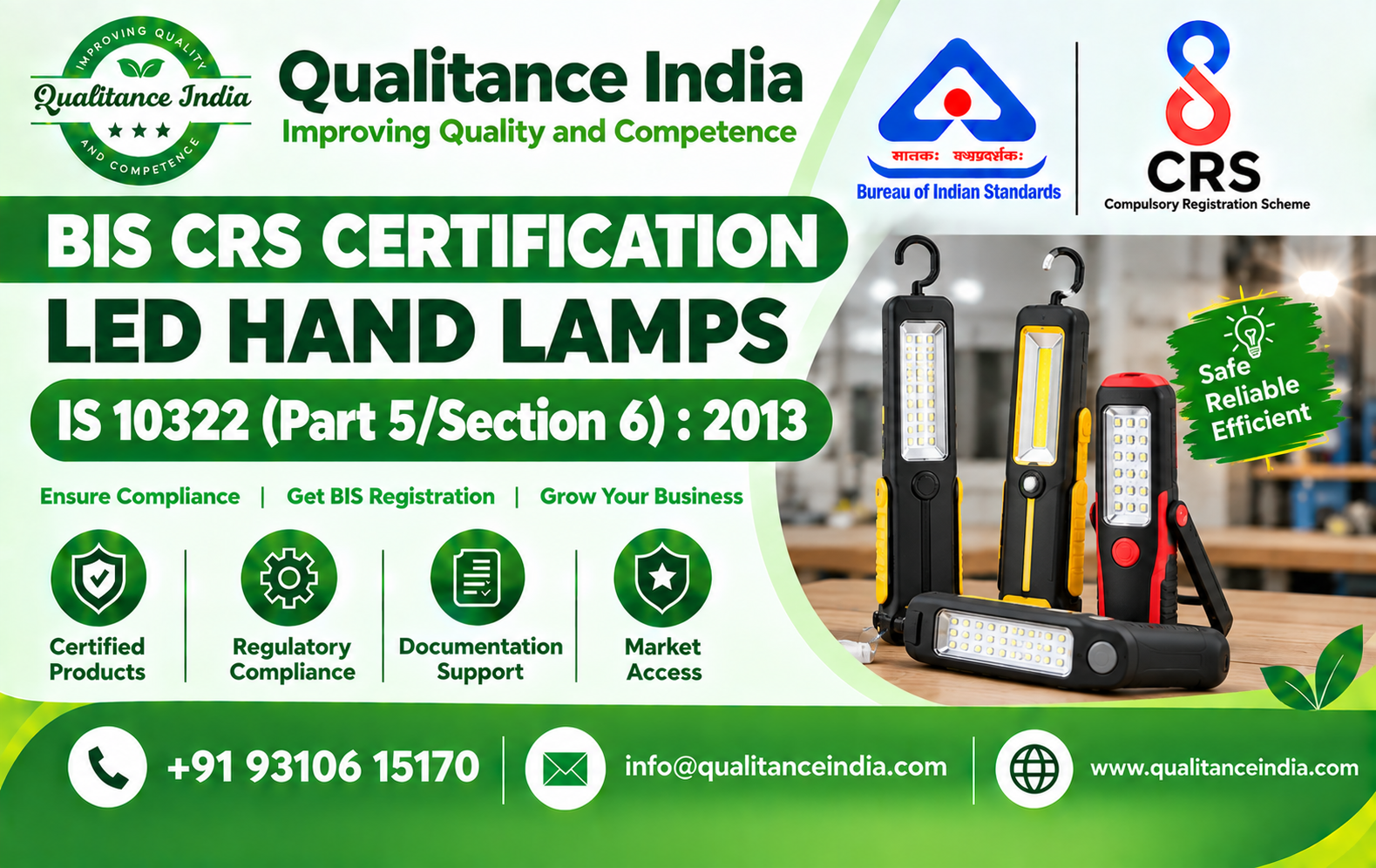
BIS CRS Certification for LED Hand Lamps | IS 10322 (Part 5/Section 6):2013 | BIS Consultancy
Introduction
LED hand lamps are portable lighting products designed for convenient illumination in homes, workshops, industrial locations, maintenance applications and other areas where a movable light source is required. Because electrical safety is an important consideration for portable luminaires, LED Hand Lamps are covered under the Bureau of Indian Standards (BIS) Compulsory Registration Scheme (CRS).
The BIS CRS product list identifies LED Hand Lamps under IS 10322 (Part 5/Section 6):2013, and the BIS standard database also now lists the revised IS 10322 (Part 5/Sec 6):2026.
Important BIS Update for 2026
BIS revised the Handlamps standard from IS 10322 (Part 5/Sec 6):2013 to IS 10322 (Part 5/Sec 6):2026. The original March 2026 implementation guideline provided a concurrent-running deadline of 02 August 2026. However, BIS subsequently issued a circular dated 31 July 2026 extending concurrent running of the old and revised standards until 02 February 2027.
Therefore, as of September 2026, the transition for LED Hand Lamps is:
Existing Standard: IS 10322 (Part 5/Sec 6):2013 Revised Standard: IS 10322 (Part 5/Sec 6):2026 IEC Reference: IEC 60598-2-8:2013 Last Date of Concurrent Running: 02 February 2027
Manufacturers planning a new CRS application or an update to an existing registration should assess whether the application should be processed under the 2013 standard during the permitted transition period or directly under the 2026 standard.
What is BIS CRS Certification for LED Hand Lamps?
BIS CRS certification is a registration-based conformity system for specified electronic and electrical products. For products covered by CRS, the manufacturer must demonstrate conformity through testing at a BIS-recognized laboratory and then apply to BIS for registration.
LED Hand Lamps are specifically listed under the CRS framework against IS 10322 (Part 5/Sec 6):2013.
Under CRS, the manufacturer receives a unique registration number, commonly referred to as the R-Number, after successful scrutiny and registration.
Unlike BIS Scheme-I products that generally use the ISI Mark, products under CRS use the Registration Mark / self-declaration conformity marking as prescribed under the CRS requirements. BIS states that registered electronic products are marked with the Registration Mark.
BIS Standard for LED Hand Lamps
The applicable product-specific standard is:
IS 10322 (Part 5/Section 6):2013 — Luminaires, Part 5: Particular Requirements, Section 6: Handlamps
BIS's official Uniform Test Report Format identifies Handlamps under this standard and includes a dedicated compliance test report format for the product.
The BIS CRS standard table currently contains both:
- IS 10322 (Part 5/Sec 6):2013 – LED Handlamps
- IS 10322 (Part 5/Sec 6):2026 – LED Handlamps
The 2026 edition is identified by BIS as the First Revision of the Handlamps section.
Why is BIS CRS Registration Required for LED Hand Lamps?
The Electronics and IT Goods compulsory registration framework includes LED Hand Lamps under IS 10322 (Part 5/Sec 6):2013. BIS's current Scheme-II information continues to identify LED Hand Lamps under this standard.
For a manufacturer or importer, appropriate CRS registration is therefore an important compliance requirement before placing covered products in the Indian market.
The compulsory registration framework also provides for requirements relating to conformity, marking, manufacturing, import and distribution, with specific provisions and exemptions for export goods.
What Products are Covered?
The certification applies to LED Hand Lamps falling within the applicable scope of the relevant handlamp standard.
A handlamp is a portable luminaire designed to be held in the hand, hooked up or placed on a surface depending on its construction and intended use. The 2013 test report format specifically evaluates handlamps according to classifications including:
- Class II or Class III
- Rewirable or non-rewirable construction
- Ordinary or rough-service application
- Applicable degree of protection
- Construction and supply arrangement
The official BIS test report format contains dedicated checkpoints for these classifications.
Because product design can vary significantly, the final scope of a CRS application should be checked against the exact construction, power supply arrangement, enclosure, wiring and intended application of the model.
Major Safety Requirements for LED Hand Lamps
Under the 2013 BIS test report format, LED Hand Lamps are evaluated across a broad range of safety requirements.
1. General Test Requirements
The laboratory first establishes the applicable test conditions and product characteristics before conducting the required product tests.
The BIS TRF provides for assessment of general test requirements as well as product-specific classification.
2. Classification of the Handlamp
The handlamp may need to be assessed for:
- Protection against electric shock classification
- Degree of IP protection
- Suitability for particular mounting conditions
- Normal-use or rough-service classification
- Class II or Class III construction
- Rewirable or non-rewirable configuration
These classifications can affect the applicable testing requirements.
3. Marking Requirements
Correct product marking is an important part of the BIS evaluation.
The BIS TRF checks mandatory marking, marking position, symbols, additional information and other product-specific marking requirements. It also addresses issues such as operating information, special conditions, supply characteristics and relevant warnings.
After CRS registration, the prescribed Registration Mark or self-declaration statement must also be displayed in accordance with BIS requirements. BIS states that the marking must be easily visible, legible, indelible and non-removable, subject to the applicable requirements.
4. Construction
Construction is a major part of handlamp testing.
The BIS 2013 TRF checks construction-related matters including components, wiring paths, lamp-holder arrangements where applicable, terminals, switches, insulating linings and sleeves, cable entries, protective arrangements and other constructional requirements.
For handlamps, particular attention should be given to:
- Mechanical integrity
- Handle design
- Insulation
- Internal wiring
- Cable entry
- Switches
- Lamp or LED assembly
- Protective covers
- Terminals
- Strain relief and cord anchorage
5. Creepage Distances and Clearances
Adequate creepage and clearance distances are necessary to reduce electrical insulation and arcing risks.
These requirements form part of the official 2013 BIS test report format for handlamps.
6. Provision for Earthing
Where applicable, the handlamp's earthing arrangements are assessed for conformity.
The BIS TRF separately identifies the provision for earthing as a compliance area.
7. Terminals
Screw terminals and screwless terminals, where applicable, are assessed against their relevant construction requirements.
The official test format includes checks for terminals, supply connections, conductor arrangements and terminal security.
8. External and Internal Wiring
The wiring system is evaluated to ensure that the selected cables, insulation, connections and mechanical protection are appropriate.
For the 2013 handlamp TRF, the external and internal wiring assessment includes:
- Supply connection
- External wiring
- Cable type
- Nominal cross-sectional area
- Cable entries
- Insulating bushings
- Cord anchorage
- Internal conductor arrangement
- Insulation
- Protection against mechanical damage
The TRF also includes requirements concerning flexible cable/cord construction and attachment arrangements.
9. Protection Against Electric Shock
Protection against electrical shock is one of the most important safety evaluations.
The 2013 BIS TRF checks whether live parts are accessible and whether protection is maintained under relevant conditions. It also assesses portable luminaires in unfavourable positions and relevant Class II/Class III protection arrangements.
10. Endurance and Thermal Tests
The handlamp must be assessed for endurance and thermal performance under applicable operating conditions.
The BIS test format includes:
- Endurance testing
- Normal-operation thermal testing
- Abnormal-operation thermal testing
- Failed lamp/control-gear conditions where applicable
- Temperature measurements
- Safety after endurance testing
The test report specifically checks whether the product remains safe and whether components, markings and construction remain acceptable after the applicable endurance evaluation.
11. Resistance to Dust and Moisture
Where an IP rating applies, the appropriate ingress-protection tests are conducted.
The BIS TRF includes testing for:
- Solid objects
- Dust
- Water/moisture
- Humidity
The test report also checks post-test electrical strength and whether hazardous water entry or contact with live parts occurs. A 48-hour humidity test is included in the 2013 format.
12. Insulation Resistance and Electric Strength
Insulation resistance testing is carried out between applicable conductive parts, including relevant live parts, metal parts and other accessible or associated parts.
Electric strength testing is also included in the BIS compliance format.
13. Resistance to Heat, Fire and Tracking
The 2013 handlamp TRF includes several fire and material safety assessments such as:
- Ball-pressure test
- Needle-flame test
- Glow-wire test
- Tracking test
- Pressure test on the handle at the applicable temperature
The TRF identifies a 10-second needle-flame test and a 650°C glow-wire test within the applicable testing section.
BIS CRS Certification Process for LED Hand Lamps
The registration process generally follows these stages.
Step 1 – Identify the Applicable Standard
Confirm the exact product category, applicable IS standard, model range and technical configuration.
For the current transition, assess whether the product is being processed under IS 10322 (Part 5/Sec 6):2013 or the revised IS 10322 (Part 5/Sec 6):2026.
Step 2 – Select a BIS-Recognized Laboratory
The LED Hand Lamp sample must be submitted to a laboratory recognized by BIS for the applicable CRS testing.
BIS instructs applicants to submit products for testing to a BIS-recognized laboratory.
Step 3 – Generate the Test Request
Applicants generate a Test Request through the CRS portal and select an approved laboratory.
BIS's current registration instructions specify entering sample details, selecting an approved laboratory and awaiting confirmation from the laboratory.
Step 4 – Submit the Sample
The sample and Test Request must be sent to the selected laboratory within the prescribed period.
BIS currently states that the sample and Test Request should reach the laboratory within 60 days of Test Request generation.
Step 5 – Product Testing
The recognized laboratory evaluates the sample against the applicable requirements and prepares the BIS test report.
Step 6 – Verify the Test Report
The applicant should carefully verify the:
- Manufacturer name
- Factory address
- Brand
- Model numbers
- Product description
- Rating
- Applicable standard
- Test results
- Representative models
- Marking information
Step 7 – Submit CRS Application Online
BIS requires the application to be filed online using the prescribed registration process.
The BIS instructions state that the test report should be not more than 90 days old at the time of online submission.
Step 8 – Submit Hard Copy Documents
The hard copy application, original test report and prescribed affidavit-cum-undertaking must be submitted within 15 days of online submission.
Step 9 – BIS Scrutiny
BIS scrutinizes the application and may raise queries.
Applicants must respond to the queries and resolve any shortcomings identified during scrutiny.
Step 10 – CRS Registration
After satisfactory scrutiny and completion of the requirements, BIS grants the CRS Registration.
Test Report Validity for BIS CRS
For CRS applications, BIS states that the test report should not be more than 90 days old at the time of online submission.
This makes proper coordination between testing, report issuance and application submission important.
A manufacturer should avoid completing laboratory testing too early and then delaying the CRS application beyond the report validity period.
Sample Requirements for LED Hand Lamps
The exact number and configuration of samples should be confirmed with the selected BIS-recognized laboratory based on the particular product design and model family.
The official BIS 2013 Uniform Test Report Format identifies representative models and multiple product configurations, but the searchable TRF itself does not provide a single universal sample quantity that can safely be applied to every LED Hand Lamp application.
Before dispatching samples, it is therefore advisable to confirm:
- Number of complete samples
- Accessories to be supplied
- Charger/adapter requirements, where applicable
- Batteries, if integral or supplied
- Different electrical ratings
- Different construction variants
- Representative models
- Label and packaging samples
Model and Series Consideration
Manufacturers often produce several LED Hand Lamp models under one brand with variations in:
- Wattage
- Dimensions
- Housing material
- Battery capacity
- Input supply
- LED arrangement
- Handle configuration
- Charging method
- IP rating
- Switch configuration
- Colour or cosmetic design
A proper model-family assessment helps determine which models should be tested and which variants may be covered through the applicable representative-model approach.
Each manufacturing location is separately relevant for CRS registration. BIS's CRS FAQ explains that the unique registration number is tied to a unique manufacturing location, and a separate location requires a separate application supported by product testing from that location.
Documents Required for BIS CRS Certification
Typical documentation for a LED Hand Lamp CRS application may include:
- Manufacturer's company registration details
- Factory address and manufacturing details
- Business or factory licence establishing manufacturing activity
- Brand/trademark information
- Product technical specification
- Product photographs
- Product label/marking artwork
- Model and model-family details
- Manufacturing process information, where required
- Authorized signatory details
- BIS-recognized laboratory test report
- Affidavit-cum-undertaking in the prescribed format
- Authorization documents, where applicable
- Import/manufacturer documents for foreign applicants
- Authorized Indian Representative documents for eligible foreign applicants
BIS specifically requires Indian applicants to submit the prescribed Format C affidavit-cum-undertaking. Foreign applicants without an Indian liaison office or branch must appoint an Authorized Indian Representative (AIR) and follow the prescribed foreign-applicant documentation requirements.
BIS CRS for Foreign Manufacturers of LED Hand Lamps
Foreign manufacturers can also obtain BIS CRS Registration.
Where a foreign applicant does not have a liaison office or branch office in India, BIS requires appointment of an Authorized Indian Representative (AIR) in accordance with the applicable BIS requirements.
The AIR acts as the designated Indian contact for the CRS application and related regulatory communication.
CRS Marking Requirements for LED Hand Lamps
After registration, the registered manufacturer must use the prescribed CRS marking.
BIS's CRS marking guideline states that the registered user may use the Registration Standard Mark or the prescribed self-declaration wording along with the registration number. The marking should be easily visible, legible, indelible and non-removable.
Where product-size limitations make marking on the product impractical, BIS guidance permits placement on the packaging in accordance with the applicable requirements.
The exact IS number used for marking must correspond to the applicable standard under which registration is granted.
2013 Standard to 2026 Standard – What Manufacturers Should Know
The revised standard is particularly important for manufacturers currently holding or seeking CRS registration.
BIS's March 2026 guideline states that the Handlamps standard changed from:
IS 10322 (Part 5/Sec 6):2013 → IS 10322 (Part 5/Sec 6):2026
The 2026 edition is associated with IEC 60598-2-8:2013 in the BIS transition document.
The original transition deadline was 02 August 2026, but BIS's 31 July 2026 circular extended the concurrent-running period until 02 February 2027.
For Section 6 specifically, BIS's March 2026 annexure lists the change as:
“References to IS 10322 (Part 1) have been updated.”
At the same time, BIS lists several changes in the revised IS 10322 Part 1:2026, including updated marking requirements, IPX9, EMF safety requirements, PELV provisions, modified touch-current/touch-voltage provisions, battery/EDLC requirements and extended photobiological requirements.
Manufacturers should therefore evaluate both the product-specific Section 6 requirements and the applicable general requirements of revised IS 10322 Part 1.
Is BIS CRS Certification Required for LED Hand Lamps Imported into India?
Yes, LED Hand Lamps are included in the CRS framework.
For foreign manufacturers, the CRS registration process generally includes testing, BIS application and appointment of an AIR where the foreign applicant does not maintain an eligible Indian liaison office or branch.
Importers should ensure that the foreign manufacturer's applicable CRS registration and product/model details are in place before commercial import and sale.
BIS Testing Charges for LED Hand Lamps
Testing charges vary considerably depending on the laboratory, applicable standard version, test scope, exclusions and product configuration.
BIS LIMS currently shows examples for IS 10322 (Part 5/Sec 6):2026 including:
- ₹35,000
- ₹50,000
- ₹55,000
- ₹85,000
- ₹99,500
- ₹1,15,000
- ₹1,50,000
These displayed laboratory charges are exclusive of taxes, and individual labs may have exclusions or additional charges for specific testing facilities.
For the 2013 standard, BIS LIMS also displays laboratory-specific testing charges; one current listing shows ₹45,000 for IS 10322 Part 5/Sec 6:2013, while another laboratory listing has a substantially different breakup. This demonstrates why a lab-wise quotation should be taken before budgeting.
BIS Government Fees
The published CRS fee schedule lists:
- Application Fee: ₹1,000
- Application Processing Fee: ₹50,000, including one test report
- Annual Registration Fee: ₹1,000 per year
For a two-year registration period, the published structure totals ₹53,000 before applicable taxes, excluding laboratory testing and consultancy charges. The fee schedule should be rechecked on the BIS portal before payment because government fees can be revised.
How Much Does Complete BIS CRS Certification for LED Hand Lamps Cost?
The total cost generally consists of:
Laboratory Testing Charges + BIS Government Fees + Consultancy/Professional Charges + Applicable Taxes + Any Additional Testing/Report Charges
Because laboratory charges vary substantially, an exact all-inclusive amount cannot be responsibly stated without checking the product model and selected BIS-recognized laboratory.
A cost assessment should consider:
- Number of representative models
- 2013 vs 2026 standard
- Laboratory scope
- Additional applicable tests
- Additional test reports
- Model inclusion
- Foreign manufacturer/AIR requirements
- Product redesign or retesting requirements
BIS CRS Certification Timeline for LED Hand Lamps
The complete timeline depends on laboratory testing, report preparation, documentation and BIS scrutiny.
The BIS CRS website states a normal time of 20 working days for grant of Registration, while delays can arise from incomplete applications, queries or delayed responses.
The overall practical timeline therefore normally includes:
Technical review → Sample preparation → Laboratory testing → Test report → Online CRS application → Hard-copy submission → BIS scrutiny → Query resolution → Registration
Manufacturers should also remember that the test report must be within the applicable 90-day validity window when the application is submitted online.
Common Reasons for Delay in LED Hand Lamp CRS Registration
Some of the most frequent technical and documentation problems include:
- Incorrect IS standard selected
- Testing under an outdated standard without considering transition requirements
- Factory address mismatch
- Incorrect brand name
- Model numbers missing from the test report
- Incomplete product specifications
- Incorrect marking artwork
- Non-compliant wiring
- Insufficient insulation
- Incorrect creepage or clearance
- Poor earthing arrangement
- Cord anchorage problems
- Unsatisfactory thermal performance
- IP protection failure
- Insulation/electric-strength failure
- Heat/fire/tracking test failure
- Incorrect affidavit or undertaking
- Delayed submission of hard-copy documents
- Delayed response to BIS queries
BIS itself notes that incomplete applications and delayed responses to queries can contribute to delays in grant of registration.
How Qualitance India Helps with LED Hand Lamp BIS CRS Certification
Qualitance India provides consultancy support for manufacturers and importers seeking BIS CRS registration for LED Hand Lamps.
Our support can include:
Product & Standard Identification Review of LED Hand Lamp specifications and applicable CRS requirements.
Laboratory Coordination Assistance in selecting a suitable BIS-recognized laboratory and coordinating sample submission.
Technical Documentation Support Guidance for product specifications, model lists, label details and required documents.
Test Report Review Checking technical and administrative details before CRS application submission.
CRS Application Support Assistance with online registration, Form VI/application requirements and related documentation.
BIS Query Support Assistance in preparing responses to deficiencies or queries raised during scrutiny.
Model Inclusion Support Support for adding eligible models and maintaining the registration scope.
Renewal & Compliance Support Assistance with renewal and standard-transition requirements.
Quick Process for LED Hand Lamp BIS CRS Registration
LED Hand Lamp → Standard Identification → BIS-Recognized Lab → Test Request → Sample Submission → Testing → Test Report → CRS Online Application → Document Submission → BIS Scrutiny → Registration Number
Frequently Asked Questions About BIS CRS Certification for LED Hand Lamps
1. Is BIS CRS Certification mandatory for LED Hand Lamps?
LED Hand Lamps are included under the BIS Compulsory Registration Scheme against IS 10322 (Part 5/Sec 6):2013.
2. What is the BIS standard for LED Hand Lamps?
The product was covered under IS 10322 (Part 5/Sec 6):2013, and BIS has now issued the revised IS 10322 (Part 5/Sec 6):2026.
3. Is IS 10322 (Part 5/Sec 6):2013 still relevant in 2026?
Yes. BIS extended concurrent running of the 2013 and 2026 versions until 02 February 2027.
4. What happens after 02 February 2027?
The concurrent-running period is scheduled to end on 02 February 2027. Manufacturers should plan transition to the revised standard before that deadline and follow any subsequent BIS directions.
5. Is this BIS certification an ISI Mark licence?
No. LED Hand Lamps fall under the CRS/Registration Scheme rather than the conventional Scheme-I ISI Mark licensing system. BIS describes Scheme-II as a Self Declaration of Conformity/Registration system.
6. Where should LED Hand Lamps be tested?
Testing should be conducted through a laboratory recognized by BIS for the applicable CRS standard.
7. How old can the test report be when applying?
BIS currently requires the test report to be not more than 90 days old at online submission.
8. How long do I have to submit the sample after generating the Test Request?
BIS currently states that the sample and Test Request should be sent to the selected laboratory within 60 days of Test Request generation.
9. How quickly should the hard copy be submitted?
The hard copy application and prescribed original documents should be submitted within 15 days of online application.
10. Is an Authorized Indian Representative required for foreign manufacturers?
A foreign applicant without a liaison office or branch office in India is required to appoint an Authorized Indian Representative as per BIS requirements.
11. Can multiple LED Hand Lamp models be covered?
Model coverage depends on the technical similarity, product construction, brand, manufacturing location and applicable BIS model/representative-model requirements. The model list should be finalized before testing.
12. Does every factory require separate CRS registration?
A unique CRS registration is tied to the manufacturing location. BIS FAQ guidance states that another manufacturing location requires a separate application supported by a report from that location.
13. Can one test report be used for different brands?
BIS FAQ guidance provides for separate registration of different brands, while a common test report may be feasible when the product and manufacturing location are the same and the relevant brands/models are properly documented.
14. What tests are performed on LED Hand Lamps?
The 2013 BIS TRF covers marking, construction, creepage and clearances, earthing, terminals, external and internal wiring, protection against electric shock, endurance and thermal tests, dust/moisture resistance, insulation/electric strength, and heat/fire/tracking requirements.
15. Are thermal tests performed?
Yes. The BIS TRF includes endurance testing and thermal testing under normal and abnormal operating conditions, as applicable.
16. Is IP testing required?
Where an applicable IP classification is declared or required, resistance to dust, solid objects and moisture is assessed according to the applicable requirements.
17. Are insulation and electric-strength tests required?
Yes. Insulation resistance and electric-strength testing are included in the BIS handlamp test format.
18. Are fire and heat tests required?
The 2013 test format includes ball-pressure, needle-flame, glow-wire and tracking tests, together with a handle pressure test where applicable.
19. Does the 2026 standard change the test requirements?
The BIS implementation guideline identifies updated references to IS 10322 Part 1 as the specific Section 6 revision change, while the revised Part 1 contains several updated safety and marking provisions. The applicable test program should therefore be confirmed against the current laboratory scope.
20. What is the current 2026 testing cost?
BIS LIMS currently shows laboratory-specific examples ranging from approximately ₹35,000 to ₹1,50,000 excluding taxes for IS 10322 Part 5/Sec 6:2026. The actual quotation depends on the laboratory and applicable scope.
21. What is the BIS government fee?
The published CRS fee schedule lists ₹1,000 application fee, ₹50,000 processing fee including one test report, and ₹1,000 annual registration fee, subject to applicable taxes and any revised BIS fee notification.
22. How long is CRS registration valid?
BIS states that registration is initially granted for two years and is renewed after every two years.
23. Can CRS registration be renewed?
Yes. BIS provides an online renewal process for registered manufacturers.
24. Can registration include new models later?
Registered manufacturers can apply for inclusion of additional models of the same product and brand under the existing registration, subject to the applicable requirements.
25. Is product marking required after registration?
Yes. BIS's CRS marking requirements provide for the Registration Mark or prescribed self-declaration wording with the registration number.
26. Can the CRS marking be placed on packaging?
Where marking on the product is not feasible due to size limitations, BIS guidance allows the prescribed marking/statement on packaging in accordance with the applicable requirements.
27. Can an imported LED Hand Lamp be sold without CRS registration?
Covered products must comply with the applicable compulsory registration requirements before commercial placement in the Indian market.
28. What if the LED Hand Lamp fails laboratory testing?
The design or construction should be reviewed, the non-conformity corrected and the applicable testing repeated as required by the laboratory and BIS process.
29. Do LED Hand Lamps with different wattages require careful model assessment?
Yes. Differences in wattage, electrical design, LED configuration, driver/charging arrangement or construction can affect testing and model coverage.
30. Why should a BIS consultant be involved?
Professional consultancy can help coordinate standard identification, laboratory testing, documentation, model coverage, application submission and responses to BIS queries, reducing avoidable procedural and technical errors.
Frequently Searched Topics Related to LED Hand Lamp BIS Certification
Manufacturers commonly search for:
BIS CRS Certification for LED Hand Lamps
IS 10322 Part 5 Section 6 Certification
LED Hand Lamp BIS Registration
BIS Registration for Hand Lamps
IS 10322:2013 Handlamps
IS 10322:2026 Handlamps
BIS Testing for LED Hand Lamps
BIS Recognized Laboratory for LED Hand Lamps
CRS Registration Consultant for LED Lighting Products
BIS Certification Consultancy for LED Products
Related BIS CRS Products
Other lighting products covered through related sections of IS 10322 include:
- Fixed General Purpose LED Luminaires
- Recessed LED Luminaires
- LED Luminaires for Road and Street Lighting
- LED Flood Lights
- LED Lighting Chains
- LED Luminaires for Emergency Lighting
BIS's current standard table lists both legacy and revised standards for several of these IS 10322 product categories.
Why Choose Qualitance India for BIS CRS Certification?
Qualitance India supports manufacturers and businesses with end-to-end BIS certification consultancy.
Our objective is to make the compliance process more structured by helping clients with:
Standard Identification Understanding the applicable BIS standard and current transition requirements.
Testing Coordination Assistance with BIS-recognized laboratory coordination and sample submission.
Technical Documentation Preparation and review of the documents required for CRS registration.
Application Support Assistance with online CRS application and supporting documentation.
Query Resolution Support during BIS scrutiny and query response.
Model Inclusion & Renewal Assistance with product model additions and renewal requirements.
Manufacturer & Importer Support Consultancy for both Indian and eligible foreign manufacturers.
Contact Qualitance India for LED Hand Lamp BIS CRS Certification
Qualitance India BIS Certification & Compliance Consultancy
Phone: +91 93106 15170 Email: info@qualitanceindia.com Website: https://qualitanceindia.com/
For LED Hand Lamps, manufacturers should plan testing, documentation and CRS registration according to the applicable standard and the current 2013-to-2026 transition requirements.
Conclusion
BIS CRS Certification is an important compliance requirement for LED Hand Lamps covered under IS 10322 (Part 5/Sec 6). The existing standard, IS 10322 (Part 5/Sec 6):2013, has been revised to IS 10322 (Part 5/Sec 6):2026, and BIS has extended concurrent running of the two versions until 02 February 2027.
Successful registration depends on selecting the correct standard version, choosing an appropriate BIS-recognized laboratory, preparing compliant samples and documentation, obtaining a valid test report, submitting the CRS application correctly and responding to BIS queries within the required timelines.
For professional support with BIS CRS Certification for LED Hand Lamps, IS 10322 Part 5 Section 6 testing, CRS registration, model inclusion, renewal and standard transition compliance, manufacturers can contact Qualitance India.