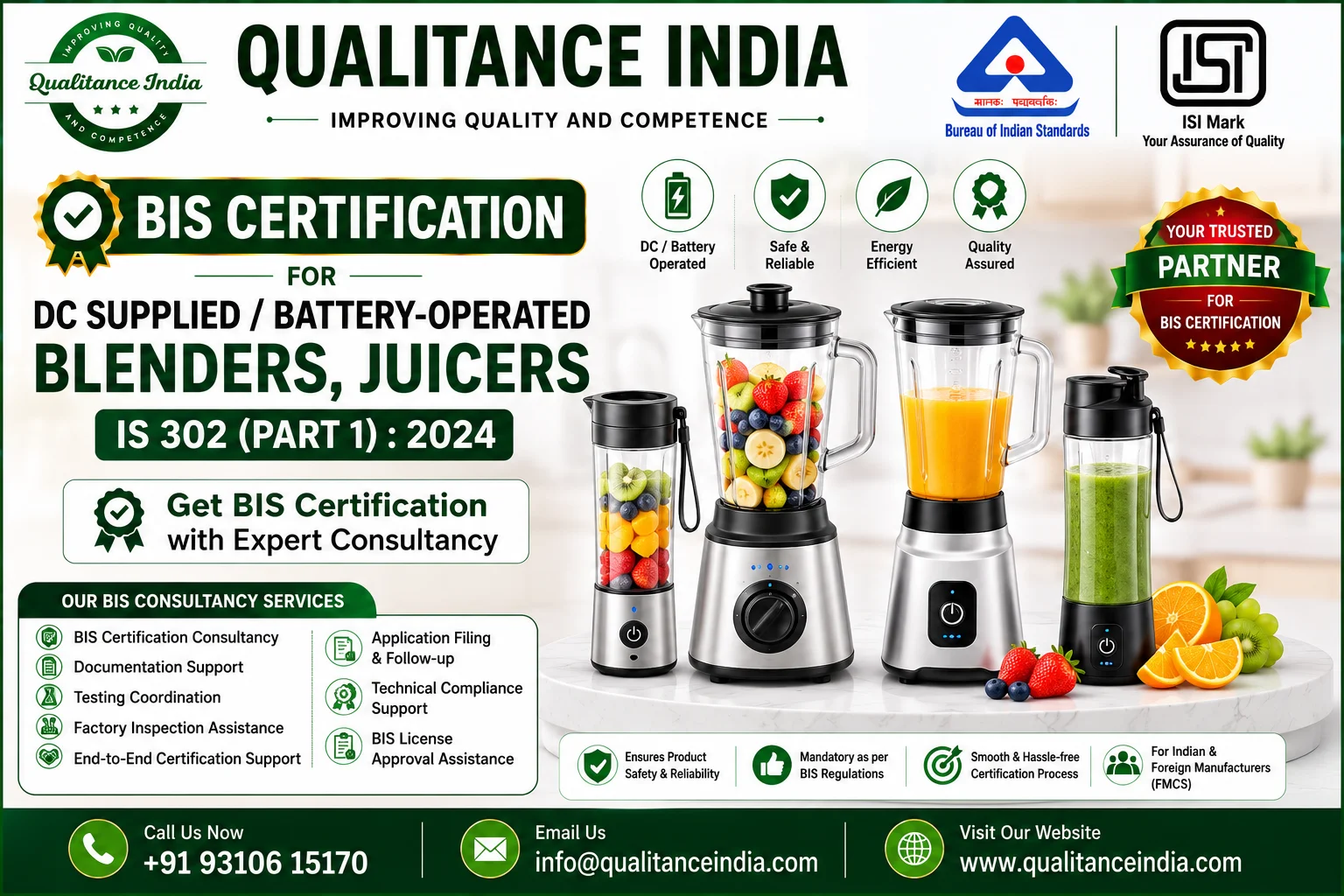
BIS Certification Consultancy for DC Supplied & Battery-Operated Blenders & Juicers under IS 302 (Part 1):2024 / IEC 60335-1:2020 – Complete Guide
Introduction
The demand for DC supplied and battery-operated blenders & juicers has increased significantly due to the popularity of portable smoothie makers, rechargeable blenders, USB-powered juicers, and compact kitchen appliances. These products combine electric motors, rechargeable batteries, and food-contact components, making electrical safety and product compliance essential.
Under the Safety of Household, Commercial and Similar Electrical Appliances Quality Control Order, a broad range of household electrical appliances—including DC supplied and battery-operated blenders and juicers—are covered by IS 302 (Part 1):2024 / IEC 60335-1:2020, subject to the applicable scope and notification. The implementation date for the general category is 01 October 2026, with separate timelines for small and micro enterprises under the notified order.
If you are an Indian manufacturer, foreign manufacturer, importer, OEM, or private label brand, early preparation for BIS Certification can help you meet regulatory requirements before the enforcement date.
Qualitance India provides complete BIS Certification consultancy, including product applicability assessment, documentation support, testing coordination, BIS application filing, and factory inspection assistance.
About the Product
DC Supplied & Battery-Operated Blenders & Juicers are portable kitchen appliances designed for blending, mixing, grinding, and preparing juices or smoothies using rechargeable batteries or direct current (DC) power sources.
These appliances are widely used in:
- Homes
- Offices
- Fitness Centers
- Travel
- Outdoor Activities
- Hotels
- Cafes
Products covered in this category may include:
- Portable Blenders
- Rechargeable Blenders
- Battery-Operated Blenders
- USB Rechargeable Blenders
- Portable Juicers
- Rechargeable Juicers
- Smoothie Makers
- Mini Blenders
- Personal Blenders
- Travel Blenders
As these appliances contain electrical components, batteries, motors, and rotating blades, they should comply with applicable electrical and mechanical safety requirements.
What is BIS Certification?
BIS (Bureau of Indian Standards) is India’s National Standards Body established under the Bureau of Indian Standards Act, 2016. BIS develops Indian Standards and operates certification schemes to help ensure product quality, safety, and conformity.
Where a product falls under a mandatory Quality Control Order (QCO), manufacturers are required to obtain a BIS licence before manufacturing, importing, or selling the product in India. Certification for products covered under IS 302 (Part 1):2024 is generally granted under Scheme-I (ISI Mark Scheme) after successful completion of the applicable certification process.
Scope of IS 302 (Part 1):2024 / IEC 60335-1:2020
IS 302 (Part 1):2024, aligned with IEC 60335-1:2020, specifies the general safety requirements for household and similar electrical appliances, including direct current (DC) supplied and battery-operated products within its scope.
The standard generally addresses:
- Protection Against Electric Shock
- Mechanical Safety
- Temperature Rise
- Leakage Current
- Insulation Resistance
- Moisture Resistance
- Battery Safety
- Charging Safety
- Fire Hazard Protection
- Construction Requirements
- Product Marking
- User Instructions
- Warning Labels
Products Covered
Examples include:
- Portable Blender
- Rechargeable Blender
- USB Blender
- Smoothie Blender
- Battery-Operated Blender
- Portable Juicer
- Rechargeable Juicer
- Mini Juicer
- Personal Blender
- Travel Blender
- Fruit Blender
- Cordless Blender
Enforcement Date
Enforcement Date: 01 October 2026
According to the notified Quality Control Order, the implementation date for general manufacturers is 01 October 2026 (with later implementation dates specified for small and micro enterprises). Manufacturers and importers should begin compliance activities well in advance to avoid delays in market access.
Applicable QCO Details
The Safety of Household, Commercial and Similar Electrical Appliances (Quality Control) Order includes DC supplied/battery-operated blenders and juicers among the listed products requiring certification under IS 302 (Part 1):2024, where applicable. The category is specifically identified in the notified list of covered appliances.
Who Needs BIS Certification?
- Indian Manufacturers
- Foreign Manufacturers
- Importers
- Brand Owners
- OEM Manufacturers
- Private Label Manufacturers
- Contract Manufacturers
- E-commerce Sellers
- Kitchen Appliance Brands
- Consumer Electronics Companies
Eligibility Criteria
Applicants should generally:
- Manufacture products covered under the applicable QCO.
- Maintain an operational manufacturing facility.
- Have appropriate quality control procedures.
- Prepare technical documentation.
- Submit products for testing through the applicable BIS process.
- Meet the requirements of the relevant BIS certification scheme.
- Cooperate with inspections and assessments where required
Need help with BIS certification for this product?
Get a free consultation from our compliance experts — we handle testing, documentation and the complete BIS process for you.
BIS Certification Readiness Checklist 2026
- Documents, testing & factory requirements in one place
- Covers ISI Mark, CRS, FMCS & Hallmarking
- Tick-box format — share it with your team