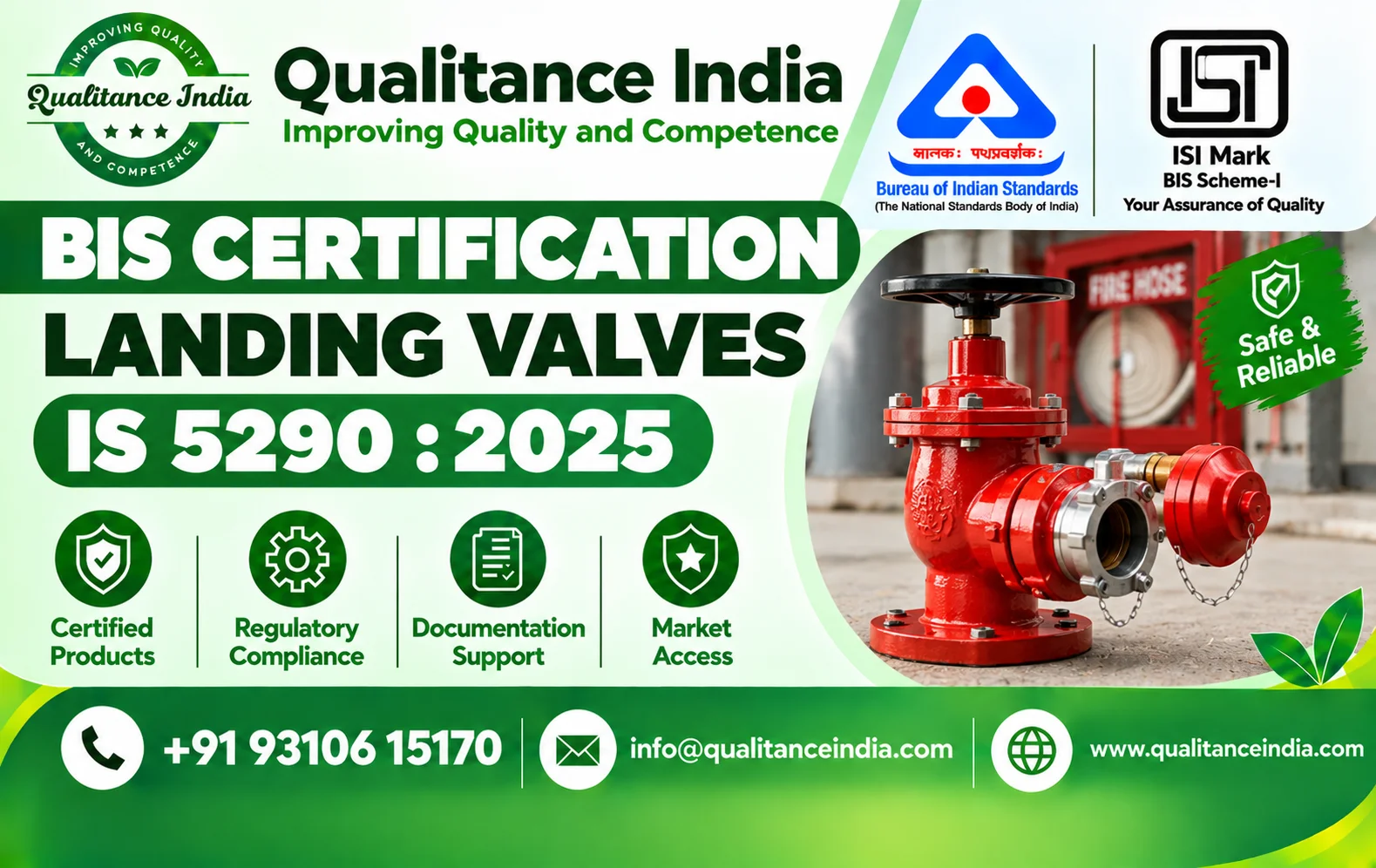
BIS Certification for Landing Valves | IS 5290:2025 | BIS Consultancy
Introduction
Landing valves are important components of fire-fighting and fire-protection systems used in buildings, industrial facilities, commercial premises and other installations where reliable access to water for fire fighting is required. Because these valves are associated with fire-fighting applications, their construction, dimensions, water tightness, pressure performance and flow characteristics need to meet defined technical requirements.
The Bureau of Indian Standards (BIS) has published IS 5290:2025 – Landing Valves – Specification (Fourth Revision). The current BIS Product Manual for this standard provides the certification framework under Scheme-I of the BIS (Conformity Assessment) Regulations, 2018.
For manufacturers looking for BIS Certification for Landing Valves, understanding the applicable product categories, material options, testing requirements, manufacturing facilities and BIS licensing procedure is important before submitting an application.
At present, BIS lists IS 5290:2025 as a voluntary certification standard. Therefore, manufacturers should distinguish between obtaining BIS certification voluntarily for demonstrating conformity and any separate mandatory requirement that may arise from a government notification, tender, project specification or other applicable regulatory requirement.
What is IS 5290:2025?
IS 5290:2025 is the Indian Standard titled “Landing Valves – Specification” and represents the fourth revision of the standard.
The BIS Standards database identifies IS 5290:2025 as a product specification under the Civil Engineering Department, with the technical committee CED 22 – Fire Fighting. The standard supersedes IS 5290:1993.
BIS has also issued a dedicated Product Manual for IS 5290:2025. The manual states that certification is operated under Scheme-I and can be used by prospective applicants as a reference for obtaining BIS certification.
Is BIS Certification Mandatory for Landing Valves?
As of the latest BIS Standards database information reviewed for this article, IS 5290:2025 is classified as “Voluntary Certification.”
This means manufacturers may obtain BIS certification to demonstrate conformity with the Indian Standard and use the BIS Standard Mark subject to the conditions of the licence.
However, buyers, government departments, consultants, project specifications, fire-safety authorities, tenders or contracts may separately require BIS-certified products. Manufacturers should therefore check the specific requirement applicable to their intended market or project.
It is also important not to confuse the current voluntary classification of IS 5290:2025 with older regulatory references to landing valves under previous standards.
BIS Certification Scheme for Landing Valves
The official BIS Product Manual for IS 5290:2025 states that certification is operated under Scheme-I of the BIS (Conformity Assessment) Regulations, 2018.
Under Scheme-I, BIS evaluates the manufacturer's ability to manufacture products conforming to the applicable Indian Standard. BIS certification involves assessment of manufacturing and testing capabilities along with product conformity evaluation.
For a manufacturer seeking an ISI Mark/BIS licence for landing valves, the application therefore needs to be supported by suitable manufacturing infrastructure, quality-control arrangements, testing facilities and product samples.
Product Scope Under IS 5290:2025
The BIS Product Manual identifies the following important varieties within the scope of IS 5290:2025.
Category of Valve
Landing valves are classified into:
- Normal Type
- Pressure Regulating Type
Type of Inlet
The Product Manual identifies:
- Flanged inlet
- Threaded inlet, applicable only for Normal Type
Material of Construction
The specified material categories include:
- Copper Alloy
- Stainless Steel
- Aluminium Alloy
The manufacturer needs to declare the varieties intended to be covered under the BIS licence.
BIS Grouping Guidelines for Landing Valves
The grouping guidelines are particularly important when planning BIS testing and applying for the desired licence scope.
According to the official Product Manual, each combination of:
- Category of valve
- Type of inlet
- Material of construction
is required to be tested to cover that particular combination within the licence scope. The manufacturer must declare the varieties intended to be included in the licence, and the final scope can be restricted according to the manufacturer's manufacturing and testing capabilities.
This means manufacturers should not assume that testing one landing valve automatically covers every category, inlet configuration and material combination.
Proper selection of the licence scope before testing can help avoid unnecessary testing and certification delays.
Sample Requirement for BIS Certification
The BIS Product Manual specifies a sample quantity of 1 valve for testing for the purpose of Grant of Licence, Change in Scope of Licence and Factory Surveillance.
The exact sample and testing requirements should always be confirmed against the latest BIS Product Manual and applicable certification instructions at the time of application.
Tests for Landing Valves as per IS 5290:2025
The Product Manual identifies several important tests and inspections for landing valves.
These include:
General Requirements
General requirements and construction-related characteristics are evaluated according to the applicable clauses of IS 5290:2025.
Construction and Dimensions
The landing valve is checked for specified constructional requirements and dimensions.
Suitable measuring equipment listed in the Product Manual includes instruments such as vernier callipers, micrometers, steel scales, measuring tapes, thread gauges and other relevant measuring equipment.
Finish
The finish of the landing valve is evaluated according to the applicable requirements of the standard.
Water Tightness Test
The stop valve is subjected to a water-tightness test to verify conformity with the applicable performance requirement.
Hydrostatic Pressure Test
A hydrostatic pressure test is carried out using suitable pressure-testing equipment and a pressure gauge.
Flow Test
The flow performance of the landing valve is evaluated using an appropriate pressure and flow measurement arrangement.
The Product Manual identifies flow meters or suitable flow-measurement arrangements and timing equipment among the relevant testing equipment.
Manufacturing and Testing Facilities Required
Manufacturers applying for BIS certification need appropriate manufacturing infrastructure and quality-control arrangements to consistently produce landing valves conforming to IS 5290:2025.
The Product Manual expects manufacturers to establish a Quality Assurance Plan covering regular testing and in-process controls to ensure that products carrying the Standard Mark conform to the Indian Standard.
The manufacturer is also expected to maintain suitable testing capabilities for routine tests.
For large-scale manufacturers, the Product Manual specifies expectations concerning in-house laboratory facilities for routine testing, along with calibration of testing equipment.
For MSME manufacturers, the Product Manual provides flexibility regarding routine in-house testing facilities. MSMEs may use common cluster facilities, shared testing facilities or suitable BIS-recognized/empanelled or NABL-accredited laboratories in accordance with the applicable BIS provisions.
Scheme of Inspection and Testing for Landing Valves
The BIS Product Manual includes a Scheme of Inspection and Testing framework for IS 5290:2025.
The manufacturer is expected to establish a Quality Assurance Plan defining the control unit and the level and frequency of testing. The recommended control unit is based on landing valves of the same category, type of inlet and material of construction manufactured during a month.
Routine product checks include requirements associated with:
- General requirements
- Construction and dimensions
- Finish
- Water tightness
- Hydrostatic pressure
- Flow performance
- Material requirements
- Marking and related requirements
The manufacturer must maintain appropriate records demonstrating conformity.
BIS Marking Requirements for Landing Valves
After the BIS licence is granted, the Standard Mark must be applied according to the conditions of the licence and the applicable requirements of IS 5290:2025.
The Product Manual states that the Standard Mark shall be clearly and permanently marked on each landing valve assembly, provided that the marked product conforms to all requirements of the specification.
The Product Manual also specifies additional marking information, including:
- Material of construction
- Reference to BIS certification details as specified in the Product Manual
BIS also requires the applicable licence number to be displayed with the Standard Mark in the prescribed manner.
BIS Testing Charges for IS 5290:2025
Testing charges depend on the laboratory, scope of testing, product configuration and applicable test parameters.
Current BIS LIMS listings show laboratories offering testing for IS 5290:2025 Landing Valves. For example, one current laboratory listing shows a testing charge of ₹23,000 excluding taxes for Normal Type landing valves, while another laboratory listing shows ₹15,000 excluding taxes for Normal Valve and Pressure Regulating Type, with certain exclusions noted.
Another current BIS LIMS listing shows ₹16,000 excluding taxes for IS 5290:2025, with separate details for material-related testing.
These figures should be treated as indicative laboratory charges rather than a fixed BIS certification cost. The final testing cost can change according to the selected laboratory, product varieties, test scope and applicable exclusions.
Documents Required for BIS Certification for Landing Valves
The exact documentation depends on the applicant and certification route, but manufacturers should generally prepare documents such as:
- BIS application details
- Manufacturer/company registration documents
- Factory address and manufacturing details
- Product technical specifications
- Product drawings
- Manufacturing process details
- List of machinery and manufacturing facilities
- List of testing equipment
- Calibration certificates for applicable equipment
- In-house laboratory details
- Details of quality-control personnel
- Raw-material details
- Product photographs
- Test reports, where applicable
- Brand/trademark documents
- Quality Assurance Plan
- Undertakings and declarations required by BIS
- Other documents requested during application scrutiny
The final checklist should be prepared according to the current BIS application requirements and the specific scope of the manufacturer.
BIS Certification Process for Landing Valves
The general process can be understood through the following stages.
Step 1: Identify the Applicable Standard
Confirm that the product falls within the scope of IS 5290:2025 and identify the required category, inlet type and material of construction.
Step 2: Determine the Required Licence Scope
Decide which combinations of valve category, inlet type and material the manufacturer wants to cover.
This is important because BIS grouping guidelines require testing of each applicable combination intended to be covered.
Step 3: Review Manufacturing Facilities
The manufacturing facility should have suitable production machinery, quality-control arrangements and testing capabilities.
Step 4: Prepare Documentation
Technical and company documents are prepared according to BIS requirements.
Step 5: Product Testing
Required product samples are tested according to IS 5290:2025 through the applicable testing route.
Step 6: Submit BIS Application
The application is submitted through the applicable BIS certification process.
BIS states that product certification applications are accepted online through its application portal.
Step 7: Factory Assessment
For Scheme-I certification, BIS assesses the manufacturing premises, production capabilities, quality-control arrangements and testing facilities.
Step 8: Sample Evaluation and Compliance
BIS evaluates the applicable inspection and test results to establish conformity with IS 5290:2025.
Step 9: Grant of BIS Licence
After satisfactory completion of the applicable certification requirements, BIS may grant the licence for the approved scope.
Step 10: Continued Compliance
After the licence is granted, the manufacturer must continue production and testing according to the applicable requirements and maintain conformity with IS 5290:2025.
BIS Certification for Foreign Manufacturers
Foreign manufacturers producing landing valves for the Indian market can also explore BIS certification through the Foreign Manufacturers Certification Scheme (FMCS), subject to the applicability of the scheme and BIS requirements.
BIS states that FMCS provides BIS licensing to foreign manufacturers for products conforming to relevant Indian Standards.
Foreign manufacturers applying under FMCS need to have appropriate manufacturing facilities, testing arrangements and competent testing personnel at the manufacturing premises. BIS also requires an Authorized Indian Representative (AIR) for the application.
BIS currently states that, from 1 June 2026, FMCS applications are accepted only through the online portal.
This makes BIS certification relevant not only to Indian landing valve manufacturers but also to overseas manufacturers planning to supply BIS-certified landing valves in India.
BIS Certification for Imported Landing Valves
Importers and overseas manufacturers should carefully distinguish their roles.
Under FMCS, the application is made by the foreign manufacturer, not by an importer applying on behalf of the foreign manufacturer. BIS specifically states that an importer cannot apply for the FMCS licence on behalf of the manufacturer.
For foreign companies manufacturing landing valves outside India, the certification strategy should therefore be planned around the manufacturing premises, applicable Indian Standard, product scope and Authorized Indian Representative requirements.
Why BIS Certification is Important for Landing Valve Manufacturers
Obtaining BIS certification for landing valves can help manufacturers demonstrate conformity with the applicable Indian Standard and provide documented evidence of product quality.
A BIS-certified landing valve can be particularly relevant when dealing with:
- Fire-safety projects
- Commercial buildings
- Industrial facilities
- Infrastructure projects
- Government procurement
- Institutional projects
- EPC contractors
- Fire-fighting system integrators
- Consultants and project specifications
- Buyers requiring ISI Mark products
Manufacturers should always verify the exact contractual or regulatory requirement applicable to a particular project.
Common Mistakes During BIS Certification
Manufacturers can face delays if they do not properly define the licence scope or prepare their factory and testing facilities.
Common issues include:
- Applying without identifying the correct product category
- Not declaring all intended valve varieties
- Incorrect selection of inlet type
- Insufficient testing equipment
- Inadequate calibration records
- Incomplete technical drawings
- Missing manufacturing process information
- Poor documentation of raw materials
- Inadequate quality-control records
- Testing only one variety when multiple combinations are intended
- Incorrect product marking
- Using outdated standard information
- Submitting incomplete BIS application documents
For IS 5290:2025, particular attention should be given to the grouping requirements because valve category, inlet type and material of construction affect the certification scope.
How Qualitance India Can Help with BIS Certification for Landing Valves
Qualitance India provides professional assistance to manufacturers seeking BIS certification and BIS licence support for products covered under Indian Standards.
For Landing Valves as per IS 5290:2025, our support can include:
- Applicable standard and scope review
- BIS certification applicability guidance
- Product scope and variety assessment
- Documentation support
- BIS application assistance
- Testing laboratory coordination
- Test report coordination
- Factory inspection preparation
- Quality-control documentation support
- BIS query response assistance
- Licence process support
- Post-application compliance guidance
- Support for Indian and eligible foreign manufacturers
Our objective is to make the BIS certification process more structured and easier for manufacturers while helping them understand the technical and documentation requirements applicable to their product.
Frequently Asked Questions
1. What is the BIS standard for Landing Valves?
The current Indian Standard is IS 5290:2025 – Landing Valves – Specification (Fourth Revision).
2. Is IS 5290:2025 mandatory?
The BIS Standards database currently classifies IS 5290:2025 under Voluntary Certification.
3. Which BIS certification scheme applies to IS 5290:2025?
The BIS Product Manual specifies certification under Scheme-I.
4. What types of landing valves are covered?
The Product Manual identifies Normal Type and Pressure Regulating Type landing valves.
5. Which inlet types are covered?
The scope includes Flanged inlet and Threaded inlet, with threaded inlet specified for Normal Type.
6. Which materials are covered under IS 5290:2025?
The Product Manual identifies Copper Alloy, Stainless Steel and Aluminium Alloy as material categories.
7. How many samples are required for BIS testing?
The Product Manual specifies one valve as the sample quantity for the relevant certification activities.
8. What tests are performed on landing valves?
Important tests include construction and dimensional checks, finish, water tightness, hydrostatic pressure and flow testing, along with applicable material and general requirements.
9. Does every type of landing valve require separate testing?
The grouping guidelines state that each combination of valve category, inlet type and material of construction intended for the licence scope is to be tested.
10. Can a manufacturer apply for only selected varieties?
Yes. The manufacturer declares the varieties intended to be covered, and the licence scope may be restricted according to manufacturing and testing capabilities.
11. Is an in-house laboratory required?
The requirements depend on the manufacturer category and applicable testing arrangements. The Product Manual provides provisions for in-house, shared, cluster-based and eligible external testing facilities.
12. Can MSMEs obtain BIS certification for landing valves?
Yes. The Product Manual contains specific provisions allowing MSME manufacturers flexibility in maintaining routine testing facilities, subject to applicable BIS conditions.
13. Can testing be done through an external laboratory?
For permitted tests, the Product Manual allows subcontracting to BIS-recognized/empanelled laboratories or laboratories having valid NABL accreditation as per IS/ISO/IEC 17025, subject to applicable requirements.
14. What is the testing cost for IS 5290:2025?
Current BIS LIMS listings show different laboratory charges, with examples around ₹15,000 to ₹23,000 excluding taxes for listed testing scopes. The actual cost depends on laboratory, scope and applicable exclusions.
15. Can foreign manufacturers obtain BIS certification for landing valves?
Eligible foreign manufacturers can apply through BIS FMCS for applicable products and Indian Standards. BIS requires the foreign manufacturer to meet manufacturing, testing and other certification requirements.
16. Is an Authorized Indian Representative required for a foreign manufacturer?
Yes. BIS FMCS application requirements include nomination of an Authorized Indian Representative.
17. Can an Indian importer apply for the foreign manufacturer's FMCS licence?
No. BIS states that the FMCS application is to be made by the foreign manufacturer and an importer cannot apply on behalf of the manufacturer.
18. Can BIS certification help in government or project procurement?
Where a tender, purchaser, consultant or project specification requires BIS certification or ISI Mark conformity, a valid BIS licence can help the manufacturer meet that specified requirement. The exact procurement condition should always be checked separately.
19. Does BIS certification remain valid automatically after obtaining the licence?
No. The manufacturer must continue complying with the applicable certification requirements, quality-control procedures and BIS licence conditions.
20. Why should manufacturers take professional BIS consultancy support?
Professional consultancy can help manufacturers understand the applicable standard, define the certification scope, prepare documentation, coordinate testing, prepare for factory assessment and respond to BIS requirements.
Conclusion
IS 5290:2025 – Landing Valves – Specification (Fourth Revision) provides the current Indian Standard requirements for landing valves, covering different valve categories, inlet configurations and materials of construction.
BIS currently classifies IS 5290:2025 as Voluntary Certification, while its Product Manual provides the certification framework under Scheme-I. Manufacturers seeking BIS certification should pay particular attention to product scope, grouping, testing, manufacturing facilities, quality assurance, marking and continued compliance.
For Indian manufacturers as well as eligible overseas manufacturers planning to supply BIS-certified landing valves in India, proper preparation can make the certification process more systematic and reduce avoidable delays.
Get BIS Certification Support for Landing Valves
Qualitance India provides end-to-end BIS certification consultancy support for manufacturers seeking certification as per applicable Indian Standards.
For assistance with BIS Certification for Landing Valves as per IS 5290:2025, contact:
Qualitance India Phone: +91-9310-615-170 Email: info@qualitanceindia.com Website: qualitanceindia.com
Speak with our BIS certification team to understand the applicable scope, testing requirements, documentation and certification process for your landing valve products.